Les marques perdent des budgets considérables lorsque leurs produits haut de gamme se retrouvent noyés sous les rayons surchargés des magasins. Si votre emballage passe inaperçu, vous perdez tout simplement l'achat impulsif. Remédions à ce problème de visibilité.
L'utilisation de présentoirs latéraux sur le lieu de vente présente plusieurs avantages : elle permet d'optimiser l'espace vertical inutilisé et de stimuler les achats impulsifs à forte marge. Grâce à un emplacement secondaire très visible, juste à côté des produits principaux, ces présentoirs suspendus augmentent considérablement la visibilité de la marque sans nécessiter d'espace au sol dédié coûteux.
S'emparer de ce petit coin de surface commerciale supplémentaire semble une excellente idée en théorie, mais comprendre comment ces structures survivent réellement dans un environnement commercial animé change tout.
Qu'est-ce qu'un écran latéral ?
Garantir un emplacement hors de l'allée principale nécessite une approche spécialisée en matière de conception structurelle.
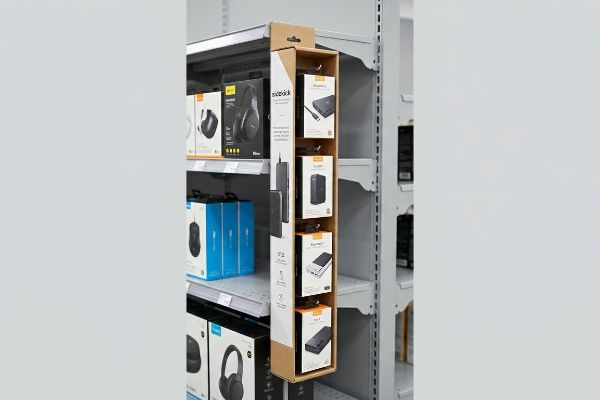
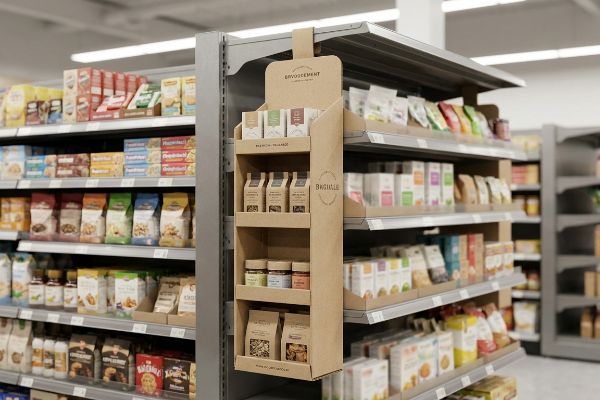
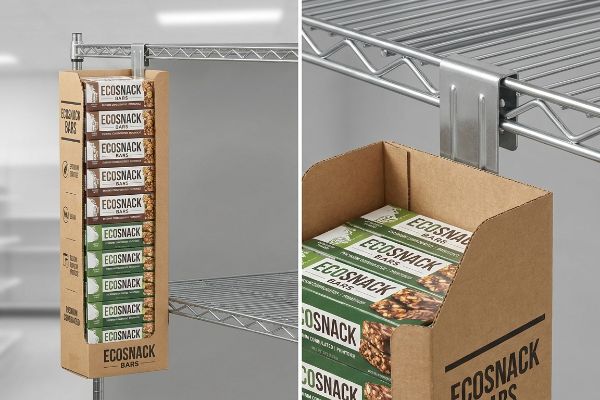
Un présentoir latéral est un présentoir vertical compact conçu pour être suspendu solidement aux éléments de mobilier ou aux têtes de gondole existants en magasin. Également appelés présentoirs d'appoint, ces présentoirs utilisent des supports métalliques universels spécifiques pour maintenir en toute sécurité les produits de grande consommation légers et à forte marge, exactement à hauteur des yeux du client.
Il est simple de savoir ce que sont ces unités, mais c'est leur conception pour qu'elles résistent aux réalités du merchandising que la plupart des marques rencontrent des difficultés.
Pourquoi le dimensionnement universel est la clé du succès des écrans Sidekick
Les graphistes considèrent souvent les présentoirs comme des toiles vierges, créant des formes et des largeurs sur mesure à partir de leurs seules illustrations. Ils supposent que les responsables de magasin trouveront simplement une solution pour intégrer les dimensions spécifiques des produits livrés. Cette approche isolée ignore complètement l' architecture rigide et standardisée des présentoirs des grandes surfaces de vente audétail¹.
La règle fondamentale est l'uniformité. Même les concepteurs les plus expérimentés oublient souvent que les présentoirs d'extrémité ont une largeur maximale de 914 mm (36 pouces). J'ai déjà vu un vendeur suer à grosses gouttes pendant vingt minutes, tentant désespérément d'installer un présentoir latéral sur mesure de 406 mm (16 pouces) de large à côté d'une étagère standard. Le grincement strident du support métallique universel contre le grillage m'a immédiatement indiqué que le présentoir était trop large, obligeant finalement le vendeur à l'abandonner dans l'arrière-boutique. Pour éviter ce refus immédiat des détaillants, je conçois tous mes présentoirs latéraux avec une largeur standardisée de 355 mm (14 pouces) et une hauteur de 1219 mm (48 pouces)², garantissant ainsi une installation universelle et sans frottement dans toutes les grandes enseignes.
| Erreurs courantes des débutants | La solution pro | Avantage du magasin |
|---|---|---|
| Largeur personnalisée supérieure à 14 pouces | Standardiser la largeur à un maximum de 14 pouces | Garantit la conformité universelle des embouts |
| Crochets en papier fragiles | Intégrer des supports métalliques universels | Empêche les déchirures et les chutes de l'écran |
| En ignorant les limites de hauteur verticale | Hauteur totale de la structure du chapeau : 48 pouces | Élimine les plaintes concernant l'encombrement des rayons |
Je refuse qu'un millimètre de carton en trop entraîne un refus en magasin. Le respect de calculs structurels éprouvés garantit que votre présentoir sera exposé en rayon plutôt que jeté directement au recyclage.
🛠️ Le bureau de Harvey : Vous vous demandez si votre nouveau présentoir à rayonnages motorisés est compatible avec les têtes de gondole standard des grandes surfaces ? 👉 Demandez une vérification de compatibilité ↗ — Accès direct à mon bureau. Zéro spam commercial automatisé, promis.
Que sont les présentoirs sur le lieu de vente ?
Au-delà des ailes suspendues, les espaces commerciaux classiques nécessitent des interventions spécifiques pour capter le flux de clients.
Les présentoirs sur le lieu de vente sont des structures marketing physiques autonomes, stratégiquement placées dans l'environnement commercial afin d'interrompre le parcours des clients. En isolant les produits des rayons d'ameublement et de décoration souvent encombrés, ces présentoirs incitent activement à des achats spontanés et accélèrent considérablement la rotation des stocks avant que le consommateur n'arrive en caisse.
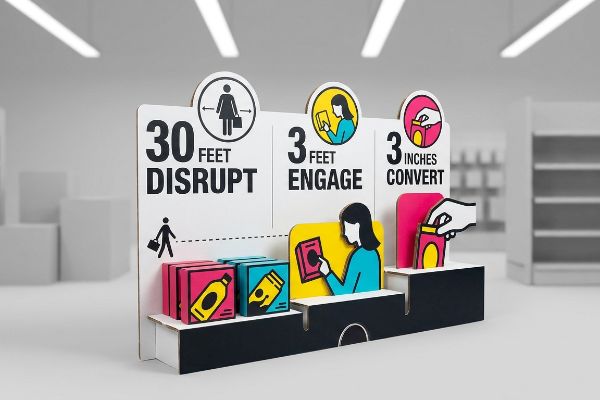
Apposer un logo sur une boîte en carton peut sembler suffisant, mais capter l'attention dans un immense entrepôt nécessite une utilisation stratégique de l'espace.
La règle 3-3-3 des présentoirs sur le lieu de vente
Les équipes marketing conçoivent souvent les présentoirs uniquement pour une visualisation rapprochée sur leurs écrans d'ordinateur haute résolution et rétroéclairés. Elles partent du principe que les clients s'arrêteront naturellement pour lire les textes de présentation de la marque, imprimés sur les panneaux latéraux. Cette approche ignore totalement la réalité du terrain et la façon dont les consommateurs, souvent distraits, circulent dans les allées bondées des magasins.
Vous devez considérer votre espace de vente comme un panneau publicitaire en bord d'autoroute, et non comme une brochure. Une question fréquente des acheteurs concerne la taille idéale de leur logo. Je leur recommande toujours la règle des 3-3-3: perturber à 9 mètres, capter l'attention à 90 cm et convertir à 7,5 cm. J'ai récemment examiné un magnifique présentoir où le client avait utilisé une typographie minuscule ; au toucher, le revêtement aqueux haut de gamme au toucher doux était luxueux, mais à seulement 3 mètres, l'ensemble se transformait en un flou invisible sous un éclairage fluorescent agressif. En remplaçant les mélanges CMJN (Cyan, Magenta, Jaune, Noir) classiques par des couleurs d'accompagnement contrastées et abondantes , nous garantissons une forte perturbation visuelle de l'ensemble du magasin, attirant immédiatement le regard des clients vers vos produits.
| Erreurs courantes des débutants | La solution pro | Avantage du magasin |
|---|---|---|
| Petit texte destiné aux écrans | Appliquer la règle spatiale 3-3-35 | Attire l'attention à 9 mètres |
| Mélanges de couleurs CMJN boueux | Utilisez des couleurs Pantone d'accompagnement inondées6 | Se distingue sous les néons |
| De longs paragraphes de texte | Utilisez des formes découpées à l'emporte-pièce audacieuses | Prévient la surcharge cognitive des consommateurs7 |
Je conçois mes présentoirs de manière à capter immédiatement le regard du consommateur, bien avant qu'il ne réalise qu'il a besoin de votre produit. Si vous échouez au test des dix mètres, le reste de votre budget marketing est complètement perdu.
🛠️ Le bureau d'Harvey : Vos œuvres d'art actuelles attirent-elles vraiment le regard à dix mètres de distance ? 👉 Obtenez un audit visuel gratuit ↗ — Téléchargement sécurisé. Ma boîte de réception reste ouverte si vous avez des questions.
Qu'est-ce qu'un exemple de présentoir sur le lieu de vente ?
Voir la théorie en pratique permet de clarifier précisément comment ces structures physiques dominent l'agencement d'un magasin.
Un exemple de présentoir sur le lieu de vente est un présentoir autoportant de type quart de palette, placé à un carrefour commercial à fort trafic. Ces unités compactes en carton ondulé renforcé mettent en valeur des produits de consommation en vrac, agissant ainsi comme une vitrine secondaire indépendante qui distingue les articles promotionnels haut de gamme des produits concurrents vendus en rayon.

Visualiser le produit final est excitant, mais obtenir l'autorisation de mettre réellement cette structure en vente au détail est une toute autre affaire.
Exploiter la géométrie fractionnaire pour l'approbation au point de vente
les marques proposent souvent aux acheteurs de la grande distribution des présentoirs de sol imposants de 1219 x 1016 mm (48 x 40 pouces)qu'une surface de présentation plus importante se traduit automatiquement par des ventes plus rapides et une présence de marque renforcée. Or, cette approche binaire empêche les lancements plus modestes d'obtenir un emplacement privilégié dans les rayons, souvent très concurrentiels.
L'espace commercial est traité comme un bien immobilier de grande valeur, et les directeurs de grandes surfaces optimisent chaque mètre carré avec une extrême rigueur. Une règle d'or consiste à subdiviser mathématiquement votre stratégie avant de la présenter. J'ai vu un jour un fondateur de marque peiner à expliquer pourquoi son présentoir imposant bloquait un passage piéton, tandis que le responsable du magasin répétait bruyamment le bruit du bloc-notes du gérant heurtant le présentoir, exigeant aussitôt son déplacement contre le mur du fond. Plutôt que de me battre pour un espace démesuré, je conçois des présentoirs aux dimensions fractionnaires standard, comme des quarts de palette de 609 × 508 mm (24 × 20 pouces) . Cette géométrie précise permet à votre campagne promotionnelle d'occuper harmonieusement l'espace sur une seule base en bois, augmentant considérablement vos chances d'approbation et optimisant votre efficacité spatiale.
| Erreurs courantes des débutants | La solution pro | Avantage du magasin |
|---|---|---|
| Déchargement de palettes complètes surdimensionnées | Pas 24×20 pouces unités fractionnaires10 | Augmente considérablement l'approbation des acheteurs |
| Ignorer les soldes des rayons en magasin | Subdivision mathématique de l'espace | Empêche les unités de bloquer les chariots |
| Surpaiement des terrains à bâtir | Partage de socles en bois standard11 | Optimise la densité globale de marchandisage |
Je ne laisse jamais un aménagement trop imposant compromettre une présentation commerciale. En adaptant parfaitement la géométrie de votre présentoir à l'espace restreint du magasin, vous transformez un refus probable en une approbation rapide.
🛠️ Le bureau de Harvey : Vos présentoirs actuels occupent-ils trop d’espace commercial coûteux ? 👉 Demandez votre plan de réduction structurelle ↗ — Pas de formulaires qui déclenchent des appels commerciaux incessants. Uniquement de la valeur.
Quel est l'objectif d'un présentoir sur le lieu de vente ?
Tandis que les présentoirs en milieu d'allée attirent l'attention, le merchandising en zone de caisse remplit une fonction de conversion finale très spécifique.
L'objectif d'un présentoir sur le lieu de vente est de capter les achats impulsifs de dernière minute, précisément là où le consommateur effectue sa transaction. Placés directement sur le comptoir de caisse, ces présentoirs compacts tirent parti du temps passé par le client en magasin pour stimuler les ventes immédiates d'articles à faible coût et à forte marge, avant même le paiement.
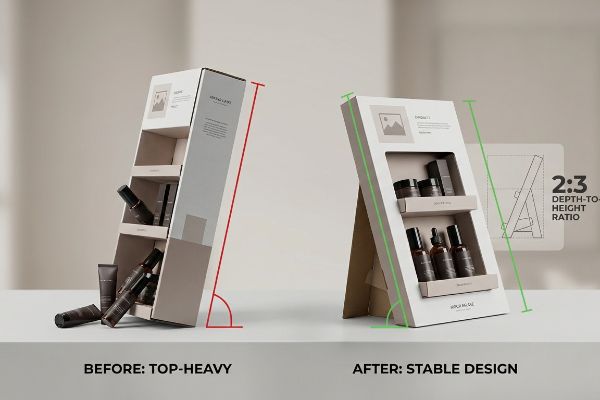
Mais connaître la théorie ne suffit pas lorsque les machines se mettent en marche et que des marchandises lourdes sont chargées dans ces minuscules espaces de comptoir.
Pourquoi les présentoirs de point de vente standard se renversent-ils ?
Les équipes d'approvisionnement conçoivent souvent des présentoirs de comptoir compacts en privilégiant l'optimisation de la capacité de stockage dans un espace réduit. Elles partent du principe que si le présentoir se place simplement à côté de la caisse, il fonctionnera parfaitement aux heures de pointe. Il en résulte des structures hautes et déséquilibrées, sans aucun calcul préalable du centre de gravité¹² .
Faire tenir un présentoir vide en laboratoire est facile, mais la réalité est tout autre lorsqu'il s'agit d'en expédier 500 remplis de produits cosmétiques lourds. Dans mon atelier, je constate régulièrement que les gabarits de découpe ne tiennent absolument pas compte des contraintes physiques. Lors de nos tests de charge initiaux en usine, si le présentoir ne respecte pas le strict rapport profondeur/hauteur de 2: 3¹³ , c'est la catastrophe. J'ai déjà entendu le bruit sec et soudain d'un présentoir chargé qui bascule sous le poids statique de 1,9 kg¹⁴ , répandant des rouges à lèvres coûteux sur la table de test. Pour éviter cela, j'impose mathématiquement le rapport 2:3 et j'intègre un faux fond dissimulé ou un support prolongé dans le fichier CAO (Conception Assistée par Ordinateur). En garantissant cette tolérance du centre de gravité, je m'assure de la parfaite stabilité de la structure, évitant ainsi les déversements en caisse et éliminant tout risque de remboursement par les détaillants.
| Erreurs courantes des débutants | La solution pro | Avantage du magasin |
|---|---|---|
| Empreinte au sol déséquilibrée vers le haut | Respectez le rapport profondeur/hauteur de 2:315 | Empêche le basculement et les déversements de produits |
| En ignorant les calculs du centre de gravité | Concevoir un chevalet allongé à l'arrière16 | Garantit une stabilité absolue du processus de paiement |
| Test des unités vides | Appliquer des essais de charge statique lourde17 | Élimine les rétrofacturations des détaillants après le lancement |
Je ne compte pas sur la chance pour que vos produits restent debout près de la caisse. Seule une structure solide garantit que vos articles à forte marge résistent à l'affluence des caisses.
🛠️ Bureau Harvey : Vos caisses enregistreuses ne respectent-elles pas le ratio profondeur/hauteur de 2:3 ? 👉 Envoyez-moi votre fichier de gabarit ↗ — Je vérifierai la robustesse des calculs avant que vous n’investissiez dans une production de masse.
Conclusion
Vous pouvez choisir un fournisseur moins cher pour vos présentoirs de caisse, mais si une structure trop lourde se renverse et éparpille les produits cosmétiques dans une allée de caisse très fréquentée, cela engendre d'importantes difficultés opérationnelles et provoque un refus immédiat de la part du détaillant. Voici la fiche technique exacte que mes 10 principaux clients du secteur de la vente au détail utilisent pour garantir zéro refus d'impression. Ne vous laissez plus guider par les lois de la physique et laissez-moi stabiliser personnellement vos fichiers de structure grâce à mon audit gratuit de gabarit ↗ avant qu'une mise en page fragile ne compromette la rentabilité de votre campagne.
« Comptoir de vente pour grandes surfaces : des options polyvalentes et durables – DisplayMax », https://displaymaxinc.com/big-box-sales-counter-2/. [Une norme industrielle ou un guide du fabricant d’agencements de vente au détail fournirait les dimensions spécifiques et les exigences de compatibilité des supports pour les systèmes d’étagères pour grandes surfaces]. Rôle de la preuve : vérification technique ; type de source : norme industrielle. Appuie : l’affirmation selon laquelle les agencements de vente au détail respectent des normes dimensionnelles strictes. Remarque : les normes peuvent varier légèrement d’un détaillant à l’autre, mais suivent les normes générales de l’industrie .
« Panneau latéral rigide 14×48 – Angola Wire Products, Inc. », https://www.shopangolawire.com/Wire-Sidekick-Panel-p/c-skr1448.htm . [Les normes de merchandising pour les présentoirs à bras articulés et les présentoirs latéraux utilisent généralement ces dimensions afin d'assurer la compatibilité avec les supports universels]. Rôle de la preuve : Spécification technique ; type de source : Guide de merchandising. Compatibilité : Universelle pour les présentoirs latéraux. Remarque: Les dimensions peuvent varier pour les produits robustes.
« La règle des 3-3-3 en marketing : ce que vous devez savoir – Display Wizard », https://www.displaywizard.co.uk/3-3-3-rule-in-marketing/ . [Un guide de merchandising ou un manuel de marketing de référence validerait les seuils de distance spécifiques pour capter l’attention, engager et convertir les consommateurs]. Niveau de preuve : définition technique ; type de source : manuel sectoriel. Appui : stratégie d’ engagement spatial. Remarque : les mesures de distance peuvent varier en fonction de la largeur moyenne des allées de magasin.
« CMJN vs. Couleurs d'accompagnement dans l'impression d'emballages », https://meyers.com/meyers-blog/cmyk-vs-spot-colors-in-packaging-printing-what-cpg-brands-need-to-know/ . [Les spécifications techniques d'impression et les recherches en théorie des couleurs démontrent que les couleurs d'accompagnement offrent une saturation et un impact visuel supérieurs aux mélanges quadrichromiques CMJN]. Preuve : spécification technique ; source : norme de l'industrie de l' imprimerie. Appui : efficacité de rupture visuelle. Remarque : s'applique spécifiquement aux supports imprimés physiques.
« Comment améliorer la visibilité en point de vente grâce aux présentoirs », https://www.industrialpackaging.com/blog/increased-retail-visibility. Les normes de conception des points de vente expliquent comment la règle 3-3-3 optimise la distance de visibilité et la durée d'attention pour capter l'attention des clients de loin. Preuve : spécification technique ; type de source : guide de conception des points de vente. Constat : l'efficacité de la règle 3-3-3. Remarque : les résultats peuvent varier en fonction de la largeur des allées et de la hauteur sous plafond .
« Couleurs d'impression d'emballage : CMJN vs Pantone… », https://sldpacking.com/blog/packaging-printing-colors-101-cmyk-vs-pantone-spot-colors-explained/ . Les normes de l'industrie de l'impression démontrent que les couleurs d'accompagnement conservent une saturation et une homogénéité chromatique supérieures sous un éclairage fluorescent artificiel par rapport aux mélanges CMJN. Preuve : spécification technique ; source : manuel d'impression. Convient à : l'utilisation des couleurs d'accompagnement pour les présentoirs de vente au détail. Remarque: s'applique spécifiquement à l'impression physique sur support.
« [PDF] Conception de magasins : complexité visuelle et réactions des consommateurs », http://yoon.human.cornell.edu/research/Jang_et_al-2018-IJD.pdf. Les recherches psychologiques sur le comportement du consommateur indiquent que le remplacement d'un texte dense par des repères visuels percutants réduit l'effort de traitement mental requis des acheteurs. Type de preuve : allégation comportementale ; type de source : revue académique. Arguments : avantage des formes découpées par rapport au texte. Remarque sur la portée : particulièrement applicable aux zones à fort trafic et aux achats impulsifs .
« Types de présentoirs sur palette : pleine, demi et quart », https://greendotpackaging.com/understanding-pallet-display-types-full-half-and-quarter-pallet-displays/. [Les manuels de logistique et de merchandising du secteur confirment que 48 × 40 pouces est la dimension standard pour les présentoirs sur palette pleine grandeur dans le commerce de détail nord-américain]. Rôle de la preuve : spécification technique ; type de source : norme industrielle ; Supporte : dimensions standard pour les présentoirs de sol ; Remarque sur la portée : s’applique principalement aux normes d’expédition et de vente au détail nord-américaines .
« Dimensions standard des palettes | Avec tableau – Kamps Pallets », https://www.kampspallets.com/standard-pallet-sizes-with-chart/. [Les normes industrielles en matière de logistique et de merchandising définissent généralement l'encombrement au sol des quarts de palette afin d'optimiser l'espace et la compatibilité avec les palettes standard]. Niveau de preuve : spécification technique ; type de source : norme industrielle. Supporte : dimensions standard pour les présentoirs à palettes fractionnées. Remarque : les dimensions peuvent varier selon les normes régionales de palettes telles que GMA ou ISO .
« Guide complet des présentoirs de point de vente pour les magasins de détail », https://colorreflections.com/digital-printing-news/the-complete-guide-to-point-of-purchase-displays-for-retail-stores/ . [Un guide de conception pour le commerce de détail ou un manuel fournisseur permettrait de vérifier si les présentoirs de 24 × 20 pouces constituent une norme reconnue pour optimiser l'acceptation par les acheteurs dans les espaces restreints]. Type de preuve : spécification technique ; type de source : manuel de référence du secteur. Sujets abordés : dimensions optimales des présentoirs de point de vente. Remarque : Spécifique aux surfaces de vente fractionnées.
« Expédition d'un présentoir quart de palette entièrement équipé – PopDisplay », https://popdisplay.me/shipping-a-quarter-pallet-display-fully-kitted/ . [Les publications spécialisées en logistique de détail confirment que l'utilisation de socles modulaires en bois partagés optimise la densité de marchandisage et réduit les coûts immobiliers]. Rôle de la preuve : meilleure pratique opérationnelle ; type de source : publication spécialisée. Appui : rentabilité de l'espace de vente. Note de portée : s'applique aux systèmes de point de vente sur palettes.
« CONCEPTION STRUCTURELLE DES PRÉSENTOIRS POUR LE COMMERCE DE DÉTAIL INTERACTIF… », https://www.bcipkg.com/display-structural-design-for-interactive-retail-displays/. [Un manuel d'ingénierie ou un guide de conception pour le commerce de détail démontrerait comment l'absence de calcul du centre de gravité dans les présentoirs à base étroite entraîne une instabilité physique et un risque de basculement]. Rôle de la preuve : vérification technique ; type de source : manuel d'ingénierie. Appuie : le lien de causalité entre des calculs de conception erronés et l'instabilité structurelle. Note de portée : s'applique spécifiquement aux présentoirs compacts pour points de vente .
« Comment choisir la hauteur de votre présentoir ? – PopDisplay », https://popdisplay.me/how-to-choose-your-retail-display-height/ . [Les normes d’ingénierie structurelle pour les présentoirs autoportants définissent des rapports profondeur/hauteur spécifiques afin de maintenir le centre de gravité et d’éviter tout basculement]. Niveau de preuve : spécification technique ; type de source : manuel d’ingénierie. Justifie : exigences de stabilité. Remarque : s’applique spécifiquement aux matériaux PLV compacts et légers.
« [PDF] Manuel NIST 44-2026 : Spécifications, tolérances et autres… », https://nvlpubs.nist.gov/nistpubs/hb/2026/NIST.HB.44-2026.pdf . [Les protocoles de contrôle qualité de l’industrie spécifient des charges statiques standard pour valider l’intégrité structurelle des présentoirs de caisse de petit format]. Rôle de la preuve : vérification métrique ; type de source : norme de contrôle qualité. Supporte : les bancs d’ essai de charge. Remarque : les charges d’essai sont généralement adaptées à la catégorie de produit visée.
« Meilleures pratiques en matière de PLV et d'affichage sur le lieu de vente – TPH Global Solutions », https://www.tphinc.com/custom-point-of-purchase-pop-pos-retail-store-displays-packaging-blog/retail-pos-pop-display-best-practices/ . [Un guide de conception ou d'ingénierie industrielle faisant autorité dans le domaine du commerce de détail fournit le ratio mathématique nécessaire pour garantir la stabilité du centre de gravité des présentoirs de comptoir]. Niveau de preuve : spécification technique ; type de source : norme industrielle. Objectif : prévention du basculement. Remarque: s'applique principalement aux présentoirs de comptoir de petite taille.
« Comment créer un présentoir en carton personnalisable ? – PopDisplay », https://popdisplay.me/how-to-customizable-cardboard-display-2/ . [Les principes de génie mécanique relatifs à la stabilité et à l’effet de levier démontrent comment l’extension de la base ou du chevalet déplace le centre de gravité pour éviter le basculement ] . Preuve : solution technique ; type de source : manuel d’ingénierie. Arguments : stabilité structurelle. Précision : spécifique aux présentoirs sur chevalet.
« Quand utiliser des présentoirs de point de vente (PLV) ou des présentoirs PLV ? », https://popdisplay.me/when-to-use-pos-vs-pop-display-stands/ . [Les normes d’assurance qualité pour les présentoirs de vente au détail exigent des tests de charge statique afin de prévenir les défaillances structurelles et les sanctions financières qui en découlent pour les détaillants]. Rôle de la preuve : procédure de contrôle qualité ; type de source : guide de fabrication. Objectif : atténuation des risques. Note sur la portée : axé sur la fiabilité après lancement.