
Vous avez du mal à vous faire remarquer dans les rayons bondés ? Les présentoirs mal conçus gaspillent de l’espace et réduisent vos marges. Confiez-nous la création de présentoirs qui captent réellement l’attention des clients.
Les présentoirs de rayon sont des structures d'emballage secondaires conçues pour organiser, protéger et mettre en valeur les produits directement sur les gondoles des détaillants. Ils optimisent l'espace limité des allées, garantissent une visibilité maximale des produits et une conformité structurelle stricte aux normes de vente au détail, ce qui favorise les achats impulsifs et réduit les contraintes liées au réapprovisionnement en magasin, quel que soit le canal de distribution.

Comprendre la théorie ne représente que la moitié du chemin ; savoir comment ces structures en carton se comportent dans des conditions physiques difficiles au sein de la chaîne d'approvisionnement est ce qui protège réellement les résultats de votre marque.
Quelles sont les six règles d'affichage ?
Réussir l'agencement de votre point de vente ne consiste pas à deviner ; cela nécessite un cadre spatial strict pour capter l'attention des clients distraits avant qu'ils ne passent devant votre rayon.
Les six règles d'affichage définissent la visibilité structurelle et l'attractivité spatiale. Elles exigent d'attirer l'attention des clients à 9 mètres, 90 centimètres et 7,5 centimètres, de maximiser la visibilité des produits, de garantir une accessibilité conforme à la loi américaine sur les personnes handicapées (ADA), de regrouper les produits par nombre impair, de placer les articles lourds sur les étagères inférieures et d'afficher clairement les prix.
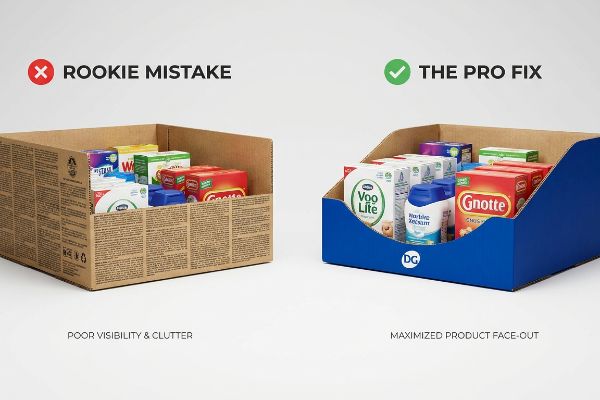
Ces règles sonnent bien en salle de réunion, mais c'est lors de leur mise en œuvre concrète que la plupart des campagnes échouent.
Le cadre d'engagement spatial 3-3-3
Les équipes marketing juniors conçoivent souvent des présentoirs pour les points de vente uniquement pour une visualisation rapprochée sur des écrans d'ordinateur rétroéclairés. Elles partent du principe qu'un logo net à l'écran attirera naturellement les clients dans les grandes surfaces. Il en résulte des présentations plates et surchargées de texte, qui ignorent complètement la réalité du comportement des consommateurs dans les allées des magasins.
Je constate régulièrement que les marques impriment leurs messages marketing saisonniers directement sur les présentoirs de rayon. En magasin, ces supports surchargés de texte créent instantanément un encombrement visuel. Les clients pressés ne peuvent pas assimiler autant d'informations et finissent par ignorer complètement le présentoir. La solution ? Réduire drastiquement le visuel à un seul point focal à fort contraste, visible à plus de 9 mètres. Nous concevons le rebord avant pour garantir une excellente visibilité du produit et favoriser ainsi l'achat impulsif. En supprimant les textes secondaires et en maximisant la surface exposée du produit, vous créez une expérience d'achat fluide et augmentez considérablement les achats impulsifs.
| Erreurs courantes des débutants | La solution pro | Avantage du magasin |
|---|---|---|
| Impression de paragraphes de texte sur la lèvre avant | Couleur Pantone unie | Attire l'attention à 9 mètres1 |
| lèvres à haute tenue dissimulant le produit | Découpe en forme de V pour une visibilité de 85 %2 | Augmente les conversions finales de 3 pouces3 |
| Conception exclusivement destinée aux écrans plats 2D | points focaux de découpe structurelle 3D | Élimine la surcharge cognitive du consommateur |
En mettant en place une stratégie d'engagement spatial rigoureuse, vos supports cartonnés agissent comme de véritables vendeurs silencieux. Oubliez les textes confus qui dissimulent vos produits ; misez plutôt sur une mise en valeur visuelle percutante.
🛠️ Le bureau d'Harvey : Vous vous demandez si votre logo principal est bien visible sur votre lèvre avant ? 👉 Demandez un audit de votre découpe ↗ — Accès direct à mon bureau. Zéro spam commercial automatisé, promis.
Les étagères flottantes seront-elles démodées en 2026 ?
L'esthétique des espaces de vente évolue rapidement, mais l'efficacité structurelle reste toujours d'actualité. Le débat autour des cloisons amovibles occulte souvent les réalités logistiques.
Non. Les étagères flottantes ne sont pas démodées, mais leur conception a évolué vers des séparateurs flottants modulaires. Les environnements de vente au détail modernes exigent une flexibilité extrême en matière de référencement (unité de gestion des stocks), remplaçant les étagères horizontales collées de façon permanente par des plateformes flottantes réglables et emboîtables qui s'adaptent instantanément aux dimensions changeantes des produits sans nécessiter de nouveaux présentoirs.

Bien que l'esthétique flottante reste populaire, la manière dont vous ancrez ces plateformes temporaires déterminera si votre produit brille ou s'écrase au sol.
L'évolution de la stratégie de séparation modulaire
De nombreux acheteurs exigent encore des étagères rigides et collées de façon permanente pour leurs têtes de gondole, partant du principe qu'une construction rigide est synonyme de meilleure qualité. Ils se retrouvent ainsi limités à une seule hauteur de produit ; si la marque lance une bouteille plus haute le trimestre suivant, l' ensemble du présentoir devient obsolète et doit être mis aurebut.
Je vois souvent des clients paniquer lorsqu'un nouvel article promotionnel ne rentre pas dans leurs rayons permanents précommandés. C'est un piège courant en matière de stratégie de vente au détail, même pour les équipes d'approvisionnement les plus expérimentées. Elles finissent par forcer les boîtes dans des espaces trop petits, ce qui nuit à la présentation. La meilleure solution consiste à utiliser des séparateurs flottants ou modulaires emboîtables⁵.Ces éléments structurels astucieux se glissent facilement dans des fentes latérales réglables. Ce simple changement stratégique permet d'ajuster la hauteur des étagères instantanément, évitant ainsi à la marque de commander de nouveaux rayons et réduisant considérablement l'obsolescence des présentoirs lorsque les dimensions des produits changentsaisons⁶.
| Erreurs courantes des débutants | La solution pro | Avantage du magasin |
|---|---|---|
| Étagères rigides collées de façon permanente | Cloisons flottantes modulaires emboîtables | Permet des modifications immédiates des dimensions des UGS |
| Jeter les présentoirs lorsque les produits changent | Fentes latérales réglables standardisées | Prolonge la durée de vie utile de l'écran |
| Déchirer le panneau pour forcer les produits à entrer | Dégagement vertical calculé mathématiquement | Réapprovisionnement sans friction en magasin |
Concevoir des présentoirs adaptés à l'imprévu prolonge leur durée de vie. En abandonnant la colle permanente au profit de plateformes flottantes modulaires, les marques bénéficient d'une flexibilité optimale pour adapter leurs stratégies de merchandising sans avoir à lancer de nouvelles productions.
🛠️ Bureau Harvey : Vos présentoirs actuels vous contraignent-ils à n’afficher qu’une seule taille de produit ? 👉 Demandez une refonte modulaire ↗ — Téléchargement sécurisé. Ma boîte de réception reste ouverte si vous avez des questions.
Quelle est la règle du triangle pour les étagères ?
Le merchandising visuel est fortement influencé par la psychologie. Bien agencer les produits en rayon nécessite de créer des points focaux qui guident naturellement le regard.
La règle du triangle pour les rayons préconise une disposition asymétrique, en forme de pyramide. Cette stratégie visuelle place le produit le plus haut ou le plus important au sommet, et les articles plus bas sont disposés en cascade vers le bas. Cette disposition crée une tension visuelle et incite les clients pressés à parcourir l'ensemble du rayon.

Connaître l'esthétique du triangle est utile, mais concevoir un plateau en carton qui oblige réellement les vendeurs à respecter cette disposition est un tout autre défi.
Application de la règle d'asymétrie 3-5-7
Les jeunes designers s'efforcent souvent de disposer à plat une grille dense et parfaitement symétrique de produits sur une seule étagère. Ils partent du principe que maximiser la densité de produits dans un espace réduit génère forcément un volume de ventes plus important.
Le problème des agencements parfaitement symétriques est la monotonie visuelle qu'ils engendrent, incitant les clients à passer devant sans s'arrêter. De plus, cette symétrie excessive provoque d'importantes difficultés de rangement lors des réassorts. Les employés peinent à placer les articles étroits sur un plateau, faute d'espace. Les responsables merchandising devraient privilégier la règle 3-5-7en utilisant des séparateurs internes dédiés qui regroupent naturellement les produits en ensembles asymétriques et impairs. Cet espacement structurel intégré crée l'espace physique optimal entre les articles. Un tel agencement génère la tension visuelle et psychologique nécessaire, tout en fluidifiant considérablement le réassort en magasin et en accélérant le respect des normes de présentation .
| Erreurs courantes des débutants | La solution pro | Avantage du magasin |
|---|---|---|
| Agencements en grille symétriques et surchargés | Groupes de produits impairs 3-5-7 | Crée une tension visuelle psychologique |
| Aucun dégagement physique entre les articles | Entretoises structurelles intégrées de 0,25 pouce | Élimine les déchirures des lèvres de rétention |
| S'appuyer sur les employés pour organiser les présentoirs | Séparateurs internes modulaires intégrés | Garantit un merchandising visuel parfait |
Le merchandising ne doit jamais être laissé au hasard. L'intégration directe de la règle du triangle dans le gabarit structurel garantit une disposition parfaitement asymétrique tout en protégeant efficacement contre les réapprovisionnements agressifs.
🛠️ Le bureau de Harvey : Votre agencement de produits trop dense vous cause-t-il des crises de nerfs en magasin ? 👉 Demandez votre guide d’espacement structurel ↗ — Pas de formulaires qui déclenchent des appels commerciaux interminables. Uniquement de la valeur ajoutée.
Quels sont les quatre types d'écrans de base ?
Pénétrer le marché de détail implique de choisir le bon support pour votre produit. Le choix d'une structure adaptée est déterminant pour la réussite logistique de votre campagne.
Les quatre types de présentoirs de base comprennent les présentoirs de sol, les présentoirs de comptoir, les présentoirs sur palette et les présentoirs d'étagère. Chaque structure physique est destinée à une zone de marchandisage spécifique, allant des imposants présentoirs de tête de gondole conçus pour générer un volume important de ventes aux présentoirs de caisse compacts, optimisés pour les achats impulsifs à forte marge dans différents rayons concurrentiels.
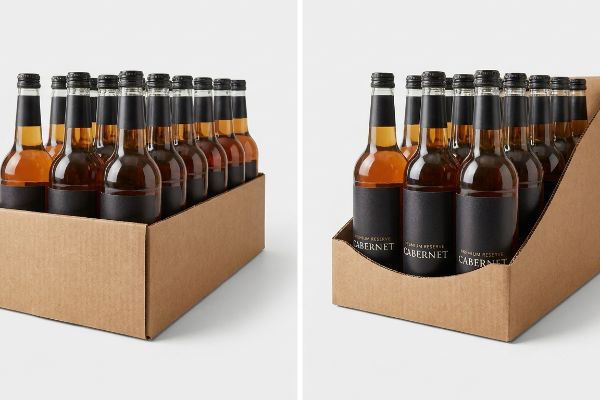
Faire tenir debout un présentoir de base en laboratoire est facile, mais voici la dure réalité lorsqu'on en expédie 500 dans un environnement de vente au détail fortement réglementé.
Le piège de l'obscurcissement des étiquettes dans les emballages de rayon
Les équipes d'approvisionnement achètent souvent des modèles de plateaux génériques prêts à l'emploi pour économiser sur les coûts initiaux d'outillage structurel8.Elles supposent que si un plateau maintient simplement le produit à la verticale et s'adapte à la profondeur de la gondole, la fonction principale de l' emballage prêt pour la vente au détail a été remplie avec succès.
Dans mon atelier, je reçois régulièrement ces modèles génériques de plateaux de rayonnage de marques de boissons et de cosmétiques haut de gamme . Le défaut de conception est majeur : les rebords de maintien avant de ces plateaux sont souvent trop hauts. Lorsque je mesure la bouteille à l'intérieur du plateau, ce rebord ondulé à coupe droite masque complètement les mentions légales essentielles et l'élément principal de l'identité de marque. Si une marque de vin dépend de la règle des 75 % de la TTB (Alcohol and Tobacco Tax and Trade Bureau) concernant le cépage , masquer ce texte entraîne une non-conformité immédiate. Je résous ce problème en important directement le tracé exact de l'étiquette de la bouteille dans mon logiciel de CAO (Conception Assistée par Ordinateur). Je conçois ensuite mathématiquement le rebord de maintien du plateau avec une découpe personnalisée, abaissant ainsi le rebord avant de 29,2 mm (1,15 pouce) précisément. Ce micro-ajustement garantit une visibilité parfaite de l'indication du cépage, assurant une réception conforme à la réglementation et évitant les refus catastrophiques en magasin.
| Erreurs courantes des débutants | La solution pro | Avantage du magasin |
|---|---|---|
| Utilisation de lèvres avant génériques à coupe droite | Découpe personnalisée en forme de courbe associée aux étiquettes | Maintient une visibilité de marque à 100 % |
| Blocage du texte de conformité légale obligatoire | cartographie des dégagements d'étiquettes des logiciels de CAO10 | Empêche les rétrofacturations massives des détaillants11 |
| En supposant que tous les produits s'adaptent aux plateaux standard | Ingénierie autour de la bouteille physique | Élimine les frictions liées au merchandising visuel |
Un étiquetage précis du produit fait toute la différence entre un lancement réussi et un échec commercial. Évitez les emballages génériques qui compromettent la conformité légale de votre marque ou sa visibilité en rayon.
🛠️ Le bureau de Harvey : Savez-vous précisément où le rebord de votre plateau d'étagère actuel croise l'étiquette principale de votre produit ? 👉 Envoyez-moi votre fichier de gabarit ↗ — Je vérifierai les calculs avant que vous n'investissiez dans une production de masse.
Conclusion
Vous pouvez choisir un fournisseur moins cher pour vos plateaux de rayonnage standard, mais si un rebord de retenue masque le texte de conformité obligatoire, cela entraîne un refus immédiat du détaillant, anéantissant ainsi la marge bénéficiaire de votre projet. Voici la fiche technique exacte utilisée par mes 10 principaux clients du secteur de la distribution pour garantir zéro refus d'impression. Cessez de prendre des risques avec des modèles génériques et laissez-moi optimiser vos calculs d'emballage grâce à mon audit de découpe gratuit ↗ afin de détecter les erreurs de visibilité critiques avant le lancement de la production en série.
« Conception d'éclairage pour les commerces : 7 conseils pour améliorer l'expérience client », https://www.alconlighting.com/blog/lighting-design/best-retail-lighting-application-lighting-practices/?srsltid=AfmBOorhE3B5ps4w88iQbzcy9IyCPhmHNfhahzSHmGuG_qNsUQgQUdxx . [Les normes du secteur en matière de merchandising visuel et de psychologie des couleurs confirment l'efficacité des couleurs d'accentuation à fort contraste pour attirer les clients éloignés] . Type de preuve : spécification technique ; source : guide sectoriel. Données : indicateurs de visibilité. Remarque : la distance peut varier selon l'éclairage du magasin.
« Gabarit de découpe des boîtes d'affichage : dimensions, tailles et modèle – BoxesGen », https://boxesgen.com/dieline-of-display-box-dimensions-sizes-template/?srsltid=AfmBOopeXAd8FjiEscwZ3CiXxdOLxDr0gBJQNcNnYgNTISRpZ9evwLzw . [Les spécifications techniques des présentoirs sur le lieu de vente (PLV) quantifient l'amélioration de la visibilité des produits obtenue grâce à des découpes structurelles spécifiques]. Rôle de la preuve : métrique technique ; type de source : spécification de conception. Supporte : l'exposition du produit. Remarque sur la portée : s'applique aux agencements de rayon standard.
« Comment la psychologie du consommateur et les données vont booster vos conversions… », https://www.youtube.com/watch?v=pDYfTjIjzmo . [Des études sur le comportement du consommateur concernant la distance physique finale entre l’acheteur et le produit établissent une corrélation entre une meilleure accessibilité et des taux de conversion plus élevés ] . Type de preuve : indicateur comportemental ; source : étude évaluée par des pairs. Appui : optimisation des conversions. Précision : axée sur les points de contact physiques.
« Perspectives du marché des rayonnages de vente au détail 2026-2034 », https://www.intelmarketresearch.com/retail-shelvingracks-market-30119 . [Des études sectorielles sur la logistique de vente au détail fourniraient des données sur la fréquence de remplacement des présentoirs à hauteur fixe par rapport aux présentoirs modulaires en cas de changement des dimensions des produits]. Apport de preuve : données logistiques ; type de source : rapport sectoriel. Argument : l’inefficacité des rayonnages rigides. Précision: s’applique spécifiquement aux têtes de gondole.
« Séparateurs d'étagères pour commerces de détail — Plastique, fil métallique et magnétiques | siffron », https://siffron.com/product-categories/shelf-management/dividers/. [Les catalogues techniques des fabricants d'agencements commerciaux attestent de l'existence et du fonctionnement mécanique des séparateurs d'étagères modulaires emboîtables]. Preuve : spécification technique ; source : catalogue du fabricant. Justification : faisabilité physique de la solution proposée. Remarque : limité aux systèmes d'étagères adaptables pour commerces de détail .
« Les avantages des présentoirs modulaires pour le commerce de détail – Frank Mayer », https://www.frankmayer.com/blog/the-benefits-of-modular-retail-displays/ . [Des études de cas sur le développement durable dans le commerce de détail et les achats optimisés illustrent comment les agencements ajustables réduisent la fréquence de remplacement des présentoirs lors des changements de saison]. Rôle des preuves : validation factuelle ; type de source : étude de cas sectorielle. Arguments : avantages économiques et logistiques de la modularité. Note de portée : axé sur l’efficacité opérationnelle dans le commerce de détail à forte rotation.
« La règle des impairs en design d'intérieur : pourquoi les groupes de 3, 5 et 7 fonctionnent », https://www.tidbitsandtwine.com/rule-of-odds-interior-design/ . [Les guides professionnels de merchandising visuel ou les ouvrages de psychologie du commerce de détail devraient vérifier les paramètres spécifiques et les effets sur le comportement du consommateur de la règle d'asymétrie 3-5-7]. Rôle de la preuve : Spécification technique ; type de source : Manuel sectoriel ou étude de psychologie du commerce de détail. Appuie : La mise en œuvre du regroupement de produits en nombre impair pour accroître l'engagement. Note de portée : S'applique à l'agencement physique des rayons en magasin.
« Le rôle des outils de découpe dans l’impression d’emballages – MOD-PAC », https://www.modpac.com/the-role-of-die-tooling-in-packaging-printing/. [Un guide technique sur la fabrication d’emballages documenterait les coûts spécifiques associés à la création d’outils de découpe sur mesure par rapport à l’utilisation de gabarits standard]. Rôle de la preuve : vérification technique ; type de source : manuel de fabrication. Appuie : la justification financière du choix de gabarits génériques. Note de portée : Sans objet. ↩
« Étiquetage des vins : Appellation d’origine | TTB : Taxe sur l’alcool et le tabac… », https://www.ttb.gov/regulated-commodities/beverage-alcohol/wine/labeling-wine/wine-labeling-appellation-of-origin. [La réglementation officielle du TTB précise le pourcentage d’un cépage particulier requis pour qu’un vin puisse être étiqueté comme tel]. Rôle de la preuve : vérification réglementaire ; type de source : organisme gouvernemental. Appui : conformité légale de l’étiquetage des produits vinicoles. Note sur la portée : s’applique aux lois fédérales américaines sur l’étiquetage .
« Le rôle de la CAO dans la conception d'emballages personnalisés – XPress360 », https://xpress-360.com/precision-and-perfection-the-role-of-cad-in-custom-packaging-design/. [La documentation technique relative aux outils de conception assistée par ordinateur (CAO) explique l'utilisation du mappage de précision pour garantir que les éléments structurels ne chevauchent pas les zones critiques de l'étiquette]. Niveau de preuve : spécification technique ; type de source : manuel technique. Sujet : méthodologie pour garantir la visibilité de l'étiquette. Remarque concernant la portée : s'applique aux logiciels d'emballage spécialisés .
« Comment prévenir les rétrofacturations en magasin : Guide des opérations pour les prestataires logistiques », https://getproductiv.com/retail-chargeback-compliance . [Les guides de conformité des détaillants et les contrats fournisseurs détaillent généralement les sanctions financières en cas d’omission d’informations légales ou de sécurité obligatoires sur les emballages] . Rôle de la preuve : lien de causalité ; type de source : réglementation sectorielle. Justifie : le risque financier lié à une conception d’emballage inadéquate. Remarque : les sanctions spécifiques varient selon le détaillant.