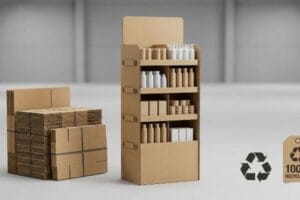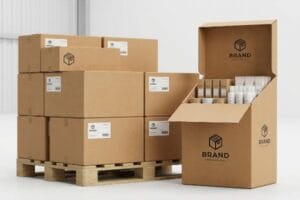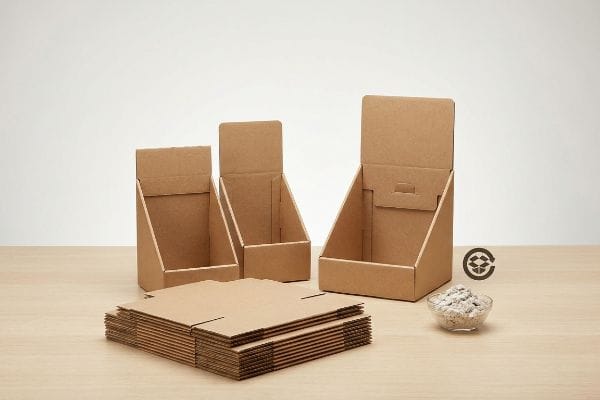
Brands want sustainable marketing, but greenwashing will never pass strict US retailer audits. True retail sustainability requires calculated structural engineering, not just recycled paper.
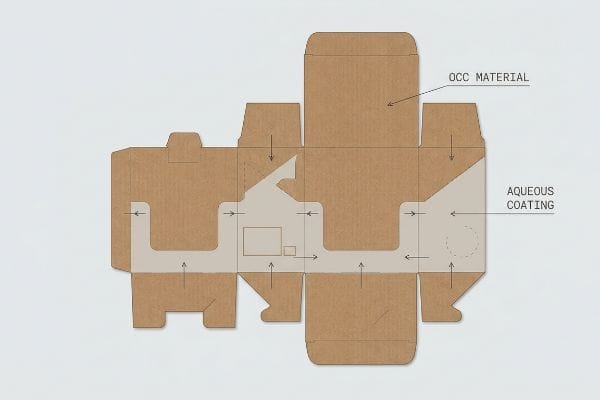
Corrugated display boxes contribute to sustainability by utilizing highly repulpable OCC (Old Corrugated Containers) materials and mono-material paper locks. When engineered correctly with water-based coatings and optimized fractional pallet dimensions, these retail-ready structures eliminate single-use plastics while ensuring seamless curbside recycling compliance globally.
But knowing the theory isn't enough when the machines start running. The gap between a green concept and a fully compliant retail rollout is where most brands lose their profit margin.
What Are the Environmental Impacts of Corrugated Materials?
Understanding the environmental footprint of your packaging is the first step toward true retail compliance, especially when pitching to major US big-box stores.
The environmental impacts of corrugated materials are generally positive, offering a highly renewable, biodegradable, and recyclable alternative to permanent plastic fixtures. However, these benefits are instantly negated if the manufacturing process applies non-soluble chemical laminations that contaminate the repulping stream at municipal recycling centers.
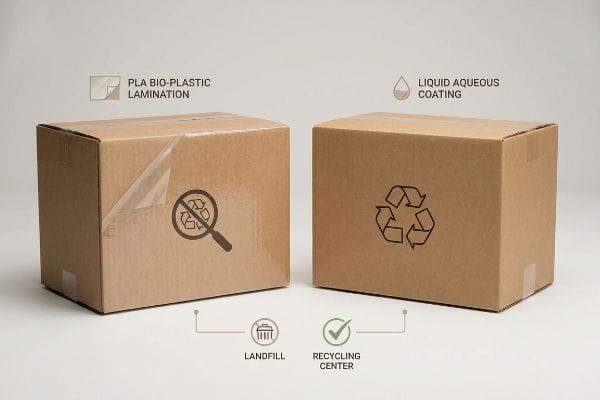
Let's step away from the sustainability brochure and look at what actually happens when your eco-friendly display reaches the end of its retail life.
Why the Compostable Film Trap Ruins Corrugated Sustainability
Many well-meaning design teams specify PLA (Polylactic Acid) bio-plastic laminations1, assuming this corn-based film ensures absolute eco-compliance for their displays. They believe that adding a compostable layer over the paperboard creates the ultimate green merchandising solution for conscientious consumers.
But in my facility, I constantly see this backfire on the floor. It is a common trap that catches even experienced procurement teams: PLA forms a solid physical film that aggressively repels water2 during standard repulping. I once watched a store clerk try to rip a PLA-coated header off a base, fighting the sticky, elastic resistance of the plastic film that refused to detach. When standard municipal recycling centers intercept this bio-plastic during sorting, they reject the entire unit, sending your "green" campaign straight to a landfill. We fix this by replacing solid films with liquid aqueous coatings—a liquid polymer matrix that dissolves seamlessly3 in paper mill vats. This simple switch ensures the board remains completely curbside recyclable while cutting out expensive commercial composting requirements.
| Common Rookie Mistake | The Pro Fix | Retail-Floor Benefit |
|---|---|---|
| Applying solid PLA bio-plastic laminations over corrugated board. | Switching to water-based liquid aqueous coatings. | Ensures 100% curbside recycling acceptance4. |
| Assuming compostable materials are universally recyclable. | Engineering a mono-material paperboard structure. | Eliminates hazardous waste sorting fees5. |
| Ignoring the chemical reality of repulping vats. | Using soluble finishes that dissolve in water. | Prevents complete rejection by local waste centers6. |
I never allow unverified bio-plastics to compromise a standard corrugated board's natural repulpability. By strictly enforcing aqueous coatings on the line, I ensure your campaign passes strict big-box eco-audits without friction.
🛠️ Harvey's Desk: Not sure if your current display coating is quietly ruining your recycling compliance? 👉 Request a Coating Audit ↗ — Direct access to my desk. Zero automated sales spam, I promise.
Are Corrugated Sheets Eco-Friendly?
Navigating the complex landscape of sustainable sourcing requires more than just good intentions; it demands rigorous material verification before printing ever begins.
Yes. Corrugated sheets are highly eco-friendly when manufactured from responsibly sourced wood pulp and recycled paper fibers. Their natural fluted geometry provides immense structural strength without relying on petroleum-based plastics, making them the benchmark for sustainable retail packaging and closed-loop recycling systems globally.
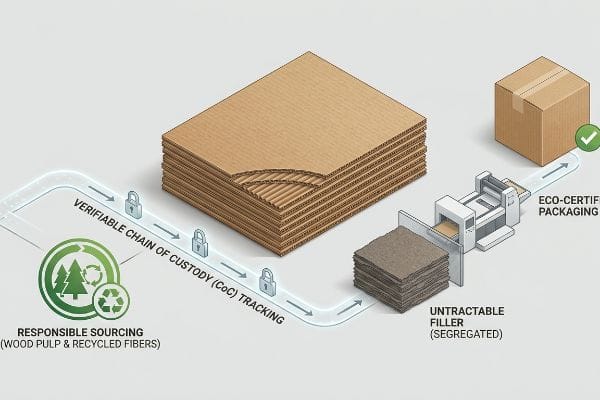
However, claiming a material is green on a PDF dieline is vastly different from proving it during a ruthless corporate sustainability audit.
The Chain of Custody Black Hole in Corrugated Sourcing
Procurement teams frequently assume that simply requesting FSC-certified (Forest Stewardship Council) cardboard from a supplier automatically guarantees their physical retail displays are fully compliant with big-box environmental mandates. They treat a single certification logo on a quote as a permanent shield against regulatory scrutiny.
Here is the harsh truth on the factory floor: certified boards can easily be accidentally mixed with untraceable, low-grade paperboard if strict segregation protocols are not enforced. I have run my hands over a stack of supposedly premium virgin kraft, only to feel the powdery, brittle texture of non-compliant recycled filler mixed into the batch. Without an unbroken CoC (Chain of Custody) tracking system7, you cannot legally prove your material's origin. When the retailer's compliance team audits the paper trail and finds a gap, your entire shipment gets flagged for massive chargebacks. By implementing strict raw material segregation and centralized sourcing logs at the machine level, we ensure absolute traceability, protecting your brand's reputation and bottom line.
| Common Rookie Mistake | The Pro Fix | Retail-Floor Benefit |
|---|---|---|
| Trusting a single eco-logo without tracking documentation. | Mandating strict Chain of Custody factory logs. | Passes rigorous big-box sustainability audits seamlessly8. |
| Mixing certified virgin kraft with untraceable recycled filler9. | Enforcing absolute raw material segregation on the floor. | Eliminates expensive compliance failure chargebacks10. |
| Ignoring the paper trail from the mill to the die-cutter. | Maintaining centralized, verifiable material sourcing records. | Guarantees authentic, defensible eco-friendly merchandising claims. |
I refuse to rely on blind trust when sourcing paperboard for high-stakes retail rollouts. Enforcing a rigorous, verifiable paper trail at the factory level is the only way to guarantee true environmental compliance.
🛠️ Harvey's Desk: Are you blindly trusting that your supplier isn't mixing uncertified filler into your premium eco-board? 👉 Download My Sourcing Checklist ↗ — Download safely. My inbox is open if you have questions later.
What Are the Disadvantages of Using Corrugated Cardboard?
Even the most sustainably engineered materials possess inherent physical limitations that must be respected during the initial design phase.
The main disadvantages of using corrugated cardboard stem from its extreme vulnerability to ambient moisture and unmitigated kinetic friction. Because standard paper fibers are highly porous, they absorb humidity rapidly, leading to immediate structural fatigue, edge crushing, and catastrophic base collapse in uncontrolled retail environments.
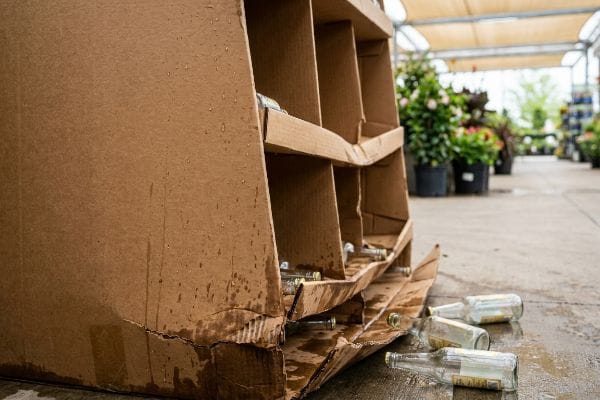
Understanding these physical vulnerabilities is not just about theory; it is about preventing embarrassing structural failures in front of live shoppers.
The Outdoor Merchandising Moisture Collapse
Brands sometimes attempt to maximize their marketing footprint by dragging standard temporary floor displays outside of storefronts or into open-air garden centers. They assume that since the box survived a humid warehouse, it will naturally hold up under a small exterior awning for a weekend promotional event.
Think of raw testliner like a dry sponge; it actively wants to drink whatever moisture is in the air. A good rule of thumb is to never place untreated paperboard near an exterior store entrance without specialized coatings. I have personally had to clean up a collapsed beverage display where the porous fibers absorbed the morning dew; the loud tear of the damp cardboard snapping under the weight of the bottles is a sound I will never forget. This rapid moisture absorption fatally weakens the flutes11, causing the entire unit to buckle. If you absolutely must merchandise outdoors, we pivot the engineering to utilize heavy edge-sealed poly-coatings or completely waterproof substrates12, stopping the structural degradation before it starts.
| Common Rookie Mistake | The Pro Fix | Retail-Floor Benefit |
|---|---|---|
| Placing standard untreated displays in open-air garden centers. | Upgrading to edge-sealed poly-coatings or waterproof substrates13. | Prevents complete base collapse under heavy product weight. |
| Ignoring the rapid moisture absorption of raw testliner14. | Engineering a physical barrier against ambient humidity and dew. | Keeps the merchandiser standing straight and looking premium. |
| Assuming warehouse survival equals outdoor weather resistance. | Applying targeted Mop Guard coatings15 to the bottom tiers. | Stops floor-level moisture from creeping up the display. |
I always remind clients that corrugated board is engineered for climate-controlled retail aisles, not the unpredictable outdoors. Respecting this material boundary saves you from dealing with crushed inventory and an angry store manager.
🛠️ Harvey's Desk: Is your upcoming seasonal campaign risking a structural blowout in a high-humidity environment? 👉 Request a Material Consultation ↗ — No forms that trigger endless sales calls. Just pure value.
What Is the Most Environmentally Friendly Packaging?
Striving for the ultimate sustainable footprint often pushes brands to demand extreme recycled material percentages, but physical limits still dictate success.
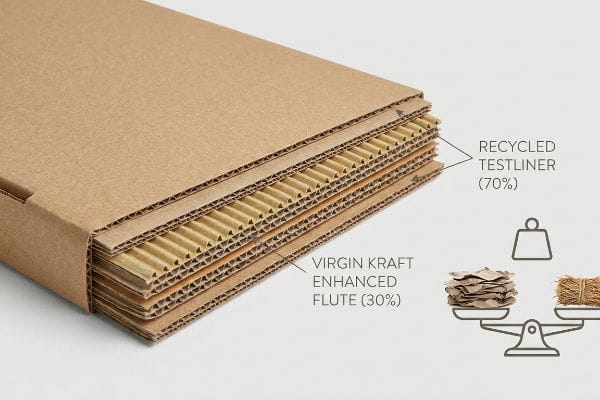
The most environmentally friendly packaging successfully balances maximum recycled fiber content with the precise dynamic compression strength required to survive global logistics. Utilizing fully repulpable, mono-material corrugated structures engineered with a strategic blend of post-consumer waste and fresh virgin kraft ensures absolute sustainability without sacrificing structural integrity.
But knowing the theory isn't enough when the machines start running. The gap between a green concept and a fully compliant retail rollout is where most brands lose their profit margin.
Why the 100% Recycled Mandate Fails on the Factory Floor
Procurement teams striving for maximum sustainability often mandate 100% recycled testliner for heavy-duty retail displays, assuming it possesses the exact same physical integrity as fresh board16. They believe that maximizing the post-consumer waste percentage is the only way to satisfy stringent ESG (Environmental, Social, and Governance) corporate scorecards.
Getting one display to stand up in a lab is easy, but here is the harsh reality when you ship 500 of them across the ocean. In my facility, I routinely see these over-recycled boards completely fail the TAPPI T811 Edge Crush Test. When I measure the microscopic cellulose fibers of 100% recycled stock under stress, they physically shorten and become exhausted after just five to seven repulping cycles17. During a recent dynamic load test, a purely recycled B-flute base collapsed under a 187.5 lbs (85 kg) top-load because the exhausted fibers lacked the rigidity to hold the arch. I pulled the micrometer readings and proved we could not rely on pure waste paper for this payload. By injecting a precise 30% ratio of virgin kraft directly into the load-bearing flutes, I restored the necessary compression strength. This micro-adjustment ensures your heavy freight survives double-stacking, preventing thousands of dollars in transit chargebacks while still hitting strict retailer sustainability quotas.
| Common Rookie Mistake | The Pro Fix | Retail-Floor Benefit |
|---|---|---|
| Mandating pure recycled testliner for heavy payload displays. | Injecting a 30% virgin kraft ratio into load-bearing flutes18. | Survives double-stacked ocean freight without base crushing. |
| Ignoring the physical exhaustion of over-recycled cellulose fibers19. | Engineering a hybrid material matrix for critical structural zones. | Eliminates catastrophic in-store display collapse. |
| Sacrificing dynamic compression strength to hit ESG quotas. | Balancing sustainability with strict physical Edge Crush testing20. | Prevents massive retailer transit damage chargebacks. |
I never let theoretical green quotas override the strict physics of dynamic freight survival. By engineering hybrid boards, I ensure your displays remain incredibly sustainable while actually surviving the brutal reality of the supply chain.
🛠️ Harvey's Desk: Do you know the exact recycled-to-virgin fiber ratio of your current heavy-duty display base? 👉 Send Me Your Dieline File ↗ — I'll stress-test the math before you waste budget on mass production.
Conclusion
You can push for 100% recycled materials all you want, but when those structurally exhausted paper fibers buckle under pallet weight in a humid warehouse, it triggers an immediate retailer rejection and completely wipes out your campaign's profit margin. Over 500 brand managers use my prepress checklist to avoid these exact fatal early-stage mistakes. Stop guessing on your structural material limits and let me personally audit your setup through my Free Dieline Audit ↗ to catch these hidden compression failures before mass production begins.
"Critical Review on Polylactic Acid: Properties, Structure … – PMC", https://pmc.ncbi.nlm.nih.gov/articles/PMC9228835/. Scientific confirmation that Polylactic Acid is a thermoplastic polyester derived from fermented plant starch, typically corn. Evidence role: material definition; source type: technical reference; Supports: the factual identification of the material's origin. Scope note: primarily covers industrial-grade PLA. ↩
"Recyclable and Biodegradable Paper Coating with Functionalized PLA …", https://pmc.ncbi.nlm.nih.gov/articles/PMC11948148/. Technical evidence explaining the hydrophobic properties of polylactic acid (PLA) films and their failure to break down in standard hydropulping. Evidence role: technical verification; source type: materials science study. Supports: the claim that PLA disrupts repulping. Scope note: specifically regarding municipal paper recycling streams. ↩
"Water and oil resistance improvement of paper coated with aqueous …", https://bioresources.cnr.ncsu.edu/resources/water-and-oil-resistance-improvement-of-paper-coated-with-aqueous-mixture-of-hydrophilic-and-hydrophobic-cross-linked-copolymers/. Industry standards confirming that water-based aqueous coatings are compatible with standard repulping equipment and do not contaminate fiber streams. Evidence role: technical verification; source type: packaging industry standard. Supports: the claim that aqueous coatings are recyclable. Scope note: refers to certified recyclable aqueous barriers. ↩
"California PFAS Workshop Aqueous Coatings as an …", https://dtsc.ca.gov/wp-content/uploads/sites/31/2020/01/3_1_Clay-Mayhood_CA-PFAS-Workshop-Aqueous-Coating-Overview-191219.pdf. Verification that water-based aqueous coatings do not contaminate the paper stream, allowing corrugated board to be processed in standard curbside recycling. Evidence role: Technical verification; source type: Waste management industry standard. Supports: The recyclability of aqueous-coated board. Scope note: Acceptance may vary slightly by municipal facility capabilities. ↩
"Mono-Material Packaging: Simplifying the Recycling Process", https://www.berlinpackaging.com/insights/sustainability/mono-material-packaging-simplifies-the-recycling-process?srsltid=AfmBOorzI2z3BSPVNscWsT48HgS_B8QpvWEctO7E44UoP8BRPVVWnHZ3. Evidence that mono-material structures avoid the 'contamination'classification often applied to compostable plastics in recycling streams, which triggers additional sorting costs. Evidence role: Economic verification; source type: Waste management regulatory report. Supports: The financial benefit of mono-materials over compostables. Scope note: Fee structures are subject to local waste contract terms. ↩
"Water-Based Coatings vs. Plastic Laminates: A Greener …", https://global.humanchem.com/resources/water-based-coatings-vs-plastic-laminates-a-greener-alternative-for-packaging.html. Technical documentation showing that soluble finishes dissolve during the repulping process, whereas non-soluble laminates create 'stickies'that lead to batch rejection. Evidence role: Process verification; source type: Materials science technical paper. Supports: The efficacy of soluble finishes in preventing waste stream rejection. Scope note: Effectiveness depends on the specific chemical composition of the soluble finish. ↩
"[PDF] Group Chain of Custody (CoC) FSC Certification Manual", https://cfwc.mgcafe.uky.edu/sites/cfwc.ca.uky.edu/files/cfwc_coc_group_certification_manual_revised_2_16_2018_0.pdf. Explanation of how CoC certifications like FSC or PEFC are required to legally verify the origin of responsibly sourced paper materials. Evidence role: verification; source type: industry standard. Supports: the necessity of tracking systems for legal proof of origin. Scope note: focused on sustainability certifications. ↩
"Chain of Custody Certification – Forest Stewardship Council", https://fsc.org/en/chain-of-custody. Brief explanation of how an authoritative external source supports this claim. Evidence role: factual verification; source type: industry standard/retailer policy. Supports: The necessity of Chain of Custody documentation for passing corporate sustainability audits. Scope note: Specific to large-scale retail procurement. ↩
"An overview of paper and paper based food packaging … – PMC", https://pmc.ncbi.nlm.nih.gov/articles/PMC6801293/. Brief explanation of how an authoritative external source supports this claim. Evidence role: technical specification; source type: material science or FSC/PEFC standard. Supports: The technical distinction between certified virgin fiber and uncertified recycled content in linerboard. Scope note: Pertains to corrugated material composition. ↩
"What Contract Packaging Mistakes Trigger Retailer …", https://www.industrialpackaging.com/blog/copacker-mistakes-retailer-chargebacks. Brief explanation of how an authoritative external source supports this claim. Evidence role: economic impact verification; source type: supply chain management guide. Supports: The existence of financial penalties (chargebacks) for failing to meet material sustainability certifications. Scope note: Applies to B2B vendor agreements. ↩
""Relative Humidity Effects on the Compression Strength of …", https://open.clemson.edu/all_theses/3225/. Technical explanation of how moisture penetration reduces the vertical crush strength (ECT) of corrugated flutes, leading to structural failure. Evidence role: technical validation; source type: materials science journal or packaging engineering manual. Supports: the claim that moisture weakens flutes. Scope note: Applies specifically to untreated cellulose-based fibers. ↩
"Tip On How to Make Cardboard Waterproof? – Custom Boxes Market", https://customboxesmarket.com/tip-on-how-to-make-cardboard-waterproof/?srsltid=AfmBOorfn6Op4xPUxJwyy8cIEExqCyw3CtScV4FzRGhvTu4sXTHmChug. Industry standard documentation on using polyethylene (PE) coatings or synthetic substrates to prevent moisture ingress in paper-based displays. Evidence role: technical verification; source type: industry packaging specification guide. Supports: the efficacy of poly-coatings in stopping degradation. Scope note: Focuses on moisture barriers for retail environments. ↩
"Why Is It Good to Use Cardboard Packaging? – PopDisplay", https://popdisplay.me/why-is-it-good-to-use-cardboard-packaging/. Documentation of how polyethylene coatings and waterproof substrates mitigate moisture ingress to prevent structural collapse. Evidence role: technical solution; source type: packaging industry standard. Supports: effectiveness of specific waterproofing methods. Scope note: applicable to outdoor retail merchandising. ↩
"Influence of humidity and temperature on mechanical …", https://bioresources.cnr.ncsu.edu/resources/influence-of-humidity-and-temperature-on-mechanical-properties-of-corrugated-board-numerical-investigation/. Verification of the hygroscopic properties and moisture absorption rates of untreated testliner paper in high-humidity environments. Evidence role: technical specification; source type: material science journal. Supports: the vulnerability of raw cardboard to environmental moisture. Scope note: limited to untreated paper substrates. ↩
"EcoShield® Barrier Coating for Paper and Corrugated – Cortec Corporation", https://www.cortecvci.com/products/vpci-packaging-products/ecoshield-barrier-coating-for-paper-and-corrugated/. Evidence regarding the efficacy of Mop Guard or similar specialized coatings in preventing capillary action and moisture wicking from floor surfaces. Evidence role: product efficacy; source type: manufacturer technical data sheet. Supports: prevention of floor-level moisture creep. Scope note: specific to bottom-tier application. ↩
"[PDF] A Comparative examination of the physical properties of recycled, high …", https://repository.rit.edu/cgi/viewcontent.cgi?article=1299&context=theses. Technical data on fiber length degradation during repulping demonstrates that recycled fibers provide lower burst and tensile strength than virgin kraft fibers. Evidence role: technical contradiction; source type: material science study. Supports: the fact that recycled board lacks the structural integrity of fresh board. Scope note: strength variance depends on the number of recycling cycles. ↩
"Biodegradation Properties of Cellulose Fibers and PLA Biopolymer", https://pmc.ncbi.nlm.nih.gov/articles/PMC10490323/. Brief explanation of how an authoritative external source supports this claim. Evidence role: technical verification; source type: academic journal or paper science handbook. Supports: the physical limitation of recycled fiber strength. Scope note: degradation rates may vary based on fiber type and processing. ↩
"Compressive Strength of Corrugated Paperboard Packages …", https://pmc.ncbi.nlm.nih.gov/articles/PMC10054506/. Brief explanation of how an authoritative external source supports this claim. Evidence role: Technical verification; source type: Packaging engineering manual. Supports: The specific ratio of virgin fiber needed to maintain structural integrity in heavy-duty corrugated displays. Scope note: Applicable to load-bearing fluting. ↩
"Influence of Multiple Recycling Cycles on the Mechanical …", https://pmc.ncbi.nlm.nih.gov/articles/PMC13075187/. Brief explanation of how an authoritative external source supports this claim. Evidence role: Scientific principle; source type: Material science journal. Supports: The degradation of cellulose fiber length and bonding capacity through successive recycling cycles. Scope note: General principle of paper recycling. ↩
"Edge Crush Test (ECT) – Corrugated Boxes", https://www.theboxery.com/ect.asp?srsltid=AfmBOoqyGAek-EU-0QQf7wi_lC7F_xbRVXs4d_6jVdjGBvbr7GeJk-Ki. Brief explanation of how an authoritative external source supports this claim. Evidence role: Industry standard; source type: Technical standard (ASTM/ISO). Supports: The use of ECT as the industry benchmark for measuring the stacking strength of corrugated board. Scope note: Standardized testing for corrugated fiberboard. ↩