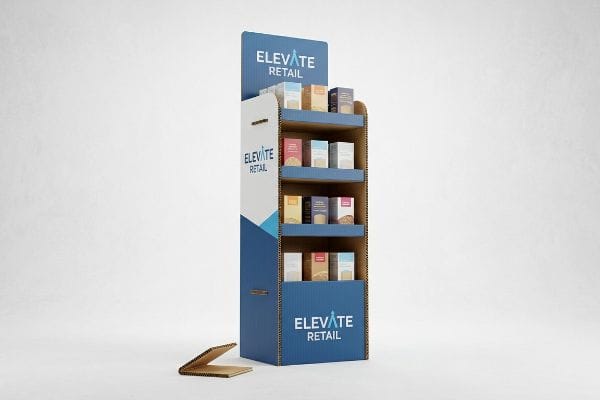
Lancer son produit en magasin est passionnant, mais traiter son emballage comme un simple conteneur d'expédition garantit l'échec avant même que le produit ne touche le sol.
Pour réussir la mise en place de présentoirs en carton, il est essentiel de trouver un équilibre entre la visibilité de la marque, les propriétés physiques de ces présentoirs et les exigences strictes des grandes enseignes. Une campagne marketing performante repose sur l'utilisation de matériaux ondulés haute performance, un ciblage précis des segments démographiques et une ingénierie spatiale rigoureuse afin d'obtenir des emplacements privilégiés en rayon et de résister aux contraintes logistiques des chaînes d'approvisionnement à haut débit sans se déformer.
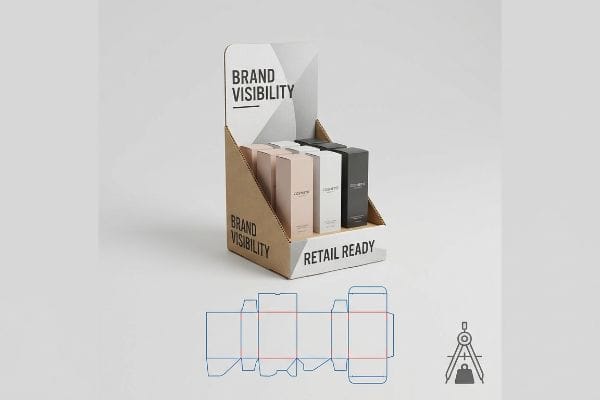
Décryptons ensemble les réalités cachées de la fabrication et les règles de la chaîne d'approvisionnement que vous devez connaître avant de finaliser votre conception.
Comment fabriquer un présentoir en carton ?
Pour capter l'attention des clients dans une allée bondée, il ne s'agit pas de recouvrir chaque centimètre carré de graphismes. Il s'agit d'une stratégie spatiale et d'une rupture visuelle calculée.
Pour qu'un présentoir en carton se démarque, il est essentiel de concevoir des éléments structurels respectant la règle d'engagement spatial 3-3-3. Cela implique l'utilisation de formes découpées audacieuses pour créer une rupture visuelle à distance, l'optimisation de la hauteur des étagères pour une interaction optimale à mi-distance et la découpe de rebords de maintien pour garantir une visibilité immédiate du produit à courte distance.
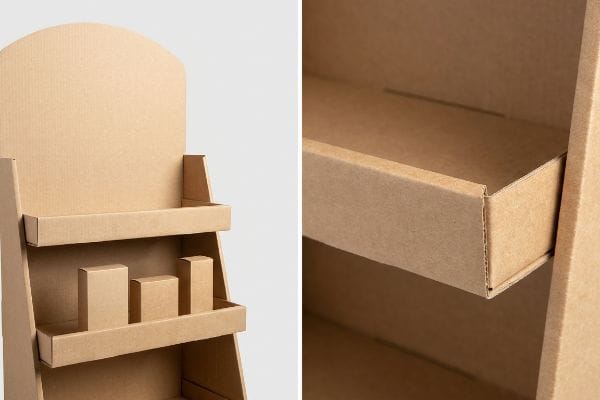
Appliquer ce concept concrètement signifie dissocier vos habitudes de conception numérique de votre comportement dans le commerce de détail physique.
La règle 3-3-3 pour la visibilité des écrans
Les équipes marketing conçoivent souvent leurs supports publicitaires uniquement pour une visualisation rapprochée sur des écrans d'ordinateur rétroéclairés. Elles partent du principe que des visuels haute résolution et des textes denses attireront naturellement les clients. Or, elles ignorent la réalité physique de la façon dont un client pressé se déplace dans les rayons bondés d'un supermarché.
Même les responsables de marque les plus expérimentés tombent souvent dans le piège de raconter toute l'histoire de leur marque sur les panneaux latéraux. Si un présentoir ne capte pas l'attention d'un chariot à 9,1 mètres (30 pieds), personne ne lira le texte de près. Dans mon atelier, je reçois constamment des fichiers qui paraissent magnifiques à l'écran, mais qui deviennent un flou chaotique et illisible sous l'éclairage intense des magasins. Je constate que les designers se fient uniquement à des graphismes plats au lieu d'utiliser le carton ondulé pour créer un effet visuel intéressant. Il m'est arrivé de voir des clients passer devant une boîte symétrique sans même la regarder. La solution ? Un ancrage strict dans le continuum spatial 3-3-3¹.J'insiste pour que mes clients utilisent des éléments 3D découpés, incurvés et de grande taille, afin d'interrompre le passage à 9,1 mètres (30 pieds), d'aligner les étagères supérieures sur la zone de contact humaine de 127 cm (50 pouces)² pour une interaction à 0,9 mètre (3 pieds), et de découper le rebord avant pour garantir une visibilité du produit de 85 % et ainsi optimiser l'espace à 7,6 cm (3 pouces). Quand on découpe le surplus de carton qui masque le produit, j'adore entendre ce bruit sec et satisfaisant du carton découpé qui se détache, sachant que la marchandise est enfin visible.
| Erreurs courantes des débutants | La solution pro | Avantage du magasin |
|---|---|---|
| Texte dense sur les panneaux latéraux | En-têtes découpés en 3D agressifs | Attire l'attention à 9 mètres3 |
| lèvres hautes et retenantes | Découper le rebord pour une visibilité de 85 %4 | Augmente les conversions d'impulsion |
| Structure plane et symétrique | Architecture spatiale courbe5 | Perturbe visuellement l'allée |
Je ne laisse jamais une marque noyer son produit sous un flot de texte. En concevant le panneau d'affichage comme un élément visuel percutant, je garantis que votre campagne incitera les consommateurs à s'arrêter, à regarder et, finalement, à acheter le produit.
🛠️ Le bureau d'Harvey : Vous vous demandez si votre découpe plate présente un relief 3D suffisamment marqué pour attirer l'attention ? 👉 Obtenez un audit de design gratuit ↗ — Accès direct à mon bureau. Zéro spam commercial automatisé, promis.
Qu'est-ce qui fait un bon panneau d'affichage ?
Une esthétique haut de gamme ne signifie absolument rien si les fondations physiques s'effondrent sous le poids de vos propres produits avant même le début de la promotion.
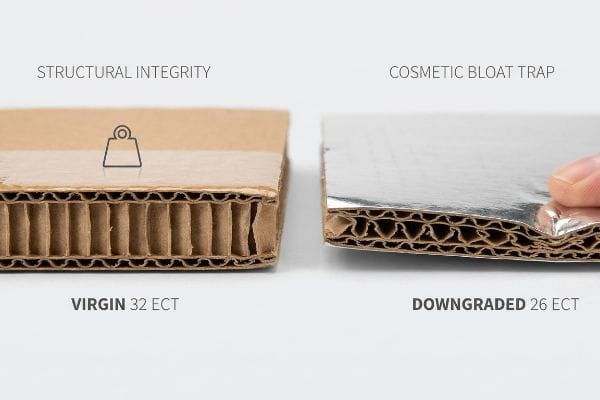
Un bon panneau d'affichage nécessite une grande intégrité structurelle, généralement obtenue grâce à l'utilisation d'un substrat ondulé vierge de 32 ECT (test de compression des bords). Cette densité de cannelures précise garantit une résistance maximale à la compression verticale, permettant ainsi au panneau de supporter les charges importantes sur les palettes et les vibrations extrêmes liées au transport, sans s'affaisser.
Connaître la terminologie ne représente que la moitié du chemin ; comprendre comment les décisions d'approvisionnement compromettent le matériel est ce qui fait le succès ou l'échec des campagnes.
Le piège de la dégradation cosmétique 32ECT
Les acheteurs pensent souvent pouvoir compenser le coût élevé des finitions cosmétiques haut de gamme, comme le pelliculage intégral, en optant discrètement pour une structure moins robuste. Ils réduisent ainsi la densité des cannelures du noyau de 32 ECT à 26 ECT6 pour économiser quelques centimes par unité.
Cela crée un déséquilibre dangereux : l'extérieur paraît luxueux, mais la structure est fondamentalement fragile. On me demande souvent si une feuille de surface plus épaisse peut compenser un noyau de qualité inférieure. La réponse est non. Le film rigide peut sembler esthétique, mais il ne peut pas répartir les charges dynamiques. Je me souviens d'un client qui insistait pour cette dégradation, et lorsque j'ai passé mon pouce sur le bord de son panneau 26 ECT, j'ai senti physiquement les cannelures internes s'écraser sous une pression minimale. Dans mon atelier, j'interdis formellement de creuser les panneaux structurels pour financer un gain esthétique. Je restaure plutôt le matériau à un standard 32 ECT vierge afin de maintenir une capacité de charge dynamiquede 7.Pour obtenir la réflexion optimale demandée sans dépasser le budget, je remplace les films épais et coûteux par des vernis aqueux. Cela préserve la géométrie arquée interne des fibres de papier, garantissant ainsi la résistance du panneau au transport en double empilage.
| Erreurs courantes des débutants | La solution pro | Avantage du magasin |
|---|---|---|
| Déclassement à 26 ECT | Application de la virginité 32 ECT8 | Empêche l'effondrement du niveau de base |
| Dépenses excessives pour des feuilles d'aluminium épaisses | Revêtement aqueux à haute teneur en solides9 | Permet de réaliser des économies sur le budget de la structure |
| S'appuyer sur la résistance de la couche supérieure | En s'appuyant sur la densité des cannelures10 | Résiste aux palettes empilées deux par deux |
Je refuse de concevoir un bel emballage qui ne soit pas suffisamment solide. En privilégiant la densité du carton ondulé brut plutôt que les films plastiques onéreux, je garantis la livraison de vos marchandises en toute sécurité, tout en préservant une présentation haut de gamme et soignée, reflétant l'image de votre marque.
🛠️ Le bureau de Harvey : Sacrifiez-vous la capacité de charge interne de votre véhicule pour un simple film de lamination brillant ? 👉 Demandez une analyse des matériaux ↗ — Téléchargement sécurisé. Ma boîte de réception reste ouverte si vous avez des questions.
Comment s'appelle un présentoir en carton ?
Le jargon du secteur peut être incroyablement déroutant, mais connaître la terminologie exacte est essentiel car des noms différents impliquent des contraintes juridiques et logistiques totalement différentes.
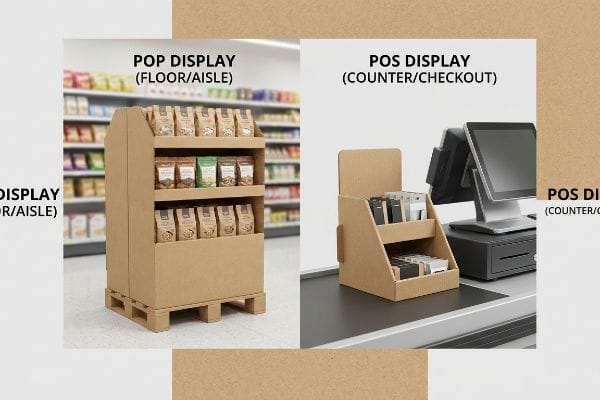
Un présentoir en carton est appelé PLV (Publicité sur le Lieu d'Achat) lorsqu'il est utilisé dans la surface de vente principale, ou présentoir PDV (Publicité sur le Lieu de Vente) lorsqu'il est placé près des caisses. Ces classifications distinctes imposent des dimensions de conformité strictes aux détaillants, des capacités de charge maximales et des limitations d'espace précises dans les allées.
Confondre ces termes n'est pas qu'une simple erreur sémantique ; cela entraîne de graves refus de livraison en magasin.
Comprendre les contraintes du point de vente (POS) et du système de point de vente (PLV)
Les entreprises commerciales proposent souvent un modèle unique et modulable, affirmant qu'un grand meuble bas peut être réduit de moitié par un simple calcul pour servir de caisse enregistreuse de comptoir. Elles utilisent les deux termes indifféremment, ignorant les règles juridiques et logistiques strictes qui régissent ces deux zonesdistinctes¹¹.
Imaginez essayer de garer un semi-remorque dans une place de parking pour voiture. Impossible de simplement réduire la taille du véhicule ; les lois de la physique sont complètement différentes. Même les équipes d'approvisionnement les plus expérimentées tombent souvent dans ce piège, en supposant qu'un fichier CAO (Conception Assistée par Ordinateur) universel fonctionne partout. J'ai vu un jour un vendeur s'acharner à faire tenir en équilibre un gabarit de sol réduit sur un comptoir de caisse étroit, luttant avec les languettes difficiles d'accès, avant d'abandonner et de le jeter à la poubelle. Je sépare systématiquement les processus d'ingénierie pour ces deux catégories. Les présentoirs de sol sont strictement limités aux dimensions des palettes en bois GMA de 121,9 × 101,6 cm (48 × 40 pouces) pour gérer la logistique lourde des entrepôts. À l'inverse, les caisses enregistreuses sont conçues pour respecter la plage de portée avant de 38,1 à 121,9 cm (15 à 48 pouces) conforme aux normes ADA . En respectant ces limites distinctes, j'évite les refacturations massives des gérants de magasin qui refusent catégoriquement les présentoirs non conformes.
| Erreurs courantes des débutants | La solution pro | Avantage du magasin |
|---|---|---|
| Réduire la conception d'un plancher | canalisations structurelles séparées | Empêche un ajustement de comptoir inconfortable |
| Ignorer les limites des palettes | Ancrage sur une base de 48×40 pouces12 | Survit à la logistique d'entrepôt |
| Ignorer les règles de portée | Fenêtre de mise en application de la conformité ADA13 | Réussit les inspections de direction |
Je considère l'espace des allées et celui des caisses comme deux univers d'ingénierie totalement distincts. En adaptant votre conception à la classification commerciale appropriée, je garantis la solidité de votre campagne et sa parfaite conformité aux normes spatiales des grandes surfaces.
🛠️ Harvey's Desk : Votre comptoir actuel enfreint-il involontairement les normes d'espace en vigueur pour les caisses enregistreuses ? 👉 Demandez votre guide d'aménagement ↗ — Pas de formulaires interminables qui vous incitent à passer des appels commerciaux. Uniquement de la valeur.
Comment fabriquer une vitrine en carton ?
La conception d'un présentoir haut de gamme nécessite d'aller au-delà des simples structures de boîtes et de concevoir des divisions spatiales dédiées qui mettent activement en valeur le produit.
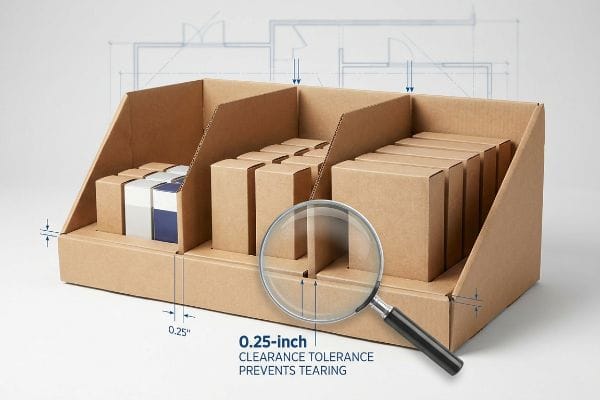
La conception d'une vitrine en carton nécessite l'utilisation de séparateurs modulaires qui répartissent naturellement les produits en groupes asymétriques spécifiques. Cette architecture structurelle réfléchie crée une tension visuelle psychologique pour le client, évite la surcharge des rayons et offre des dégagements physiques essentiels pour prévenir les déchirures du carton lors des réapprovisionnements rapides en magasin.
Mais connaître la théorie ne suffit pas lorsque les machines se mettent en marche et que les employés doivent réellement remplir les rayons.
Pourquoi la symétrie parfaite échoue-t-elle en usine ?
Les jeunes designers tentent souvent de disposer à plat une grille dense et parfaitement symétrique de produits sur une seule étagère. Ils partent du principe logique, mais dangereux, que maximiser la densité des produits génère automatiquement des ventes plus élevéeset un meilleur retour sur investissement.
Faire tenir un présentoir debout en laboratoire est facile, mais la réalité est tout autre lorsqu'il s'agit d'en expédier 500 vers des points de vente. Ce tassement symétrique engendre d'importantes frictions physiques lors du réapprovisionnement. Dans mon atelier, je le teste en obligeant les employés à charger rapidement des présentoirs très denses, et j'entends constamment le craquement des languettes de maintien en carton ondulé brut qui se déchirent lorsque les articles sont trop serrés. J'ai analysé les données d'agencement et prouvé qu'un carton plus épais n'était pas nécessaire : une tolérance de jeu horizontal de 6,35 mm (0,25 pouce)suffisait. J'impose la règle 3-5-7,en concevant des séparateurs modulaires qui divisent le présentoir en groupes impairs. Ce micro-ajustement offre l'espace physique précis nécessaire à un chargement sans friction. En appliquant cette simple tolérance spatiale, je garantis une réduction significative du temps d'assemblage pour le conditionnement, éliminant ainsi les étagères déchirées et évitant à mes clients des frais de reprise coûteux sur les productions standard.
| Erreurs courantes des débutants | La solution pro | Avantage du magasin |
|---|---|---|
| Grilles parfaitement symétriques | 3-5-7 groupes asymétriques17 | Crée une tension visuelle chez le consommateur |
| Dégagement horizontal nul | Tolérance spatiale de 0,25 pouce18 | Élimine les bords déchirés des étagères |
| Maximisation de la densité stricte | Cloisons structurelles modulaires19 | Réapprovisionnement sans friction |
Je ne sacrifie jamais la facilité d'utilisation pour une densité maximale. En concevant des espaces physiques précis dans l'agencement de votre vitrine, je vous garantis que votre présentoir restera visuellement attrayant et résistera aux aléas du réapprovisionnement en magasin.
🛠️ Conseils d'Harvey : Un défaut structurel de 2 millimètres ne doit pas compromettre le déploiement dans 500 magasins. 👉 Envoyez-moi votre fichier de gabarit ↗ — Je vérifierai la robustesse des calculs avant que vous n'investissiez votre budget dans une production de masse.
Conclusion
Vous pouvez choisir un fournisseur moins cher, mais si ce carton ECT de qualité inférieure s'effondre sous le poids d'une palette lourde, le gauchissement de la base qui en résulte entraînera un refus immédiat du détaillant et anéantira la marge de votre campagne. Plus de 500 responsables de marque utilisent ma checklist prépresse pour éviter précisément ces erreurs fatales en début de production. Ne vous fiez plus aux estimations de la densité des cannelures et laissez-moi auditer personnellement vos plans grâce à mon Audit Pré-Factory de Moulage Gratuit ↗ afin de détecter les faiblesses physiques cachées avant de lancer la production en série.
« La règle des 3 pour les présentoirs en magasin », https://mcintyredisplays.com/blog/custom-store-displays/. Vérification du cadre d'engagement spatial 3-3-3 utilisé dans la conception de présentoirs PLV pour attirer les clients à différentes distances. Rôle de la preuve : cadre technique ; type de source : guide de marketing de détail ou manuel de conception industrielle. Appuie : la stratégie globale d'engagement en fonction de la distance. Note sur la portée : peut être une heuristique propriétaire ou spécifique à un secteur .
« Conception des espaces de vente au détail pour des présentoirs efficaces et une circulation client optimale », https://www.business.qld.gov.au/industries/manufacturing-retail/retail-wholesale/retail-displays. Confirmation des normes ergonomiques relatives à la hauteur des étagères dans la « zone d’interaction » des commerces de détail afin d’optimiser l’interaction des clients. Type de preuve : spécification technique ; source : étude ergonomique ou norme de conception de points de vente. Appuie : l’affirmation concernant la hauteur optimale des étagères pour une interaction intermédiaire. Remarque sur la portée : peut varier en fonction de la taille du public cible .
« AMÉLIORER LA VISIBILITÉ DE LA MARQUE GRÂCE AUX PRÉSENTOIRS PERSONNALISÉS », https://www.bcipkg.com/elevating-brand-visibility-with-custom-pop-displays/ . Recommandations sectorielles sur la portée visuelle optimale des en-têtes 3D découpés pour attirer les clients dans les allées à fort trafic. Niveau de preuve : validation métrique ; type de source : guide de merchandising. Sujet : portée visuelle des en- têtes 3D. Remarque : la distance peut varier en fonction de l’agencement et de l’éclairage du magasin.
« Point de vente : comment les détaillants peuvent influencer les consommateurs… », https://blog.intouch.com/posts/points-of-purchase-displays . Normes techniques relatives aux taux de visibilité des produits dans les présentoirs en carton et leur corrélation avec les taux d'achats impulsifs. Type de preuve : spécification technique ; source : manuel d'ingénierie de l'emballage. Objectif : optimisation du taux de conversion par la visibilité. Remarque : applicable aux emballages standard prêts à la vente.
« Impact de différents types de présentoirs en magasin sur le comportement du consommateur… », https://www.sciencedirect.com/science/article/pii/S0022435921000634 . Recherche architecturale et psychologique sur la manière dont les formes courbes perturbent la linéarité des allées pour augmenter le taux d’arrêt des consommateurs. Rôle des preuves : soutien théorique ; type de source : étude de psychologie environnementale. Arguments : utilisation de l’architecture courbe pour capter l’attention. Note de portée : axée sur la perturbation spatiale.
« Explication des indices ECT : leur importance pour vos emballages en carton ondulé », https://epackagesupply.com/blogs/packaging-guide/ect-ratings-explained-what-they-mean-for-your-corrugated-packaging?srsltid=AfmBOor-Y-eLeTu7zK0QJzoqvo0pCc12TLhIoO0fz0Plw60YZr06NSGh . Documentation technique justifiant l’écart de résistance à la compression et les différences de coût typiques entre les qualités de carton 32 ECT et 26 ECT. Type de preuve : spécification technique ; source : norme de l’industrie de l’emballage. Confirme : l’affirmation selon laquelle la réduction des indices ECT diminue le coût unitaire , mais compromet l’intégrité structurelle. Remarque : s’applique spécifiquement aux supports en carton ondulé standard.
« Estimation de la résistance à la compression du carton ondulé… », https://pmc.ncbi.nlm.nih.gov/articles/PMC8467740/ . Les normes techniques industrielles relatives à l’essai d’écrasement des bords (ECT) définissent la résistance à la compression verticale du carton ondulé 32 ECT. Rôle de la preuve : spécification technique ; type de source : norme industrielle. Appuie : la relation entre l’ECT 32 et la capacité de charge dynamique. Note de portée : Spécifique aux performances du support ondulé.
« Explication des valeurs ECT : leur importance pour votre emballage… », https://epackagesupply.com/blogs/packaging-guide/ect-ratings-explained-what-they-mean-for-your-corrugated-packaging?srsltid=AfmBOoo6vDrIpQXGwDY2Df1aGDyeWT_xfmaWk0QVneEFbY5y6pUl8_t0 . Brève explication de la corrélation entre les valeurs ECT (Edge Crush Test) et la capacité de charge verticale du carton ondulé en milieu commercial. Preuve : spécification technique ; source : normes de l’industrie de l’ emballage. Confirme : l’affirmation selon laquelle une valeur ECT de 32 empêche l’effondrement de la base. Remarque : spécifique au carton ondulé.
« Qu’est-ce qu’un revêtement aqueux ? Avantages, applications et son importance pour… », https://millionpack.com/aqueous-coating/. Brève explication des avantages structurels et économiques des revêtements aqueux à haute teneur en solides par rapport aux laminages à l’aluminium dans l’impression commerciale. Type de preuve : comparaison de matériaux ; source : guide technique de l’industrie de l’impression. Argumentaire : utilisation des revêtements aqueux comme alternative structurelle économique. Note sur le champ d’application : axé sur la finition de surface .
« Étude de l’influence de la rigidité du plateau supérieur des palettes… – PMC », https://pmc.ncbi.nlm.nih.gov/articles/PMC8585293/. Brève explication de l’influence du nombre de cannelures par pouce sur la résistance à la compression verticale et la stabilité d’empilage des panneaux d’affichage. Domaine de la preuve : génie des structures ; type de source : manuel de logistique et d’emballage. Confirme : l’importance de la densité des cannelures pour la résistance des palettes à double empilage. Note de portée : concerne la compression axiale .
« Présentoirs sur le lieu de vente (PLV) : fonctionnement et impact sur le commerce de détail », https://www.optisigns.com/post/point-of-purchase-pop-display-how-they-work-their-retail-impact. Vérification des directives, normes de sécurité et contraintes logistiques spécifiques aux détaillants qui distinguent les présentoirs PLV sur pied des présentoirs de comptoir. Rôle de la preuve : vérification technique ; type de source : manuel de conformité du secteur du commerce de détail. Appuie : l’existence de contraintes distinctes pour les différentes zones d’affichage. Note de portée : les directives varient selon les détaillants .
« Quelle est la taille standard d'une palette ? 48 po x 40 po – PalletOne Inc. », https://www.palletone.com/what-is-the-standard-pallet-size/ . Confirmation des dimensions standard des palettes GMA nord-américaines utilisées en logistique d'entrepôt. Type de preuve : spécification technique ; type de source : norme industrielle ; éléments pris en charge: dimensions de base standard. Remarque : s'applique principalement à la logistique nord-américaine.
« Normes d’accessibilité de l’ADA – Access-Board.gov », https://www.access-board.gov/ada/. Vérification des exigences de l’Americans with Disabilities Act (ADA) concernant les distances d’accessibilité dans les commerces de détail. Rôle de la preuve : exigence légale ; type de source : réglementation gouvernementale ; Supports : période de conformité à l’ADA. Note relative à la portée : applicable aux commerces de détail américains .
« Statistiques sur l’agencement des points de vente 2026 : Tendances en matière de positionnement des rayons et leurs conséquences… », https://www.millsshelving.com.au/retail-store-layout-statistics/. Les études en merchandising et en psychologie du consommateur montrent généralement qu’une densité de produits trop élevée peut entraîner une surcharge de choix, impactant négativement les ventes. Type de données : contradictoires ; source : étude de marketing de détail. Conclusion : Une forte densité de produits ne garantit pas un meilleur retour sur investissement. Précision : Applicable aux présentoirs sur le lieu de vente .
« Meilleures pratiques de merchandising : Conformité », https://www.vanguardpkg.com/merchandising-best-practices-compliance/ . Validation des mesures de jeu standard en ingénierie d'emballage afin de prévenir les défaillances structurelles et les déchirures de matériau lors du chargement des produits. Niveau de preuve : spécification technique ; type de source : manuel d'ingénierie d'emballage. Éléments pris en compte : la mesure spécifique requise pour éliminer les déchirures du carton. Remarque : les tolérances peuvent varier selon le type de cannelure.
« Qu'est-ce que la règle 3-5-7 en décoration ? », https://montcarta.com/blogs/art-guide-inspiration/3-5-7-rule-interior-decorating-guide?srsltid=AfmBOoo8EYIu3_ngF3nu541sISNvF_95iO1POveviXP7BkFCbUkBlbuV. Vérification des règles de regroupement asymétrique (comme le principe 3-5-7) en merchandising visuel pour optimiser la distribution spatiale et l'efficacité de présentation. Rôle de la preuve : principe de conception ; type de source : norme de merchandising. Appuie : l'utilisation de groupes impairs pour éviter la surcharge visuelle. Note de portée : peut faire référence à des normes spécifiques d'agencement psychologique en point de vente .
« L’art du merchandising visuel : stratégies pour – T-ROC – TROC global », https://trocglobal.com/visual-merchandising/ . Explication technique de la façon dont les regroupements asymétriques et la « règle des impairs » améliorent la visibilité des produits et l’engagement des consommateurs. Rôle de la preuve : principe technique à l’appui ; type de source : guide de conception de points de vente. Appui : utilisation de regroupements asymétriques plutôt que symétriques. Note de portée : s’applique au merchandising visuel.
« 14 types de présentoirs de vente au détail | Chicago, IL », https://wertheimerbox.com/types-of-retail-displays/ . Spécifications techniques relatives aux jeux de dégagement dans les présentoirs en carton ondulé afin de prévenir la fatigue et la déchirure du matériau lors de la mise en place des produits. Type de preuve : spécification technique ; type de source : manuel d’ingénierie de l’emballage. Supports : mesure de tolérance spatiale spécifique. Remarque concernant la portée: spécifique au carton ondulé.
« Boîtes de présentation personnalisées avec séparateurs pour produits de détail », https://print247.us/display-boxes-with-divider?srsltid=AfmBOopOrMp4uT7EHqGgVjZc1FKWTkYdSCuIhB9w-UXzTvV1J-k7QGLQ. Explication de la manière dont les séparateurs modulaires améliorent la solidité de la structure et facilitent la rotation des stocks dans les présentoirs sur le lieu de vente. Rôle de la preuve : meilleure pratique structurelle ; type de source : norme de conception PLV. Appui : utilisation de séparateurs modulaires pour une réapprovisionnement efficace. Note de portée : axé sur la logistique de détail .