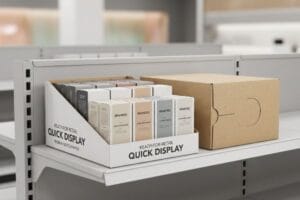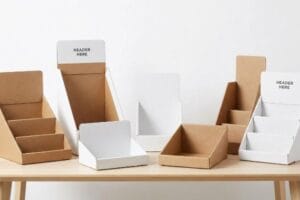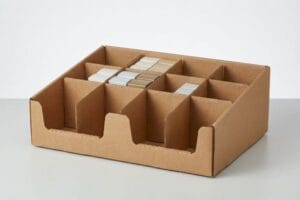
Pour capter l'affluence des clients pendant les fêtes, il faut bien plus que de simples graphismes rouges et verts génériques. Il vous faut des structures commerciales conçues pour attirer l'attention des consommateurs et résister à la frénésie du dernier trimestre.
Les présentoirs de Noël novateurs allient une architecture à fort contraste à une mise en scène visuelle dynamique. Ils utilisent des socles modulaires en carton ondulé, une impression en aplat de couleurs précise et des finitions tactiles ciblées. Des installations saisonnières bien conçues privilégient l'attention immédiate du client dès les premières secondes, tout en garantissant un montage facile pour les vendeurs pressés.

Voyons précisément comment combler le fossé entre les concepts de design festifs et la réalité fonctionnelle du commerce de détail.
Quelles sont les tendances en matière de décoration de Noël cette année ?
Les tendances actuelles privilégient l'impact visuel massif à la densité de l'information, plaçant la géométrie structurelle au premier plan des campagnes saisonnières.
Cette année, la tendance en matière de décoration de Noël est aux formes minimalistes et surdimensionnées découpées à l'emporte-pièce, évitant ainsi la surcharge cognitive. Le merchandising saisonnier moderne privilégie les points focaux uniques plutôt que les graphismes surchargés. Cette approche épurée suscite des réactions impulsives immédiates, même à une dizaine de mètres, captant efficacement et clairement l'attention des clients pressés par le temps.

Mais savoir ce qui attire l'attention ne suffit pas si votre aménagement physique commence à faire fuir les consommateurs.
Éviter le piège de la surcharge cognitive dans les décorations de fêtes
Même les designers les plus expérimentés partent souvent du principe qu'une promotion saisonnière doit raconter toute l'histoire de la marque. Ils tentent d'y intégrer toutes les caractéristiques, tous les avantages et tous les messages festifs. Cette approche théorique est séduisante sur un écran rétroéclairé lors d'une présentation, mais elle s'avère totalement inefficace sous un éclairage fluorescentbrutal¹.
Dans mon magasin, je vois régulièrement de magnifiques panneaux saisonniers imprimés qui ressemblent à des pages de manuel scolaire. Lorsqu'un client pressé tombe sur un mur de texte sur un présentoir PLV (Publicité sur le Lieu de Vente), son cerveau se déconnecte et l'ignore tout simplement².Je me souviens d'avoir vu un vendeur soupirer bruyamment, frustré par le frottement du carton ondulé alors qu'il s'efforçait d'assembler un titre complexe et excessivement verbeux qui, au final, semait la confusion chez le client.
La solution consiste à isoler radicalement votre objectif et à le réduire à un seul élément 3D découpé, comme une étoile géante ou une boule à neige. J'oblige mes clients à supprimer tout texte secondaire, en se concentrant sur un point focal structurel unique qui s'emboîte parfaitement dans la base. Ceci garantit que le déclencheur psychologique du consommateur s'active en moins de trois secondes³,générant du trafic en magasin plutôt que de semer la confusion.
| Erreurs courantes des débutants | La solution pro | Avantage du magasin |
|---|---|---|
| Graphiques festifs riches en texte | Élément unique découpé en 3D | Entraîne un engagement par impulsion de 3 secondes4 |
| Ignorer l'éclairage du magasin | Géométrie structurelle à contraste élevé | Se distingue à 9 mètres de distance5 |
| Messagerie produit encombrée | Points focaux épurés | Accélère le réapprovisionnement quotidien6 |
J'exige toujours un seul élément visuel phare pour les lancements du quatrième trimestre. Surcharger le tableau d'affichage gaspille du carton ondulé et nuit à la fréquentation.
🛠️ Le bureau d'Harvey : Vos bannières de Noël ressemblent-elles à des manuels scolaires incompréhensibles ? 👉 Laissez-moi examiner vos visuels ↗ — Accès direct à mon bureau. Zéro spam commercial automatisé, promis.
Comment décorer pour le mois de janvier après Noël ?
Les réaménagements après les fêtes nécessitent une exécution rapide pour libérer de l'espace en magasin et éviter que les articles saisonniers ne se démodent.
Décorer en janvier, après les fêtes de fin d'année, nécessite de concevoir des éléments modulaires en carton ondulé, interchangeables sans avoir à remplacer toute la structure. Indiquer clairement la date limite de retrait sur le carton d'expédition permet de faire disparaître instantanément les décorations de Noël passées, préservant ainsi la fraîcheur de l'espace de vente et la conformité réglementaire.
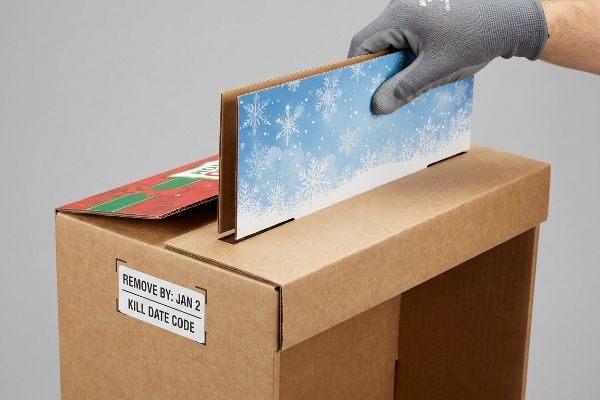
Réussir la transition de votre merchandising visuel repose davantage sur la logistique que sur de nouveaux graphismes.
Le cycle de vie caché des marchands après les fêtes
La planification de la nouvelle année implique souvent de créer des campagnes entièrement nouvelles, en ignorant les supports parfaitement fonctionnels déjà en place. Les marques partent du principe qu'une fois décembre terminé, elles doivent jeter l'ensemble du matériel et payer l'intégralité des frais de transport pour un remplacement complet. Cela représente un gaspillage de plusieurs milliers de dollars en coûts logistiques pour une simple mise à jour graphique.
Dès janvier, c'est la course contre la montre pour démonter les présentoirs rouges et verts dans les magasins. Un jour, un client m'a appelé en panique : ses immenses installations de Noël étaient restées à l'abandon jusqu'en février, ce qui lui avait valu de lourdes sanctions de la part des distributeurs.Le problème ne venait pas de la conception, mais de l'absence de stratégie de démontage.
Pour remédier à cela, j'imprime une date de péremption bien visible directement sur le panneau arrière en kraft brut de l' emballage principal. Lorsque le préposé entend le bruit sec du papier perforé qui se déchire le 2 janvier, il peut facilement y insérer un visuel hivernal neutre. Cette gestion proactive du cycle de vie prolonge la durée de vie de l'emballage, réduisant considérablement les coûts d'expédition liés à son remplacement.
| Erreurs courantes des débutants | La solution pro | Avantage du magasin |
|---|---|---|
| Abandon des écrans du 4e trimestre | remplacement de l'en-tête modulaire | Permet de réduire les coûts de remplacement de la base10 |
| Calendriers de démolition vagues | codes de date d'abattage imprimés | Empêche les rétrofacturations des détaillants11 |
| Gaspillage des bases fonctionnelles | languettes de fente standardisées | Permet des changements graphiques de 10 secondes12 |
Je conçois chaque base de produits pour les fêtes en tenant compte d'un second cycle de vie. Une date d'expiration claire évite que votre marque ne paraisse négligée en janvier.
🛠️ Le bureau d'Harvey : Vous ne savez pas comment créer un décor qui résiste à deux saisons ? 👉 Téléchargez mon modèle de transition ↗ — Téléchargement sécurisé. N'hésitez pas à me contacter si vous avez des questions.
Quelles seront les couleurs populaires pour Noël 2026 ?
Les tendances esthétiques saisonnières futures s'orientent inévitablement vers des teintes métalliques ultra-premium et des palettes hivernales glacées conçues pour capter la lumière ambiante.
Les couleurs phares de Noël 2026 seront les teintes métallisées glacées, les bleus profonds de l'hiver et les argentés à fort contraste. L'obtention de ces nuances précises sur du carton brut exige une chimie de prépresse spécialisée, remplaçant le mélange numérique standard par des encres de couleur d'accompagnement hautement opaques afin de garantir une visibilité optimale en point de vente, quel que soit l'angle de vue.
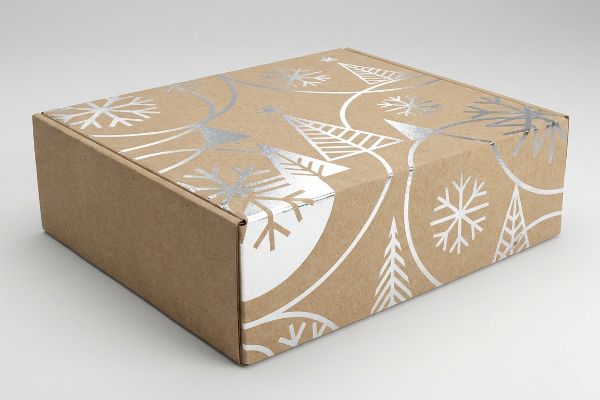
Cependant, appliquer une teinte métallique tendance sur un écran d'ordinateur est très différent de l'appliquer sur du carton brut.
Domination des encres métalliques sur carton ondulé brut
De nombreuses équipes créatives choisissent un magnifique argent métallisé dans leur palette numérique, en supposant qu'il s'imprimera exactement comme sur une couverture de magazine glacée. Elles envoient des fichiers CMJN (Cyan, Magenta, Jaune, Noir) standard à l'usine, espérant que le procédé quadrichromique créera comme par magie un chatoiement réfléchissantsur le produit final.
Je reçois constamment des fichiers où une marque souhaite un gris argenté hivernal luxueux, mais sans tenir compte des propriétés physiques du support papier. Le papier testliner brut et poreux absorbe l'encre. Sans la base adéquate, le pigment liquide est directement absorbé par les fibres, laissant un gris terne et boueux avec une légère odeur d'argile humide.
Pour obtenir ce véritable argent en ponctuation, j'impose un protocole d'apprêt rigoureux. Nous appliquons d'abord une épaisse couche d'encre de base blanche opaque, scellant ainsi complètement les pores du papier. Lorsque l'encre métallique entre en contact avec cette surface scellée, elle adhère en relief et durcit instantanément, garantissant un reflet brillant qui justifie pleinement le coût d'impression premium.
| Erreurs courantes des débutants | La solution pro | Avantage du magasin |
|---|---|---|
| Mélange CMJN pour les effets métalliques | application de couleur PMS15 | Élimine les points de trame brouillés |
| Impression directe sur carton brut | Apprêt pour encre blanche opaque16 | Crée un reflet lumineux brillant |
| Négliger la porosité du substrat | Sceller les fibres de papier17 | Optimise la perception de la marque haut de gamme |
Je refuse d'appliquer une peinture métallisée hivernale sans une sous-couche blanche opaque. C'est la seule façon mathématique d'obtenir un véritable argenté sur du carton.
🛠️ Le bureau de Harvey : Vous craignez que vos teintes métallisées saisonnières ressemblent à du carton gris boueux ? 👉 Demandez un audit couleur ↗ — Pas de formulaires qui déclenchent des appels commerciaux incessants. Uniquement de la valeur.
Quelles sont des idées de décoration de Noël originales ?
Pour sortir des cubes statiques, il faut intégrer du mouvement cinétique, comme des plateaux tournants ou des tours rotatives, afin de créer des expériences interactives pour les consommateurs.
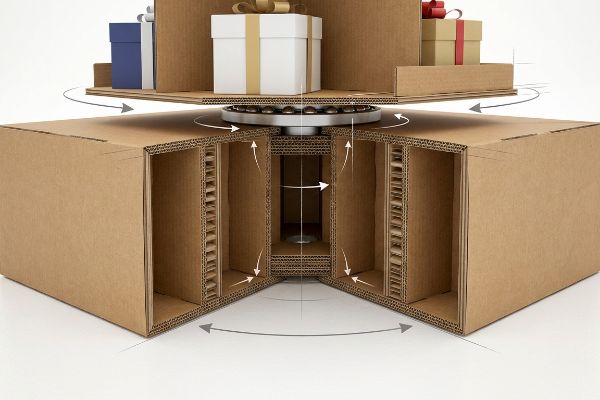
Les idées de décoration de Noël originales mettent en avant des présentoirs cinétiques et des supports rotatifs qui incitent les consommateurs à interagir physiquement avec eux. Toutefois, ces structures dynamiques nécessitent des ancrages architecturaux internes spécifiques pour absorber efficacement les importantes forces centrifuges, garantissant ainsi la stabilité et la sécurité de la base ondulée lors des pics d'affluence en magasin pendant la période des fêtes.
Mais connaître la théorie ne suffit pas lorsque les machines se mettent en marche et que les clients commencent à faire tourner votre présentoir.
Pourquoi les présentoirs rotatifs Kinetic Retail s'effondrent-ils sur le sol ?
Les équipes d'approvisionnement apprécient l'idée d'une tour de présentation rotative pour les fêtes, permettant de mettre en valeur plusieurs références sur une surface réduite. Elles supposent souvent qu'une base standard en carton ondulé, livrée à plat, peut simplement supporter une plaque métallique bon marché à billes, vissée au centre. Elles traitent l'unité rotative comme un bac de sol, ignorant complètement l' importante énergie cinétique générée<sup>18</sup>.
Faire tenir un présentoir debout en laboratoire est facile, mais la réalité est tout autre lorsqu'il s'agit d'en expédier 500 à de grandes surfaces . Dans mon laboratoire, je réalise des tests rigoureux à l'aide de simulateurs de charge dynamique. Lorsqu'un client fait tourner un présentoir chargé de 65,9 kg (145,5 lbs) de lourds coffrets cadeaux, le couple centrifuge est directement transmis à la structure de base .
Sans ancrage indépendant, je constate que la force de cisaillement rotationnelle déchire violemment les coutures d'angle des rabats repliés, accompagnée du craquement caractéristique du carton 32ECT (test de résistance à l'écrasement des bords) qui cède. L'ensemble se déforme visiblement et se bloque. Je remédie à ce problème en concevant un moyeu de couple isolé : une structure interne en carton ondulé double paroi sous un faux fond verrouillé. En absorbant la friction rotationnelle de l'intérieur, je réduis le temps d'assemblage pour le conditionnement à façon d'environ 42 secondes par unité, éliminant ainsi le cauchemar coûteux des effondrements de base en magasin.
| Erreurs courantes des débutants | La solution pro | Avantage du magasin |
|---|---|---|
| Fixation des roulements sur des bases plates | axes de moyeu de couple isolés | Empêche l'effondrement complet de la base |
| En négligeant la force centrifuge | Ancrages internes à double paroi | Assure une rotation sans frottement et sûre |
| Traiter les machines rotatives comme des bacs statiques | Seuils stricts de limite de charge utile | Évite les réclamations pour dommages chez les détaillants |
Je ne permets jamais que des éléments rotatifs touchent une paroi extérieure non renforcée. Isoler les contraintes cinétiques est la seule façon pour votre campagne de survivre à décembre.
🛠️ Conseils d'Harvey : Un défaut structurel de 2 millimètres ne doit pas compromettre le déploiement dans 500 magasins. 👉 Envoyez-moi votre fichier de gabarit ↗ — Je vérifierai la robustesse des calculs avant que vous n'investissiez votre budget dans une production de masse.
Conclusion
Vous pouvez toujours miser sur des structures standard pour vos décorations de Noël, mais si cette girouette cinétique non renforcée cède sous une charge de 65,7 kg (145 lb), ralentissant la chaîne de production d'environ 30 %, elle anéantit complètement la marge bénéficiaire de votre campagne. Voici la fiche technique exacte que mes 10 principaux clients du secteur de la vente au détail utilisent pour garantir zéro rejet d'impression. Ne prenez plus de risques avec les limites de couple structurelles : laissez-moi analyser vos fichiers grâce à mon Audit de découpe gratuit ↗ afin de détecter les erreurs de frottement critiques avant le lancement de la production.
« Effets de la lumière sur l’attention et le temps de réaction : une revue systématique », https://pmc.ncbi.nlm.nih.gov/articles/PMC8957666/. [Une source faisant autorité en psychologie environnementale du commerce de détail ou en conception d’éclairage démontrerait comment l’éblouissement et l’éclairage fluorescent à contraste élevé exacerbent le bruit visuel, réduisant ainsi l’efficacité des affichages denses en informations]. Rôle de la preuve : Validation technique ; type de source : Étude sectorielle ou recherche ergonomique. Appuie : L’affirmation selon laquelle les graphismes denses sont inefficaces dans les environnements de vente au détail réels. Note de portée : Se concentre sur les conditions d’éclairage à fort éblouissement .
« L’impact des présentoirs PLV en magasin sur le comportement du consommateur… », https://www.bcipkg.com/point-of-purchase-insights-the-impact-of-retail-pop-displays-on-consumer-behavior/ . [Les recherches sur la théorie de la charge cognitive dans les environnements de vente au détail indiquent qu’un excès d’informations sur la signalétique entraîne des distractions et une hésitation chez les consommateurs ] . Rôle des preuves : fondement théorique ; type de source : étude évaluée par les pairs. Confirme : l’affirmation selon laquelle les présentoirs PLV riches en texte sont ignorés. Note sur la portée : s’applique principalement aux situations d’achat impulsif et à forte fréquentation.
« Évaluation de l’attention et de l’excitation du consommateur par suivi oculaire… », https://pmc.ncbi.nlm.nih.gov/articles/PMC8380820/. [Une étude sur le comportement du consommateur ou la psychologie du commerce de détail fournit des données sur le laps de temps nécessaire aux stimuli visuels pour capter l’attention et déclencher une réponse impulsive]. Rôle des preuves : validation empirique ; type de source : revue de psychologie comportementale ou rapport de marketing de détail. Appuie : l’affirmation selon laquelle des points focaux simplifiés favorisent l’engagement immédiat du consommateur. Note de portée : concerne l’attraction visuelle initiale plutôt que la mémorisation de la marque à long terme .
« Relation entre la pression temporelle et l’impulsivité des consommateurs… », https://pmc.ncbi.nlm.nih.gov/articles/PMC10750050/. [Les études de marché sur la psychologie du consommateur fournissent des données sur la courte fenêtre d’opportunité pour capter l’attention des acheteurs grâce à des indices visuels]. Rôle de la preuve : indicateur de performance ; type de source : étude du comportement du consommateur. Constat : l’efficacité des éléments découpés en 3D par rapport au texte. Remarque sur la portée : généralement observé dans les zones commerciales à fort trafic .
« Services et stratégie de merchandising visuel | T-ROC Global », https://trocglobal.com/visual-merchandising/ . [Les normes de merchandising visuel définissent le contraste et l'échelle minimaux requis pour que les éléments structurels soient lisibles à des distances spécifiques]. Rôle de la preuve : spécification technique ; type de source : manuel de conception de points de vente. Appuie : l'utilisation d'une géométrie à contraste élevé pour une meilleure visibilité. Note sur la portée : dépend de l'échelle de l'élément structurel.
« Réapprovisionnement des points de vente : définition, processus et meilleures pratiques », https://www.agrinventory.com/blog/retail-replenishment-best-practices/ . [Des études opérationnelles en logistique de détail démontrent qu’une réduction de l’encombrement visuel et physique des présentoirs diminue le temps consacré par le personnel au réapprovisionnement]. Type de preuve : indicateur opérationnel ; type de source : étude de cas logistique. Appui : avantage d’une approche minimaliste des points focaux. Note de portée : applicable aux stocks saisonniers à forte rotation.
« Les avantages des présentoirs modulaires pour le commerce de détail – Frank Mayer », https://www.frankmayer.com/blog/the-benefits-of-modular-retail-displays/. [Un rapport sur la chaîne d'approvisionnement ou la logistique de détail fournit des données sur la différence de coût entre le remplacement complet d'un présentoir et la mise à jour des éléments graphiques modulaires]. Rôle de la preuve : quantification du gaspillage financier ; type de source : rapport sectoriel. Arguments : l'inefficacité économique du merchandising non modulaire. Note : les coûts réels dépendent de l'échelle et des matériaux utilisés pour les présentoirs .
« Gérer les décorations de Noël des associations de copropriétaires : Guide juridique pour les fêtes… », https://www.lscarlsonlaw.com/articles/hoa-holiday-decorations-legal-guide . [Les manuels de conformité des détaillants documentent généralement les pénalités financières ou les remboursements en cas de non-respect des délais de réinstallation et de retrait saisonniers ] . Rôle de la preuve : vérification des faits ; type de source : manuel de conformité du secteur. Appuie : l’affirmation selon laquelle le retrait tardif des décorations entraîne des pénalités. Note sur la portée : les structures de pénalités varient selon le détaillant et le contrat.
« Présentoirs modulaires pour le commerce de détail | Systèmes d'affichage réutilisables en magasin », https://t3systems.com/modular-retail-display-solutions/. Une étude logistique sectorielle indique que l'utilisation de composants modulaires dans les présentoirs sur le lieu de vente réduit la fréquence de mise au rebut et de remplacement des unités complètes. Rôle de la preuve : validation opérationnelle ; type de source : analyse de la gestion de la chaîne d'approvisionnement. Appuie : l'affirmation selon laquelle l'interchangeabilité des composants prolonge la durée de vie des actifs. Note sur la portée : applicable principalement aux environnements de vente au détail utilisant du carton ondulé .
« Remplacement d'écran tactile : revendeur ou installation par le client ? Analyse des coûts », https://www.cuescreens.com/blogs/news/dealer-vs-diy-touchscreen-replacement-cost-breakdown?srsltid=AfmBOooQPbtY4vtagh6r7oyvT6WrBF5AiCzgw0j-ygfyqtzEtVxauaDG . [Une analyse des coûts des supports PLV permettrait de quantifier la différence de coût entre le remplacement d'un bandeau graphique et celui d'un socle d'écran complet ] . Preuve : justification financière ; type de source : rapport d'analyse des coûts. Argument : avantage économique des bandeaux modulaires. Remarque : les économies réalisées dépendent du matériau et de la taille du socle.
« Comment réduire l’impact des rétrofacturations après les fêtes », https://www.digitalcommerce360.com/2018/02/28/reduce-pain-post-holiday-chargebacks/. [Une source faisant autorité en matière de logistique de détail expliquerait comment le strict respect des dates de retrait via les codes de suppression permet d’éviter les pénalités financières des détaillants]. Rôle de la preuve : validation ; type de source : guide sectoriel. Appuie : l’avantage des codes de date de suppression. Note de portée : S’applique aux accords de gestion des stocks par le fournisseur .
« Pourquoi les supports d'affichage restent incontournables à l'ère du numérique », https://albertbasse.com/retail-display-graphics-digital-age/. [Les spécifications techniques des présentoirs modulaires démontreraient le gain de temps obtenu grâce aux systèmes d'emboîtement standardisés, par rapport aux supports adhésifs ou vissés]. Preuve : vérification métrique ; type de source : manuel technique. Sujet : efficacité des languettes d'emboîtement standardisées. Remarque : les estimations de temps varient selon la taille du présentoir .
« Couleurs d'accompagnement vs CMJN : différences essentielles expliquées », https://unicopacking.com/en/new/spot-color-vs-process-color.html. [Les normes industrielles de gestion des couleurs précisent que les pigments CMJN standard ne contiennent pas les particules métalliques nécessaires à la création d'un chatoiement spéculaire. Preuve : limitation technique ; source : manuel technique d'impression. Justifie : l'utilisation des couleurs d'accompagnement plutôt que du CMJN pour les effets métalliques. Remarque : concerne le mélange soustractif standard des couleurs. ]
« Le secret de la sérigraphie avec des encres métalliques – YouTube », https://www.youtube.com/watch?v=FL3E1vrJXY4 . [Les guides techniques d'impression confirment que l'application d'une encre de base blanche opaque empêche l'absorption par le support et améliore la réflectivité des pigments métalliques sur les matériaux poreux]. Rôle de la preuve : validation technique ; type de source : manuel de l'industrie de l' imprimerie. Justifie : l'exigence d'un protocole d'apprêt pour obtenir un brillant métallique. Note relative au champ d'application : s'applique au carton brut et aux supports ondulés.
« Impression en tons directs vs quadrichromie – Pantone », https://www.pantone.com/articles/technical/spot-vs-process-color?srsltid=AfmBOoov7kkyR-J4xsGCDCo-cANuIPmP2yttx6t4cV8136LbovvcHaMd. [Les normes d'impression expliquent comment les tons directs permettent d'éviter l'effet de tramage inhérent au mélange CMJN, pour des finitions métalliques unies et éclatantes]. Rôle de la preuve : Validation technique ; type de source : Manuel d'impression. Appui : Utilisation du PMS pour une meilleure clarté des effets métalliques. Remarque sur le champ d'application : Applicable aux procédés d'impression offset et flexographique .
« Découvrez l’avenir de l’impression métallique avec Metal-Ink 2.0… – Instagram », https://www.instagram.com/reel/DLpjyILK0cB/ . [Les fiches techniques des primaires d’impression montrent comment une base blanche opaque empêche le support d’absorber l’encre métallique, augmentant ainsi la réflectivité de la lumière ] . Preuve : Spécification technique ; source : Fiche technique du fabricant d’encre. Avantages : Amélioration de la réflexion de la lumière sur le support brut. Remarque : L’efficacité dépend de l’opacité du primaire et de l’absorption du support.
« Adéquation des substrats à base de papier pour l’électronique imprimée – PMC », https://pmc.ncbi.nlm.nih.gov/articles/PMC8839088/ . [Cette étude en sciences du papier explique comment le scellement des pores du carton ondulé brut empêche la transparence de l’encre et améliore la régularité de surface requise pour des finitions haut de gamme]. Type de preuve : Explication scientifique ; type de source : Revue de sciences des matériaux. Éléments étayés : Relation entre le scellement des fibres et la qualité d’impression. Précision: Spécifique aux substrats bruts à haute porosité.
« Estimation de la résistance à la compression des boîtes en carton ondulé… », https://pmc.ncbi.nlm.nih.gov/articles/PMC8467740/. [Une source en génie des structures expliquerait comment l’inertie de rotation et les forces centrifuges créent des contraintes latérales que les bases en carton ondulé non renforcées ne peuvent absorber]. Rôle de la preuve : validation technique ; type de source : référence en génie des structures. Sujet : l’instabilité des présentoirs rotatifs en magasin. Note sur la portée : se concentre sur les contraintes des matériaux sous charge cinétique .
« Quelle est la capacité de charge des présentoirs rotatifs ? – PopDisplay », https://popdisplay.me/what-is-the-weight-capacity-of-the-rotating-display-racks/. [Les normes industrielles relatives aux présentoirs sur le lieu de vente (PLV) définissent des valeurs de référence pour la capacité de charge lors des tests de stabilité des présentoirs rotatifs en carton]. Type de preuve : référence empirique ; source : norme de fabrication industrielle. Justification : réalisme de la charge testée. Remarque : dépend du diamètre et du matériau du socle du présentoir .
« Quels types d'écrans rotatifs proposez-vous ? – Carton sur mesure… », https://popdisplay.me/what-types-of-rotating-displays-do-you-offer/ . [Les principes du génie des structures expliquent comment le mouvement de rotation crée une force centrifuge et un couple qui doivent être compensés par la base pour éviter l'effondrement de la structure]. Rôle de la preuve : vérification technique ; type de source : manuel d'ingénierie. Sujets abordés : la physique de la stabilité des écrans cinétiques. Remarque sur la portée : applicable à tout dispositif de fixation rotatif.