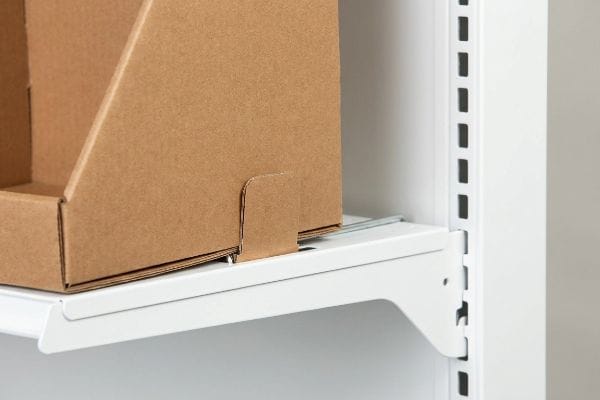
Vous avez du mal à installer votre nouveau présentoir sans déchirer le carton ? Une installation ratée compromet la présentation de vos produits et le respect des règles d’agencement des allées.
L'installation d'un présentoir motorisé nécessite la fixation d'un support métallique ou de clips en S en plastique sur l'étagère de la gondole. Il suffit d'aligner les fentes de montage ondulées prédécoupées, de faire glisser le présentoir vers le bas jusqu'à ce qu'il se verrouille solidement et de s'assurer que la base repose bien à plat contre l'extrémité de l'allée.
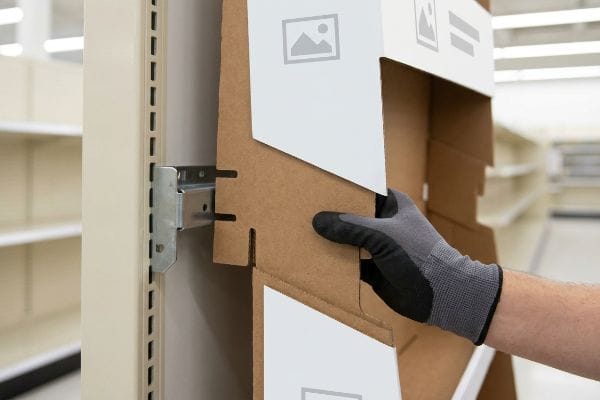
La maîtrise de cette connexion matérielle n'est que la base. Pour comprendre pourquoi ces présentoirs mobiles dominent les rayons des magasins, il faut examiner les exigences structurelles sous-jacentes.
Qu'est-ce qu'un Power Wing Display ?
Vous n'avez que quelques secondes pour détourner l'attention d'un client. Si votre présentoir d'appoint ne s'intègre pas parfaitement à la gondole, il n'atteindra même pas la surface de vente.
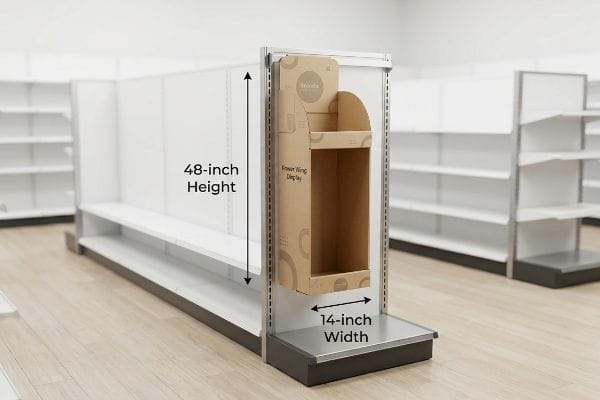
Un présentoir latéral, aussi appelé « decorateur d'angle », est un présentoir vertical en carton ondulé conçu pour être suspendu aux extrémités des rayons des magasins. Ces présentoirs optimisent l'espace inutilisé des allées et respectent des dimensions standardisées afin de s'adapter à tous les types d'étagères des grandes surfaces.
Mais la qualité d'un présentoir suspendu dépend de sa compatibilité géométrique avec le mobilier du magasin.
La contrainte spatiale « d’ajustement universel »
Les marques partent souvent du principe que n'importe quel présentoir suspendu peut facilement être installé en tête de gondole. Elles privilégient les graphismes tape-à-l'œil et les formes originales, croyant qu'attirer l'attention du client grâce à une présence imposante est le seul obstacle à la réussite d'une opération promotionnelle en magasin.
En réalité, l'implantation en point de vente est bien plus contraignante en matière d'espace. Ces présentoirs doivent respecter des normes strictes, généralement limitées à 122 cm de hauteur et 36 cm de largeur¹.Si un présentoir dépasse ces dimensions minimales, il entrave la circulation des clients et gêne le passage des chariots dans les allées principales. Les détaillants refusent systématiquement les présentoirs non conformes afin de garantir une circulation fluide dans les allées, faisant du respect des dimensions de base l'étape cruciale pour la réussite de toute campagne de présentoirs d'appoint.
| Métrique/Fonctionnalité | Approche générique | Réalité artificielle |
|---|---|---|
| Profil de largeur | dimensionnement arbitraire personnalisé | Limite fixe de 14 pouces2 |
| Empreinte verticale | Plus de 50 pouces | Limité à 48 pouces3 |
| Dégagement des allées | Risque de collision élevé | Circulation fluide |
Le strict respect des directives commerciales en vigueur garantit une acceptation universelle en magasin. Un aménagement spatial adéquat protège votre campagne des refus frustrants en rayon.
🛠️ Le bureau de Harvey : Vos présentoirs latéraux sont-ils constamment refusés par les gérants de magasin car ils empiètent sur l’allée principale ? 👉 Demandez un audit de compatibilité spatiale gratuit ↗ — J’examine personnellement chaque fichier structurel sous 24 heures.
Qu'est-ce qu'une aile motorisée ?
Les conventions d'appellation varient au sein de la chaîne d'approvisionnement du commerce de détail, mais la réalité matérielle de base demeure la même. Une campagne d'accompagnement réussie nécessite un ancrage mécanique adéquat.
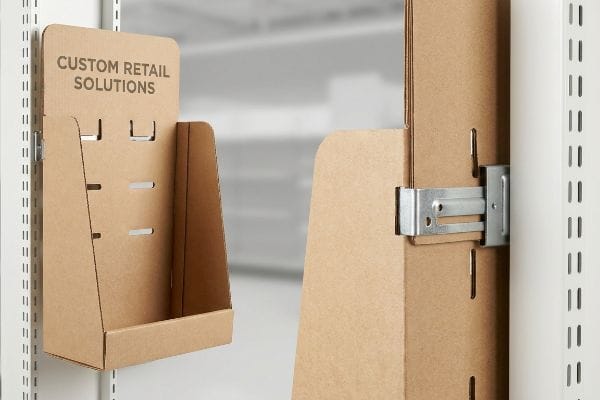
Un présentoir d'extrémité, ou « power wing », est un autre terme technique désignant un présentoir latéral ou de bout de gondole. Il utilise des supports métalliques standardisés ou des clips en S en plastique pour fixer solidement des panneaux ondulés légers directement sur les montants rigides des panneaux perforés ou des étagères standard des magasins.
Comprendre la terminologie est facile, mais la réussite de l'installation nécessite une compatibilité matérielle spécifique.
Garantir la compatibilité matérielle adéquate
Les équipes marketing se concentrent souvent exclusivement sur le visuel et le message promotionnel de leurs présentoirs suspendus. Elles partent du principe que de simples perforations et des attaches en plastique standard suffiront à maintenir leurs produits de marque pendant toute la durée d'une promotion classique en magasin.
Dans un contexte de vente au détail réel, la compatibilité du matériel est essentielle au succès. Les responsables merchandising ont besoin de supports métalliques universels ou de fixations en S robustes compatibles avec le système d'étagères du magasin. Le panneau arrière ondulé doit être conçu avec des encoches spécifiques pour accueillir parfaitement ces supports standard . L'utilisation du matériel approprié garantit que le présentoir supporte le poids des produits sans s'affaisser, assurant ainsi une présentation professionnelle et accessible aux clients tout au long de la campagne.
| Métrique/Fonctionnalité | Approche générique | Réalité artificielle |
|---|---|---|
| Matériel de montage | Colliers de serrage en plastique fragiles | Support métallique universel6 |
| Conception de la machine à sous | Découpes grossières et lâches | Emplacements matériels mappés7 |
| Présentation | S'affaisse avec le temps | Professionnel et sécurisé |
Choisir le matériel de fixation standard adapté garantit la visibilité et la sécurité de votre promotion. Un présentoir bien fixé stimule les achats impulsifs tout au long de son cycle de vie en magasin.
🛠️ Harvey's Desk : Vos systèmes d'accrochage pour présentoirs abîment-ils vos plaques arrière ondulées et provoquent-ils une fermeture prématurée de votre point de vente ? 👉 Demandez votre test de résistance matériel gratuit ↗ — Confidentialité garantie à 100 %. Vos maquettes non commercialisées sont en sécurité.
Quelles sont les alternatives aux écrans Powerwing ?
La capacité de suspension a ses limites pratiques. Lorsque votre gamme de produits est tout simplement trop volumineuse pour un présentoir latéral, vous devez vous tourner vers des stratégies de placement au sol.
Parmi les alternatives aux présentoirs à bras articulés, on trouve les présentoirs de sol fractionnés, comme les quarts et les demi-palettes. Au lieu d'être suspendus à une tête de gondole, ces présentoirs compacts et autoportants reposent directement sur le sol, offrant une capacité de charge supérieure tout en s'intégrant parfaitement aux intersections des allées à fort trafic des magasins.
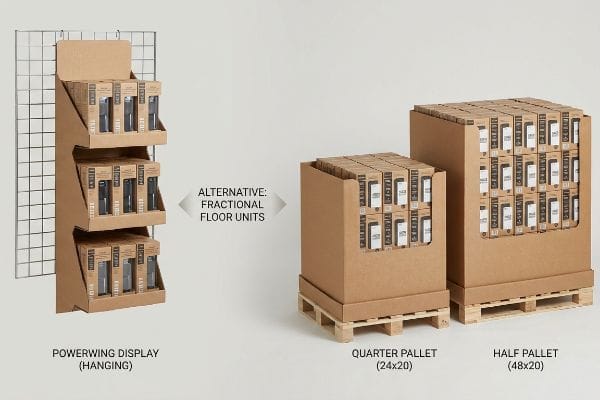
Le passage d'une étagère à une installation au sol résout les problèmes de charge utile, mais nécessite une planification précise de l'encombrement.
Le pivot de palette fractionnaire
Lors du passage des présentoirs suspendus aux présentoirs de sol traditionnels, les responsables de marque demandent souvent des présentoirs de grande taille. Ils partent du principe qu'une surface plus importante générera automatiquement une meilleure visibilité de la marque et permettra d'exposer l'intégralité de leur stock pour un impact maximal sur la surface de vente.
Les détaillants protègent farouchement leur surface de vente et approuvent rarement des emplacements complets de 122 x 102 cm (48 x 40 pouces) pour les cycles promotionnels standards. Pour une transition réussie, il est donc nécessaire d'utiliser des palettes fractionnées standardisées, comme des quarts de palette (61 x 51 cm ou 24 x 51 cm ou 48 x 20 pouces) ou des demi-palettes (122 x 51 cm ou 48 x 20 pouces). Le fractionnement de l'espace selon les recommandations de la Grocery Manufacturers Association (GMA) s'intègre parfaitement à la planification spatiale rigoureuse du détaillant. Cette stratégie permet de sécuriser un espace précieux, garantit une validation rapide en magasin et simplifie considérablement la logistique d'expédition pour la marque.
| Métrique/Fonctionnalité | Approche générique | Réalité artificielle |
|---|---|---|
| Dimensions au sol | Dimensionnement arbitraire | Palettes fractionnaires exactes9 |
| Utilisation des palettes | imbrication inefficace | Subdivision parfaite10 |
| Approbation de vente au détail | Taux de rejet élevé11 | Approbation spatiale rapide |
L'adoption d'emprises au sol fractionnées standardisées garantit un emplacement optimal dans les zones à fort passage lorsque les présentoirs suspendus ne sont pas envisageables. Proposer des dimensions adaptées aux détaillants est la solution la plus rapide pour obtenir une validation rapide de l'implantation en magasin.
🛠️ Le bureau de Harvey : Vos produits lourds sont-ils refusés car vos présentoirs imposants occupent trop d’espace en magasin ? 👉 Obtenez un audit gratuit du calcul des palettes fractionnées ↗ — Pas d’intermédiaires. Vous parlez directement à des ingénieurs en structure.
Power Wing est-il légitime ?
Il est légitime d'être sceptique lorsqu'il s'agit de placer des articles coûteux sur des présentoirs temporaires. Le carton ondulé peut-il réellement supporter votre charge promotionnelle pendant toute la durée de la vente au détail ?
Oui. Un présentoir à rayonnages motorisés est une solution tout à fait valable lorsqu'il est bien conçu, supportant sans effort des charges importantes pour la vente au détail. Grâce à l'utilisation de carton ondulé de haute qualité, de plis d'en-tête stratégiquement placés et de supports universels, ces présentoirs maintiennent les produits en toute sécurité, sans s'affaisser ni se rompre, dans des conditions normales d'utilisation en magasin.
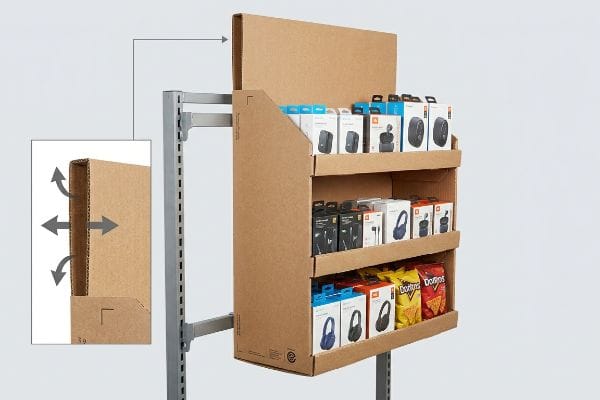
Cela fonctionne parfaitement sur le terrain, mais seulement si vous vous préparez aux interactions quotidiennes en magasin.
Construire pour la pérennité du commerce de détail
Les nouveaux vendeurs ont parfois tendance à rejeter les présentoirs suspendus en carton ondulé, les jugeant fragiles et pensant qu'ils ne conviennent qu'aux articles légers à forte consommation impulsive, comme les bonbons en sachet . Ils estiment que les emballages de vente au détail classiques ne sont pas suffisamment fiables pour être utilisés sur une structure temporaire en carton pour des produits lourds.
Correctement conçus, les présentoirs latéraux en carton ondulé sont extrêmement robustes et parfaitement adaptés à une large gamme de produits de consommation. Leur succès repose sur une planification réaliste des interactions courantes en magasin, où les clients consultent et manipulent constamment des articles. Grâce à des améliorations structurelles simples, comme un bandeau supérieur double paroi plié(12), le présentoir acquiert la solidité nécessaire pour résister à une utilisation quotidienne intensive. Cette conception soignée garantit la durabilité du présentoir, le maintien en toute sécurité d'articles plus lourds et la pérennité de son efficacité en tant qu'outil promotionnel.
| Métrique/Fonctionnalité | Approche générique | Réalité artificielle |
|---|---|---|
| Capacité de charge utile | Suppose uniquement une version légère | Soutient des biens diversifiés |
| Structure de l'en-tête | panneau simple paroi de base13 | En-tête à double paroi repliée14 |
| Endurance du commerce de détail | Perception fragile | performances quotidiennes robustes |
Choisir la bonne résistance de panneau transforme un simple présentoir suspendu en un outil de merchandising haut de gamme. Une planification rigoureuse garantit que votre présentoir supportera efficacement vos produits de grande valeur.
🛠️ Harvey's Desk : Vos présentoirs suspendus sont-ils arrachés de leurs supports métalliques par des clients agressifs ? 👉 Demandez votre audit gratuit de votre en-tête Kinetic ↗ — J'examine personnellement chaque fichier structurel sous 24 h.
Quels sont les avantages des ailes motorisées ?
Pourquoi s'embêter à installer un présentoir alors qu'il existe des gondoles standard ? Parce que le fait de placer mathématiquement votre produit dans le champ de vision naturel d'un client détermine la vitesse d'achat impulsif.
Les principaux avantages des présentoirs suspendus sont de stimuler les achats impulsifs, d'optimiser l'utilisation des têtes de gondole et de favoriser les ventes croisées. En positionnant les produits à la hauteur du regard du client, ces présentoirs perturbent le flux de clients et augmentent considérablement le taux de conversion.
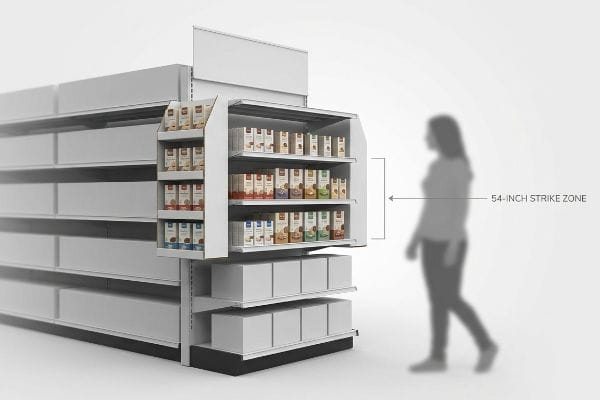
Obtenir cette vente impulsive n'est pas un hasard ; c'est le résultat direct d'un ciblage biologique et d'un alignement structurel en hauteur.
Zone de frappe ergonomique de 54 pouces
Dans mon magasin, je vois régulièrement des rendus 3D théoriques qui partent du principe que n'importe quel présentoir suspendu générera automatiquement des ventes simplement en étant déplacé de l'étagère principale. Ils ne tiennent pas compte de l'ergonomie de la disposition des produits<sup>15</sup>, reléguant arbitrairement les produits phares au bas des rayons et obligeant les clients pressés à détourner leur regard<sup>16</sup> pour lire l'emballage.
Il ne s'agit pas que de théorie : j'en constate les conséquences désastreuses sur la chaîne de test CNC lors du montage des prototypes sur les montants standard des nacelles. Lors d'un récent audit de visibilité, le produit phare d'un client était fixé à 965,2 mm (38 pouces) du sol, hors du champ de vision périphérique d'un adulte moyen. J'ai immédiatement interrompu la production et repositionné numériquement les principaux éléments découpés dans la zone verticale optimale de 1 270 à 1 371,6 mm (50 à 54 pouces). En modifiant le centre de gravité et en rehaussant mathématiquement le point focal sans augmenter l'encombrement, nous avons immédiatement créé une rupture tactile et accéléré les ventes quotidiennes.
| Métrique/Fonctionnalité | Approche générique | Réalité artificielle |
|---|---|---|
| Focus produit | Placement aléatoire des étagères | Cible de 50 à 54 pouces (1270 à 1371,6 mm)17 |
| Plan visuel | Oblige l'acheteur à se plier | Se fixe à la ligne naturelle des yeux18 |
| Fréquence d'impulsion | Manque à l'appel | Conversion tactile immédiate |
Concevoir des perspectives visuelles adaptées à la biologie humaine donne des résultats bien supérieurs à ceux obtenus en comblant simplement les espaces vides. Surélever vos produits phares garantit mathématiquement un impact visuel maximal et des revenus accrus.
🛠️ Le bureau de Harvey : Vos articles à forte marge sont-ils relégués au fond de votre présentoir, hors du champ de vision du client ? 👉 Obtenez une analyse ergonomique gratuite de votre champ de vision ↗ — Confidentialité garantie à 100 %. Vos prototypes non commercialisés sont en sécurité.
Conclusion
La maîtrise de l'installation d'une étagère mobile est inutile si la structure métallique ondulée sous-jacente ne supporte pas le poids dynamique ou si elle est mal alignée avec le regard du client. Récemment, lors d'un contrôle technique, une erreur de tolérance de 2 mm dans la fente d'un support de suspension a été détectée avant même le début de la production, lors d'un déploiement national majeur. Pour garantir la résistance de vos étagères aux frottements dans les allées, je vous propose un audit cinétique gratuit de vos fichiers structurels ↗. Je vous assure ainsi que votre chargement reste bien fixé à l'extrémité de l'étagère.
« Présentoir Sidekick personnalisé en carton, Powerwing… », https://grandfly.com/cardboard-display/sidekick-powerwing-display/. Les spécifications commerciales du secteur ou les directives des détaillants vérifient les dimensions maximales autorisées pour les présentoirs Sidekick afin de garantir la sécurité et la conformité. Rôle de la preuve : spécification technique ; type de source : manuel du secteur. Supporte : les contraintes spatiales standardisées pour les ailes motorisées. Remarque : les dimensions spécifiques peuvent varier d’une chaîne de grandes surfaces à l’autre
« Présentoirs latéraux motorisés personnalisés », https://www.creativedisplaysnow.com/display/power-wing-sidekick-displays/ . Vérification des contraintes de largeur standard pour les présentoirs latéraux ou latéraux motorisés afin de garantir leur compatibilité avec les gondoles universelles. Type de preuve : spécification technique ; source : manuel d’agencement de points de vente. Éléments pris en charge : limitations de largeur. Remarque : peut varier selon les directives spécifiques des détaillants.
« 14 types de présentoirs de vente au détail | Chicago, IL », https://wertheimerbox.com/types-of-retail-displays/ . Vérification de l’encombrement vertical maximal autorisé pour les présentoirs latéraux de point de vente afin d’éviter l’obstruction des allées. Rôle de la preuve : spécification technique ; type de source : directives de marchandisage en magasin. Appuie : contraintes d’encombrement vertical. Note de portée : se réfère à la hauteur physique du présentoir.
« Clip de fixation, clip en J Sidekick, support Powerwing », https://www.shopangolawire.com/Sidekick-Shelf-J-Clip-p/c-skjclp.htm. Vérification des composants matériels standard utilisés pour fixer les présentoirs Sidekick aux rayonnages de vente au détail. Rôle de la preuve : spécification technique ; type de source : catalogue du fabricant ou guide d’équipement de vente au détail. Supporte : les exigences matérielles pour les supports Powerwing. Note sur la portée : se concentre sur les normes industrielles courantes .
« Présentoirs Power Wing et Sidekick », https://brownpackaging.com/custom-packaging-products/pop-displays/corrugated/power-wing-sidekick/. Confirmation que les présentoirs en carton ondulé nécessitent des découpes précises pour l’intégration des supports. Rôle de la preuve : spécification de conception ; type de source : guide d’ingénierie d’emballage. Appuie : exigences de conception structurelle pour les supports Power Wing. Note de portée : s’applique aux présentoirs en carton ondulé. ↩
« Conception personnalisée de présentoirs Power Wing », https://pack-design.com/custom-power-wing-display-design/ . Les guides de présentation officiels pour la vente au détail recommandent l'utilisation de supports métalliques plutôt que de supports en plastique pour une meilleure intégrité et stabilité structurelles. Preuve : spécification technique ; type de source : manuel industriel. Appui: l'utilisation de supports métalliques comme norme professionnelle de montage. Remarque : concerne les accessoires de montage Sidekick.
« 7 avantages des présentoirs Sidekick – PopDisplay », https://popdisplay.me/7-benefits-of-sidekick-displays/. Les spécifications de fabrication des présentoirs haut de gamme pour la vente au détail détaillent l’utilisation de fentes de précision pour garantir la compatibilité et l’ajustement du matériel. Rôle de la preuve : norme de conception ; type de source : spécification de fabrication. Appuie : l’avantage technique des fentes de précision par rapport aux découpes grossières. Note sur la portée : spécifique au matériel d’affichage technique. ↩
« Types de présentoirs sur palette : pleine, demi et quart », https://greendotpackaging.com/understanding-pallet-display-types-full-half-and-quarter-pallet-displays/. Documentation des normes sectorielles établies par la GMA concernant l’aménagement de l’espace et l’encombrement des palettes. Niveau de preuve : norme sectorielle ; type de source : recommandations d’une association professionnelle. Appuie : l’affirmation selon laquelle l’approbation en point de vente est conforme à des directives institutionnelles spécifiques. Note relative au champ d’application : s’applique principalement aux secteurs de l’épicerie et des biens de consommation courante .
« Présentoirs attrayants pour les magasins-entrepôts », https://www.qpack.com/retail-displays/pallet/club-store. Vérification des dimensions normalisées des palettes fractionnées utilisées pour optimiser l’espace de vente. Type de preuve : spécification technique ; source : manuel de logistique. Contribue à : la précision du dimensionnement des palettes fractionnées. Note relative au périmètre : normes de vente au détail nord-américaines .
« Présentoir sur palette », https://www.smurfitwestrock.com/products/retail-displays-and-signage/retail-displays/pallet-displays . Analyse des taux d'utilisation spatiale lors de l'utilisation d'empreintes de palettes subdivisées par rapport à un placement arbitraire. Type de preuve : mesure comparative ; type de source : recherche sur la chaîne d'approvisionnement. Confirme : l'affirmation d'une utilisation optimisée des palettes. Note sur la portée : limité aux placements au niveau du sol.
« 7 caractéristiques d'un présentoir à fort impact en magasin », https://www.smurfitwestrock.com/blog/7-features-of-a-high-impact-retail-display . Données statistiques sur la fréquence des rejets de présentoirs en magasin en raison d'une empreinte au sol non conforme ou arbitraire. Type de preuve : statistique ; source : rapport de gestion de la vente au détail. Confirme : l'affirmation selon laquelle les approches génériques entraînent un taux de rejet plus élevé. Précision : concerne les grandes surfaces.
« CONCEPTION STRUCTURELLE DES PRÉSENTOIRS INTERACTIFS… », https://www.bcipkg.com/display-structural-design-for-interactive-retail-displays/. Vérification technique de la manière dont la construction en carton ondulé double cannelure augmente la résistance à la compression verticale et la rigidité d'un bandeau de présentation en point de vente. Rôle de la preuve : spécification technique ; type de source : guide d'ingénierie de l'emballage. Appuie : l'affirmation selon laquelle les bandeaux de présentation double cannelure offrent une résistance structurelle. Remarque : les résultats varient selon le type de cannelure .
« Spécifications du carton ondulé », https://www.fibrebox.org/assets/2025/09/Walmart_Corrugated-Board_Specifications_Automation_Packaging_Standards.pdf . Les normes industrielles relatives aux emballages en carton ondulé définissent les limites de charge et les taux de déformation du carton simple cannelure dans les environnements de vente au détail. Rôle de la preuve : Référence comparative ; type de source : Manuel de science des matériaux. Points à retenir : La tendance du carton standard à se rompre sous des charges promotionnelles plus importantes. Note sur la portée : Application générale aux présentoirs en carton.
« Focus sur les matériaux : Explorer les avantages du carton ondulé… », https://wicpackaging.com/material-spotlight-exploring-the-benefits-of-corrugated-cardboard/ . La documentation technique sur le cannelage du carton ondulé explique comment les constructions à double cannelure augmentent considérablement la résistance à l’écrasement vertical et la rigidité. Type de preuve : Spécification technique ; type de source : Guide d’ingénierie de l’emballage. Arguments : La supériorité structurelle des fonds de caisse renforcés par rapport aux fonds de caisse standard. Précision : Concerne spécifiquement le carton ondulé.
« Cadre d’analyse des facteurs humains pour la conception des présentoirs », https://ntrs.nasa.gov/api/citations/19990009348/downloads/19990009348.pdf. Les normes de conception industrielle pour les présentoirs de vente au détail fournissent des lignes directrices sur la géométrie des charges utiles afin de garantir la stabilité structurelle et une accessibilité optimale pour les consommateurs. Rôle de la preuve : spécification technique ; type de source : manuel de conception industrielle. Appuie : la nécessité de calculer la géométrie des charges utiles pour les présentoirs. Note de portée : Spécifique aux présentoirs suspendus de vente au détail .
« La science du merchandising à hauteur des yeux », https://www.nexgenus.com/company/blog/the-science-of-eye-level-merchandising-does-it-really-drive-more-revenue . Des recherches en psychologie et ergonomie du commerce de détail établissent la hauteur moyenne à hauteur des yeux (zone de contact) qui maximise la visibilité des produits et les taux d'achats impulsifs. Type de preuve: données factuelles ; source : étude de commerce de détail évaluée par des pairs. Constat : l'existence et l'importance du plan visuel naturel. Public cible : consommateurs adultes.
« Conception des espaces de vente au détail pour des présentations efficaces et une meilleure expérience client… », https://www.business.qld.gov.au/industries/manufacturing-retail/retail-wholesale/retail-displays . Norme industrielle ou étude ergonomique confirmant le positionnement vertical optimal pour la visibilité des produits en magasin. Type de preuve : spécification technique ; source : étude d’ergonomie du commerce de détail. Éléments justificatifs : plage de hauteurs spécifique pour une visibilité maximale. Remarque : les hauteurs moyennes peuvent varier selon les caractéristiques démographiques.
« Pourquoi les détaillants placent-ils les produits à hauteur des yeux ? – PopDisplay », https://popdisplay.me/why-do-retailers-place-products-at-eye-level/. Recherche sur le merchandising visuel et le comportement des consommateurs démontrant la corrélation entre le placement à hauteur des yeux et l’augmentation des taux d’engagement. Type de preuve : validation comportementale ; source : revue de psychologie du consommateur. Confirme : l’affirmation selon laquelle le positionnement à hauteur des yeux optimise la visibilité. Note relative à la portée : se concentre sur les moyennes des consommateurs adultes .