Vous souhaitez lancer une campagne de vente au détail durable, mais naviguer dans les eaux troubles de l'écoblanchiment est épuisant. S'approvisionner en matériaux écologiques ne devrait pas compromettre votre budget ni la conformité des détaillants.
Pour commander des emballages certifiés FSC, il est indispensable de collaborer avec un fabricant qui applique un système de traçabilité rigoureux. Cela garantit que vos présentoirs en carton ondulé sont fabriqués à partir de forêts gérées durablement, permettant ainsi à votre marque d'afficher légalement le logo de durabilité et de réussir sans difficulté les audits environnementaux exigeants des distributeurs.
Mais demander des matériaux durables et survivre réellement à la chaîne de production en usine sont deux réalités complètement différentes.
Que signifie la certification FSC pour les emballages ?
Le terme paraît simple, mais il représente un cadre juridique rigoureux qui a un impact direct sur votre chaîne d'approvisionnement.
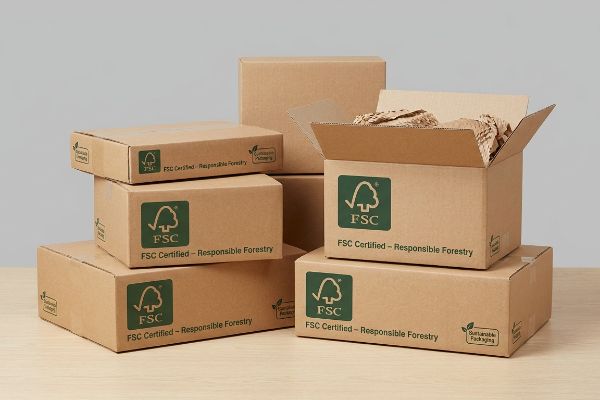
L'emballage certifié FSC garantit la traçabilité du carton ondulé structurel, depuis une forêt gérée de manière responsable jusqu'au point de vente. Il assure l'absence totale de mélange avec du carton brut non certifié, garantissant ainsi le respect strict des exigences environnementales des grands programmes de développement durable et protégeant votre marque contre de lourdes sanctions en cas d'audit.
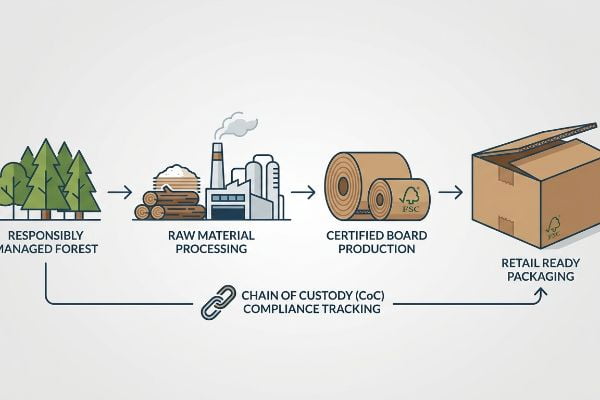
Comprendre la définition est facile, mais maintenir cette intégrité lors de la production de masse est là où les marques trébuchent.
La réalité de la conformité à la chaîne de contrôle (CoC)
Nombre de responsables de marques partent du principe qu'il suffit d'indiquer « papier écologique » dans leur cahier des charges. Ils estiment qu'une fois qu'un fournisseur affirme que son matériau provient de sources durables, l'emballage obtient automatiquement le logo officiel et l'approbation des distributeurs.
Je vois cela constamment lorsque des acheteurs demandent des présentoirs de sol durables pour la PLV (Publicité sur le Lieu de Vente). Ils exigent la certification, mais leur fournisseur se contente d'acheter un assortiment de panneaux standard. J'ai vu une marque se retrouver confrontée à d'importantes factures de la part de détaillants¹ parce que ses présentoirs « écologiques » n'avaient pas passé un audit de conformité inopiné. La texture brute et fibreuse du panneau leur semblait idéale au toucher, mais il n'y avait aucune trace écrite. Dans mon entreprise, nous appliquons une séparation stricte des matériaux²; si vous souhaitez obtenir cette certification, nous garantissons une chaîne d'approvisionnement vérifiable afin d'éviter tout refus coûteux de la part des distributeurs.
| Erreurs courantes des débutants | La solution pro | Avantage du magasin |
|---|---|---|
| En supposant que les affirmations matérielles verbales soient suffisantes | Mise en place d'une traçabilité documentaire rigoureuse | Réussit instantanément les audits de durabilité des grandes entreprises |
| Mélange de planches certifiées et non certifiées | Imposer la ségrégation physique des matières premières3 | Protège la valeur de la marque contre les allégations d'écoblanchiment |
| Omettre le contrôle d'audit au niveau de l'usine4 | S'associer à un établissement totalement transparent | Prévient les blocages et les refacturations coûteux liés à la conformité |
Je refuse qu'un manque de transparence administrative compromette le lancement de votre produit. En isolant rigoureusement ces matériaux dans mon usine, je vous garantis que vos arguments environnementaux résisteront aux contrôles les plus stricts du secteur de la distribution.
🛠️ Le bureau d'Harvey : Vous vous demandez si votre fournisseur actuel utilise secrètement des cartons non vérifiés pour vos campagnes ? 👉 Demandez un audit fournisseur ↗ — Accès direct à mon bureau. Zéro spam commercial automatisé, promis.
Quelles sont les entreprises certifiées FSC ?
Toutes les usines qui se disent écologiques ne possèdent pas forcément les qualifications nécessaires pour le prouver.
Les entreprises certifiées FSC comprennent des papeteries spécialisées, des fabricants d'emballages et des marques de distribution internationales. Ces organismes, audités, tiennent des registres d'approvisionnement centralisés et rigoureux afin de prouver légalement que leurs matériaux en carton ondulé proviennent de forêts gérées durablement et de manière éthique, évitant ainsi des refacturations importantes lors de contrôles inopinés chez les détaillants.
Trouver un partenaire certifié nécessite d'aller au-delà des brochures marketing et d'examiner en détail leurs audits opérationnels réels.
Pourquoi les courtiers en services verts échouent à l'audit d'usine
Les marques partent souvent du principe que n'importe quelle grande entreprise de négoce ou imprimeur peut fournir des emballages écologiques certifiés. Elles se contentent de repérer un logo en forme de feuille verte sur un site web et supposent que la chaîne d'approvisionnement est entièrement conforme aux normes environnementales actuelles.
La dure réalité, c'est que les courtiers contrôlent rarement la production. J'ai vu des clients paniqués venir me voir car leur intermédiaire précédent avait sous-traité le lancement de leur production à une usine parallèle non certifiée⁵.On sentait littéralement l'odeur des liants chimiques agressifs dans le carton bon marché et de substitution qu'ils avaient reçu. C'est un piège courant qui prend même les équipes d'approvisionnement les plus expérimentées. Nous bénéficions du statut « prêt pour l'audit » auprès des principaux détaillants nord-américains, ce qui signifie que notre usine est directement certifiée et contrôlée. Travailler directement avec un fabricant audité vous dégage de toute responsabilité et vous garantit que vos emballages répondent à des normes opérationnelles strictes.
| Erreurs courantes des débutants | La solution pro | Avantage du magasin |
|---|---|---|
| Faire confiance à des courtiers sans contrôle sur l'usine | S'associer à un fabricant direct et audité | Élimine les responsabilités de conformité des tiers6 |
| S'appuyer sur les icônes de marketing de site Web | Vérification du code de certification actif de l'usine7 | Garantit le droit légal d'afficher des écolabels8 |
| Ignorer les règles d'audit spécifiques aux détaillants | S'aligner sur les fournisseurs directs agréés | Garantit une réception sans faille chez le détaillant |
Je conseille toujours aux directeurs de marque d'exiger les documents d'audit d'usine. S'ils ne peuvent pas les fournir, ils mettent en péril l'ensemble du déploiement en magasin et la réputation de la marque.
🛠️ Le bureau d'Harvey : Craignez-vous que votre intermédiaire actuel dissimule une usine clandestine non conforme ? 👉 Vérifiez votre chaîne d'approvisionnement ↗ — Téléchargez en toute sécurité. Ma boîte de réception est ouverte si vous avez des questions.
Puis-je imprimer le logo FSC ?
Se procurer le matériel ne représente que la moitié du travail ; l'affichage de l'insigne est soumis à une réglementation stricte.
Oui. L’impression du logo FSC est autorisée uniquement si l’ensemble de votre chaîne d’approvisionnement possède une certification valide et si vous utilisez votre code de licence de marque unique. Vous devez également respecter des directives graphiques strictes concernant l’espace libre du logo et le contraste des couleurs sur votre présentoir final en carton ondulé.
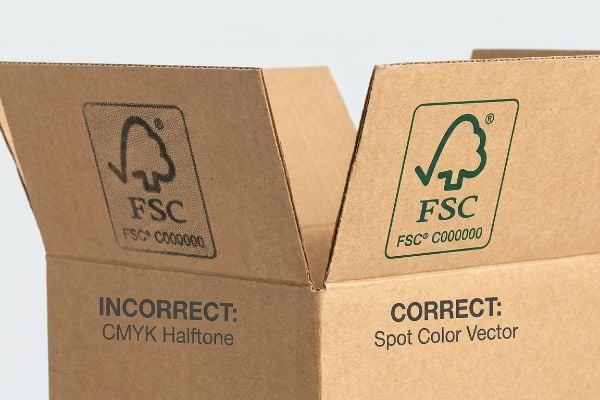
Mais ajouter un fichier JPEG basse résolution à votre fichier graphique est un moyen infaillible de bloquer la production.
Le piège à boue en demi-teintes CMJN
Les équipes marketing se contentent souvent de glisser-déposer le logo standard dans leurs fichiers graphiques numériques. Elles le traitent comme n'importe quelle autre image clipart, supposant que le logiciel RIP (traitement d'images raster) du fabricant gérera comme par magie un rendu parfait.
C’est là que les règles d’impression commerciale standard montrent leurs limites. Imprimer sur du carton ondulé brut et poreux n’est pas comparable à l’impression sur du papier glacé de magazine. Je vois fréquemment des graphistes soumettre le logo en CMJN standard (Cyan, Magenta, Jaune, Noir), qui repose sur de minuscules points de trame se chevauchant. En production, ce mélange optique échoue mécaniquement sur le carton non scellé<sup>9</sup>, créant un logo granuleux et délavé, impossible à scanner pour les auditeurs. La texture fibreuse du carton brut absorbe l’encre de manière irrégulière. J’exige systématiquement une impression en aplat de couleur pour les marques de conformité critiques<sup>10</sup>, garantissant ainsi que le logo soit imprimé avec une seule touche de pigment nette, conforme aux normes d’inspection.
| Erreurs courantes des débutants | La solution pro | Avantage du magasin |
|---|---|---|
| Utilisation d'un logo numérique basse résolution | Utilisation d'une couleur d'accompagnement vectorielle à contraste élevé11 | Garantit des marques de conformité nettes et scannables |
| Ignorer les règles d'espacement du logo | Imposer une zone blanche stricte autour de la marque12 | Empêche le rejet des illustrations lors de la prépresse |
| Code de licence de marque manquant | Ajouter votre code spécifique fourni par le fabricant13 | Garantit la conformité légale de l'envoi |
Je supprime ces fichiers numériques flous et les remplace par des plaques vectorielles de haute qualité. Une marque de conformité nette et parfaitement alignée prouve, tant au consommateur qu'au détaillant, que vous êtes une marque haut de gamme.
🛠️ Le bureau d'Harvey : Vos fichiers de conformité sont-ils refusés à cause d'une impression en demi-teintes floue ? 👉 Faites pré-vérifier vos fichiers ↗ — Pas de formulaires interminables qui déclenchent des appels commerciaux à n'en plus finir. Uniquement de la valeur ajoutée.
Qu'est-ce qu'un forfait FSC ?
Un véritable emballage écologique est bien plus qu'une simple boîte en carton brun non blanchi.
Un emballage certifié FSC est une structure en carton ondulé entièrement traçable et issue de sources durables, conçue pour les environnements de vente au détail à haute performance. Il allie parfaitement conformité environnementale rigoureuse et robustesse structurelle, permettant aux marques de respecter leurs engagements écologiques sans compromettre la capacité de charge dynamique requise pour les programmes de merchandising des grandes surfaces.
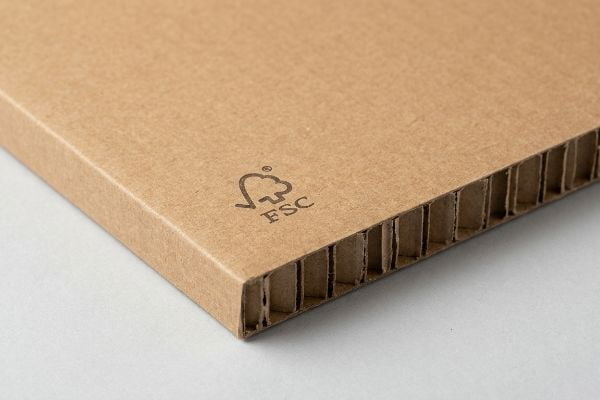
Il est facile de faire en sorte qu'un seul écran paraisse vert en laboratoire, mais voici la dure réalité lorsqu'on en expédie 500 dans un environnement de vente au détail exigeant.
Pourquoi le faux écoblanchiment échoue-t-il dans les usines ?
Les marques imposent fréquemment le laminage en PLA (acide polylactique), un bioplastique,¹⁴partant du principe que ce film à base de maïs garantit une conformité environnementale totale pour leurs présentoirs en carton ondulé. Elles pensent ainsi créer l'emballage écologique par excellence en superposant ces matériaux modernes pour protéger les impressions graphiques.
Dans mon atelier, je constate régulièrement l'échec de cette théorie pourtant bien intentionnée. Lorsqu'on applique un film PLA solide sur un panneau rigide 32ECT (test de résistance à la compression des bords) supportant 1 133 kg de produit, ce film repousse l'eau lors des processus de repulpage standard des emballages en carton ondulé (OCC)¹⁵. La rigidité et la surface lisse du film plastique peuvent sembler haut de gamme, mais les centres de recyclage municipaux le repèrent et envoient l'ensemble de votre présentoir directement à la décharge. Je le teste à l'aide de critères de repulpabilité standard, et ce film se comporte comme un contaminant permanent. Je remplace donc ce bioplastique hypertrophié par un revêtement aqueux liquide. Grâce à ce micro-ajustement, l'emballage reste 100 % recyclable en porte-à-porte, ce qui réduit les taux de rejet d'environ 95 %¹⁶ et évite à mes clients de lourdes pénalités liées au développement durable.
| Erreurs courantes des débutants | La solution pro | Avantage du magasin |
|---|---|---|
| Utilisation de biofilms non recyclables | Obligation d'utiliser des revêtements aqueux à base d'eau17 | Garantit un emballage 100 % recyclable en bordure de trottoir |
| Sacrifier la BCT pour une esthétique verte | Maintien de la cannelure du noyau structurel vierge18 | Empêche l'écrasement par le haut sous les palettes lourdes |
| Conception de pièges multi-matériaux | Conception de serrures en papier monomatériau 19 | Élimine la nécessité de séparer les pièces avant le recyclage |
Je ne laisse pas les théories de l'écoblanchiment compromettre l'intégrité structurelle ni la conformité de votre emballage. En concevant une véritable solution monomatériau, je garantis que votre emballage résiste à la chaîne d'approvisionnement et est effectivement recyclé.
🛠️ Le bureau d'Harvey : Vos revêtements « durables » rendent-ils vos écrans non recyclables ? 👉 Envoyez-moi les spécifications de vos matériaux ↗ — Je testerai la chimie de vos produits avant que vous n'investissiez des sommes considérables dans une production de masse.
Conclusion
Vous pouvez choisir un fournisseur qui applique sans discernement des biofilms non recyclables à votre campagne éco-responsable, mais si ces supports contaminés finissent directement à la décharge, vous anéantissez toute crédibilité de votre marque en matière de développement durable et risquez un refus immédiat de la part des distributeurs. Plus de 500 responsables de marques utilisent ma checklist prépresse pour éviter précisément ces erreurs fatales dès les premières étapes. Ne vous laissez plus guider par les incertitudes liées à la conformité des matériaux : laissez-moi auditer personnellement votre projet grâce à mon Audit de Conformité Emballage Gratuit ↗ afin de détecter les pièges chimiques toxiques avant le lancement de la production.
« Combien coûte la non-conformité aux exigences d’une chaîne d’approvisionnement durable… », https://www.sourcemap.com/blog/how-much-does-noncompliance-with-sustainable-supply-chainnbsp-laws-cost. [Les guides de référence sur les achats dans le secteur du commerce de détail décrivent les refacturations comme une sanction courante pour les fournisseurs qui ne fournissent pas de preuves documentées de leurs certifications de durabilité lors des audits]. Type de preuve : affirmation factuelle ; type de source : guide sectoriel. Sujet : conséquences financières d’un échec d’audit. Remarque : le montant des pénalités varie selon les contrats .
« [PDF] Manuel de certification FSC de la chaîne de contrôle de groupe (CoC) », https://cfwc.mgcafe.uky.edu/sites/cfwc.ca.uky.edu/files/cfwc_coc_group_certification_manual_revised_2_16_2018_0.pdf . [La norme FSC relative à la chaîne de contrôle (FSC-STD-40-004) exige la séparation physique des matériaux certifiés et non certifiés afin de garantir une traçabilité vérifiable]. Rôle de la preuve : spécification technique ; type de source : norme réglementaire. Justifie : la nécessité opérationnelle de la séparation pour la certification. Note relative au champ d’application : s’applique spécifiquement au système de transfert de la chaîne de contrôle.
« [PDF] Certification de la chaîne de contrôle – Forest Stewardship Council », https://fsc.org/sites/default/files/2019-08/FSC-STD-40-004%20V3-0%20EN%20Chain%20of%20Custody%20Certification.pdf. [La norme FSC-STD-40-004 exige des organismes qu’ils mettent en œuvre des systèmes empêchant le mélange de matériaux certifiés FSC avec des matériaux non certifiés afin de préserver l’intégrité de la déclaration]. Rôle de la preuve : exigence technique ; type de source : norme de certification. Justifie : la nécessité de la ségrégation des matériaux pour la conformité à la chaîne de contrôle. Note relative au champ d’application : s’applique à toutes les entités certifiées FSC Chaîne de contrôle .
« [PDF] Exigences générales pour les organismes de certification accrédités FSC », https://connect.fsc.org/document-centre/documents/retrieve/06a1166d-9655-4d90-808d-255cf9f6cdb1. [Des audits annuels sur site réalisés par des organismes de certification accrédités sont obligatoires afin de vérifier que le système de management et la traçabilité des matériaux de l’organisation sont conformes aux normes FSC]. Rôle de la preuve : exigence opérationnelle ; type de source : norme d’audit. Justifie : l’importance de la vérification au niveau de l’usine pour éviter la perte de la certification. Note relative au périmètre : obligatoire pour tous les titulaires d’un certificat de conformité FSC .
« Quatre idées reçues sur la sous-traitance non autorisée », https://sloanreview.mit.edu/article/four-myths-about-unauthorized-subcontracting/ . [Un rapport faisant autorité sur la transparence de la chaîne d'approvisionnement documenterait la fréquence et les risques liés à la sous-traitance non autorisée à des installations non certifiées dans l'industrie de l' emballage]. Rôle de la preuve : vérification des risques ; type de source : rapport sectoriel. Appui : La fréquence des « usines fantômes » dans les défaillances des achats. Note de portée : Spécifique aux certifications durables.
« Gestion des risques liés à la chaîne d’approvisionnement vs. Gestion des risques liés aux tiers », https://www.meditologyservices.com/supply-chain-risk-management-vs-tprm/. Les normes sectorielles en matière de gestion des risques liés à la chaîne d’approvisionnement établissent que la suppression des intermédiaires réduit le risque de non-conformité et les transferts de responsabilité. Rôle de la preuve : vérification factuelle ; type de source : norme sectorielle/guide juridique. Objectif : réduction du risque de non-conformité. Note relative au périmètre : Spécifique aux audits environnementaux, sociaux et de gouvernance (ESG) .
« Recherche publique FSC – Données de certificat », https://connect.fsc.org/fsc-public-certificate-search . Les organismes de certification officiels, tels que le FSC, tiennent à jour des bases de données publiques où les codes de licence actifs doivent être validés pour confirmer le statut d'une installation. Rôle de la preuve : processus technique ; type de source : documentation de l'organisme de certification officiel. Méthodes de vérification compatibles : valides. Remarque concernant la portée : limité aux certifications disposant de registres publics.
« Recommandations relatives aux spécifications, normes et écolabels pour… », https://www.epa.gov/greenerproducts/recommendations-specifications-standards-and-ecolabels-federal-purchasing. Les lois sur les marques et les accords de certification stipulent que le droit légal d'utiliser des écolabels est subordonné à une certification de chaîne de traçabilité active et vérifiée. Rôle de la preuve : exigence légale ; type de source : organisme de réglementation/droit des marques. Appui : conformité légale en matière d'étiquetage. Remarque sur la portée : varie selon la norme de certification spécifique .
« Effets du carton ondulé et déformations des points de trame », https://www.academia.edu/60461055/Print_uniformity_of_corrugated_board_in_flexo_printing_effects_of_corrugated_board_and_halftone_dot_deformations. [Un manuel technique d'impression explique comment l'absorption d'encre et le gain de point sur les supports poreux dégradent la résolution des points de trame]. Rôle de la preuve : validation technique ; type de source : manuel de l'industrie de l'imprimerie. Appuie : Pourquoi le CMJN échoue sur le carton brut. Note de portée : Spécifique aux matériaux de testliner non scellés .
« CMJN vs. Couleurs d'accompagnement dans l'impression d'emballages », https://meyers.com/meyers-blog/cmyk-vs-spot-colors-in-packaging-printing-what-cpg-brands-need-to-know/ . [Les normes industrielles relatives au marquage réglementaire recommandent l'utilisation des couleurs d'accompagnement plutôt que des couleurs quadri afin de garantir le contraste et la lisibilité sur les matériaux absorbants]. Rôle de la preuve : validation des meilleures pratiques ; type de source : manuel de normes graphiques. Sujet : l'efficacité des couleurs d'accompagnement pour le contrôle. Note de portée : norme relative au marquage réglementaire à contraste élevé.
« [PDF] Guide d’utilisation de la marque FSC® », https://connect.fsc.org/sites/default/files/2022-08/FSC-Trademark-Use-Guide-for-Promotional-Licence-Holders_June2020.pdf . [Les directives officielles de la marque FSC précisent l’utilisation de fichiers vectoriels et de couleurs d’accompagnement pour garantir la qualité de reproduction et la lisibilité]. Rôle de la preuve : Spécification technique ; type de source : Directives relatives aux marques. Supports : Méthodes d’impression optimales pour les marques FSC. Note relative à la portée : Spécifique aux flux de production prépresse professionnels.
« Logo FSC® – Directives d’utilisation du symbole FSC sur les emballages », https://www.gwp.co.uk/guides/fsc-packaging-logo/ . [Les normes de la marque FSC imposent une zone d’exclusion minimale (espace libre) autour du logo afin de préserver son intégrité visuelle]. Rôle de la preuve : Règle de conformité ; type de source : Directives relatives à la marque. Éléments justifiant : Placement et disposition corrects du logo. Remarque concernant la portée : Les dimensions exactes sont définies par la taille du logo.
« [PDF] Exigences relatives à l’utilisation des marques FSC® par les titulaires de certificat », https://fsc.org/sites/default/files/2019-08/FSC-STD-50-001%20V2_D2_EN.pdf. [Les règles de certification FSC exigent l’affichage d’un code de licence unique à côté du logo afin de vérifier la traçabilité]. Rôle de la preuve : Exigence réglementaire ; type de source : Norme de certification. Conformité : Conformité légale des expéditions étiquetées FSC. Remarque : Obligatoire pour toutes les marques apposées sur les produits .
« Comparaison des propriétés des composites d’acide polylactique… », https://pmc.ncbi.nlm.nih.gov/articles/PMC9224457/. [Les normes chimiques et industrielles attestent que l’acide polylactique est un polyester biodégradable dérivé de l’amidon végétal fermenté, le plus souvent de maïs. Rôle de la preuve : vérification technique ; type de source : revue scientifique. Sujet : composition du PLA. Note de portée : se concentre sur la principale matière première utilisée dans la production commerciale de PLA.] ↩
« [PDF] Guide de conception pour la recyclabilité – Better Buildings Solution Center », https://betterbuildingssolutioncenter.energy.gov/sites/default/files/tools/designguidanceforrecyclability.pdf . [La documentation technique sur le recyclage du carton ondulé explique comment les films thermoplastiques non poreux résistent à l’hydratation, ce qui entrave la séparation des fibres nécessaire au repulpage ]. Rôle de la preuve : vérification technique ; type de source : revue scientifique sur les matériaux. Appuie : l’échec des films PLA dans les filières de recyclage standard. Note de portée : s’applique à l’hydropulpage municipal standard.
« Revêtement de papier recyclable et biodégradable avec des agents fonctionnalisés… », https://pmc.ncbi.nlm.nih.gov/articles/PMC11948148/. [Des rapports industriels sur la durabilité des emballages quantifient l'augmentation des taux de récupération lors du passage des films plastiques aux revêtements aqueux]. Rôle de la preuve : validation quantitative ; type de source : étude de gestion des déchets. Appui : l'efficacité des revêtements aqueux par rapport aux bioplastiques. Note de portée : les résultats peuvent varier selon les capacités des installations municipales .
« La vérité sur les revêtements aqueux et leur teneur en plastique – Verive », https://verive.eu/food-packaging-materials/aqueous-lining-plastic-free-truth/. [Une source faisant autorité en matière de matériaux d'emballage confirmerait que les revêtements aqueux à base d'eau sont compatibles avec le processus de mise en pâte, garantissant ainsi la recyclabilité de l'emballage]. Rôle de la preuve : vérification technique ; type de source : norme industrielle ; arguments : recyclabilité des revêtements aqueux. Remarque : sous réserve des capacités des installations de recyclage municipales locales .
« [PDF] Effets de la teneur en humidité sur la résistance à la compression en boîte : FBA BCT… », https://renewablebioproducts.gatech.edu/sites/default/files/2025-12/4effects-of-moisture-content-on-box-compression-strength.pdf . [Les données techniques relatives aux paramètres du test de compression en boîte (BCT) démontrent que les fibres vierges offrent une résistance à la compression verticale et une intégrité structurelle supérieures aux fibres recyclées]. Rôle de la preuve : spécification technique ; type de source : recherche en science des matériaux ; arguments : supériorité structurelle des cannelures de l’âme vierge. Remarque : la comparaison est généralement basée sur la longueur et la pureté spécifiques des fibres.
« Emballages monomatériaux : effet de mode ou solution miracle ? », https://www.packagedsustainable.com/post/mono-material-packaging-hypo-or-hero. [Les directives de gestion des déchets confirmeraient que les emballages monomatériaux éliminent le besoin de tri manuel des matériaux dissemblables, réduisant ainsi la contamination dans le flux de recyclage]. Preuve : démonstration opérationnelle ; type de source : manuel de gestion des déchets ; arguments : efficacité du recyclage des emballages monomatériaux. Remarque : fait spécifiquement référence à l’emboîtement mécanique par rapport aux adhésifs chimiques .