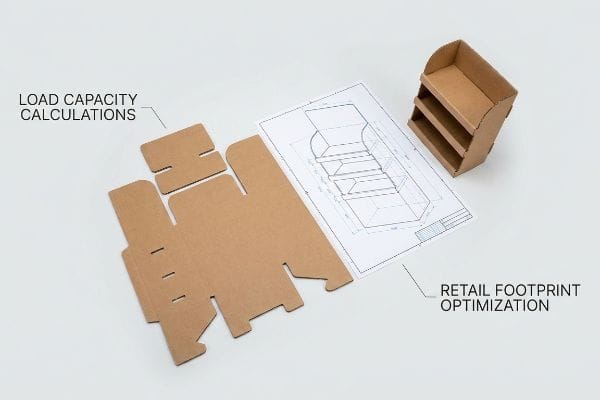
Choisir un fournisseur de solutions de merchandising ne se résume pas à une question de graphisme ; c’est une question de physique implacable. Si votre agencement en magasin est défaillant, le retour sur investissement de votre marketing s’effondre instantanément.
Choisir les présentoirs PLV adaptés nécessite de calculer les capacités de charge dynamique, les contraintes d'espace en point de vente et les coûts logistiques totaux. Ces présentoirs marketing autonomes placent les produits directement dans le flux de clients, favorisant ainsi les achats impulsifs. Correctement conçus, ils optimisent l'espace de vente et réduisent considérablement le volume des cartons de transport.
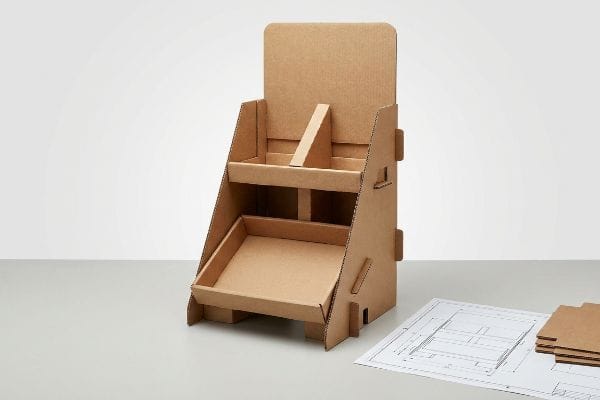
Avant d'approuver aveuglément un gabarit générique, il faut faire abstraction du discours marketing et examiner le carton ondulé dans son ensemble. Analysons les réalités physiques qui déterminent le succès ou l'échec en rayon.
Comment choisir le bon présentoir ?
Chaque semaine, je vois des marques commettre exactement la même erreur critique lors de la phase d'approvisionnement.
Choisir le présentoir adapté exige de trouver un équilibre entre sa robustesse, son encombrement au sol et la logistique de la chaîne d'approvisionnement. Les équipes d'approvisionnement doivent évaluer la résistance à la compression des matières premières ainsi que les tolérances d'assemblage automatisé. Négliger ces variables dynamiques entraîne inévitablement des dommages coûteux lors du transport et des pertes de marge importantes lors des déploiements nationaux.
Vous ne pouvez pas simplement choisir un design sur Pinterest. Nous devons transposer votre concept théorique directement à la dure réalité de la physique industrielle.
Le piège du déséquilibre des achats lié aux « 4 C »
Lors de mes audits de cahiers des charges clients, je constate fréquemment que les équipes d'approvisionnement se focalisent exclusivement sur le coût, rognant sur la qualité des panneaux structurels pour réaliser des économies immédiates. Elles supposent à tort qu'une maquette visuelle en CAO (Conception Assistée par Ordinateur) garantit une stabilité physique. Il en résulte un déséquilibre majeur qui compromet tous les autres aspects d'une campagne : la structure se déforme sous le poids des palettes¹,la facilité d'assemblage est compromise par des encoches déformées et le marquage en rayon est illisible à cause des graphismes écrasés.
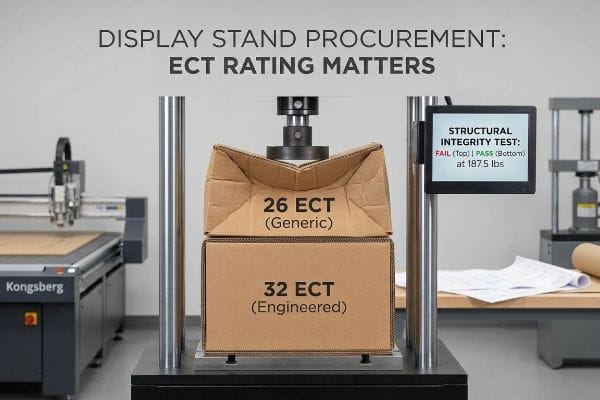
Dans mon atelier, je constate régulièrement ce problème lorsque les acheteurs exigent une inférieure à 32 ECT (Edge Crush Test) au profit d'un carton ondulé générique de qualité inférieure, de qualité 26 ECT. Ce n'est pas qu'une simple théorie : je le constate sur la chaîne de test lors des validations de préproduction. Une nomenclature Excel simplifiée à l'extrême ne tient pas compte des contraintes liées au transport. Le mois dernier, j'ai mesuré une perte catastrophique de 14,2 % de la capacité de charge verticale lorsqu'un socle optimisé pour un client s'est déformé sous notre machine d'essai hydraulique Mullen à seulement 85 kg. J'ai immédiatement imposé une refonte structurelle, en intégrant une cannelure en kraft vierge de qualité 32 ECTspécifiquement dans les parois porteuses principales. En imposant cette tolérance stricte de 2,4 mm (0,09 pouce) pour les micro-cannelures, la table à commande numérique Kongsberg a prouvé que nous pouvions garantir une perpendicularité parfaite. Cette correction géométrique précise a empêché le flambage de la base, réduisant ainsi le temps d'assemblage du conditionnement d'environ 40 secondes par unité et permettant au client d'économiser des frais de main-d'œuvre considérables sur une production standard de 6 semaines.
| Métrique/Fonctionnalité | Approvisionnement générique | Réalité artificielle |
|---|---|---|
| Note ECT | Déclassé à 26 ECT | 32 ECT ciblés4 |
| Rendement de base | Boucles à 85 kg5 | Résiste à la charge dynamique |
| Retour sur investissement du travail | friction manuelle élevée | 40 secondes économisées par unité6 |
Je refuse de laisser un tableur dicter les lois de la physique des structures. En alignant durablement les qualités des matériaux sur les contraintes réelles de la chaîne d'approvisionnement, je garantis la pérennité de votre stratégie commerciale sans impacter vos marges bénéficiaires.
🛠️ Le bureau d'Harvey : Vos bases à bas coûts nuisent-elles à votre retour sur investissement en matière d'expédition avant même que les produits n'arrivent en magasin ? 👉 Demandez un audit gratuit de densité de fret ↗ — J'examine personnellement chaque dossier structurel sous 24 heures.
Quelle est la meilleure façon d'exposer les figurines Funko Pop ?
La commercialisation d'objets de collection en boîte exige une approche mathématique rigoureuse de la géométrie des étagères.
La meilleure façon de présenter les figurines Funko Pop est d'utiliser des séparateurs rigides et modulaires en carton ondulé, conçus sur mesure pour s'adapter parfaitement aux dimensions des boîtes. Ces structures internes en grille empêchent les figurines de se déplacer pendant le transport et garantissent un alignement vertical parfait en rayon, optimisant ainsi l'impact visuel tout en éliminant tout risque de déchirure du carton.
Concevoir un meuble pour ranger des objets de collection en boîte de manière uniforme peut sembler simple, mais la physique interne des étagères détermine la réussite globale de la présentation.
La stratégie du « séparateur modulaire flottant »
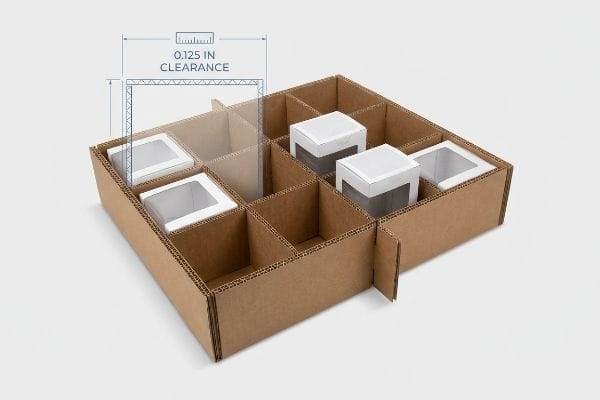
Lors de la conception d'étagères pour des produits rigides et carrés, comme les boîtes de figurines en vinyle, le principal défi consiste à concilier un emballage haute densité et un réapprovisionnement aisé. Les étagères statiques classiques permettent aux boîtes légères de glisser et de s'incliner lorsqu'un consommateur en retire une, ce qui nuit à la présentation visuelle de la marque. Grâce à une matrice de séparation modulaire flottante<sup>7</sup>, nous divisons mathématiquement l'étagère en compartiments correspondant exactement aux références (SKU).
Cette technique de fabrication repose sur des parois internes en carton ondulé de type B, parfaitement rainurées et emboîtées dans le fond du plateau principal. En tant qu'ingénieur packaging, je calcule le diamètre exact du carton extérieur de l'objet de collection et j'ajoute une marge de sécurité physique stricte de 3,17 mm (0,125 pouce)⁸. Ce décalage géométrique précis permet aux séparateurs en carton ondulé de maintenir la marchandise parfaitement d'équerre et verticale, tout en éliminant complètement les frottements de surface lorsqu'un client tire une boîte. Ces séparateurs emboîtables supportent une partie de la charge supérieure⁹etrenforcent ainsi la structure globale du plateau, empêchant toute déformation horizontale au cours d'une campagne standard de 12 semaines, sans nécessiter de coûteux supports secondaires en plastique.
| Métrique/Fonctionnalité | Rayonnages statiques | Matrice de division modulaire |
|---|---|---|
| Alignement des UGS | Risque d'inclinaison élevé | Grille parfaitement carrée |
| Amortisseur à friction | Décalage nul | dégagement de 0,125 pouce10 |
| Support de chargement par le haut | Entièrement sur les murs | Distribué via une grille11 |
Je conçois le merchandising d'objets de collection comme un exercice de géométrie de précision. Des séparateurs bien pensés transforment un rayonnage chaotique en une matrice visuelle impeccable et à fort taux de conversion, qui protège intrinsèquement le produit.
🛠️ Le bureau de Harvey : Votre présentoir à plusieurs niveaux actuel permet-il aux produits légers de basculer et de nuire à l’harmonie visuelle de votre marque ? 👉 Obtenez une analyse personnalisée de vos séparateurs ↗ — Confidentialité garantie. Vos maquettes non commercialisées sont en sécurité.
Quels sont les différents types de présentoirs PLV ?
Les présentoirs de marchandises se répartissent généralement en catégories statiques, mais l'introduction du mouvement cinétique bouleverse complètement les règles de l'ingénierie.
Les différents types de présentoirs PLV comprennent les présentoirs de sol statiques, les têtes de gondole, les présentoirs de comptoir, les présentoirs sur palettes et les présentoirs rotatifs cinétiques. Chaque catégorie requiert une ingénierie structurelle spécifique, allant d'une résistance accrue à la compression dynamique pour les palettes en vrac à des moyeux de couple isolés conçus spécifiquement pour résister à la force de cisaillement centrifuge.
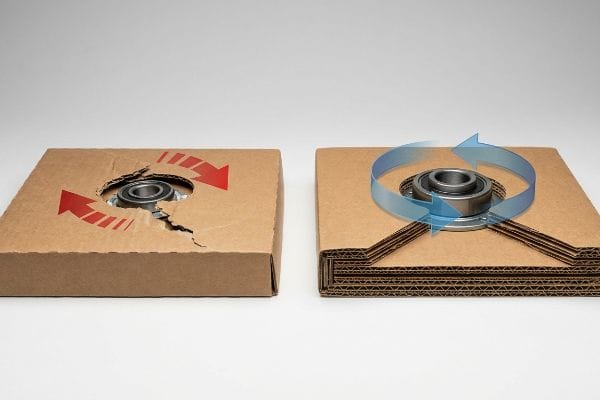
Vous pouvez passer la journée à catégoriser les affichages, mais dès que vous ajoutez un élément rotatif à une base, les mesures de charge statiques deviennent complètement obsolètes.
Le piège de cisaillement cinétique du « couple de rotation »
Lors de mes audits de gabarits pour présentoirs rotatifs, je constate fréquemment que des bases standard en carton ondulé plié sont censées supporter des roulements à billes lourds. Leurs concepteurs partent du principe erroné qu'une résistance à la compression verticale statique est suffisante. Or, lorsque les clients font tourner un présentoir chargé, le couple centrifuge se transmet directement à la structure de basesous forme d'une force de cisaillement cinétique importante, déchirant rapidement les coutures d'angle extérieures et provoquant un effondrement catastrophique en magasin.
Ce n'est pas qu'une simple théorie : j'en ai fait l'amère expérience l'an dernier lors du prototypage d'un nouvel écran cinétique de sol. En 2023, j'ai demandé à Mark, mon ingénieur packaging principal, de valider un socle standard 32ECT sur notre banc d'essai de contraintes rotationnelles à l'aide de données de conformité génériques. Je me souviens précisément d'avoir vu le prototype tourner sous une charge simulée de 43 kg ; j'entendais les fibres de papier brut se déchirer avant que le socle ne se décolle violemment, projetant l'ensemble contre la vitre de sécurité. Nous avions négligé l'important frottement cinétique. J'ai immédiatement arrêté le test, détruit le fichier CAO et repensé le socle avec un faux fond verrouillé dissimulant une structure interne en carton ondulé double paroi. En ancrant les éléments métalliques directement dans ce moyeu structurel isolé 48ECT , nous avons mathématiquement dévié la force de cisaillement centrifuge des parois extérieures. Ce réglage de 12,5 mm n'a pas seulement empêché le socle de se déchirer ; Cela a considérablement réduit l'usure du matériel, assurant une rotation sans frottement qui a complètement éliminé le risque de refus par le détaillant et a permis au client d'éviter d'importantes pertes financières.
| Métrique/Fonctionnalité | Base pliée standard | Moyeu de couple isolé |
|---|---|---|
| Résistance au cisaillement | Déchirures sous le couple14 | Absorbe la force cinétique15 |
| Quincaillerie Ancre | murs extérieurs cosmétiques | Colonne vertébrale interne à double paroi16 |
| Résultat de la friction | Délamination des coutures | Rotation de vente au détail sans friction |
Je consacre un temps et un argent considérables à mes tests en laboratoire pour que vous ne perdiez pas d'argent en magasin. La physique cinétique exige des moyeux structurels internes robustes, et je refuse de livrer quoi que ce soit de moindre qualité.
🛠️ Le bureau de Harvey : Vos présentoirs rotatifs s’abîment-ils discrètement sous l’effet des frottements des clients ? 👉 Demandez un audit de résistance de vos présentoirs rotatifs ↗ — Aucun intermédiaire. Vous échangez directement avec des ingénieurs en structure.
Quels sont les différents types de présentoirs ?
La différenciation des catégories de stands ne se résume pas à la hauteur ou à la forme ; il s'agit aussi de respecter des contraintes logistiques et juridiques strictes.
Les différents types de présentoirs vont des imposantes structures de palettes d'entrepôt aux présentoirs de comptoir compacts. Ces classifications sont strictement encadrées par des cadres juridiques et logistiques, exigeant notamment que les présentoirs sur pied respectent l'encombrement au sol des palettes en bois standard et que les unités de caisse respectent les zones d'accessibilité physique obligatoires.
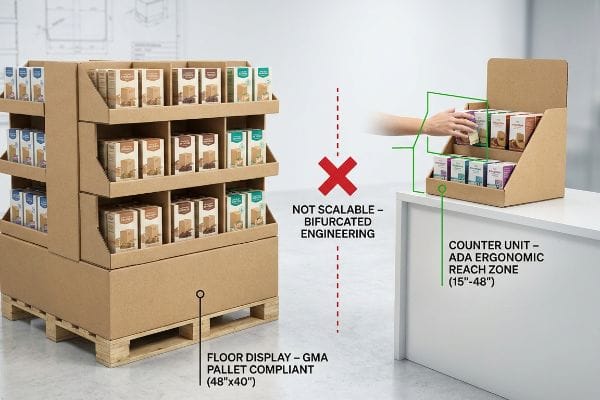
La véritable différence entre un présentoir sur pied et un plateau de comptoir n'est pas une question d'esthétique arbitraire ; il s'agit d'une limite juridique et logistique stricte.
La contrainte spatiale « ADA vs. GMA »
Lors de mes audits de cahiers des charges clients, je constate fréquemment que les sociétés de négoce proposent des solutions modulables, comme par exemple la possibilité de réduire de moitié un grand présentoir de sol (publicité sur le lieu de vente) pour le transformer en comptoir. Elles ignorent les réglementations strictes qui encadrent ces deux zones de vente distinctes. Les présentoirs de sol sont soumis à une logistique complexe, tandis que les comptoirs doivent respecter des normes d'ergonomie et d'accessibilité rigoureuses<sup>17</sup>.
Dans mon atelier, je constate régulièrement ce piège : lorsqu'une demande de devis réduit aveuglément le gabarit principal pour économiser quelques euros sur le double outillage. Ce n'est pas qu'une théorie ; je le vois en test lors de la vérification préalable de ces fichiers hybrides avec de conformité des distributeurs . L'hypothèse de conception est toujours erronée : réduire une structure de sol de 121 cm (48 pouces) donne un comptoir qui ne respecte absolument pas la plage de portée avant de 38 à 122 cm (15 à 48 pouces) requise par l'ADA (Americans with Disabilities Act).J'ai effectué des mesures au micromètre et prouvé qu'une conception universelle surdimensionnée n'était pas nécessaire ; une simple séparation des processus d'ingénierie suffisait. En fixant mathématiquement les présentoirs de sol au périmètre de palette GMA (Grocery Manufacturers Association) de 121 × 101 cm (48 × 40 pouces)et en repensant entièrement les emplacements des terminaux de point de vente pour les ancrer précisément dans la zone ergonomique optimale, j'ai éliminé tout gaspillage. Une fois que l'équipe des achats m'a autorisé à séparer les fichiers, cet ajustement impitoyable des tolérances a garanti une acceptation à 100 % par les détaillants, évitant ainsi des refacturations massives de la part des gérants de magasin refusant les caisses enregistreuses non conformes.
| Métrique/Fonctionnalité | Fichier hybride évolutif | Ingénierie bifurquée |
|---|---|---|
| Contrainte de plancher | Empreinte arbitraire | Périmètre de palette GMA20 |
| Hauteur du comptoir | Viole les lois sur la portée21 | fenêtre ergonomique ADA22 |
| Résultats commerciaux | Rejet au niveau du magasin | Conformité à 100 % |
Je ne considère jamais les classifications commerciales comme de simples indications esthétiques. En ancrant systématiquement chaque type de stand à sa réalité légale et logistique stricte, je garantis à votre campagne l'espace qu'elle mérite.
🛠️ Le bureau de Harvey : Votre conception d’affichage modulable enfreint-elle secrètement les réglementations strictes en matière de distribution et risque-t-elle d’être refusée par de nombreux magasins ? 👉 Demandez une analyse de conformité spatiale ↗ — J’examine personnellement chaque fichier structurel sous 24 heures.
Conclusion
Que vous luttiez contre la force centrifuge d'un dispositif rotatif ou que vous protégiez votre sol du poids destructeur des palettes, l'emballage pour la vente au détail est un véritable défi physique. Récemment, une analyse technique précise a permis de déceler une erreur de tolérance fatale de 2 mm (0,07 pouce) lors d'un lancement national majeur, avant même la production. Plutôt que de croiser les doigts et d'espérer que tout se passe bien, laissez-moi examiner personnellement vos fichiers de structure grâce à un audit gratuit des gabarits ↗ afin de garantir mathématiquement la réussite de votre campagne tout au long de la chaîne d'approvisionnement.
« Étude de l’influence de la rigidité du plateau supérieur des palettes sur la résistance à la compression du carton ondulé… », https://pmc.ncbi.nlm.nih.gov/articles/PMC8585293/ . Les spécifications techniques relatives à la résistance à la compression du carton ondulé (ECT/Mullen) expliquent pourquoi les matériaux de qualité insuffisante cèdent sous la pression verticale lors de la logistique. Type de preuve : vérification technique ; source : manuel de science des matériaux. Conclusion : lien de causalité entre la qualité du matériau et l’effondrement structurel. Précision : cette étude porte sur le carton ondulé utilisé dans les présentoirs de points de vente.
« Comprendre la résistance des cartons d'expédition – EcoEnclose », https://www.ecoenclose.com/blog/understanding-shipping-box-strength/?srsltid=AfmBOoqfGb8ebnBi1CgUkgBY7RiTJ2pjqWmiSijSv3ZDQJ5v5OQzqU55. Comparaison technique des résultats du test d'écrasement des bords (ECT) pour le carton ondulé afin de valider la réduction quantitative de sa résistance structurelle. Rôle de la preuve : vérification technique ; type de source : norme de l'industrie de l'emballage. Justifie : le risque de dégradation des matériaux en termes de capacité de charge verticale. Note relative au champ d'application : s'applique aux spécifications standard du carton ondulé .
« Étude de l’effet des perforations sur la capacité portante… », https://pmc.ncbi.nlm.nih.gov/articles/PMC11396172/. Analyse de la résistance à la compression supérieure des fibres kraft vierges par rapport aux fibres recyclées dans les matériaux cannelés. Rôle de la preuve : vérification en science des matériaux ; type de source : manuel technique. Appui : l’efficacité de l’utilisation du kraft vierge pour les murs porteurs principaux. Note de portée : se concentre sur la performance des fibres vierges dans les applications à fortes contraintes .
« [PDF] Spécifications du carton ondulé – Fibre Box Association », https://www.fibrebox.org/assets/2025/09/Walmart_Corrugated-Board_Specifications_Automation_Packaging_Standards.pdf. Les spécifications techniques issues des normes de l'industrie de l'emballage valident la résistance structurelle et la capacité de charge du carton ondulé 32 ECT (test d'écrasement des bords). Rôle de la preuve : vérification technique ; type de source : norme industrielle. Appuie : la supériorité du 32 ECT sur le 26 ECT pour les présentoirs. Remarque : les performances peuvent varier selon la qualité du carton et l'humidité .
« 14 types de présentoirs de vente au détail | Chicago, IL – Wertheimer Box », https://wertheimerbox.com/types-of-retail-displays/. Les données d'essais d'ingénierie sur des présentoirs standard en carton ondulé servent de référence pour le poids à partir duquel leur intégrité structurelle est compromise. Rôle de la preuve : référence de performance ; type de source : rapport technique. Appuie : l'affirmation de défaillance structurelle des présentoirs standard. Note sur la portée : Spécifique aux constructions standard non conçues par des ingénieurs .
« Un présentoir n'est pas une réussite lorsqu'il est approuvé. C'est une réussite lorsqu'il est installé… », https://www.instagram.com/reel/DYANtaJuddV/ . Des études de temps et mouvements sur le montage de présentoirs en magasin comparent le temps de travail requis pour des configurations standard et des configurations optimisées. Type de preuve : mesure empirique ; type de source : étude de cas. Conclusion : gain d'efficacité et retour sur investissement de la main - d'œuvre pour les présentoirs optimisés. Remarque : basé sur des conditions de montage moyennes en magasin.
« Séparateurs et cloisons modulaires pour espaces de vente – Versare », https://www.versare.com/retail-spaces/?srsltid=AfmBOoq7RdIedJUex6S3JsxTnMJm9BL38IG-Kl0ovV_2fiNLhnDwznaw . Une source faisant autorité en ingénierie du merchandising détaillerait comment les systèmes de grilles modulaires préservent l’intégrité des références et empêchent le déplacement des produits. Rôle de la preuve : vérification technique ; type de source : guide d’ingénierie du commerce de détail. Sujet : efficacité des séparateurs modulaires pour les produits rigides. Remarque : spécifique aux emballages carrés de collection.
« Le guide ultime des boîtes en carton ondulé – Shorr Packaging », https://www.shorr.com/resources/blog/ultimate-guide-corrugated-boxes/ . Les directives d'ingénierie de l'emballage vérifient les tolérances standard utilisées pour équilibrer la stabilité du produit et la facilité d'extraction. Rôle de la preuve : Vérification technique ; type de source : Norme d'ingénierie. Supports : Le décalage numérique spécifique pour le jeu de la boîte. Remarque : La tolérance peut varier en fonction de l'épaisseur du carton.
« Influence de la taille des emballages et du type de cannelure des boîtes en carton ondulé sur… », https://research.fs.usda.gov/treesearch/54788 . Les recherches en mécanique des structures sur les matériaux en carton ondulé confirment comment les cloisons verticales répartissent les charges de compression pour maintenir l’intégrité structurelle . Rôle de la preuve : Preuve structurelle ; type de source : Revue académique. Appuie : L’affirmation selon laquelle les séparateurs empêchent le cintrage horizontal. Note de portée : L’efficacité dépend du type de cannelure et de l’assemblage.
« Normes d’accessibilité ADA – Access-Board.gov », https://www.access-board.gov/ada/ . Brève explication de la manière dont une source externe faisant autorité appuie cette affirmation. Rôle de la preuve : Vérification des spécifications techniques ; type de source : Fiche technique de fabrication. Justifie : L’écart précis requis pour éliminer les frottements lors de l’insertion du produit. Remarque sur la portée : S’applique aux systèmes de grilles modulaires découpées avec précision.
« Rayonnages gondoles vs. rayonnages muraux : lesquels sont les plus adaptés aux commerces de détail ? », https://www.aceshelving.com/blog/gondola-shelving-vs-wall-shelving-which-is-better-for-retail-stores . Brève explication de la manière dont une source externe faisant autorité appuie cette affirmation. Rôle de la preuve : validation structurelle ; type de source : manuel d’ingénierie ou analyse de charge. Appuie : l’affirmation selon laquelle les systèmes de grilles répartissent la pression exercée par le haut loin des murs extérieurs. Note sur la portée : dépend de la rigidité du matériau des séparateurs.
« Estimation de la résistance à la compression des boîtes en carton ondulé… », https://pmc.ncbi.nlm.nih.gov/articles/PMC8467740/. Les principes de génie des structures relatifs à la dynamique de rotation démontrent comment le couple de rotation se traduit en contrainte de cisaillement dans les bases non rigides. Rôle de la preuve : validation technique ; type de source : manuel de génie des structures. Appuie : la conversion du mouvement centrifuge en force de cisaillement cinétique. Note de portée : spécifique aux matériaux composites légers comme le carton ondulé .
« Comprendre la résistance des cartons d'expédition – EcoEnclose », https://www.ecoenclose.com/blog/understanding-shipping-box-strength/?srsltid=AfmBOoozrjNUGX7w_v_juyYMNtN7yBwKfgLUjXMKWC2IBX59Kj7PhC8X. Un manuel d'ingénierie de l'emballage faisant autorité ou une norme industrielle validerait les capacités de résistance à la charge et au cisaillement du carton 48ECT par rapport au 32ECT. Preuve : spécification technique ; type de source : norme industrielle/manuel d'ingénierie. Appuie : l'affirmation selon laquelle des indices ECT plus élevés sont nécessaires pour supporter la force de cisaillement centrifuge déviée. Note sur la portée : porte sur la compression et l'intégrité structurelle du carton ondulé .
« RotationShearCurve – OpenSeesWiki », https://opensees.berkeley.edu/wiki/index.php/RotationShearCurve. Analyse technique de la rupture structurelle des supports en carton non renforcé soumis à une force de rotation. Rôle de la preuve : vérification technique ; type de source : guide d’ingénierie des matériaux. Confirme : l’affirmation selon laquelle les supports pliés standard sont susceptibles de se déchirer sous l’effet d’un couple de torsion. Note relative au champ d’application : applicable aux présentoirs en carton ondulé standard .
« Concentrateur d'énergie cinétique à vortex – ADS – Astrophysics Data System », http://ui.adsabs.harvard.edu/abs/1976iece.conf.1773H/abstract. Évaluation mécanique de la manière dont des moyeux spécialisés atténuent l'énergie cinétique pour prévenir le cisaillement structurel. Rôle des preuves : validation des performances ; type de source : étude d'ingénierie mécanique. Appui : l'efficacité du moyeu de couple dans la gestion des charges cinétiques. Note de portée : axé sur le merchandising de détail rotatif .
« Les présentoirs de sol en carton peuvent-ils être expédiés à plat ? – Sur mesure… », https://popdisplay.me/can-the-cardboard-floor-display-stands-be-shipped-flat/ . Spécifications techniques pour les supports internes renforcés des présentoirs cinétiques de vente au détail. Éléments de preuve : spécifications de conception ; type de source : manuel technique du fabricant. Supports : utilisation de supports à double paroi pour une intégrité structurelle accrue. Remarque : spécifique aux architectures à moyeu de couple isolé.
« Chapitre 9 : Éléments intégrés – Access-Board.gov », https://www.access-board.gov/ada/chapter/ch09/. Vérification des exigences légales spécifiques, telles que l’Americans with Disabilities Act (ADA), concernant la hauteur et la portée des comptoirs de points de vente. Rôle de la preuve : validation technique ; type de source : réglementation gouvernementale. Appuie : l’affirmation selon laquelle les terminaux de point de vente sont soumis aux lois sur l’accessibilité. Note sur la portée : axé sur les normes américaines de l’ADA .
« Normes ADA pour la conception accessible, Titre III, Règlement 28 CFR… », https://www.ada.gov/law-and-regs/design-standards/1991-design-standards/ . Les normes officielles de l’ADA spécifient les plages de hauteur acceptables pour les parties manipulables afin de garantir l’accessibilité aux personnes handicapées. Rôle de la preuve : vérification de la spécification légale ; type de source : réglementation gouvernementale. Conformité : respect des zones d’accessibilité de l’ADA pour les écrans. Remarque sur la portée : spécifique aux limites d’accès vers l’avant.
Palettes GMA « 48×40 » | Premier fabricant et fournisseur de palettes, https://www.palletone.com/products/gma-pallets/. Spécifications standard de l'industrie pour les palettes de la Grocery Manufacturers Association utilisées pour la logistique, le transport et l'agencement des rayons. Preuve : vérification des spécifications techniques ; source : association professionnelle. Conforme aux exigences standard d'encombrement des palettes. Portée : norme pour la logistique de détail nord-américaine .
« Dimensions standard des palettes — 48 × 40 GMA et 6 autres dimensions courantes », https://www.wearewarp.com/standard-pallet-sizes . Vérification des dimensions standard des palettes de la Grocery Manufacturers Association (GMA) afin d’établir des contraintes d’ encombrement spécifiques pour les présentoirs de vente au détail. Rôle de la preuve : spécification technique ; type de source : norme industrielle. Justifie : limitations d’encombrement. Note relative au champ d’application : applicable à la logistique nord-américaine.
« Exigences de l’ADA pour les commerces de détail – Surfaces d’avertissement tactiles », https://adatile.com/ada-requirements-for-retail-stores/ . Analyse des lois sur l’accessibilité afin de déterminer les seuils de hauteur et de profondeur spécifiques constituant une violation de la portée pour les présentoirs de vente au détail. Rôle de la preuve : corroboration juridique ; type de source : directive réglementaire. Apport : risque de non-conformité. Note de portée : spécifique aux lois sur l’accessibilité.
« Chapitre 3 : Éléments fonctionnels – Access-Board.gov », https://www.access-board.gov/ada/guides/chapter-3-operable-parts/ . Validation des exigences de l’Americans with Disabilities Act (ADA) concernant les distances d’accès et les hauteurs de comptoir dans les espaces publics. Rôle de la preuve : exigence légale ; type de source : réglementation gouvernementale. Appui : conformité ergonomique. Note de portée : se réfère aux normes ADA pour la conception accessible.