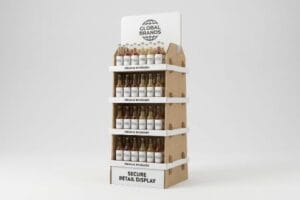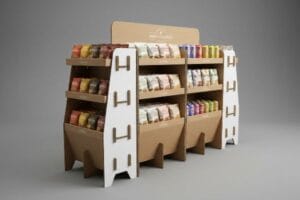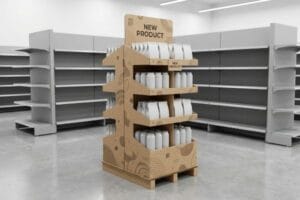
Getting noticed during the Q4 retail rush requires more than festive graphics. It demands physical disruption.
Boosting holiday sales with merchandising requires isolating your core promotional offer using high-contrast POP (Point of Purchase) displays. By engineering structural visual tension and utilizing fractional pallet geometries, brands can capture shopper attention within three seconds, effectively converting standard foot traffic into immediate impulse purchases.
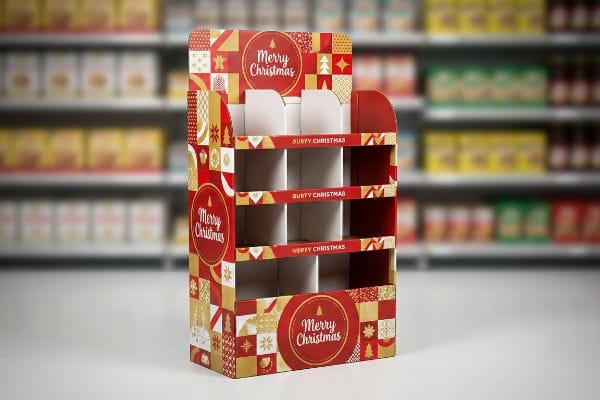
Theory sounds great in a marketing meeting. Let's look at how this physically comes together on the store floor.
How to Increase Sales Through Merchandising?
Slapping your logo on a cardboard box won't stop a rushing shopper.
Increasing sales through merchandising involves satisfying the strict 3-3-3 spatial engagement rule. Displays must physically disrupt visual patterns from thirty feet away, engage specific consumer interest at three feet, and provide unobstructed product access at three inches to successfully drive rapid retail conversions.
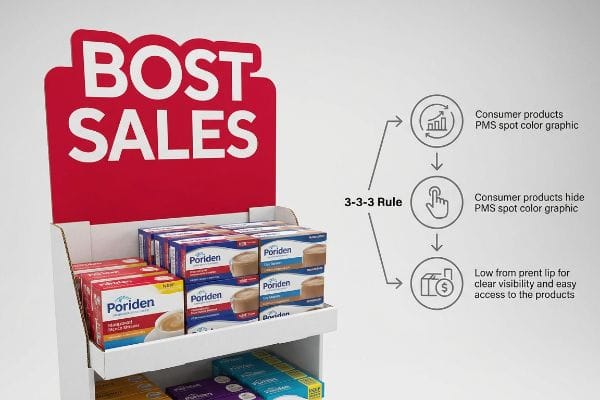
But knowing the engagement distances is just the starting line. The real friction happens when you try to print this onto raw paperboard.
The 3-3-3 Engagement Rule for Merchandising Displays
Even veteran designers often overlook how physical distance changes visual hierarchy. They build massive floor displays directly on backlit digital monitors, cramming every square inch with tiny text and complex graphics. They assume that if a design looks perfectly balanced on their screen, shoppers will naturally stop to read the fine print in the aisle.
I see this trap weekly when brands try to merge their entire website copy onto a single merchandiser. A client recently sent me a beautiful file, but when I ran a physical test print on unsealed corrugated testliner, the small text turned into a muddy, unreadable blur. The harsh fluorescent lights in big-box stores instantly wash out subtle details1. To fix it, I tell buyers to ruthlessly strip away secondary messaging and use a massive die-cut header flooded with a single solid PMS (Pantone Matching System) spot color2. You need that aggressive visual disruption, or the customer just walks by. Feeling the powdery finish of a properly flooded spot-color board proves you have the contrast needed to pull foot traffic.
| Common Rookie Mistake | The Pro Fix | Retail-Floor Benefit |
|---|---|---|
| Printing tiny text blocks | Use a massive die-cut header | Grabs attention from a distance |
| CMYK process printing | PMS spot color flood | Eliminates muddy halftone grain |
| Tall front retaining lips | Cut lip to 85% visibility | Secures 3-inch tactical conversion |
I never let a client waste budget printing a novel on a display base. You have exactly three seconds to trigger an impulse buy, so I force the architecture to isolate the core offer immediately.
🛠️ Harvey's Desk: Not sure if your graphics will turn into muddy halftones on raw cardboard? 👉 Get a Free Prepress Audit ↗ — Direct access to my desk. Zero automated sales spam, I promise.
What Are the 7 Rules of Merchandising?
You can engineer the strongest display in the world, but if it violates store rules, it goes straight to the dumpster.
The 7 rules of merchandising encompass aligning your product, price, place, and promotion across the seven distinct types of retailers. Adapting physical display footprints, inventory density, and visual communication strictly to specific store operational models guarantees seamless receiving and maximizes downstream supply chain profitability.
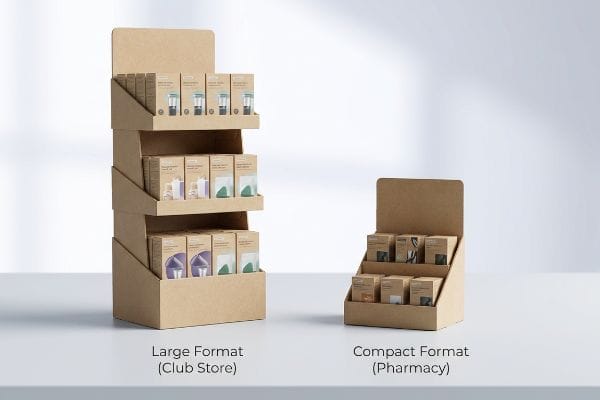
Knowing these structural frameworks prevents massive logistical headaches before your campaign ever ships.
Aligning Your Packaging with Retailer Store Frameworks
Emerging CPG brands frequently design a single, beautiful floor stand and assume it will magically work everywhere from a local pharmacy to a massive warehouse club. They treat the physical retail rollout as a one-size-fits-all operation. This oversight completely ignores the strict commercial ecosystems unique to each specific store category3.
I get calls all the time from frustrated marketing managers who just had their entire campaign rejected at the receiving dock. They try to jam a massive pallet designed for a club store into a tight grocery end-cap, and the store manager immediately tosses it. When I review their CAD (Computer-Aided Design) files, the problem is always a lack of framework alignment. You have to map your structural footprint directly to the retailer's spatial limits4. I once watched a frantic store clerk rip apart a beautifully printed header just so the unit could physically clear a low shelving overhang, producing that awful tearing sound of forced cardboard. I always engineer separate files for different store types to ensure the physical unit slides into place effortlessly.
| Common Rookie Mistake | The Pro Fix | Retail-Floor Benefit |
|---|---|---|
| One universal display size | Map footprint to store type | Eliminates receiving dock rejections5 |
| Ignoring forward reach limits | Anchor POS to specific heights | Prevents register obstruction |
| Overstocking heavy units | Match payload to shelf limit6 | Stops base crushing failures |
I map out the retailer's operational guidelines before I draw a single line of structure. Forcing a generic box into a specialized retail ecosystem only guarantees expensive chargebacks and angry store managers.
🛠️ Harvey's Desk: Are your current floor displays legally compliant with forward reach limits at the register? 👉 Request a Compliance Check ↗ — Download safely. My inbox is open if you have questions later.
How to Increase Sales During Christmas?
Q4 retail floors are absolute war zones for spatial real estate.
Increasing sales during Christmas requires utilizing fractional pallet geometries like half pallets or quarter displays to secure highly contested aisle space. By mathematically scaling down your merchandising footprint, retail buyers can seamlessly fit your seasonal promotions into premium high-traffic intersections, maximizing overall floor density.
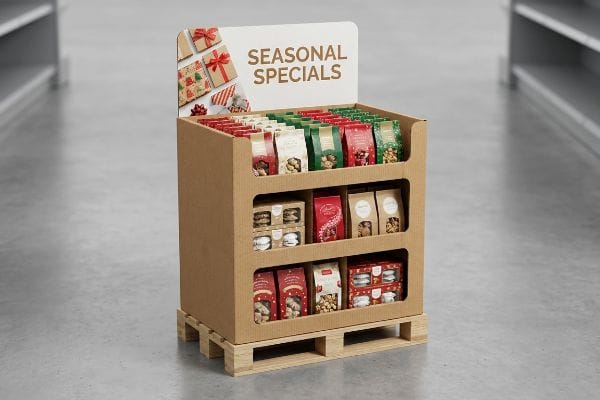
Securing that premium intersection space requires thinking strategically about your base dimensions.
Utilizing Fractional Pallets for Seasonal Retail Merchandising
Brands commonly push for massive, full-size floor displays during the holiday season, assuming a bigger footprint automatically translates to higher visibility. They spend their entire budget engineering a giant structural monument to their brand. Unfortunately, they ignore the reality that big-box buyers strictly ration floor space7 during the busiest shopping months of the year.
Pushing a full-size display during Q4 is like trying to park an RV in a crowded shopping mall lot. I often see brands get their holiday rollout entirely rejected because their physical footprint is just too greedy. The fix is mathematically subdividing the campaign. Instead of begging for a full GMA (Grocery Manufacturers Association) pallet spot, I engineer bulk merchandisers into exact quarter pallets measuring 24×20 inches (609×508 mm). The loud metallic clank of a pallet jack dropping perfectly alongside three other complementary displays proves this works. This structural division allows the retail buyer to mix and match multiple promotions on one wood base, guaranteeing your scaled-down unit actually makes it out of the backroom.
| Common Rookie Mistake | The Pro Fix | Retail-Floor Benefit |
|---|---|---|
| Forcing full-pallet displays | Engineer quarter pallet bases | Secures placement in tight aisles |
| Narrow, unstable towers | Engineer false weighted bottoms8 | Prevents dangerous tipping |
| Ignoring forklift access | Design 4-way block access9 | Speeds up warehouse sorting |
I always advise stepping down to a fractional footprint during the holidays. It is much more profitable to have a compact merchandiser actively selling in the aisle than a massive unit sitting out of sight.
🛠️ Harvey's Desk: Worried your holiday display is too bulky to get approved by a strict big-box buyer? 👉 Claim Your Structural Review ↗ — No forms that trigger endless sales calls. Just pure value.
What Is the Slowest Month for Retail Sales?
Slow turnover months mean your packaging sits trapped in harsh warehouse conditions for weeks.
The slowest month for retail sales exposes your seasonal merchandising inventory to extended warehouse storage cycles. During these prolonged transit periods, cardboard displays remain subjected to ambient humidity, which physically swells corrugated fibers and severely compromises critical structural interlocking mechanisms before reaching the store aisle.

Getting one display to stand up in a dry, climate-controlled lab is easy, but here is the harsh reality when you store 500 of them over a slow sales quarter.
Why Standard Corrugated Engineering Fails During Slow Retail Months
Even experienced procurement teams often approve flat-pack dielines based entirely on the absolute dry caliper of the board in a pristine office environment. They assume a perfectly drawn 3-millimeter slot will remain exactly three millimeters forever. They completely fail to account for environmental physics when inventory sits stagnant during low-turnover months in humid regions.
In my facility, I routinely see the disastrous effects of this blind spot when we pull archived samples from the testing floor. During slow months, flat-packed 32 ECT (Edge Crush Test) testliner absorbs massive amounts of ambient moisture and physically swells. A slot that fit flawlessly in the CAD software suddenly becomes 0.04 inches (1.01 mm) too tight. When I measure the swollen board with a micrometer, the friction lock is totally misaligned. If we don't catch this, the co-packing assembly team ends up crushing the internal flutes and aggressively tearing the printed top sheet just trying to force the swollen parts together. By mathematically engineering a strict 1-millimeter "Humidity Buffer" directly into the receiving slots before mass production, I ensure a frictionless, zero-tear assembly. Enforcing this micro-tolerance drops co-packing labor time by an estimated 35 seconds per unit, effectively saving the client thousands in manual rework fees when the slow season finally breaks.
| Common Rookie Mistake | The Pro Fix | Retail-Floor Benefit |
|---|---|---|
| Using dry lab dimensions | Add a 1mm humidity buffer | Eliminates friction during assembly |
| Ignoring storage humidity | Apply targeted liquid coatings | Prevents testliner structural warp |
| Forcing tight swollen tabs | Pre-crush folding score lines | Stops top-sheet litho-cracking |
I never let a structural file go to print without injecting dynamic climate tolerances. A display is totally useless if it rips apart in the co-packer's hands before the product even gets loaded.
🛠️ Harvey's Desk: Do you know the exact moisture swelling tolerance built into your current B-flute dieline slots? 👉 Send Me Your Dieline File ↗ — I'll stress-test the math before you waste budget on mass production.
Conclusion
You can choose a cheaper vendor for your holiday merchandising, but when that flat-packed 32 ECT board swells in a humid warehouse and causes massive friction, slowing down your assembly line by an estimated 30%, it will completely wipe out your Q4 profit margin. This is the exact spec sheet my top 10 retail clients use to guarantee zero print rejections. Stop guessing on environmental physics and let me personally run your structural files through my Free Dieline Pre-Flight Audit ↗ to catch fatal tolerance errors before mass production begins.
"Comparing task performance, visual comfort and alertness under …", https://pmc.ncbi.nlm.nih.gov/articles/PMC6295624/. Technical explanation of how high-intensity retail lighting affects visual perception and color wash-out on printed displays. Evidence role: technical validation; source type: lighting or optical engineering study. Supports: the claim that store lighting impairs small text legibility. Scope note: specific to high-lumen retail environments. ↩
"PMS vs CMYK for Packaging: Which Is Better? – PAX Solutions", https://pax.solutions/corrugated-packaging/pms-vs-cmyk-for-packaging/. Industry standard comparison regarding the vibrancy and consistency of Pantone spot colors over process printing for visual disruption in signage. Evidence role: technical specification; source type: graphic design or printing manual. Supports: use of PMS for aggressive visual disruption. Scope note: focuses on print saturation. ↩
"Retail Category Management by Industry | JAGGAER", https://www.jaggaer.com/blog/category-management-retail-procurement. An industry analysis of how different retail formats (e.g., convenience vs. big box) mandate specific display dimensions and logistics standards. Evidence role: contextual validation; source type: retail management guide. Supports: the claim that store categories have unique operational ecosystems. Scope note: focus on CPG physical retail constraints. ↩
"The Ultimate Guide to Designing an Engaging Retail Store …", https://spc-retail.com/the-ultimate-guide-to-designing-an-engaging-retail-store-layout/. Authoritative retail compliance guides verify that product displays must adhere to specific spatial dimensions to be accepted. Evidence role: technical validation; source type: industry standard/manual. Supports: the necessity of aligning CAD footprints with retailer spatial constraints. Scope note: applies to physical POP displays. ↩
"Loading Dock Equipment – Loading Dock Design", https://loadingdocksupply.com/loading_dock_design. Verification of how non-compliant display dimensions lead to shipments being rejected at the retail receiving dock. Evidence role: factual validation; source type: retail logistics manual. Supports: The connection between footprint mapping and dock acceptance. Scope note: Varies by retailer size. ↩
"1926.250 – General requirements for storage. – OSHA", http://www.osha.gov/laws-regs/regulations/standardnumber/1926/1926.250. Technical documentation regarding maximum load-bearing capacities for standard retail shelving systems to prevent collapse. Evidence role: technical specification; source type: shelving manufacturer engineering guide. Supports: The necessity of payload matching to prevent base crushing. Scope note: Applies to industry-standard gondola shelving. ↩
"For big-box retailers, one of the longest-running experiments is …", https://www.nbcnews.com/business/economy/big-box-retailers-one-longest-running-experiments-shrinking-rcna182287. Industry data on how major retailers manage spatial real estate and slotting fees during Q4 to optimize floor density. Evidence role: factual validation; source type: retail industry report. Supports: the claim that floor space is limited and strictly controlled. Scope note: focuses on big-box retail environments. ↩
"AG 1091A: Retail Merchandise Displays in the Frontage Zone", https://www.seattle.gov/transportation/permits-and-services/permits/applicant-guides/ag-1091a. Technical documentation on center-of-gravity physics for retail displays showing how weighted bases prevent tipping. Evidence role: technical validation; source type: engineering manual. Supports: safety of narrow towers. Scope note: applies to freestanding seasonal displays. ↩
"2-way vs 4-way Pallets: What are the Differences and Benefits?", https://performance-corp.com/4-way-vs-2-way-pallets-differences-benefits-uses/. Logistics standards explaining the efficiency of 4-way entry pallets for forklift maneuverability and sorting speed. Evidence role: operational proof; source type: supply chain textbook. Supports: speed of warehouse sorting. Scope note: focused on material handling equipment. ↩