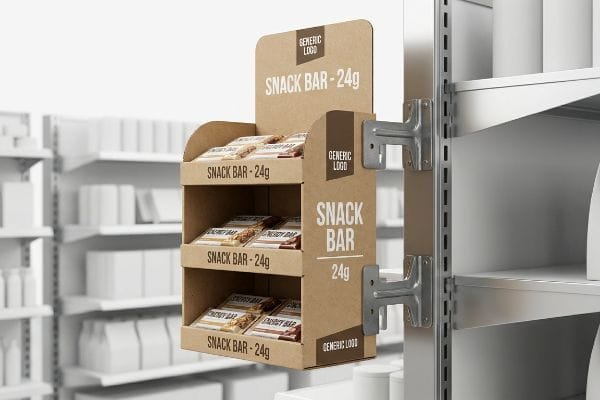
Los pasillos de las tiendas con mayor afluencia de público son una mina de oro para las compras impulsivas, pero también son auténticos campos de batalla para el cartón frágil. Para sobrevivir a la avalancha de clientes, se necesita algo más que buenos gráficos.
Los expositores Power Wing son ideales para zonas de mucho tránsito, ya que mantienen la mercancía a la altura de los ojos sin ocupar espacio en el suelo. Sin embargo, estas unidades laterales suspendidas requieren soportes metálicos especializados y una distribución precisa del peso para resistir las constantes colisiones con los carritos de la compra.

Saber que una unidad complementaria puede impulsar un volumen de ventas masivo es solo la mitad del trabajo. Analicemos qué es lo que realmente mantiene a estas unidades firmemente en los estantes.
¿Por qué deberían colocarse los expositores en zonas de mucho tránsito?
Lograr que su producto esté al alcance de miles de compradores que pasan por allí garantiza visibilidad, pero las estructuras minoristas estándar a menudo se mimetizan con el ruido visual caótico de una enorme tienda de grandes dimensiones.
Colocar los expositores en zonas de mucho tránsito fomenta la interacción física inmediata, captando a los compradores impulsivos en el crucial lapso de tres segundos para tomar una decisión. Aprovechar las zonas de mayor afluencia maximiza el retorno de la inversión (ROI) de su espacio comercial, siempre que el diseño estructural interrumpa visualmente el pasillo y guíe la mirada del comprador directamente hacia el producto.
Captar la atención es estupendo, pero mantenerla requiere una estrategia comercial bien calculada.
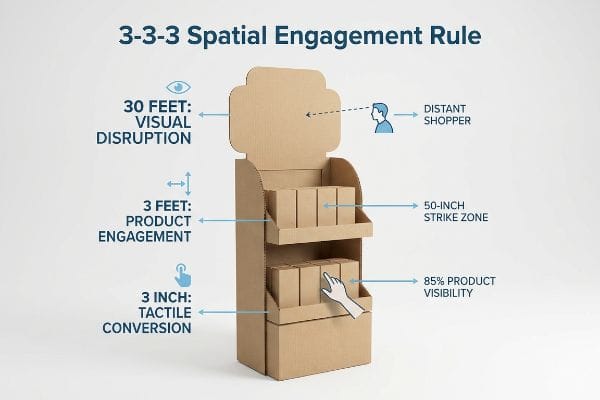
Regla de compromiso espacial 3-3-3 para tráfico alto
La mayoría de las marcas diseñan sus puntos de venta exclusivamente para una visualización cercana en monitores de ordenador retroiluminados, ignorando la realidad física de cómo los compradores se mueven por los pasillos abarrotados de las tiendas. Asumen erróneamente que un texto impreso en gran cantidad detendrá el flujo de personas. Sin elementos estructurales y gráficos diseñados específicamente para distintas distancias de visualización¹ , el punto de venta simplemente se mimetiza con el entorno.
Veo esto constantemente cuando los compradores revisan obras de arte planas. La exhibición se ve genial a la distancia de un brazo, pero desde treinta pies al final de un pasillo de Walmart, es solo una caja marrón borrosa. En mi centro, aplico la "Regla 3-3-3" para la interacción espacial. Usamos formas troqueladas agresivas para una disrupción visual a 30 pies, optimizamos la ergonomía del estante a la zona de impacto de 50 pulgadas (1270 mm)2 para la interacción a 3 pies, y cortamos el borde de retención frontal para garantizar una visibilidad del 85% del producto para la conversión táctil final de 3 pulgadas. Una vez vi una exhibición bellamente impresa pero físicamente plana ser completamente ignorada por los carritos apresurados, lo que resultó en inventario estancado y rechazo inmediato por parte del minorista. Agregar un enorme encabezado 3D cambia la interacción física por completo, reduciendo la sobrecarga cognitiva3 e impulsando conversiones de alto volumen.
| Error común de principiante | La solución profesional | Beneficio para el punto de venta |
|---|---|---|
| Impresión de paneles laterales planos con mucho texto | Utilizando formas troqueladas en 3D para una visibilidad de 30 pies4 | Detiene la acumulación de carritos de compra al instante |
| Colocar los productos clave demasiado abajo | Anclaje a la zona de impacto de 50 pulgadas (1270 mm)5 | Aumenta las tasas de interacción impulsiva |
| Labios de alta retención que ocultan la marca | Recortar los labios delanteros para garantizar una visibilidad del 85%6 | Agarrar sin fricción para el comprador |
Jamás permito que los clientes aprueben gráficos planos sin antes revisar una representación estructural en 3D. Guiar la mirada del comprador por un recorrido físico calculado es lo que transforma una simple caja de cartón corrugado en un vendedor silencioso y altamente efectivo en el punto de venta.
🛠️ Oficina de Harvey: ¿Tus exhibidores actuales se confunden con el ruido de fondo del comercio minorista? 👉 Obtén un render 3D estructural gratuito ↗ — Acceso directo a mi oficina. Sin spam de ventas automatizado, lo prometo.
¿Qué tipo de expositor se coloca en zonas de mucho tránsito para fomentar las compras impulsivas?
Si bien se busca llegar a las zonas específicas donde los compradores ya se detienen, no se pueden simplemente colocar enormes contenedores de basura en cualquier lugar de un espacio comercial altamente regulado.
Los expositores de brazo, los soportes laterales y las tiras con clip son las unidades principales que se colocan en zonas de mucho tránsito para fomentar las compras impulsivas. Dado que se montan directamente sobre los cabeceros de los pasillos o las estanterías metálicas existentes, estas configuraciones específicas evitan las estrictas limitaciones de espacio en el suelo, al tiempo que sitúan físicamente los artículos de alto margen al alcance natural del cliente.
Adquirir un local privilegiado en un extremo de la tienda solo resulta rentable si la unidad se ajusta a la infraestructura del minorista.
La trampa de la estandarización de altura para las alas motorizadas
Las marcas suelen intentar diseñar unidades laterales muy personalizadas para destacar, asumiendo que sus dimensiones únicas las harán más atractivas para los compradores. Ignoran por completo la rígida infraestructura física de los expositores estándar de las grandes superficies comerciales,creando unidades que son demasiado altas para las estanterías metálicas o demasiado anchas para ocupar la esquina del pasillo.
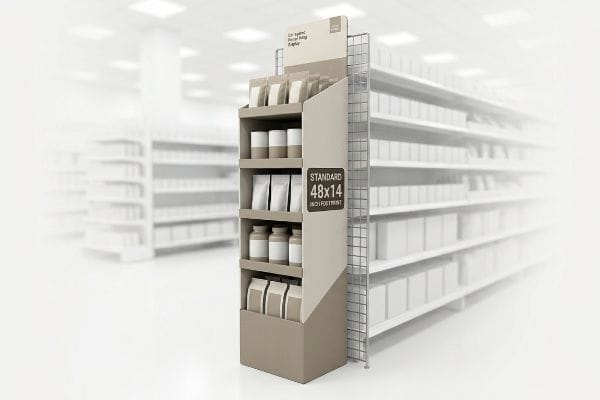
La pregunta más común que me hacen los nuevos profesionales del marketing es si pueden agrandar su expositor auxiliar para colocar artículos más pesados. Es una trampa que atrapa incluso a los equipos de compras más experimentados. Una vez, un cliente me envió 5000 unidades bellamente laminadas litográficamente que medían 1320 mm (52 pulgadas) de alto. Cuando los empleados intentaron colgarlas, sintieron la rigidez del cartón corrugado rozando contra el estante superior, bloqueando físicamente la señalización del pasillo principal. El minorista las tiró a la basura. Yo aplico estrictamente el estándar de 1219 mm (48 pulgadas) de alto por 355 mm (14 pulgadas) de anchoenesta medida universal, su unidad se integra perfectamente en la estructura física, eliminando por completo los costosos cargos de devolución del minorista y asegurando que sus artículos de compra impulsiva permanezcan en el piso.
| Error común de principiante | La solución profesional | Beneficio para el punto de venta |
|---|---|---|
| Personalización de las dimensiones exteriores del Sidekick | Aplicación de la regla de 48 × 14 pulgadas (1219 × 355 mm)9 | Garantiza la aceptación universal de las tapas de los extremos10 |
| Sobrecargar la unidad con SKU pesados | Cálculo de los límites de peso exactos de los soportes | Evita que el hardware se rompa bajo carga |
| Bloqueando la señalización del pasillo principal | Dejar el espacio vertical adecuado | Elimina los rechazos del gerente de la tienda |
Construyo cada producto auxiliar partiendo de la estructura metálica del estante del minorista y diseñando a la inversa. Si no se respetan los límites físicos de su sistema de estanterías existente, el mejor producto del mundo jamás llegará a la tienda.
🛠️ Harvey's Desk: ¿Cumple el troquelado de tu producto auxiliar con las estrictas dimensiones de 48×14 pulgadas que exigen las principales cadenas minoristas de EE. UU.? 👉 Verifica las dimensiones de tu troquelado ↗ — Descarga de forma segura. Si tienes alguna pregunta, puedes consultarme más adelante.
¿Qué es una pantalla Power Wing?
Comprender la terminología básica ayuda, pero saber exactamente cómo se fijan físicamente estos expositores secundarios a los muebles de la tienda es lo que evita lanzamientos desastrosos para su marca.
Un expositor de ala de potencia es un elemento de venta minorista especializado, diseñado para colgarse de los laterales de las estanterías de cabecera mediante herrajes metálicos especiales. A menudo fabricados con cartón corrugado ligero, estos expositores de gran visibilidad aprovechan la infraestructura existente de la tienda para presentar artículos de compra impulsiva directamente en zonas de mucho tránsito.
La estructura de cartón es solo el recipiente; la verdadera ingeniería se realiza en los puntos de conexión que lo sostienen todo.
La física universal de los soportes para alas de potencia
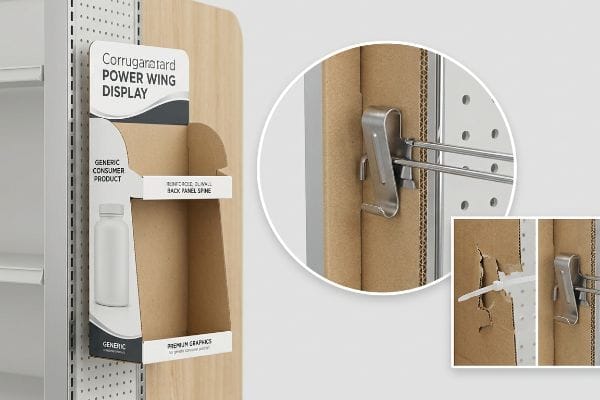
Los diseñadores novatos suelen tratar las extensiones de mostrador como si fueran bandejas, haciendo unos cuantos agujeros en el panel trasero y dando por sentado que unas bridas o ganchos de plástico baratos soportarán el peso. Subestiman la enorme fuerza de cizallamiento cinético que se aplicacuando cincuenta clientes ansiosos sacan los productos de la unidad durante un fin de semana ajetreado.
Piensa en un expositor de gran capacidad como en una mochila pesada; si las correas son débiles, la bolsa se caerá por muy resistente que sea la tela. Veo constantemente a clientes que intentan ahorrar dinero usando ranuras de cartón sin tratar para colgar los expositores. Recuerdo el horrible sonido de desgarro del cartón sin tratar cuando un expositor de 13,6 kg (30 lb) se desprendió de un panel perforado estándar y se estrelló contra el suelo. Yo exijo un sistema de "soporte universal" para cada expositor de gran capacidad. Al diseñar una estructura interna de cartón corrugado de doble pared que se ajusta perfectamente a un clip metálico universal rígido en forma de S, aíslo completamente la tensión cinética de las paredes exteriores. Esto garantiza una sujeción estable y sin fricción que agiliza el empaquetado conjunto y elimina por completo el riesgo de caídas en el pasillo.
| Error común de principiante | La solución profesional | Beneficio para el punto de venta |
|---|---|---|
| Utilizando ranuras para colgar de cartón crudo | Integración de un soporte universal de metal | Evita desgarros bajo cargas pesadas13 |
| Confiar en bridas de plástico baratas | Utilizando clips en forma de S de metal rígido | Acelera la instalación del empleado en minutos |
| Paneles traseros de una sola pared | Diseño de una estructura de soporte para colgar de doble pared | Absorbe la fuerza de tracción y el impacto cinético14 |
Me niego a que los puntos débiles de conexión arruinen una campaña impresa impecable. Al sobredimensionar considerablemente la carcasa del soporte, garantizo que su unidad permanezca fija en esa zona de tráfico prioritario desde el primer día hasta el último.
🛠️ Harvey's Desk: ¿Te preocupa que el panel trasero de tu escritorio se rompa con el peso de los productos? 👉 Solicita una prueba de resistencia del hardware ↗ — Sin formularios que generen interminables llamadas de ventas. Solo valor puro.
¿Cuáles son los cuatro tipos básicos de pantallas?
La ejecución en el comercio minorista generalmente se divide en zonas diferenciadas, que van desde grandes puntos de venta principales hasta pequeños puntos de venta en las cajas. Dominar las reglas específicas de cada zona es fundamental.
Los cuatro tipos básicos de expositores para puntos de venta incluyen soportes de suelo, bandejas de mostrador, expositores de palés y expositores expositores con brazo articulado. Cada categoría requiere una física estructural completamente diferente, una logística especializada y estrategias de cumplimiento por parte del minorista para una transición exitosa desde la planta de fabricación directamente al punto de venta.

Pero conocer la teoría no es suficiente cuando las máquinas empiezan a funcionar y enormes palés de madera comienzan a moverse por el suelo del almacén.
Por qué el diseño "reducido para ajustar" para diferentes categorías falla en la planta de producción
Las empresas comerciales suelen presentar un paquete de diseño "escalable" donde una enorme exhibición en el punto de venta (POP) se puede reducir a la mitad mediante software para que funcione como mostrador o bandeja auxiliar en el punto de venta (POS). Ignoran por completo las estrictas limitaciones legales, espaciales y logísticas que rigen estas distintas zonas comerciales en el mercado estadounidense.
En mis instalaciones, veo con frecuencia que los clientes intentan engañar a los cálculos enviándome un archivo de piso a escala reducida, pidiéndome que simplemente agregue clips colgantes para un ala eléctrica. Esto no es solo teoría: lo veo suceder en el área de pruebas cuando el diseño "reducido" de un cliente coloca los SKU más pesados completamente fuera de las ventanas de alcance frontal legales. Cuando mido el prototipo físico, una escala directa del 50% coloca los elementos interactivos a 62 pulgadas (1574 mm) de altura, violando drásticamente la ventana de cumplimiento de la ADA (Ley para Estadounidenses con Discapacidades) de 15-48 pulgadas (381-1219 mm)16.Al imponer tuberías de ingeniería permanentemente separadas para paletas de piso y alas eléctricas, fijo matemáticamente los archivos de POS con precisión en la ventana espacial de cumplimiento. Este ajuste geométrico de 14 pulgadas (355 mm) evita cargos masivos por parte de los gerentes de tienda que rechazarían y desecharían sin piedad los accesorios que no cumplen con la normativa en el muelle de carga.
| Error común de principiante | La solución profesional | Beneficio para el punto de venta |
|---|---|---|
| Adaptación de archivos de piso a los mostradores | Ingeniería de separación de pisos y mostradores | Evita que el centro de gravedad de la estructura se vuelque |
| Ignorar las alturas de alcance legales | Anclaje a límites ADA de 15-48 pulgadas (381-1219 mm)17 | Evita los rechazos agresivos de los gerentes de tienda |
| Utilizando matemáticas de palets para unidades colgantes | Transición de los palets GMA18 a los soportes universales | Elimina el espacio desperdiciado en la tienda |
Jamás permitiré que un cliente utilice una plantilla simplificada y poco elaborada para un lanzamiento nacional. Definir con precisión los límites matemáticos para cada tipo de pantalla es la única manera de proteger su marca de costosos problemas logísticos.
🛠️ Oficina de Harvey: ¿Tu archivo de punto de venta "escalable" cumple realmente con las estrictas normativas de cumplimiento para el comercio minorista en EE. UU.? 👉 Envíame tu archivo de troquelado ↗ — Pondré a prueba los cálculos antes de que malgastes tu presupuesto en la producción en masa.
Conclusión
Puedes ignorar la física mecánica extrema de las unidades colgantes, pero cuando las ranuras de pared simple sin tratar se desprenden de los paneles perforados, provocando rechazos inmediatos por parte de los minoristas y semanas de retrabajo manual, el margen de beneficio de tu campaña se esfuma por completo. Esta es la hoja de especificaciones exacta que utilizan mis 10 principales clientes minoristas para garantizar cero rechazos de impresión. Deja de adivinar las capacidades de carga estructurales y permíteme probar personalmente las carcasas de tus soportes mediante mi Auditoría Previa a la Producción Gratuita ↗ para detectar errores fatales de aplastamiento de bordes antes de que comience la producción en masa.
"Atención visual en entornos de consumo, J. Wesley Hutchinson…", https://faculty.wharton.upenn.edu/wp-content/uploads/2016/06/Visual_Attention_in_Consumer_Settings_IHCP_150814.pdf . Una guía autorizada sobre diseño minorista o psicología ambiental validaría la necesidad de diseñar para distancias de visualización específicas para mantener la visibilidad. Función de la evidencia: verificación técnica; tipo de fuente: estándar de la industria o estudio académico. Apoya: la afirmación de que la ingeniería especializada para distancias de visualización evita la fusión visual. Nota de alcance: Se aplica principalmente a entornos minoristas de grandes superficies con mucho tránsito.
"Directrices para supermercados minoristas: ergonomía para el…", https://www.osha.gov/sites/default/files/publications/OSHA3192.pdf . Breve explicación de cómo los estudios ergonómicos sobre la altura de los ojos y el alcance del comprador respaldan la altura de 50 pulgadas como zona de interacción principal. Función de la evidencia: especificación técnica; tipo de fuente: estudio ergonómico. Apoya: optimización de la altura de los estantes. Nota de alcance: puede variar según la altura del público objetivo.
"Las exhibiciones de productos en línea pueden influir en tu comportamiento de compra", https://today.ucsd.edu/story/products-displays-on-webpages-can-affect-what-you-add-to-your-cart. Breve explicación de cómo la jerarquía visual y los elementos 3D en el diseño minorista reducen el esfuerzo de procesamiento mental para los consumidores en entornos de alto tráfico. Función de la evidencia: mecanismo psicológico; tipo de fuente: investigación de mercado. Apoya: la eficacia de los encabezados 3D. Nota de alcance: Se aplica a entornos minoristas de alta estimulación. ↩
"Cómo las cajas de exhibición de mostrador de cartón maximizan la visibilidad en el comercio minorista...", https://cosourceglobal.com/blogs/cardboard-display-1/how-cardboard-counter-display-boxes-enhance-visibility. Explicación de cómo los elementos estructurales 3D en el merchandising visual mejoran la visibilidad a larga distancia en comparación con los paneles planos. Función de la evidencia: validación técnica; tipo de fuente: guía de merchandising visual. Apoya: la afirmación de que las formas 3D aumentan la visibilidad hasta 9 metros. Nota de alcance: La efectividad depende de la iluminación de la tienda y el ancho del pasillo .
"Colocación típica de productos por zona en el estante de venta minorista y…", https://www.bpc.works/en/news/typical-product-placement-by-zone-on-the-retail-shelf-and-its-impact-on-packaging-design/. Verificación de la altura estándar de la industria para la "zona de impacto" para una interacción óptima a la altura de los ojos del consumidor y la compra impulsiva. Función de la evidencia: estándar ergonómico; tipo de fuente: manual de diseño minorista. Apoya: la altura de 50 pulgadas como la ubicación ideal para la interacción. Nota de alcance: Basado en estadísticas promedio de la altura de los ojos de un adulto. ↩
"¿Por qué los minoristas colocan los productos a la altura de los ojos? – PopDisplay", https://popdisplay.me/why-do-retailers-place-products-at-eye-level/. Análisis de cómo la reducción de la altura de los bordes de sujeción de los expositores se correlaciona con un aumento específico en la visibilidad y accesibilidad del producto. Rol de la evidencia: métrica empírica; tipo de fuente: estudio de ingeniería de empaques. Apoya: el umbral de visibilidad del 85 % para un agarre sin fricción. Nota de alcance: el porcentaje puede variar según el tamaño del producto. ↩
"14 Tipos de Exhibidores Minoristas | Chicago, IL", https://wertheimerbox.com/types-of-retail-displays/. Verificación de las dimensiones estándar de la industria y las limitaciones físicas para los accesorios de cabecera de góndola en entornos minoristas de grandes superficies. Función de la evidencia: verificación fáctica; tipo de fuente: directrices de la industria minorista o especificaciones del fabricante de accesorios. Apoyos: la existencia de limitaciones de infraestructura rígidas. Nota de alcance: las especificaciones pueden variar ligeramente entre los principales minoristas. ↩
"Expositores laterales Power Wing personalizados", https://www.creativedisplaysnow.com/display/power-wing-sidekick-displays/. Una fuente autorizada, como una guía de fabricación de mobiliario comercial o un manual de planificación de espacios comerciales, confirma estas dimensiones específicas como el estándar de la industria para expositores laterales. Función de la evidencia: Verificación técnica; tipo de fuente: Estándar de la industria. Apoya: La afirmación de que estas dimensiones constituyen una huella universal para la integración en el comercio minorista. Nota de alcance: Si bien algunos minoristas tienen especificaciones personalizadas, esto representa la base general. ↩
"Expositor lateral de cartón personalizado, Powerwing…", https://grandfly.com/cardboard-display/sidekick-powerwing-display/. Las especificaciones técnicas de los fabricantes de mobiliario comercial o los estándares de la industria verifican la huella estándar para los expositores laterales. Función de evidencia: especificación técnica; tipo de fuente: manual de la industria. Soporta: el requisito dimensional específico para el hardware comercial. Nota de alcance: puede variar ligeramente según los mandatos de cada minorista. ↩
"¿Diferencias clave entre los expositores laterales y los de cabecera de góndola?", https://popdisplay.me/key-differences-between-sidekick-and-endcap-displays/. Los manuales de operaciones minoristas o las directrices del proveedor confirman que el tamaño estandarizado evita el rechazo de la colocación por parte de los gerentes de tienda. Función de la evidencia: verificación de procedimiento; tipo de fuente: guía de operaciones minoristas. Apoya: la correlación entre el tamaño estándar y la aceptación de la tienda. Nota de alcance: "universal" se refiere a los estándares comunes de la industria, no a todos los minoristas globales. ↩
"Estructuras aeroespaciales – Introducción a…", https://eaglepubs.erau.edu/introductiontoaerospaceflightvehicles/chapter/aerospace-structures/. Explicación técnica de las tensiones mecánicas y las fuerzas cortantes que actúan sobre los expositores comerciales colgantes durante la interacción con un alto volumen de consumidores. Función de la evidencia: validación técnica; tipo de fuente: ingeniería estructural o normas de diseño para el comercio minorista. Apoyos: la necesidad de herrajes especializados en lugar de fijaciones temporales. Nota de alcance: enfoque en los límites estructurales del cartón corrugado. ↩
"Power Wing & Sidekick Displays", https://brownpackaging.com/custom-packaging-products/pop-displays/corrugated/power-wing-sidekick/. Explicación técnica de cómo el corrugado de doble pared aumenta la capacidad de carga vertical en los expositores de cartón corrugado para venta al por menor. Función de evidencia: especificación técnica; tipo de fuente: estándar de la industria del embalaje. Soportes: el uso de nervaduras reforzadas para aislar la tensión. Nota de alcance: específico para cartón corrugado. ↩
"Los fundamentos del hardware de pared para tiendas minoristas", https://storefixturesdirect.com/blog/the-abcs-of-retail-store-wall-hardware/?srsltid=AfmBOoqaHlcAJORJsYc0_VUWeBTKpqn8ClLQDD6PdHKEcXBqBwzYuZEa. Comparación técnica de la resistencia a la tracción y la resistencia al corte entre soportes metálicos y cartón corrugado en mobiliario comercial. Función de la evidencia: validación; tipo de fuente: especificación de ingeniería de materiales. Apoyos: superioridad estructural de los soportes metálicos. Nota de alcance: específico para escenarios de carga pesada. ↩
"Planificación de embalaje y logística para expositores minoristas", https://www.frankmayer.com/blog/packaging-and-logistics-planning-for-retail-displays/. Análisis de la capacidad de carga y absorción de impactos del cartón ondulado de doble pared frente al de pared simple. Función de la evidencia: verificación técnica; tipo de fuente: estudio de ingeniería de embalaje. Apoyos: durabilidad de los lomos colgantes de doble pared. Nota de alcance: se aplica a la aplicación de fuerza lateral. ↩
"N/A", https://www.villageofgraftonwi.gov/DocumentCenter/View/11151. Los estándares externos de la industria y las directrices de cumplimiento minorista verifican las restricciones físicas y reglamentarias que rigen las diferentes ubicaciones de exhibición. Función de la evidencia: verificación de hechos; tipo de fuente: guía de cumplimiento de la industria. Apoya: La existencia de restricciones de zonificación en el comercio minorista de EE. UU. Nota de alcance: Las regulaciones pueden variar según la política corporativa de cada minorista. ↩
"Capítulo 3: Partes Operables", https://www.access-board.gov/ada/guides/chapter-3-operable-parts/. Verificación de las normas ADA para rangos de alcance accesibles en entornos comerciales. Función de la evidencia: validación de la restricción técnica; tipo de fuente: regulación gubernamental. Apoya: los requisitos de altura específicos para elementos de visualización interactivos. Nota de alcance: Se centra en la accesibilidad de alcance frontal. ↩
"Normas ADA para el diseño accesible, Reglamento del Título III…", https://www.ada.gov/law-and-regs/design-standards/1991-design-standards/. Verificación de las directrices de la Ley de Estadounidenses con Discapacidades (ADA) relativas a los rangos de alcance para accesorios y exhibidores comerciales. Función de la evidencia: verificación regulatoria; tipo de fuente: norma gubernamental. Apoya: requisitos legales de altura de alcance. Nota de alcance: se aplica a los rangos de alcance accesibles en espacios públicos. ↩
"GMA American Pallet. Dimensiones, tipos y mucho más.", https://acrosslogistics.com/blog/en/american-pallet-gma. Confirmación de las especificaciones de palés de la Grocery Manufacturers Association (GMA) como estándar de la industria para la logística minorista y los cálculos de huella. Función de la evidencia: verificación del estándar de la industria; tipo de fuente: asociación comercial. Apoya: dimensiones estándar de palés. Nota de alcance: se refiere a los estándares de envío norteamericanos. ↩