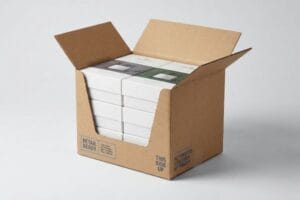
¿Te cuesta alcanzar tus objetivos de ingresos mientras los costes de la publicidad digital se disparan? Depender exclusivamente del tráfico online reduce tus márgenes de beneficio. En su lugar, deja que la venta física en tienda haga el trabajo pesado.
Para impulsar las ventas minoristas de manera eficiente, es necesario reasignar capital de los canales digitales saturados a la comercialización física de alto impacto. Al optimizar estratégicamente el diseño del empaque, aprovechar la colocación precisa de los productos en el piso de ventas y maximizar su visibilidad, las marcas pueden generar compras impulsivas espontáneas directamente en la caja registradora sin aumentar sus gastos recurrentes en publicidad.

La teoría de la conversión en tienda suena increíblemente sencilla sobre el papel. Sin embargo, ejecutar esta estrategia en un entorno comercial caótico y de ritmo acelerado requiere una planificación mecánica rigurosa.
¿Cómo aumentar las ventas en una tienda minorista?
Para captar realmente la atención en pasillos abarrotados, debe asegurarse ubicaciones privilegiadas en los pisos superiores, que los gerentes de las grandes superficies suelen reservar para las principales marcas corporativas.
El aumento de las ventas en tiendas minoristas depende por completo de asegurar ubicaciones estratégicas en los pasillos. El uso de espacios de merchandising fraccionados permite a las marcas más pequeñas evitar costos de espacio excesivos, integrando sin problemas unidades promocionales de alta visibilidad y gran resistencia en zonas de alto tránsito sin exigir secciones completas de pasillo a gerentes de tienda escépticos.

Lograr que tu producto llegue físicamente a la tienda es el mayor obstáculo. Si diseñas un expositor atractivo que el gerente de la tienda no puede colocar legalmente, tu campaña está condenada al fracaso desde el principio.
Cómo superar la trampa del "todo o nada"
Incluso los gerentes de marca más experimentados suelen asumir que asegurar espacio en la tienda significa presentar a los compradores unidades independientes enormes y de tamaño completo. Diseñan expositores gigantescos destinados a monopolizar un palé completo de 48 × 40 pulgadas (1219 × 1016 mm) de la GMA (Asociación de Fabricantes de Alimentos)¹. Si bien esto luce increíblemente imponente en una representación de software 3D, ignora por completo las duras realidades espaciales y el estricto racionamiento de espacio que imponen las tiendas de clubes de alto tránsito.
Veo cómo esta trampa espacial frustra lanzamientos prometedores constantemente. Un cliente envía un expositor grande y atractivo, solo para que el gerente de la tienda lo rechace porque simplemente no puede sacrificar todo un espacio en el pasillo para un SKU (unidad de mantenimiento de existencias) no probado. Recuerdo haber visto a un operario de almacén arrastrar físicamente una pesada paleta de madera hasta el muelle de carga, con la madera áspera raspando ruidosamente contra el concreto, simplemente porque la unidad era demasiado ancha para el pasillo de temporada. Para evitar esto, diseño expositores a granel con dimensiones fraccionarias estrictas. Al diseñar unidades matemáticamente ajustadas a medios palets de 48 × 20 pulgadas (1219 × 508 mm)² o cuartos de palet, garantizo que su campaña pueda compartir perfectamente una sola base de madera con otra marca. Esto reduce su requisito de espacio físico en un 75 %³, eliminando por completo la fricción del espacio en el piso y permitiendo que los compradores minoristas cautelosos aprueben con confianza su ubicación.
| Error común de principiante | La solución profesional | Beneficio para el punto de venta |
|---|---|---|
| Presentación de expositores de palets de tamaño real para productos nuevos no probados | Ingeniería de estructuras modulares de medio o cuarto de palé | Incrementa drásticamente los índices de aprobación de los minoristas |
| Ignorar las estrictas políticas de racionamiento de espacio en las grandes superficies | Subdividir matemáticamente la huella de la base de madera de GMA | Se adapta perfectamente a intersecciones congestionadas y de mucho tráfico |
| Obligar a los gerentes de las tiendas a sacrificar los expositores de los extremos de los pasillos | Diseñar unidades para convivir con otras marcas | Reduce las barreras de entrada para los espacios promocionales de temporada. |
Al reducir la superficie construida, supero eficazmente la principal barrera de entrada al sector minorista. Se obtiene de inmediato una visibilidad física privilegiada sin tener que luchar por espacios imposibles.
🛠️ Oficina de Harvey: ¿Le preocupa que su próximo encargado de merchandising incumpla las normas de espacio estándar del comercio minorista? 👉 Obtenga su auditoría estructural ↗ — Acceso directo a mi oficina. Le prometo que no recibirá spam de ventas automatizado.
¿Cómo generar ventas sin marketing?
Si se excluyen las campañas digitales y los descuentos promocionales, el embalaje físico debe absorber el 100% del trabajo de captación de clientes.
Generar ventas pasivas de forma independiente se basa en utilizar el empaque estructural como un elemento visual impactante y de alto contraste. Al eliminar las resoluciones de impresión borrosas y diseñar paneles gráficos nítidos y con colores precisos, los vendedores físicos captan la atención del comprador de forma natural a distancia, fomentando la interacción sin necesidad de campañas promocionales externas adicionales.
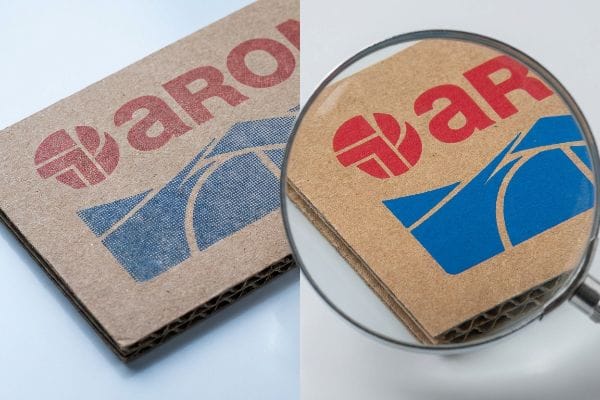
Lograr este nivel de impacto visual no es una tarea de diseño gráfico; es fundamentalmente un desafío de impresión química y mecánica.
¿Por qué la impresión en semitonos acaba con las compras impulsivas?
Los equipos creativos suelen diseñar patrones de marca magníficos y complejos en monitores digitales retroiluminados, exportando los archivos en formatos CMYK (cian, magenta, amarillo, clave) estándar. Dan por sentado que las imprentas comerciales automatizadas reproducirán sin problemas su visión digital en cartón estructural. Esta lógica ignora por completo el comportamiento físico del pigmento líquido cuando entra en contacto con superficies altamente porosas y sinsellar⁴.
Resulta increíblemente frustrante ver una inversión tan grande desperdiciada en una química de tinta deficiente. Cuando se imprimen colores de proceso estándar en papel de prueba 32ECT5, las máquinas depositan puntos microscópicos superpuestos. Con frecuencia, paso el pulgar por estas superficies impresas en el suelo de la fábrica, sintiendo la textura seca y calcárea donde las fibras del papel sin tratar han absorbido de forma desigual los puntos de semitono húmedos. Bajo la intensa iluminación fluorescente azulada de los comercios, esta mezcla óptica falla mecánicamente, convirtiendo un logotipo rojo vibrante en un lodo granulado y descolorido que desaparece por completo a 609 cm de distancia. Para solucionar esto, exijo un protocolo estricto de color directo PMS (Pantone Matching System) para todos los logotipos principales. Al mezclar físicamente un único y denso depósito de tinta personalizada, depositamos una capa gruesa y continua de pigmento sólido que sella las fibras porosas6, lo que da como resultado una valla publicitaria nítida y de alto contraste que atrae agresivamente al público.
| Error común de principiante | La solución profesional | Beneficio para el punto de venta |
|---|---|---|
| Confiar en la fusión óptica CMYK para logotipos de marca sólidos | Formulación de cubas de pigmentos de color directo mezcladas a medida | Evita que los gráficos se vean descoloridos bajo la luz intensa de las tiendas |
| Impresión de semitonos complejos sobre papel de prueba altamente poroso | Inundar el papel con colores de fondo sólidos para sellar las fibras | Ofrece una visibilidad de marca nítida desde 20 pies de distancia |
| Suponiendo que los colores de las pantallas digitales coincidan con los sustratos físicos | Utilizar espectrofotómetros físicos para una coincidencia de color exacta | Garantiza una absoluta coherencia de la marca en todos los pasillos de la tienda |
Me niego a que una impresión borrosa destruya el valor de su marca. Una impresión con tinta de precisión matemática garantiza que su promotor comercial venda activamente su producto desde el momento en que llega al punto de venta.
🛠️ Harvey's Desk: ¿Su proveedor actual verifica la tasa de absorción de tinta en función de la porosidad específica del cartón corrugado que ha elegido? 👉 Consulte las Directrices de preimpresión ↗ — Descárguelas de forma segura. Si tiene alguna pregunta, puede consultarme más adelante.
¿Cuáles son las 4 formas de aumentar las ventas?
Existen mecanismos universales que permiten acelerar la rotación del inventario. La medida más inmediata consiste en eliminar por completo las barreras físicas entre el cliente y la mercancía.
Los cuatro factores clave para impulsar las ventas incluyen optimizar la visibilidad del producto, maximizar el espacio disponible en la tienda, mejorar la estética de los materiales y aprovechar la ubicación estratégica en el punto de venta. Al exponer el empaque primario, se elimina la fricción física, lo que acelera la transición del consumidor desde la simple observación hasta la adquisición inmediata del producto.
Puedes tener los gráficos más llamativos en la tienda, pero si la arquitectura física oculta el inventario, tu ritmo de ventas se estancará.
La regla de visibilidad del 85% de la "altura del labio"
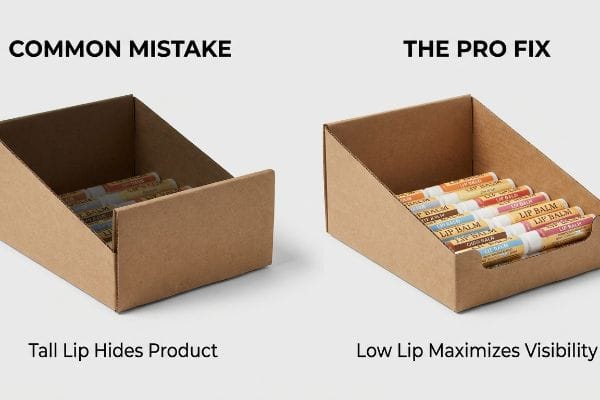
Los equipos de compras suelen exigir paneles frontales increíblemente profundos en los expositores de mostrador . Suponen, lógicamente, que una pared frontal más alta proporciona seguridad estructural y evita que los artículos sueltos se caigan al suelo durante la reposición. Si bien un borde frontal alto ofrece una excelente contención, al mismo tiempo crea una barrera visual impenetrable que oculta por completo la imagen principal del producto desde la perspectiva del cliente .
Esta deficiencia estructural limita activamente los ingresos. He estado cerca de las cajas registradoras y he visto a clientes rasparse los nudillos intentando sacar torpemente un pequeño bálsamo labial de una bandeja PDQ (Pretty Darn Quick) profunda y oscura. La alta pared de cartón proyecta una sombra oscura en el interior, lo que hace que la mercancía parezca poco atractiva y difícil de acceder. Para eliminar esta barrera, aplico matemáticamente una regla de visibilidad del 85 % durante la fase de ingeniería CAD (Diseño Asistido por Computadora). Elimino drásticamente el borde frontal de retención, dejando solo una barrera de seguridad calculada de 38,1 mm (1,5 pulgadas). Este corte preciso expone casi todo el envase principal, permitiendo que la luz de la tienda ilumine el producto de forma natural y eliminando por completo la fricción física que impide que el cliente lo tome al instante.
| Error común de principiante | La solución profesional | Beneficio para el punto de venta |
|---|---|---|
| Diseñar paredes frontales altas que oculten el embalaje primario | Bajando el labio delantero para garantizar una exposición visual del 85%8 | Desencadena compras impulsivas más rápidas y sin fricción9 |
| Creando cavidades profundas y oscuras que proyectan sombra sobre la mercancía | Aplicación de troquelados de perfil bajo para aprovechar la iluminación natural de la tienda10 | Hace que el inventario parezca de primera calidad y muy accesible |
| Priorizar la contención extrema del inventario sobre la facilidad de compra | Cálculo de la altura mínima exacta del labio de seguridad requerida | Evita la frustración del cliente al intentar alcanzar las unidades |
Al eliminar meticulosamente el material que obstaculiza la visión, logro que el producto hable por sí mismo. Dejas de ocultar tu inventario y empiezas a facilitar transacciones rápidas y fluidas.
🛠️ Harvey's Desk: ¿Tus mostradores actuales están ocultando tus productos más rentables? 👉 Solicita una plantilla de corte ↗ — Sin formularios que generen interminables llamadas de ventas. Solo valor puro.
¿Cómo puedo aumentar las ventas sin cambiar los precios?
Para mantener sus márgenes de precios actuales a la vez que impulsa un mayor volumen de ventas, el consumidor debe percibir físicamente que el artículo vale intrínsecamente más que el precio indicado en su etiqueta.
Para aumentar las ventas sin modificar los precios, es necesario mejorar la presentación física del producto. Al eliminar las texturas baratas y de baja calidad, y diseñar paneles de exhibición impecables y de alta fidelidad, las marcas aumentan artificialmente el valor percibido del producto, haciendo que el precio de venta actual parezca una ganga muy ventajosa.
Pero conocer la teoría no basta cuando las máquinas empiezan a funcionar; las realidades estructurales pueden sabotear rápidamente una estética de alta gama.
El sabotaje del "efecto tabla de lavar" a los precios premium
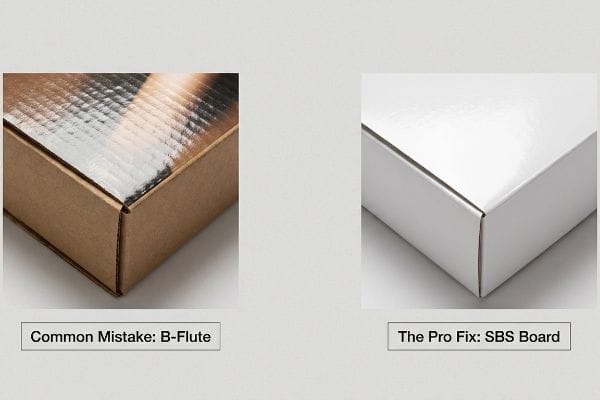
En mi centro, veo con frecuencia a equipos de compras intentando ahorrar dinero montando láminas superiores impresas de alta calidad y con acabado brillante directamente sobre bases de cartón corrugado estándar de flauta B gruesa. Suponen que el pegamento, al ser tan denso, simplemente mantendrá el papel plano. Esto ignora por completo la fuerte presión de vacío y el desplazamiento de humedad que se produce cuando el adhesivo húmedo se cura sobre nervaduras estructurales anchas y huecas.
Esto no es solo teoría: lo veo suceder en la sala de pruebas cuando un expositor de cosméticos supuestamente de "lujo" sale de la prensa de laminación. El pegamento húmedo se contrae en los valles de las ondulaciones del cartón corrugado, arrastrando consigo la fina lámina superior. Al pasar el pulgar por el panel terminado, puedo sentir una textura irregular y distintiva: el temido "efecto tabla de lavar". Las luces intensas de la tienda captan cada ondulación, haciendo que una crema de 40 dólares parezca un producto de liquidación de una tienda de un dólar, lo que provoca una fricción enorme y elimina por completo el posicionamiento premium del proyecto. Para erradicar esto, tomé las lecturas del micrómetro y demostré que no necesitábamos un papel más grueso; necesitábamos un sustrato más denso. Inmediatamente modifiqué las especificaciones a una microcanal de alta densidad (canal E) o exigí una laminación litográfica directamente sobre cartón SBS (sulfato blanqueado sólido). Al proporcionar una base microscópicamente plana, elimino el 100% de las ondulaciones de la superficie, lo que garantiza que la estructura se sienta pesada, densa y genuinamente cara en las manos del comprador.
| Error común de principiante | La solución profesional | Beneficio para el punto de venta |
|---|---|---|
| Montaje de papel fino brillante directamente sobre las anchas estrías de cartón ondulado tipo B | Especificación de cartón sólido de flauta E o SBS de alta densidad12 | Elimina la textura de superficie de tabla de lavar barata y con bultos |
| Ignorando cómo el adhesivo húmedo se contrae formando valles corrugados13 | Diseño de sustratos de laminación planos y resistentes a la humedad | Garantiza una estética impecable y lujosa incluso bajo iluminación intensa |
| Devaluar un producto de alta gama con un embalaje físicamente barato | Adaptar la densidad estructural al precio del producto14 | Justifica los altos márgenes de venta minorista a través de la calidad física |
Al optimizar la topografía microscópica del tablero, protejo el valor de su marca. Una estructura perfectamente lisa transmite implícitamente al comprador que su producto es de alta gama, justificando así su precio sin esfuerzo.
🛠️ Oficina de Harvey: ¿Conoce el calibre exacto de la ondulación y el contenido de humedad de la base corrugada de su proveedor actual antes de la laminación litográfica? 👉 Envíeme su archivo de troquelado ↗ — Haré una prueba de estrés para verificar los cálculos antes de que gaste su presupuesto en la producción en masa.
Conclusión
Puedes intentar ahorrar costes con la impresión CMYK estándar en papel testliner poroso, pero cuando ese gráfico borroso y descolorido entra en contacto con las luces fluorescentes, pierdes instantáneamente el impacto visual necesario para impulsar las compras por impulso, lo que provoca una caída devastadora del 30 % en la velocidad general de la campaña. Esta es la hoja de especificaciones exacta que utilizan mis 10 principales clientes minoristas para garantizar cero rechazos de impresión. Deja de adivinar las tasas de absorción de tinta y permíteme revisar personalmente tu diseño con mi Auditoría Gratuita de Troqueles ↗ para detectar errores fatales de preimpresión antes de que destruyan el valor de tu marca en el punto de venta.
-
"Palets GMA de 48×40" | El mayor fabricante y proveedor de palets", https://www.palletone.com/products/gma-pallets/. [Los estándares de la industria logística confirman que el palet GMA es el estándar norteamericano con unas dimensiones de 48 x 40 pulgadas]. Función de la evidencia: especificación técnica; tipo de fuente: estándar de la industria. Apoya: dimensiones estándar de palets. Nota de alcance: Se aplica específicamente al comercio minorista y la logística de Norteamérica. ↩
-
"¿Cuáles son los tamaños estándar de palets y por qué son importantes?", https://crateandpack.com/what-are-standard-pallet-sizes-and-why-does-it-matter/. [Una fuente autorizada de la industria en manejo de materiales y logística confirmaría que 48 × 20 pulgadas es una dimensión estándar para medios palets]. Función de la evidencia: validación técnica; tipo de fuente: estándar logístico; respalda: la precisión de las dimensiones fraccionarias de comercialización; nota de alcance: se centra en los tamaños estándar de palets norteamericanos. ↩
-
"Tipos de exhibición de palets: completos, medios y cuartos – GreenDot Packaging", https://greendotpackaging.com/understanding-pallet-display-types-full-half-and-quarter-pallet-displays/. [Un cálculo geométrico que compara un palet completo estándar de 48×40 con la huella de un cuarto de palet confirma una reducción del 75 % en el área de superficie]. Función de la evidencia: verificación matemática; tipo de fuente: informe técnico de la industria; respalda: la afirmación de reducir la fricción del espacio en el suelo; nota de alcance: se asume una comparación con un palet estándar de tamaño completo. ↩
-
"Optimización del proceso de conversión de cartón – Holmen Iggesund", https://www.iggesund.com/insights/paperboard-know-how/paperboard-manual/paperboard-manual-publication/printing-and-converting-performance/paperboard-converting/. [La literatura técnica sobre química de impresión explica cómo se extiende la tinta por acción capilar en cartón sin recubrimiento, lo que provoca ganancia de punto y pérdida de detalle]. Función de la evidencia: validación técnica; tipo de fuente: manual de la industria de la impresión. Apoya: la degradación del diseño digital durante la impresión física. Nota de alcance: se centra específicamente en sustratos sin recubrimiento. ↩
-
"Modelo de color CMYK para la impresión de cajas – Gentlever", https://gentlever.com/cmyk-for-printing-boxes/. [Una fuente autorizada sobre sustratos de embalaje explica la interacción entre los puntos de semitono CMYK y las propiedades absorbentes del testliner 32ECT]. Función de la evidencia: validación técnica; tipo de fuente: manual de la industria de la impresión. Apoya: el fenómeno de absorción de tinta en los liners de cartón ondulado crudo. Nota de alcance: limitado a testliner sin recubrimiento. ↩
-
"Comprendiendo los colores directos (y su función en la impresión digital)", https://www.mohawkconnects.com/article/mohawk-blog/understanding-spot-colors-and-their-role-digital-printing. [La literatura científica sobre impresión confirma que los colores directos crean una capa de pigmento más densa que reduce la penetración en el sustrato en comparación con los medios tonos de proceso]. Función de la evidencia: validación técnica; tipo de fuente: revista de química de tintas. Apoya: el uso de colores directos para sellar fibras porosas y lograr un mayor contraste. Nota de alcance: se aplica a formulaciones de tinta con alto contenido de pigmento. ↩
-
"PERSPECTIVAS DEL PUNTO DE VENTA: EL IMPACTO DE LOS EXHIBICIONADORES EN EL PUNTO DE VENTA…", https://www.bcipkg.com/point-of-purchase-insights-the-impact-of-retail-pop-displays-on-consumer-behavior/. [Investigaciones en visual merchandising y psicología del consumidor demuestran cómo las barreras físicas en los exhibidores del punto de venta obstruyen la línea de visión, reduciendo así el recuerdo de la marca y la conversión]. Función de la evidencia: de apoyo; tipo de fuente: estudio de diseño minorista. Apoya: el impacto negativo de los paneles frontales altos en la visibilidad del producto. Nota de alcance: aplicable específicamente a exhibidores de mostrador y POP. ↩
-
"Capítulo 2: Cómo elegir la altura de exhibición para sus clientes", https://www.creativedisplaysnow.com/guides/understanding-the-retail-customer/chapter-2-how-to-choose-the-right-display-height-for-your-customers/. [Una fuente autorizada sobre diseño minorista o merchandising visual validaría el umbral de visibilidad del 85 % para maximizar el reconocimiento del producto]. Función de la evidencia: especificación técnica; tipo de fuente: estándar de la industria. Apoya: la efectividad de las alturas bajas del borde. Nota de alcance: Específico para la visibilidad del borde del estante. ↩
-
"Factores que afectan el comportamiento de compra impulsiva de los consumidores – PMC – NIH", https://pmc.ncbi.nlm.nih.gov/articles/PMC8206473/. [Investigaciones revisadas por pares en psicología del consumidor confirmarían que reducir las barreras físicas y visuales aumenta la probabilidad de compras no planificadas]. Función de la evidencia: vínculo causal; tipo de fuente: estudio académico. Apoya: el beneficio de la exposición visual. Nota de alcance: Se centra en los desencadenantes de la compra impulsiva. ↩
-
"Embalaje personalizado con troquelado", https://blingblingpackaging.com/protective-packaging/die-cut-packaging/. [Los estándares de diseño para el comercio minorista explicarían cómo los patrones de troquelado en los expositores de punto de venta optimizan la penetración de la luz ambiental para mejorar el atractivo del producto]. Función de la evidencia: método técnico; tipo de fuente: manual de diseño. Apoya: el uso de troquelados de bajo perfil. Nota de alcance: Se aplica a cartón o expositores de punto de venta. ↩
-
"Reducción de los efectos de la humedad durante el curado de adhesivos epoxi…", https://www.academia.edu/60442352/Reduction_of_moisture_effects_during_the_cure_of_epoxy_adhesives_used_in_composite_repair. [La literatura técnica sobre materiales de embalaje explica cómo la migración de la humedad y las diferencias de presión durante el curado de adhesivos húmedos sobre sustratos acanalados crean irregularidades en la superficie]. Función de la evidencia: verificación técnica; tipo de fuente: manual de ingeniería de embalaje. Apoyos: El mecanismo físico que causa el "efecto tabla de lavar". Nota de alcance: Específico para la interacción entre adhesivos acuosos y cartón corrugado. ↩
-
"Tipos de flautas para cajas de cartón corrugado explicados: A, B, C, E y F", https://www.onyxpackaging.com/blog/corrugated-box-flute-types.php. [Los estándares de embalaje de la industria explican cómo los tamaños de flauta más pequeños (flauta E) o los sustratos sólidos (SBS) evitan el efecto de telegrafía superficial y el efecto de tabla de lavar común en la flauta B]. Función de evidencia: especificación técnica; tipo de fuente: estándar de la industria. Apoya: la eficacia de tipos específicos de cartón para eliminar defectos de textura. Nota de alcance: específico para superposiciones de calibre delgado. ↩
-
"Corrugator Bonding: A TAPPI PRESS Anthology of Published Pa", https://imisrise.tappi.org/TAPPI/Products/01/R/0101R265.aspx. [La documentación de ciencia de materiales sobre adhesivos acuosos describe la contracción volumétrica durante el proceso de curado, que puede introducir los revestimientos frontales en los huecos de las ondulaciones]. Función de la evidencia: propiedad física; tipo de fuente: revista de ciencia de materiales. Apoya: la causa de las irregularidades superficiales en los embalajes de cartón ondulado. Nota de alcance: aplicable principalmente a adhesivos a base de agua]. ↩
-
"Diseño de envases como herramienta de marca en la industria cosmética – PMC", https://pmc.ncbi.nlm.nih.gov/articles/PMC9123395/. [La investigación en psicología del consumidor indica que el peso táctil y la densidad estructural del envase influyen significativamente en el valor premium percibido y la justificación del precio de un producto]. Rol de la evidencia: principio psicológico; tipo de fuente: investigación de mercado. Apoya: el vínculo entre la calidad física y la justificación del margen minorista. Nota de alcance: sujeto a variación demográfica del consumidor]. ↩