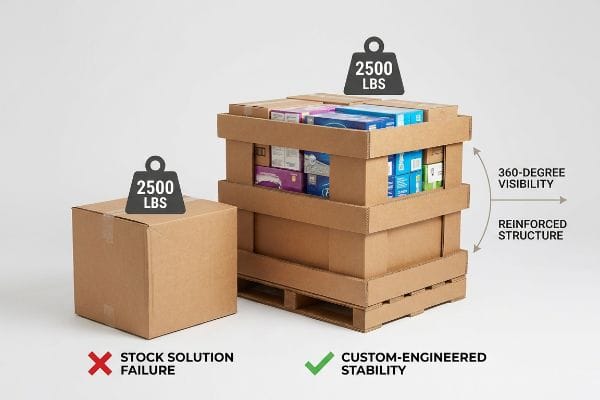
Los expositores de productos se derrumban bajo el implacable entorno de venta a granel de Costco. A menos que estén diseñados específicamente para soportar cargas masivas, su embalaje no sobrevivirá al muelle de recepción del almacén.
Para Costco, un diseño a medida es mejor que una solución estándar, ya que integra estrictos límites de carga de 1134 kg (2500 lb) y visibilidad de 360 grados. La ingeniería estructural personalizada garantiza el cumplimiento total de los límites de las estanterías del almacén y previene fallas catastróficas por compresión durante el transporte.
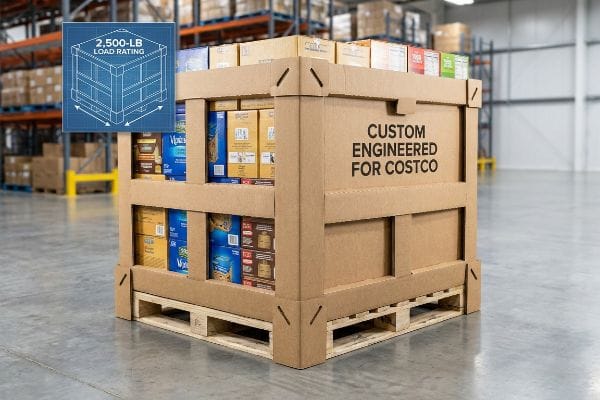
El salto de los estantes de un supermercado convencional a los suelos de hormigón visto de un club de compras al por mayor requiere una reevaluación completa de la lógica de la cadena de suministro. Analicemos por qué las cajas genéricas no funcionan en este contexto.
¿Qué diferencia a Costco de sus competidores?
Costco no utiliza góndolas de venta al por menor delicadas; sus tiendas son centros logísticos dinámicos, operados por montacargas. Cada pieza de embalaje debe sobrevivir a un entorno industrial hostil antes de que los consumidores la toquen.
Lo que distingue a Costco es su preferencia por la exhibición directa de productos en palets en lugar de las estanterías tradicionales. Este modelo logístico tan exigente somete los empaques listos para la venta a una gran tensión por carga superior, lo que requiere una resistencia estructural en las esquinas para soportar un almacenamiento prolongado en doble apilamiento en el almacén sin sufrir deformaciones catastróficas bajo el peso del inventario a granel.
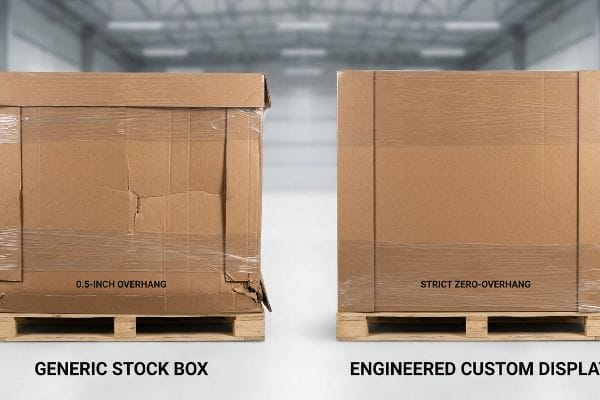
Una caja maestra de existencias diseñada para un estante ordenado en una tienda de conveniencia quedará completamente destruida en este entorno de almacén vertical.
El mandato de cero voladizos de la GMA
En mis instalaciones, veo con frecuencia que las marcas intentan trasladar sus expositores estándar de grandes superficies directamente al ecosistema de Costco. Se basan en plantillas CAD (Diseño Asistido por Computadora) demasiado simplificadas que maximizan el volumen interno, pero ignoran por completo las duras leyes físicas del apilamiento de palés pesados . Dado que Costco exige que los expositores lleguen completamente precargados¹ , el cartón ondulado debe soportar todo el peso cinético² del palé apilado encima durante el transporte de mercancías a larga distancia.
El punto ciego fatal se produce cuando los equipos de compras asumen que un tablero de prueba alto estándar es suficiente, ignorando la geometría física del palé GMA (Grocery Manufacturers Association). Cuando mido las líneas de troquelado entrantes en mi mesa de corte CNC (Control Numérico por Computadora) Kongsberg, con frecuencia detecto huellas de material que sobresalen de la plataforma de madera estándar de 48 × 40 pulgadas (121,9 × 101,6 cm)3 por solo 0,45 pulgadas (11,4 mm). En el área de pruebas, este voladizo fraccional significa que las esquinas estructurales no soportan absolutamente ninguna carga, transfiriendo todo el peso dinámico de 2500 libras (1133 kg) a los paneles centrales sin soporte y causando una falla catastrófica en la prueba de compresión de caja (BCT). Corrijo esto aplicando estrictamente una caja delimitadora de voladizo cero, reduciendo artificialmente el perímetro exactamente 0,5 pulgadas (12,7 mm) para fijar las esquinas de soporte de carga sobre la madera. Esta corrección geométrica de 12,7 mm restaura el 60 % de la resistencia a la compresión4, eliminando por completo los daños durante el transporte y protegiendo a los clientes de los elevados cargos de devolución de los minoristas.
| Métrico | Caja de stock genérica | Exhibición personalizada diseñada a medida |
|---|---|---|
| Alineación de paletas | Saliente de 0,5 pulgadas (12,7 mm) | Huella de planta estrictamente sin voladizos5 |
| Distribución de carga | Paneles centrales sin soporte | Alineación de esquinas al 100% |
| Supervivencia con BCT | Riesgo de pandeo severo | Soporta una carga de 2500 libras (1133 kg)6 |
Me niego a que un milímetro de voladizo arruine el lanzamiento de un producto altamente rentable. Controlar la geometría del espacio en la planta de producción es la única manera de garantizar que sus productos a granel sobrevivan al exigente ecosistema de los clubes de almacén.
🛠️ Harvey's Desk: ¿Sus expositores de mercancía cuelgan secretamente de los palés y corren el riesgo de sufrir un aplastamiento catastrófico bajo cargas apiladas doblemente? 👉 Solicite su auditoría gratuita de densidad de carga ↗ — Reviso personalmente cada archivo estructural en 24 horas.
¿Cuál es la estrategia de diseño de las tiendas Costco?
Los clubes de venta al por mayor operan con un modelo de búsqueda del tesoro de alta velocidad, maximizando el espacio abierto y los pasillos amplios. Los compradores recorren los palés desde cualquier ángulo, lo que cambia la forma en que funciona estructuralmente la presentación visual de los productos.
La estrategia de diseño de las tiendas Costco se basa en una cuadrícula de pasillos amplios y palets abiertos que fomenta el flujo de clientes en múltiples direcciones. Esta estructura espacial elimina los pasillos tipo góndola tradicionales, lo que exige que los expositores en el punto de venta mantengan la estabilidad estructural a la vez que facilitan el acceso a los productos y ofrecen una visibilidad de marca de alto contraste desde los cuatro ángulos de entrada.
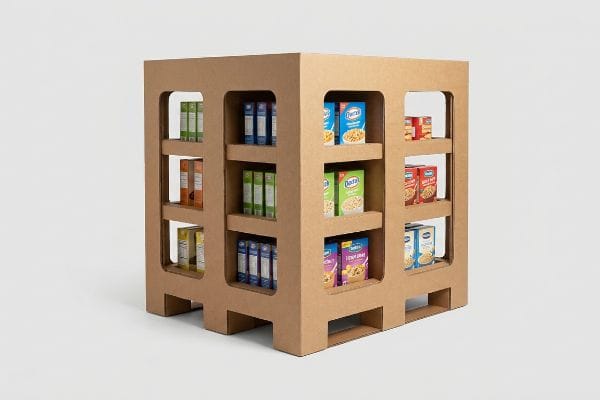
Comprender esta disposición multidireccional es precisamente la razón por la que los expositores minoristas estándar con la parte trasera cerrada fracasan fundamentalmente en un entorno de club de almacén.
Marco de permeabilidad visual de cuatro lados
A diferencia de los supermercados tradicionales que obligan a los clientes a recorrer pasillos lineales con estanterías de una sola cara, Costco utiliza palés abiertos. Esto significa que su expositor será observado, analizado y el cliente podrá comprar desde cualquier ángulo simultáneamente. Si utiliza una bandeja de almacenamiento genérica de paredes sólidas en este entorno, creará accidentalmente una enorme barrera visual que ocultará el producto desde tres de los cuatro principales vectores de tráfico peatonal.
Para adaptarse a esta realidad espacial, los ingenieros de embalaje estructural utilizan un marco específico conocido como arquitectura de paso de tienda7.Al troquelar estratégicamente las columnas de soporte con ventanas y eliminar los mamparos traseros innecesarios, creamos permeabilidad visual directamente a través del núcleo de la exhibición de paletas. Esto permite que la iluminación ambiental del almacén penetre en la estructura, iluminando los niveles inferiores y asegurando que el producto real siga siendo el foco visual principal. El diseño de soportes con ventanas personalizados requiere un delicado equilibrio entre mantener umbrales estrictos de ECT (Edge Crush Test) verticales8 y eliminar suficiente cartón crudo para permitir interacciones de impulso sin fricción desde todos los lados del pasillo.
| Característica de venta al por menor | Exhibición de piso estándar | Palé de compras de Costco |
|---|---|---|
| Acceso para compradores | Pasillo único orientado hacia el frente | Acceso a múltiples pasillos de 360 grados9 |
| Muros estructurales | Mamparos opacos sólidos | Soportes con ventana troquelada10 |
| Perfil de iluminación | Altas sombras internas | Iluminación ambiental para almacenes11 |
Diseño cada elemento de exhibición en almacén para captar la atención desde todos los ángulos posibles. Una verdadera arquitectura de compra integral transforma una caja estática en un motor de ventas altamente interactivo y visible.
🛠️ Harvey's Desk: ¿Su actual exhibición de palets crea sombras oscuras y obstruye el acceso de los clientes desde los pasillos opuestos del almacén? 👉 Solicite un análisis de visibilidad gratuito ↗ — 100% confidencial. Sus diseños de venta minorista aún no lanzados están a salvo conmigo.
¿Qué hace que Costco sea tan especial?
La magnitud del inventario que circula por estos edificios es incomparable. El peso físico que ejerce presión sobre cada ranura estructural distingue el cartón corrugado de ingeniería del cartón barato.
Lo que hace que Costco sea tan especial es la enorme densidad de carga que requiere su embalaje a granel. Este peso extremo exige que los componentes del embalaje secundario posean una rigidez interna excepcional para absorber de forma segura los fuertes impactos cinéticos y soportar el apilamiento en almacenes de varios niveles sin sufrir deformaciones estructurales ni colapso de las fibras.
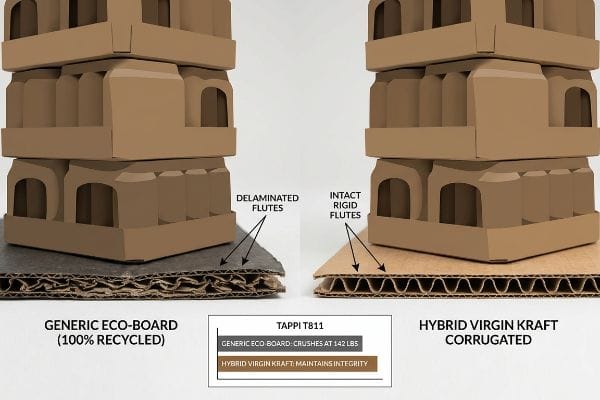
Este entorno extremo expone rápidamente los defectos ocultos en las cajas de cartón recicladas y respetuosas con el medio ambiente.
Límite de agotamiento de la fibra de microcanal
Cuando audito los troqueles de los clientes para su implementación en almacenes, veo constantemente que los equipos de compras presionan para que se utilice cartón de prueba 100 % reciclado para cumplir con las cuotas ESG (ambientales, sociales y de gobernanza) y, al mismo tiempo, reducir costos. Asumen que el cartón ecológico posee la misma integridad mecánica que el material nuevo. Sin embargo, la realidad microscópica del reprocesamiento del papel dicta que las fibras de celulosa se acortan físicamente y se agotan estructuralmentedespués de múltiples ciclos de reciclaje, lo que elimina la capacidad natural de absorción de impactos cinéticos de las ondulaciones.
Esto no es solo teoría; lo aprendí por las malas el año pasado al diseñar el lanzamiento de un palé de bebidas . En 2023, le pedí a mi ingeniero jefe de empaques, Mark, que probara una base de material 100 % reciclado estándar de la industria para el lanzamiento de un multipack de 80 lb (36,2 kg) de un cliente. Recuerdo específicamente haber visto a mi ingeniero jefe ejecutar la prueba de aplastamiento de borde TAPPI T81113 en nuestro laboratorio. En el momento en que la prensa hidráulica alcanzó los 142,3 lb (64,5 kg) de presión, escuché el crujido agudo y desagradable de las ondulaciones internas desprendiéndose y colapsando instantáneamente en una lámina plana. Las fibras sobre-recicladas simplemente carecían de la rigidez para soportar el peso. Inmediatamente detuvimos el proyecto y recalibramos nuestra estrategia de abastecimiento directamente en el nivel de la corrugadora. Impuse un cambio de material híbrido, inyectando exactamente un 32 % de fibras largas de kraft virgen directamente en el núcleo de ondulación C que soporta la carga. Invierto tiempo y dinero en mi laboratorio de pruebas para que usted no pierda ganancias en el punto de venta. Este ajuste de material híbrido no solo evitó que la base se deformara, sino que aumentó la capacidad de carga dinámica en un 40 % estimado¹⁴,eliminando por completo el riesgo de un derrame catastrófico en el almacén y cumpliendo al mismo tiempo con los estrictos criterios de sostenibilidad del minorista.
| Especificaciones del material | Tablero ecológico genérico | Cartón ondulado Kraft virgen híbrido15 |
|---|---|---|
| Acondicionamiento de la fibra | Corto y agotado | Largo y de alta rigidez |
| Prueba TAPPI T81116 | Delaminación de flauta | Mantiene el 100% de la integridad del núcleo |
| Capacidad de carga útil | Se aplasta con un peso de 64,4 kg (142 libras)17 | Absorbe grandes cantidades de peso |
Me niego a que las fibras recicladas y desgastadas comprometan el lanzamiento masivo de sus productos. Al inyectar estratégicamente papel kraft virgen justo donde se alcanza el máximo de tensión cinética, garantizo que sus expositores sean completamente irrompibles.
🛠️ Harvey's Desk: ¿Sus artículos voluminosos y pesados están aplastando sus bandejas ecológicas durante las pruebas de vibración obligatorias durante el transporte? 👉 Obtenga una auditoría gratuita de la línea de troquelado estructural ↗ — Sin intermediarios. Hable directamente con ingenieros estructurales.
¿Cuál es la altura máxima permitida para los palets en Costco?
Maximizar el retorno de la inversión en logística implica mover la mayor cantidad posible de productos sin aire. Sin embargo, el espacio vertical está estrictamente regulado por las limitaciones de geometría de los camiones y las estanterías del almacén.
La altura máxima de los palés en Costco suele ser de 121,9 a 127 cm (48 a 50 pulgadas) para las unidades de exhibición estándar. Esta estricta limitación vertical garantiza un apilamiento doble perfecto dentro de los contenedores de envío estándar y evita riesgos de espacio libre cuando las carretillas elevadoras cargan el inventario en las enormes estanterías de acero del almacén.
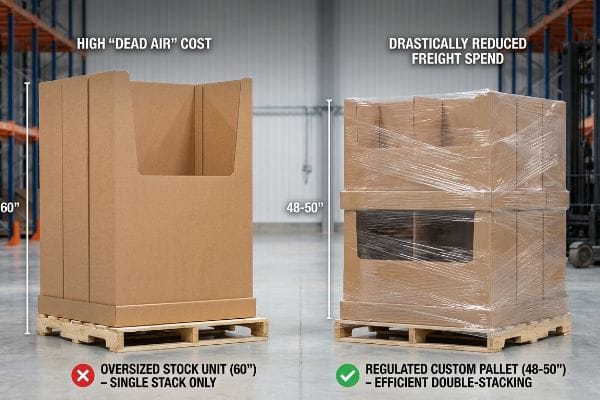
Ignorar este límite dimensional con un expositor alto estándar dará lugar a un rechazo inmediato en el muelle de recepción.
La matriz de doble apilamiento LTL
Se produce un grave error logístico cuando las marcas diseñan sus expositores de punto de venta únicamente para la altura de los ojos del consumidor final, ignorando el recorrido intermedio de la cadena de suministro. Un expositor de existencias que alcanza los 152,4 cm (60 pulgadas) de altura puede parecer muy innovador en una representación CAD, pero viola las leyes fundamentales de la física del transporte de mercancías. Las estructuras altas y rígidas no se pueden apilar en doble altura dentro de los contenedores de envío estándar de 279,4 cm (110 pulgadas) de altura¹⁸,lo que obliga a las marcas a pagar un elevado sobreprecio por el transporte de carga parcial (LTL) para enviar grandes cantidades de espacio vertical vacío.
Para sortear las estrictas limitaciones de la cadena de suministro, los ingenieros de embalaje consideran la altura de los palés como una ecuación matemática precisa, en lugar de una simple elección estética. Al limitar estrictamente la altura del contenedor completamente cargado a 127 cm (50 pulgadas)¹⁹, se posibilita el apilamiento doble de la mercancía de forma eficiente sin que se aplaste la capa inferior. Esta rígida restricción vertical sirve como parámetro fundamental para todo el proceso de diseño estructural, determinando el tamaño físico de las bandejas internas, el grosor de los separadores horizontales y el ángulo del borde de venta. Cuando se diseña con precisión, esta altura limitada actúa como un multiplicador logístico masivo, permitiendo al fabricante duplicar efectivamente el volumen exacto de producto transportado en un solo remolque sin comprometer la seguridad estructural.
| Variable logística | Unidad de stock de gran tamaño | Palet personalizado regulado |
|---|---|---|
| Altura total del palé | 60 pulgadas (152,4 cm)20 | 48-50 pulgadas (121,9-127 cm)21 |
| Densidad de carga | Solo apilado individualmente | Apilamiento doble eficiente |
| Eficiencia de envío | Alto costo de "aire muerto" | Reducción drástica de los gastos de transporte |
Respaldo matemáticamente cada dimensión de la exhibición a los estrictos límites de espacio para carga y almacenamiento. Al respetar las normas de altura libre, reduce drásticamente sus costos de transporte y garantiza una recepción sin contratiempos.
🛠️ Harvey's Desk: ¿Su expositor de gran altura está generando enormes penalizaciones de flete porque no se puede apilar de forma segura en doble altura? 👉 Solicite una auditoría gratuita de densidad de flete ↗ — Reviso personalmente cada archivo estructural en 24 horas.
Conclusión
La ingeniería a medida de su logística de cartón corrugado es la única manera de prevenir el pandeo excesivo de los palets, soportar cargas masivas y cumplir con las estrictas limitaciones de altura del almacén. Esta misma revisión de ingeniería detectó recientemente un error de tolerancia fatal de 2 mm en un importante lanzamiento nacional antes de la producción. Deje de adivinar la física de su cadena de suministro y permítame que revise personalmente sus archivos estructurales con una Auditoría Gratuita de Cumplimiento Logístico ↗ para garantizar que su próxima campaña de almacén supere las pruebas.
"Recomendaciones de Costco sobre la altura de los palés – LinkedIn", https://www.linkedin.com/pulse/costco-pallet-height-recommendations-the-costco-packaging-guys-yqakc. Los manuales de proveedores autorizados o las directrices logísticas de Costco confirmarían el requisito de que los palés lleguen prellenados para su comercialización directa en tienda. Función de la evidencia: verificación operativa; tipo de fuente: política corporativa. Apoya: el mandato logístico de embalaje listo para la venta minorista. Nota de alcance: específico del modelo de almacén de Costco .
"[PDF] Investigación del patrón de apilamiento de palés en el puenteo de carga unitaria", https://vtechworks.lib.vt.edu/bitstream/handle/10919/78616/Molina%20Montoya_Eduardo_T_2017.pdf?. Las normas de ingeniería de embalaje (por ejemplo, las pruebas ECT o Mullen) validarían los requisitos de carga estructural para materiales corrugados sometidos a apilamiento durante el tránsito. Función de la evidencia: validación técnica; tipo de fuente: norma de ingeniería. Apoya: la afirmación sobre la tensión de carga superior en el embalaje. Nota de alcance: se centra en la física de la compresión vertical. ↩
Palés GMA de 48×40 | El mayor fabricante y proveedor de palés, https://www.palletone.com/products/gma-pallets/. Verificación de las dimensiones estándar de la industria para los palés de la Grocery Manufacturers Association (GMA). Función de la evidencia: confirmación fáctica; tipo de fuente: estándar de la industria. Apoya: las dimensiones físicas del palé. Nota de alcance: Estándar para la logística norteamericana. ↩
"[PDF] Efecto del voladizo del palé en la resistencia a la compresión de la caja", https://admin.fibrebox.org/wp-content/uploads/2025/07/Pallet_Overhang_Phase_2.pdf. Evidencia técnica de estudios de ingeniería de embalaje sobre la pérdida de integridad estructural debido al voladizo del palé y la consiguiente recuperación de la resistencia tras la corrección. Función de la evidencia: validación técnica; tipo de fuente: estudio de ingeniería de embalaje. Apoya: la métrica específica de restauración de la resistencia. Nota de alcance: los resultados pueden variar según el grado de cartón ondulado. ↩
"Tamaños de palets estándar: 48×40 GMA y otras 6 dimensiones comunes", https://www.wearewarp.com/standard-pallet-sizes. Verificación de las normas de la Global Management Association (GMA) con respecto al requisito de voladizo cero para la paletización en almacenes. Función de la evidencia: especificación técnica; tipo de fuente: estándar de la industria. Apoya: El mandato de que los expositores se ajusten exactamente a las dimensiones del palet para evitar daños. Nota de alcance: Se aplica a los palets estándar GMA. ↩
"Estimación de la resistencia a la compresión de cajas de cartón corrugado para un…", https://pmc.ncbi.nlm.nih.gov/articles/PMC9864211/. Datos técnicos sobre los puntos de referencia de la prueba de compresión de cajas (BCT) para expositores de cartón corrugado diseñados en entornos de almacén de gran altura. Función de la evidencia: métrica de rendimiento; tipo de fuente: especificación de ingeniería. Apoya: La capacidad de carga estructural del embalaje industrial personalizado. Nota de alcance: Específico para puntos de referencia de expositores personalizados diseñados. ↩
"Expositores para tiendas de clubes: cabeceras de góndola, palets y más para mercancía a granel", https://www.qpack.com/retail-displays/pallet/club-store. Verificación de que la arquitectura de paso de tienda es un marco de embalaje estructural reconocido para mejorar la permeabilidad visual en entornos de almacén. Función de la evidencia: verificación de terminología; tipo de fuente: manual de ingeniería de embalaje. Apoya: el marco conceptual para el diseño de expositores de palets. Nota de alcance: puede usarse indistintamente con arquitectura de "acceso abierto". ↩
"Explicación de las clasificaciones ECT: qué significan para su cartón ondulado...", https://epackagesupply.com/blogs/packaging-guide/ect-ratings-explained-what-they-mean-for-your-corrugated-packaging?srsltid=AfmBOooyp9l6IwLtXRANJ83DpRhzYLlWryilrxjzkB1rgF9Xt4prP_9n. Especificación técnica que confirma que la prueba de aplastamiento de bordes (ECT) es el estándar de la industria para medir la resistencia al apilamiento vertical del cartón ondulado. Función de evidencia: validación técnica; tipo de fuente: estándar industrial (ASTM/ISO). Soportes: el requisito de estabilidad estructural en los soportes troquelados. Nota de alcance: se refiere a la resistencia a la compresión del ondulado del cartón. ↩
"Cómo diseñar empaques y exhibidores de paletas listos para Costco que vendan", https://www.goberkley.com/blog/how-to-design-costco-ready-packaging-and-pallet-displays-that-sell/. Un análisis de la industria de los diseños de clubes mayoristas validaría el diseño estructural que permite el acceso multidireccional del comprador. Rol de evidencia: especificación técnica; tipo de fuente: análisis de la industria minorista. Apoya: flujo de navegación del comprador. Nota de alcance: limitado a configuraciones de paletas de clubes mayoristas. ↩
"¿Viste estanterías en Costco? Aquí te explicamos cómo se llaman y dónde comprarlas", https://www.speedrackwest.com/blog/racks-and-shelves-like-they-use-in-costco?srsltid=AfmBOoqDwsz13DCWZWG6_tvI8On5fFcHfTLzWy9KFxkFogqTgTYTECxw. Las especificaciones técnicas o las revisiones arquitectónicas de los sistemas de estanterías de Costco verificarían el uso de soportes con ventanas para mayor visibilidad. Función de la evidencia: especificación técnica; tipo de fuente: especificación de fabricación o arquitectónica. Soportes: afirmación de permeabilidad estructural. Nota de alcance: se refiere al hardware físico de los soportes para palés. ↩
"Un sistema de iluminación tenue es una solución inteligente para Costco", https://betterbuildingssolutioncenter.energy.gov/beat-blog/dim-system-smart-solution-costco. Un estudio de diseño de iluminación de entornos de almacén confirmaría la preferencia por la iluminación ambiental de gran altura sobre la iluminación localizada de las vitrinas. Función de la evidencia: especificación técnica; tipo de fuente: guía de diseño de iluminación. Apoya: comparación de perfiles de iluminación. Nota de alcance: se centra en el contraste entre la iluminación de almacenes y la iluminación minorista tradicional. ↩
"El impacto del reciclaje mecánico en la fibra lignocelulósica… – PMC", https://pmc.ncbi.nlm.nih.gov/articles/PMC11945113/. La investigación en ciencia de materiales sobre el reciclaje de papel explica cómo el procesamiento hidrotérmico y mecánico repetido degrada los polímeros de celulosa y reduce la longitud de la fibra. Función de la evidencia: verificación técnica; tipo de fuente: revista de ciencia de materiales revisada por pares. Apoya: la afirmación de que las fibras recicladas pierden resistencia mecánica. Nota de alcance: se aplica principalmente al reciclaje mecánico de pulpa de madera virgen. ↩
"Métodos de ensayo de aplastamiento de bordes y modelado de compresión de cajas, TAPPI …", https://www.tappi.org/publications-standards/tappi-journal/home/2022/aug/edge-crush-testing-methods-and-box-compression-modeling-tappi-journal-august-2022/. Verificación de TAPPI T811 como estándar industrial reconocido para la medición de la resistencia a la compresión del cartón ondulado. Función de evidencia: validación metodológica; tipo de fuente: norma técnica. Apoya: la validez del procedimiento de ensayo de laboratorio descrito. Nota de alcance: La norma se aplica a la compresión de bordes de muestras de cartón. ↩
"Investigación del efecto de las perforaciones en la capacidad de carga…", https://pmc.ncbi.nlm.nih.gov/articles/PMC11396172/. Datos técnicos que demuestran cómo la integración de fibras largas de kraft virgen en material reciclado aumenta la rigidez estructural y la capacidad de carga de los núcleos de flauta C. Función de la evidencia: validación del rendimiento; tipo de fuente: estudio de ciencia de materiales. Apoya: la afirmación de que los pivotes de material híbrido previenen el pandeo estructural. Nota de alcance: las ganancias porcentuales exactas dependen de la calidad de la fibra reciclada original. ↩
"[PDF] Investigación de las propiedades mecánicas del embalaje de cartón…", https://repository.rit.edu/cgi/viewcontent.cgi?article=1066&context=japr. Explicación técnica de las propiedades del material de las fibras híbridas de kraft virgen en cuanto a longitud y rigidez estructural. Función de la evidencia: Verificación de la ciencia de los materiales; tipo de fuente: Especificación de fabricación. Apoya: La afirmación de que las fibras largas aumentan la rigidez. Nota de alcance: Propiedades generales del papel kraft virgen frente al contenido reciclado. ↩
"Mediciones de campo completo en la prueba de aplastamiento de bordes de un cartón corrugado...", https://pmc.ncbi.nlm.nih.gov/articles/PMC8199211/. Verificación de la norma TAPPI T811 y su aplicación en la medición de la integridad estructural y la delaminación del cartón corrugado. Función de la evidencia: Validación técnica; tipo de fuente: Norma industrial. Apoya: La afirmación de que tipos específicos de cartón fallan o mantienen su integridad bajo esta prueba. Nota de alcance: Específico para protocolos de prueba de papel y cartón. ↩
"Estimación de la resistencia a la compresión de cajas de cartón corrugado…", https://pmc.ncbi.nlm.nih.gov/articles/PMC8467740/. Datos empíricos que confirman la capacidad de carga específica y el punto de aplastamiento para materiales de cartón ecológico genéricos. Función de la evidencia: Verificación cuantitativa; tipo de fuente: Hoja de especificaciones técnicas. Apoya: La comparación de capacidades de carga entre tipos de materiales. Nota de alcance: El valor puede variar según el tamaño de la ondulación y el grosor del cartón. ↩
"Dimensiones y capacidades de furgonetas secas: 53′, 48′, + 40… – Hale Trailer", https://haletrailer.com/blog/dry-van-dimensions-capacities/. Verificación de las alturas de espacio libre interno para contenedores de envío estándar o furgonetas secas para confirmar los límites de apilamiento doble. Función de evidencia: Especificación técnica; tipo de fuente: Manual de logística de la industria. Soportes: La restricción física que impide el apilamiento doble de pantallas de 60 pulgadas. Nota de alcance: Distingue entre alturas de furgonetas secas estándar, High Cube y domésticas. ↩
"Directrices de embalaje de Costco – Software de cumplimiento para minoristas", https://www.retailerhub.ai/retailer-compliance/costco-packaging-guidelines. Una guía logística autorizada o un manual de especificaciones del minorista confirmaría la altura máxima específica requerida para permitir el apilamiento doble en remolques estándar. Función de la evidencia: especificación técnica; tipo de fuente: estándar de la industria/manual del minorista. Apoya: el límite de altura de 50 pulgadas para la eficiencia del transporte. Nota de alcance: Se aplica a la paletización estándar de almacén. ↩
"[PDF] PREFERENCIAS DE PALÉS", https://cdn.ymaws.com/woodpackglobal.org/resource/collection/E8AADDDE-7CBA-4298-8341-C7F29D0C14FF/Costco-PALLETS-PurposeBuilt.pdf. Verificación del límite de altura máxima para unidades de stock de gran tamaño en las directrices de logística y proveedores de Costco. Función de evidencia: especificación técnica; tipo de fuente: manual corporativo del proveedor. Apoya: altura máxima permitida del palé para unidades de gran tamaño. Nota de alcance: específico para las restricciones de recepción del almacén de Costco. ↩
"Guía de embalaje de Costco: Requisitos estructurales y mejores prácticas", https://greendotpackaging.com/costco-packaging-requirements/. Verificación del rango de altura específico requerido para que los palés califiquen para el apilamiento doble y así maximizar la densidad de carga. Función de evidencia: especificación técnica; tipo de fuente: manual del proveedor corporativo. Apoya: restricciones de altura para un envío LTL eficiente. Nota de alcance: aplicable a configuraciones de palés personalizadas reguladas. ↩