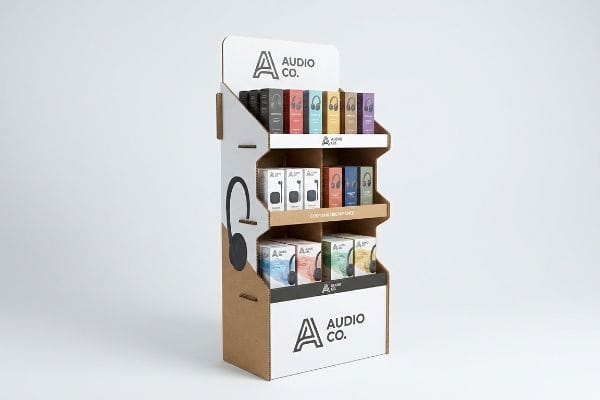
Lograr que un producto llegue a los estantes de las tiendas es solo la mitad del trabajo. Si los compradores pasan de largo sin detenerse, tus logros en distribución no significan nada.
Los expositores son importantes en las tiendas porque rompen la monotonía visual e interceptan activamente a los compradores antes de que lleguen a los pasillos de la competencia. Un expositor estratégicamente diseñado transforma el tránsito peatonal pasivo en compras impulsivas inmediatas, afianzando la identidad de la marca y organizando los productos para un acceso rápido y sencillo por parte del cliente.
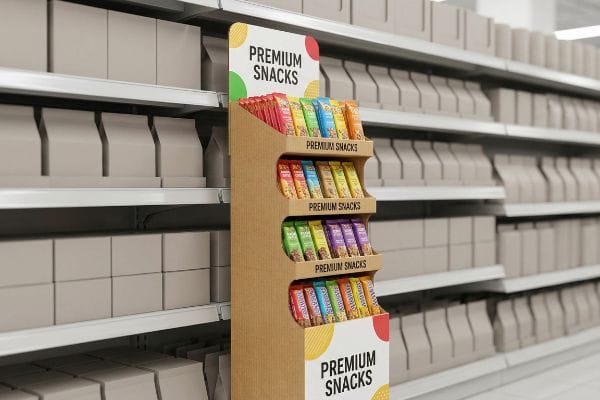
Eso suena genial en una presentación de marketing, pero traducir esa teoría en una unidad física de cartón corrugado que realmente sobreviva en un entorno minorista ajetreado es donde la mayoría de las campañas fracasan silenciosamente.
¿Cuál es el propósito de una exhibición?
Un elemento de control de calidad sirve para detener un carrito de compras en movimiento. Si se mimetiza con el entorno, es simplemente un costoso papel tapiz impreso.
El objetivo de un expositor es interrumpir de inmediato los patrones de compra habituales y diferenciar visualmente su producto del entorno comercial, que suele ser abrumador. Los profesionales del merchandising utilizan el contraste estructural, colores vibrantes y una colocación precisa del producto para captar la atención del consumidor y acelerar el proceso de decisión de compra.
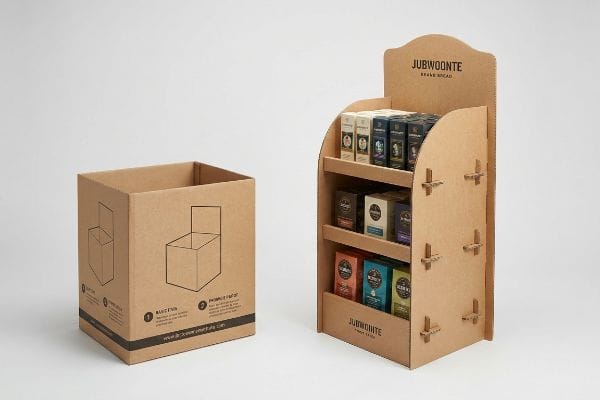
Para lograr ese impacto visual, hay que construir algo que destaque estructuralmente, y ahí es donde la ingeniería física se complica.
La psicología de la disrupción visual y las formas estructurales
Muchos gerentes de marca asumen que con envolver una caja cuadrada estándar con gráficos llamativos es suficiente para captar la atención. Confían únicamente en la impresión superficial para lograr el efecto deseado. Si bien los colores vivos ayudan, una silueta plana y cuadrada sigue siendo ruido de fondopara un comprador cansado que recorre los pasillos de una gran cadena minorista estadounidense.
Veo esta trampa constantemente al revisar archivos planos iniciales. Un diseñador crea un archivo de arte hermoso, pero lo aplica a un encabezado cuadrado completamente rígido. Para realmente romper el campo visual, incorporo formas curvas troqueladas que rompen físicamente la cuadrícula lineal de los estantes de la tienda. Pero aquí está el problema: cuando un principiante intenta un encabezado troquelado complejo sin calcular la dirección de la ondulación vertical, el borde sin tratar se ve irregular y falla estructuralmente²tratarcuando el cuello sin refuerzo se doblaba hacia atrás. Les tomó diez minutos de cinta adhesiva para arreglar lo que debería haber sido una inserción de ranura y pestaña de tres segundos, arruinando por completo la estética de marca premium.
| Error común de principiante | La solución profesional | Beneficio para el punto de venta |
|---|---|---|
| Basándose estrictamente en encabezados cuadrados | Troquelado de perfiles de cabezal curvos y asimétricos | Rompe inmediatamente la cuadrícula visual del estante |
| Ignorando la dirección de la ranura vertical | Alineando la veta estructural con el cuello troquelado | Impide que el panel de encabezado se ajuste |
| Forzar inserciones de pestañas complejas | Utilizando estructuras de pestañas autoblocantes | Ahorra 45 segundos de tiempo de montaje por unidad |
Jamás permito que un encabezado troquelado sin refuerzo llegue a la mesa de corte. Al diseñar la veta de la ranura para que coincida con la forma estructural, garantizo que su campaña luzca impecable desde el primer día hasta el último.
🛠️ Escritorio de Harvey: ¿No estás seguro de si tu pieza personalizada se romperá por su propio peso? 👉 Solicita una revisión de troquelado ↗ — Acceso directo a mi escritorio. Sin spam de ventas automatizado, lo prometo.
¿Por qué es importante exhibir mercancía?
La visibilidad es completamente inútil si su presentación se ve totalmente destruida después de solo dos días de gran afluencia de público.
La presentación de la mercancía es importante porque establece una representación física inmediata del valor de su marca en la tienda. Un expositor bien diseñado protege la integridad estructural del empaque de su producto, manteniendo una apariencia impecable y organizada incluso después de cientos de interacciones con los consumidores y ciclos de reposición frecuentes.
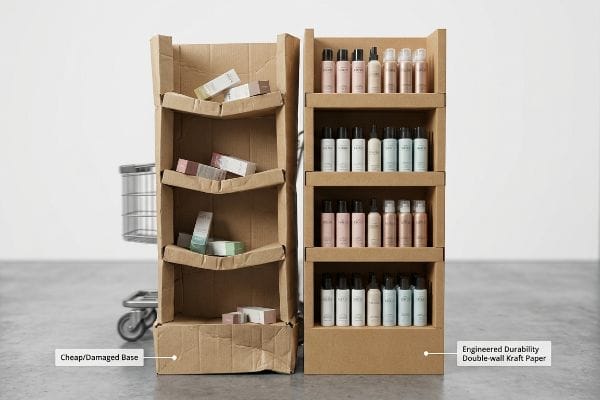
Para proteger el valor de esa marca, es necesario reconocer la agresividad con la que los compradores interactúan realmente con los elementos temporales de las tiendas.
Valor de marca y la regla de los 50 toques
Un error común en el diseño de espacios comerciales temporales es crear un ambiente estéril. Los equipos aprueban hermosas representaciones digitales en 3D, dando por sentado que el expositor permanecerá intacto en un rincón tranquilo. Especifican paneles ligeros de una sola capapara ahorrar dinero, ignorando la cruda realidad de un fin de semana de compras con gran afluencia de público.
Cuando colocas una unidad en un pasillo de mucho tránsito, inevitablemente recibirá golpes de carritos de compra, roces con fregonas y será revuelta por compradores impacientes. A esto lo llamo la Regla de los 50 Toques. Cada artículo en ese estante será levantado y vuelto a colocar varias veces. Recuerdo a un cliente que lanzó una línea de cosméticos líquidos pesados usando una base barata de flauta E (microflauta) para ahorrar en volumen de envío. Al tercer día, los estantes se estaban doblando visiblemente. Podías pasar la mano por la base y sentir las flautas blandas y aplastadas donde la integridad estructural había cedido por completo bajo la humedad y el peso. Todo el expositor parecía agotado, y los gerentes de la tienda simplemente tiraron las unidades restantes a la basura, lo que provocó una fuerte caída en los ingresos previstos.
| Error común de principiante | La solución profesional | Beneficio para el punto de venta |
|---|---|---|
| Especificación de bases ligeras de pared simple | Actualización a bases corrugadas de doble pared | Resiste golpes y fregonas agresivas |
| Ignorar la densidad del producto a lo largo del tiempo | Ingeniería para la regla de reabastecimiento de 50 toques | Evita que los estantes se curven o se aplasten visiblemente |
| En busca de la materia prima más barata | Uso de papel kraft virgen para zonas de carga estructural | Elimina el colapso prematuro de la fijación |
Me niego a que unos pocos centavos de ahorro en materiales arruinen un lanzamiento comercial masivo. Actualizar a una base de doble pared garantiza que su presentación luzca tan impecable en la cuarta semana como el primer día.
🛠️ Oficina de Harvey: ¿Le preocupa que su estructura actual no resista un fin de semana largo concurrido? 👉 Obtenga una auditoría de durabilidad ↗ — Descárguela de forma segura. Mi bandeja de entrada está abierta si tiene alguna pregunta.
¿Cuál es el poder de los displays en las tiendas?
El verdadero poder de un elemento físico reside en su dominio espacial. Te permite controlar con precisión cómo interactúa el consumidor con tu producto.
El poder de los expositores en tienda reside en su capacidad para controlar matemáticamente la ubicación del producto dentro del campo de visión óptimo del consumidor. Al elevar la mercancía de alto margen a la zona de impacto visual principal, estas estructuras evitan la saturación de los estantes y guían activamente los movimientos de las manos de los compradores.
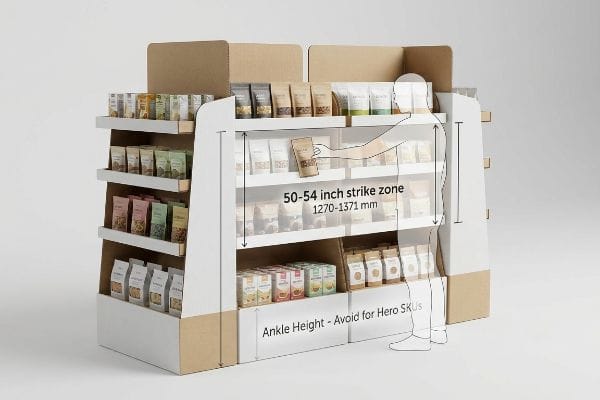
Controlar ese campo visual no es magia; es un juego estricto de ergonomía humana y mediciones de alta precisión.
Mapa de calor de la altura humana y zona de impacto visual
Con demasiada frecuencia, los diseñadores tratan un expositor independiente como una valla publicitaria gigante, colocando su marca más importante y sus productos estrella en la parte inferior o superior para maximizar el espacio. Diseñan gráficos planos en un monitor, olvidando por completo que los seres humanos tienen un campo de visión cómodo muy limitadocuando empujan un carrito pesado.
Piensa en las estanterías de las tiendas como en el sector inmobiliario; el ático está justo a la altura del pecho. Diseño intervalos específicos entre estantes basándome en el mapa de calor de la altura humana, forzando intencionadamente los surtidos de SKU (Unidad de Mantenimiento de Inventario) más rentables directamente a la zona de impacto de 50 a 54 pulgadas (1270 a 1371 mm)⁶. Incluso los equipos de compras más experimentados a veces se oponen a esto, queriendo espaciar uniformemente cinco estantes para meter más inventario en el espacio disponible. Una vez vi a un cliente quejarse físicamente, doblando las rodillas en un pasillo estrecho solo para sacar una pesada botella de champú de una bandeja inferior. La incómoda fricción física de sacar esa unidad tan compacta desde la altura de los tobillos acabó por completo con el impulso de compra. Si obligas al cliente a esforzarse, simplemente se irá.
| Error común de principiante | La solución profesional | Beneficio para el punto de venta |
|---|---|---|
| Amontonar artículos de alto margen en la parte inferior | Elevando a los héroes a la zona de impacto de 50-54 pulgadas7 | Aumenta la facilidad para agarrar objetos por impulso |
| Espaciar uniformemente todos los estantes estructurales | Variar la altura de las bandejas según criterios ergonómicos | Reduce la fricción física del comprador |
| Ocultar el mensaje principal a la altura del tobillo | Colocar los elementos clave de valor de la marca a la altura de los ojos | Llama la atención desde 3 metros de distancia8 |
Siempre planifico el alcance físico antes de cortar una sola pieza de madera. Optimizar esa zona de impacto vertical garantiza que se capten las ventas de los transeúntes sin que el comprador se detenga a buscar.
🛠️ Escritorio de Harvey: ¿Tus productos de mayor margen están accidentalmente enterrados a la altura de los tobillos? 👉 Solicita tu Plan Ergonómico ↗ — Sin formularios que generen interminables llamadas de ventas. Solo valor puro.
¿Qué es un punto de exhibición en el retail?
Existe una estricta diferencia legal y logística entre una unidad ubicada en la planta principal y otra ubicada en el mostrador de caja.
Un punto de exhibición es un espacio físico altamente regulado dentro de una tienda donde los materiales promocionales se ven afectados por normas específicas de cumplimiento espacial. Estas zonas dictan estrictamente las dimensiones máximas de los expositores, los rangos de alcance frontal permitidos y los requisitos de las bases de los palés para garantizar una navegación segura y sin obstáculos para los clientes y una gestión eficiente del almacén.
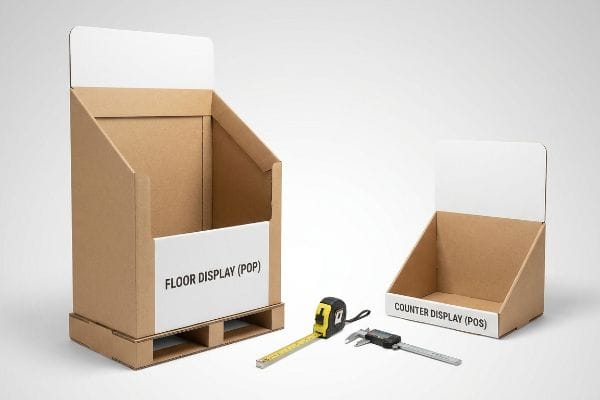
Lograr que un prototipo funcione en un laboratorio es fácil, pero esta es la cruda realidad cuando se envían quinientos de ellos a un distribuidor importante.
Por qué falla el dimensionamiento estándar por contracción en la planta de producción
Un error muy peligroso que cometen los compradores es creer que un expositor de punto de venta (POP) exitoso se puede reducir a la mitad para que funcione como caja registradora (TPV). Intentan usar una plantilla de archivo universal para ambas zonas de venta, asumiendo que las proporciones seguirán siendo funcionalmente idénticas una vez que las dimensiones generales se reduzcan.
En mis instalaciones, veo con frecuencia que las empresas comerciales envían estos archivos genéricos escalables, ignorando por completo las estrictas normas espaciales que rigen la logística minorista. Esto no es solo teoría: lo veo suceder en la planta de pruebas cuando evaluamos el cumplimiento estructural. Las unidades de piso deben anclarse al estricto límite de paletas de 48 × 40 pulgadas (1219 × 1016 mm) de la GMA (Asociación de Fabricantes de Alimentos)9 para soportar la logística de contenedores. Sin embargo, las unidades de caja registradora deben cumplir estrictamente con los límites de alcance frontal de la ADA (Ley para Estadounidenses con Discapacidades)10, que requieren una ventana de 15 a 48 pulgadas (381 a 1219 mm). Cuando un comprador fuerza un archivo a escala reducida sin recalcular el calibre físico del tablero, las pestañas se desalinean exactamente 3,17 mm (0,12 pulgadas). Les muestro las lecturas del micrómetro que forzar una pestaña corrugada gruesa en una ranura desproporcionadamente encogida provoca una grave deformación del papel. Al separar permanentemente los procesos de ingeniería y aplicar tolerancias de máquina precisas para cada zona, evito por completo las bases inestables. Esta separación específica reduce el tiempo de ensamblaje de coempaquetado en más de 30 segundos por unidad, lo que permite a los clientes ahorrar considerablemente en costos de mano de obra y elimina por completo el riesgo de costosas devoluciones por parte de los minoristas.
| Error común de principiante | La solución profesional | Beneficio para el punto de venta |
|---|---|---|
| Adaptación de archivos POP a las zonas de los puntos de venta | Separación de los procesos de ingeniería POP y POS | Evita bases inestables y productos defectuosos |
| Ignorar los límites legales de alcance hacia adelante | Aplicación de parámetros ADA exactos de 15 a 48 pulgadas11 | Garantiza el pleno cumplimiento legal por parte del minorista |
| Forzar el uso de tablas gruesas en ranuras encogidas | Ajuste de las tolerancias del calibrador de ranura en 3,17 mm12 | Reduce el tiempo de montaje en 30 segundos13 |
Jamás permito que un mismo archivo estructural sirva a dos ecosistemas minoristas diferentes. La inclusión de fórmulas matemáticas específicas para el cumplimiento normativo en la tabla de corte evita fricciones inesperadas en la línea de montaje.
🛠️ Oficina de Harvey: No permita que un defecto estructural de 2 milímetros arruine el lanzamiento de 500 tiendas. 👉 Envíeme su archivo de troquelado ↗ — Analizaré los cálculos antes de que malgaste su presupuesto en la producción en masa.
Conclusión
Puedes encontrar la plantilla escalable más barata en línea, pero si ese archivo genérico ignora los estrictos límites de alcance de la ADA y provoca una desalineación de calibre de 3,17 mm durante el coempaquetado, los estantes inestables resultantes provocarán rechazos inmediatos por parte de los minoristas y eliminarán por completo el margen de beneficio de tu campaña. Más de 500 gerentes de marca utilizan mi lista de verificación de preimpresión para evitar estos errores fatales en las primeras etapas. Deja de arriesgarte con especificaciones minoristas que no cumplen y permíteme revisar personalmente tus archivos estructurales con mi Auditoría Previa a la Impresión Gratuita ↗ para asegurar la física antes de que las máquinas comiencen a cortar.
«¿Cómo influyen los escaparates en las decisiones de entrada de…?», https://www.sciencedirect.com/science/article/abs/pii/S0969698911000889. [Una fuente autorizada sobre percepción visual o psicología del comercio minorista demostraría cómo la disrupción estructural rompe los patrones de escaneo habituales de manera más efectiva que el color por sí solo]. Función de la evidencia: apoyo a la ineficiencia de los gráficos 2D sobre las formas 3D; tipo de fuente: estudio académico o informe técnico de la industria. Apoya: la necesidad de contraste estructural para generar interacción. Nota de alcance: se aplica específicamente a entornos minoristas con alta estimulación. ↩
"[PDF] Un estudio sobre la viabilidad del cartón ondulado tipo F como sustituto del cartón plegable", https://repository.rit.edu/cgi/viewcontent.cgi?referer=&httpsredir=1&article=1300&context=theses. [Los manuales técnicos de ingeniería de embalaje explican cómo el corte perpendicular o diagonal al ondulado del cartón corrugado compromete el acabado del borde y la capacidad de carga]. Función de la evidencia: Verificación técnica; tipo de fuente: Libro de texto de ingeniería de embalaje. Apoya: La afirmación de que la alineación del ondulado es fundamental para el éxito estructural de los cabezales troquelados. Nota de alcance: Se aplica específicamente a la construcción de cartón corrugado. ↩
"[PDF] ¿Hablas el idioma del cartón ondulado?", https://www.packagingcorp.com/filebin/pdf/DoYouSpeakCorrugated/do-you-speak-corrugated.pdf. [La documentación técnica sobre embalajes de cartón ondulado detallaría las limitaciones de carga y durabilidad del cartón de pared simple en comparación con las opciones de doble pared en entornos de alto tránsito]. Función de la evidencia: especificación técnica; tipo de fuente: ciencia de los materiales/estándar de la industria. Apoya: la afirmación de que los materiales ligeros son insuficientes para entornos minoristas de alto volumen. Nota de alcance: Se centra en la integridad estructural de los accesorios temporales de cartón. ↩
"Determinación analítica de la rigidez a la flexión de un cartón ondulado de cinco capas…", https://pmc.ncbi.nlm.nih.gov/articles/PMC8777652/. [Las normas de la industria del embalaje proporcionan especificaciones sobre la resistencia a la compresión y la susceptibilidad a la humedad del cartón ondulado E en comparación con los grados de cartón ondulado más pesados]. Función de la evidencia: especificación técnica; tipo de fuente: guía de embalaje industrial. Apoya: la afirmación de que el cartón ondulado ligero es insuficiente para exhibidores de productos líquidos pesados. Nota de alcance: se centra en la ciencia de los materiales del cartón ondulado. ↩
"Posición preferida de las pantallas visuales en relación con los ojos – PubMed", https://pubmed.ncbi.nlm.nih.gov/9674376/. [Un estudio ergonómico o un artículo sobre psicología del comercio minorista definiría los grados verticales y horizontales específicos del campo visual primario para los compradores]. Función de la evidencia: Especificación técnica; tipo de fuente: Estudio revisado por pares o manual de ergonomía. Apoya: El concepto de zona de impacto visual restringida. Nota de alcance: Puede variar según la estatura promedio de los adultos. ↩
"¿Cuál es la altura promedio de los estantes en tiendas minoristas? – PopDisplay", https://popdisplay.me/what-is-the-average-retail-shelf-height/. [Un estudio ergonómico o una guía de comercialización minorista validaría que el rango de altura de 50 a 54 pulgadas se alinea con el nivel promedio de los ojos humanos y la zona de fácil alcance]. Función de la evidencia: validación técnica; tipo de fuente: investigación ergonómica o manual de la industria minorista. Apoya: la identificación de la altura específica de la zona de impacto. Nota de alcance: las mediciones específicas pueden variar según el perfil demográfico del consumidor objetivo]. ↩
"¿Por qué los minoristas colocan los productos a la altura de los ojos? – PopDisplay", https://popdisplay.me/why-do-retailers-place-products-at-eye-level/. [Investigaciones autorizadas sobre ergonomía en el comercio minorista y alcance del consumidor definen la "zona de impacto" como la altura óptima para las compras impulsivas, generalmente centrada en torno a las 50-54 pulgadas]. Rol de evidencia: Especificación técnica; tipo de fuente: Investigación de mercado/Estudio de ergonomía. Apoya: Optimización de la altura de colocación del producto. Nota de alcance: Pueden existir variaciones según los perfiles de altura de la demografía objetivo.] ↩
"Visibilidad de las letras de los letreros: Guía de distancia de Houston Sign", https://houstonsign.com/letter-size-signs-at-distance-letter-visibility-chart/. [La psicología ambiental y los estándares de merchandising visual establecen la distancia a la que los mensajes de marca a la altura de los ojos captan eficazmente la atención del comprador antes de que entre en la zona inmediata del producto]. Rol de la evidencia: Métrica de rendimiento; tipo de fuente: Manual de merchandising visual. Apoya: Distancia de impacto visual. Nota de alcance: La efectividad depende del contraste, la escala y la iluminación.] ↩
"Palets GMA de 48×40" | El mayor fabricante y proveedor de palets", https://www.palletone.com/products/gma-pallets/. [La documentación de estándares de la industria de la Asociación de Fabricantes de Alimentos confirma que el palet de 48" x 40" es el estándar logístico norteamericano]. Función de la evidencia: especificación técnica; tipo de fuente: estándar de la industria. Apoya: requisitos de dimensiones físicas para unidades de piso. Nota de alcance: Aplicable específicamente a las cadenas de suministro norteamericanas. ↩
"Normas ADA para el Diseño Accesible, Título III, Reglamento 28 CFR…", https://www.ada.gov/law-and-regs/design-standards/1991-design-standards/. [Las Normas ADA para el Diseño Accesible definen rangos de alcance específicos para garantizar que los entornos comerciales sean accesibles para las personas que usan sillas de ruedas]. Función de la evidencia: requisito legal; tipo de fuente: reglamento federal. Apoyos: restricciones de altura y profundidad para exhibidores de cajas registradoras. Nota de alcance: ley federal de EE. UU .
"Capítulo 3: Partes Operables – Access-Board.gov", https://www.access-board.gov/ada/guides/chapter-3-operable-parts/. [Una fuente autorizada sobre las Normas ADA para el Diseño Accesible verificará las mediciones específicas del rango de alcance requeridas para la accesibilidad en el comercio minorista]. Función de la evidencia: Verificación; tipo de fuente: Norma legal. Apoya: Cumplimiento legal para el alcance de la pantalla. Nota de alcance: Se refiere a las normas ADA de EE. UU .
"[PDF] Libro de referencia sobre grabado – Gravostore", https://www.gravostoreusa.com/img/catalog/US-Catalog-2018-web.pdf. [Los manuales de ingeniería técnica para embalajes de cartón ondulado especifican ajustes de tolerancia estándar para tener en cuenta las variaciones del espesor del cartón]. Función de la evidencia: Especificación técnica; tipo de fuente: Manual de ingeniería. Apoya: Precisión en las cadenas de producción. Nota de alcance: Específico para tolerancias de material de cartón. ↩
"GD&T en ingeniería de precisión: uso de ranuras en la ubicación de precisión", https://www.faro.com/en/Resource-Library/Article/gd-t-in-precision-engineering-using-slots-in-precision-location. [Estudios industriales de tiempo y movimiento en el ensamblaje de empaques demuestran la reducción del tiempo de mano de obra cuando se optimizan las tolerancias de las ranuras]. Función de evidencia: Métrica cuantitativa; tipo de fuente: Informe industrial. Apoya: Ganancias en la eficiencia operativa. Nota de alcance: Representa el ahorro de tiempo promedio por unidad. ↩