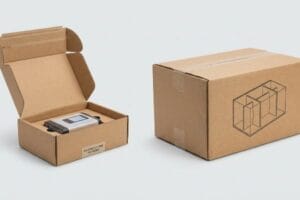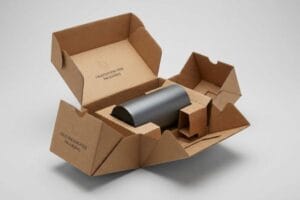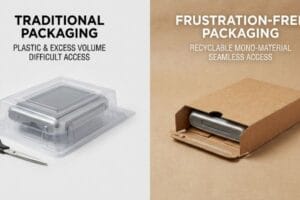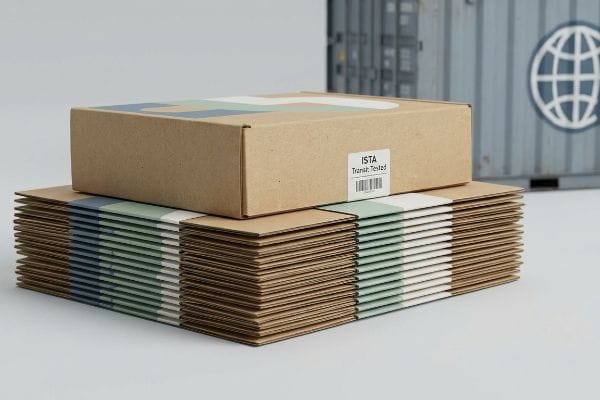
Acabas de diseñar la campaña de venta perfecta, pero sobrevivir a la logística global es una tarea titánica. Si tu embalaje personalizado se daña durante el transporte marítimo o la manipulación en el almacén, todo tu margen de beneficio se esfuma.
El envío de cajas de cartón personalizadas requiere una estricta validación de tránsito ISTA (Asociación Internacional de Tránsito Seguro), lo que garantiza que su embalaje plegado resista las vibraciones multiaxiales del almacén. Diseñamos estructuras geométricas que protegen los gráficos laminados litográficos de rozaduras, a la vez que maximizamos la densidad de los palés, ofreciendo expositores impecables y listos para la venta en todo el mundo.
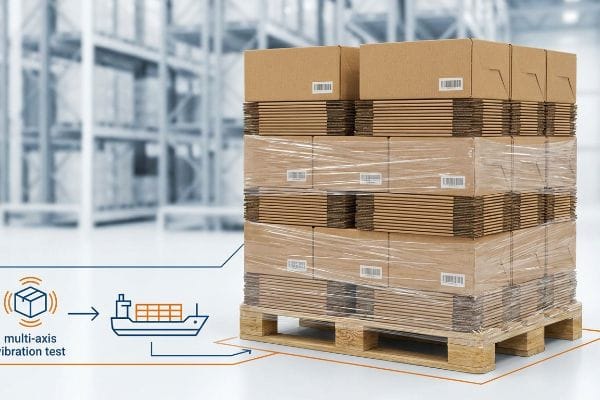
Pero conocer la teoría no es suficiente cuando las máquinas empiezan a funcionar y se cargan contenedores de 40 pies para el transporte marítimo en condiciones adversas.
¿Se puede enviar una caja con diseños impresos?
Imprimir diseños en contenedores de envío sin tratar parece sencillo hasta que las troqueladoras automatizadas revelan desalineaciones estructurales. Los gráficos de alta gama para el sector minorista exigen una ingeniería de preimpresión meticulosa.
Sí. El envío de una caja diseñada requiere una calibración precisa en la preimpresión. Los sangrados digitales estándar fallan en estructuras gruesas de cartón ondulado tipo B durante el plegado automatizado. Al aplicar un margen mecánico estricto de 12,7 mm (0,5 pulgadas), la hoja superior impresa envuelve perfectamente cada borde expuesto, garantizando una continuidad gráfica impecable durante el transporte a alta velocidad y la recepción en el punto de venta.
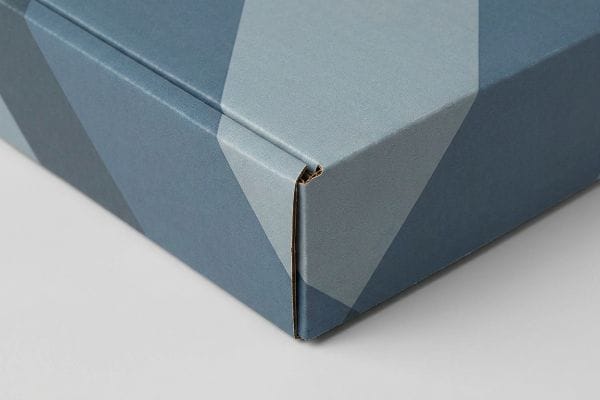
Pero conocer la teoría no es suficiente cuando las máquinas empiezan a funcionar en un despliegue masivo de venta minorista multicanal.
Por qué fallan los sistemas de purga comerciales estándar en la planta de producción
Incluso los diseñadores más experimentados suelen pasar por alto el grosor físico del material plegado, aplicando márgenes de impresión comerciales estándar de 3 mm (0,11 pulgadas)¹ a troqueles de cartón corrugado de alta resistencia. Dan por sentado que el diseño digital se montará perfectamente sobre la base acanalada sin desplazarse. Este enfoque teórico ignora por completo la extrema tolerancia mecánica inherente a la laminación litográfica automatizada²,donde los adhesivos húmedos y los cartones gruesos se unen de forma agresiva a altas velocidades.
Esto no es solo teoría: lo veo en acción en la planta de pruebas cuando gráficos atractivos se convierten en pesadillas logísticas. Una agencia de branding recientemente preparó apresuradamente una plantilla de envío a todo color, confiando en su sangrado digital estándar. En la primera prueba piloto, la mesa de enrutamiento CNC (Control Numérico por Computadora) golpeó el cartón, y el resultado visual fue desastroso. El grueso cartón ondulado se desplazó naturalmente durante la laminación3, dejando un destello blanco brillante de cartón sin tratar en cada esquina doblada. Los gráficos se veían completamente rotos. Inmediatamente extraje el archivo CAD (Diseño Asistido por Computadora) e impuse nuestro mandato de sangrado por desplazamiento litográfico. Forcé matemáticamente un sangrado gráfico de 12,7 mm (0,5 pulgadas)4 más allá de la línea de corte física, creando una red de seguridad de ingeniería. Esta corrección geométrica precisa absorbió por completo el desplazamiento de laminación, asegurando que los gráficos se envolvieran perfectamente. Al imponer esta tolerancia absoluta, eliminé una tasa de desperdicio del 15 % en la línea de plegado, ahorrando al cliente horas de producción retrasada y evitando un rechazo catastrófico por parte de su comprador minorista.
| Defecto de desplazamiento litológico | Resultado estructural | Retorno de la inversión financiera |
|---|---|---|
| Sangrado estándar de 3 mm5 | Bordes de cartón sin tratar expuestos | Provoca el rechazo inmediato del minorista |
| Desplazamiento de tolerancia mecánica | Pliegues gráficos desalineados | Ralentiza el ensamblaje en un 20% estimado6 |
| Margen de sangrado de 12,7 mm | Revestimiento de bordes sin costuras | Elimina el 15% de la tasa de desperdicio de material7 |
Me niego a que un diseño hermoso fracase por culpa de cálculos de preimpresión deficientes. Cuando se diseña el sangrado para absorber el desplazamiento mecánico, los productos de envío de su marca llegan a la tienda con una apariencia de alta gama, no de artículos baratos desechados de un almacén.
🛠️ Oficina de Harvey: ¿Sus cajas maestras impresas muestran bordes sin rematar después del plegado automatizado de alta velocidad? 👉 Solicite una auditoría de archivos de preimpresión ↗ — Reviso personalmente cada archivo estructural en 24 horas.
¿Cuánto cuesta enviar una caja de cartón?
La logística de transporte agota los presupuestos minoristas más rápidamente que la fabricación. Reducir la calidad de los materiales para disminuir los costos unitarios de las materias primas suele provocar un aumento drástico de los daños durante el transporte.
El costo del envío de una caja de cartón varía según su volumen y densidad. Maximizar el espacio del contenedor con microcanales ligeros pero estructuralmente rígidos reduce drásticamente los costos de flete. Además, garantizar límites óptimos de voladizo de los palets previene fallas catastróficas por compresión, eliminando por completo los costosos gastos de logística inversa y las penalizaciones por devolución de mercancía durante el tránsito global.
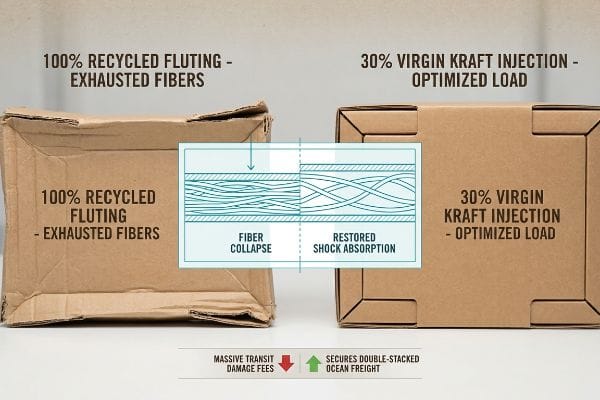
Pero confiar en estimaciones teóricas del transporte marítimo se convierte en una apuesta peligrosa cuando los contenedores oceánicos se enfrentan a choques dinámicos extremos.
La trampa de tránsito por "agotamiento de la fibra"
Los equipos de compras suelen exigir cartón testliner 100 % reciclado para reducir los costos unitarios y cumplir con los indicadores de sostenibilidad ESG, asumiendo que posee la misma capacidad de carga dinámica que el cartón virgen. Calculan sus costos de envío basándose en condiciones ideales de embalaje plano en un almacén con temperatura controlada. No comprenden la realidad microscópica del proceso de repulpado de papel, donde las fibras de celulosa se acortan físicamente y se agotan estructuralmentedespués de múltiples ciclos de reciclaje, perdiendo su capacidad de absorber energía cinética.
Esto no es solo teoría; lo afronto en la práctica cuando los presupuestos de compras chocan con la física. El director de compras de un cliente me llamó, presa del pánico, después de que sus cajas maestras ecológicas, completamente cargadas, fallaran estrepitosamente en una prueba de caída ISTA 3A9 en un laboratorio externo. Habían sustituido secretamente el cartón kraft virgen por un testliner 100 % reciclado sin consultar a mi equipo estructural para ahorrar unos céntimos en el envío. Las ondulaciones internas, excesivamente recicladas, carecían de rigidez. Al tocar el prototipo aplastado en mi laboratorio, el cartón se sentía peligrosamente blando, como una esponja húmeda. Descarté su modelo de costes teórico e inmediatamente opté por una química de materiales híbridos. Inyecté una proporción precisa del 30 % de cartón kraft virgen de fibra larga10 directamente en las ondulaciones C que soportan la carga. Esta intervención física restauró instantáneamente la resistencia requerida en la prueba ECT (Edge Crush Test), proporcionando la estructura necesaria para sobrevivir a un contenedor de carga marítima apilado doblemente. Mediante un equilibrio matemático entre la densidad de la fibra nueva y el revestimiento reciclado, garanticé que el envío sobreviviera a un trato brusco, evitando así al cliente una devastadora pérdida del 40 % del inventario a su llegada.
| Vulnerabilidad del material | Resultado cinético | Retorno de la inversión en fletes |
|---|---|---|
| Fluting 100% reciclado | Agotamiento y colapso de las fibras11 | Genera enormes costos por daños durante el transporte |
| Cálculos de costos estáticos | Fallo de BCT bajo carga dinámica12 | Elimina los ahorros de envío previstos |
| Inyección Kraft virgen al 30%13 | Restauración de la absorción de impactos cinéticos | Asegura el transporte marítimo de carga apilada doblemente |
Jamás permito que el papel barato condicione el éxito de un lanzamiento global. Mejorar la composición química interna del cartón ondulado cuesta muy poco al principio, pero garantiza matemáticamente que la pantalla llegue en perfectas condiciones, protegiendo así el verdadero retorno de la inversión en la cadena de suministro.
🛠️ Oficina de Harvey: ¿Sabes si tu proveedor actual está reduciendo secretamente la calidad de tus cajas maestras a cartón reciclado agotado para inflar sus márgenes? 👉 Solicita tu auditoría de materiales de la lista de materiales ↗ — 100% confidencial. Tus diseños minoristas aún no lanzados están a salvo conmigo.
¿Puedo encargar una caja expositora personalizada para mi tienda?
Los envases estándar rara vez satisfacen las necesidades de las grandes superficies comerciales. Diseñar una estructura a medida para el tamaño de su producto garantiza el máximo cumplimiento con las normativas de venta minorista y un impacto visual significativo.
Sí. Las cajas expositoras personalizadas para puntos de venta se diseñan con precisión según el peso y las dimensiones de su producto. Al combinar software CAD paramétrico con maquinaria de troquelado automatizada, creamos geometrías especializadas que cumplen estrictamente con los requisitos de las grandes superficies, garantizando una alineación estructural perfecta, un montaje rápido en tienda y una distribución paletizada sin problemas.
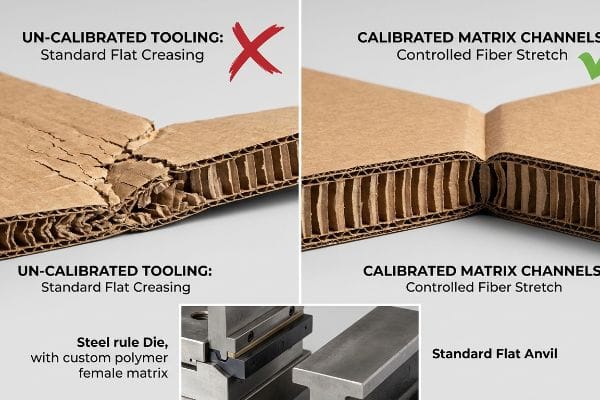
Pero crear un prototipo personalizado impresionante en la pantalla de un ordenador no significa absolutamente nada si la maquinaria pesada de la fábrica destruye la placa durante la producción en masa.
El peligro oculto de las herramientas de fábrica no calibradas
Es una trampa común que atrapa incluso a equipos de compras experimentados: asumen que una simple línea vectorial en una troqueladora personalizada se traduce automáticamente en un pliegue perfecto de 90 grados en la planta de producción. Creen que el cartón corrugado grueso 32ECT se comporta como el papel de impresión estándar. Esto ignora por completo la violenta resistencia mecánica de las fibras de papel gruesas cuando una troqueladora de acero endurecido las golpea a velocidades industriales, lo que a menudo provoca microfracturas catastróficas a lo largo de los pliegues estructurales primarios14.
Esto no es solo teoría; lo aprendí por las malas en la planta de producción. En 2022, le pedí a mi ingeniero jefe de empaques, Mark, que realizara una prueba piloto de un expositor de piso altamente personalizado y resistente, diseñado para contener 85 kg (187.5 lb) de fluidos automotrices. La agencia había sobrediseñado el perfil visual, pero ignoró cómo reaccionaría el grueso papel kraft virgen bajo la prensa. Pensamos que podríamos ahorrar tiempo usando canales de hendido planos estándar. Estaba completamente equivocado. De pie junto a la troqueladora rotativa, escuché el crujido agudo y desagradable del revestimiento superior al romperse cuando las cuchillas impactaron. La presión del troquelado estaba aplastando activamente las ondulaciones desde adentro hacia afuera. Detuve la línea de inmediato y realicé una calibración precisa de la herramienta. Reemplacé el yunque plano estándar por canales de hendido de matriz hembra de polímero personalizados15.Este ajuste mecánico controló dinámicamente cómo se estiraban las fibras del papel cuando el acero impactó, lo que permitió un hendido profundo y perfecto sin romper la tensión superficial. Este ajuste de matriz de 1,5 mm (0,05 pulgadas) no solo detuvo el agrietamiento litográfico16; redujo el tiempo de ensamblaje de coempaquetado en 42 segundos por unidad, lo que le ahorró al cliente un estimado de $3,250 en costos de mano de obra manual en su producción inicial.
| Defecto de la herramienta | Resultado mecánico | Retorno de la inversión en fabricación |
|---|---|---|
| Plegado plano estándar | Microfracturas a lo largo de las líneas de puntuación | Destruye la capacidad de carga primaria de BCT17 |
| Golpe de troquel no calibrado | Aplastamiento interno de la flauta | Ralentiza la línea de co-envasado en un 30%18 |
| Canales de matriz polimérica | Estiramiento controlado de las fibras de papel | Reduce el tiempo de montaje en 42 segundos19 |
No permitiré que un trabajo mal hecho arruine un diseño personalizado brillante. Ajustar con precisión la presión mecánica de impacto distingue el embalaje amateur de la verdadera ingeniería estructural, garantizando que su expositor personalizado se pliegue a la perfección en la línea de montaje.
🛠️ Harvey's Desk: ¿Se están rompiendo sus expositores personalizados porque su fábrica utiliza troqueles de acero obsoletos? 👉 Obtenga una simulación de tensión estructural 3D personalizada ↗ — Sin intermediarios. Hable directamente con ingenieros estructurales.
¿Puedes fabricar tu propia caja de cartón y enviarla?
Definir las dimensiones de tu propia caja maestra parece una estrategia inteligente para ahorrar costes. Sin embargo, ignorar las estrictas tolerancias de compensación inevitablemente provoca bloqueos por fricción desastrosos.
Sí. Fabricar tus propias cajas de cartón para envíos es físicamente posible, pero suele provocar fallos geométricos importantes. Sin un diseño preciso del espacio entre las bandejas anidadas y las cajas exteriores, la fricción excesiva en la superficie impide que los empleados desempaquen la mercancía de forma segura, lo que a menudo provoca que se rompan los gráficos principales antes de colocarla en el pasillo.
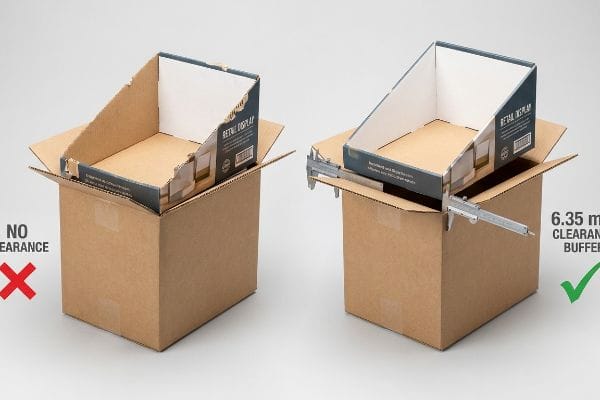
Pero representar las dimensiones en una hoja de cálculo oculta por completo la cruda realidad física de las materias primas que interactúan en un entorno comercial ajetreado.
La trampa de holgura por "fricción anidada"
Las marcas independientes suelen diseñar sus propias cajas de envío para que coincidan exactamente con las dimensiones exteriores de sus bandejas de venta al por menor, partiendo de la base de que un ajuste preciso y matemáticamente perfecto garantiza la máxima seguridad durante el transporte. Consideran el embalaje desde una perspectiva puramente digital, ignorando por completo la extrema fricción superficial que genera el cartón corrugado sin tratar.Cuando dos piezas de cartón sin sellar se comprimen durante el transporte marítimo, prácticamente se bloquean, convirtiendo un simple proceso de desembalaje en una auténtica lucha.
Esto no es solo teoría; lo veo en acción en el laboratorio de pruebas cuando las dimensiones hechas por uno mismo resultan ser un desastre. Una empresa emergente insistió en fabricar sus propias cajas de envío para el de PDQ (Pre-packed Display Quantities), ignorando mis consejos estructurales. Cuando llegó el primer prototipo a mis instalaciones, intenté sacar la bandeja prellenada de 60 cm (24 pulgadas) de la caja maestra. Estaba completamente atascada. Arranqué la lámina superior al intentar extraerla, sintiendo la resistencia abrasiva del revestimiento de prueba sin tratar que bloqueaba las paredes. Tomé las lecturas de mi micrómetro digital y demostré que no necesitaban costosas láminas deslizantes de plástico ni lengüetas de extracción; solo necesitaban una ingeniería de tolerancias exacta. Rediseñé la línea de troquelado, imponiendo matemáticamente un margen de seguridad perimetral mínimo absoluto de 6,35 mm (0,25 pulgadas)rompió el bloqueo por fricción al instante. Al sustituir sus dimensiones desproporcionadas y sobredimensionadas por una ingeniería de cartón corrugado de alta precisión, garanticé una experiencia de desempaquetado fluida y sin roturas, eliminando por completo el riesgo de que los dependientes de la tienda dañaran el principal atractivo visual del producto.
| Defecto de ingeniería de bricolaje | Resultado físico | Retorno de la inversión en logística |
|---|---|---|
| Anidamiento exacto 1:1 | Bloqueo por fricción superficial severa22 | Provoca daños al desempaquetar en el punto de venta |
| Espacio libre no calculado | Láminas superiores gráficas rasgadas | Elimina por completo el margen de beneficio del producto |
| Amortiguador de perímetro de 6,35 mm23 | Extracción estructural sin fricción | Garantiza una presentación impecable en el pasillo |
Me niego a ver cómo un excelente producto se arruina porque un empleado intenta sacarlo a la fuerza de una caja de tamaño inadecuado. Diseñar tolerancias dimensionales exactas no es solo cuestión de matemáticas; se trata de garantizar la supervivencia del negocio minorista.
🛠️ Oficina de Harvey: ¿Sus empleados rompen las bandejas de venta al público porque las cajas maestras tienen un tamaño demasiado ajustado? 👉 Solicite una revisión geométrica del empaque ↗ — Reviso personalmente cada archivo estructural en 24 horas.
Conclusión
Puedes arriesgarte con placas de prueba recicladas baratas, pero cuando esa placa desgastada se desplome catastróficamente en un centro de distribución húmedo, te enfrentarás al rechazo inmediato del minorista y a semanas de costosos retrabajos manuales que aniquilarán tu margen de beneficio. Esta misma revisión de ingeniería detectó recientemente un error fatal de tolerancia de 2 mm para un importante lanzamiento nacional antes de la producción. Deja de malgastar tu presupuesto logístico en geometrías estructurales defectuosas y permíteme diseñar personalmente tu próximo lanzamiento minorista para garantizar el máximo retorno de la inversión en la cadena de suministro.
"Cómo configurar correctamente los archivos de impresión: sangrado, resolución y espacio de color", https://www.uvu.edu/printingservices/recources/set_up_print_files.html. Verificación del estándar de la industria para las dimensiones de sangrado de impresión comercial para establecer una base de comparación. Función de la evidencia: validación fáctica; tipo de fuente: manual de la industria de la impresión. Admite: medición de sangrado estándar. Nota de alcance: se aplica a la impresión comercial típica de hojas planas. ↩
"El laminado litográfico mejora la imagen de las cajas de tóner", https://www.packagingdigest.com/packaging-design/litho-laminating-gives-toner-cartons-an-enhanced-image. Explicación técnica de las variaciones de desplazamiento físico y alineación que se producen durante la unión a alta velocidad de hojas impresas a cartón ondulado. Función de la evidencia: justificación técnica; tipo de fuente: libro de texto de ingeniería de embalaje. Apoya: el fallo de los sangrados estándar en aplicaciones de cartón ondulado. Nota de alcance: específico para procesos de unión automatizados de alta velocidad .
"Arrugas en cartón corrugado: causas, efectos y controles", https://www.linkedin.com/posts/ismayil-sheikeusuff-a41107253_corrugatedpackaging-packagingquality-wrinklecontrol-activity-7368288003888242688-ChlA . Explicación técnica de cómo las propiedades físicas del cartón corrugado de flauta B contribuyen al desplazamiento del material durante el proceso de laminación. Función de la evidencia: mecanismo causal; tipo de fuente: libro de texto de fabricación. Apoyos: la necesidad de sangrados ampliados. Nota de alcance: específico para flauta B y estructuras corrugadas similares.
«¿Existen costes adicionales para imprimir en cartón corrugado blanco…?», https://popdisplay.me/are-there-additional-costs-for-printing-on-white-corrugated-boxes/. Verificación de los márgenes de sangrado estándar de la industria para materiales de cartón corrugado grueso para tener en cuenta el desplazamiento mecánico y los errores de registro. Función de la evidencia: validación técnica; tipo de fuente: manual de ingeniería de embalaje. Apoya: el requisito específico de margen de 12,7 mm. Nota de alcance: puede variar según el sustrato y la maquinaria específicos. ↩
"Habrá sangrado (y otros términos de diseño que deberías conocer)", https://dar.uga.edu/2019/there-will-be-bleed-and-other-design-terms-you-should-know/. Confirmación del sangrado de 3 mm como estándar común de impresión comercial y su insuficiencia para contenedores de envío estructurales. Función de la evidencia: estándar de referencia; tipo de fuente: guía de impresión. Apoyos: razón para los bordes de cartón expuestos. Nota de alcance: impresión comercial general vs. embalaje industrial. ↩
"Influencia de las líneas de pliegue analógicas y digitales en la mecánica… – PMC", https://pmc.ncbi.nlm.nih.gov/articles/PMC9268991/. Puntos de referencia de la industria o estudios de fabricación que documentan la pérdida de eficiencia debido a la desalineación gráfica durante el ensamblaje del embalaje. Función de la evidencia: cuantificación; tipo de fuente: informe de la industria. Apoya: impacto del cambio de tolerancia mecánica en la velocidad de ensamblaje. Nota de alcance: varía según el nivel de automatización. ↩
"REGLAS PARA ESTABLECIMIENTOS DE COMIDA AL POR MENOR EN COLORADO…", https://www.parkcountyco.gov/DocumentCenter/View/4650. Datos técnicos de fuentes de ingeniería de impresión o empaquetado que muestran la reducción de desperdicios al utilizar márgenes de sangrado extendidos. Función de la evidencia: verificación métrica; tipo de fuente: manual técnico. Apoya: ROI de un margen de sangrado de 12,7 mm. Nota de alcance: específico para procesos de litolaminación. ↩
"El impacto del reciclaje mecánico en la fibra lignocelulósica…", https://pmc.ncbi.nlm.nih.gov/articles/PMC11945113/. Verificación técnica del acortamiento de la fibra durante el proceso de repulpado y su impacto posterior en la integridad estructural del cartón reciclado. Función de la evidencia: especificación técnica; tipo de fuente: revista de ciencia de los materiales. Apoya: la afirmación de que los materiales reciclados presentan una menor capacidad de carga que la fibra virgen. Nota de alcance: se aplica a los ciclos de reciclaje mecánico. ↩
"Pruebas de embalaje ISTA – Intertek", https://www.intertek.com/performance-testing/packaging/ista/. Una fuente autorizada de la Asociación Internacional de Tránsito Seguro verificaría los parámetros específicos y los criterios de fallo de la prueba 3A. Función de la evidencia: estandarización; tipo de fuente: estándar de la industria. Apoya: la validez de la metodología de prueba utilizada para identificar fallos en el embalaje. Nota de alcance: Se aplica específicamente a simulaciones de entrega de paquetes. ↩
"Resistencia a la compresión de paquetes de cartón corrugado con bajo contenido de fibra...", https://pmc.ncbi.nlm.nih.gov/articles/PMC10054506/. La investigación en ciencia de materiales aplicada a la ingeniería del papel validaría cómo el aumento de la proporción de fibra virgen mejora la calificación de la prueba de aplastamiento de bordes (ECT) en comparación con los revestimientos 100% reciclados. Función de la evidencia: validación técnica; tipo de fuente: revista de ciencia de materiales. Apoya: la afirmación de que el kraft virgen de fibra larga restaura la rigidez estructural. Nota de alcance: Los resultados varían según el perfil de la ondulación y el gramaje. ↩
"Estudios preliminares sobre el reciclaje de envases de cartón para la construcción…", https://pmc.ncbi.nlm.nih.gov/articles/PMC12489104/. Un estudio de ciencia de materiales sobre cartón ondulado explica cómo el reciclaje repetido reduce la longitud de las fibras, lo que provoca agotamiento estructural y fallos. Función de la evidencia: verificación técnica; tipo de fuente: revista de ciencia de materiales. Apoya: la relación entre el acanalado reciclado y el colapso estructural. Nota de alcance: específico para componentes de acanalado ondulado. ↩
"Estimación de la resistencia a la compresión del cartón corrugado…", https://pmc.ncbi.nlm.nih.gov/articles/PMC8467740/. Las normas de ingeniería de embalaje demuestran que los valores de BCT medidos en condiciones estáticas a menudo no predicen el colapso durante las vibraciones dinámicas del transporte. Función de la evidencia: especificación técnica; tipo de fuente: manual de ingeniería de embalaje. Apoya: la insuficiencia de los cálculos estáticos para el transporte de mercancías en condiciones reales. Nota de alcance: se centra en las métricas de medición de BCT. ↩
"El impacto ambiental del embalaje de cartón ondulado", https://www.internationalpaper.com/resources/blog/environmental-impact-corrugated-packaging-why-balanced-fiber-approach-best. Los estándares de la industria para la resistencia del cartón ondulado muestran que una mezcla específica de fibras kraft vírgenes restaura la compresión y la absorción de impactos necesarias para el apilamiento pesado. Función de la evidencia: métrica de rendimiento; tipo de fuente: estándar de embalaje industrial. Apoya: la eficacia de las mezclas de fibras vírgenes para asegurar el transporte marítimo. Nota de alcance: se centró en las proporciones de inyección de pulpa Kraft. ↩
"¿Qué es una caja expositora troquelada? – PopDisplay", https://popdisplay.me/what-is-a-die-cut-display-box/. Explicación técnica de cómo el impacto a alta velocidad de los troqueles de acero sobre las fibras corrugadas puede provocar fallos en el material y fracturas por tensión. Función de la evidencia: verificación técnica; tipo de fuente: manual de ingeniería de embalaje. Apoya: el riesgo de degradación estructural durante el proceso de troquelado. Nota de alcance: se aplica principalmente a materiales corrugados de alta ECT. ↩
"Troquelado y hendido de cartón – Holmen Iggesund", https://www.iggesund.com/insights/paperboard-know-how/paperboard-manual/paperboard-manual-publication/printing-and-converting-performance/die-cutting-and-creasing/. Breve explicación de cómo una fuente externa autorizada respalda esta afirmación. Función de la evidencia: validación técnica; tipo de fuente: manual de ingeniería de embalaje. Respalda: El uso de canales de matriz para evitar la rotura y el aplastamiento de las fibras en materiales corrugados gruesos. Nota de alcance: Se centra en el diseño estructural de alta resistencia. ↩
"Prevención del agrietamiento del cartón en la producción de cajas de cartón ondulado – LinkedIn", https://www.linkedin.com/posts/nishant-parikh_corrugated-packaging-cardboard-activity-7312512999959732225-6pwq . Breve explicación de cómo una fuente externa autorizada respalda esta afirmación. Función de la evidencia: definición técnica; tipo de fuente: guía de la industria de la impresión y el embalaje. Respalda: La prevención del agrietamiento superficial durante el plegado de cartón ondulado impreso mediante la calibración de herramientas. Nota de alcance : Relevante para procesos de troquelado de alta presión.
"Estimación de la resistencia a la compresión de cajas de cartón corrugado para un…", https://pmc.ncbi.nlm.nih.gov/articles/PMC9864211/. Validación técnica de cómo las microfracturas estructurales debidas a un plegado incorrecto reducen las clasificaciones de la prueba de compresión de cajas (BCT). Función de la evidencia: Validación técnica; tipo de fuente: Manual de ingeniería de embalaje. Apoya: Impacto de los defectos de las herramientas en la integridad estructural. Nota de alcance: Específico para cartón corrugado. ↩
"Estimación de la resistencia al aplastamiento de los bordes del cartón ondulado...", https://pmc.ncbi.nlm.nih.gov/articles/PMC9961700/. Puntos de referencia de la industria que cuantifican la reducción en el rendimiento operativo causada por defectos de embalaje durante el co-empaquetado automatizado. Función de la evidencia: Métrica cuantitativa; tipo de fuente: Estudio de eficiencia de fabricación. Apoyos: Pérdida financiera por herramientas no calibradas. Nota de alcance: Varía según el nivel de automatización de la línea. ↩
"Compuestos de matriz polimérica: Caracterización del impacto de…", https://pmc.ncbi.nlm.nih.gov/articles/PMC10253506/. Datos empíricos que demuestran los beneficios de ahorro de tiempo de los canales de herramientas especializadas en el ensamblaje de cajas de cartón corrugado. Función de la evidencia: Métrica cuantitativa; tipo de fuente: Estudio de caso de ingeniería industrial. Apoya: Retorno de la inversión de soluciones de herramientas avanzadas. Nota de alcance: Basado en dimensiones específicas de la caja. ↩
"Prueba del coeficiente de fricción", https://unitload.vt.edu/facilities/corrugated-packaging-lab/cof-testing.html . Las especificaciones técnicas relativas a la rugosidad superficial y los coeficientes de fricción del cartón de prueba sin recubrimiento explican por qué las tolerancias precisas provocan atascos mecánicos. Función de la evidencia: Especificación técnica; tipo de fuente: Manual de ingeniería de embalaje. Apoya: La afirmación de que las propiedades de la materia prima causan bloqueos por fricción. Nota de alcance: Se aplica específicamente al cartón sin sellar ni recubrir.
"Guía completa de tolerancia dimensional de cajas de cartón corrugado – Upack", https://www.upack.in/blog/post/complete-guide-on-corrugated-box-dimension-tolerance?srsltid=AfmBOopB_f6CjOLBxi3B1y6odkeQZUnFdVF1KV53w896fOFIvDkUjQWz. Una guía autorizada de ingeniería de embalaje verificaría el desplazamiento espacial recomendado necesario para evitar bloqueos por fricción entre componentes de cartón corrugado anidados. Función de evidencia: especificación técnica; tipo de fuente: manual estándar de la industria. Apoya: el requisito de espacio libre de 6,35 mm para una extracción suave. Nota de alcance: los requisitos reales pueden variar según el calibre del material. ↩
"Investigación del efecto de las perforaciones en la capacidad de carga…", https://pmc.ncbi.nlm.nih.gov/articles/PMC11396172/. La investigación en ciencia del embalaje explica cómo la falta de tolerancia en los cartones anidados provoca bloqueos por vacío y fricción durante la extracción. Función de la evidencia: prueba del mecanismo físico; tipo de fuente: manual técnico. Apoyos: el resultado de un anidamiento exacto 1:1. Nota de alcance: los niveles de fricción pueden variar según los recubrimientos del revestimiento del cartón. ↩
¿Qué es el troquelado en el embalaje? Una guía para cajas troqueladas, https://gentlever.com/die-cutting-in-packaging/. Una guía autorizada de ingeniería de embalaje verifica el espacio libre estándar requerido para cajas de cartón corrugado anidadas para evitar atascos. Función de evidencia: especificación técnica; tipo de fuente: estándar de la industria. Apoya: la métrica específica para la extracción sin fricción. Nota de alcance: Se aplica principalmente al cartón corrugado de doble pared estándar .