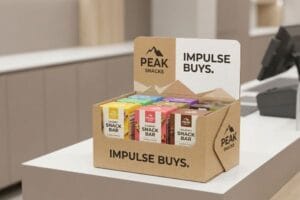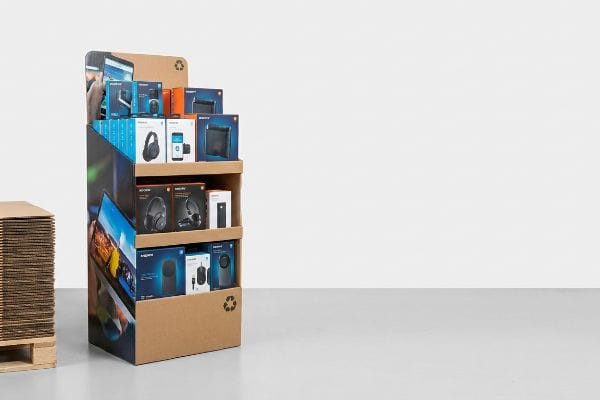
You are fighting for retail floor space, and every dollar spent on display fixtures matters. If your current strategy eats your margins, you are likely using the wrong materials.
The four advantages of corrugated POP (Point of Purchase) displays include massive freight savings via flat-packing, rapid graphic customization using digital printing, structural kinetic shock absorption, and 100% curbside recyclability. Utilizing this substrate reduces your overall supply chain costs while maintaining heavy-duty load capacities.
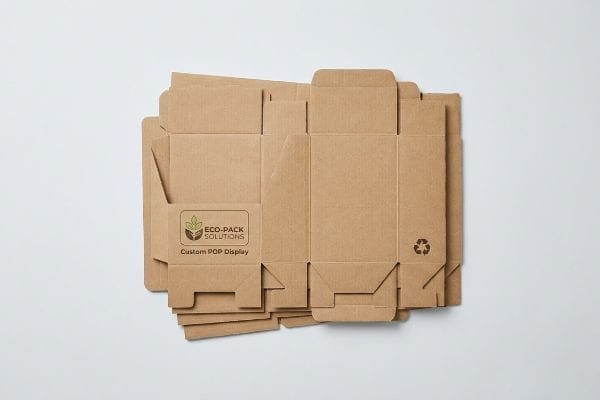
Before you default to heavy, permanent metal racks, let's look at exactly how engineered paperboard changes your profit margins.
What Are the Benefits of Using Corrugated?
The biggest immediate benefit hits your shipping budget before the product even reaches the store.
The top benefits of corrugated displays include unmatched logistical efficiency. Unlike permanent metal fixtures that ship fully assembled, temporary cardboard units ship flat, eliminating dead air in containers and cutting global freight volume by up to 75% for short-term campaigns.
But understanding this logistical theory isn't enough when you are booking international sea freight and watching costs skyrocket.
The Permanent Hardware Freight Penalty
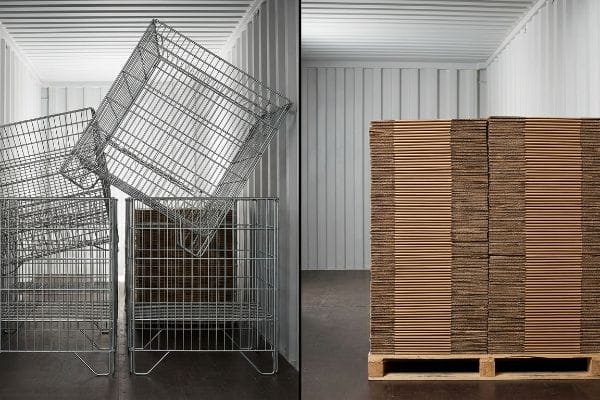
A common rookie trap is defaulting to welded wire racks for a short twelve-week promotional window. Brands assume that heavy steel FSDU (Free Standing Display Unit) fixtures automatically provide a better return on investment because they feel substantial in the design phase.
But here is what happens on the loading dock. I once watched a client pay a massive premium to ship a 40HQ container holding just 250 welded metal racks. They were literally paying to ship empty "dead air." When we pivoted them to flat-pack engineered corrugated structures, we fit 1,500 units into that exact same container. The physical friction of wrestling heavy metal fixtures out of a truck vanishes; instead, you hear the crisp, satisfying zip of a tear-tape opening a dense master carton. This simple material switch completely eliminated the 300% permanent hardware freight penalty1 while easily supporting a 100 lbs (45.3 kg) payload per tier2.
| Common Rookie Mistake | The Pro Fix | Retail-Floor Benefit |
|---|---|---|
| Shipping permanent welded wire FSDUs for short campaigns. | Engineering flat-packed high-performance corrugated units. | Slashes inbound freight volume and storage space. |
| Paying to ship "dead air" inside assembled racks. | Maximizing 40HQ container density with folded boards. | Fits 6x more merchandising units per truck3. |
| Assuming temporary means structurally weak. | Specifying heavy-duty load-bearing fluting. | Holds equal product weight without the metal hazard4. |
I never let clients burn their marketing budget on shipping empty container volume. By engineering a flat-pack corrugated system, I convert your wasted freight dollars directly into higher point-of-purchase unit volume.
🛠️ Harvey's Desk: Are you paying to ship empty air with permanent hardware? 👉 Get a Flat-Pack Freight Audit ↗ — Direct access to my desk. Zero automated sales spam, I promise.
What Are the Advantages of Corrugated Board?
Another major advantage is the sheer visual agility it offers your marketing team.
A major advantage of corrugated board is its compatibility with high-speed digital UV (Ultraviolet) flatbed printing. This substrate allows brands to bypass expensive traditional printing plates, enabling rapid prototyping, localized graphic changes, and incredibly fast speed-to-market without compromising visual impact.
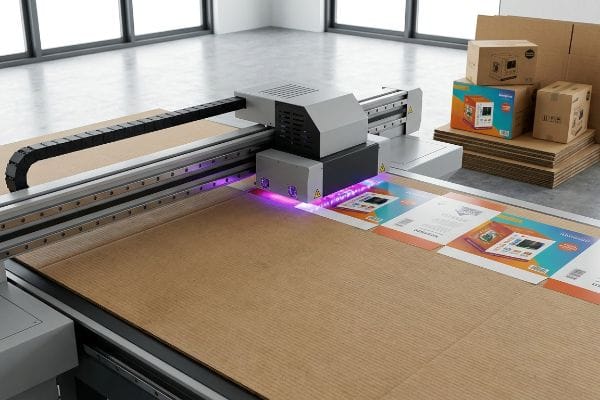
However, navigating printing techniques requires understanding how wet ink interacts with raw paper fibers on the assembly line.
Bypassing the Litho-Lam Setup Bottleneck
Traditional procurement teams often insist on standard litho-lamination for every single project, assuming it is the only way to get retail-quality graphics. They absorb massive setup fees for metal printing plates and wet adhesives5, even for small regional test runs.
I see this trap when brands need 200 rapid displays for a seasonal test but are paralyzed by weeks of prepress bottlenecks. You can practically smell the wet PVA (Polyvinyl Acetate) glue drying in a traditional lamination setup, which takes 24 hours just to cure flat under dead-weights6. By mandating direct-to-board UV digital printing, we bypass the water absorption entirely. The liquid ink hits the raw paper and instantly polymerizes into a solid film under the UV light arrays7. This agility drops your lead time from weeks to days, completely eliminating plate costs while saving the assembly line from warped, moisture-heavy boards.
| Common Rookie Mistake | The Pro Fix | Retail-Floor Benefit |
|---|---|---|
| Paying for expensive litho plates on a short 200-unit run. | Using plate-free UV digital flatbed printing8. | Enables profitable small-batch regional testing. |
| Waiting weeks for wet PVA glue lamination to cure flat9. | Instantly polymerizing ink directly onto the board. | Speeds up physical delivery to the retail aisle. |
| Letting liquid inks bleed into porous paper fibers. | Using UV curing to lock pigment on the surface10. | Delivers crisp, high-contrast branding instantly. |
I refuse to let archaic printing setups delay your product launch. Utilizing digital direct-to-board technology gives you massive agility, allowing you to react to market trends while eliminating unnecessary tooling fees.
🛠️ Harvey's Desk: Are your current litho-lamination setup fees eating the profit margin of your short-run campaigns? 👉 Request a Direct-Print Cost Analysis ↗ — Download safely. My inbox is open if you have questions later.
What Are the Pros and Cons of Corrugated Cardboard?
Understanding both the capabilities and the natural limitations of this material is essential for a successful rollout.
The pros and cons of corrugated cardboard heavily depend on your environment. The main pro is superior lightweight strength and cost-efficiency. The primary con is vulnerability to ambient moisture; porous testliner absorbs humidity and physically swells, which can distort interlocking tabs during long ocean transit.
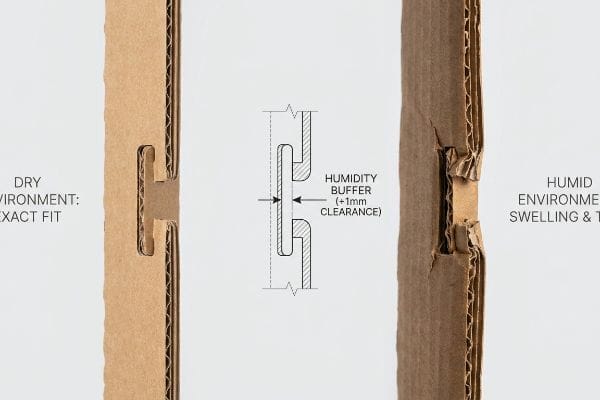
Knowing this environmental weakness is only half the battle; the real secret is engineering around it before mass production begins.
The Moisture Swelling Tolerance Reality
Designers sitting in climate-controlled offices often assume that absolute dry material calipers remain perfectly static11 in the real world. They engineer interlocking slots based precisely on the dry board thickness, completely ignoring the humid environmental journey the packaging must survive.
Think of a wooden door that perfectly fits its frame in winter but suddenly sticks in the humid summer. Corrugated paper does the exact same thing. I've watched co-packers sweating on the assembly line, aggressively forcing a CAD (Computer-Aided Design) slot that was perfectly sized at 0.12 inches (3 mm) in the software but swelled to 0.16 inches (4 mm)12 in a humid Florida warehouse. You hear the sickening tearing sound of the top sheet ripping because the friction is too high. To fix this, I automatically engineer a specific "Humidity Buffer" into the die-lines, adding an extra 0.04 inches (1 mm) of clearance13 to the receiving slots. This mathematical adjustment ensures zero-tear assembly regardless of the ambient warehouse humidity.
| Common Rookie Mistake | The Pro Fix | Retail-Floor Benefit |
|---|---|---|
| Engineering exact-fit tab slots based on dry paper calipers. | Adding a mathematical 1mm humidity clearance buffer14. | Guarantees frictionless co-packing assembly. |
| Ignoring the physical swelling of porous testliner boards15. | Anticipating transit through high-humidity environments. | Prevents torn graphics during store setup. |
| Forcing swollen paper locks until the flutes crush. | Utilizing parametric design to widen structural receivers. | Maintains maximum dynamic load capacity16. |
I never rely on static dry-board math for global shipments. By mathematically anticipating the environmental physics of paper, I ensure your displays assemble flawlessly without slowing down the co-packing line.
🛠️ Harvey's Desk: Are your store clerks tearing the printed graphics just trying to assemble swollen interlocking tabs? 👉 Claim Your Dieline Tolerance Review ↗ — No forms that trigger endless sales calls. Just pure value.
What Are the Strengths of Corrugated Cardboard?
The geometric architecture is where the true power of this substrate lies.
The primary strengths of corrugated cardboard lie in its fluted internal geometry, which creates continuous arched columns that dynamically disperse kinetic shock. This structural design provides exponentially higher compression strength and vertical top-load capacity compared to heavy, solid, unfluted chipboard of similar weight.
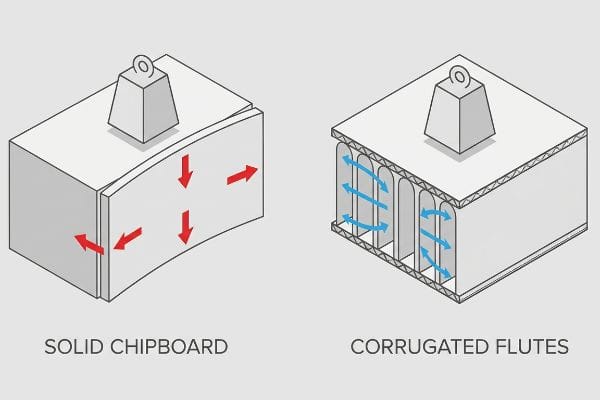
But knowing the theory isn't enough when the machines start running and heavy merchandise gets loaded onto pallets.
Why Solid Substrates Fail Under Kinetic Top-Load
A seemingly reasonable but actually dangerous assumption is that solid density equals structural strength17. Procurement teams frequently attempt to scale up lightweight solid chipboard designs into heavier retail-ready trays to save raw material costs, believing the sheer material thickness will support the product weight.
In my facility, I routinely see this fail on the testing floor when we run heavy-freight transit simulations. Without the internal wavy flutes found in corrugated board, unfluted chipboard has zero mechanical mechanism to dynamically disperse kinetic shock18. When I measure the performance under an irregular 187.5 lbs (85 kg) top-load, the solid board simply bows outward and snaps—the static material density cannot replace geometric load displacement19. I immediately mandate a pivot to a lightweight micro-fluted B-flute substrate. By relying on the structural arches instead of dead mass, we maintain a perfectly square display tray, completely eliminating bottom-tier sag and preventing severe retailer chargebacks.
| Common Rookie Mistake | The Pro Fix | Retail-Floor Benefit |
|---|---|---|
| Scaling up heavy solid chipboard for large merchandise trays. | Pivoting to a fluted structural corrugated board20. | Prevents the tray walls from bulging outward. |
| Assuming raw paper density equals dynamic compression strength. | Relying on arched flute geometry to disperse kinetic shock21. | Survives double-stacked warehouse top-loads. |
| Downgrading materials to save fractional cents per unit. | Specifying the correct micro-flute to preserve the design22. | Eliminates catastrophic in-aisle buckling failures. |
I don't gamble your merchandise on flat, unfluted substrates. By strictly utilizing the geometric strength of fluted arches, I guarantee your trays will survive real-world supply chain vibrations intact.
🛠️ Harvey's Desk: Do you know if your current display trays are actually utilizing fluted geometry to survive heavy pallet top-loads? 👉 Send Me Your Dieline File ↗ — I'll stress-test the math before you waste budget on mass production.
Conclusion
You can choose to rely on dry-lab theories, but when that unfluted solid board snaps under a heavy top-load, the resulting bottom-tier collapse triggers immediate retailer rejection and completely wipes out your campaign's profit margin. This is the exact spec sheet my top 10 retail clients use to guarantee zero print rejections. Stop guessing on material strengths and let me personally audit your structural tolerances through my Free Dieline Pre-Flight Audit ↗ to catch fatal compression risks before mass production begins.
"Flat-Pack vs Fully Assembled: Which Is More Cost-Effective", https://www.samtop.com/flat-pack-vs-fully-assembled-display/. An industry logistics report or supply chain analysis comparing the freight costs of pre-assembled metal racks versus flat-shipped corrugated units. Evidence role: Quantitative verification; source type: Industry analysis. Supports: The cost efficiency of corrugated shipping. Scope note: Percentage may vary based on container size and fixture dimensions. ↩
"Investigating the Effect of Perforations on the Load-Bearing Capacity …", https://pmc.ncbi.nlm.nih.gov/articles/PMC11396172/. Technical data sheets from corrugated packaging engineers specifying the maximum weight capacity for heavy-duty, engineered cardboard structures. Evidence role: Technical specification verification; source type: Engineering manual. Supports: Structural integrity of corrugated materials. Scope note: Capacity depends on flute type and board grade. ↩
"Flat Pack VS Traditional Shipping Containers – Prefabex", https://www.prefabex.com/our_galleries/flat-pack-vs-traditional-shipping-containers. An industry logistics study or packaging whitepaper comparing the cubic volume and shipping density of knocked-down corrugated displays versus pre-assembled metal racks. Evidence role: quantitative verification; source type: logistics industry report. Supports: freight volume reduction. Scope note: based on typical FSDU dimensions. ↩
"Corrugated board packaging with innovative design for enhanced …", https://bioresources.cnr.ncsu.edu/resources/corrugated-board-packaging-with-innovative-design-for-enhanced-durability-during-transport/. Technical data sheets from corrugated board manufacturers detailing the compression strength and load-bearing capacity of high-performance fluting grades. Evidence role: technical specification; source type: manufacturer data sheet. Supports: structural equivalence to metal for specific weight loads. Scope note: specific to heavy-duty load-bearing fluting. ↩
"Understanding Litho-Laminated Packaging", https://pmpackaging.com/blog/understanding-litho-laminated-packaging. Detailed explanation of the litho-lamination process involving offset printing plates and the use of wet mounting adhesives to bond paper to corrugated board. Evidence role: Technical verification; source type: Printing and packaging industry handbook. Supports: The technical requirements and associated setup costs of traditional litho-lamination. Scope note: Specifically relates to traditional offset litho-lamination processes. ↩
"Effects of Moisture in the Lamination Process – AICC Now", https://now.aiccbox.org/effects-of-moisture-in-the-lamination-process/. Authoritative source on industrial adhesive curing times for corrugated lamination. Evidence role: technical specification; source type: industrial printing handbook. Supports: traditional prepress bottleneck duration. Scope note: Curing times may vary by ambient humidity and glue type. ↩
"What is UV Printing? UV Curable Inks for Packaging – TROY Group", https://www.troygroup.com/blog/what-is-uv-printing-uv-curable-inks-for-packaging. Scientific explanation of UV-curable ink polymerization on paper substrates. Evidence role: technical mechanism; source type: material science or printing engineering journal. Supports: speed and dryness of UV printing over traditional methods. Scope note: Focus on direct-to-board application. ↩
"Box Printer: Carton, Corrugated Box Print for Packaging – Sublistar", https://www.subli-star.com/applications/printing-on-box/. Technical documentation on digital printing processes confirms the elimination of physical printing plates compared to lithography. Evidence role: Technical verification; source type: Industry specification. Supports: Claim that UV flatbed printing removes plate costs. Scope note: Applies to digital vs. traditional lithography. ↩
"Additives for enhancing the drying properties of adhesives for …", https://www.sciencedirect.com/science/article/pii/S1110016812000920. Material science guidelines for polyvinyl acetate (PVA) adhesives describe the drying time and potential for substrate warping during the curing phase. Evidence role: Process validation; source type: Technical data sheet. Supports: Claim that PVA lamination requires significant curing time. Scope note: Curing times vary by climate and adhesive volume. ↩
"Understanding the Role of Paper-Ink Interactions on the … – PMC – NIH", https://pmc.ncbi.nlm.nih.gov/articles/PMC10145729/. Chemical analysis of UV-curable inks explains the rapid polymerization process that prevents ink migration and bleeding into porous substrates. Evidence role: Mechanism verification; source type: Scientific technical paper. Supports: Claim that UV curing prevents ink bleed. Scope note: Focuses on the polymerization of photoinitiators. ↩
"What is relative humidity and how does it affect your boxes? – Billerud", https://www.billerud.com/products/packaging-materials/corrugated-materials/knowledge-center/humidity. Technical data confirms that corrugated cardboard calipers fluctuate with moisture levels, contradicting the assumption of stability. Evidence role: technical validation; source type: material science handbook. Supports: the effect of humidity on board thickness. Scope note: variation depends on liner grade and fluting type. ↩
"[PDF] Effects of Moisture content on Box Compression Strength : FBA BCT …", https://renewablebioproducts.gatech.edu/sites/default/files/2025-12/4effects-of-moisture-content-on-box-compression-strength.pdf. Technical data on the coefficient of moisture expansion for corrugated linerboard to verify the physical swelling metrics. Evidence role: Fact-check; source type: Material science study. Supports: Dimensional change of material due to humidity. Scope note: Expansion rates vary based on paper grade and moisture saturation. ↩
""Relative Humidity Effects on the Compression Strength of …", https://open.clemson.edu/all_theses/3225/. Industry engineering standards for implementing design buffers to accommodate material expansion in interlocking cardboard joints. Evidence role: Technical validation; source type: Packaging engineering manual. Supports: Standard clearance specifications. Scope note: Application-specific based on slot depth and fit requirements. ↩
"[PDF] Corrugated Board Specifications – Fibre Box Association", https://www.fibrebox.org/assets/2025/09/Walmart_Corrugated-Board_Specifications_Automation_Packaging_Standards.pdf. Technical guidance on dimensional tolerances used in packaging engineering to account for hygroscopic expansion. Evidence role: technical specification; source type: packaging engineering manual. Supports: the specific 1mm buffer recommendation. Scope note: tolerances may vary based on board grade and humidity levels. ↩
"Influence of humidity and temperature on mechanical properties of …", https://bioresources.cnr.ncsu.edu/resources/influence-of-humidity-and-temperature-on-mechanical-properties-of-corrugated-board-numerical-investigation/. Material science data regarding the hygroscopic nature of porous testliner boards and their expansion in humid environments. Evidence role: material property; source type: material science study. Supports: the fact that testliner boards experience physical swelling. Scope note: expansion rates depend on the specific sizing and coating used. ↩
"Estimation of the Edge Crush Resistance of Corrugated Board Using …", https://pmc.ncbi.nlm.nih.gov/articles/PMC9961700/. Structural analysis demonstrating how preserving flute integrity prevents the loss of vertical compression strength. Evidence role: mechanical validation; source type: structural engineering paper. Supports: the link between avoiding flute crush and maintaining load capacity. Scope note: specifically relates to vertical compression strength. ↩
"Compressive Strength of Corrugated Paperboard Packages with …", https://pmc.ncbi.nlm.nih.gov/articles/PMC10054506/. Scientific evidence from packaging engineering identifies the disparity between material mass and load-bearing capacity in solid versus fluted substrates. Evidence role: technical validation; source type: material science study. Supports: The premise that density does not equate to structural strength. Scope note: Applicable to vertical compression. ↩
"Estimation of the Compressive Strength of Corrugated Board Boxes …", https://pmc.ncbi.nlm.nih.gov/articles/PMC8467740/. Technical analysis of material properties comparing solid chipboard and fluted corrugated board regarding impact absorption. Evidence role: technical validation; source type: material science textbook or engineering journal. Supports: The necessity of fluted geometry for kinetic energy dispersion. Scope note: Applies to standard commercial grades of board. ↩
"[PDF] Material Property Characterization of Ultra-High Performance …", https://www.fhwa.dot.gov/publications/research/infrastructure/structures/06103/06103.pdf. Comparative study on how geometric structure provides superior compression strength over simple mass increase. Evidence role: theoretical foundation; source type: structural engineering paper. Supports: The superiority of geometric architecture over material density for load bearing. Scope note: Focused on vertical compression. ↩
"The Ultimate Guide To Corrugated Boxes – Shorr Packaging", https://www.shorr.com/resources/blog/ultimate-guide-corrugated-boxes/. Comparison of lateral rigidity and hoop strength between solid chipboard and fluted substrates in large-scale packaging. Evidence role: material performance comparison; source type: packaging industry standard. Supports: prevention of outward wall bulging. Scope note: Specific to merchandise tray applications. ↩
"[PDF] Corrugated Board Packaging with Innovative Design for Enhanced …", https://bioresources.cnr.ncsu.edu/wp-content/uploads/2026/01/BioRes_21_1_2229_Tworzydlo_PSMPGG_Corrugated_Packaging_Design_Durability_Transport_25399.pdf. Technical explanation of how the arched structure of corrugated fluting distributes vertical and lateral forces to maintain structural integrity. Evidence role: mechanism verification; source type: structural engineering study. Supports: kinetic shock dispersion via geometry. Scope note: Applies to standard fluting profiles. ↩
"Micro-Flute Packaging | E F N-Flute Cartons – Netpak", https://www.netpak.com/en/packaging-resources/industry-articles/micro-flute-packaging-e-f-n-flute/. Technical data demonstrating the compression strength and buckling resistance of micro-flute materials compared to downgraded substrates. Evidence role: failure mode analysis; source type: technical specification sheet. Supports: elimination of in-aisle buckling failures. Scope note: Dependent on specific load-bearing requirements. ↩