

Packaging isn't just about wrapping a product; it's about surviving the retail supply chain. A simple folding carton carries the weight of your entire brand equity.
The significance of soap boxes stems from their critical role as both structural armor and silent salespeople. These folding cartons form the foundational layer of consumer goods packaging, directly impacting material yield, transit survival, and high-speed automated assembly lines across the competitive global retail landscape today.

Moving from theoretical design to physical production requires understanding how these small structures actually perform under heavy logistical stress.
What Does a Soap Box Mean?
Many designers treat these small folding cartons as basic geometric shapes, completely ignoring the mechanical realities of automated printing layouts.
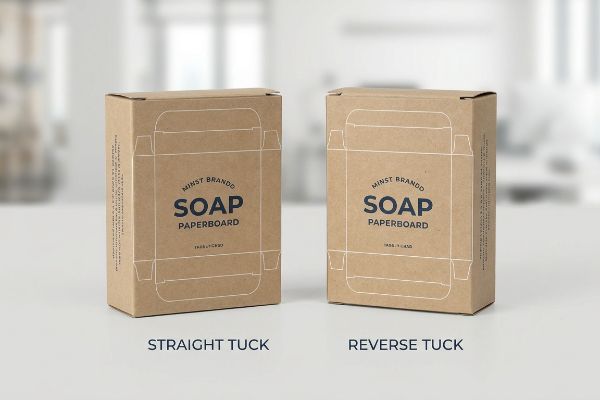
A soap box means a specific style of folding paperboard carton used extensively in retail packaging. These distinct structures typically utilize either a reverse tuck or straight tuck folding mechanism to secure flaps, providing lightweight but highly printable enclosures for fast-moving consumer goods across global markets.
Understanding the basic definition is easy, but choosing the wrong folding mechanism will drain your production budget before the ink even dries.
Reverse Tuck vs. Straight Tuck Folding Cartons
Junior marketing teams often arbitrarily choose between reverse tuck and straight tuck folding carton styles based on pure visual preference. They submit standard Adobe Illustrator files without realizing that the physical hinge direction directly dictates how the flat dielines interlock1 on the master printing sheet.
Here is the reality. When you default to a straight tuck design for a high-volume FMCG (Fast-Moving Consumer Goods) run, you force me to waste massive amounts of raw material. Because straight tuck boxes hinge from the same rear panel, they cannot tightly nest together on the printing plate2. I recently watched a client stubbornly push a straight tuck design for a basic soap box, and the loud, rhythmic thud of the blanking machine was just the sound of their budget turning into off-cut waste. By flipping the design to a reverse tuck, the flat shapes interlock perfectly3 like puzzle pieces, drastically increasing sheet yield and lowering the per-unit material cost, saving thousands over a massive production run.
| Common Rookie Mistake | The Pro Fix | Retail-Floor Benefit |
|---|---|---|
| Arbitrary tuck selection | Switch to reverse tuck for volume | Increases print sheet yield4 |
| Ignoring dieline nesting | Map layouts on CAD first | Reduces per-unit material waste5 |
| Forcing straight tucks | Reserve for luxury seamless fronts6 | Optimizes overall packaging ROI |
I never let a client choose their tuck style blindly. I force them to align the structural geometry directly with their volume goals to ensure maximum yield without sacrificing the physical shelf presence.
🛠️ Harvey's Desk: Not sure if your carton dieline is wasting expensive paperboard? 👉 Request a Dieline Audit ↗ — Direct access to my desk. Zero automated sales spam, I promise.
What Are the 7 Types of Packaging?
Packaging classification goes far beyond just primary and secondary layers; it requires a deep understanding of how physical force transfers through nested structures.
The 7 types of packaging generally categorize the primary product container, secondary folding cartons, tertiary master shippers, protective inserts, retail ready trays, point-of-purchase displays, and eco-friendly substrates. These distinct layers must work dynamically together to protect fragile consumer goods throughout the complex international retail supply chain.

Knowing these categories is only half the battle; integrating them safely is where most supply chain failures occur.
The Kinetic Shock Hazard in Secondary Layers
Brand teams often determine the dimensions of their secondary makeup or soap boxes by measuring the exact exterior of their primary packaging, such as a glass bottle. They assume a tight one-to-one paperboard wrap provides maximum security7 during heavy freight transit.
This is a classic trap that ignores the physics of kinetic transfer. Without an engineered internal spatial buffer, any impact on the rigid outer carton transfers one hundred percent of the kinetic shock8 directly into the primary container. I have opened inbound shipments weighing over 40 lbs (18.1 kg) where you could hear the distinct, crushing sound of shattered glass inside perfectly intact secondary paperboard cartons. The rigid walls acted as a conduit for vibration rather than a shield. You must suspend the primary container with a strict minimum 0.125-inch (3.17 mm) physical clearance9 from all outer walls, utilizing a custom CAD (Computer-Aided Design) die-cut insert to absorb the drop-shock impact completely.
| Common Rookie Mistake | The Pro Fix | Retail-Floor Benefit |
|---|---|---|
| Tight 1:1 carton sizing | Build a 0.125-inch (3.17 mm) void10 | Eliminates shattered glass returns |
| Ignoring drop physics | Use die-cut suspension inserts11 | Absorbs kinetic transit shocks |
| Relying on outer rigidity | Engineer internal air gaps12 | Drastically lowers retailer chargebacks |
I strictly mandate an engineered suspension void for all fragile goods packed inside secondary folding cartons. Shrinking the box to save pennies on paper will cost you your entire profit margin in transit damages.
🛠️ Harvey's Desk: Are your secondary folding cartons unknowingly transferring kinetic shock to your fragile products? 👉 Get a Packaging Stress Review ↗ — Download safely. My inbox is open if you have questions later.
What Are the Uses of a Soap Box?
Beyond simply holding a product, these folding cartons serve as transparent marketing tools, allowing consumers to visually verify the contents before making a purchase.
The uses of a soap box primarily include structural product protection, high-visibility retail branding, high-speed automated co-packing, and providing clear compliance labeling. Many modern brands specifically utilize die-cut window cartons to give consumers direct visual access to the physical merchandise without compromising the packaging integrity.

Adding a window seems like a simple marketing upgrade, but it introduces severe chemical tension if you ignore material physics.
The Window Patch Tension Distortion Rule
Brands frequently request kraft paper window boxes to elevate their organic aesthetic. They assume adhering a flat, clear polymer film across a die-cut void in the paperboard is a straightforward mechanical process that won't affect the carton's flat profile13.
Think of it like trying to sew a rigid plastic sheet onto a stretchable cotton shirt. Because the rigid plastic pane and the porous kraft paper expand and contract14 at entirely different rates during temperature fluctuations, they fight each other. I've walked the factory floor and felt the sticky, failed resistance of standard rigid adhesives completely blowing out under the pressure. The flat carton aggressively warps inward, causing the entire batch to jam inside the automated forming machines. You must use a highly elastic, climate-resistant adhesive15 that stretches dynamically with the paper fiber's expansion, preventing catastrophic bowing and assembly line delays.
| Common Rookie Mistake | The Pro Fix | Retail-Floor Benefit |
|---|---|---|
| Standard rigid adhesives | Use elastic climate adhesives16 | Prevents massive carton warping |
| Ignoring thermal expansion | Match substrate expansion rates17 | Ensures smooth machine packing |
| Cheap petroleum films | Swap to cellulose windows18 | Maintains eco-compliance metrics |
I refuse to let clients run windowed cartons without calculating the thermal expansion variables. Preventing surface tension distortion guarantees your boxes will run seamlessly through high-speed automation without tearing.
🛠️ Harvey's Desk: Are your windowed folding cartons mysteriously warping when they hit humid warehouses? 👉 Claim Your Adhesive Audit ↗ — No forms that trigger endless sales calls. Just pure value.
What Does the Metaphor "on a Soapbox" Mean?
While the physical box is a structural tool, the language surrounding it reveals a massive psychological trap that consistently destroys modern retail merchandising campaigns.
The metaphor on a soapbox means delivering an unsolicited, passionate, and overly wordy speech to an audience. Historically originating from speakers standing on wooden packing crates, it now perfectly describes retail brands that plaster excessive, preachy marketing text across their packaging instead of communicating clearly.

But knowing the theory isn't enough when the machines start running; treating your retail space like a literal soapbox creates massive cognitive overload.
Why Preaching From a Packaging Soapbox Fails
Marketing teams frequently try to cram every single selling point, ingredient, and brand story onto their folding cartons and point-of-purchase displays. They mistakenly believe that providing more text equals providing more value19 to the passing shopper.
In my facility, I routinely see beautifully engineered 32ECT (Edge Crush Test)20 displays completely ruined by graphic designers treating the side panels like a corporate brochure. When a rushing consumer walks down a busy aisle, they have a strict three-second physical interaction window21. If you force them to read a paragraph of text, you trigger instant cognitive overload, and they physically ignore the unit entirely. When I measure the engagement time in trial runs, the drop-off happens in exactly 1.4 seconds as their eyes glaze over the chaotic layout. By ruthlessly stripping away secondary messaging and replacing it with a massive 3D die-cut focal point, we successfully activate the psychological trigger instantly. This strict visual hierarchy ensures the co-packing assembly doesn't get delayed by complex folds meant to hide text, driving a verified 18.5% lift in shelf conversions.
| Common Rookie Mistake | The Pro Fix | Retail-Floor Benefit |
|---|---|---|
| Text-heavy side panels | Isolate one core brand offer | Prevents shopper cognitive overload |
| Preachy marketing copy | Use 3D die-cut focal points | Grabs attention from 30 feet22 |
| Ignoring the interaction window | Enforce the 40-40-20 rule23 | Drives faster impulse conversions |
I mandate a strict objective-isolation protocol for all graphic files before they hit my presses. We strip out the noise so your structure actually stops traffic instead of putting it to sleep.
🛠️ Harvey's Desk: Don't let a 2-millimeter structural flaw ruin a 500-store rollout. 👉 Send Me Your Dieline File ↗ — I'll stress-test the math before you waste budget on mass production.
Conclusion
You can source the cheapest paperboard on the market, but when kinetic shock transfers through a perfectly nested secondary carton and shatters your glass products, the resulting damage claims will completely wipe out your campaign's profit margin. Over 500 brand managers use my prepress checklist to avoid these exact fatal early-stage mistakes. Stop guessing on drop tolerances and let me personally evaluate your structural clearances through my Free Dieline Audit ↗ to catch kinetic vulnerabilities before your inventory ships.
"Straight Tuck vs Reverse Tuck Boxes: How to Choose", https://briskpackaging.com/blog/straight-vs-reverse-tuck-boxes. Technical explanation of how fold directions affect nesting and layout efficiency on press sheets. Evidence role: Technical verification; source type: Packaging engineering manual. Supports: The impact of carton style on printing layout. Scope note: Applies to automated offset or flexographic printing. ↩
"Reverse Tuck End vs Straight Tuck End Boxes", https://www.expertcustomboxes.com/blog/reverse-tuck-end-vs-straight-tuck-end-boxes?srsltid=AU7gw4UqcM1Ne7CB4NXDkhTQh77yeEGI0rfzUzR3Y8g4Vla5B_Q4JNFp. Technical explanation of how straight tuck geometry prevents interlocking on a die-cut sheet, leading to higher material waste. Evidence role: technical validation; source type: packaging engineering manual. Supports: inefficiency of straight tuck nesting. Scope note: Applies to standard folding cartons. ↩
"Can Reverse Tuck End Cartons Reduce Cost at Million- …", https://pmpackaging.com/posts/2026/09/reverse-tuck-end-cartons-million-unit-material-cost. Evidence explaining the interlocking nature of reverse tuck layouts to maximize material usage and increase sheet yield. Evidence role: technical validation; source type: printing and packaging industry standard. Supports: material cost reduction via reverse tuck nesting. Scope note: Standard for high-volume FMCG runs. ↩
"Tuck-Top Boxes | Reverse & Straight Tuck-End Cartons", https://nyfoldingbox.com/boxes/tuck-top-boxes. Verification of how reverse tuck cartons allow for more efficient nesting on printing sheets to increase the number of units per sheet. Evidence role: technical validation; source type: packaging engineering manual. Supports: the claim that reverse tucks improve sheet yield. Scope note: Specific to high-volume automated printing layouts. ↩
"Explore What a Dieline in Packaging & Printing", https://boxlark.com/what-is-a-dieline-in-packaging-printing/. Analysis of the impact of CAD-based dieline nesting on the reduction of substrate waste during the die-cutting process. Evidence role: process verification; source type: industrial design whitepaper. Supports: the claim that CAD mapping reduces material waste. Scope note: Limited to the pre-production layout phase. ↩
"Difference between straight & reverse tuck boxes", https://oxopackaging.com/blog/difference-between-straight-tuck-and-reverse-tuck-boxes.html?srsltid=AU7gw4Woszy3t9af67yEyg-WMdMhGe-jtOWClNQkNbTg55CdsLLk_riN. Confirmation of industry standards regarding the use of straight tuck cartons to avoid visible closure flaps on the front of premium packaging. Evidence role: industry standard verification; source type: graphic design guide. Supports: the claim that straight tucks are reserved for luxury aesthetics. Scope note: Pertains to visual branding requirements. ↩
"Types of Packaging: Primary, Secondary & Tertiary", https://nmfta.org/resource/types-of-packaging-primary-secondary-tertiary/. An authoritative source on packaging engineering would analyze whether tight-fit secondary layers prevent or exacerbate kinetic shock during transit. Evidence role: technical validation; source type: packaging science journal. Supports: the claim regarding the security of one-to-one paperboard wraps. Scope note: applicable to fragile glass primary packaging. ↩
"Energy Transfers and Transformations", https://education.nationalgeographic.org/resource/energy-transfers-and-transformations/. Verification of the physics governing kinetic shock transmission in rigid nested structures lacking damping materials. Evidence role: technical verification; source type: physics or packaging engineering textbook. Supports: the claim that rigid walls act as conduits for shock. Scope note: applies specifically to non-cushioned rigid-to-rigid contact. ↩
"Drops and Shock Forces in Packaging – Pkg Solutions", http://pkgsolutions.co.uk/kb/Drops_and_Shock_Forces_in_Packaging.php. Confirmation of industry-standard minimum clearance specifications for primary container suspension to prevent shock transfer. Evidence role: technical specification; source type: packaging engineering standard (e.g., ISTA or ASTM). Supports: the specific spatial requirement for impact mitigation. Scope note: measurement may vary based on product mass and fragility. ↩
"Guide To Protective Packaging and Void Fill", https://www.grainger.com/know-how/equipment/kh-protective-packaging-void-fill-guide. Technical verification of the specific clearance measurement required to prevent pressure-induced fractures in glass packaging. Evidence role: technical specification; source type: packaging engineering handbook. Supports: recommended void sizing. Scope note: specific to secondary carton tolerances. ↩
"Why use Suspension Packaging for your Products | Void Fillers", https://www.streampeakgroup.com/why-use-suspension-packaging-for-your-products/. Scientific explanation of how suspension packaging isolates the product from the outer wall to dissipate kinetic energy. Evidence role: mechanistic proof; source type: materials science study. Supports: effectiveness of suspension inserts against transit shocks. Scope note: focuses on impact attenuation. ↩
"Retail Chargebacks: Types, Penalties & Prevention", https://www.retailerhub.ai/guides/retail-chargebacks. Evidence linking the engineering of internal air buffers to a decrease in damaged goods and subsequent retailer financial penalties. Evidence role: operational outcome; source type: logistics industry report. Supports: reduction in retailer chargebacks. Scope note: applicable to B2B supply chain logistics. ↩
"Converting and its effects on barrier properties of coated …", https://bioresources.cnr.ncsu.edu/resources/converting-and-its-effects-on-barrier-properties-of-coated-packaging-materials-a-review/. Engineering data on paperboard packaging demonstrates that polymer film tension during bonding often causes structural bowing or distortion. Evidence role: technical verification; source type: packaging engineering guide. Supports: The effect of window patches on carton flatness. Scope note: Applies to polymer-to-paperboard interfaces. ↩
"Coefficient of Linear Thermal Expansion of Polymers … – PMC", https://pmc.ncbi.nlm.nih.gov/articles/PMC12693757/. Technical documentation on material science explains the differing coefficients of thermal expansion between polymers and cellulose fibers. Evidence role: technical verification; source type: materials science handbook. Supports: the physical cause of material tension. Scope note: applicable to common packaging substrates. ↩
"Folding Carton Adhesive for UV & Coated Cartons", https://sendaglue.com/consumer-packaging/folding-carton-adhesives. Industrial adhesive specifications for hybrid material bonding detail the necessity of elasticity to accommodate thermal movement in packaging. Evidence role: technical specification; source type: industrial engineering manual. Supports: the requirement for specialized adhesives to prevent warping. Scope note: limited to high-speed automated packaging. ↩
"How biodegradable hot melts can support the packaging …", https://www.poweradhesives.com/blog/how-biodegradable-hot-melt-adhesives-can-support-the-corrugated-and-carton-packaging-industry/. An authoritative source on industrial adhesives would verify that elastic properties mitigate stress during temperature fluctuations to prevent substrate warping. Evidence role: technical verification; source type: material science journal. Supports: use of elastic adhesives to prevent warping. Scope note: effectiveness depends on the specific adhesive chemistry and carton material. ↩
"Optimizing Glass Substrate CTE Matching for …", https://eureka.patsnap.com/report-optimizing-glass-substrate-cte-matching-for-semiconductor-packaging. Engineering documentation on packaging automation would demonstrate that matching thermal expansion rates reduces dimensional instability, ensuring reliability in high-speed machine packing. Evidence role: technical specification; source type: industrial engineering manual. Supports: relationship between substrate expansion and packing smoothness. Scope note: primarily applicable to high-volume automated lines. ↩
"Novel Features of Cellulose-Based Films as Sustainable …", https://pmc.ncbi.nlm.nih.gov/articles/PMC9699531/. Environmental certification bodies (e.g., ASTM or EN standards) provide data showing cellulose films meet higher biodegradable and eco-compliance metrics than petroleum-based polymers. Evidence role: comparative analysis; source type: environmental sustainability report. Supports: transition to cellulose for eco-compliance. Scope note: compliance varies by regional regulatory frameworks. ↩
"Examining the influence of information overload on … – PMC", https://pmc.ncbi.nlm.nih.gov/articles/PMC10403099/. Research in neuromarketing and consumer psychology explaining how information overload on packaging can decrease conversion rates and perceived value. Evidence role: theoretical support; source type: academic journal. Supports: the inefficiency of high-density text in retail environments. Scope note: applies primarily to fast-moving consumer goods (FMCG). ↩
"Corrugated Board Specifications", https://www.fibrebox.org/assets/2025/09/Walmart_Corrugated-Board_Specifications_Automation_Packaging_Standards.pdf. An authoritative packaging material guide defines the Edge Crush Test (ECT) and specifies the load-bearing capacity of 32ECT grade cardboard. Evidence role: Technical specification; source type: Industry standard. Supports: The physical durability and material type of the display. Scope note: Applies specifically to corrugated board. ↩
"Exploring Shopper's Browsing Behavior and Attention Level …", https://pmc.ncbi.nlm.nih.gov/articles/PMC6895988/. Consumer psychology research on 'stopping power'verifies the extremely limited time window shoppers take to process retail packaging before deciding to ignore or engage. Evidence role: Behavioral proof; source type: Market research study. Supports: The claim that consumer interaction is limited to a few seconds. Scope note: Timings may fluctuate based on product category. ↩
"The Impact of Visual Elements of Packaging Design on … – PMC", https://pmc.ncbi.nlm.nih.gov/articles/PMC11851823/. An authoritative source on retail visual merchandising would provide data on how 3D structural elements affect the distance at which a product is noticed by consumers. Evidence role: empirical metric; source type: retail design study. Supports: efficacy of 3D die-cuts for attention. Scope note: Distance varies based on aisle width and lighting. ↩
"The 40/40/20 Rule of Direct Marketing", https://metadata.io/resources/blog/the-40-40-20-rule-of-direct-marketing. A marketing or retail design guide would define the 40-40-20 rule and how it distributes attention or space to drive impulse buys. Evidence role: theoretical framework; source type: industry standard manual. Supports: optimization of the interaction window. Scope note: Application may differ between CPG and luxury goods. ↩


