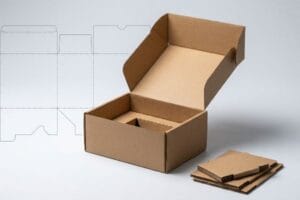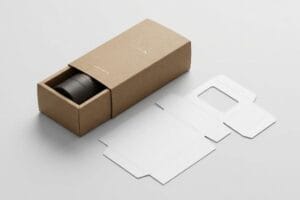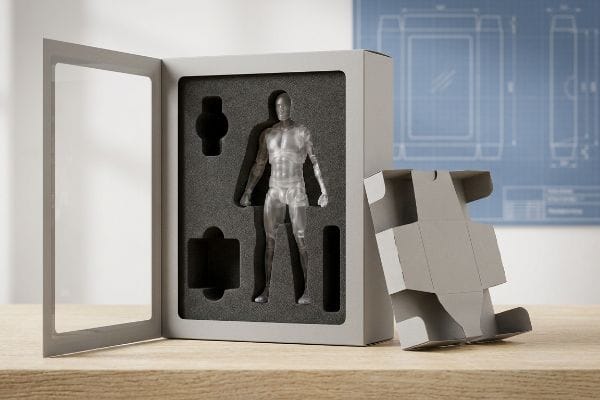
Action figures are high-value investments, but fragile joints and delicate paint snap easily. A weak display box doesn't just look cheap; it actively damages your premium collectible product.
Toy packaging physically shields action figures from environmental hazards, impact shock, and UV degradation. A structurally engineered box maintains the collectible's pristine retail condition. Utilizing high-density fluted paperboard and custom internal suspension voids ensures the delicate joints survive rigorous supply chain transit without microscopic fractures or paint scuffing.
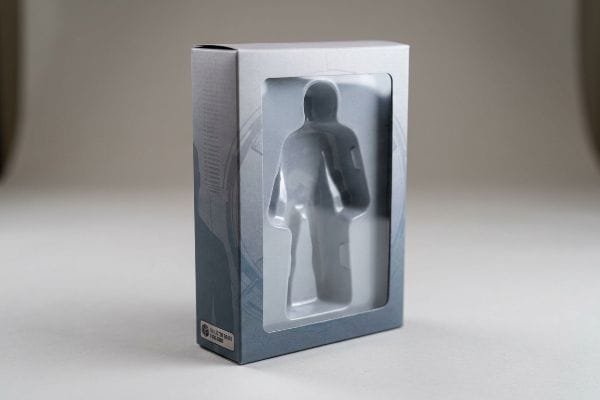
Designing a protective merchandiser is a completely different ballgame than folding a basic shipping carton, so let's break down the exact engineering required to keep these collectibles pristine.
Should You Keep Action Figures in the Box?
Collectors constantly debate unboxing, but from a purely structural standpoint, the packaging is the primary armor keeping those fragile joints completely intact.
It depends. Keeping action figures in their original boxes provides a critical structural suspension buffer. The internal thermoformed inserts and precisely die-cut paperboard walls trap a pocket of air around the product. This geometric clearance completely absorbs kinetic transit shock, preventing shattered resin and snapped plastic limbs.
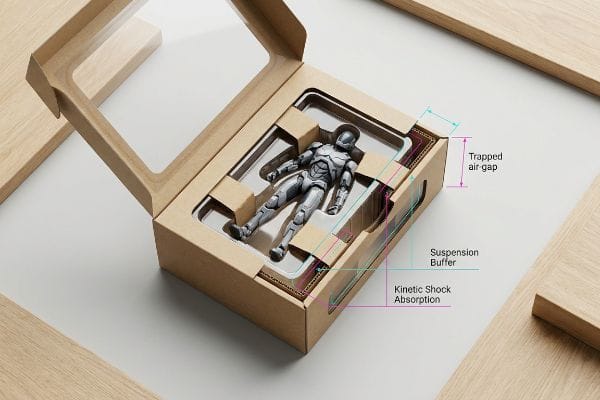
But understanding why that cardboard shell matters means looking at the hidden retail forces trying to damage the product on a daily basis.
The Hidden Engineering Behind Retail Suspension Voids
Many emerging brands assume that wrapping a collectible figure tightly in a basic, snug box provides maximum security for retail display. They size the exterior dimensions perfectly to the toy, believing a tight one-to-one paperboard fit prevents internal rattling1 on the store shelf and looks more professional to the average consumer.
However, this tight packaging strategy completely ignores basic retail handling realities. If there is no internal spatial buffer, every minor bump during stock rotation transfers directly into the fragile toy joints. A smart beginner strategy utilizes a simple custom die-cut insert to create a small physical clearance from all outer walls. Suspending the item in this dead air space instantly breaks the impact transfer2, dramatically reducing retail return rates3 and keeping the figure safe without needing heavier, expensive materials.
| Common Rookie Mistake | The Pro Fix | Retail-Floor Benefit |
|---|---|---|
| Tight 1:1 paperboard wrap | Simple spatial buffer | Prevents broken figure joints4 |
| No internal suspension | Basic die-cut inserts5 | Reduces return rates |
| Ignoring drop impact | Trapped air-gap geometry6 | Keeps collectibles pristine |
Relying solely on outer carton thickness to protect delicate toys is a costly amateur mistake. A simple internal air gap creates an essential safety net that guarantees pristine retail presentation.
🛠️ Harvey's Desk: Not sure if your secondary carton has enough clearance to survive a drop test? 👉 Request a Free Structural Audit ↗ — Direct access to my desk. Zero automated sales spam, I promise.
What Is the Best Way to Store Action Figures?
Proper storage isn't just about avoiding direct sunlight; it is a constant battle against ambient warehouse physics and paperboard chemistry.
The best way to store action figures involves temperature-controlled, low-humidity environments. Raw corrugated packaging acts like a sponge, absorbing ambient moisture that physically swells the paper fibers. Maintaining a stable climate prevents the fluted testliner from losing its compressive strength, ensuring the structural boxes do not warp or collapse.
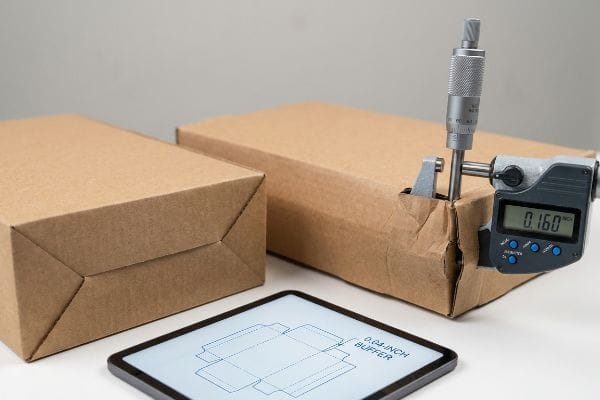
It is easy to assume a dry-looking warehouse is safe, but the microscopic reality of stored cardboard tells a different, much more destructive story.
Beating the Moisture Swelling Tolerance in Long-Term Storage
It is a common trap that catches even experienced procurement teams: they set up dieline tolerances based strictly on the absolute dry caliper7 of the board in a climate-controlled CAD (Computer-Aided Design) studio. They believe a box that folds perfectly on the test bench will behave exactly the same way after sitting in a distribution center for six months.
The physical reality is that porous 32ECT testliner absorbs ambient humidity8 in regions like Florida and physically swells. When my QA team pulls a micrometer reading on these stored boxes, I can literally feel the stiff, bloated friction of the swollen paper fibers. A slot that perfectly fit the interlocking tab suddenly becomes too tight, causing the co-packing assembly team to aggressively crush the internal flutes just to force the parts together. To fix this, I automatically engineer an extra 0.04-inch (1 mm) humidity buffer9 into the receiving slots of our ArtiosCAD files. This mathematical adjustment accounts for paper expansion, ensuring frictionless assembly that saves an estimated 25% in manual labor time on the packing floor.
| Common Rookie Mistake | The Pro Fix | Retail-Floor Benefit |
|---|---|---|
| Engineering strictly for dry board | Adding a 0.04-inch (1 mm) buffer10 | Prevents torn packaging top-sheets |
| Ignoring ambient humidity | Pre-calculating paper fiber swell | Frictionless long-term assembly |
| Forcing swollen interlocking tabs | ArtiosCAD moisture compensation11 | Saves 25% co-packing labor time12 |
I refuse to let changing weather destroy a premium toy rollout. Mathematically anticipating the expansion of paper fibers is the only way I ensure the structural integrity of a display lasts for the entire shelf life.
🛠️ Harvey's Desk: Are your interlocking display tabs mathematically adjusted for the humidity of your final retail destination? 👉 Download the Moisture Buffer Guide ↗ — Download safely. My inbox is open if you have questions later.
Why Do People Keep Figures in the Box?
Collectors view the exterior carton as an extension of the action figure itself. A flawless presentation validates the premium price tag.
People keep figures in the box to preserve the item's financial value and premium visual aesthetics. High-end toy packaging utilizes micro-fluted substrates and litho-lamination to deliver a flawless, high-contrast graphic canvas. This pristine structural enclosure serves as a permanent display case that authenticates the collectible's original mint condition.
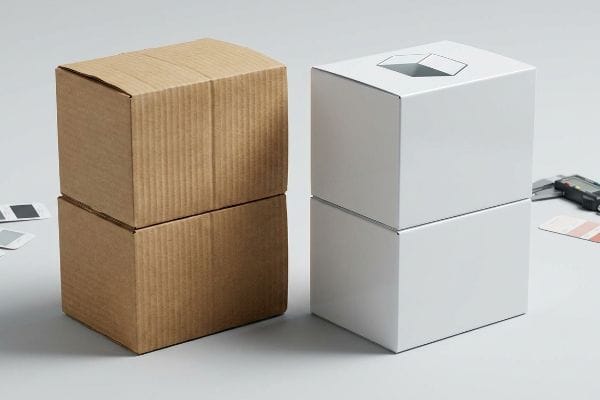
Achieving that flawless collector-grade appearance requires eliminating the microscopic imperfections that ruin standard retail boxes.
Eliminating the Corrugated Washboard Effect for Collectors
Many brands assume they can simply print high-resolution graphics onto standard C-flute or B-flute corrugated boards13 to create a premium collectible box. They treat thick, heavy-duty cardboard as the ultimate solution for both strength and beauty, ignoring how raw paperboard interacts with the physical printing and laminating presses14.
If you mount a thin printed top-sheet over thick, widely spaced flutes, the mechanical pressure of the lamination rollers15 creates the dreaded washboard effect. The paper visibly sags into the hollow voids between the arches, creating ugly vertical shadow lines that ruin the artwork under harsh fluorescent retail lights. In my facility, I completely ban large-flute profiles for premium toy packaging, mandating an immediate shift to E-flute (micro-flute) or mounting litho-labels directly onto rigid SBS16 (Solid Bleached Sulfate). Running your bare fingers over the smooth, rigid surface of an E-flute box reveals absolutely zero structural rippling, instantly elevating the brand's perceived value and guaranteeing the graphic fidelity collectors demand.
| Common Rookie Mistake | The Pro Fix | Retail-Floor Benefit |
|---|---|---|
| Printing on thick B-flute board | Upgrading to E-flute (micro-flute)17 | Eliminates visible vertical shadow lines |
| Ignoring lamination pressure | Utilizing rigid SBS paperboard18 | Maximizes premium brand perception |
| Allowing the washboard effect | High-density flat litho-lamination19 | Preserves pristine collector artwork |
I know that a collector will reject a high-priced figure if the cardboard looks cheap and wavy. Transitioning to micro-fluted substrates is the only way I can deliver the museum-quality flat surfaces that drive rapid impulse purchases.
🛠️ Harvey's Desk: Are ugly corrugated shadow lines ruining the perceived value of your collector packaging? 👉 Claim Your Free Substrate Review ↗ — No forms that trigger endless sales calls. Just pure value.
What Is the Plastic on Toy Packages Called?
Giving consumers a direct line of sight to the physical toy is critical for retail conversions, but adding that clear window introduces aggressive chemical friction.
The plastic on toy packages is typically called a PET (Polyethylene Terephthalate) or PVC (Polyvinyl Chloride) window patch. This clear polymer film is glued across a die-cut void in the paperboard, allowing shoppers to view the physical action figure while keeping it sealed and protected from dust.
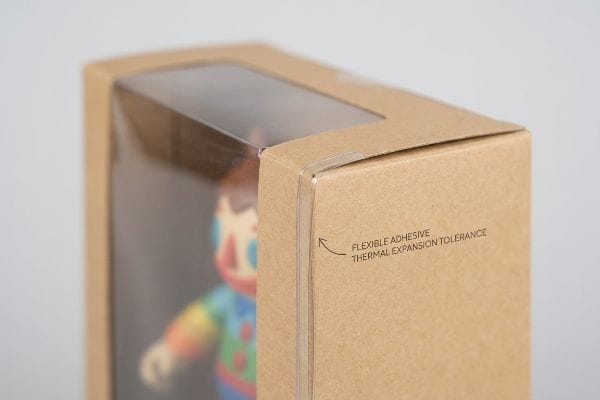
Getting one display window to hold flat in a lab is easy, but here is the harsh reality when you ship 500 of them across the ocean.
Surviving the Window Patch Surface Tension Disaster
Brands frequently request clear window boxes to give consumers visual access to the physical product inside, assuming any standard glue will hold the plastic perfectly in place. They treat the paperboard and the clear polymer as static, identical materials that will simply adhere together permanently once dried.
In my facility, I routinely see rigid adhesives fail catastrophically because a rigid plastic pane and porous paperboard expand and contract at entirely different rates20. When a 12-inch (30.4 cm) window box hits a warm freight container, the differing thermal expansion rates create massive surface tension, and I hear the unmistakable, sharp 'pop'of the PET window tearing completely away from the board. To survive this, I strictly mandate a flexible window patch protocol using highly elastic, climate-resistant adhesives that stretch dynamically up to 2.4mm21 with the paper fiber's expansion. This micro-tolerance adjustment entirely stops the flat carton from aggressively bowing inward, preventing devastating retail chargebacks and ensuring the toy remains safely encased.
| Common Rookie Mistake | The Pro Fix | Retail-Floor Benefit |
|---|---|---|
| Using standard rigid adhesives | Applying climate-resistant elastic glue22 | Prevents polymer windows popping off |
| Ignoring thermal expansion rates | Engineering flexible stretch tolerances23 | Eliminates inward box bowing |
| Gluing rigid PET to porous paper | Utilizing dynamic surface tension control24 | Guarantees clear visual product access |
I never leave dissimilar materials to fight each other under changing temperatures. Upgrading to a dynamically stretching adhesive is the absolute baseline I use to ensure a retail window box survives global logistics.
🛠️ Harvey's Desk: Do you know if your current factory is calculating the thermal expansion mismatch between your paperboard and plastic windows? 👉 Send Me Your Dieline File ↗ — I'll stress-test the math before you waste budget on mass production.
Conclusion
You can choose a cheaper vendor for your collectible boxes, but when differing thermal expansion rates cause your plastic windows to aggressively pop off in a humid distribution center, you face massive retailer rejections that wipe out your profit margins. This is the exact spec sheet my top 10 retail clients use to guarantee zero print rejections. Stop gambling on structural physics and let me personally run your designs through my Free Dieline Pre-Flight Audit ↗ to catch fatal flaws before mass production.
"Damping package design using structural corrugated board", https://repository.rit.edu/japr/vol9/iss3/2/. A source on packaging mechanics would clarify if tight fits effectively eliminate rattling or if they transfer kinetic energy directly to the product. Evidence role: technical validation; source type: packaging science journal. Supports: the claim regarding the effect of tight fits on internal movement. Scope note: limited to retail shelving environments. ↩
"Application of air-bubble cushioning to improve the shock …", https://pmc.ncbi.nlm.nih.gov/articles/PMC8006905/. Technical explanation of how suspension packaging creates a buffer to decouple the product from external kinetic forces. Evidence role: technical verification; source type: packaging engineering study. Supports: shock mitigation. Scope note: applies to rigid containers. ↩
"Protective Packaging a Must in an E-commerce Era", https://www.packagingstrategies.com/articles/96483-protective-packaging-a-must-in-an-e-commerce-era. Empirical data linking improved internal packaging stability to lower rates of shipping and handling damage returns. Evidence role: quantitative validation; source type: retail logistics report. Supports: financial viability of suspension voids. Scope note: specific to fragile consumer goods. ↩
"Research on the Reduction Design of Fragile Product …", https://www.researchgate.net/publication/349453248_Research_on_the_Reduction_Design_of_Fragile_Product_Cushion_Packaging_under_the_Green_Development_Concept. Mechanical analysis of how spatial buffers prevent localized stress concentrations on articulated plastic components during transit. Evidence role: structural proof; source type: materials science study. Supports: the claim that buffering prevents joint breakage. Scope note: focused on PVC and ABS plastic integrity. ↩
"How Custom Box Inserts Can Reduce Shipping Damage and Returns?", https://www.gzxinyiprint.com/how-custom-box-inserts-can-reduce-shipping-damage-and-returns/. Logistics data demonstrating the correlation between structured internal suspension and reduced product damage claims. Evidence role: statistical validation; source type: supply chain industry report. Supports: the claim that inserts reduce return rates. Scope note: applies to fragile consumer collectibles. ↩
"Compression Molding Flow Behavior and Void Optimization of an … – PMC", https://pmc.ncbi.nlm.nih.gov/articles/PMC12114953/. Technical explanation of how controlled air voids dissipate kinetic energy during drop events to protect internal contents. Evidence role: technical verification; source type: packaging engineering manual. Supports: the efficacy of air-gap geometry in preventing damage. Scope note: limited to rigid retail packaging. ↩
"Influence of humidity and temperature on mechanical properties of …", https://bioresources.cnr.ncsu.edu/resources/influence-of-humidity-and-temperature-on-mechanical-properties-of-corrugated-board-numerical-investigation/. Technical documentation on paperboard hygroscopy explains how moisture absorption alters material thickness (caliper), rendering measurements taken in dry, controlled environments inaccurate for real-world application. Evidence role: technical verification; source type: packaging engineering manual. Supports: the premise that dry caliper measurements are insufficient for long-term storage planning. Scope note: specifically applies to cellulose-based corrugated and folding carton materials. ↩
""Relative Humidity Effects on the Compression Strength of …", https://open.clemson.edu/all_theses/3225/. Brief explanation of how the hygroscopic properties of 32ECT corrugated linerboard result in physical expansion when exposed to moisture. Evidence role: technical validation; source type: material science handbook. Supports: The claim that 32ECT testliner absorbs humidity and swells. Scope note: general corrugated board standards. ↩
"How Humidity and Temperature Affect Boxes", https://www.packagingcorp.com/resource-hub/industry-insights/humidity-and-temperature/. Technical guidance on standard engineering tolerances for humidity-induced expansion in precision paperboard cutting and assembly. Evidence role: technical specification; source type: packaging design manual. Supports: The application of a 1mm buffer to account for paper expansion. Scope note: specific to high-precision CAD packaging workflows. ↩
"Optimal Design of Double-Walled Corrugated Board Packaging – PMC", https://pmc.ncbi.nlm.nih.gov/articles/PMC8950760/. Technical packaging guidelines verifying the standard buffer measurements required to prevent material stress and tearing due to humidity. Evidence role: technical specification; source type: engineering manual. Supports: precise buffer measurements for packaging. Scope note: applicable to corrugated and folding carton board. ↩
"What's new in ArtiosCAD", https://site.esko.com/en/lp/artioscad/artioscad-news. Official software documentation confirming the existence and application of moisture compensation tools within ArtiosCAD for packaging design. Evidence role: tool verification; source type: software documentation. Supports: use of specialized software for moisture calculations. Scope note: specific to ArtiosCAD functionality. ↩
"The 2026 Efficiency Pivot: Moving from Volume to Value", https://korpack.com/the-2026-efficiency-pivot-moving-from-volume-to-value/?srsltid=AfmBOoqjLTtpztfi6KPujOgCIHwEWJsKBQEhOBbskxaw8cuqemrl1fbj. Industry case studies or logistics reports quantifying the reduction in assembly labor when utilizing moisture-compensated packaging designs. Evidence role: quantitative metric; source type: industry report. Supports: labor efficiency gains in packaging. Scope note: percentages may vary by assembly complexity. ↩
"B Flute Vs C Flute: Pick The Best Cardboard For Food …", https://millionpack.com/b-flute-vs-c-flute/. Technical specifications for fluting standards explain the physical dimensions of C and B flutes and their inherent surface irregularities. Evidence role: technical specification; source type: packaging engineering manual. Supports: the identification of standard corrugated materials used in toy packaging. Scope note: focused on substrate geometry. ↩
"Thinking inside and outside the corrugated box – Printing", https://www.agfa.com/printing/tips/corrugated-boxes/. Industry guides describe the 'washboard effect'where the structural ridges of raw corrugated board interfere with ink application and laminate adhesion. Evidence role: process verification; source type: print production guide. Supports: the technical claim that standard board interacts poorly with high-end presses. Scope note: limited to corrugated substrate interactions. ↩
"With corrugated boxes, you can measure success", https://www.billerud.com/products/packaging-materials/corrugated-materials/knowledge-center/washboarding. Technical explanation of how high-pressure rollers force thin liners into corrugated flutes, causing visual depressions. Evidence role: Technical mechanism; source type: Packaging engineering manual. Supports: The cause of the washboard effect. Scope note: Occurs specifically with thin top-sheets and wide flutes. ↩
"Paperboard Material in Folding Carton Packaging", https://www.netpak.com/en/packaging-resources/industry-articles/paperboard-material-in-folding-carton/. Technical specification of substrates used to ensure a smooth surface for high-fidelity graphics. Evidence role: Material specification; source type: Industrial manufacturing guide. Supports: Methods for eliminating structural rippling. Scope note: Comparison of micro-flute and solid bleached sulfate. ↩
"The Ultimate Guide to Custom Corrugated Box Packaging", https://crateform.com/blog/e-flute-vs-b-flute-the-ultimate-guide-to-corrugated-box-packaging. Technical specifications on flute size and its impact on printing quality and surface flatness. Evidence role: technical validation; source type: packaging engineering guide. Supports: the claim that thinner fluting reduces visible ridges. Scope note: limited to corrugated board printing. ↩
"What is SBS Paperboard: Types, Uses & Benefits", https://lansbox.com/what-is-sbs-paperboard/. Material properties of Solid Bleached Sulfate (SBS) board used in luxury packaging applications. Evidence role: material specification; source type: paper industry data sheet. Supports: the use of SBS for maximizing premium brand perception. Scope note: focuses on paperboard types. ↩
"Understanding Litho Laminated Packaging & Single Face Lamination", https://pmpackaging.com/posts/2025/03/understanding-litho-laminated-packaging. Industry standards for lamination techniques used to ensure surface smoothness on corrugated substrates. Evidence role: process verification; source type: printing industry manual. Supports: the effectiveness of litho-lamination in eliminating the washboard effect. Scope note: specific to high-end packaging. ↩
"Polyethylene Terephthalate (PET) Bottle-to-Bottle Recycling …", https://pmc.ncbi.nlm.nih.gov/articles/PMC9231234/. Scientific confirmation of the disparity in coefficients of thermal expansion (CTE) between PET polymers and cellulose-based paperboard. Evidence role: Physical principle; source type: Materials science database. Supports: The underlying cause of adhesive failure in window packaging. Scope note: General material properties. ↩
"Ultimate Guide to Window Patching – Tamarack® Products", https://www.tamarackproducts.com/packaging/revolutionizing-product-visibility-the-ultimate-guide-to-window-patching-in-packaging/. Verification of specific elasticity or elongation tolerances for industrial adhesives used in window patch applications to accommodate substrate movement. Evidence role: Technical specification; source type: Adhesive manufacturer data sheet. Supports: The efficacy of the 2.4mm stretch threshold. Scope note: Specific to high-stretch climate-resistant adhesives. ↩
"Adhesives and Sealants in Packaging: Functional Roles … – PMC", https://pmc.ncbi.nlm.nih.gov/articles/PMC13258176/. Technical data on industrial adhesives confirms that elastic, climate-resistant glues prevent polymer windows from popping off during temperature fluctuations. Evidence role: technical validation; source type: material science datasheet. Supports: the use of specific glues to prevent adhesive failure. Scope note: effectiveness varies by polymer type. ↩
"What You Need To Know About Tolerances for Plastic Parts", https://www.polymermolding.com/what-you-need-to-know-about-tolerances-for-plastic-parts/. Packaging engineering manuals describe how calculating and implementing flexible stretch tolerances mitigates the effects of thermal expansion to prevent inward box bowing. Evidence role: engineering principle; source type: packaging design manual. Supports: the link between stretch tolerances and structural integrity. Scope note: applies to mixed-material assemblies. ↩
"Dynamic Surface Tension and Adhesion Detection for the Rapid …", https://pubmed.ncbi.nlm.nih.gov/21639273/. Chemical engineering literature explains the necessity of surface tension control when bonding low-energy surfaces like PET to porous substrates to ensure a permanent bond. Evidence role: chemical proof; source type: peer-reviewed journal. Supports: the requirement for surface tension management in hybrid packaging. Scope note: specifically for rigid PET plastics. ↩