¿Te cuesta que tus productos destaquen en los pasillos abarrotados? Las grandes cadenas exigen la perfección, y una caja de cartón endeble no es suficiente. Vamos a optimizar tu estrategia de empaquetado para tiendas.
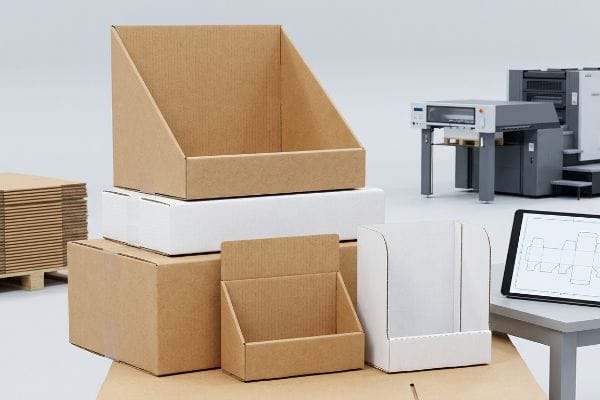
Los embalajes de cartón ondulado y cartón para la venta al por menor constituyen la base de la comercialización a gran escala, utilizando cartón ondulado para garantizar la integridad estructural y la visibilidad de la marca. Estos expositores aseguran un transporte seguro y el cumplimiento de la normativa ADA, transformando los embalajes estándar a granel en elementos promocionales que impulsan las compras impulsivas en tiendas concurridas.
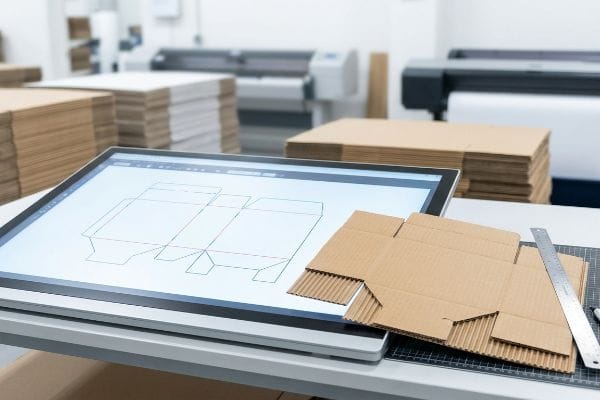
Conseguir la aprobación de un diseño es solo la mitad del trabajo. Esto es lo que sucede cuando esos archivos CAD (Diseño Asistido por Computadora) teóricos chocan con la dura realidad de una planta de fabricación de alta velocidad.
¿Por qué es bueno el cartón corrugado para el embalaje?
Puede que pienses que el cartón ondulado es simplemente un material de embalaje barato, pero en realidad es una maravilla estructural de alta ingeniería cuando se utiliza correctamente para lanzamientos en el sector minorista.
El cartón ondulado es ideal para el embalaje porque su capa interior acanalada actúa como un amortiguador mecánico continuo. Esta estructura geométrica especializada ofrece una excepcional resistencia a la compresión vertical, lo que permite que materiales de papel ligeros soporten de forma segura grandes cargas dinámicas durante el transporte sin dañar la valiosa mercancía.
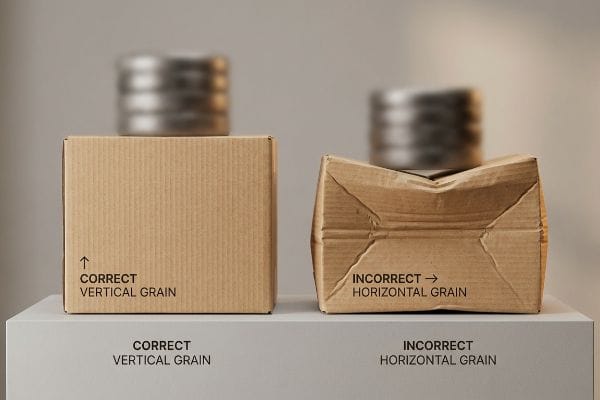
Ese núcleo estriado es increíble en teoría, pero solo si se alinean correctamente las leyes de la física durante la preimpresión.
Maximización de la resistencia BCT (prueba de compresión de caja) en la dirección de la fibra
Incluso los diseñadores más experimentados suelen pasar por alto la orientación específica de las ondulaciones del papel al elaborar sus plantillas iniciales. Priorizan colocar la mayor cantidad de paneles posible en una sola hoja maestra para minimizar el desperdicio. Si bien esto parece muy eficiente en un diseño digital, ignora por completo los requisitos de carga física de un entorno comercial con estanterías apiladas¹.Una impresión hermosa no sirve de nada si la estructura subyacente se derrumba bajo su propio peso.
Con frecuencia veo este punto ciego al revisar los archivos de arte entrantes donde la veta del cartón ondulado corre horizontalmente a través de las paredes principales de carga. El trimestre pasado, un cliente intentó forzar un ensamblaje donde la ondulación horizontal se arrugó bajo la presión de solo 30 libras (13,6 kg), produciendo un horrible sonido de desgarro cuando el cartón crudo se dobló hacia adentro. Es una trampa común que atrapa incluso a equipos de compras experimentados que buscan ahorrar unos centavos en el rendimiento del material. Al simplemente girar la línea de troquelado 90 grados para que la veta corra completamente vertical, aprovechamos la máxima resistencia a la compresión del borde del material. Esto significó que el mismo cartón ondulado E de repente podía soportar paletas apiladas doblemente sin doblarse, reduciendo drásticamente los daños en el transporte y eliminando por completo el riesgo de cargos de los minoristas.
| Error común de principiante | La solución profesional | Beneficio para el punto de venta |
|---|---|---|
| Orientación de las ranuras horizontalmente para obtener un mejor rendimiento | Rotación vertical del grano sobre los muros de carga2 | Evita el aplastamiento del nivel base |
| Ignorar los requisitos de carga vertical | Ingeniería para los límites de apilamiento de BCT3 | Sobrevive al tránsito de contenedores apilados doblemente |
| Priorizar el ahorro de desperdicios sobre la resistencia | Alinear los troquelados con la veta natural del papel4 | Elimina los ruidos de desgarro estructural |
Jamás transijo en la orientación de las fibras solo para ahorrar un centímetro de papel. Alinear la fibra verticalmente es fundamental para garantizar que su pantalla sobreviva a la dura cadena logística y llegue en perfectas condiciones.
🛠️ Oficina de Harvey: ¿No está seguro de si sus archivos de empaque actuales están afectando la textura natural del papel? 👉 Solicite una auditoría gratuita de troquelado ↗ — Acceso directo a mi oficina. Sin spam de ventas automatizado, lo prometo.
¿Qué es un embalaje de cartón ondulado?
Comprender la composición exacta de su material es el primer paso para prevenir fallas catastróficas en el taller.
El embalaje de cartón ondulado es un material multicapa que presenta una capa intermedia ondulada pegada entre dos láminas de cartón plano. Esta estructura tipo sándwich proporciona una rigidez y un aislamiento superiores. Las normas internacionales dictan diversos perfiles de ondulación y tipos de papel, lo que permite a los fabricantes personalizar el cartón para impresión de alta resolución y una durabilidad protectora extrema.
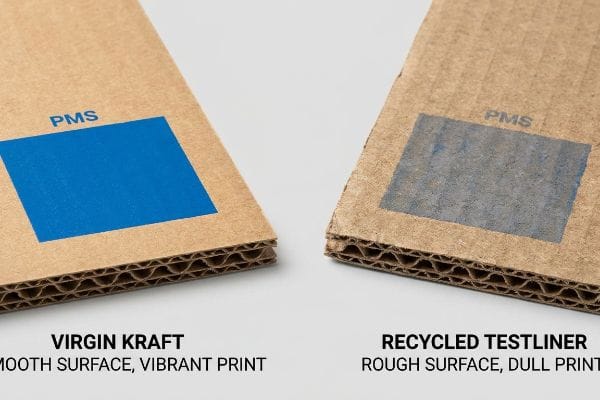
Definir las capas es sencillo, pero seleccionar la composición química adecuada para esos revestimientos determina cómo se ve realmente su marca bajo la intensa luz fluorescente.
El dilema entre el papel Kraft virgen y el Testliner reciclado
Las marcas presionan agresivamente para que se utilicen materiales 100 % reciclados para cumplir con los objetivos de sostenibilidad corporativa, asumiendo que todo el papel marrón se comporta de la misma manera en la imprenta. Especifican testliner reciclado estándar para sus principales exhibidores de venta minorista sin considerar la textura superficial microscópica del cartón. Debido a que las fibras recicladas se han procesado varias veces, son inherentemente más cortas y altamente porosas5. Esto crea un lienzo rugoso e impredecible que absorbe la tinta de manera desigual durante las tiradas de offset de alta velocidad6.
Lo noto inmediatamente al imprimir con colores corporativos sólidos sobre cartulina reciclada estándar, donde la superficie porosa absorbe la tinta y deja un acabado opaco y descolorido. Un cliente observó con frustración cómo su azul PMS (Pantone Matching System) de primera calidad se convertía en un gris opaco y calcáreo recién salido de la imprenta Heidelberg porque las fibras recicladas dispersaban la luz7.Al cambiar la capa de impresión más externa a un revestimiento liso de papel Kraft virgen, las fibras largas proporcionan una superficie compacta y sellada8.La tinta se asienta limpiamente sobre la superficie, ofreciendo una presencia de marca nítida y vibrante, al tiempo que se sigue utilizando material reciclado para las ondulaciones internas ocultas para mantener el cumplimiento ecológico.
| Error común de principiante | La solución profesional | Beneficio para el punto de venta |
|---|---|---|
| Impresión sobre papel de testliner reciclado rugoso | Actualización a una capa exterior lisa de papel Kraft virgen | Ofrece coincidencias de color Pantone vibrantes9 |
| Suponiendo que todas las placas marrones son iguales | Especificación de la longitud de la fibra para superficies de impresión | Evita la absorción de tinta y la turbidez10 |
| Utilizamos materiales 100% reciclados para expositores de alta calidad | Utilizando tableros interiores híbridos reciclados y exteriores vírgenes11 | Combina objetivos ecológicos con una estética de alta calidad |
Siempre especifico una capa superior de fibra virgen para campañas donde el color es crucial. La suavidad microscópica de esas fibras primarias es precisamente lo que transforma una caja de envío común en una pieza central llamativa para el punto de venta.
🛠️ Harvey's Desk: ¿Los colores de tu marca se ven apagados y sin brillo al imprimirlos en cartón reciclado marrón estándar? 👉 Obtén una evaluación de materiales ↗ — Descárgala de forma segura. Mi bandeja de entrada está abierta si tienes alguna pregunta.
¿Cuál es una desventaja del cartón corrugado?
Incluso el cartón más resistente tiene un punto débil, e ignorarlo convertirá tu diseño perfecto en una pesadilla imposible de ensamblar durante el proceso de envío.
Una de las principales desventajas del cartón ondulado es su extrema sensibilidad a la humedad ambiental y a la alta humedad. Debido a que las fibras de papel son inherentemente porosas, absorben vapor de agua de la atmósfera. Esta exposición ambiental provoca que el material se hinche físicamente, alterando las tolerancias de troquelado y reduciendo drásticamente su resistencia a la compresión.
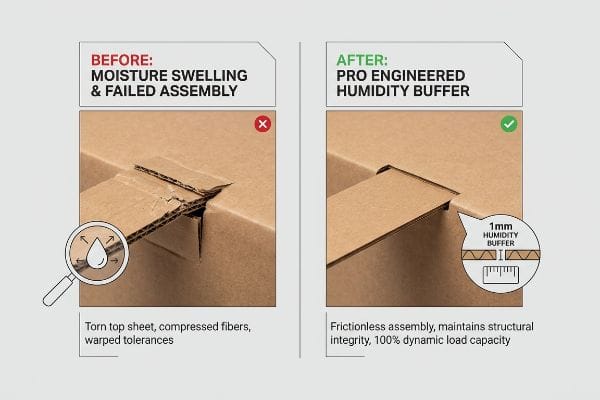
Esa distorsión ambiental es un asesino invisible que convierte un diseño digital perfectamente elaborado en basura física.
Cálculo de la "Tolerancia a la hinchazón por humedad" para el coempaquetado
Los ingenieros que elaboran planos en oficinas con temperatura controlada suelen establecer tolerancias para las ranuras de enclavamiento basándose en el calibre absoluto del cartón en seco. Dan por sentado que una ranura de 3 mm de ancho aceptará perfectamente una pestaña de 3 mm de ancho indefinidamente. No tienen en cuenta la realidad de los largos transportes marítimos ni el almacenamiento en centros de distribución con alta humedad en regiones como Florida. Cuando ese cartón poroso 32ECT (Edge Crush Test)permanece en un almacén húmedo, actúa como una esponja seca.
Imagínelo como una puerta de madera que se atasca en su marco durante un verano lluvioso. Veo a empleados de tiendas empujando violentamente pestañas de cartón hinchadas en ranuras que se han encogido, rasgando la hoja superior impresa y comprometiendo toda la capacidad de carga dinámica13.Para solucionar esto, incorporo automáticamente un amortiguador de humedad de 0,04 pulgadas (1 mm)14 en todos mis archivos ArtiosCAD destinados a climas húmedos. Esta holgura matemática absorbe perfectamente la expansión natural del papel, lo que garantiza que el coempaquetador experimente un ensamblaje sin fricción que reduce aproximadamente 30 segundos el tiempo de mano de obra por unidad.
| Error común de principiante | La solución profesional | Beneficio para el punto de venta |
|---|---|---|
| Diseño de ranuras para dimensiones de calibre seco | Agregar un margen de humedad de 1 mm a los archivos CAD15 | Garantiza un montaje de coempaquetado sin fricción |
| Ignorar la absorción de humedad del transporte marítimo | Cálculo de las tasas de hinchamiento por humedad regional16 | Evita que se rompan las hojas superiores impresas |
| Forzar pestañas hinchadas en cortes estrechos | Ampliación de las tolerancias de holgura de enclavamiento | Mantiene el 100% de la capacidad de carga dinámica17 |
Me niego a que un poco de humedad arruine el lanzamiento de tu campaña. Incorporar ese margen matemático microscópico en el troquel de corte es la única manera de garantizar que tus expositores se ensamblen sin esfuerzo en cualquier base de carga.
🛠️ Harvey's Desk: ¿Sus proveedores de embalaje tienen problemas para plegar los expositores porque el papel se ha hinchado durante el transporte? 👉 Solicite su prueba de resistencia estructural ↗ — Sin formularios que generen interminables llamadas de ventas. Solo valor puro.
¿Cuáles son las ventajas del embalaje en cajas de cartón?
Más allá de su gran resistencia física, este material ofrece enormes ventajas logísticas y de cumplimiento normativo que los plásticos rígidos simplemente no pueden igualar en el mercado actual.
Las principales ventajas del embalaje de cartón incluyen una reciclabilidad sin precedentes, una personalización rentable y una rápida escalabilidad de la fabricación. Estas estructuras ligeras reducen drásticamente los costes de envío internacionales, al tiempo que cumplen a la perfección con las estrictas normativas de sostenibilidad de los minoristas, lo que permite a las marcas lanzar campañas promocionales ecológicas sin sacrificar la estética ni el rendimiento.
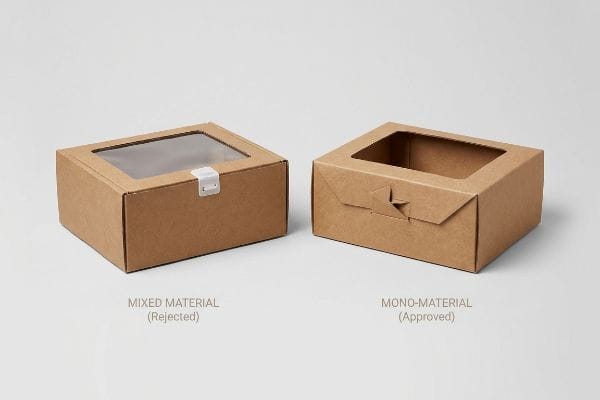
Si bien todo el mundo habla de sostenibilidad, la verdadera ventaja reside en cómo este cumplimiento acelera directamente el proceso de aprobación por parte de los grandes compradores minoristas.
La normativa sobre "Reciclaje en la acera" para una rápida aprobación por parte de los comercios minoristas
Muchas agencias creativas aún intentan usar clips de plástico pesado, ventanas de PVC (cloruro de polivinilo) o sujetadores de materiales mixtos para reforzar los expositores de cartón. Creen que estos añadidos rígidos transmiten una estética prémium al comprador. Sin embargo, las grandes cadenas minoristas han convertido cada vez más sus directrices de sostenibilidad en un arma, considerando el embalaje de materiales mixtos como un enorme problema logístico¹⁸.Si un empleado de la tienda no puede simplemente tirar la unidad completa directamente a la empacadora de reciclaje estándar de OCC (envases de cartón ondulado usados), es probable que el comprador rechace el diseño por completo.
Recuerdo haber visto a un gerente de marca en apuros porque su magnífico expositor híbrido fue marcado por contener pegamento termofusible no reciclable y conectores de plástico. Para salvar el lanzamiento, reemplacé todos los sujetadores de plástico con cierres de papel diseñados al estilo origami, fabricados con cartón 100 % certificado SFI/FSC (Iniciativa de Silvicultura Sostenible). Escuchar ese satisfactorio y rígido clic del papel puro al encajar, sin una sola gota de plástico, demostró la eficacia del concepto de inmediato. Esta mejora monomaterial evita por completo las dificultades de cumplimiento normativo para los minoristas, lo que garantiza que su campaña llegue a las tiendas más rápido y elimina por completo las engorrosas penalizaciones por reempaquetado o eliminación.
| Error común de principiante | La solución profesional | Beneficio para el punto de venta |
|---|---|---|
| Utilizar clips de plástico para reforzar | Diseño de cerraduras de papel al estilo origami | Acelera la aprobación de compras por parte de grandes superficies |
| Incluyendo ventanas transparentes de materiales mixtos | Utilizando estructuras de OCC 100% reciclables en la acera | Elimina las penalizaciones por eliminación de residuos por parte de los minoristas |
| Ignorar las estrictas directrices de sostenibilidad | Diseño de unidades monomateriales que cumplen con las normas SFI/FSC | Permite a los empleados reciclar fácilmente los contenedores |
Considero la reciclabilidad al 100% un requisito de ingeniería fundamental, no una característica opcional. Eliminar la fricción del plástico garantiza que sus expositores superen el proceso de aprobación sin problemas y, además, luzcan impecables.
🛠️ Oficina de Harvey: ¿Su expositor actual está repleto de clips de plástico no reciclables que podrían provocar el rechazo del vendedor? 👉 Solicite un rediseño monomaterial ↗ — Acceso directo a mi oficina. Le prometo que no recibirá publicidad no deseada.
¿Cómo se llama el embalaje de cartón?
La jerga del sector puede resultar abrumadora, pero el uso indebido de estas clasificaciones estructurales específicas puede provocar fallos logísticos masivos incluso antes de que comience la producción.
El embalaje de cartón se conoce comúnmente como cartón ondulado, expositores POP (punto de venta) o mercadillos POS (punto de venta), según su aplicación específica en el sector minorista. Estas clasificaciones técnicas específicas determinan las dimensiones espaciales exactas, los límites de carga estructural y las normativas de cumplimiento necesarias para su colocación segura en entornos comerciales de alto tránsito.
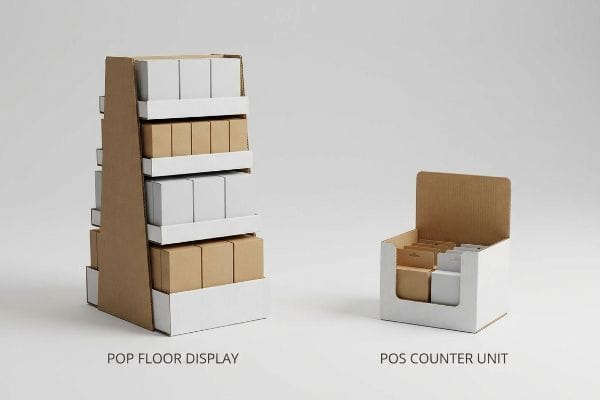
Pero conocer la teoría no es suficiente cuando las máquinas empiezan a funcionar y esas dimensiones teóricas chocan con los rígidos planos de los minoristas.
Por qué la terminología estándar de "encogimiento para ajustar" para puntos de venta falla en la fábrica
Las empresas comerciales suelen presentar un concepto de diseño "escalable" muy atractivo, sugiriendo que un gran expositor de punto de venta (POP ) puede reducirse a la mitad para funcionar como un expositor de mostrador compacto. Esta confusión terminológica presupone que la geometría del embalaje se adapta perfectamente a una pantalla digital. Ignoran por completo las estrictas normas legales y logísticas, innegociables, que rigen estas dos zonas totalmente separadas dentro de la arquitectura minorista estadounidense.
En mis instalaciones, veo con frecuencia la devastación causada por esta suposición de "reducir para ajustar". Cuando comparo estas unidades de punto de venta (POS) a escala reducida con las cajas registradoras físicas de las tiendas, la base casi siempre viola el rango crítico de alcance frontal de 15 a 48 pulgadas (38,1 a 121,9 cm) de la ADA (20 , lo que desplaza el producto completamente fuera del alcance del cliente. Separo permanentemente los flujos de ingeniería para estos términos: los archivos de piso de POP están estrictamente anclados al límite de palé de alta resistencia de 48 × 40 pulgadas (121,9 × 101,6 cm) de la GMA (Asociación de Fabricantes de Alimentos)21, mientras que las unidades de mostrador se reconstruyen matemáticamente desde cero para la ergonomía. Al imponer esta separación absoluta en la geometría CAD, elimino el punto ciego, evitando rechazos inmediatos por parte de los minoristas que podrían agotar instantáneamente todo su presupuesto de marketing.
| Error común de principiante | La solución profesional | Beneficio para el punto de venta |
|---|---|---|
| Reducción del tamaño de los expositores de punto de venta (POP) para convertirlos en unidades de punto de venta (POS) | Separar completamente las tuberías CAD estructurales | Evita el rechazo inmediato por parte de los minoristas |
| Ignorar las regulaciones de alcance frontal de la ADA22 | Anclaje de los diseños de punto de venta a zonas de impacto ergonómicas | Mantiene la mercancía accesible para los compradores |
| Terminología confusa sobre la ubicación en tiendas | Diseño adaptado estrictamente a la logística de palés de GMA23 | Evita fallos de carga dinámica en palés24 |
Jamás trato una caja registradora como si fuera un pasillo de almacén en miniatura. Considerar estos términos como disciplinas matemáticas independientes es lo que garantiza que su implementación cumpla con la normativa, sea legal y rentable.
🛠️ Oficina de Harvey: No permita que un defecto estructural de 2 milímetros arruine el lanzamiento de 500 tiendas. 👉 Envíeme su archivo de troquelado ↗ — Analizaré los cálculos antes de que malgaste su presupuesto en la producción en masa.
Conclusión
Puedes elegir el testliner más barato del mercado, pero cuando ese material poroso absorbe la humedad del almacén y las ranuras físicas se hinchan, corres el riesgo de que la base se aplaste de forma catastrófica, lo que ralentiza el proceso de co-empaquetado en un 30 % aproximadamente. Más de 500 gerentes de marca utilizan mi lista de verificación de preimpresión para evitar precisamente estos errores fatales en las primeras etapas. Deja de adivinar las tolerancias de humedad y permíteme revisar personalmente tus archivos estructurales con mi Auditoría Previa a la Impresión Gratuita ↗ para eliminar la fricción antes de que comience la producción en masa.
"Estimación de la resistencia a la compresión de cajas de cartón corrugado para un…", https://pmc.ncbi.nlm.nih.gov/articles/PMC9864211/. [Las normas de embalaje de la industria explican cómo la orientación vertical de las ondulaciones es fundamental para maximizar la resistencia a la compresión y prevenir fallas estructurales en configuraciones de paletas apiladas]. Función de la evidencia: justificación técnica; tipo de fuente: manual de ingeniería. Apoya: el vínculo entre la orientación de las ondulaciones y la integridad estructural. Nota de alcance: Se aplica específicamente a cargas de compresión verticales. ↩
"Estimación de la resistencia al aplastamiento de los bordes del cartón corrugado mediante…", https://pmc.ncbi.nlm.nih.gov/articles/PMC9961700/. [Las guías técnicas sobre ingeniería estructural de embalajes de cartón corrugado confirman que alinear las ondulaciones verticalmente maximiza la resistencia a la compresión del material, evitando el colapso de las capas base bajo carga]. Función de la evidencia: validación técnica; tipo de fuente: manual de ingeniería. Apoya: relación entre la orientación de la fibra y la resistencia a la compresión. Nota de alcance: se aplica específicamente a escenarios de carga vertical. ↩
"Cómo calcular la resistencia al apilamiento de una caja de cartón corrugado – Lansbox", https://lansbox.com/calculate-corrugated-box-stacking-strength/. [Los estándares de embalaje de la industria utilizan métricas de prueba de compresión de cajas (BCT) para determinar la carga máxima que un contenedor puede soportar para garantizar la estabilidad durante el envío apilado doble]. Función de evidencia: estándar de la industria; tipo de fuente: especificación de embalaje. Apoya: uso de BCT para calcular la durabilidad en tránsito. Nota de alcance: los valores de BCT están sujetos a variables ambientales como la humedad. ↩
"Por qué la dirección de la fibra importa en la impresión de cartón monocapa – LinkedIn", https://www.linkedin.com/posts/selvanathan-qa_monocarton-printingandpackaging-packagingdesign-activity-7390651101022412800-t6nG. [La documentación de ciencia de los materiales explica cómo alinear los cortes con la dirección de las fibras del papel reduce las concentraciones de tensión y previene fallas estructurales prematuras o desgarros durante el ensamblaje]. Función de evidencia: prueba de ciencia de los materiales; tipo de fuente: libro de texto técnico. Apoya: relación entre la alineación del troquelado y la integridad estructural. Nota de alcance: se centra en las propiedades físicas de las fibras de celulosa. ↩
"Propiedades mecánicas e higroscópicas de productos de pulpa moldeada…", https://pmc.ncbi.nlm.nih.gov/articles/PMC8512325/. [La literatura sobre ciencia de los materiales en pulpa y papel explica que los ciclos repetidos de reciclaje rompen las cadenas de celulosa, acortando la longitud de las fibras y aumentando la porosidad del sustrato]. Función de la evidencia: especificación técnica; tipo de fuente: revista académica. Apoya: propiedades de las fibras recicladas. Nota de alcance: General a papeles reciclados a base de celulosa. ↩
"¿Qué es la ganancia de punto en la impresión? | Rehan Siddique publicó en…", https://www.linkedin.com/posts/rehan-siddique-440b5a1b1_dotgain-printing-activity-7371590745176260608-LryZ. [Los manuales de química de tintas e impresión detallan cómo la alta porosidad y la rugosidad superficial de los sustratos reciclados provocan una penetración inconsistente de la tinta y una ganancia de punto deficiente]. Función de la evidencia: consecuencia técnica; tipo de fuente: manual de la industria. Apoya: defectos de impresión en placas recicladas. Nota de alcance: específicamente para litografía offset. ↩
"Despulpado fraccional de tinta de inyección de tinta a base de tóner y pigmentos impresos...", https://bioresources.cnr.ncsu.edu/resources/fractional-pulping-of-toner-and-pigment-based-inkjet-ink-printed-papers-ink-and-dirt-behavior/. [Una fuente sobre las propiedades ópticas del papel explicaría cómo la morfología irregular de las fibras recicladas provoca una reflexión difusa de la luz, reduciendo la profundidad y la saturación del color]. Función de la evidencia: mecanismo científico; tipo de fuente: libro de texto de ciencia del papel. Apoya: la causa de los colores apagados en los cartones reciclados. Nota de alcance: se centra en la interacción entre la luz y la pulpa reciclada. ↩
"Descripción general del papel y los materiales de envasado de alimentos a base de papel", https://pmc.ncbi.nlm.nih.gov/articles/PMC6801293/. [Las guías autorizadas sobre pulpa y papel describen cómo las fibras vírgenes largas aumentan la densidad superficial y reducen la porosidad en comparación con las fibras recicladas cortas]. Función de la evidencia: especificación técnica; tipo de fuente: guía de fabricación industrial. Apoya: el uso de kraft virgen para una impresión vibrante. Nota de alcance: aplicable al revestimiento exterior del cartón corrugado. ↩
"Papel Kraft vs Testliner: Resistencia, Costo y Sostenibilidad – LinkedIn", https://www.linkedin.com/posts/fahd-malik-54047a17_packagingindustry-kraftpaper-testliner-activity-7355463111815901184-7J57. [Las guías técnicas sobre sustratos de impresión explican cómo la suavidad y pureza de las fibras kraft vírgenes minimizan la absorción de tinta y mejoran la viveza del color en comparación con los testliners reciclados]. Función de la evidencia: validación técnica; tipo de fuente: estándar de impresión de la industria; Apoyos: beneficio del kraft virgen para la igualación de colores; Nota de alcance: se aplica a la impresión offset y flexográfica. ↩
"Efecto de las condiciones de fabricación del papel en la absorción de tinta y la sobreimpresión…", https://bioresources.cnr.ncsu.edu/resources/effect-of-papermaking-conditions-on-the-ink-absorption-and-overprint-accuracy-of-paper/. [Los artículos técnicos sobre ciencia del papel demuestran que las fibras más largas y el encolado superficial reducen la penetración de la tinta en el cartón, evitando el desenfoque o la "oscuridad" que se observa en los papeles reciclados de alta absorción]. Función de la evidencia: mecanismo científico; tipo de fuente: revista de ciencia de los materiales; Apoyos: papel de la longitud de la fibra en la calidad de impresión; Nota de alcance: enfoque en la porosidad superficial. ↩
"El impacto ambiental del embalaje de cartón ondulado", https://www.internationalpaper.com/resources/blog/environmental-impact-corrugated-packaging-why-balanced-fiber-approach-best. [Las especificaciones de ingeniería de embalaje suelen recomendar construcciones híbridas para lograr la sostenibilidad estructural manteniendo la superficie de impresión de alta calidad requerida para las exhibiciones en puntos de venta]. Función de la evidencia: mejores prácticas de la industria; tipo de fuente: guía de diseño de embalaje; Apoyos: equilibrio entre sostenibilidad y estética; Nota de alcance: común en embalajes minoristas de alta gama. ↩
"Influencia de la humedad y la temperatura en las propiedades mecánicas de…", https://bioresources.cnr.ncsu.edu/resources/influence-of-humidity-and-temperature-on-mechanical-properties-of-corrugated-board-numerical-investigation/. [Las especificaciones técnicas para cartón corrugado con clasificación ECT confirman la naturaleza higroscópica de las fibras de celulosa y su capacidad de absorción de vapor de agua]. Función de la evidencia: especificación técnica; tipo de fuente: manual de ciencia de los materiales. Apoya: la vulnerabilidad del cartón 32ECT a la hinchazón inducida por la humedad. Nota de alcance: se aplica al cartón reciclado y virgen estándar. ↩
"Estimación de la resistencia a la compresión de cajas de cartón corrugado…", https://pmc.ncbi.nlm.nih.gov/articles/PMC8467740/. [Investigaciones en ciencia de materiales sobre cartón corrugado indican que las roturas estructurales en el revestimiento exterior reducen significativamente la resistencia a la compresión vertical y la capacidad de carga general]. Función de la evidencia: afirmación fáctica; tipo de fuente: estudio de ciencia de materiales. Apoya: la afirmación de que el daño físico a la lámina superior reduce la integridad estructural. Nota de alcance: Se aplica específicamente a cargas dinámicas durante el transporte. ↩
"¿Cuál es la diferencia entre cajas de cartón y cajas de cartón corrugado?", https://popdisplay.me/what-is-the-difference-between-cardboard-and-corrugated-boxes/. [Las directrices de ingeniería para el diseño de embalajes especifican las holguras necesarias para tener en cuenta la expansión higroscópica del cartón corrugado en ambientes húmedos]. Función de la evidencia: especificación técnica; tipo de fuente: manual de ingeniería de embalajes. Apoya: la validez de la medición específica utilizada para prevenir fallos de montaje. Nota de alcance: Las tolerancias pueden variar según el grado del cartón y el tamaño de la ondulación. ↩
""Efectos de la humedad relativa en la resistencia a la compresión de…", https://open.clemson.edu/all_theses/3225/. Las normas de ingeniería de embalaje proporcionan medidas de tolerancia específicas para tener en cuenta la expansión del cartón en ambientes húmedos. Función de la evidencia: especificación técnica; tipo de fuente: manual de ingeniería. Apoya: la implementación de amortiguadores CAD para la humedad. Nota de alcance: Los tamaños de los amortiguadores varían según el tipo de flauta y el grado de papel específicos. ↩
"[PDF] Efectos de la humedad relativa en la compresión… – Clemson OPEN", https://open.clemson.edu/context/all_theses/article/4232/viewcontent/Brown_clemson_0050M_15634.pdf. Los datos científicos sobre fibras de celulosa demuestran que el cartón corrugado se expande de forma predecible en función de los niveles de humedad relativa encontrados durante el transporte. Función de la evidencia: corroboración fáctica; tipo de fuente: estudio de ciencia de los materiales. Apoya: la necesidad de calcular las tasas de hinchamiento para la logística. Nota de alcance: Las tasas se ven influenciadas por la presencia de recubrimientos resistentes a la humedad. ↩
"Análisis simplificado de la resistencia dinámica del embalaje de cartón...", https://pmc.ncbi.nlm.nih.gov/articles/PMC10385285/. Las pruebas estructurales indican que evitar el ensamblaje forzado de pestañas hinchadas previene microdesgarros en el cartón, preservando así la resistencia de carga prevista en el diseño. Función de la evidencia: validación técnica; tipo de fuente: informe de pruebas de la industria. Apoya: el vínculo entre tolerancias e integridad estructural. Nota de alcance: la capacidad de carga dinámica se mide en condiciones de transporte simuladas. ↩
"Guía para elegir envases ecológicos para su negocio", https://www.ecoenclose.com/blog/a-guide-to-choosing-eco-friendly-packaging-for-your-business?srsltid=AfmBOooeCCHpoQO7epla6BIz8nbY_bFrXXtBZZV7CSISs6G26HSADQjS. [Las políticas de sostenibilidad corporativa de los principales minoristas documentan cómo los envases de materiales mixtos aumentan los costos laborales de clasificación y complican los flujos de residuos, creando ineficiencias operativas]. Función de la evidencia: Apoyo fáctico; tipo de fuente: Política de sostenibilidad del minorista. Apoya: La afirmación de que los materiales mixtos se consideran pasivos logísticos. Nota de alcance: Se aplica específicamente a entornos minoristas a gran escala. ↩
"Exhibidores POP vs. POS: ¿Cuál es la diferencia?", https://www.creativedisplaysnow.com/whats-difference-point-sale-point-purchase-displays/. [Una guía autorizada de gestión minorista o arquitectura detallaría los requisitos de zonificación y cumplimiento para exhibidores de pie frente a exhibidores de mostrador para garantizar la seguridad y la accesibilidad.] Función de la evidencia: especificación técnica; tipo de fuente: reglamento/manual de la industria. Apoya: La afirmación de que existen reglas distintas que rigen las zonas POP y POS. Nota de alcance: Se centra en los estándares minoristas de EE. UU .
"Capítulo 3: Partes Operables – Access-Board.gov", https://www.access-board.gov/ada/guides/chapter-3-operable-parts/. [Las directrices de accesibilidad de la ADA para rangos de alcance verificarán las ventanas de altura específicas requeridas para exhibidores de venta minorista públicos]. Función de evidencia: estándar técnico; tipo de fuente: organismo regulador. Apoya: dimensiones de alcance frontal de la ADA. Nota de alcance: se refiere a la ley de accesibilidad de EE. UU.
"Palets GMA de 48×40" | El mayor fabricante y proveedor de palets", https://www.palletone.com/products/gma-pallets/. [Los estándares de la industria de la GMA o los manuales de logística confirmarán que el palet de 48×40 pulgadas es la huella estándar en Norteamérica]. Función de la evidencia: estándar de la industria; tipo de fuente: asociación comercial. Apoya: dimensiones estándar de palets. Nota de alcance: principalmente logística norteamericana. ↩
"Estándares de Accesibilidad de la ADA", https://www.access-board.gov/ada/. [Los Estándares de la ADA para el Diseño Accesible exigen rangos de alcance y alturas específicos para garantizar que las personas que usan sillas de ruedas puedan acceder a la mercancía en entornos minoristas]. Función de la evidencia: cumplimiento normativo; tipo de fuente: estándar gubernamental. Apoya: la necesidad de anclar los diseños a zonas de impacto ergonómicas. Nota de alcance: Específico de la ley federal de los Estados Unidos. ↩
"Guía completa de palés GMA: todo lo que un comprador debe saber", https://www.meridianpkg.com/feeds/blog/gma-pallets. [La Asociación de Fabricantes de Alimentos (GMA) proporciona dimensiones y patrones de carga estandarizados para palés con el fin de garantizar la estabilidad estructural y la eficiencia durante el transporte]. Función de la evidencia: especificación técnica; tipo de fuente: estándar de la industria. Apoya: la prevención de fallas de carga durante el envío. Nota de alcance: Aplicable principalmente a la logística norteamericana. ↩
"Investigación del efecto de la rigidez de la plataforma superior del palé en el cartón ondulado…", https://pmc.ncbi.nlm.nih.gov/articles/PMC8585293/. [La falla por carga dinámica ocurre cuando las fuerzas combinadas de vibración, aceleración y desplazamiento durante el tránsito superan la resistencia a la compresión de los materiales de embalaje]. Función de la evidencia: explicación técnica; tipo de fuente: manual de ingeniería estructural. Apoya: el vínculo entre la logística de palés y el colapso estructural. Nota de alcance: se centra en la física del transporte para estructuras de cartón. ↩