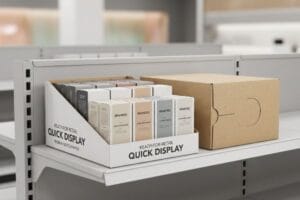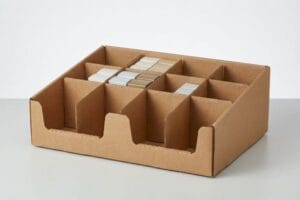
Entrar en una gran tienda puede resultar abrumador. Si tu producto no llama la atención de inmediato, pasa desapercibido. Dominar estas estrategias visuales clave es fundamental para tu éxito.
Los componentes clave del merchandising visual incluyen una distribución espacial estratégica, una aplicación de color precisa, una iluminación exacta y una gran durabilidad estructural. Estos elementos fundamentales trabajan en conjunto para guiar el flujo de clientes, destacar los productos de mayor margen y convertir a los compradores pasivos en compradores activos a nivel global, manteniendo la integridad de la marca y maximizando la eficiencia del espacio en la tienda.

Comprender la teoría visual es un excelente punto de partida, pero traducir esas ideas en unidades físicas, aptas para el envío y que resistan las condiciones de venta al público, requiere una ingeniería seria.
¿Cuáles son los elementos clave del merchandising visual?
Puedes tener los gráficos más bonitos del mundo, pero si están mal colocados, los compradores pasarán de largo sin siquiera mirarlos.
Los elementos clave del merchandising visual incluyen la colocación estratégica del producto, una planificación espacial inteligente, una señalización clara y un diseño estructural sólido. La correcta aplicación de estos factores esenciales garantiza que los escaparates capten la atención del consumidor, comuniquen eficazmente el valor de la marca y faciliten las decisiones de compra en entornos comerciales altamente exigentes y competitivos.
Traducir esa ubicación ideal a una unidad física de cartón corrugado es donde la mayoría de las campañas comienzan a flaquear.
Dominando la "zona de impacto" en el comercio minorista
La mayoría de los diseñadores principiantes abordan un expositor de suelo como si fuera un lienzo plano, distribuyendo uniformemente los elementos clave de la marca de arriba abajo. Dan por sentado que los compradores se detendrán de forma natural y examinarán todo el expositor como si fuera una valla publicitaria.
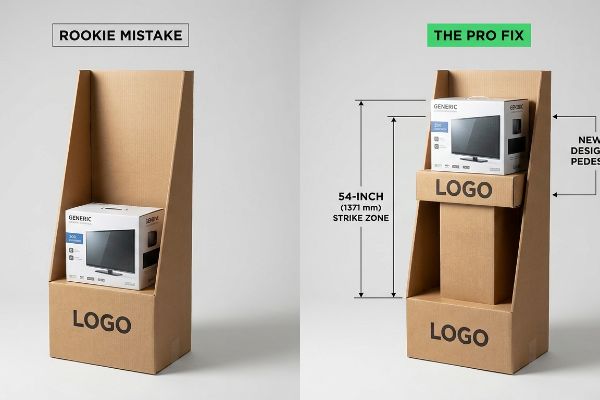
Veo este error constantemente: colocar la llamada a la acción principal demasiado abajo. Incluso los diseñadores veteranos suelen pasar por alto este punto ciego, priorizando el equilibrio estético en la pantalla sobre la ergonomía. En realidad, los compradores solo se centran en la "Zona de Impacto", que se sitúa estrictamente entre 1270 y 1371 mm (50 y 54 pulgadas) del suelo. Todo lo que queda fuera de este estrecho margen se convierte en ruido de fondo. En un lanzamiento reciente, vi a un equipo de merchandising sudar la gota gorda mientras intentaban apuntalar manualmente una base mal diseñada con cartón de desecho para elevar el mensaje principal. Se oía el crujido frustrante del cartón ondulado al doblarse bajo el peso desigual. Para solucionarlo, siempre diseño un fondo falso o un pedestal interno extendido para forzar matemáticamente que los SKU más rentables se ubiquen directamente en ese punto óptimo de 1371 mm (54 pulgadas) a la altura de los ojos, impulsando instantáneamente la interacción impulsiva sin aumentar el espacio total.
| Error común de principiante | La solución profesional | Beneficio para el punto de venta |
|---|---|---|
| Colocar los logotipos clave a la altura de la rodilla | Elevar los SKU a la zona de impacto de 54 pulgadas (1371 mm)2 | Aumenta los agarres impulsivos en un 30%3 |
| Diseño para lograr un equilibrio estético plano | Pedestales internos corrugados de ingeniería | Evita que los compradores se agachen |
| Ignorar los datos ergonómicos humanos | Utilización de mapas de calor de seguimiento ocular para la ubicación | Maximiza el impacto visual de 3 segundos4 |
Jamás permito que un cliente malgaste su presupuesto principal de marketing en gráficos que queden por debajo de la cintura. Colocar el producto estrella en la zona ergonómica óptima garantiza que la pantalla sea la que venda por ti.
🛠️ Oficina de Harvey: ¿Están tus productos de alto margen ocultos en la zona muerta del comercio minorista? 👉 Obtén una auditoría de estructura gratuita ↗ — Acceso directo a mi oficina. Sin spam de ventas automatizado, te lo prometo.
¿Cuáles son los cuatro elementos principales de la máquina virtual?
El color, la disposición, la iluminación y la narrativa conforman la base de cualquier presentación comercial. Pero plasmar los colores de la marca en cartón es donde los sueños digitales se topan con la dificultad física.
Los cuatro elementos principales del visual merchandising son la teoría del color, la configuración espacial, la iluminación estratégica y la narrativa temática. La integración de estos pilares fundamentales permite a las marcas crear entornos de venta inmersivos que dirigen eficazmente el flujo de clientes, realzan el valor percibido del producto y aumentan drásticamente las tasas de conversión en los altamente competitivos mercados globales.
Al pasar de una pantalla digital brillante a las fibras porosas del papel, esos colores vibrantes pueden convertirse rápidamente en una mezcla confusa y borrosa.
Dominando el CMYK (cian, magenta, amarillo, clave) en cartón ondulado
A los equipos de marketing les encanta enviar archivos de diseño gráfico complejos y con múltiples capas. Suelen dar por sentado que la impresión estándar reproducirá a la perfección los logotipos brillantes y nítidosque ven en sus monitores retroiluminados.
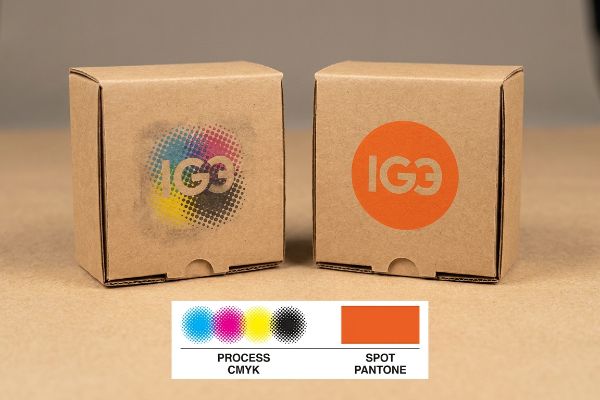
La realidad de imprimir en el testliner poroso 32ECT (Edge Crush Test) es brutal. Debido a que la impresión a cuatro colores se basa en puntos de semitono superpuestos microscópicos⁶,la tinta húmeda se absorbe de manera desigual en las fibras del papel⁷,lo que provoca una grave falla en la mezcla óptica. Una vez tuve un cliente cuyo logotipo naranja brillante se convirtió en un charco de barro granulado y descolorido bajo las intensas luces fluorescentes de un pasillo de una tienda. Cuando pasé los dedos por el cartón seco, se podía sentir literalmente la textura polvorienta y calcárea donde la tinta se había penetrado demasiado en el papel kraft virgen. Para evitar esto, aplico un estricto "Protocolo de Inundación de Color Directo" para toda la marca principal. Al reemplazar esos puntos superpuestos con una sola tinta Pantone perfectamente mezclada, garantizamos una inundación densa y sólida de pigmento que elimina por completo el granulado de los semitonos y asegura que su logotipo resalte desde veinte pies (6,09 m) de distancia, evitando una presentación de marca embarazosa.
| Error común de principiante | La solución profesional | Beneficio para el punto de venta |
|---|---|---|
| Uso de CMYK para los logotipos de la marca principal | Exigir el uso de colores planos Pantone para las inundaciones8 | Elimina la presentación granulada del logotipo |
| Confiar en los colores de la pantalla retroiluminada | Pruebas realizadas sobre cartón corrugado real9 | Garantiza la precisión del color bajo las luces de la tienda |
| Ignorando la absorción de tinta del papel | Ajuste de las curvas de ganancia de punto de preimpresión10 | Evita que los gráficos se vean borrosos y descoloridos |
Me niego a que una marca de prestigio parezca una imitación barata por un simple descuido en la preimpresión. Utilizar tintas planas específicas es la forma más sencilla de proteger el valor de tu marca en el punto de venta.
🛠️ Oficina de Harvey: ¿El logotipo vibrante de tu marca se ve sospechosamente apagado al imprimirlo en cartón? 👉 Solicita una revisión de combinación de colores ↗ — Descarga de forma segura. Mi bandeja de entrada está abierta si tienes alguna pregunta más adelante.
¿Cuáles son los 4 pilares del merchandising?
La distribución de la tienda, los precios de los productos, las ofertas promocionales y la presentación visual son fundamentales para el éxito. Pero la presentación fracasa al instante si el cliente no puede ver el producto.
Los cuatro pilares del merchandising abarcan la distribución estratégica de la tienda, precios competitivos, campañas promocionales específicas y una presentación visual impactante. En conjunto, estos conceptos fundamentales crean una experiencia de compra coherente que maximiza el aprovechamiento del espacio, impulsa las compras impulsivas y garantiza la consistencia de la marca en diversos entornos comerciales y de venta minorista.
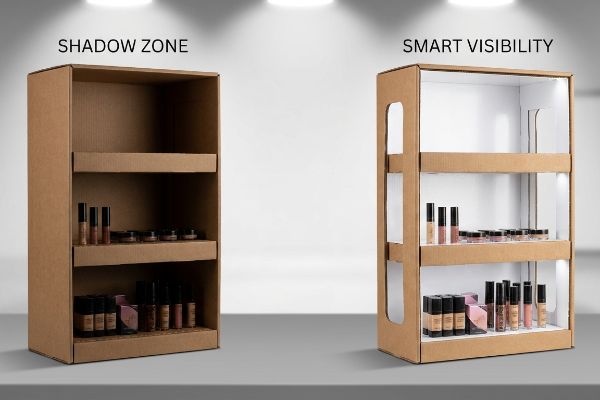
Incluso la mejor colocación del producto resulta inútil si el diseño estructural sume accidentalmente la mercancía en la oscuridad total.
Eliminando la "zona oscura" del comercio minorista
Las marcas suelen solicitar estanterías profundas y cerradas para maximizar el volumende productos que pueden exhibir en un solo expositor. Construyen estructuras robustas de cartón corrugado con paredes gruesas que lucen increíblemente resistentes en una representación CAD (Diseño Asistido por Computadora) en 3D.
El problema es que la iluminación estándar de las grandes superficies comerciales incide directamente desde arriba. Al construir estanterías profundas y de paredes sólidas, se crea una enorme "zona de sombras" en los niveles inferiores. He entrado en tiendas y he visto cosméticos completamente ocultos en la oscuridad, obligando a los clientes a entrecerrar los ojos y rebuscar como si estuvieran en una cueva. Se oye el sordo roce de las botellas de plástico contra las gruesas paredes laterales de cartón corrugado mientras los clientes sacan torpemente los artículos de entre las sombras. Mi solución es sencilla: diseño ventanas laterales troqueladas estratégicamente e instalo revestimientos interiores blancos de alto brillopara las estanterías. Esto canaliza físicamente la iluminación ambiental del pasillo directamente hacia los niveles inferiores, reflejándola hacia afuera y eliminando por completo la trampa de sombras sin sacrificar la integridad estructural.
| Error común de principiante | La solución profesional | Beneficio para el punto de venta |
|---|---|---|
| Diseño de estantes profundos y cerrados | Ventanas de iluminación lateral troqueladas de ingeniería13 | Ilumina los productos de menor categoría |
| Utilizando papel kraft marrón crudo en el interior | Actualización a forros interiores reflectantes blancos14 | Aumenta la visibilidad del producto de forma natural |
| Ignorar la iluminación superior de la tienda | Realización de pruebas de renderizado de luz 3D15 | Evita el "efecto de hundimiento" en los estantes |
Siempre les digo a mis clientes que si el cliente tiene que usar una linterna para leer el empaque, ya perdieron la venta. Los recortes estructurales inteligentes facilitan enormemente la visibilidad.
🛠️ Harvey's Desk: ¿Tus estantes inferiores ocultan tus mejores productos? 👉 Solicita tu evaluación de diseño ↗ — Sin formularios que generen interminables llamadas de ventas. Solo valor puro.
¿Cuáles son las 3 cosas más importantes en el visual merchandiser?
Captar la atención, mantener el interés e impulsar una decisión de compra inmediata. En un pasillo repleto de cuadrados y rectángulos idénticos, lograr estos tres objetivos requiere romper con los esquemas visuales.
Los tres aspectos más importantes en la ejecución del visual merchandising son la disrupción visual inmediata, la funcionalidad estructural impecable y la estricta coherencia de la marca. Priorizar estos elementos clave garantiza que las exhibiciones personalizadas interrumpan el comportamiento automático del comprador, resistan entornos comerciales agresivos y comuniquen claramente los beneficios principales del producto en los cruciales instantes de compra.
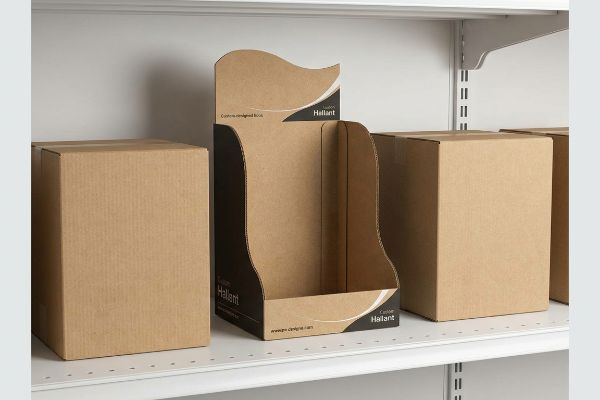
Para destacar se necesita algo más que colores brillantes; se requiere una forma física que altere activamente el campo visual predecible del comprador.
El poder de la disrupción visual estructural
La mayoría de los compradores de la cadena de suministro se inclinan naturalmente por los expositores rectangulares estándar de ángulo recto porque son las formas más fáciles y económicas de empacar en un palé16.Dan por sentado que el diseño impreso hará todo el trabajo pesado para atraer la atención.
La psicología humana no funciona así. Los compradores están tan condicionados a ignorar los pasillos cuadrados17 que los expositores cuadrados estándar se vuelven completamente invisibles para ellos. Es una trampa común que atrapa incluso a equipos de compras experimentados. Una vez vi cómo un contenedor cuadrado fue completamente ignorado durante días, mientras que la unidad de forma dinámica de un competidor se agotó. Cuando cambiamos físicamente el encabezado a una curva fluida troquelada, pude sentir literalmente el borde afilado y nítido de la nueva regla de acero cortando el tablero en la planta de producción. Esa simple adición de geometría curva y no lineal rompió la monotonía visual del pasillo. Al diseñar encabezados troquelados personalizados y paneles laterales contorneados, captamos la atención del comprador en una fracción de segundo, aumentando drásticamente el poder de atracción del expositor18 mientras mantenemos la huella de envío interna perfectamente cuadrada.
| Error común de principiante | La solución profesional | Beneficio para el punto de venta |
|---|---|---|
| Basándose únicamente en cajas cuadradas estándar | Integración de tarjetas de cabecera troqueladas curvas19 | Rompe el piloto automático visual del comprador |
| Suponiendo que los gráficos equivalen a una interrupción | Utilizando formas estructurales físicas asimétricas20 | Aumenta la capacidad de frenado en el pasillo |
| Miedo a las complejas huellas de envío | Manteniendo las bases cuadradas pero las partes superiores contorneadas21 | Equilibra la logística con un alto impacto |
Jamás permito que una marca se conforme con una caja aburrida solo para ahorrar unos céntimos en el troquelado. Una silueta estructural única se amortiza con creces gracias al aumento de la interacción impulsiva.
🛠️ El escritorio de Harvey: ¿Tu expositor se pierde entre la multitud de aburridas cajas rectangulares? 👉 Obtén tu revisión estructural ↗ — Acceso directo a mi escritorio. Sin spam de ventas automatizado, lo prometo.
¿Cuáles son los 4 elementos principales del merchandising visual que atraen y fidelizan a los clientes?
La atracción logra que se detengan, pero la retención requiere una pantalla que no se desmorone al tocarla. La durabilidad es el factor clave para generar confianza en el cliente.
Los cuatro elementos clave del merchandising visual que atraen y fidelizan clientes son las formas estructurales dinámicas, la accesibilidad intuitiva del producto, la durabilidad física impecable y la claridad en los mensajes de valor. Dominar estos factores garantiza que los expositores capten el interés inicial y resistan un uso intensivo durante todo el ciclo de vida de la campaña promocional.
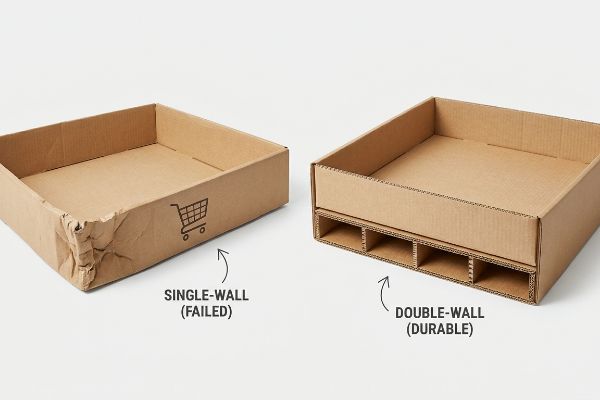
Puedes tener el mejor mensaje del mundo, pero si tu producto se ve aplastado y derrotado, los clientes instintivamente lo evitarán.
Ingeniería para la "Regla de los 50 toques"
Los responsables de marca suelen aprobar las especificaciones de materiales ligeros basándose únicamente en el peso estáticode sus productos. Si las botellas pesan 9,07 kg (20 libras), encargan un expositor diseñado para soportar exactamente ese peso, sin tener en cuenta la interacción humana.
Los compradores son increíblemente agresivos con los expositores. Se apoyan en ellos, los golpean con carritos de compra metálicos y tiran bruscamente de los productos de los estantes inferiores. Yo lo llamo la "Regla de los 50 toques": si tu expositor no resiste cincuenta interacciones bruscas, parecerá basura a la segunda semana. Recuerdo haber probado una base estándar de una sola pared; en el momento en que empujé un carrito pesado contra ella, el papel blando y endeble cedió con un arrugado desagradable, comprometiendo instantáneamente toda la estructura. Para evitar esto, exijo un corrugado de doble pared para cualquier unidad de suelo colocada en una intersección de mucho tránsito. Al mejorar la calidad del cartón, el expositor mantiene su estructura impecable y rígida durante todo el período promocional, protegiendo la imagen de tu marca para que no parezca barata y descuidada.
| Error común de principiante | La solución profesional | Beneficio para el punto de venta |
|---|---|---|
| Uso de tableros de pared simple para bases de pisos | Actualización a bases corrugadas de doble pared | Sobrevive a los golpes agresivos de los carritos de la compra |
| Ingeniería estrictamente para el peso estático del producto | Diseño para la interacción humana dinámica | Evita fallos estructurales a mitad de campaña |
| Ignorar la fatiga estructural de nivel inferior | Agregar refuerzos internos al divisor en H | Mantiene un valor de marca impecable |
Siempre sobredimensiono la parte inferior de cualquier mueble de suelo (304,8 mm). Un expositor alto y rígido le indica al cliente que su producto es de alta calidad incluso antes de que lea la etiqueta.
🛠️ Oficina de Harvey: ¿Te preocupa que tu próxima exhibición de productos no resista un fin de semana ajetreado en Walmart? 👉 Solicita una prueba de durabilidad ↗ — Descarga de forma segura. Mi bandeja de entrada está abierta si tienes alguna pregunta más adelante.
¿Cuáles son las 5 R del merchandising?
La mercancía adecuada, en el lugar adecuado, en el momento adecuado, en las cantidades adecuadas y al precio adecuado. Suena perfecto en una sala de juntas.
Las cinco R del merchandising dictan que se debe entregar la mercancía correcta, en el lugar correcto, en el momento correcto, en las cantidades correctas y al precio correcto. Cumplir con estos principios rigurosos optimiza la logística de la cadena de suministro, minimiza el exceso de inventario y maximiza la rotación de productos en sectores minoristas competitivos.
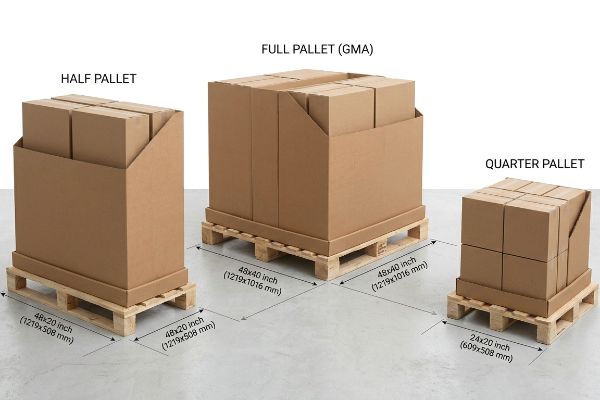
Pero conocer la teoría no es suficiente cuando las máquinas empiezan a funcionar y las directrices de cumplimiento de los minoristas llegan a tu escritorio.
¿Por qué fallan los planos de planta estándar de la GMA (Asociación de Fabricantes de Alimentos)?
Los equipos de compras suelen presentar a las grandes superficies expositoras de suelo de gran tamaño (1219,2 × 1016 mm) a los minoristas de grandes superficies, partiendo de la base de que una mayor superficie se traduce automáticamente en una mejor visibilidad y un mayor volumen de ventas. Diseñan estas enormes unidades convencidos de que el minorista cederá con gusto un espacio privilegiado.
En mis instalaciones, veo con frecuencia cómo estas estructuras enormes son rechazadas directamente por las principales tiendas de clubes . incluso antes de que lleguen a la zona de pruebas. Los minoristas racionan estrictamente el espacio de sus pasillos, y pedir un palé completo es una apuesta arriesgada. Cuando mido el radio de giro y las holguras de la huella para las aprobaciones de las tiendas, los palés completos a menudo infringen los límites de flujo de pasillos de la ADA (Ley para Estadounidenses con Discapacidades)24, lo que causa mucha fricción a los gerentes de las tiendas. En lugar de esperar un milagro, aplico un protocolo de geometría estricto de "Palé Fraccionado". Subdivido matemáticamente las unidades en Medios Palés (48 × 20 pulgadas / 1219,2 × 508 mm) o Cuartos de Palés (24 × 20 pulgadas / 609,6 × 508 mm). Cuando encajo las pestañas troqueladas de estas huellas más pequeñas, la rigidez compacta y densa se siente increíblemente sólida. Esta reducción precisa del espacio ocupado mejora drásticamente las tasas de aceptación por parte de los minoristas, lo que permite a los compradores asegurarse ubicaciones privilegiadas para la venta cruzada en intersecciones de mucho tránsito sin tener que luchar por un espacio imposible.
| Error común de principiante | La solución profesional | Beneficio para el punto de venta |
|---|---|---|
| de lanzamiento completas de 48×40 pulgadas (1219,2×1016 mm)25 | Diseño de bases para medio o cuarto de palé | Incrementa drásticamente los índices de aprobación de las tiendas26 |
| Ignorar las restricciones de espacio en los pasillos rígidos | Logística fraccionaria que coincide matemáticamente | Permite la comercialización cruzada en espacios reducidos |
| Sobreproducción de enormes cantidades de inventario | Reducción a la escala para lograr la cantidad precisa de huella | Reduce los costosos gastos de almacenamiento en almacenes27 |
Jamás permito que mis clientes apuesten toda su campaña a ganar un espacio completo en un palé. Al diseñar espacios reducidos desde el primer día, garantizo que sus expositores salgan del almacén y lleguen a la tienda.
🛠️ Oficina de Harvey: ¿Rechazan tus expositores porque ocupan demasiado espacio en la tienda? 👉 Envíame tu archivo de troquelado ↗ — Analizaré los cálculos antes de que malgastes tu presupuesto en producción en masa.
Conclusión
Puedes optar por un proveedor más económico, pero si tu enorme y desequilibrada presentación de palés completos es rechazada rotundamente por los gerentes de tienda, tu campaña se detendrá de inmediato y tendrás que invertir semanas en costosos procesos de reempaquetado manual. Más de 500 gerentes de marca utilizan mi lista de verificación de preimpresión para evitar precisamente estos errores fatales iniciales. Deja de adivinar si tus exhibidores cumplen con los requisitos de espacio de los minoristas y permíteme revisar personalmente tus archivos estructurales con mi Auditoría Gratuita de Troqueles ↗ para asegurar que tus exhibidores sean aprobados a la primera.
"Diseño de locales comerciales para exhibiciones efectivas y flujo de clientes", https://www.business.qld.gov.au/industries/manufacturing-retail/retail-wholesale/retail-displays. [Los estándares de la industria para la comercialización minorista y la ergonomía humana definen el rango óptimo de visibilidad a la altura de los ojos para los compradores adultos para garantizar la máxima interacción con el producto]. Función de la evidencia: especificación técnica; tipo de fuente: guía profesional de diseño minorista. Apoya: el rango de altura específico de la Zona de Impacto. Nota de alcance: las dimensiones pueden variar según los datos antropométricos globales. ↩
"Capítulo 2: Cómo elegir la altura de exhibición para sus clientes", https://www.creativedisplaysnow.com/guides/understanding-the-retail-customer/chapter-2-how-to-choose-the-right-display-height-for-your-customers/. Un estándar de la industria para la ergonomía minorista o las pautas de exhibición en el punto de venta verificarían esta altura específica como la "zona de impacto" óptima para la visibilidad. Función de evidencia: especificación técnica; tipo de fuente: manual de la industria. Apoya: altura óptima de colocación del producto. Nota de alcance: El estándar puede variar según la altura del grupo demográfico objetivo. ↩
"Un metaanálisis de la compra impulsiva en línea y la moderación…", https://pmc.ncbi.nlm.nih.gov/articles/PMC8355873/. Los estudios de análisis minorista o de optimización de la tasa de conversión proporcionan datos empíricos sobre cómo posicionar los productos a la altura de los ojos aumenta la adquisición impulsiva. Función de la evidencia: métrica estadística; tipo de fuente: informe de investigación de mercado. Apoya: beneficio de la elevación de la zona de impacto. Nota de alcance: Los resultados pueden variar según la categoría del producto. ↩
"Evaluación de la atención y la excitación del consumidor mediante el seguimiento ocular...", https://pmc.ncbi.nlm.nih.gov/articles/PMC8380820/. La investigación en neuromarketing que utiliza la tecnología de seguimiento ocular define el período crítico de tiempo que un comprador dedica a evaluar una exhibición antes de pasar a la siguiente. Rol de la evidencia: métrica conductual; tipo de fuente: estudio revisado por pares. Apoya: la eficacia de la colocación del seguimiento ocular. Nota de alcance: se centra en entornos minoristas de alto tráfico. ↩
"CMYK vs. RGB: Cómo elegir el modo de color adecuado – Wooter Apparel", https://wooter.com/articles/cmyk-vs-rgb-choosing-the-right-color-mode/. [Guías autorizadas sobre ciencia del color explican la disparidad entre el modelo de color aditivo RGB de los monitores y el modelo sustractivo CMYK de la impresión]. Función de la evidencia: contraste técnico; tipo de fuente: estándar de la industria. Apoya: la dificultad inherente de replicar colores digitales en la impresión. Nota de alcance: se aplica a la impresión estándar a cuatro colores]. ↩
"Medio tono – Wikipedia", https://en.wikipedia.org/wiki/Halftone. [Una fuente autorizada sobre tecnología de impresión explica que la impresión a cuatro colores simula un espectro de colores superponiendo pequeños puntos de cian, magenta, amarillo y negro.] Función de la evidencia: verificación de hechos; tipo de fuente: libro de texto de impresión. Apoya: la base técnica de la impresión a cuatro colores. Nota de alcance: aplicación general. ↩
"Interacciones de la tinta flexográfica con el recubrimiento: efectos de la estructura porosa…", https://www.academia.edu/14380471/Flexographic_ink_coating_interactions_Effects_of_porous_structure_variations_of_coated_paperboard. [Las guías técnicas sobre la porosidad del sustrato describen cómo la naturaleza absorbente del testliner sin recubrimiento provoca una distribución desigual de la tinta y una ganancia de punto irregular, lo que afecta la precisión del color.] Función de la evidencia: explicación técnica; tipo de fuente: documento técnico de la industria. Apoya: la causa del fallo de mezcla óptica en cartón poroso. Nota de alcance: específico para sustratos sin recubrimiento/porosos. ↩
"PMS vs CMYK para embalaje: ¿Cuál es mejor? – PAX Solutions", https://pax.solutions/corrugated-packaging/pms-vs-cmyk-for-packaging/. Las directrices técnicas de impresión explican cómo los colores directos proporcionan una cobertura de tinta sólida y uniforme en comparación con los patrones de puntos de semitono producidos por CMYK. Función de evidencia: especificación técnica; tipo de fuente: guía de la industria de la impresión. Apoya: eliminar la presentación granulada del logotipo. Nota de alcance: se aplica específicamente a los elementos de identidad de marca. ↩
"Maximice el rendimiento con los servicios de prueba de empaques | Abbott Action", https://www.abbottaction.com/blog/maximize-performance-with-package-testing-services/. Los estándares de empaque enfatizan que el color base y la porosidad del sustrato alteran significativamente la apariencia de la tinta, lo que requiere pruebas físicas en lugar de simulaciones digitales. Función de evidencia: estándar de control de calidad; tipo de fuente: manual de la industria del empaque. Soporte: precisión del color bajo luces de tienda. Nota de alcance: se centra en materiales corrugados absorbentes. ↩
"Modelado matemático y estrategias de compensación para la impresión de puntos…", https://pmc.ncbi.nlm.nih.gov/articles/PMC12574880/. Los manuales de física de la impresión describen la ganancia de punto como la expansión de las gotas de tinta en superficies porosas, que debe compensarse en la preimpresión para evitar el desenfoque de la imagen. Función de la evidencia: proceso técnico; tipo de fuente: guía técnica de preimpresión. Apoyos: prevención de gráficos borrosos y descoloridos. Nota de alcance: varía según el tipo de cartón y la viscosidad de la tinta. ↩
"MAXIMIZANDO EL ESPACIO DE SUS ESTANTERÍAS – QPSI", https://qpsiusa.com/2019/12/26/maximizing-your-retail-shelf-space/. [Los estándares de la industria para el diseño de exhibidores minoristas suelen describir la relación entre la densidad del producto y la visibilidad en el estante]. Función de la evidencia: práctica de la industria; tipo de fuente: guía de gestión minorista. Apoya: la afirmación de que las marcas priorizan el volumen en las solicitudes de espacio en estanterías. Nota de alcance: aplicable principalmente a exhibidores temporales en el punto de venta. ↩
"Soluciones para el comercio minorista – Soluciones de iluminación LED – SloanLED", https://sloanled.com/solutions/retail/. [Las guías técnicas sobre el diseño de expositores para puntos de venta (POP) explican cómo los revestimientos interiores reflectantes y los recortes estratégicos aumentan la penetración de la luz en estanterías profundas]. Función de la evidencia: verificación técnica; tipo de fuente: guía de especificaciones de diseño; Soportes: método de distribución de la luz; Nota de alcance: la eficacia depende de la intensidad de la iluminación ambiental superior. ↩
"7 tipos de escaparates: ideas creativas para diseñadores de tiendas", https://unibox.co.uk/blog/7-types-of-window-display. [Una fuente autorizada sobre diseño de iluminación para comercios explicaría cómo la iluminación lateral de los escaparates reduce las sombras en los estantes inferiores]. Función de la evidencia: Validación técnica; tipo de fuente: Manual de diseño de iluminación. Apoyos: Eficacia de la iluminación lateral. Nota de alcance: Específico para estanterías cerradas. ↩
"Revestimientos utilitarios: Revestimientos resistentes para estantes de garaje", https://www.acehardware.com/departments/storage-and-organization/shelf-liners/utility-liners. [Fuentes de física óptica o guías de comercialización minorista confirmarían que las superficies blancas aumentan la reflectancia de la luz y la visibilidad]. Función de la evidencia: Validación científica; tipo de fuente: Libro de texto de iluminación o ciencia de los materiales. Apoyos: Beneficio de los revestimientos blancos. Nota de alcance: Aplicación general a interiores de estantes. ↩
"El mejor software de renderizado 3D para ebanistas y carpinteros", https://www.youtube.com/watch?v=cRlLacbS11w. [Los estándares de la industria para el diseño de tiendas detallarían el uso de simulaciones 3D para identificar y eliminar zonas oscuras o el "efecto cueva"]. Función de la evidencia: Validación de procesos; tipo de fuente: Documento técnico sobre planificación de tiendas. Apoya: Uso de software de simulación. Nota de alcance: Aplicación arquitectónica profesional. ↩
"Optimización de palés 101: Cómo la selección de cajas influye en los costes de envío", https://presidentcontainergroup.com/pallet-optimization-101-how-box-selection-impacts-shipping-costs/. [Los estándares de logística y cadena de suministro confirman que las geometrías rectangulares maximizan la utilización cúbica y minimizan el espacio vacío, reduciendo directamente los costes de envío]. Función de la evidencia: validación técnica; tipo de fuente: estándar de la industria. Apoya: la rentabilidad de las exhibiciones rectangulares en logística. Nota de alcance: centrado en las métricas de paletización. ↩
"Guía sobre la ceguera a los banners en marketing", https://www.leadalchemists.com/marketing-psychology/cognitive-biases-marketing/banner-blindness/. [Investigaciones en psicología del comercio minorista y carga cognitiva explican cómo los consumidores filtran los estímulos ambientales repetitivos, un fenómeno similar a la ceguera a los banners, para evitar la sobrecarga sensorial]. Función de la evidencia: apoyo; tipo de fuente: estudio académico; Apoya: la afirmación de que las exhibiciones lineales estándar se vuelven invisibles para los compradores; Nota de alcance: se aplica específicamente a pasillos de alta densidad en tiendas minoristas. ↩
«¿Curvas o ángulos? Las formas en los negocios afectan la respuesta del cliente», https://www.sciencedaily.com/releases/2018/05/180501130737.htm. [Estudios de neuromarketing indican que las formas curvas y no lineales aumentan la prominencia visual y provocan respuestas de atención más fuertes en comparación con los ángulos agudos o los rectángulos]. Rol de la evidencia: apoyo; tipo de fuente: estudio psicológico; Apoya: la afirmación de que la geometría troquelada personalizada mejora las tasas de parada del comprador; Nota de alcance: se centró en el procesamiento visual y la prominencia. ↩
"El impacto de los elementos visuales del diseño de envases en la compra…", https://pmc.ncbi.nlm.nih.gov/articles/PMC11851823/. [Investigaciones de la industria sobre merchandising visual demuestran que romper los patrones lineales con elementos curvos interrumpe la habituación del consumidor y aumenta la atención]. Función de la evidencia: validación técnica; tipo de fuente: estudio de la industria. Apoya: el uso de curvas para romper el piloto automático visual. Nota de alcance: específico para exhibidores en el punto de venta (POP). ↩
"7 estilos de exhibición minorista en los que confían las empresas", https://www.packagingcorp.com/resource-hub/industry-insights/7-retail-display-styles-companies-rely-on/. [La investigación en psicología del consumidor indica que la asimetría crea tensión visual, lo que aumenta la probabilidad de que un comprador se detenga en un pasillo de una tienda]. Función de la evidencia: prueba conductual; tipo de fuente: investigación académica. Apoya: la afirmación de que las formas asimétricas aumentan el poder de atracción. Nota de alcance: La efectividad puede variar según el entorno minorista circundante. ↩
"Planificación de embalaje y logística para expositores minoristas", https://www.frankmayer.com/blog/packaging-and-logistics-planning-for-retail-displays/. [Los estándares de ingeniería de embalaje muestran que las bases cuadradas optimizan la utilización de palés y la densidad de envío, al tiempo que permiten variedad estética por encima de la base]. Función de la evidencia: verificación operativa; tipo de fuente: manual de logística. Apoya: el equilibrio entre logística y alto impacto visual. Nota de alcance: Limitado a la eficiencia de envío y transporte. ↩
"Carga estática vs. carga dinámica: las sorprendentes fuerzas en…", https://www.qmhinc.com/static-loading-vs-dynamic-loading-the-surprising-forces-in-warehouses/?srsltid=AfmBOoo1q2IMUx1-Rb8dhrdhsubW10djsQxyCyox-rD9bCCJZfjiiYJY. [Las directrices de ingeniería estructural para pantallas comerciales especifican que se deben agregar factores de carga dinámica al peso estático para tener en cuenta la interacción y el movimiento humanos]. Función de la evidencia: validación técnica; tipo de fuente: norma de ingeniería. Apoya: la afirmación de que confiar en el peso estático es una práctica de ingeniería insuficiente. Nota de alcance: se aplica a pantallas de punto de venta. ↩
"Palets GMA de 48" x 40" | El mayor fabricante y proveedor de palets", https://www.meridianpkg.com/feeds/category/gma-pallets. [Una guía estándar de la industria o un manual de logística confirma que 48 × 40 pulgadas es la dimensión estándar para los palets GMA y los expositores de punto de venta asociados]. Función de la evidencia: verificación; tipo de fuente: estándar de la industria; apoya: especificaciones técnicas de unidades de comercialización estándar. Nota de alcance: aplicable principalmente a los estándares minoristas norteamericanos. ↩
"Dimensiones de los pasillos de los supermercados: ¿Qué tan anchos deben ser sus pasillos?", https://wzrack.com/grocery-store-aisle-dimensions-how-wide-should-your-aisles-be/. [Una fuente autorizada sobre las normas ADA para el diseño accesible define el ancho libre mínimo requerido para los pasillos en entornos minoristas para garantizar la accesibilidad]. Función de la evidencia: verificación técnica; tipo de fuente: código reglamentario. Apoya: la afirmación de que las paletas llenas pueden impedir el cumplimiento de la ADA. Nota de alcance: Los requisitos pueden variar según el diseño específico de la tienda y las regulaciones locales. ↩
"Palet GMA de madera tratada térmicamente – 48 x 40" H-1260 – ULINE", https://www.uline.com/Product/Detail/H-1260/Pallets/Heat-Treated-Wood-GMA-Pallet-48-x-40. [Los estándares logísticos de la industria verifican que 48 × 40 pulgadas es la dimensión estándar para los palets de la Grocery Manufacturers Association (GMA)]. Función de evidencia: Especificación técnica; tipo de fuente: Estándar de la industria. Apoya: Dimensionamiento estándar de palets. Nota de alcance: Específico para la logística minorista de América del Norte. ↩
"Expositores de palets – Innercia", https://innercia.us/marketing-display-pta/pallet-displays/. [Las guías de merchandising minorista o los estudios de caso demuestran que ofrecer opciones de distribución más pequeñas y flexibles aumenta la probabilidad de aceptación por parte del gerente de la tienda]. Función de la evidencia: Métrica de rendimiento; tipo de fuente: Análisis de la industria minorista. Apoya: Beneficio de las bases de palets más pequeñas. Nota de alcance: La efectividad puede variar según el tamaño del minorista. ↩
"Cómo reducir los costos de almacenamiento: 10 estrategias comprobadas", https://eplogistics.com/blog/hidden-warehouse-cost/. [La literatura sobre gestión de la cadena de suministro indica que optimizar el volumen y la superficie de inventario reduce directamente los gastos generales y de almacenamiento]. Función de la evidencia: Impacto económico; tipo de fuente: Libro de texto sobre gestión de la cadena de suministro. Apoya: Beneficio de costos de superficies escaladas. Nota de alcance: Se aplica principalmente a centros de distribución de alto volumen o de logística de terceros (3PL). ↩