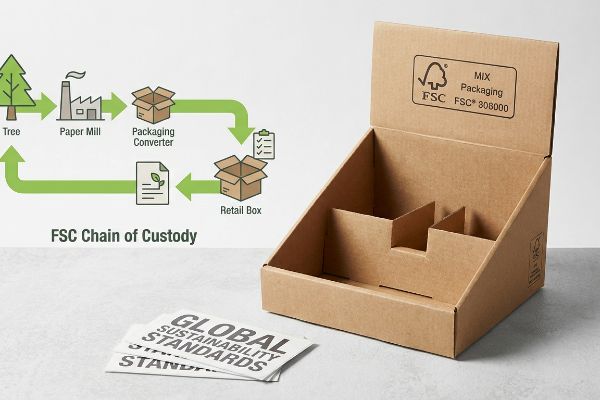
Deja de adivinar si tus expositores cumplen con las principales normativas de sostenibilidad. Un embalaje ecológico auténtico te garantiza superar las estrictas auditorías de compras y proteger tus ajustados márgenes de beneficio.
Las certificaciones clave del FSC (Forest Stewardship Council) garantizan que el cartón ondulado proviene de bosques gestionados de forma responsable. Obtener estas credenciales asegura que su embalaje para la venta al por menor cumpla con los estándares globales de sostenibilidad, evitando devoluciones de cargo por parte de los minoristas y atrayendo a consumidores con conciencia ecológica en las principales cadenas de suministro internacionales.
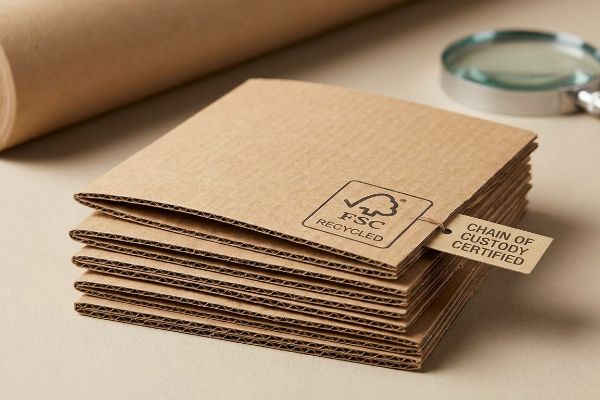
Pero superar la auditoría de sostenibilidad de un minorista requiere algo más que simplemente estampar un logotipo de una hoja verde en el troquelado.
¿Qué es la certificación de cadena de custodia FSC?
¿Te preguntas cómo demostrar que tu cartón proviene realmente de fuentes sostenibles?
La certificación FSC de cadena de custodia rastrea las materias primas sostenibles desde el bosque hasta el producto final. Mantener este estricto registro documental verifica que sus expositores de cartón ondulado utilizan componentes respetuosos con el medio ambiente, garantizando el cumplimiento normativo y evitando caer en prácticas engañosas de ecoblanqueo.
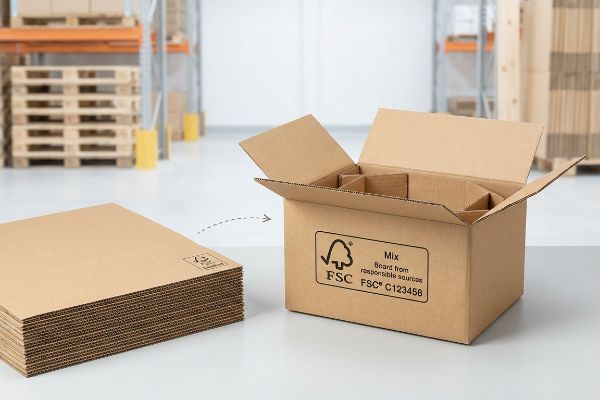
Saber de dónde proviene el papel es fundamental, pero mantener esa trazabilidad intacta durante la fabricación es donde las cosas se complican.
Seguimiento del estándar de abastecimiento en la planta de producción
Muchos gerentes de marca asumen que solicitar cartón "ecológico" es suficiente para cumplir con los requisitos de los minoristas modernos. Se basan en confirmaciones verbales de los intermediarios, omitiendo por completo la documentación necesaria para superar una auditoría de sostenibilidad estricta1.
En mi empresa, es frecuente ver cómo los clientes entran en pánico cuando un gran comprador exige pruebas de su cumplimiento con la Iniciativa de Silvicultura Sostenible (SFI). Incluso los equipos de compras más experimentados suelen pasar por alto este punto ciego, dando por sentado que la fábrica se encargará automáticamente del papeleo. Recuerdo a un cliente que envió un lote enorme de tapas de góndola, solo para descubrir que su intermediario había utilizado cartón no rastreable; el característico raspado seco del cartón de baja calidad al deslizarse del palé fue la primera señal de problemas. Al aplicar nuestro estricto estándar de abastecimiento de cartón corrugado 100% reciclable, garantizo que toda la cadena de suministro esté controlada. Esto garantiza que el material sea totalmente rastreable, eliminando el riesgo de un rechazo masivo en el muelle de recepción del minorista.
| Error común de principiante | La solución profesional | Beneficio para el punto de venta |
|---|---|---|
| Confiar en las afirmaciones verdes verbales | Aplicación del seguimiento documentado | Supera las auditorías de cumplimiento de los minoristas2 |
| Perder la documentación de origen | Utilización de registros de origen centralizados | Evita costosos retrasos en la cadena de suministro |
| Mezcla de placas certificadas y desconocidas | Estricta segregación de materias primas3 | Garantiza una sostenibilidad 100% auténtica |
Jamás dejo el cumplimiento de las normas medioambientales al azar ni a promesas verbales. Al documentar rigurosamente cada palé de cartón ondulado que llega a nuestras instalaciones, protejo el valor de su marca y garantizo que su lanzamiento en el mercado minorista se desarrolle sin problemas regulatorios.
🛠️ Oficina de Harvey: ¿No está seguro de si su embalaje actual cumple con las normas de sostenibilidad de las grandes superficies? 👉 Solicite una auditoría de materiales ↗ — Acceso directo a mi oficina. Le prometo que no recibirá correo basura automatizado.
¿Qué son las certificaciones FSC?
¿Te confunden las diferentes insignias medioambientales que ofrece tu impresora?
Las certificaciones FSC son credenciales ambientales globales que verifican que los productos de papel provienen de fuentes sostenibles. Estas clasificaciones estándar incluyen fibras vírgenes, mezclas recicladas o materiales totalmente reciclados, lo que permite a las marcas alinear las especificaciones de sus envases con los sistemas de puntuación de sostenibilidad de los minoristas.
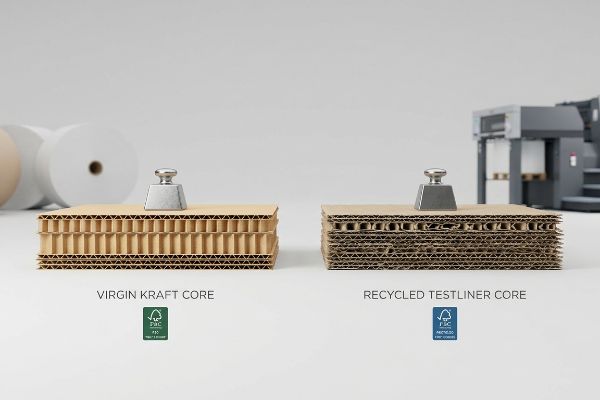
Si bien las clasificaciones parecen sencillas en un PDF (Formato de Documento Portátil), elegir la incorrecta altera drásticamente el comportamiento de la pantalla bajo tensión física.
Realidades del papel Kraft virgen frente al papel Testliner reciclado
Los diseñadores suelen elegir cartón 100% reciclado para maximizar sus afirmaciones de marketing ambiental. Parten de la base de que el papel reciclado se comportará exactamente igual que el material virgenal soportar 68 kg (150 libras) de productos de consumo.
Cuando se utiliza exclusivamente cartón reciclado para las estructuras portantes, se emplean fibras de papel que han sido repulpadas y acortadas físicamente⁵ . He observado cómo los expositores de suelo construidos con cartón excesivamente reciclado se deforman visiblemente bajo alta humedad; se puede sentir la textura suave y esponjosa de las ondulaciones desgastadas cediendo bajo el peso. Para solucionar esto, diseño una mezcla estratégica, utilizando papel Kraft virgen certificado para el núcleo estructural, con el fin de mantener los estrictos límites de 32 ECT (Edge Crush Test) ⁶ . Este enfoque híbrido mejora drásticamente la resistencia a la compresión, evitando el colapso del nivel inferior y manteniendo el expositor dentro de las directrices medioambientales del minorista.
| Error común de principiante | La solución profesional | Beneficio para el punto de venta |
|---|---|---|
| Exigir el uso de material 100% reciclado para cargas pesadas | Mezcla de kraft virgen con reciclado7 | Evita el aplastamiento de la capa inferior |
| Ignorar el agotamiento de la fibra8 | Utilizar revestimientos nuevos certificados | Maximiza la rigidez de la pantalla a largo plazo |
| Sacrificar la resistencia por las etiquetas ecológicas | Ingeniería de estructuras de materiales híbridos | Sobrevive a las condiciones de humedad de un almacén9 |
Me niego a que la sostenibilidad comprometa la física estructural. El equilibrio entre fibras vírgenes certificadas y componentes reciclados garantiza que su expositor soporte el peso sin sacrificar sus credenciales medioambientales.
🛠️ Harvey's Desk: ¿Estás sacrificando la resistencia estructural crítica solo para cumplir con una cuota de material reciclado? 👉 Obtén una revisión estructural ↗ — Descarga de forma segura. Mi bandeja de entrada está abierta si tienes preguntas más adelante.
¿Qué es una certificación de cadena de custodia?
¿Cómo garantizan que su embalaje siga siendo sostenible una vez que sale del bosque?
La certificación de cadena de custodia es un sistema de seguimiento verificado que garantiza que los materiales sostenibles nunca se contaminen con componentes no autorizados. Mantener este registro ininterrumpido garantiza que cada etapa de la fabricación, desde la molienda de la materia prima hasta el empaquetado final, cumpla estrictamente con los protocolos ambientales documentados.
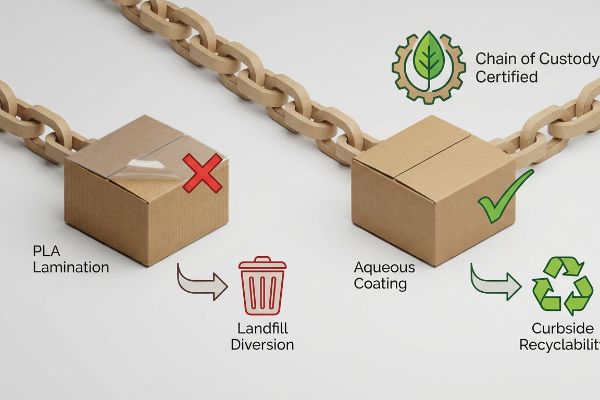
Puede que la documentación de seguimiento sea impecable, pero una sola mala decisión durante el proceso de finalización puede destruir instantáneamente toda la certificación.
La trampa del compostaje en las cadenas de suministro sostenibles
Los equipos de marketing suelen exigir laminaciones de bioplástico PLA (ácido poliláctico)10, asumiendo que esta película a base de maíz garantiza el cumplimiento ecológico total para sus exhibidores en tiendas. Creen que están extendiendo perfectamente la cadena de custodia sostenible sin comprender la realidad química de la eliminación al final de su vida útil11.
Imagínelo como echar diésel a un coche eléctrico; está tomando un sistema limpio y corrompiéndolo al instante. Constantemente veo marcas que arruinan accidentalmente la capacidad de repulpado de sus OCC (envases de cartón ondulado usados) totalmente certificados porque esa película de PLA forma una capa sólida e hidrófuga12.Cuando los centros de reciclaje municipales estándar interceptan este bioplástico durante la clasificación, el crujido áspero del plástico les alerta y la unidad completa se desvía directamente a un vertedero13.Aplico estrictamente un protocolo de recubrimiento acuoso líquido sobre películas sólidas, asegurando que el acabado se disuelva sin problemas y que el papel certificado subyacente siga siendo 100% reciclable en la acera.
| Error común de principiante | La solución profesional | Beneficio para el punto de venta |
|---|---|---|
| Especificación de laminaciones de PLA sólido | Utilizando recubrimientos acuosos líquidos | Garantiza una capacidad de reciclaje en la acera del 100%14 |
| Mezclar bioplásticos con papel | Hacer cumplir un mandato monomaterial15 | Evita multas de sostenibilidad para los minoristas |
| Arruinando la reciclabilidad del OCC16 | Especificación de acabados a base de agua | Simplifica la eliminación al final de su vida útil |
Siempre protejo la integridad de la fibra de papel subyacente. Al eliminar las películas plásticas incompatibles, garantizo que su material certificado pase por el sistema de reciclaje municipal en lugar de terminar en un vertedero.
🛠️ Harvey's Desk: ¿Has comprobado si el acabado brillante de tu expositor está perjudicando tus afirmaciones sobre la reciclabilidad? 👉 Solicita tu análisis de recubrimiento ↗ — Sin formularios que generen interminables llamadas de ventas. Solo valor puro.
¿Qué es la etiqueta FSC?
¿Listo para imprimir ese logotipo verde en tu archivo de diseño?
La etiqueta FSC es una marca impresa que indica que el material de embalaje cumple con estrictos estándares de abastecimiento ambiental. Mostrar este símbolo reconocido mundialmente proporciona a los consumidores una prueba visual inmediata de sostenibilidad, diferenciando su producto y cumpliendo con los requisitos de cumplimiento ecológico de la empresa.
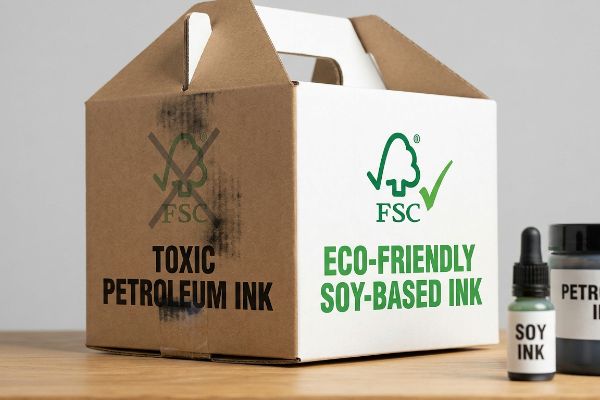
Pero simplemente colocar el logotipo sobre la línea de troquelado es una suposición peligrosa cuando las imprentas comerciales empiezan a funcionar.
¿Por qué fallan las tintas estándar? Embalaje sostenible
Los diseñadores gráficos suelen colocar el logotipo de certificación en su mesa de trabajo y lo envían a imprimir utilizando tintas CMYK (cian, magenta, amarillo, negro/clave) estándar a base de petróleo17.Dan por sentado que el proceso ecológico termina una vez que se obtiene el cartón certificado.
En mi planta , veo con frecuencia cómo se arruinan en la etapa de preimpresión pantallas de excelente calidad y totalmente certificadas debido a la ignorancia sobre los componentes químicos. Al aplicar tintas de petróleo pesadas y tóxicas sobre papel puro y sostenible, se contaminan químicamente las mismas fibras que la certificación pretende proteger. Percibo el fuerte olor químico de esas tintas baratas bajo las lámparas UV (ultravioleta), sabiendo que liberarán COV (compuestos orgánicos volátiles) y dificultarán el reciclaje . Para corregir esto, exijo una transición estricta a tintas a base de soja y barnices a base de agua. Al imponer este cambio químico del 100%, garantizo que el logotipo impreso coincida perfectamente con la seguridad del sustrato, que cumple con la CPSIA (Ley de Mejora de la Seguridad de los Productos de Consumo) , evitando así fallos importantes en las auditorías ambientales y ofreciendo un rico contraste visual.
| Error común de principiante | La solución profesional | Beneficio para el punto de venta |
|---|---|---|
| Impresión con tintas derivadas del petróleo | Cambio a tintas a base de soja | Mantiene el cumplimiento total de las normas medioambientales |
| Uso de barnices químicos con alto contenido de COV | Obligatoriedad del uso de barnices transparentes a base de agua | Elimina las emisiones tóxicas de los comercios minoristas |
| Papel certificado contaminado | Aplicación de estándares de tinta seguros para bebés | Protege la reputación de la marca |
Controlo meticulosamente la química aplicada a sus placas certificadas. Al utilizar tintas de origen vegetal, garantizo que su mensaje medioambiental se vea respaldado de forma auténtica por la impresión física de la tinta sobre el papel.
🛠️ Harvey's Desk: No permita que las tintas tóxicas derivadas del petróleo arruinen la reciclabilidad de su costoso cartón certificado. 👉 Envíeme su archivo de troquelado ↗ — Haré una prueba de estrés antes de que gaste su presupuesto en producción en masa.
Conclusión
Puedes invertir mucho en materiales sostenibles certificados, pero si una laminación de bioplástico oculta daña químicamente la capacidad de reciclaje de tu OCC, esto provoca el rechazo inmediato del minorista y elimina por completo el margen de beneficio del proyecto. Más de 500 gerentes de marca utilizan mi lista de verificación de preimpresión para evitar estos errores fatales en las primeras etapas. Deja de adivinar sobre la compatibilidad química y permíteme auditar personalmente las especificaciones de tu empaque con mi Auditoría Gratuita de Troqueles ↗ para detectar estos incumplimientos antes de la producción en masa.
"Reglamento de Envases 2026: Una Guía Completa", https://creativeretailpackaging.com/packaging-insights/packaging-regulations/. [Una norma o guía de certificación autorizada del sector especificaría la documentación y las certificaciones exactas de la cadena de custodia necesarias para superar las auditorías de sostenibilidad corporativa]. Función de la evidencia: verificación; tipo de fuente: norma de certificación del sector. Apoya: la afirmación de que las confirmaciones verbales son insuficientes para el cumplimiento de la sostenibilidad. Nota de alcance: se aplica a las auditorías del sector minorista y de envases. ↩
"[PDF] Informe de certificación de cadena de custodia – IN.gov", https://www.in.gov/dnr/forestry/files/fo-FSC_COC_AuditReportPrim_2012.pdf. Las guías de certificación de la industria explican cómo los sistemas de seguimiento documentados son un requisito principal para superar las auditorías de sostenibilidad de terceros y minoristas. Función de la evidencia: validación; tipo de fuente: estándar de la industria; Apoya: el vínculo entre el seguimiento documentado y el éxito de la auditoría. Nota de alcance: Se centra en los minoristas que requieren un abastecimiento sostenible verificado. ↩
"[PDF] Manual de certificación FSC de cadena de custodia grupal (CoC)", https://cfwc.mgcafe.uky.edu/sites/cfwc.ca.uky.edu/files/cfwc_coc_group_certification_manual_revised_2_16_2018_0.pdf. La norma FSC-STD-40-004 exige la segregación física o sistémica de los materiales certificados de los no certificados para mantener la integridad de la cadena de custodia. Función de evidencia: requisito técnico; tipo de fuente: norma de certificación oficial; Apoyos: la necesidad de segregación para la autenticidad. Nota de alcance: Específico para los sistemas de transferencia y procesamiento de FSC CoC. ↩
"Evaluación del rendimiento de los contenedores de envío de cartón ondulado", https://vuir.vu.edu.au/18233/. [La documentación técnica sobre la longitud y la unión de las fibras de celulosa demostraría la diferencia en la resistencia a la tracción y a la compresión entre fibras vírgenes y recicladas]. Función de la evidencia: verificación técnica; tipo de fuente: estudio de ciencia de los materiales. Apoya: la comparación de la integridad estructural entre tipos de materiales. Nota de alcance: el rendimiento varía según el grado de fibra y el grosor del cartón. ↩
"Efecto de la adición de nanocelulosa en las propiedades mecánicas de…", https://pmc.ncbi.nlm.nih.gov/articles/PMC10780965/. [La literatura científica sobre el reciclaje de papel confirma que los ciclos de repulpado mecánico y procesamiento químico reducen la longitud promedio de las fibras de celulosa, disminuyendo la integridad estructural]. Función de la evidencia: validación técnica; tipo de fuente: revista académica. Apoya: la afirmación de que las fibras recicladas son físicamente más cortas. Nota de alcance: se aplica específicamente al testliner reciclado]. ↩
"Especificaciones de cartón corrugado", https://www.fibrebox.org/assets/2025/09/Walmart_Corrugated-Board_Specifications_Automation_Packaging_Standards.pdf. [Los estándares de embalaje de la industria demuestran que las fibras kraft vírgenes poseen mayor resistencia a la compresión vertical y mayores valores de la prueba de aplastamiento de bordes (ECT) que las fibras recicladas]. Función de la evidencia: especificación técnica; tipo de fuente: manual de ingeniería industrial. Apoya: el uso de kraft virgen para cumplir con clasificaciones ECT específicas. Nota de alcance: 32 ECT es un punto de referencia estándar de la industria para cartón corrugado portante]. ↩
"[PDF] Papel Kraft y cartón para revestimiento recubiertos de zeína reciclables", https://research.fs.usda.gov/download/treesearch/8583.pdf. [Una fuente autorizada sobre ingeniería de embalaje de cartón ondulado respalda cómo la mezcla de fibras kraft vírgenes mejora la resistencia a la compresión para evitar el colapso de la caja]. Función de la evidencia: verificación técnica; tipo de fuente: estándar industrial/manual de ingeniería. Respalda: beneficio estructural de la mezcla. Nota de alcance: enfoque en la resistencia a la compresión. ↩
"Impacto del grado de trituración en el potencial de fabricación de papel del material reciclado...", https://pmc.ncbi.nlm.nih.gov/articles/PMC8410872/. [Documentación técnica sobre la degradación de la fibra de celulosa que explica cómo los ciclos repetidos de reciclaje conducen al agotamiento de la fibra y a la pérdida de rigidez estructural]. Función de la evidencia: explicación científica; tipo de fuente: revista de ciencia de los materiales. Apoya: impacto del agotamiento de la fibra. Nota de alcance: específicamente para testliner/cartón corrugado. ↩
"Desafíos, soluciones y tendencias futuras en el embalaje de cartón", https://www.pffc-online.com/coat-lam/18426-challenges-solutions-and-future-paperboard-packaging-trends. [Estudios de la industria sobre estructuras de materiales híbridos demuestran una mayor resistencia a la deformación higroscópica y a la pérdida de resistencia en entornos de alta humedad]. Función de la evidencia: verificación del rendimiento; tipo de fuente: documento técnico. Apoyos: durabilidad ambiental de las estructuras híbridas. Nota de alcance: específico para los niveles de humedad del almacén. ↩
"Una revisión sobre el potencial del polímero de base biológica ácido poliláctico en… – PMC", https://pmc.ncbi.nlm.nih.gov/articles/PMC11091039/. [La documentación técnica de ciencia de materiales confirma que el PLA es un poliéster termoplástico derivado de recursos renovables como el almidón de maíz]. Función de la evidencia: verificación fáctica; tipo de fuente: referencia técnica. Apoyos: identidad del material. Nota de alcance: Especificaciones generales industriales del PLA. ↩
"Evaluación del ciclo de vida del ácido poliláctico (PLA) para convertirlo en un material de bajo consumo...", https://pmc.ncbi.nlm.nih.gov/articles/PMC8199738/. [Investigaciones ambientales revisadas por pares demuestran que el PLA requiere instalaciones de compostaje industrial a altas temperaturas para degradarse y no se descompone en vertederos ni en compost doméstico]. Función de la evidencia: validación técnica; tipo de fuente: revista académica. Apoya: la tesis de la "trampa del compostaje". Nota de alcance: Se aplica a polímeros de PLA estándar. ↩
"Recubrimiento de papel reciclable y biodegradable con funcionalización…", https://pmc.ncbi.nlm.nih.gov/articles/PMC11948148/. [Documentación técnica sobre ciencia de materiales que explica cómo el ácido poliláctico (PLA) crea una barrera hidrofóbica que resiste el proceso de rotura hidráulica necesario para el repulpado de OCC]. Función de la evidencia: Validación técnica; tipo de fuente: Revista de ciencia de materiales o estándar de la industria del reciclaje. Apoya: La afirmación de que el PLA arruina la capacidad de repulpado del papel. Nota de alcance: Se aplica específicamente a las fábricas de pulpa industriales]. ↩
"Reciclaje en contenedores azules – LA Sanitation – Ciudad de Los Ángeles", https://sanitation.lacity.gov/san/faces/home/portal/s-lsh-wwd/s-lsh-wwd-s/s-lsh-wwd-sr/s-lsh-wwd-sr-rybb. [Los manuales operativos de gestión de residuos describen el proceso de identificación y eliminación de contaminantes bioplásticos no compatibles de los flujos de papel para prevenir la contaminación por lotes]. Función de la evidencia: Prueba operativa; tipo de fuente: Informe de la agencia de gestión de residuos. Apoya: La afirmación de que los materiales recubiertos de PLA generalmente se depositan en vertederos durante la clasificación municipal. Nota de alcance: Las tasas de desviación pueden variar según las capacidades de las instalaciones regionales]. ↩
"[PDF] Repulpabilidad del cartón ondulado recubierto – TAPPI.org", https://imisrise.tappi.org/download.aspx?key=91OCT079. [Las normas técnicas sobre recubrimientos de papel describen la eficacia de los recubrimientos acuosos para lograr una repulpabilidad completa en comparación con los laminados plásticos]. Función de la evidencia: verificación técnica; tipo de fuente: norma de la industria del embalaje. Apoya: La afirmación de que los recubrimientos acuosos permiten el reciclaje en la acera. Nota de alcance: Puede variar según la tecnología de la planta de reciclaje municipal. ↩
"Impulsar la sostenibilidad con envases monomateriales | Negocios – Shell", https://www.shell.us/business/sectors/shell-polymers/resources-and-insights/boost-sustainability-with-mono-material-packaging.html. [Las cartas de sostenibilidad de los minoristas y los códigos de conducta de los proveedores a menudo exigen envases monomateriales para reducir la contaminación y pueden imponer sanciones económicas por incumplimiento]. Función de la evidencia: verificación regulatoria; tipo de fuente: política de sostenibilidad corporativa. Apoya: El vínculo entre los mandatos de monomateriales y la evitación de multas a los minoristas. Nota de alcance: Varía según la organización minorista. ↩
"[PDF] Norma voluntaria para el repulpado y reciclaje de materiales recubiertos o tratados…", https://www.fibrebox.org/assets/2025/07/2025_Voluntary_-Standard.pdf. [Las directrices de la industria para los envases de cartón ondulado usados (OCC) definen cómo los adhesivos y acabados específicos interfieren con la recuperación de fibra durante el proceso de pulpado]. Función de la evidencia: especificación técnica; tipo de fuente: directrices de gestión de residuos. Apoya: El riesgo que suponen los acabados inadecuados para el reciclaje de cartón ondulado. Nota de alcance: Específico para el flujo de residuos de OCC. ↩
"Procesos de impresión y tintas de impresión – NCBI – NIH", https://www.ncbi.nlm.nih.gov/books/NBK424340/. [Una fuente autorizada sobre química de impresión confirmaría que las tintas CMYK comerciales convencionales se derivan principalmente de disolventes y pigmentos a base de petróleo. Función de la evidencia: especificación técnica; tipo de fuente: manual de la industria o estudio químico. Apoya: la afirmación de que las opciones de tinta estándar entran en conflicto con los objetivos de embalaje sostenible. Nota de alcance: se aplica a los procesos de impresión offset tradicionales y digitales]. ↩
"Tintas sin COV: 7 grandes razones por las que son un cambio radical para…", https://www.jumpdp.com/latest-news/voc-free-advantages-for-eco-friendly-printing. [Fuentes autorizadas de química industrial explican cómo las tintas curadas con UV a base de petróleo liberan compuestos orgánicos volátiles y pueden interferir con el proceso de destintado durante el reciclaje de papel]. Función de la evidencia: validación técnica; tipo de fuente: revista de ciencias ambientales. Apoya: el impacto ambiental negativo de las tintas estándar en sustratos sostenibles. Nota de alcance: se centra específicamente en la interacción química durante el curado UV. ↩
"Ley de Mejora de la Seguridad de los Productos de Consumo (CPSIA) | CPSC.gov", https://www.cpsc.gov/Regulations-Laws–Standards/Statutes/The-Consumer-Product-Safety-Improvement-Act. [La documentación reglamentaria de la CPSC define los límites de seguridad específicos para el plomo y los ftalatos en los materiales de los productos de consumo para garantizar el cumplimiento de la Ley de Mejora de la Seguridad de los Productos de Consumo]. Función de la evidencia: verificación reglamentaria; tipo de fuente: reglamento gubernamental. Apoya: la afirmación de que la selección de tinta y sustrato afecta el cumplimiento legal de la seguridad. Nota de alcance: se aplica a productos destinados al uso del consumidor. ↩