
Dominar las características clave de una bandeja expositora PDQ marca la diferencia entre un lanzamiento minorista de alta conversión y un desastre de cartón arrugado en el pasillo.
Las características clave de una bandeja expositora PDQ incluyen una estructura modular preencolada, bordes de sujeción óptimos para una visibilidad del 85 % del producto y una estricta relación de estabilidad de 2:3. Estas características estructurales garantizan un montaje rápido en el punto de venta, maximizan las compras por impulso y previenen riesgos de vuelco.
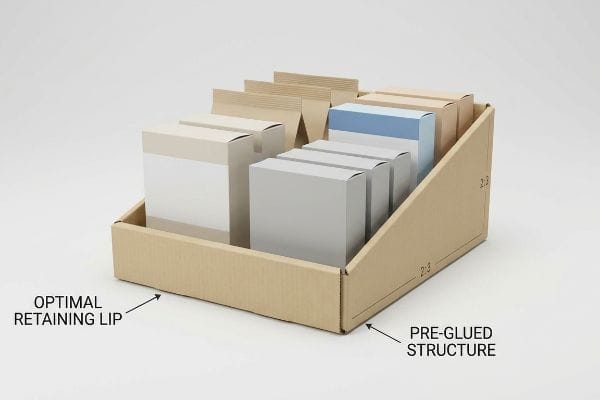
Pero conocer la teoría no es suficiente cuando las máquinas empiezan a funcionar; analicemos cómo se desempeñan realmente estas funciones en el entorno físico de la tienda.
¿Cuáles son las características clave de una buena pantalla?
El diseño de un escaparate requiere una estricta alineación matemática con el comportamiento del comprador.
Las características clave de una buena exhibición combinan una disrupción visual estratégica a treinta pies de distancia, una interacción ergonómica específica a tres pies y un acceso táctil sin obstáculos a tres pulgadas. Este distintivo continuo espacial 3-3-3 garantiza que el encargado de la exhibición física atraiga activamente a los clientes, al tiempo que elimina las dificultades de reposición para los empleados de la tienda.
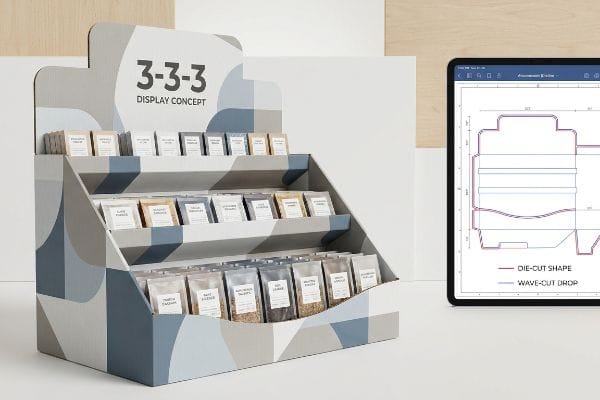
Para comprender cómo funciona esto, debemos ir más allá de los archivos de diseño gráfico y examinar el pasillo físico.
Aplicación de la regla de interacción espacial 3-3-3
La mayoría de los equipos de marketing principiantes diseñan los expositores para tiendas minoristas pensando exclusivamente en su visualización en monitores retroiluminados, centrando perfectamente los logotipos y apretando el texto al máximo. Parten de la base de que si se ve bien en una pantalla, captará la atención de forma natural en una tienda grande y concurrida. Esto crea una profunda desconexión con la realidad física de cómo los compradores se muevenpor los largos pasillos de las tiendas a paso lento.
Veo esto todo el tiempo cuando una marca se niega a recortar su borde frontal de retención, violando por completo la zona de conversión final de tres pulgadas2.El concepto central aquí es que el exhibidor debe adaptarse físicamente a la distancia del comprador, utilizando formas troqueladas masivas para la interrupción de largo alcance y estantes inclinados para el acceso inmediato. Cuando veo a un empleado frustrado luchando por forzar productos perfectamente simétricos y apretados en una bandeja profunda genérica, escucho el inconfundible sonido de desgarro del cartón crudo cediendo. Ese borde roto abarata instantáneamente el valor de la marca y ralentiza drásticamente el proceso de reposición. Para solucionar esto, siempre diseño una caída ondulada pronunciada en el panel frontal, garantizando una visibilidad del 85 % del producto3 y proporcionando ese espacio libre fraccional crítico para eliminar la fricción de la reposición.
| Error común de principiante | La solución profesional | Beneficio para el punto de venta |
|---|---|---|
| Diseño exclusivamente para pantallas planas | Utilizando la regla espacial 3-3-34 | Capta el flujo de peatones impulsivos |
| Productos para disimular los labios | Perfil de labio delantero rebajado5 | Aumenta la accesibilidad táctil |
| Empaquetamiento compacto perfectamente simétrico | Agregar separadores de SKU modulares6 | Evita que el cartón se rompa |
Ocultar tu producto estrella tras una alta pared de cartón corrugado solo para imprimir texto publicitario adicional es un error fatal de merchandising. Al mostrar el perfil frontal, la mirada del comprador se dirige directamente a tu producto principal.
🛠️ Oficina de Harvey: ¿Están sus bordes de retención ocultando accidentalmente las características más importantes de su producto? 👉 Solicite una auditoría gratuita de troquelado ↗ — Acceso directo a mi oficina. Sin spam de ventas automatizado, lo prometo.
¿Qué son las bandejas PDQ?
Una bandeja PDQ es un expositor de venta al por menor específico, diseñado para la rapidez y una ubicación privilegiada.
Las bandejas PDQ son expositores compactos de cartón corrugado, listos para su uso en tiendas, diseñados para su colocación inmediata en estanterías y su rápida reposición. Estas unidades de punto de venta, ligeras y fáciles de instalar, se colocan directamente sobre mostradores o cabeceras de góndola estándar, gracias a sus estructuras modulares preencoladas y a un estricto índice de estabilidad estructural que permite presentar productos de consumo de alta rotación directamente en las zonas de mayor afluencia de clientes.
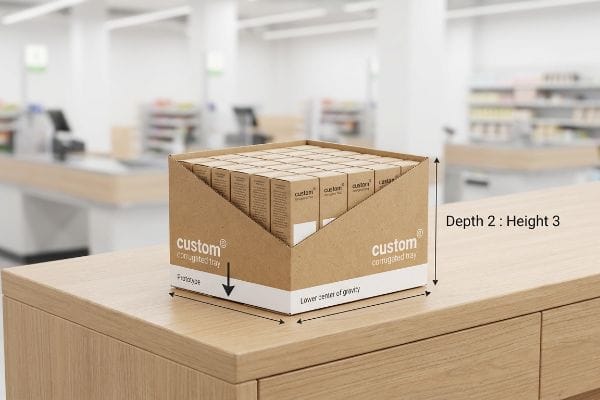
Debido a que estas bandejas se colocan justo donde los consumidores buscan sus billeteras, su geometría física no perdona errores.
Dominando la relación de estabilidad profundidad-altura de 2:3
Las marcas suelen considerar el mostrador de caja como un espacio ilimitado, diseñando bandejas excesivamente altas para exhibir sus gráficos por encima de los productos de la competencia. Parten de la base de que, siempre que la base quepa dentro del área general, un panel trasero alto generará automáticamente mayor visibilidad e impulsará las ventas por impulso.
La realidad es que la gravedad y los movimientos frenéticos de los compradores no entienden de gráficos publicitarios. Una pregunta frecuente es cómo evitar que estas unidades se vuelquen cuando están muy cargadas. Recibo constantemente diseños donde la altura de la bandeja supera drásticamente su profundidad, creando una pesadilla inestable que actúa como una vela. Durante un lanzamiento reciente, vi a un cliente golpear accidentalmente una bandeja alta y sin anclaje en una caja concurrida; la unidad entera se inclinó violentamente hacia adelante, derramando latas de metal pesadas por el suelo con un fuerte estruendo. Para evitar este riesgo, aplico una estricta relación de profundidad a altura de 2:3 en todas las unidades de punto de venta (TPV), bajando el centro de gravedad y utilizando un fondo falso para anclar los artículos máspesados .
| Error común de principiante | La solución profesional | Beneficio para el punto de venta |
|---|---|---|
| Diseño de espaldas altas y desproporcionadas | Imponer una relación de estabilidad de 2:39 | Elimina los riesgos de vuelco |
| Ignorando el centro de gravedad | Agregar un falso fondo oculto10 | Ancla productos pesados de forma segura |
| Utilizando bases delgadas y flexibles | Especificación de tableros microcanalados11 | Mantiene la bandeja perfectamente cuadrada |
Ignorar las leyes básicas de la física espacial en las cajas registradoras es sumamente arriesgado. Una bandeja que se vuelca no solo supone la pérdida de una venta impulsiva, sino que constituye una grave infracción de seguridad para el comerciante que conlleva la expulsión inmediata y permanente del establecimiento.
🛠️ Escritorio de Harvey: ¿No está seguro de si su mostrador de caja alto resistirá una prueba de inclinación estándar para comercios? 👉 Descargue la Calculadora de Estabilidad ↗ — Descarga segura. Mi bandeja de entrada está abierta si tiene alguna pregunta más adelante.
¿Cuáles son los cuatro tipos básicos de pantallas?
Comprender el panorama del comercio minorista implica dividir su estrategia estructural en zonas funcionales específicas.
Los cuatro tipos básicos de expositores son: expositores de suelo, unidades de mostrador, expositores sobre palés y bandejas para estanterías. Cada categoría se adapta a una zona comercial específica, con dimensiones físicas estrictamente reguladas por la normativa ADA y la logística de palés GMA para garantizar una interacción segura con el consumidor y una gestión eficiente del almacén.
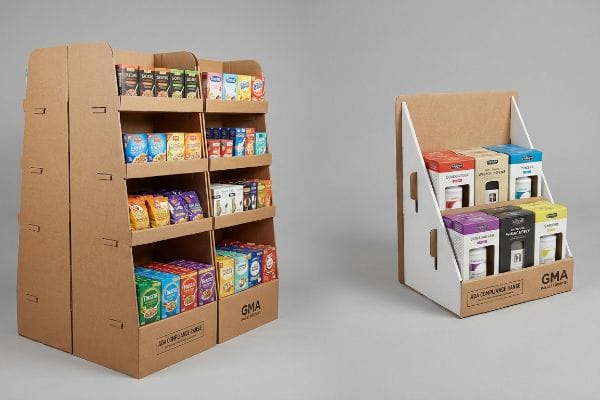
No se puede simplemente reducir el tamaño de una unidad de exhibición a la mitad y esperar que funcione en un estante de caja.
La restricción espacial de la ADA frente a la GMA
Las empresas comerciales suelen presentar un concepto de diseño altamente escalable, sugiriendo que un expositor de suelo puede reducirse matemáticamente a la mitad para servir instantáneamente como bandeja de mostrador. Lo presentan como una medida de ahorro de costes, asumiendo que un único archivo CAD (Diseño Asistido por Ordenador) universal puede evitar la necesidad de una ingeniería estructural independiente12.
Piensa en esto como intentar usar el plano de un camión para construir un kart; la mecánica interna es completamente diferente. Una regla general común es separar permanentemente los procesos de ingeniería para las unidades de piso POP (Punto de Venta) y las unidades de caja POS. Un cliente intentó forzar un archivador de piso encogido en un mostrador de caja, y debido a que los cierres corrugados de flauta B densa estaban miniaturizados, el cartón grueso se rompió violentamente y se desgarró cuando el equipo de ensamblaje intentó doblarlo. Tuvieron que cubrir las esquinas rotas con cinta adhesiva transparente, arruinando por completo la estética de la marca premium incluso antes del envío. Yo desacoplo matemáticamente estos formatos, anclando los archivadores de piso a la base GMA 13 de 48 × 40 pulgadas (1219 × 1016 mm) y diseñando las unidades de mostrador completamente alrededor de la ventana de cumplimiento de alcance frontal ADA 14 de 15 a 48 pulgadas (381 a 1219 mm) usando flauta E delgada.
| Error común de principiante | La solución profesional | Beneficio para el punto de venta |
|---|---|---|
| Archivos de piso reductores para mostradores | Separación de los flujos de trabajo CAD | Garantiza radios de pliegue limpios |
| Ignorar las alturas de alcance legales | Anclaje para cumplir con la Ley ADA15 | Evita el rechazo del gerente de la tienda |
| Utilizando ranuras densas en pestañas diminutas | Bajando al tablero de flauta en Mi16 | Proporciona un ensamblaje sin fricción |
Es fundamental diseñar arquitecturas estructurales específicas para cada zona de venta. Intentar adaptar un archivo CAD universal y reducido a un entorno diferente garantiza microfracturas graves en el cartón, gráficos impresos dañados y enormes cuellos de botella en el proceso de empaquetado conjunto.
🛠️ Harvey's Desk: ¿Se doblan las pestañas de enclavamiento reducidas bajo la presión del cartón corrugado grueso? 👉 Obtenga un mapa de tolerancia personalizado ↗ — Sin formularios que generen interminables llamadas de ventas. Solo valor puro.
¿Cuál es el significado completo de PDQ Display Box?
El nombre en sí mismo establece las expectativas sobre cómo debe comportarse este embalaje específico bajo presión.
Las siglas PDQ significan "Product Displayed Quickly" (Exhibición Rápida del Producto) o "Pretty Darn Quick" (Muy Rápido), y se refieren directamente a los envases para venta minorista diseñados para su despliegue inmediato en los pasillos. Esta clasificación específica exige sistemas modulares preencolados y sin fricción que permiten a los empleados de la tienda transformar la caja, desde su embalaje de envío hasta su uso como expositor, en cuestión de segundos.
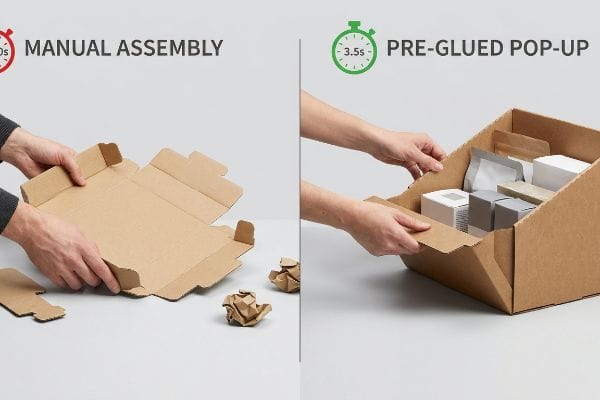
Pero conocer la teoría no es suficiente cuando las máquinas empiezan a funcionar y el lanzamiento masivo de tiendas está en juego.
¿Por qué falla el ensamblaje estándar de PDQ en la planta de producción?
Los equipos de compras suelen asumir que proporcionar una lámina troquelada plana y sin pegar a la planta de co-empaquetado es la forma más rentable de llevar a cabo una campaña de bandejas para venta al por menor. Consideran el menor costo unitario de los cartones crudos y sin ensamblar17 y creen que la mano de obra básica del almacén puede doblar y fijar rápidamente las intrincadas pestañas estructurales en el lugar.
Lograr que una bandeja encaje perfectamente en un laboratorio de oficina tranquilo es fácil, pero esta es la cruda realidad cuando se envían 5000 de ellas a un centro de distribución de alta velocidad. En mis instalaciones, veo con frecuencia diseños complejos, tipo origami, que no se han pegado y que obstruyen toda la línea de producción, ya que el papel kraft liner 18, que no cumple con la prueba de resistencia al aplastamiento de bordes (32ECT), se resiste al plegado manual. Al medir el rendimiento real, un empleado de tienda o un operario de empaquetado que lucha con las esquinas rígidas y sin pegar tarda entre 45 y 60 segundos por unidad, y a menudo escucho el crujido característico de las estrías internas que se destruyen al forzar el ensamblaje. Para eliminar esta enorme fricción a gran escala, exijo un estricto estándar de ensamblaje sin frustración, utilizando máquinas plegadoras-encoladoras automatizadas para entregar estructuras modulares desplegables preencoladas. Al imponer este preensamblaje mecánico, me aseguro de que el tiempo de configuración manual se reduzca a solo 3,5 segundos por unidad 19 , lo que efectivamente ahorra al cliente un estimado del 30 % en costos de mano de obra de coempaquetado por hora, al tiempo que garantizo una base perfectamente cuadrada y estructuralmente sólida en cada ocasión.
| Error común de principiante | La solución profesional | Beneficio para el punto de venta |
|---|---|---|
| Suministro de sábanas planas complejas | Exigir estructuras preencoladas | Reduce el tiempo de montaje en un 90%20 |
| Dependencia del bloqueo manual de pestañas | Utilizando máquinas plegadoras-encoladoras automáticas21 | Garantiza paredes cuadradas y resistentes |
| Forzar pliegues rígidos de la tabla | Mecanismos emergentes de ingeniería | Evita que las ranuras internas se aplasten |
Sacrificar la velocidad crítica de la cadena de suministro para ahorrar unos céntimos en láminas planas sin ensamblar es un desastre estratégico. Un proceso de plegado manual lento y frustrante anula por completo el propósito fundamental de alta velocidad de este formato de venta minorista en particular.
🛠️ Oficina de Harvey: No permita que un defecto estructural de 2 milímetros arruine el lanzamiento de 500 tiendas. 👉 Envíeme su archivo de troquelado ↗ — Analizaré los cálculos antes de que malgaste su presupuesto en la producción en masa.
Conclusión
Puedes optar por un proveedor más económico para ahorrar costes, pero si esa bandeja desequilibrada rompe la proporción de estabilidad 2:3 y se derrumba violentamente en un pasillo concurrido, provocará el rechazo inmediato del minorista y dañará permanentemente la imagen de tu marca. Esta es la hoja de especificaciones exacta que utilizan mis 10 principales clientes minoristas para garantizar cero rechazos de impresión. Deja de adivinar sobre la compleja física estructural y permíteme revisar personalmente tus archivos con mi Auditoría Gratuita de Troqueles ↗ para detectar errores de equilibrio fatales antes de la producción en masa.
"Evaluación de la atención y la excitación del consumidor mediante el seguimiento ocular...", https://pmc.ncbi.nlm.nih.gov/articles/PMC8380820/. Breve explicación de cómo una fuente externa autorizada respalda esta afirmación. Función de la evidencia: Validación; tipo de fuente: estudio de psicología minorista. Apoya: La discrepancia entre el diseño basado en pantallas y la interacción física del comprador. Nota de alcance: Específico para entornos minoristas de grandes superficies con mucho tráfico. ↩
"La importancia de la regla de 3 para sus exhibidores personalizados", https://mcintyredisplays.com/blog/custom-store-displays/. Una fuente autorizada sobre diseño espacial minorista validaría la zona de 3 pulgadas como la distancia crítica para la interacción táctil y la conversión de compra final. Función de evidencia: especificación técnica; tipo de fuente: manual de merchandising. Apoya: el requisito físico de acceso sin obstáculos al producto. Nota de alcance: aplicable a exhibidores en el punto de venta. ↩
"AG 1091A: Exhibiciones de mercancía minorista en la zona frontal", https://www.seattle.gov/transportation/permits-and-services/permits/applicant-guides/ag-1091a. Los estándares de la industria para la comercialización visual cuantifican el área mínima de superficie visible del producto necesaria para mantener la atención del comprador. Función de la evidencia: métrica de rendimiento; tipo de fuente: estudio de ingeniería minorista. Apoya: la afirmación de que cortes específicos de paneles optimizan la visibilidad. Nota de alcance: el porcentaje puede variar según las dimensiones del producto. ↩
"Punto de venta: Cómo los minoristas pueden influir en los compradores en el punto de venta...", https://blog.intouch.com/posts/points-of-purchase-displays. Las directrices autorizadas de diseño minorista definirían la regla 3-3-3 y su eficacia para captar el flujo de clientes impulsivos. Rol de evidencia: definición técnica; tipo de fuente: manual de diseño minorista. Apoya: estrategias de interacción espacial. Nota de alcance: específicamente para exhibidores en el punto de venta. ↩
"Altura promedio de los estantes en tiendas minoristas – Great Northern Instore", https://www.greatnortherninstore.com/2022/01/choosing-retail-display-height/. Los estudios ergonómicos en el sector minorista proporcionan evidencia de que reducir las barreras físicas, como los bordes frontales, aumenta la frecuencia de contacto con el producto. Función de la evidencia: principio de diseño; tipo de fuente: investigación ergonómica. Apoya: la relación entre accesibilidad y comportamiento del comprador. Nota de alcance: se centra en la interacción física. ↩
"Por qué necesita separadores de cartón para un envío seguro", https://www.premier-packaging-products.com/fiberboard-dividers/paperboard-dividers/. La documentación de ingeniería de embalaje explica cómo los separadores internos distribuyen el peso para evitar fallos estructurales del cartón. Función de la evidencia: especificación técnica; tipo de fuente: guía de ingeniería de embalaje. Apoya: integridad estructural de expositores de cartón. Nota de alcance: limitado a materiales de cartón. ↩
"14 Tipos de Exhibidores para Puntos de Venta | Chicago, IL – Wertheimer Box", https://wertheimerbox.com/types-of-retail-displays/. Verificación de las proporciones estructurales estándar de la industria para exhibidores de punto de venta minorista para garantizar la estabilidad y evitar que se vuelquen. Función de evidencia: especificación técnica; tipo de fuente: manual de ingeniería de empaque. Apoya: la proporción 2:3 para la estabilidad estructural. Nota de alcance: específico para unidades de punto de venta de cartón corrugado. ↩
"Estudio de caso sobre el centro de gravedad: pruebas de estabilidad y seguridad", https://www.interfaceforce.com/center-of-gravity-case-study-highlights-testing-for-stability-and-safety/. Validación técnica del uso de fondos falsos para reducir estratégicamente el centro de gravedad en expositores comerciales. Función de la evidencia: metodología estructural; tipo de fuente: guía de diseño industrial. Apoyos: estabilidad mediante la distribución del peso. Nota de alcance: se centra en la colocación de SKU pesados. ↩
"Entendiendo el empaque PDQ en el comercio minorista – LinkedIn", https://www.linkedin.com/pulse/understanding-pdq-packaging-retail-moss-tvthc. Verificación de la relación profundidad-altura 2:3 como estándar para prevenir el vuelco de los expositores en puntos de venta. Función de la evidencia: Validación técnica; tipo de fuente: Guía de ingeniería de empaques. Apoya: Relación de estabilidad para bandejas PDQ. Nota de alcance: Puede variar según la distribución de peso específica del producto. ↩
"Expositores PDQ de cartón corrugado diseñados para una rápida instalación y un gran impacto en el punto de venta", https://www.abbottaction.com/packaging/corrugated-pdq-displays/. Explicación técnica de cómo los fondos falsos reducen el centro de gravedad en los expositores para evitar que se vuelquen. Función de la evidencia: Análisis estructural; tipo de fuente: Manual de diseño industrial. Apoyos: Uso de fondos falsos para anclar productos pesados. Nota de alcance: Aplicable específicamente a surtidos de productos con la parte superior pesada. ↩
"Estimación de la resistencia a la compresión de cajas de cartón corrugado…", https://pmc.ncbi.nlm.nih.gov/articles/PMC8467740/. Confirmación técnica de que los cartones microcanalados proporcionan una rigidez estructural superior para evitar la deformación de las bandejas y mantener la escuadra. Función de la evidencia: Especificación del material; tipo de fuente: Norma de embalaje de cartón corrugado. Apoyos: Uso de cartones microcanalados para la integridad estructural. Nota de alcance: Comparación con grados de canalización estándar. ↩
"DISEÑO ESTRUCTURAL DE EXHIBICIONES PARA COMERCIO MINORISTA INTERACTIVO…", https://www.bcipkg.com/display-structural-design-for-interactive-retail-displays/. Un manual de ingeniería detallaría cómo el escalado geométrico en CAD no tiene en cuenta los cambios en la tensión del material, el centro de gravedad y la capacidad de carga. Función de la evidencia: validación técnica; tipo de fuente: manual de ingeniería. Apoya: la necesidad de un análisis estructural independiente para diferentes escalas de exhibición. Nota de alcance: se aplica a accesorios físicos de venta minorista. ↩
"Guía de tamaños de palets estándar para empresas de McIntyre, GA – 48forty", https://www.48forty.com/blog/standard-pallet-sizes-guide-for-mcintyre-ga-businesses. Los estándares externos de la Grocery Manufacturers Association (GMA) confirman la huella estándar de los palets en Norteamérica. Función de la evidencia: especificación técnica; tipo de fuente: estándar de la industria. Soporte: dimensionamiento estándar para expositores de piso. Nota de alcance: aplicable a la logística de Norteamérica. ↩
"Capítulo 3: Partes Operables – Access-Board.gov", https://www.access-board.gov/ada/guides/chapter-3-operable-parts/. Las Normas ADA para el Diseño Accesible especifican los rangos de alcance permitidos para las partes operables a fin de garantizar la accesibilidad para las personas en sillas de ruedas. Función de la evidencia: cumplimiento normativo; tipo de fuente: reglamento gubernamental. Apoyos: dimensionamiento físico de las exhibiciones de mostrador. Nota de alcance: específico de las directrices ADA de EE. UU.
"Normas ADA para el diseño accesible, Título III, Reglamento 28 CFR…", https://www.ada.gov/law-and-regs/design-standards/1991-design-standards/. Las Normas ADA para el diseño accesible especifican las alturas máximas de alcance para los accesorios de venta minorista a fin de garantizar la accesibilidad para las personas con discapacidades. Función de la evidencia: Validación regulatoria; tipo de fuente: Norma gubernamental. Apoya: Cumplimiento legal para accesorios de tiendas. Nota de alcance: Regulaciones con sede en EE. UU .
"Guía para el cartón ondulado de flauta E: para qué sirve y cuándo usarlo", https://www.accbox.com/blog/a-guide-to-e-flute-corrugated-what-its-good-for-and-when-to-use-it/. Las especificaciones de materiales para cartón ondulado indican que el perfil más delgado de la flauta E permite pliegues más ajustados y un ensamblaje más sencillo en componentes pequeños en comparación con las flautas más gruesas. Función de la evidencia: Especificación técnica; tipo de fuente: Guía de ciencia de materiales. Apoyos: Elección de material para pestañas de exhibición. Nota de alcance: Industria del embalaje de cartón ondulado. ↩
"Empaquetado plano vs. totalmente ensamblado: ¿Cuál es más rentable?", https://www.samtop.com/flat-pack-vs-fully-assembled-display/. Un análisis de costos de materiales de embalaje que compara troquelados enviados en plano con unidades preensambladas. Función de la evidencia: verificación de hechos; tipo de fuente: guía de precios de la industria o documento técnico sobre embalaje. Apoya: la justificación económica para elegir el envío en plano. Nota de alcance: se centra en los costos de materia prima frente a los costos de mano de obra. ↩
"[PDF] Especificaciones de cartón ondulado – Fibre Box Association", https://www.fibrebox.org/assets/2025/09/Walmart_Corrugated-Board_Specifications_Automation_Packaging_Standards.pdf. Verificación de las especificaciones del material 32ECT y su resistencia mecánica al plegado manual en el montaje del embalaje. Función de la evidencia: Especificación técnica; tipo de fuente: Norma de ingeniería de embalaje. Apoya: La afirmación de que ciertos pesos del revestimiento dificultan el montaje manual. Nota de alcance: Se aplica a las normas de la industria del cartón ondulado. ↩
"Cajas expositoras de mostrador y bandejas PDQ personalizadas – hs packfactory", https://hspackfactory.com/custom-counter-display-boxes/. Comparación del tiempo de montaje entre diseños de cartón ondulado sin pegar y expositores desplegables pre-encolados para puntos de venta. Función de la evidencia: Métrica de rendimiento; tipo de fuente: Referencia de ingeniería industrial. Apoya: La afirmación sobre las ganancias de eficiencia de las estructuras modulares pre-encoladas. Nota de alcance: Los tiempos reales pueden variar según las dimensiones del expositor. ↩
¿Qué significa PDQ en el comercio minorista? – PopDisplay, https://popdisplay.me/what-does-pdq-mean-in-retail/. Estudios de caso o informes de productividad de la industria del embalaje que cuantifican la reducción de tiempo al pasar de láminas planas a estructuras preencoladas. Función de la evidencia: validación cuantitativa; tipo de fuente: informe técnico de la industria. Respalda: afirmaciones de eficiencia. Nota sobre el alcance: el porcentaje puede variar según la complejidad del expositor. ↩
"Máquina plegadora-encoladora automática de alta velocidad para embalaje de precisión", https://nagpalindustries.com/automatic-folder-gluer-machine-high-speed-precision-packaging/. Documentación técnica de fabricantes de maquinaria de embalaje que demuestra cómo las plegadoras-encoladoras automatizadas garantizan una escuadra precisa y una estabilidad de pared óptima en comparación con el montaje manual. Función de la evidencia: especificación técnica; tipo de fuente: manual del equipo. Soportes: calidad estructural. Nota de alcance: Aplicable a la producción a escala industrial. ↩