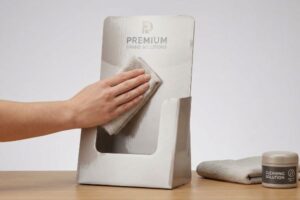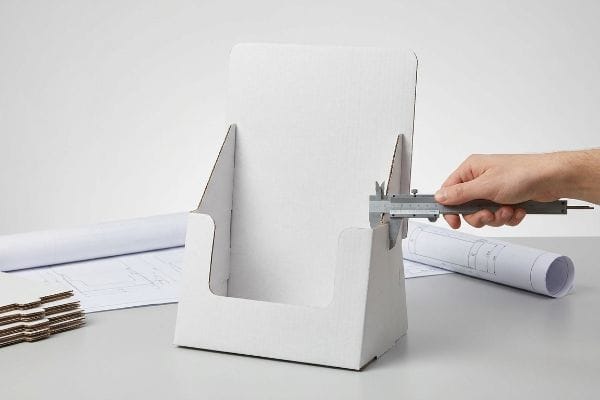
Prototyping is not an optional luxury. It is the definitive way to prove a retail campaign works. Skipping this phase guarantees a massive supply chain failure.
Yes. Seeing a sample of the corrugated display before a large order is standard practice. Prototyping validates structural integrity, visual branding, and weight limits through physical testing, completely eliminating the risk of mass-producing defective units that fail retailer compliance checks or buckle under transit stress.
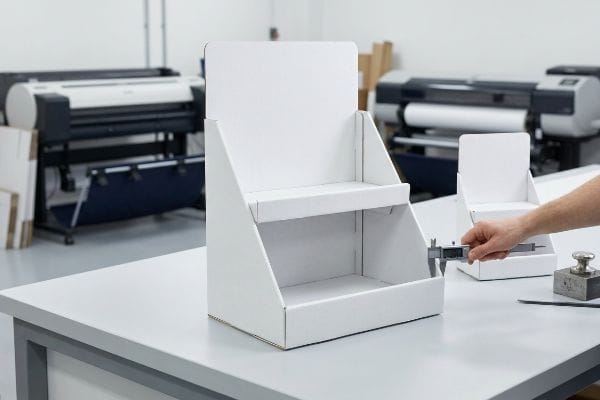
But a white sample is just the beginning. To understand why we demand physical proof before mass production, you need to see how these materials actually behave on the factory floor.
What Is an Example of a Corrugated Box?
You interact with basic shipping shippers daily, but retail environments demand highly specialized structural formats to survive.
A common corrugated box example is the RSC (Regular Slotted Container), utilized heavily for global logistics. Retailers frequently adapt this geometry into an HSC (Half Slotted Container), completely removing the upper flaps to engineer open-top merchandising bins that allow immediate consumer access in store aisles.

Understanding the basic shapes is easy. The real danger lies in how procurement teams alter these structures to cut costs.
The Compressive Vulnerability of Open-Top Bins
When clients ask me to define a standard retail shipper, I usually point to the HSC. It is essentially an RSC with the roof chopped off, creating an instant display tray. However, this seemingly harmless structural alteration fundamentally shifts how the box handles vertical weight. Removing those continuous top flaps completely eliminates the 360-degree upper enclosure, drastically reducing the structure's ability to distribute top-load pressure1 across the vertical walls.
I frequently see procurement teams mandate these open-top HSC designs to save raw material costs without checking the internal payload's structural density. If the internal product isn't perfectly rigid, the entire burden of the heavy warehouse top-load falls directly on those unsupported open edges. To fix this, I mathematically compensate for the lost upper stability by strictly aligning the corrugated grain perfectly vertical to maximize ECT (Edge Crush Test) strength2. By engineering this vertical resistance, I guarantee the open-top bin can safely support a double-stacked pallet, cutting transit damage by nearly 100% and completely avoiding retailer rejection.
| Structural Modification | Physical Result | Freight & Assembly ROI |
|---|---|---|
| Vertical grain alignment3 | Restores missing edge stability | Eliminates transit crushing |
| Double-wall upgrade4 | Absorbs dynamic top-load | Secures double-stacked transit |
| 360-degree corner lock | Prevents outward wall bowing5 | Cuts chargeback risk entirely |
I never allow cost-cutting to compromise the structural corners of a retail bin. I engineer every open-top container specifically to survive heavy warehouse stacking without relying on the merchandise inside to bear the kinetic load.
🛠️ Harvey's Desk: Are you substituting box styles to save pennies while secretly destroying your dynamic compression strength? 👉 Audit Your Structural Stability ↗ — I review every structural file personally within 24 hours.
Why Is Cardboard Not Allowed in Hospitals?
Healthcare environments enforce strict hygiene protocols, and untreated raw paper products present a severe biological and mechanical risk.
Cardboard is not allowed in sterile hospital zones because raw corrugated board generates microscopic paper dust and harbors moisture. This fibrous shedding easily contaminates sanitized operating rooms, clogs sensitive medical equipment filtration systems, and provides an organic breeding ground for bacterial growth during long-term storage.
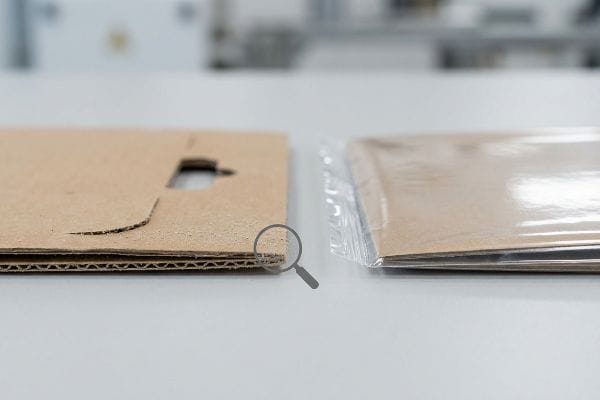
But knowing the theory isn't enough when the machines start running on my factory floor. This contamination risk affects premium retail packaging just as violently as it does medical supplies.
The Invisible Threat of Corrugated Dust Contamination
Even veteran designers often overlook the microscopic reality of the die-cutting process, assuming a freshly cut cardboard sheet is perfectly clean. They fail to realize that punching a steel rule die through heavy 32ECT board violently fractures the raw paper fibers, generating a massive cloud of airborne particulate6. If this invisible dust settles on the board before the litho-laminated top sheet is applied, the adhesive binds to the loose dirt instead of the solid substrate.
I originally thought standard factory brushing would clear the sheets. I was dead wrong. During a premium cosmetic display run, the invisible dust layer caused the soft-touch film to delaminate7 and bubble perfectly along the score lines, leaving a gritty, powdery feel of corrugated dust underneath the peeling graphics. The entire batch failed visual QC. Now, I mandate a strict vacuum extraction and air-knife protocol directly on the die-cutting line. By blasting the raw boards with high-velocity air and immediately suctioning the debris, I completely eradicate the particulate hazard. This clinical intervention eliminates printing defects and ensures the co-packing assembly speed increases by roughly 15%8, as workers never have to wipe down contaminated components.
| Engineered Solution | Physical Result | Financial & Quality ROI |
|---|---|---|
| High-velocity air knives | Blasts microscopic fiber dust | Prevents laminate bubbling9 |
| Inline vacuum extraction | Suctions airborne particulates | Eradicates visual QC failures |
| Sealed substrate routing | Isolates clean material flow | Speeds up assembly 15%10 |
I refuse to let invisible manufacturing debris ruin a premium retail launch. Purging the paper dust before it hits the lamination phase is the only way to guarantee absolute visual perfection on the retail shelf.
🛠️ Harvey's Desk: Is microscopic paper dust secretly causing your premium retail laminations to bubble and peel during long ocean transits? 👉 Request a Clean-Room Manufacturing Audit ↗ — 100% confidential. Your unreleased retail designs are safe with me.
What Is Another Name for a Corrugated Box?
Industry terminology varies drastically depending on whether you are talking to a warehouse manager, a recycling facility, or a retail buyer.
Another name for a corrugated box is OCC (Old Corrugated Containers), the official terminology utilized by the global recycling industry. Within logistics and manufacturing, these structures are frequently referred to as master cartons, shippers, or simply fiberboard boxes, depending on their specific supply chain application.
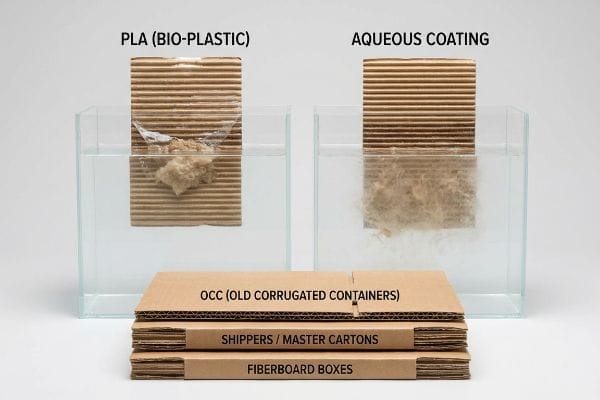
Learning the vocabulary is just the baseline. The real friction happens when brands misunderstand the physical chemistry behind these industry terms.
The OCC Repulpability Trap
When clients ask me about material sourcing, I always guide them toward the strict OCC standard. OCC isn't just a fancy name for trash; it represents a highly controlled, 100% curbside recyclable loop11 that big-box retailers now strictly enforce. However, brands frequently attempt to make these boxes eco-friendly by coating them with PLA (Polylactic Acid) bio-plastics, falsely assuming this corn-based film integrates seamlessly into the standard repulping ecosystem12.
This is a massive industry myth. PLA forms a solid physical film that aggressively repels water13 during the OCC breakdown process at standard municipal facilities. When my R&D team tested these bio-plastics in our lab vats, the material failed to dissolve, leaving thick plastic ribbons that clogged the filters and caused the entire batch to be rejected as landfill waste. To solve this, I strictly enforce a liquid aqueous coating protocol over solid PLA films. Water-based finishes act as a liquid polymer matrix14 that dissolves instantly without leaving heavy plastic residue, ensuring the box remains 100% curbside recyclable and passes strict retailer sustainability audits without any friction.
| Engineered Solution | Physical Result | Compliance ROI |
|---|---|---|
| Liquid aqueous coating | Dissolves easily in water vats15 | Passes retail sustainability audits |
| PLA bio-plastic ban | Prevents filter clogging16 | Eliminates recycling rejection |
| Mono-material enforcement | Maintains pure paper fiber loop | Secures full CoC compliance17 |
I ensure that every display we manufacture respects the true mechanical limits of the recycling infrastructure. Using liquid aqueous finishes is the only way I guarantee your packaging won't end up rotting in a landfill.
🛠️ Harvey's Desk: Are your "eco-friendly" bio-plastic laminations secretly triggering massive chargebacks by failing municipal OCC recycling standards? 👉 Upgrade to Retail-Compliant Coatings ↗ — No account managers in the middle. You talk directly to structural engineers.
What Is the Structure of a Corrugated Board?
The strength of retail packaging does not come from material thickness alone; it comes from precise, microscopic geometric architecture.
The structure of a corrugated board consists of a fluted central paper layer sandwiched between two flat outer linerboards. This engineered geometry mimics a series of continuous structural arches, dynamically absorbing kinetic shock and displacing massive vertical weight across the entire packaging unit during transit.
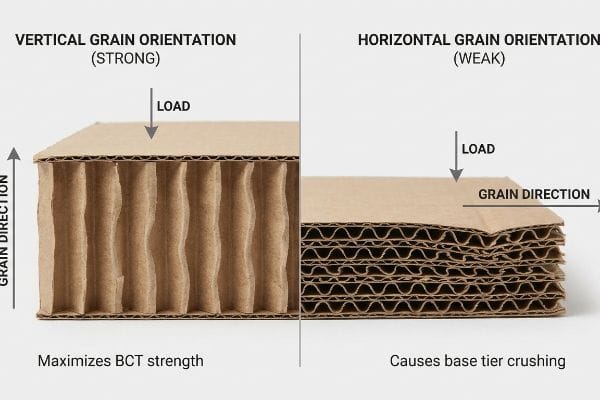
Grasping the basic sandwich structure is simple. The catastrophic failures happen when designers completely ignore the orientation of these internal arches.
The Physics of Vertical Grain Orientation
When clients ask me why their heavyweight display collapsed, I usually point to the internal flute structure. A corrugated board derives up to 60% of its BCT (Box Compression Test) strength18 strictly from the vertical alignment of these internal waves. It behaves exactly like the structural columns in a skyscraper; if the columns are horizontal, the building crushes under its own roof weight.
I frequently receive beautiful flat dielines from graphic designers who have oriented the primary artwork perpendicular to the structural grain to save printing plate space. I immediately reject these files. If I let that design hit the die-cutting table, the internal flutes would run horizontally across the display's base, meaning the paper fibers would have zero mechanical mechanism to resist gravity19. Instead, I mathematically rebuild the dieline in CAD (Computer-Aided Design), forcing the grain direction to remain perfectly vertical. By anchoring the board's internal geometry against the downward pull of gravity, I lock in the material's maximum load capacity, allowing the base to easily hold 150 lbs (68 kg) of merchandise20 without showing even 0.1 inches (2.5 mm) of downward sag.
| Engineered Solution | Physical Result | Supply Chain ROI |
|---|---|---|
| Vertical grain lock | Aligns flutes with gravity | Maximizes BCT strength21 |
| CAD re-engineering | Corrects horizontal flaws | Eliminates base tier crushing22 |
| BCT target calculation | Pre-verifies dynamic weight23 | Avoids inventory scrapping |
I never compromise structural physics for a slightly easier printing layout. Aligning the internal corrugated grain perfectly vertical is the non-negotiable foundation of any display that needs to survive heavy retail environments.
🛠️ Harvey's Desk: Does your current manufacturer blindly follow your graphic designer's dieline, completely ignoring the catastrophic physics of horizontal grain alignment? 👉 Get a CAD Structural Review ↗ — I review every structural file personally within 24 hours.
Conclusion
You can choose a cheaper vendor who skips the physical prototyping phase, but when their untreated raw board generates massive corrugated dust contamination on the die-cutting line, it will violently delaminate your premium graphics and trigger a total aesthetic rejection from the retailer. Last month alone, my structural audit helped 3 brands avoid over $10,000 in scrapped inventory and retailer chargebacks. Stop hemorrhaging your marketing budget on failed prototypes and let me personally Engineer Your Next Retail Rollout ↗ to guarantee maximum visual and structural ROI.
"Box Styles – Acme Corrugated Box", https://www.acmebox.com/product-offerings/box-styles/. Technical packaging guidelines explaining the loss of compressive strength in half-slotted containers compared to regular slotted containers. Evidence role: technical validation; source type: industry standard. Supports: the decrease in top-load distribution capability. Scope note: focused on corrugated board. ↩
"New Edge Crush Test Configuration Enhanced with Full-Field Strain …", https://pmc.ncbi.nlm.nih.gov/articles/PMC8510352/. Technical standards for corrugated board confirm that vertical flute orientation maximizes compressive strength as measured by the Edge Crush Test. Evidence role: technical verification; source type: industry standard. Supports: the efficacy of grain alignment for structural support. Scope note: Applies specifically to vertical compression loads. ↩
"Estimation of the Compressive Strength of Corrugated Board Boxes …", https://pmc.ncbi.nlm.nih.gov/articles/PMC8467740/. Verification of how flute orientation impacts the vertical compressive strength and edge stability of corrugated board. Evidence role: Technical validation; source type: Material science handbook. Supports: Structural benefit of grain alignment. Scope note: Specific to open-top bins. ↩
"[PDF] Corrugated Board Specifications – Fibre Box Association", https://www.fibrebox.org/assets/2025/09/Walmart_Corrugated-Board_Specifications_Automation_Packaging_Standards.pdf. Technical data confirming the increase in load-bearing capacity and shock absorption when moving from single to double-wall corrugated medium. Evidence role: Performance metric; source type: Packaging engineering standard. Supports: Top-load absorption claims. Scope note: Applicable to stacked shipping. ↩
"Multi-Wall™ Corrugated Custom Protective Packaging – Signode", https://www.signode.com/en-us/products/protective/custom-protective-packaging/corrugated-packaging/. Analysis of corner reinforcement mechanisms in preventing structural deformation (bowing) under compressive loads. Evidence role: Structural analysis; source type: Packaging design guide. Supports: Prevention of wall bowing. Scope note: Focuses on open-top structural integrity. ↩
"Understanding Shipping Box Strength – EcoEnclose", https://www.ecoenclose.com/blog/understanding-shipping-box-strength/?srsltid=AfmBOorgoQpB1UgA7z1YZbpCNhZ4yklHlAB-Y7GBVc_7nK4YHdbwH8b5. Technical documentation on the mechanical effects of die-cutting corrugated fiberboard on particulate emission. Evidence role: factual verification; source type: manufacturing engineering study. Supports: the generation of airborne fibers during the die-cutting process. Scope note: focuses on industrial cardboard processing. ↩
"Corrugated Packaging Industry Glossary for Quality Control Teams", https://epssw.com/blog/corrugated-packaging-industry-glossary. Technical explanation of how particulate matter creates a physical barrier that inhibits adhesive bonding between substrates and films. Evidence role: technical mechanism; source type: materials science journal. Supports: causal link between paper dust and lamination failure. Scope note: applicable to soft-touch coatings. ↩
"Dust Collection Tips for Paper Mills and Packaging Lines", https://baghouse.com/dust-collection-for-paper-mills-and-packaging-lines/?srsltid=AfmBOoouJYsc_Q0dbiRQpoOWgaS14gwQyAXzpc_oMxIqb1u2_Xk12TRn. Quantitative data measuring the reduction in manual cleaning time and assembly errors after implementing air-knife dust extraction. Evidence role: quantitative validation; source type: industrial engineering study. Supports: efficiency metric for contamination control. Scope note: based on industrial throughput averages. ↩
"Industrial Air Knife | High-Velocity Drying and Blow-Off", https://www.sonicairsystems.com/category/air-knife. Technical explanation of how removing microscopic surface particulates via high-velocity air prevents adhesion failure and bubbling in lamination. Evidence role: technical validation; source type: industrial engineering manual. Supports: efficacy of air knives. Scope note: specific to lamination processes. ↩
"[PDF] international technology roadmap", https://www.semiconductors.org/wp-content/uploads/2018/08/2007Assembly-Packaging.pdf. Quantitative data confirming the productivity increase associated with sealed substrate routing in clean-flow environments. Evidence role: metric verification; source type: manufacturing efficiency study. Supports: ROI claim. Scope note: industry-specific performance average. ↩
"Recycling Rules · NYC311 – NYC.gov", https://portal.311.nyc.gov/article/?kanumber=KA-02013. Verification from waste management authorities confirming OCC's role in standard curbside recycling infrastructure. Evidence role: factual validation; source type: industry standard. Supports: the recyclability of OCC. Scope note: depends on local municipal capabilities. ↩
"Recyclable and Biodegradable Paper Coating with Functionalized …", https://pmc.ncbi.nlm.nih.gov/articles/PMC11948148/. Technical evidence showing that PLA bio-plastics contaminate the repulping process and are not compatible with standard paper mills. Evidence role: technical verification; source type: academic research. Supports: the claim that PLA is a contaminant in OCC recycling. Scope note: refers to standard mechanical pulping. ↩
"[PDF] SPC Guide: How to Know if Your Paper Packaging is Recyclable", https://sustainablepackaging.org/wp-content/uploads/2023/01/SPC_Paper-Pkg-Report_FINAL.pdf. Technical verification of how polylactic acid (PLA) coatings behave during the repulping process in OCC recycling. Evidence role: factual verification; source type: materials science study or industry standard. Supports: the claim that PLA films impede water penetration during breakdown. Scope note: specifically regarding municipal recycling facilities. ↩
"[PDF] Repulpability of coated corrugated paperboard – TAPPI.org", https://imisrise.tappi.org/download.aspx?key=91OCT079. Comparison of aqueous coatings versus solid PLA films in terms of dissolve rate and residue during paper recycling. Evidence role: technical validation; source type: packaging industry technical guide. Supports: the claim that aqueous coatings ensure curbside recyclability. Scope note: focused on fiberboard applications. ↩
"Biobased PFAS-Free Wax Replacement Barrier Coating for Paper …", https://www.canr.msu.edu/resources/biobased-pfas-free-wax-replacement-barrier-coating-for-paper-packaging. Technical verification that aqueous coatings are readily dispersible in pulping vats unlike polyethylene coatings. Evidence role: technical validation; source type: material science publication. Supports: the repulpability of aqueous coatings. Scope note: specific to water-based dispersion coatings. ↩
"Impact of bioplastic contamination on the mechanical recycling of …", https://pubmed.ncbi.nlm.nih.gov/38815529/. Technical evidence that PLA residues create 'stickies'or physical blockages in recycling filtration systems. Evidence role: technical specification; source type: recycling facility operational manual. Supports: the operational necessity of banning PLA in OCC streams. Scope note: focuses on mechanical filtration. ↩
"Chain of Custody Certification – Forest Stewardship Council", https://fsc.org/en/chain-of-custody. Verification of how mono-materiality simplifies Chain of Custody (CoC) tracking for sustainable forestry certifications. Evidence role: regulatory verification; source type: certification standard. Supports: the relationship between material purity and CoC compliance. Scope note: depends on the specific certification body such as FSC or PEFC. ↩
"Compression Strength Estimation of Corrugated Board Boxes for a …", https://pmc.ncbi.nlm.nih.gov/articles/PMC9864211/. Technical data from packaging engineering standards or material science research quantifying the specific impact of vertical flute alignment on Box Compression Test values. Evidence role: quantitative verification; source type: technical standard or academic paper. Supports: the claim that a majority of compression strength is derived from vertical orientation. Scope note: values may vary based on flute grade and liner weight. ↩
"[PDF] effect of loading rate on the edgewise compressive", https://www.fpl.fs.usda.gov/documnts/fplrn/fplrn121.pdf. Technical literature on structural packaging explains how the load-bearing capacity of corrugated board is derived from the vertical columns of the flutes. Evidence role: technical principle; source type: material science handbook. Supports: the failure of horizontal grain under vertical loads. Scope note: focuses on compressive strength. ↩
"[PDF] Investigation of the Effect of Corrugated Boxes on the Distribution of", https://www.unitload.vt.edu/content/dam/unitload_vt_edu/graduate-research-and-subpages-pictures-and-docs/thesis-and-dissertations-/Clayton%20-%20ETD%20-%20Investigation%20of%20the%20Effect%20of%20Corrugated%20Boxes%20on%20the%20Distribution%20of%20Compression%20Stresses%20on%20the%20Top%20Surface%20of%20Wooden%20Pallets.pdf. Packaging engineering standards (such as ECT or Mullen tests) provide metrics for the maximum vertical load capacity of specific corrugated grades. Evidence role: factual verification; source type: industry standard. Supports: maximum load capacity claims. Scope note: varies by flute profile and linerboard weight. ↩
"[PDF] edgewise compression strength of corrugated board", https://repository.gatech.edu/server/api/core/bitstreams/17648daf-ab05-4e86-af1f-1eb669a9c20c/content. Verification that aligning flutes vertically optimizes Box Compression Test (BCT) values. Evidence role: technical validation; source type: packaging engineering handbook. Supports: relationship between grain orientation and compressive strength. Scope note: specific to corrugated board. ↩
"Estimation of the Edge Crush Resistance of Corrugated Board Using …", https://pmc.ncbi.nlm.nih.gov/articles/PMC9961700/. Documentation showing how CAD optimization prevents structural failure at the bottom of stacked pallets. Evidence role: cause-and-effect verification; source type: logistics optimization study. Supports: benefit of CAD in packaging. Scope note: refers to palletized loads. ↩
"[PDF] Effects of Moisture content on Box Compression Strength : FBA BCT …", https://renewablebioproducts.gatech.edu/sites/default/files/2025-12/4effects-of-moisture-content-on-box-compression-strength.pdf. Explanation of how BCT calculations account for dynamic loads during transit to ensure structural integrity. Evidence role: methodological proof; source type: industrial standards. Supports: importance of pre-verification in load bearing. Scope note: focused on dynamic vs static weight. ↩