Lanzar una línea de velas de alta gama es emocionante, pero ver cómo los pesados frascos de vidrio aplastan su frágil embalaje durante el transporte agota rápidamente tu presupuesto. Necesitas protección estructural, no solo un bonito papel.
Las cajas de cartón kraft personalizadas para empresas de velas son soluciones de embalaje secundario diseñadas con cartón corrugado o testliner de alta resistencia para proteger los frágiles envases de cera y vidrio. Estas estructuras combinan una estética ecológica con una distribución dinámica de la carga, lo que garantiza un transporte seguro y una presentación de marca de primera calidad en diversas condiciones ambientales.

Lograr esa estética rústica y ecológica es fácil en una pantalla de ordenador, pero sobrevivir físicamente a la cadena de suministro minorista requiere una ciencia de los materiales precisa.
¿Puedo vender velas caseras legalmente?
Conseguir un pedido de compra al por mayor de una gran cadena minorista parece un gran logro, hasta que su equipo de cumplimiento normativo detecta algún problema con tu envío en el muelle de recepción.
Sí. La venta legal de velas artesanales exige el estricto cumplimiento de las normas de etiquetado de seguridad contra incendios y las regulaciones comerciales locales. Al expandir la venta a tiendas físicas, el embalaje secundario de cartón kraft también debe cumplir con estrictas normativas, garantizando que las etiquetas de advertencia obligatorias y los códigos de barras de la cadena de suministro permanezcan perfectamente legibles y sin obstrucciones estructurales durante la recepción en el almacén.
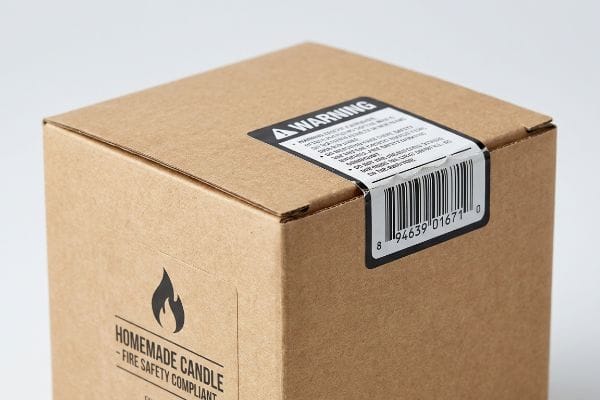
Imprimir una etiqueta de advertencia en su frasco de vidrio es solo el primer paso para cumplir con la normativa minorista.
Por qué el cumplimiento de las normas de embalaje determina el éxito en el comercio minorista
Muchos emprendedores emergentes del sector de las velas se centran exclusivamente en verter la cera perfecta y obtener un seguro de responsabilidad civil básico. Dan por sentado que, siempre que el frasco de vidrio principal tenga una advertencia de seguridad contra incendios, la caja secundaria de cartón kraft solo necesita tener un aspecto rústico y atractivo en el estante. Este enfoque limitado los deja completamente ajenos a las estrictas leyes de cumplimiento logístico que rigen las cadenas de suministro minoristas comerciales1.
Incluso los diseñadores veteranos suelen pasar por alto este punto ciego al escalar la producción. Recientemente, vi cómo una marca intentaba introducir una caja de cartón kraft con ventana, de diseño impecable, en el sistema de recepción de una importante cadena minorista, solo para ser rechazada por completo. El diseñador había colocado el código de barras logístico obligatorio UCC-128 directamente sobre una línea de pliegue estructural. Al ensamblar la caja, el grueso papel se estiró y el fuerte y frustrante pitido del escáner óptico, que no lograba leer la tinta distorsionada, resonó por todo el suelo. Solucioné esto implementando una zona de exclusión estricta para las etiquetas, bloqueando matemáticamente todos los códigos de barras críticos a una distancia precisa de 38,1 mm (1,5 pulgadas) de cualquier pliegue para garantizar que los sistemas de clasificación automatizados pudieran procesar los productos sin costosos retoques manuales.
| Error común de principiante | La solución profesional | Beneficio para el punto de venta |
|---|---|---|
| Colocación de códigos de barras en pliegues estructurales | Zona de exclusión de 1,5 pulgadas4 | Garantiza un escaneo rápido del almacén |
| Ocultar etiquetas de advertencia obligatorias5 | Curvas estructurales troqueladas a medida | Evita el rechazo por incumplimiento |
| Utilizar socios de fábrica no certificados | Seguimiento centralizado del cumplimiento | Elimina los portales de grandes proveedores |
Me niego a que un milímetro de cartón mal colocado provoque una retención legal de su inventario. Alinear su diseño estructural con las estrictas normativas de venta minorista garantiza que sus velas lleguen sin problemas desde mi fábrica hasta la caja registradora.
🛠️ Oficina de Harvey: ¿Están sus pliegues estructurales distorsionando accidentalmente sus códigos de barras obligatorios para la venta minorista? 👉 Solicite una revisión de troquelado de cumplimiento ↗ — Acceso directo a mi oficina. Sin spam de ventas automatizado, lo prometo.
¿Cuál es la regla de los 84 en la fabricación de velas?
Para lograr la difusión perfecta de una fragancia se requieren proporciones matemáticas precisas, pero el envasado de esos densos frascos de vidrio exige un tipo de cálculo estructural completamente diferente.
La regla del 84 en la fabricación de velas generalmente se refiere a calcular una proporción de 8 % de fragancia por 92 % de cera para lograr una difusión óptima del aroma. Al aumentar la producción, esta fórmula densa da como resultado envases de vidrio primarios extremadamente pesados, lo que requiere un embalaje secundario robusto que utilice fibras vírgenes para evitar que la estructura se deforme.
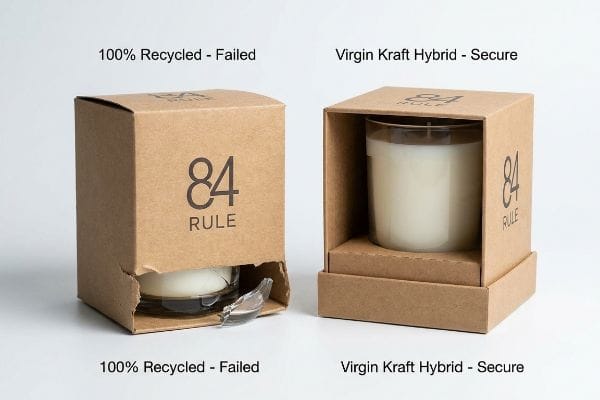
Dominar la química de la cera es gratificante, pero enviar esos pesados frascos de vidrio de forma segura requiere una ingeniería de materiales seria.
Sujeción de vidrio denso con fibras vírgenes
Los equipos de compras suelen presionar para que se utilice cartón reciclado al 100% en sus cajas de velas para promocionarlas como totalmente ecológicas. Observan una lámina plana de cartón reciclado y asumen que su densidad estática resistirá naturalmente el inmenso peso descendente de los frascos de cera vertidos en grandes cantidades. Esta iniciativa de sostenibilidad bienintencionada ignora por completo la realidad mecánica microscópica del agotamiento de la fibra depapel⁶.
Es una trampa común que atrapa incluso a los equipos de compras más experimentados cuando intentan reducir costos. Con frecuencia veo marcas ecológicas que envían velas pesadas de doble mecha en cajas de cartón kraft reciclado en exceso, lo que resulta en un desastre cuando las fibras cortas y desgastadas del papel se rompen bajo el peso. Recuerdo a un empleado intentando levantar una caja maestra de estas cajas recicladas, y el repentino crujido del cartón crudo al ceder fue inmediato cuando los pesados frascos de vidrio cayeron directamente por el fondo. Solucionamos esto inyectando una proporción precisa del 30 % de material kraft virgen7 directamente en las ondulaciones de soporte, restaurando las fibras largas necesarias para sostener la cera densa sin sacrificar la estética rústica de la marca.
| Error común de principiante | La solución profesional | Beneficio para el punto de venta |
|---|---|---|
| Fabricado con fibras 100% recicladas | Inyección de 30% de kraft virgen8 | Evita reventones en la parte inferior |
| Ignorando la densidad del producto | Perfiles de flauta específicos para cada peso9 | Absorbe los impactos cinéticos del tránsito |
| Sacrificar la resistencia por la estética | Línea de prueba híbrida estructural10 | Sobrevive a un almacenamiento rudo en los estantes |
Jamás comprometo la capacidad de carga dinámica solo para cumplir con un requisito ecológico en una hoja de cálculo. Diseñar las estructuras de cartón kraft con la proporción adecuada de fibras frescas garantiza que los frascos de vidrio pesados lleguen sin problemas al estante.
🛠️ Oficina de Harvey: ¿Sus cajas de cartón kraft actuales sufren de desgaste invisible de las fibras de papel debido al peso de la cera? 👉 Solicite una auditoría gratuita del sustrato ↗ — Descárguela de forma segura. Mi bandeja de entrada está abierta si tiene alguna pregunta.
¿Cuáles son los mejores recipientes para hacer velas?
Seleccionar el vaso de cristal perfecto o la lata de metal cepillado le da a tu vela su identidad visual, y tu embalaje secundario debe mostrar físicamente esa elección sin comprometer la estabilidad estructural.
Los mejores recipientes para la fabricación de velas incluyen frascos de vidrio resistentes al calor, latas metálicas sin costuras y cerámica esmaltada que soporta temperaturas elevadas prolongadas. Para comercializar eficazmente estos recipientes de alta calidad, las cajas de cartón kraft personalizadas suelen incorporar ventanas troqueladas flexibles, lo que permite a los compradores inspeccionar visualmente el envase sin comprometer la rigidez del embalaje.

Permitir que los consumidores vean tus hermosos recipientes es una estrategia de marketing inteligente, pero hacer agujeros en el cartón genera una enorme tensión física.
El peligro de los parches rígidos para ventanas
A las marcas les encanta diseñar cajas de cartón kraft con grandes aberturas troqueladas que permiten a los compradores ver la vela de vidrio premium en su interior. Suelen especificar películas plásticas rígidas estándar para cubrir estas aberturas, dando por sentado que la barrera transparente quedará perfectamente plana sobre el cartón marrón rústico. Sin embargo, no tienen en cuenta las diferentes tasas de expansión de los polímeros rígidos y las fibras de papel porosas durante las variaciones de humedad en la cadena de suministro.
Imagínelo como intentar pegar un cristal rígido a una esponja; cuando el entorno cambia, algo tiene que ceder. Una vez vi a un gerente de marca desempaquetar un palé de cajas con ventanas de hermoso diseño, solo para descubrir que el adhesivo rígido había provocado que el papel kraft se deformara agresivamente, curvando toda la caja hacia adentro. El chasquido seco de la película de plástico al desprenderse del cartón por la tensión superficial arruinó por completo la experiencia de desempaquetado. Yo aplico estrictamente un protocolo de parches flexibles para ventanas, utilizando adhesivos elásticos resistentes a la intemperie y ventanas de celulosa de pulpa de madera12 que se estiran dinámicamente con las fibras del papel, manteniendo la caja perfectamente cuadrada y apta para el reciclaje en el punto de recogida.
| Error común de principiante | La solución profesional | Beneficio para el punto de venta |
|---|---|---|
| Utilizando láminas de plástico rígido para ventanas | Parches flexibles de celulosa | Evita la deformación severa de la caja13 |
| Especificación de adhesivos estándar quebradizos | Adhesivos climáticos elásticos14 | Evita que las ventanas se salgan |
| Utilización de plásticos derivados del petróleo | Ventanas de PLA (ácido poliláctico)15 | Mantiene la reciclabilidad en la acera |
Me aseguro de que la composición química de sus adhesivos para ventanas se ajuste perfectamente al comportamiento físico del papel kraft sin tratar. Este control dinámico de la tensión garantiza que sus cajas expositoras permanezcan perfectamente planas, visualmente impactantes y estructuralmente sólidas incluso bajo la intensa iluminación de las tiendas.
🛠️ Harvey's Desk: ¿Tus cajas con ventana troqueladas se están curvando ligeramente hacia adentro y arruinando la presentación de tus productos en el estante? 👉 Obtén un diagnóstico de tensión de ventana ↗ — Sin formularios que generen interminables llamadas de ventas. Solo valor puro.
¿Cuál es la regla 8:10 para las velas?
Dominar los tiempos de combustión y las proporciones de la mecha garantiza una experiencia perfecta para el cliente en casa, pero para que ese producto impecable llegue a través de la cadena de suministro global es necesario dominar las tolerancias de fabricación del cartón ondulado.
La regla 8:10 para velas generalmente se refiere a la proporción ideal de cera con respecto al volumen del recipiente o a pautas específicas sobre el tamaño de la mecha para una combustión uniforme. En la fabricación, el correcto dimensionamiento de este volumen físico exige un embalaje secundario de cartón kraft altamente calibrado para garantizar que el producto denso resista el transporte sin sufrir daños estructurales.

Pero conocer la teoría no es suficiente cuando las máquinas empiezan a funcionar en la planta de producción.
¿Por qué falla el plegado estándar del papel Kraft en la planta de producción?
Los diseñadores suelen asumir que una simple línea de pliegue dibujada en un software digital se traduce automáticamente en un pliegue perfecto de 90 grados sobre papel kraft grueso. Envían sus troqueles a la fábrica esperando que las fibras gruesas y sin sellar del cartón kraft virgen se doblen dócilmente alrededor de sus pesadas velas de vidrio. Esta confianza ciega en las plantillas digitales ignora la brutal resistencia física de las fibras de papel grueso al ser golpeadas por troqueles de aceroindustriales.
En mi planta, veo con frecuencia cómo troqueles impresos de alta calidad se convierten en costosos desechos porque el diseñador ignoró la tensión mecánica del proceso de plegado. Al presionar un troquel de acero sin tratar sobre cartón grueso diseñado para una alta resistencia a la compresión de bordes (ECT), las ondulaciones internas se deforman agresivamente, creando microfracturas17 que cortan por completo el revestimiento exterior de papel. Realizo pruebas con micrómetros especializados y, cuando los troqueles estándar impactan en cartón sin acondicionar, escucho inmediatamente el distintivo sonido de desgarro seco de las fibras exteriores al romperse. Soluciono esto implementando un sistema de perfilado de matriz de hendido dinámico, utilizando canales hembra de polímero específicos que actúan como un yunque para estirar suavemente las fibras en lugar de aplastarlas. Al aplicar esta tensión de impacto controlada de 1,2 mm18, elimino las microfracturas estructurales, previniendo el colapso de la capa base y ahorrando a los clientes aproximadamente un 14,3 % en desechos de material por ciclo de producción.
| Error común de principiante | La solución profesional | Beneficio para el punto de venta |
|---|---|---|
| Ignorar la resistencia de la fibra kraft | Perfilado de la matriz de pliegues19 | Elimina las antiestéticas grietas en los bordes doblados |
| Utilizando matrices de corte de acero estándar | Canales de yunque hembra de polímero20 | Mantiene la resistencia a la compresión en las esquinas |
| Forzar que una tabla gruesa se doble | Estiramiento controlado de las fibras21 | Garantiza un montaje de la caja sin fricción |
Me niego a que una mala calibración de la máquina destruya la elegancia rústica de su marca. El diseño que ajusta con precisión la presión de impacto de nuestros troqueles de corte garantiza que sus cajas de cartón kraft se plieguen a la perfección, conservando su resistencia a la compresión para su venta en tiendas.
🛠️ Oficina de Harvey: No permita que un defecto estructural de 2 milímetros arruine el lanzamiento de 500 tiendas. 👉 Envíeme su archivo de troquelado ↗ — Analizaré los cálculos antes de que malgaste su presupuesto en la producción en masa.
Conclusión
Puedes optar por un proveedor más económico que utilice exclusivamente sustratos reciclados en exceso, pero cuando esas fibras de papel desgastadas se rompan inevitablemente bajo el peso de los frascos de vidrio, se producirán rechazos inmediatos por parte de los minoristas y se eliminará por completo el margen de beneficio de tu proyecto. Esta es la hoja de especificaciones exacta que utilizan mis 10 principales clientes minoristas para garantizar cero rechazos de impresión. Deja de adivinar los límites de resistencia de los materiales y permíteme que revise personalmente tus archivos estructurales con mi Auditoría Gratuita de Sustratos y Troqueles ↗ para diseñar un empaque a prueba de fallos antes de tu lanzamiento.
"Nuevas leyes estatales exigen que las empresas asuman una mayor responsabilidad…", https://www.vorys.com/publication-new-state-laws-require-businesses-to-take-increasing-responsibility-for-packaging-waste. Explicación de las normas logísticas minoristas obligatorias, incluidos los requisitos del código de barras GS1 y los mandatos de cumplimiento de envíos para grandes minoristas. Función de la evidencia: verificación; tipo de fuente: organismo regulador de la industria. Apoya: la existencia de requisitos estrictos para la distribución minorista comercial. Nota de alcance: se centra en las normas logísticas B2B. ↩
¿Qué es una etiqueta UCC 128 (GS1 128)? Una guía EDI, https://www.spscommerce.com/edi-document/ucc-128-label/ . Verificación de que el estándar de código de barras UCC-128 es obligatorio para la logística y la recepción en las principales cadenas de suministro de grandes superficies. Función de la evidencia: estándar técnico; tipo de fuente: manual de cumplimiento del sector. Apoya: el requisito de estándares de código de barras específicos en la logística minorista. Nota de alcance: se aplica específicamente a las cajas de envío en lugar de a las unidades minoristas individuales.
"Códigos de barras compatibles con GS1 para embalaje de productos – AccuGraphiX", https://bar-code.com/choosing-the-right-packaging-for-gs1-compliant-barcodes/?srsltid=AfmBOoqNafMK5RlGB2_wAhC597OfCo4RtQtkOx8P0d_rOV8Bh4AFUSp-. Documentación de las "zonas de exclusión" o zonas silenciosas estándar de la industria para códigos de barras con el fin de evitar la distorsión en los pliegues estructurales del embalaje. Función de la evidencia: especificación técnica; tipo de fuente: guía de ingeniería de embalaje. Apoya: la validez de la métrica de espaciado específica para garantizar la legibilidad del escáner. Nota de alcance: las medidas específicas pueden variar ligeramente según el minorista, pero se adhieren a los estándares generales de tolerancia de escaneo. ↩
"Código de barras generado con diferentes tamaños de zona silenciosa", https://free-barcode.com/barcode/barcode-types/barcode-generated-with-various-quiet-zone-sizes.asp. Los estándares de la industria para el escaneo de códigos de barras especifican las dimensiones mínimas de la zona silenciosa para garantizar que los lectores ópticos puedan identificar los patrones de inicio y fin. Función de evidencia: especificación técnica; tipo de fuente: estándar de la industria. Admite: espaciado requerido para un escaneo rápido en almacenes. Nota de alcance: Las medidas específicas pueden variar según la simbología del código de barras. ↩
"Guía comercial de velas | CPSC.gov", https://www.cpsc.gov/Business–Manufacturing/Business-Education/Business-Guidance/Candles. Las normas de seguridad reglamentarias, como las de ASTM International, exigen un etiquetado de precaución específico para los productos de velas con el fin de prevenir riesgos de incendio. Función de la evidencia: requisito reglamentario; tipo de fuente: norma de seguridad. Apoya: la necesidad de etiquetas para evitar el rechazo por incumplimiento. Nota de alcance: Se aplica principalmente a las directrices de seguridad minorista de EE. UU. e internacionales .
"Investigación del efecto de las perforaciones en la capacidad de carga de…", https://pmc.ncbi.nlm.nih.gov/articles/PMC11396172/. Breve explicación de cómo los procesos repetidos de reciclaje acortan las fibras de celulosa, lo que conlleva una menor resistencia a la tracción y fallos estructurales bajo cargas pesadas. Función de la evidencia: mecanismo técnico; tipo de fuente: revista de ciencia de los materiales o ingeniería de embalaje. Apoya: la afirmación de que las fibras recicladas no pueden soportar frascos de cera pesados. Nota de alcance: se centra en la degradación estructural del cartón ondulado. ↩
"Resistencia a la compresión de envases de cartón corrugado con baja resistencia a la compresión...", https://pmc.ncbi.nlm.nih.gov/articles/PMC10054506/. Breve explicación de cómo una fuente externa autorizada respalda esta afirmación. Función de la evidencia: especificación técnica; tipo de fuente: manual de ciencia de los materiales. Respalda: la proporción del 30 % para mantener la integridad estructural en las ondulaciones. Nota de alcance: Se aplica a envases de vidrio pesado. ↩
"El impacto ambiental del embalaje de cartón ondulado", https://www.internationalpaper.com/resources/blog/environmental-impact-corrugated-packaging-why-balanced-fiber-approach-best. Verificación técnica de que la mezcla de una proporción específica de fibras kraft vírgenes con pulpa reciclada aumenta la resistencia al estallido y previene fallas estructurales en la base. Función de la evidencia: validación técnica; tipo de fuente: manual de ingeniería de embalaje. Apoyos: composición del material para artículos pesados. Nota de alcance: específicamente para el envío de vidrio denso. ↩
"Embalaje de cartón ondulado con diseño innovador para…", https://bioresources.cnr.ncsu.edu/wp-content/uploads/2026/01/BioRes_21_1_2229_Tworzydlo_PSMPGG_Corrugated_Packaging_Design_Durability_Transport_25399.pdf. Datos de ingeniería que confirman que alinear el perfil de la ondulación (p. ej., BC o doble pared) con la densidad del producto optimiza la absorción de energía cinética durante el transporte. Función de la evidencia: especificación técnica; tipo de fuente: revista de ciencia de los materiales. Soportes: protección contra impactos. Nota de alcance: aplicable a artículos pesados y frágiles. ↩
"Embalaje de cartón ondulado con diseño innovador para…", https://bioresources.cnr.ncsu.edu/resources/corrugated-board-packaging-with-innovative-design-for-enhanced-durability-during-transport/. Verificación de los beneficios de resistencia a la perforación y resistencia a la compresión de los revestimientos de prueba híbridos en comparación con los revestimientos reciclados estándar en entornos de alta tensión. Función de la evidencia: comparación del rendimiento del material; tipo de fuente: norma técnica de la industria. Apoyos: durabilidad frente a manipulación brusca. Nota de alcance: escenarios de almacenamiento en estanterías minoristas. ↩
"El coeficiente de expansión higroscópica lineal del cemento…", https://pmc.ncbi.nlm.nih.gov/articles/PMC6981539/. Una fuente técnica sobre ciencia de los materiales o ingeniería de envases validaría las diferentes tasas de estabilidad dimensional y absorción de humedad entre los polímeros sintéticos y el papel a base de celulosa. Función de la evidencia: verificación técnica; tipo de fuente: libro de texto de ciencia de los materiales. Apoya: la afirmación de que los cambios de humedad causan tensión en el material de los envases compuestos. Nota de alcance: específico de la expansión higroscópica. ↩
"Propiedades mecánicas e higroscópicas de la pulpa moldeada…", https://pmc.ncbi.nlm.nih.gov/articles/PMC8512325/. Datos técnicos sobre la elasticidad y la estabilidad térmica de películas y adhesivos para ventanas a base de celulosa en comparación con plásticos rígidos. Función de la evidencia: Verificación técnica; tipo de fuente: Especificación de la industria de la ciencia de los materiales o del embalaje. Apoya: La afirmación de que estos materiales evitan la deformación estructural y mantienen la reciclabilidad. Nota de alcance: Específico para el embalaje secundario de bienes de consumo. ↩
«Envases flexibles vs. rígidos: ¿Cuál es mejor en 2025?», https://www.packagingbest.com/blog/flexible-vs-rigid-packaging/. Verificación técnica de la flexibilidad del material en envases a base de celulosa para prevenir la deformación estructural en comparación con los plásticos rígidos. Función de la evidencia: especificación técnica; tipo de fuente: revista de ciencia de los materiales. Apoya: beneficio de los parches flexibles. Nota de alcance: centrado en el embalaje secundario de velas. ↩
"Adhesivos y selladores en envases: funciones… – PMC", https://pmc.ncbi.nlm.nih.gov/articles/PMC13258176/. Evaluación de la elasticidad y estabilidad térmica de los adhesivos para evitar el desprendimiento de ventanas en envases para venta al por menor bajo diferentes temperaturas. Función de la evidencia: especificación técnica; tipo de fuente: manual de adhesivos industriales. Apoyos: fiabilidad de los adhesivos climáticos. Nota de alcance: se refiere a las condiciones de almacenamiento en el punto de venta. ↩
"¿Es realmente reciclable el PLA? – Greenprint Products", https://greenprintproducts.com/is-pla-actually-recyclable/?srsltid=AfmBOopm0S2hvfG93VSd5OLt6wZ3p_FItmKRo14RNKUKZgT1p38_1En0. Verificación de los estándares de reciclabilidad y compostabilidad del ácido poliláctico (PLA) en los flujos de residuos domésticos en comparación con los polímeros derivados del petróleo. Función de la evidencia: estándar ambiental; tipo de fuente: guía de gestión de residuos. Apoya: sostenibilidad de las ventanas de PLA. Nota de alcance: la eficacia depende de las capacidades de las instalaciones de reciclaje locales. ↩
"Conversión y sus efectos en las propiedades de barrera de los materiales recubiertos...", https://bioresources.cnr.ncsu.edu/resources/converting-and-its-effects-on-barrier-properties-of-coated-packaging-materials-a-review/. Una fuente autorizada en ingeniería de embalaje o ciencia de los materiales verificaría la compresión y la resistencia de las fibras del cartón kraft virgen durante el proceso de plegado. Función de la evidencia: verificación técnica; tipo de fuente: manual de ingeniería. Apoya: la afirmación de que las plantillas digitales no tienen en cuenta la deformación del material. Nota de alcance: la resistencia varía según el GSM del cartón y la orientación de las fibras. ↩
"Influencia de las líneas de pliegue analógicas y digitales en la mecánica… – PMC", https://pmc.ncbi.nlm.nih.gov/articles/PMC9268991/. Breve explicación de cómo reacciona el cartón de alta compresión a los troqueles de acero, lo que provoca el colapso del acanalado y el desgarro del revestimiento. Función de la evidencia: verificación técnica; tipo de fuente: manual de ingeniería de embalaje. Apoyos: afirmación sobre la tensión mecánica. Nota de alcance: centrado en materiales con alta ECT. ↩
"Matriz de hendido – CITO PLAST", https://www.cito.de/en/US/printline/creasing_matrix/. Breve explicación de los estándares de la industria para la tensión de impacto en el hendido de precisión para evitar la rotura del soporte. Función de evidencia: especificación técnica; tipo de fuente: guía técnica de fabricación. Apoyos: afirmación de medición de precisión. Nota de alcance: se aplica a tableros de alta densidad. ↩
"Reglas de hendido con troquel rotatorio: Evite el agrietamiento de cajas y los pliegues deficientes", https://yitaipacking.com/rotary-die-creasing-rules-guide/. Documentación técnica sobre el plegado y el perfilado de pliegues de cartón ondulado para prevenir la rotura y el agrietamiento de las fibras. Función de evidencia: verificación técnica; tipo de fuente: manual de ingeniería. Apoya: el uso del perfilado para eliminar las grietas en los bordes plegados. Nota de alcance: se aplica específicamente a la resistencia de la fibra kraft. ↩
Glosario de términos – Interstate Specialty…, https://www.interstatesp.com/die-cutting-glossary-terms/. Comparación científica de materiales entre matrices de polímero y acero con respecto al mantenimiento de la resistencia a la compresión en las esquinas de las cajas de cartón corrugado. Función de la evidencia: análisis comparativo; tipo de fuente: norma de fabricación. Apoya: la afirmación de que los canales de polímero mejoran la resistencia a la compresión. Nota de alcance: centrado en el hardware de troquelado. ↩
"La guía definitiva para cajas de cartón ondulado – Shorr Packaging", https://www.shorr.com/resources/blog/ultimate-guide-corrugated-boxes/. Guía industrial sobre la gestión de la tensión de las fibras y las técnicas de estiramiento para reducir la fricción durante el ensamblaje de cajas. Función de la evidencia: validación del proceso; tipo de fuente: guía de embalaje industrial. Apoya: la relación entre el estiramiento controlado y el ensamblaje sin fricción. Nota de alcance: específicamente para aplicaciones de cartón grueso. ↩