Pasas meses elaborando la bebida artesanal, pero si tu envase se derrumba en un pasillo húmedo del supermercado, la reputación de tu marca se hace añicos antes de que el cliente dé un solo sorbo.
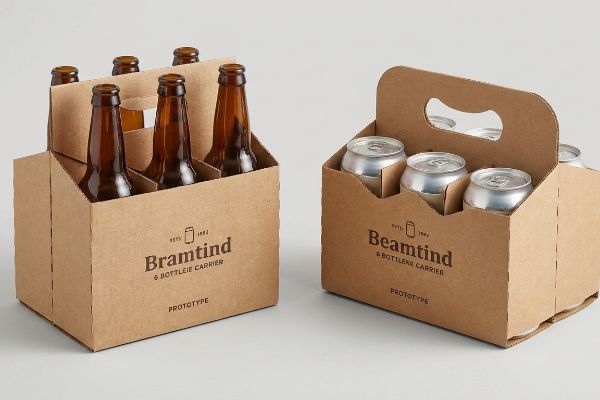
Los paquetes personalizados de 6 botellas y las cajas para transportar cerveza son estructuras especializadas de cartón corrugado diseñadas para transportar, exhibir y comercializar de forma segura envases de bebidas de vidrio o aluminio. Estos contenedores multipack incorporan separadores internos y asas reforzadas para evitar el impacto entre botellas y maximizar la visibilidad de la marca en los estantes de las tiendas.
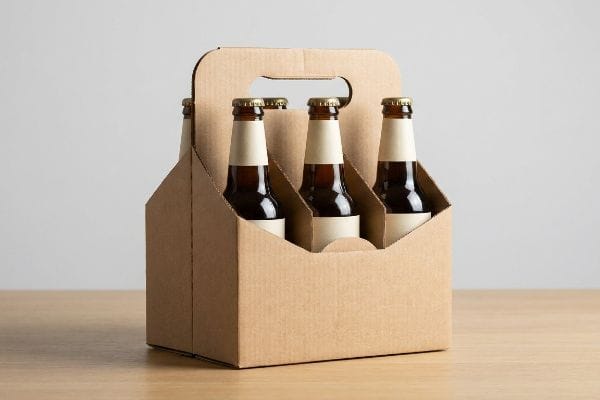
Conocer la definición básica es solo el punto de partida. Al pasar de la representación digital a la fabricación en masa, la física de los líquidos densos y el vidrio frágil cambia por completo las reglas del juego.
¿Cuáles son los diferentes tipos de envases para cerveza?
Elegir el formato estructural adecuado determina exactamente cómo sobrevivirá su producto a la brutal fricción física de la cadena de suministro global.
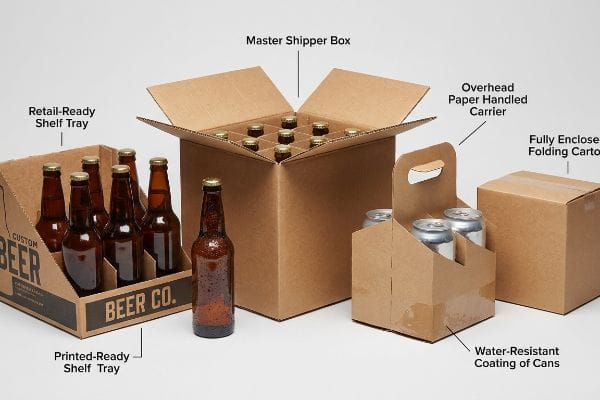
Los distintos tipos de envases para cerveza incluyen cajas maestras de cartón corrugado de alta resistencia, bandejas para estanterías listas para la venta, carros tradicionales con asas superiores y cajas plegables completamente cerradas. Cada formato estructural exige protocolos específicos de resistencia a la humedad y cálculos de distribución del peso para garantizar un transporte seguro desde la línea de embotellado hasta el consumidor.
Elegir un estilo es fácil, pero adaptar ese estilo para que sobreviva a microclimas minoristas específicos es donde las campañas de aficionados fracasan instantáneamente.
Por qué el cartón estándar no supera la prueba del enfriador de cerveza
Incluso los diseñadores veteranos a menudo pasan por alto el punto ciego ambiental de los entornos minoristas refrigerados1.Dan por sentado que las cajas de cartón resistirán perfectamente porque pasaron una prueba básica de peso en seco en una oficina con aire acondicionado.
Veo este problema constantemente cuando las marcas pasan de la fábrica de cerveza al supermercado. La condensación es el peor enemigo de la pulpa de papel. Una vez vi a un dependiente sacar una bolsa genérica de una nevera, y el crujido del cartón mojado resonó por el pasillo cuando la base se desprendió por completo, haciendo que seis botellas cayeran al suelo. Para solucionarlo, exijo aplicar un revestimiento biodegradable resistente al agua en los 50,8 mm inferioresde la bolsa. Esto crea un sello hidrofóbico que impide la entrada de humedad, evitando por completo las reclamaciones de responsabilidad y asegurando que el asa no se rompa cuando el cliente se dirija a su coche.
| Error común de principiante | La solución profesional | Beneficio para el punto de venta |
|---|---|---|
| Utilizando cartón kraft poroso sin sellar | Aplicación de una capa base hidrofóbica de 2 pulgadas (50,8 mm)3 | Elimina por completo la condensación |
| Pruebas de portadores en aire seco de oficina | Simulando niveles de humedad más fríos | Evita el colapso estructural por el tope4 |
| Utilizando pegamento PVA estándar | Utilizando adhesivos resistentes a la humedad5 | Elimina las engorrosas reparaciones con cinta adhesiva transparente |
Jamás dejo que un portavasos llegue a la prensa sin antes comprobar el acabado de la base. Un sencillo recubrimiento localizado transforma una frágil caja de cartón en una herramienta duradera que resiste sin problemas las duras condiciones del mercado minorista.
🛠️ Oficina de Harvey: ¿Te preocupa que el diseño actual de tu portabotellas se deteriore en la nevera del supermercado? 👉 Envíame tu archivo de troquelado plano ↗ — Acceso directo a mi oficina. Sin spam de ventas automatizado, te lo prometo.
¿Cuáles son las dimensiones de un paquete de seis botellas de cerveza?
Lograr la huella matemática precisa es un requisito indispensable para la logística automatizada de embotellado y venta minorista de alta velocidad.
Las dimensiones de un paquete de seis botellas de cerveza suelen ser de aproximadamente 190,5 mm (7,5 pulgadas) de largo, 127 mm (5 pulgadas) de ancho y 215,9 mm (8,5 pulgadas) de alto. Las medidas exactas varían según la forma de la botella, el grosor del vidrio y los requisitos del separador interno corrugado.
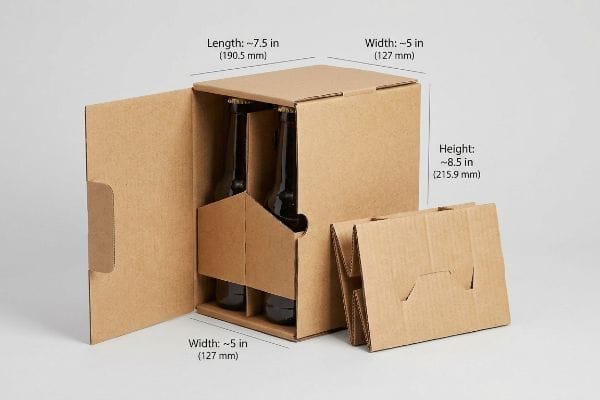
Si bien esas cifras generales sirven para un prototipo rápido, basarse en ellas para la producción en masa provocará enormes cuellos de botella en la línea de montaje.
El peligro oculto de las dimensiones perfectas de las botellas
Al determinar el tamaño de los envases, los equipos de compras simplemente toman el diámetro exacto de su botella de vidrio y lo multiplican por tres para obtener la longitud(6) y por dos para el ancho(7). Suponen que esta fórmula matemática 1:1 garantiza un ajuste perfecto y protector para su producto.
Lo que olvidan es el grosor físico del cartón corrugado en sí. En mi planta, si no se calcula la tolerancia de curvatura específica para un sustrato de flauta B8, toda la estructura se arquea hacia afuera. He visto a los co-empacadores sudar en la línea de montaje, luchando por meter botellas en ranuras matemáticamente "perfectas" que ahora son drásticamente demasiado estrechas porque el papel doblado consumió el espacio. Se puede oír el chirrido del vidrio rozando contra el cartón denso. Para eliminar esto, uso software CAD (Diseño Asistido por Computadora) para inyectar algoritmos de compensación de calibre automatizados en la línea de troquelado, ensanchando ligeramente las ranuras. Esto garantiza un empaque automatizado sin fricción, reduciendo sus tiempos de ensamblaje de mano de obra en un estimado del 25%9.
| Error común de principiante | La solución profesional | Beneficio para el punto de venta |
|---|---|---|
| Ranuras de ajuste al diámetro exacto de la botella | Inyección de compensación de calibradores CAD10 | Acelera el empaquetado automatizado de la línea |
| Ignorando el grosor de la tabla plegada | Ranuras de ensanchamiento para permitir la curvatura11 | Evita que el papel se rompa durante la inserción |
| Apretar las botellas para que quepan en bandejas estrechas | Microholguras de ingeniería12 | Evita que el embalaje secundario se curve |
Siempre extiendo matemáticamente los separadores internos más allá de las dimensiones del vidrio en bruto. Una fracción de milímetro en la preimpresión elimina horas de fricción manual al empacar en el suelo.
🛠️ Oficina de Harvey: ¿Su troqueladora actual de 6 paquetes incluye algoritmos de compensación de calibre exactos para el grosor específico de la flauta corrugada? 👉 Solicite una revisión gratuita de la troqueladora ↗ — Descárguela de forma segura. Mi bandeja de entrada está abierta si tiene alguna pregunta más adelante.
¿Cómo se llama un soporte para botellas de cerveza?
La terminología es de suma importancia cuando se buscan componentes estructurales complejos a través de diversas cadenas de suministro globales.
Un soporte para botellas de cerveza se conoce profesionalmente como cesta para bebidas, portabotellas o cesta de venta al por menor. En entornos de fabricación, estos términos determinan la arquitectura estructural específica, definiendo si la unidad utiliza un asa superior integrada, una base automática totalmente cerrada o un sistema de divisores modulares insertables.
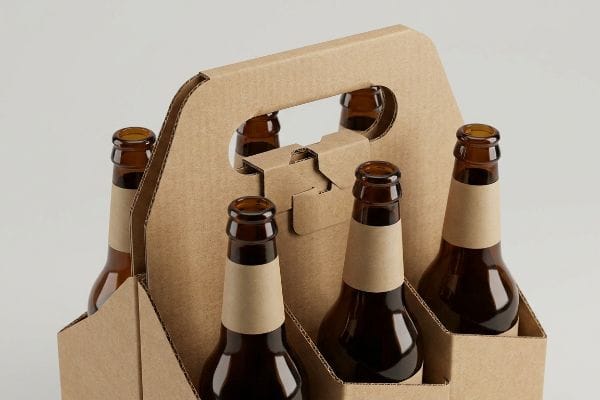
Acertar con el nombre garantiza que la fábrica sepa exactamente qué formato necesita, pero aún así hay que diseñar correctamente la mecánica de elevación física.
Diseñando el portabotellas de cerveza ideal sin plástico
Piensa en un portavasos como en una caja de herramientas resistente; si el asa central falla, la integridad estructural de la unidad queda totalmente comprometida. Las empresas emergentes suelen recurrir a asas baratas pegadas o soportes de plástico a presión¹³para asegurar el agarre, asumiendo que los materiales sintéticos ofrecen una resistencia superior.
Los clips de plástico representan un gran problema de sostenibilidad para las grandes superficies comerciales que aplican estrictas normas de reciclaje. He visto palés enteros de bebidas artesanales rechazados porque los gerentes de las tiendas se niegan a separar manualmente los envases de materiales mixtos. Elimino por completo este riesgo utilizando un mecanismo de cierre de papel tipo origami integrado directamente en la columna central. Al ensamblarlo en el suelo, se puede sentir el distintivo y rígido "clic" de las pestañas corrugadas macho/hembra que encajan perfectamente. Esta exigencia de un solo material garantiza que el contenedor sea 100 % reciclable en la acera14 , manteniendo la capacidad de carga dinámica para contener cómodamente 10 lb (4,5 kg)15 de líquido.
| Error común de principiante | La solución profesional | Beneficio para el punto de venta |
|---|---|---|
| Utilizando clips de plástico a presión | Diseño de cerraduras de papel al estilo origami | Garantiza el 100% de reciclabilidad en la acera16 |
| Dependencia de asas adhesivas débiles | Utilizando espinas centrales entrelazadas17 | Contiene de forma segura cargas útiles líquidas pesadas |
| Envío de unidades de materiales mixtos | Hacer cumplir un mandato monomaterial | Evita las auditorías ambientales de los minoristas18 |
Elimino los componentes de plástico innecesarios siempre que sea posible. El uso de un plegado geométrico inteligente en lugar de clips sintéticos reduce el costo unitario y simplifica el cumplimiento de las normativas de venta minorista.
🛠️ Harvey's Desk: ¿Necesitas ayuda para diseñar un asa de cierre resistente, 100 % de papel, para tu portavasos pesado? 👉 Solicita tu consulta estructural gratuita ↗ — Sin formularios que generen interminables llamadas de ventas. Solo valor puro.
¿Cuál es el tamaño estándar de una caja de vino para 6 botellas?
El cambio de las cervezas estándar de 12 onzas a los formatos de vino de 750 ml requiere un enfoque logístico y dimensional completamente diferente.
Las dimensiones estándar de una caja para 6 botellas de vino suelen ser de 266,7 mm (10,5 pulgadas) de largo, 177,8 mm (7 pulgadas) de ancho y 317,5 mm (12,5 pulgadas) de alto. Estas dimensiones están diseñadas específicamente para acomodar copas de 750 ml de mayor tamaño, lo que requiere separadores internos diseñados para evitar fuertes impactos durante el transporte.
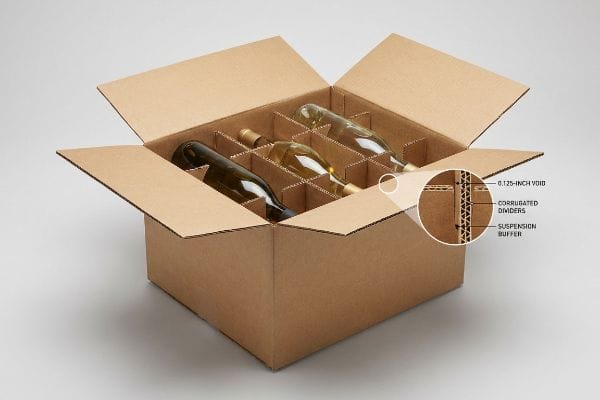
Pero conocer las dimensiones teóricas no es suficiente cuando los palés se cargan en un camión y comienza la vibración propia del transporte de mercancías pesadas.
¿Por qué las dimensiones estándar provocan que el vidrio se rompa en la planta de producción?
Las marcas suelen determinar las dimensiones de su embalaje listo para la venta (RRP, por sus siglas en inglés) midiendo el exterior exacto de sus seis botellas de vino agrupadas. Suponen que un envoltorio de cartón ajustado y termoencogible proporciona la máxima seguridad contra el movimiento durante la logística.
En mis instalaciones, veo con frecuencia que esta suposición teórica conduce a fallas catastróficas en la mesa de pruebas de vibración. Cuando las botellas de vidrio pesadas se empaquetan de forma compacta sin ningún tipo de amortiguación espacial, cualquier impacto externo transfiere el 100 % de la energía cinética directamente a los contenedores primarios20.He escuchado el crujido devastador de una carga de paleta de 68 kg (150 lb) que se desplaza, pulverizando instantáneamente la capa inferior de vidrio. Para evitar esto, extiendo matemáticamente las dimensiones interiores de la caja para crear un espacio de suspensión mínimo estricto de 3,17 mm (0,125 pulgadas)21 entre las paredes exteriores y los separadores internos de cartón corrugado. Al atrapar aire y usar las estrías internas como amortiguadores mecánicos, esta solución de ingeniería específica elimina la rotura durante el transporte, lo que ahorra a los clientes miles de dólares en cargos por daños en el flete LTL (carga parcial).
| Error común de principiante | La solución profesional | Beneficio para el punto de venta |
|---|---|---|
| Ajustar la caja al tamaño adecuado para el cristal | Diseñar un vacío de 0,125 pulgadas (3,17 mm)22 | Elimina por completo la rotura de cristales durante el transporte |
| Ignorando la transferencia de energía cinética | Utilizar flautas como amortiguadores mecánicos23 | Evita costosos cargos adicionales por flete LTL |
| Quitar los separadores para ahorrar espacio | Integración de rejillas de separación modulares24 | Mantiene las etiquetas de botellas de alta calidad libres de rayones |
Me niego a aprobar un embalaje para vino que carezca de una zona de amortiguación cinética calculada. Diseñar unos milímetros adicionales de espacio negativo es la mejor garantía para productos frágiles.
🛠️ Oficina de Harvey: ¿Sus costosas botellas de vino absorben el 100% del impacto cinético durante el transporte marítimo agitado? 👉 Envíeme su archivo de troquelado ↗ — Haré una prueba de estrés antes de que gaste su presupuesto en la producción en masa.
Conclusión
Puedes optar por un proveedor de embalaje más económico, pero si las dimensiones ajustadas y la falta de amortiguación cinética provocan que las botellas de vidrio pesadas se rompan durante el transporte, los cargos por envíos LTL y los rechazos de los minoristas aniquilarán instantáneamente todo el margen de tu campaña. Más de 500 gerentes de marca utilizan mi lista de verificación de preimpresión para evitar precisamente estos errores fatales en las primeras etapas. Deja de adivinar las tolerancias estructurales y permíteme revisar personalmente tus archivos con mi Auditoría de Troqueles Gratuita ↗ para detectar errores fatales antes de que comience la producción en masa.
"Impacto ambiental de los materiales de envasado de alimentos: una revisión…", https://pmc.ncbi.nlm.nih.gov/articles/PMC7664184/. Explicación técnica de cómo la alta humedad y la condensación en los refrigeradores de los comercios minoristas degradan la integridad estructural del cartón estándar. Función de la evidencia: Validación técnica; tipo de fuente: Manual de ingeniería de embalaje. Apoya: El fallo del cartón estándar en el comercio minorista de cadena de frío. Nota de alcance: Se centra en la absorción de humedad en materiales corrugados. ↩
"Consejo sobre cómo impermeabilizar el cartón? – Custom Boxes Market", https://customboxesmarket.com/tip-on-how-to-make-cardboard-waterproof/?srsltid=AfmBOop4-EGl4w5h8gzVM40kJrK8TsVDOoXp7jq5YkEqOdHeDGM2Dwc0. Documentación técnica o investigación de ingeniería de embalaje que confirma que los recubrimientos hidrofóbicos previenen la filtración de humedad y la falla estructural en el cartón. Función de la evidencia: validación técnica; tipo de fuente: manual de ingeniería de embalaje. Apoya: la efectividad de los recubrimientos resistentes al agua específicos en los portabotellas de cerveza. Nota de alcance: enfoque en alternativas biodegradables. ↩
"Características y métodos de procesamiento del cartón ondulado impermeable", https://www.llypack.com/blog/waterproof-corrugated-cardboard-features-and-processing-methods-69353.html. Las especificaciones técnicas para recubrimientos de barrera contra la humedad verifican la eficacia de alturas hidrofóbicas específicas para prevenir la acción capilar/absorción en cartones porosos. Función de evidencia: especificación técnica; tipo de fuente: manual de ingeniería de embalaje. Apoyos: eficacia de las capas base contra la condensación. Nota de alcance: limitado a aplicaciones de cartón kraft poroso. ↩
"Influencia de la humedad y la temperatura en las propiedades mecánicas…", https://bioresources.cnr.ncsu.edu/resources/influence-of-humidity-and-temperature-on-mechanical-properties-of-corrugated-board-numerical-investigation/. Los estudios de ciencia de materiales sobre la resistencia a la compresión del cartón corrugado saturado demuestran cómo la humedad conduce a fallas estructurales en entornos de cadena de frío. Función de la evidencia: mecanismo causal; tipo de fuente: revista de ciencia de materiales. Apoyos: necesidad de pruebas de simulación de humedad. Nota de alcance: se centra en la capacidad de carga bajo estrés hídrico. ↩
"Aplicaciones de embalaje para congelación | Bostik US", https://www.bostik.com/us/en_US/markets-applications/consumer-goods/freezer-grade-packaging-adhesives/. Las normas industriales para adhesivos comparan la resistencia al corte y la durabilidad de los adhesivos resistentes a la humedad con el PVA en entornos de refrigeración con alta humedad. Función de la evidencia: comparación de materiales; tipo de fuente: ficha técnica del adhesivo químico. Apoyos: eliminación del refuerzo secundario con cinta. Nota de alcance: aplicable a la logística de la cadena de frío. ↩
"Construcción: Soporte para 6 botellas de cerveza – Blog de carpintería de Danny", https://dannyswoodworking.wordpress.com/2019/06/12/build-6-pack-beer-holder/. Directrices de embalaje de la industria para la logística de embotellado que confirman el cálculo de la longitud estándar basado en el diámetro de la botella. Función de evidencia: verificación técnica; tipo de fuente: manual de ingeniería industrial. Soportes: la regla de longitud 3x diámetro. Nota de alcance: Botellas cilíndricas estándar. ↩
"Cartucho de cartón para seis latas: 5 pasos", https://www.instructables.com/CardBoard-Six-Pack-Carrier/. Directrices de embalaje de la industria para la logística de embotellado que confirman el cálculo del ancho estándar basado en el diámetro de la botella. Función de evidencia: verificación técnica; tipo de fuente: manual de ingeniería industrial. Soportes: la regla del ancho 2x diámetro. Nota de alcance: Botellas cilíndricas estándar. ↩
"Determinación analítica de la rigidez a la flexión de un cartón ondulado de cinco flautas...", https://pmc.ncbi.nlm.nih.gov/articles/PMC8777652/. Normas técnicas para embalajes de cartón ondulado que detallan cómo el espesor del sustrato (específicamente la flauta B) requiere un margen de flexión para evitar la deformación estructural. Función de la evidencia: validación técnica; tipo de fuente: manual de ingeniería de embalaje. Apoya: la necesidad de cálculos de margen de flexión. Nota de alcance: se aplica al cartón ondulado de flauta B. ↩
"Diseño de envases con software CAD: una guía paso a paso", https://www.esko.com/en/blog/packaging-design-with-cad-software. Referencias de la industria o estudios de caso que cuantifican las ganancias de eficiencia derivadas del uso de troqueles optimizados por CAD y compensación de calibre en la logística de embotellado. Función de evidencia: verificación cuantitativa; tipo de fuente: informe de ingeniería industrial. Apoya: la afirmación de una reducción del 25 % en el tiempo de ensamblaje. Nota de alcance: el porcentaje puede variar según la escala de la instalación. ↩
"Maximice la eficiencia con líneas de embotellado automatizadas: taponado | llenado", https://torqpackagingusa.com/automated-bottling-lines-efficiency-customization/. Breve explicación de cómo la incorporación de la compensación de tolerancias en los modelos CAD reduce la fricción y los atascos en el envasado automatizado. Función de la evidencia: Validación técnica; tipo de fuente: Manual de ingeniería de envasado. Apoya: La relación entre la compensación CAD y la velocidad de envasado. Nota de alcance: Aplicable al embotellado automatizado de alta velocidad. ↩
"La guía definitiva para cajas de cartón ondulado – Shorr Packaging", https://www.shorr.com/resources/blog/ultimate-guide-corrugated-boxes/. Breve explicación del requisito matemático para la tolerancia de doblez en cartón plegado para evitar la tensión y el desgarro del material. Función de la evidencia: Validación de la ciencia de los materiales; tipo de fuente: Manual de diseño industrial. Apoyos: La necesidad de ensanchar las ranuras en función del grosor del cartón. Nota de alcance: Específico para materiales de cartón plegable. ↩
"¿Cómo puede el empaque de cosméticos mejorar el atractivo del producto?", https://popdisplay.me/how-can-cosmetic-packaging-enhance-product-appeal/. Breve explicación de cómo las tolerancias precisas (microholguras) evitan la deformación o curvatura hacia afuera de las bandejas de empaque rígidas. Función de evidencia: Especificación mecánica; tipo de fuente: Norma de empaque logístico. Apoya: El uso de holguras para mantener la integridad estructural. Nota de alcance: Se refiere a los portabotellas rígidos. ↩
"Guía práctica para adhesivos de etiquetas de bebidas", https://mileslabel.com/guide-to-beverage-label-adhesives/. Verificación de métodos comunes de ensamblaje de bajo costo para envases de bebidas en la etapa inicial de producción. Función de la evidencia: verificación fáctica; tipo de fuente: análisis de fabricación industrial. Apoya: la afirmación sobre el uso de adhesivos y soportes de plástico en hardware de puesta en marcha. Nota de alcance: limitado a soluciones de empaque de bajo costo. ↩
"Estándar voluntario para el repulpado y reciclaje…", https://ptacts.uspto.gov/ptacts/public-informations/petitions/1558049/download-documents?artifactId. Breve explicación de cómo una fuente externa autorizada respalda esta afirmación. Función de la evidencia: verificación de la propiedad técnica; tipo de fuente: estándar de la industria del reciclaje. Respalda: la afirmación de que el cartón monomaterial es totalmente reciclable en los flujos municipales estándar. Nota de alcance: Sujeto a las capacidades de las instalaciones regionales. ↩
"[PDF] diseño de un contenedor de bebidas de cartón", https://yadda.icm.edu.pl/baztech/element/bwmeta1.element.baztech-bfc4a754-c158-4572-a67b-0f9c4ca0885c/c/rozmuszynska_sustainable_4_2025.pdf. Breve explicación de cómo una fuente externa autorizada respalda esta afirmación. Función de la evidencia: verificación de la especificación técnica; tipo de fuente: manual de ingeniería de embalaje. Respalda: la afirmación de que diseños específicos de cartón corrugado pueden soportar una carga líquida de 10 lb. Nota de alcance: la capacidad de carga varía según el grado del cartón y el tamaño de la ondulación. ↩
"[PDF] Papel y cartón: qué se puede (y qué no se puede) reciclar | Scarsdale.gov", https://www.scarsdale.gov/DocumentCenter/View/4016/CAC-Sustainability-Articles—Recycling-Part-II-Paper-and-Cardboard—Dec-2018. Breve explicación de cómo una fuente externa autorizada respalda esta afirmación. Función de la evidencia: validación; tipo de fuente: normas ambientales; respalda: la reciclabilidad de los mecanismos de cierre a base de papel sin plástico. Nota de alcance: depende de las capacidades de las instalaciones de reciclaje municipales locales. ↩
"Contenedores intermedios a granel | El futuro del embalaje y el envío", https://siaflexitanks.com/news/intermediate-bulk-containers-the-future-of-packaging-and-shipping. Breve explicación de cómo una fuente externa autorizada respalda esta afirmación. Función de la evidencia: verificación técnica; tipo de fuente: manual de ingeniería de embalaje; respalda: la capacidad de carga de los lomos entrelazados para cargas pesadas. Nota de alcance: específico para cartón corrugado de alta densidad. ↩
«¿Qué hay de nuevo en la política de embalaje? Resumen de políticas de embalaje», https://sustainablepackaging.org/2026/07/29/packaging-policy-news/. Breve explicación de cómo una fuente externa autorizada respalda esta afirmación. Función de la evidencia: cumplimiento de la industria; tipo de fuente: directrices de sostenibilidad minorista; respalda: cómo los mandatos de monomateriales simplifican el proceso de auditoría para el embalaje sostenible. Nota de alcance: se refiere a los estándares globales de cumplimiento ESG minorista. ↩
"Soluciones de embalaje para vino | Cajas de envío de vino reciclables", https://www.internationalpaper.com/packaging/corrugated-packaging/wine-packaging. Análisis técnico de la eficacia del embalaje de cartón para evitar el movimiento de botellas de vidrio durante el transporte. Función de la evidencia: validación de la hipótesis del embalaje; tipo de fuente: estudio de ingeniería logística. Apoya: afirmación sobre la seguridad percibida del embalaje tipo envoltura retráctil. Nota de alcance: específicamente en relación con el movimiento logístico. ↩
"Vidrios de embalaje: De contenedores a composición de encapsulación…", https://pmc.ncbi.nlm.nih.gov/articles/PMC12897758/. Los principios de la mecánica de impacto describen la falta de atenuación en sistemas de embalaje rígidos y sin espacios. Función de la evidencia: Validación teórica; tipo de fuente: Física de materiales. Apoya: la afirmación de que los amortiguadores cero causan la máxima transferencia de energía. Nota de alcance: Máximo teórico. ↩
"Dimensiones de las cajas de envío de vino: tamaños y consejos de viaje", https://napamailcenter.com/wine-shipping-box-dimensions. Las especificaciones técnicas del embalaje definen el espacio libre necesario entre los separadores internos y las paredes exteriores para mitigar el impacto. Función de la evidencia: Especificación técnica; tipo de fuente: Norma de embalaje industrial. Apoya: la eficacia de un amortiguador dimensional específico. Nota de alcance: Varía según la densidad del material. ↩
"Consejos para mudanzas: Cómo embalar botellas de vino", https://asiantigersgroup.com/news/industry-news/moving-tips-how-to-pack-wine-bottles/. Breve explicación de cómo una fuente externa autorizada respalda esta afirmación. Función de la evidencia: Especificación técnica; tipo de fuente: Manual de ingeniería de embalaje. Respalda: La dimensión específica del espacio vacío necesaria para evitar el contacto entre botellas durante el transporte. Nota de alcance: Puede variar según el grosor de la pared de la botella. ↩
"Por qué importa la orientación de las botellas de vino en el envío: vertical vs. de lado", https://www.wineshippingboxes.com/blogs/news/why-wine-bottle-orientation-matters-in-shipping-upright-vs-sideways?srsltid=AfmBOoogiHVew2ogsZinAEfuk-pwlesf2fc5CLCV_djkttI4Li27gMVB. Breve explicación de cómo una fuente externa autorizada respalda esta afirmación. Función de la evidencia: Validación de la propiedad del material; tipo de fuente: Estudio de ciencia de materiales. Respalda: La capacidad de las ondulaciones corrugadas para atenuar la transferencia de energía cinética. Nota de alcance: Limitado a materiales corrugados de doble pared o de alta calidad. ↩
"Cómo prevenir fácilmente el desgaste de las etiquetas en las botellas", https://www.premier-packaging-products.com/fiberboard-dividers/prevent-label-scuffing-on-bottles/. Breve explicación de cómo una fuente externa autorizada respalda esta afirmación. Función de la evidencia: Mejores prácticas de la industria; tipo de fuente: Guía de logística y embalaje. Respalda: La eficacia de las rejillas de separación para mantener la integridad de la etiqueta. Nota de alcance: Aplicable a formatos de botellas premium. ↩