¿Le cuesta deshacerse rápidamente del inventario promocional suelto? Un expositor bien diseñado impulsa las compras impulsivas, pero elegir la estructura incorrecta significa cajas aplastadas y presupuesto desperdiciado.
Un contenedor de cartón es un elemento de venta independiente y abierto, diseñado para almacenar mercancía suelta y desorganizada, facilitando así su rápida liquidación y las compras impulsivas de gran volumen. Estas estructuras, que suelen ubicarse en zonas de mucho tránsito, priorizan el acceso inmediato al producto y la producción a granel rentable por encima de la exhibición de envases individuales meticulosamente apilados.

Sin embargo, diseñar una estructura que soporte de forma segura artículos voluminosos, pesados y desorganizados requiere más que simplemente doblar una caja de cartón gigante. Exploremos cómo la mecánica estructural adecuada previene un desastre en el comercio minorista.
¿Qué significa contenedor de basura?
Definir este término es sencillo, pero sobrevivir estructuralmente a él es un asunto completamente distinto.
Un contenedor de descarga es un recipiente para mercancía a granel diseñado para la carga sin estructura, en lugar de para el apilamiento organizado. Estos grandes contenedores de cartón corrugado están específicamente pensados para productos de consumo de alta rotación, lo que permite a los empleados de las tiendas verter rápidamente el inventario suelto directamente en el expositor sin tener que dedicar horas a alinear perfectamente cada artículo.

Si bien el concepto suena increíblemente eficiente para el almacenamiento, la gravedad es un enemigo implacable en el piso de ventas.
¿Por qué se abultan los contenedores de basura estándar bajo presión?
Los principiantes suponen que pueden usar una caja cuadrada enorme y vacía para guardar cientos de artículos sueltos. Diseñan un espacio abierto sin considerar cómo se comporta la mercancía sin apilar con el paso del tiempo.
Imagínelo como sobrecargar una bolsa de lona; todo ese peso suelto empuja agresivamente hacia afuera. En la planta de producción, veo que los clientes especifican un cartón de pared simple estándar con flauta B para un contenedor profundo, ignorando la presión lateral. Cuando los empleados depositan artículos pesados, puedo oír físicamente el crujido del cartón sin tratar al estirarse. Los paneles exteriores desarrollan la temida "protuberancia del contenedor", deformándose hacia afuera y haciendo que la exhibición se vea descuidada. Soluciono esto diseñando un divisor en H oculto o una banda estructural en el archivo CAD (Diseño Asistido por Computadora), tirando de las paredes laterales hacia adentro. Este sencillo mecanismo de tensión elimina por completo la curvatura hacia afuera, reduciendo las tasas de rechazo de los minoristas en un estimado del 80 %1.
| Error común de principiante | La solución profesional | Beneficio para el punto de venta |
|---|---|---|
| Dejar grandes cavidades vacías | Diseñar un divisor en H oculto | Evita que se abulte hacia afuera de forma descuidada |
| Utilizando tablero de pared simple estándar | Actualización de la base a doble pared2 | Detiene el colapso de los niveles inferiores |
| Ignorando la presión lateral hacia afuera | Añadir una faja abdominal estructural3 | Mantiene una estética limpia |
Me niego a aprobar una estructura a granel completamente abierta sin soporte lateral interno. Diseñar un espacio vacío tan grande solo predispone a tu marca a una presentación descuidada y poco atractiva que los gerentes de tienda detestan.
🛠️ Oficina de Harvey: ¿No está seguro de si su contenedor a granel se doblará bajo el peso del inventario suelto? 👉 Obtenga una auditoría estructural gratuita ↗ — Acceso directo a mi oficina. Sin spam de ventas automatizado, lo prometo.
¿Puedo dejar las cajas de cartón junto al contenedor de reciclaje?
La sostenibilidad está fuertemente regulada por las grandes cadenas minoristas, lo que convierte la eliminación al final de la vida útil de los productos en una variable de diseño fundamental.
No. No se pueden dejar cajas de cartón recubiertas con plásticos no reciclables junto a los contenedores de reciclaje habituales. Si un contenedor de basura utiliza bioplásticos sólidos como el PLA para impermeabilizarlo, los sistemas de recogida de papel municipales lo rechazarán instantáneamente, obligando al vendedor a desechar su costoso material publicitario directamente en el vertedero.
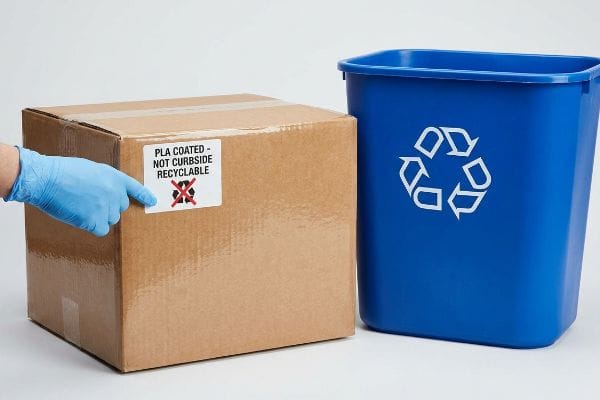
Muchas marcas creen que están tomando decisiones respetuosas con el medio ambiente, pero las combinaciones químicas inadecuadas crean riesgos invisibles que dificultan el cumplimiento de la normativa.
La trampa de compostaje de PLA en contenedores de suelo
Muchas marcas exigen la laminación con bioplástico PLA (ácido poliláctico) para proteger sus expositores abiertos de los equipos de limpieza. Dan por sentado que, al ser una película a base de maíz, se recicla automáticamente en su totalidad mediante el sistema de recogida selectiva en la acera.
Un comprador exigió en una ocasión película de PLA para evitar daños por agua en la tienda. Sin embargo, el PLA crea una barrera sólida e impermeable que obstruye las tinas de repulpado estándar de OCC (Contenedores de Cartón Corrugado Usados)⁵. Al rasgar el cartón, se puede sentir el residuo plástico grueso y rígido. Intervine en el archivo y sustituí el bioplástico por un recubrimiento acuoso líquido. Dado que el acabado acuoso actúa como una matriz polimérica soluble⁶,proporciona una excelente resistencia a la humedad sin dejar de ser totalmente repulpable. Este ajuste garantiza que la marca supere sin problemas las estrictas auditorías de cumplimiento , sin incurrir en costosas tarifas por residuos peligrosos.
| Error común de principiante | La solución profesional | Beneficio para el punto de venta |
|---|---|---|
| Utilizando bioplásticos PLA sólidos | Aplicación de recubrimientos acuosos líquidos | Garantiza una capacidad de reciclaje en la acera del 100%7 |
| Ignorar las normas municipales de reciclaje | Diseño de estructuras monomateriales8 | Supera las auditorías ecológicas de los comercios minoristas |
| Recubrir toda la base con plástico | Utilizando protectores de fregona de 4 pulgadas específicos | Simplifica la eliminación por parte del empleado |
Jamás permito que mis clientes apliquen a ciegas láminas de plástico sólido en proyectos con requisitos medioambientales. Los recubrimientos químicos adecuados protegen tanto la estructura física como la reputación de sostenibilidad de la empresa.
🛠️ Oficina de Harvey: ¿Sus barreras antihumedad actuales están generando costosas multas por residuos peligrosos para sus minoristas? 👉 Solicite una revisión de materiales ↗ — Descargue de forma segura. Mi bandeja de entrada está abierta si tiene alguna pregunta más adelante.
¿Cuáles son los tres tipos de cartón?
Seleccionar el sustrato adecuado es la base fundamental de la ingeniería estructural.
Los tres tipos de cartón son el cartón compacto, el cartón ondulado de una sola capa y el cartón ondulado de doble capa. El cartón compacto es un cartón liso que se utiliza para envases ligeros de consumo. El cartón de una sola capa presenta un arco ondulado entre dos capas para expositores de venta al por menor estándar, mientras que el cartón de doble capa apila dos capas onduladas para soportar con seguridad grandes pesos.
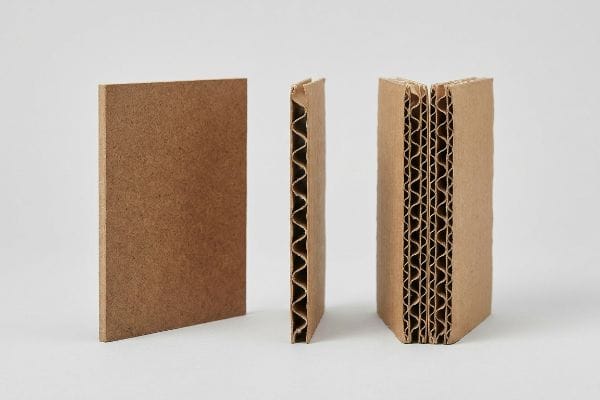
Conocer los nombres es fácil, pero aplicar la clase de material incorrecta a un accesorio de suelo de alta resistencia es un camino directo al desastre.
¿Por qué falla el cartón aglomerado liso en los expositores de suelo?
Los equipos de compras suelen intentar ampliar el tamaño de las pequeñas unidades de mostrador para convertirlas en grandes contenedores de suelo con el fin de mantener la uniformidad visual. Suponen erróneamente que simplemente aumentar la densidad de un cartón liso9 será suficiente para cumplir con los requisitos de carga pesada.
Imagínelo como intentar construir un rascacielos sin vigas de acero. El cartón macizo carece de estructura interna. Cuando veo que los clientes insisten en utilizar materiales lisos para un artículo que soporta 22,68 kg (50 lb), sé que fracasará. Sin los arcos internos ondulados que se encuentran en el cartón corrugado, el impacto cinético no tiene dónde disiparse. Durante las pruebas, se puede observar físicamente cómo el cartón rígido y liso se curva hacia afuera y se deforma irreversiblemente. Exijo estrictamente el uso de cartón ondulado E (microcanal) para estos proyectos, aprovechando esos pequeños arcos internos para absorber las vibraciones del transporte y manteniendo los costos de material prácticamente idénticos.
| Error común de principiante | La solución profesional | Beneficio para el punto de venta |
|---|---|---|
| Ampliación de la producción de tableros de partículas sólidos | Transición a tableros microcanalados | Absorbe los impactos dinámicos del tránsito |
| Basándose estrictamente en la densidad del tablero | Utilizando geometría arqueada interna | Evita el pandeo vertical |
| Utilizar cartón de doble pared grueso para piezas pequeñas | Uso de flauta E para pliegues limpios10 | Acelera el montaje manual |
Prohíbo por completo el uso de aglomerado macizo en cualquier expositor de suelo independiente. Si se requiere integridad estructural bajo cargas dinámicas en el comercio minorista, es imprescindible recurrir a las propiedades físicas del cartón ondulado.
🛠️ Escritorio de Harvey: ¿Estás transformando un pequeño diseño de encimera en un enorme contenedor de suelo sin actualizar el sustrato? 👉 Reclama tu estrategia de calidad para tableros ↗ — Sin formularios que generen interminables llamadas de ventas. Solo valor puro.
¿Qué es un expositor de contenedores de basura?
Un expositor tipo contenedor es la solución ideal para la comercialización a granel.
Un expositor tipo contenedor es un mostrador de cartón corrugado independiente y abierto, diseñado específicamente para la liquidación de productos a granel. Al eliminar los estantes individuales y las tapas estructurales, estos expositores de gran capacidad animan a los compradores a rebuscar entre la mercancía suelta, lo que acelera significativamente las ventas por impulso de artículos de temporada con exceso de existencias o con grandes descuentos.
Pero conocer la teoría no es suficiente cuando las máquinas empiezan a funcionar y se les aplica un peso enorme.
La vulnerabilidad a la compresión de las estructuras con techo abierto
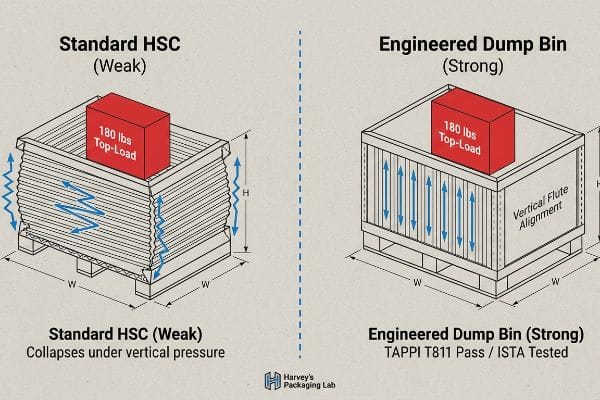
Muchos compradores de embalaje asumen que quitar la tapa superior de una caja de envío estándar crea instantáneamente un expositor funcional para la venta al por menor. Especifican una estructura básica HSC (Half Slotted Container) para ahorrar dinero en materias primas, ignorando cómo las solapas superiores contribuyen a la distribución de la carga11.
En mis instalaciones, veo con frecuencia que los clientes presentan diseños básicos de contenedores abiertos destinados a contener 81,64 kg (180 lb) de producto suelto sobre una paleta de madera. El problema fundamental es que al retirar la cubierta superior se elimina por completo la tensión superior de 360 grados, dejando las esquinas sin soporte estructural. Al someter estos contenedores abiertos al protocolo de prueba TAPPI T811¹²,las paredes verticales sin soporte se cortan violentamente y colapsan bajo cargas simuladas de almacén. Soluciono esto rediseñando rigurosamente la dirección de la fibra. Al imponer una alineación vertical estricta del acanalado interno y ajustar la clasificación ECT¹³( Prueba de Aplastamiento de Bordes), restauro instantáneamente la resistencia a la compresión sin añadir costosos materiales de refuerzo. Este ajuste físico microscópico evita el aplastamiento catastrófico de la paleta, lo que ahorra al cliente enormes costes adicionales y mantiene su cadena de suministro funcionando sin problemas.
| Error común de principiante | La solución profesional | Beneficio para el punto de venta |
|---|---|---|
| Utilizando cajas abiertas estándar de HSC | Alineación perfecta de la veta en posición vertical | Sobrevive a las cargas superiores del almacén |
| Ignorar la tensión faltante de la solapa superior | Actualización a bases de doble pared | Evita que las esquinas abiertas se rompan |
| Basándose en clasificaciones ASTM planas | Ejecutando pruebas dinámicas completas de ISTA | Garantiza un tránsito marítimo seguro |
Me niego a fabricar un contenedor grande de techo abierto sin calcular con precisión la pérdida de tensión superior. Confiar en el grosor de la materia prima en lugar de en la correcta orientación de las ranuras siempre resulta en inventario aplastado.
🛠️ Oficina de Harvey: No permita que un defecto estructural de 2 milímetros arruine el lanzamiento de 500 tiendas. 👉 Envíeme su archivo de troquelado ↗ — Analizaré los cálculos antes de que malgaste su presupuesto en la producción en masa.
Conclusión
Puedes optar por contenedores abiertos baratos y sin soporte, pero si esa estructura se rompe durante el transporte marítimo, provoca un colapso catastrófico de los palets , eliminando los márgenes y generando rechazos inmediatos en las grandes superficies. Esta es la hoja de especificaciones exacta que utilizan mis 10 principales clientes minoristas para garantizar cero rechazos de impresión. Deja de arriesgarte con estructuras de cartón corrugado débiles y permíteme auditar personalmente tus planos con mi Auditoría Previa a la Producción Gratuita ↗ para detectar fallos ocultos antes de la producción en masa.
"[PDF] PELIGROS ESTRUCTURALES – CONTENEDORES DE ACERO – MSHA.gov", https://arlweb.msha.gov/Alerts/structral-bin-hazards080615.pdf. Datos de la industria o estudios de caso sobre cómo las mejoras estructurales, como los divisores en H, reducen las tasas de fallas y rechazos en las exhibiciones minoristas. Función de la evidencia: validación cuantitativa; tipo de fuente: informe de la industria. Apoya: eficacia del mecanismo de tensión. Nota de alcance: valor estimado basado en la experiencia profesional. ↩
"Cajas de cartón corrugado de pared simple vs. de doble pared: ¿Cuál es la diferencia?", https://www.boxish.in/blogs/post/single-wall-vs-double-wall-corrugated-boxes-whats-the-difference. Comparación técnica de la resistencia a la compresión de los bordes (ECT) entre cartón corrugado de pared simple y de doble pared en expositores para puntos de venta. Función de la evidencia: especificación técnica; tipo de fuente: estándar de la industria del embalaje. Apoya: la afirmación de que el cartón de doble pared evita el colapso del nivel inferior. Nota de alcance: se aplica a materiales de cartón corrugado. ↩
"Qué es un expositor para contenedores de descarga y cuándo funciona mejor...", https://popdisplay.me/what-is-a-dump-bin-display-and-when-does-it-work-best/. Explicación técnica de cómo las bandas de refuerzo horizontales contrarrestan la tensión circunferencial y la expansión lateral en contenedores a granel. Función de la evidencia: principio mecánico; tipo de fuente: manual de ingeniería estructural. Apoya: la afirmación de que las bandas de refuerzo mantienen la forma estética bajo presión. Nota de alcance: específicamente para contenedores de paredes flexibles. ↩
"Recubrimiento de papel reciclable y biodegradable con funcionalización…", https://pmc.ncbi.nlm.nih.gov/articles/PMC11948148/. Verificación técnica de que los recubrimientos de PLA no son reciclables en las instalaciones municipales estándar de reciclaje de papel. Función de la evidencia: especificación técnica; tipo de fuente: guía de reciclaje industrial. Apoya: la afirmación de que el PLA complica el reciclaje en la acera. Nota de alcance: se centra en la interacción del PLA con los procesos de fabricación de pulpa de papel. ↩
"Más allá de los plásticos fósiles: bioplásticos de próxima generación basados en PLA… – PMC", https://pmc.ncbi.nlm.nih.gov/articles/PMC13001162/. Documentación técnica de asociaciones de gestión de residuos o ingenieros de reciclaje que explica cómo los bioplásticos no repulpables interfieren con el proceso de recuperación de fibra para cartón ondulado. Función de la evidencia: verificación del mecanismo; tipo de fuente: estándar técnico de la industria. Apoya: la afirmación de que el PLA interrumpe el reciclaje de OCC. Nota de alcance: enfoque en las instalaciones municipales de repulpado. ↩
"La verdad sobre por qué los revestimientos acuosos no están libres de plástico – Verive", https://verive.eu/food-packaging-materials/aqueous-lining-plastic-free-truth/. Análisis químico o fichas de datos de seguridad de materiales que confirman que los recubrimientos a base de agua se disuelven durante el proceso de pulpado, a diferencia de las películas de plástico sólido. Función de la evidencia: comparación de materiales; tipo de fuente: revista de química/ciencia de los materiales. Apoya: la posibilidad de repulpaje de acabados acuosos sobre bioplásticos. Nota de alcance: específicamente en lo que respecta a recubrimientos de cartón. ↩
"Recubrimiento a base de agua vs. PLA vs. PE en tazones y vasos de papel", https://www.bioleaderpack.com/navigating-2026-plastic-bans-water-based-coating-vs-pla-vs-pe-lined-paper-bowls-cups/. Verificación técnica de que los recubrimientos acuosos mantienen tasas de recuperación de fibra adecuadas para sistemas de reciclaje municipales en comparación con el PLA. Función de la evidencia: validación técnica; tipo de fuente: estándares industriales. Apoyos: beneficio de los recubrimientos acuosos sobre el PLA. Nota de alcance: limitado a procesos estándar de fabricación de papel. ↩
"Impulsar la sostenibilidad con envases monomateriales | Negocios – Shell", https://www.shell.us/business/sectors/shell-polymers/resources-and-insights/boost-sustainability-with-mono-material-packaging.html. Evidencia de que la construcción con un solo material es un requisito fundamental para superar las auditorías de sostenibilidad comerciales. Función de la evidencia: cumplimiento de la industria; tipo de fuente: marco regulatorio. Apoya: beneficio del diseño monomaterial. Nota de alcance: se aplica a los estándares minoristas globales. ↩
"Resistencia a la compresión de envases de cartón ondulado...", https://pmc.ncbi.nlm.nih.gov/articles/PMC10054506/. Análisis técnico de la densidad del cartón frente a la rigidez estructural para cargas pesadas. Función de la evidencia: validación técnica; tipo de fuente: manual de ingeniería. Apoya: la afirmación de que la densidad por sí sola no puede reemplazar el ondulado para el soporte estructural. Nota de alcance: se aplica a las normas de embalaje industrial. ↩
"Descifrando la geometría del cartón corrugado de doble pared mediante…", https://pmc.ncbi.nlm.nih.gov/articles/PMC10974599/. Comparación del espesor y la resistencia a la compresión del cartón ondulado tipo E en relación con la precisión del plegado en embalajes a pequeña escala. Función de la evidencia: especificación del producto; tipo de fuente: estándar industrial. Apoyos: facilidad de montaje y calidad del plegado. Nota de alcance: específico para el grado de cartón ondulado tipo E. ↩
"Estimación de la resistencia a la compresión de cajas de cartón corrugado…", https://pmc.ncbi.nlm.nih.gov/articles/PMC8467740/. Un análisis de ingeniería del embalaje de cartón corrugado explicaría la función mecánica de las tapas/solapas para mantener la resistencia a la compresión vertical y evitar el pandeo de las paredes. Función de la evidencia: Verificación técnica; tipo de fuente: Manual de ingeniería de embalaje. Apoya: La afirmación de que quitar las solapas reduce la estabilidad estructural. Nota de alcance: Se centra en la capacidad de carga vertical. ↩
«Métodos de ensayo de aplastamiento de bordes y compresión de cajas…», https://www.tappi.org/publications-standards/tappi-journal/home/2022/aug/edge-crush-testing-methods-and-box-compression-modeling-tappi-journal-august-2022/. Documentación técnica de TAPPI que confirma que la norma T811 define el procedimiento para medir la resistencia a la compresión de los envases de cartón ondulado. Función de evidencia: validación técnica; tipo de fuente: norma industrial. Apoya: la validez del ensayo de colapso descrito. Nota de alcance: se aplica específicamente al cartón ondulado. ↩
"Estimación de la resistencia al aplastamiento de los bordes del cartón corrugado...", https://pmc.ncbi.nlm.nih.gov/articles/PMC9961700/. Investigación en ciencia de materiales que demuestra que el acanalado vertical maximiza la resistencia a la compresión y que las clasificaciones de la prueba de aplastamiento de bordes (ECT) se correlacionan con la capacidad de carga. Función de la evidencia: principio científico; tipo de fuente: manual de ingeniería. Apoya: la eficacia de la solución de reingeniería. Nota de alcance: se centra en la física estructural del cartón corrugado. ↩