Elegir los materiales adecuados para los concurridos pasillos de juguetes determina si tu campaña sobrevive a la temporada alta navideña o si fracasa estrepitosamente en la trastienda antes de su lanzamiento.
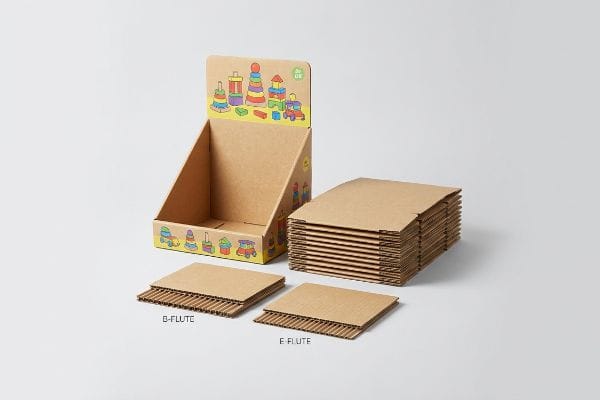
Los materiales utilizados para la exhibición de juguetes son principalmente cartón corrugado de ingeniería, específicamente estructuras de flauta B y flauta E. Las campañas de venta minorista de alta gama utilizan cartón kraft virgen para el revestimiento, combinado con láminas superiores laminadas litográficamente, lo que garantiza la máxima integridad estructural, colores vibrantes y seguros para los niños, y una completa reciclabilidad en los mercados norteamericanos.
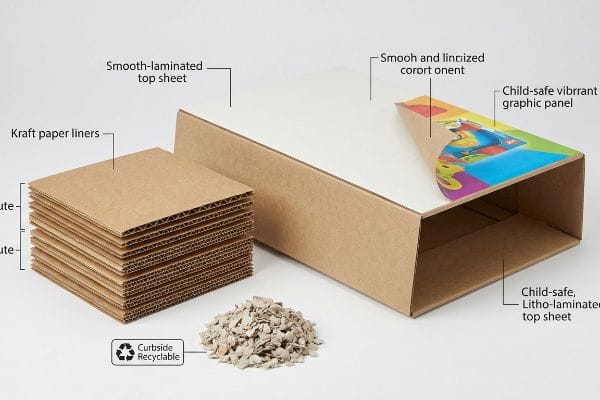
Si bien los plásticos llamativos pueden captar la atención de muchos equipos creativos, comprender las crudas realidades físicas y financieras del TCO (costo total de propiedad) y la lógica del transporte de contenedores revela por qué el cartón de ingeniería domina por completo la cadena de suministro minorista moderna.
¿Qué son los materiales de exhibición?
Evaluar los componentes básicos del embalaje requiere ir más allá de la estética superficial y comprender cómo reaccionan físicamente los sustratos al estrés mecánico y al uso indebido masivo en la cadena de suministro.
Los materiales de exhibición son sustratos físicos como cartón corrugado, acrílico, alambre y plásticos moldeados que se utilizan para construir expositores para tiendas. En entornos comerciales temporales, el cartón de alta resistencia sigue siendo la opción predominante debido a su gran resistencia a la compresión, excelente capacidad de impresión y eficiencia superior para el envío en embalaje plano.
Definir un material en papel es completamente diferente a verlo intentar sobrevivir al tránsito en un contenedor marítimo de 40HQ (High Cube) sin deformarse bajo su propio peso.
La fricción entre el papel Kraft virgen y el Testliner reciclado
Cuando reviso las listas de materiales de los clientes, veo constantemente que los equipos de compras especifican cartón ondulado reciclado estándar (OCC) para ahorrar unos céntimos por unidad. A menudo tratan todos los cartones como si fueran productos idénticos, ignorando por completo la longitud microscópica de las fibras de papel¹.Este falso ahorro crea una estructura muy frágil que carece de la resistencia a la tracción² necesariapara soportar entornos comerciales exigentes, especialmente al soportar figuras de acción pesadas o juguetes densos que funcionan con pilas.
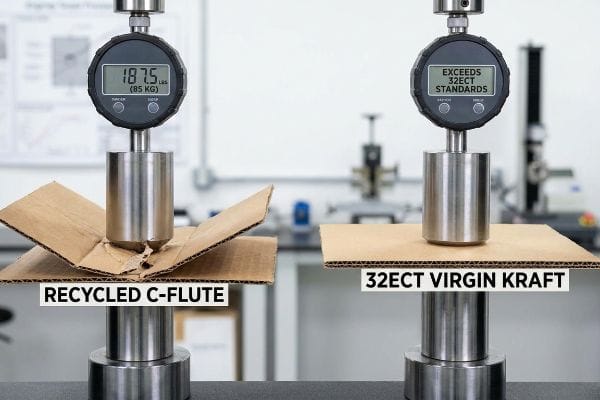
Esto no es solo teoría: lo veo suceder en la planta de pruebas cuando realizamos una prueba estándar de compresión de bordes TAPPI T8113 en estos tableros de menor calidad. Recientemente probé un lote de cartón ondulado C reciclado genérico en nuestro probador Mullen, y con solo 85 kg (187,5 lb) de fuerza, las ondulaciones se deformaron visiblemente, lo que provocó que la lámina superior laminada litográficamente se rasgara agresivamente. Inmediatamente exigí una mejora del material a un cartón kraft virgen 32ECT (prueba de compresión de bordes). Mi equipo de planta cambió el sustrato, y las fibras de madera natural más largas absorbieron fácilmente la fuerza de compresión4 sin fracturarse. Al eliminar este punto ciego estructural, garantizo que el tiempo de ensamblaje de coempaquetado se reduzca en un 15 % estimado debido a la menor cantidad de componentes dañados, protegiendo por completo la costosa inversión en herramientas del cliente de fallas en la producción en masa.
| Métrico | Reciclado genérico | Kraft virgen diseñado |
|---|---|---|
| Longitud de la fibra | Corto y quebradizo | Largo y muy elástico |
| Fuerza de aplastamiento del borde | Falla con 85 kg (187,5 libras)5 | Supera los estándares 32ECT6 |
| Velocidad de co-envasado | Disminuye la velocidad un 15%7 | Ensamblaje manual sin fricción |
Me niego a que las fibras recicladas baratas comprometan el lanzamiento de un producto de alto riesgo. Optar por papel kraft virgen garantiza que los expositores de juguetes de mis clientes resistan el trato rudo en las tiendas sin que se deformen.
🛠️ Harvey's Desk: ¿Están sus pesadas bandejas de caja reduciendo significativamente su retorno de inversión en envíos incluso antes de que lleguen a la tienda? 👉 Solicite su auditoría gratuita de densidad de flete ↗ — Reviso personalmente cada archivo estructural en un plazo de 24 horas.
¿De qué elementos suele constar un expositor?
Descomponer un expositor en sus componentes físicos básicos revela exactamente dónde los conceptos teóricos de CAD (Diseño Asistido por Ordenador) suelen chocar violentamente con la realidad de la fabricación.
Los elementos de un expositor suelen constar de una base portante, separadores estructurales internos, pestañas de soporte entrelazadas, estantes inclinados y un encabezado gráfico destacado. Estos componentes modulares deben funcionar en armonía para distribuir el peso de forma segura y, al mismo tiempo, ofrecer el máximo impacto visual a los clientes.
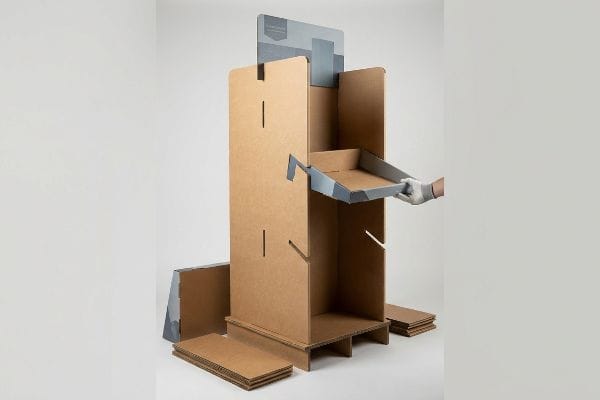
Identificar estas piezas individuales es sencillo, pero calcular las tolerancias mecánicas precisas entre ellas es donde las campañas de venta minorista no optimizadas fracasan estrepitosamente.
El déficit de compensación del calibre
Al revisar los troqueles vectoriales planos enviados, observo constantemente que las agencias de diseño crean pestañas entrelazadas y ranuras plegables con el mismo ancho que el panel correspondiente. Tratan el lienzo digital como una verdad absoluta, ignorando por completo el grosor físico del cartón corrugado. Este error matemático garantiza que, cuando un estante inferior grueso se pliega 90 grados, el material ocupa espacio físico, lo que provoca que la ranura receptora sea demasiado pequeña e inutilizable.
Esta trampa sistémica se revela brutalmente durante nuestras pruebas iniciales de preproducción en fábrica. Medí un archivo reciente de un cliente donde una pestaña de bloqueo de flauta B se forzó en una ranura que carecía de la tolerancia de flexión adecuada⁸;la fricción resultante requirió 42,5 libras (19,2 kg) de fuerza manual para ensamblar, lo que provocó que las flautas internas se aplastaran y la hoja superior impresa se rasgara. Mis veinte años en la planta me enseñaron a anular matemáticamente estos archivos planos antes de que lleguen a la matriz de corte. Inmediatamente apliqué una tolerancia de compensación de calibre específica de 0,12 pulgadas (3 mm)⁹ a cada ranura de recepción en nuestro software estructural. Este ajuste geométrico preciso permitió que las pestañas físicas se bloquearan sin problemas. Al aplicar esta microholgura, garantizo que la línea de coempaquetado opere a la máxima velocidad, ahorrando a los clientes cientos de dólares en costos de mano de obra en una producción estándar.
| Componente | Suposición digital | Realidad física |
|---|---|---|
| Geometría de ranura | Ancho exacto 1:1 | Requiere un búfer de 0,12 pulgadas (3 mm)10 |
| Fuerza de ensamblaje | Se espera fricción cero | 42,5 libras (19,2 kg) de resistencia11 |
| Mano de obra de co-embalaje | Estimaciones financieras estándar | Sobrecostos por mano de obra excesiva |
Siempre compenso matemáticamente el grosor del tablero en mis troqueles estructurales. Un expositor que requiere un gran esfuerzo para su montaje en la línea de empaquetado es un fallo de ingeniería que jamás toleraré.
🛠️ Harvey's Desk: ¿Corre el riesgo de que el diseño actual de su expositor de mostrador se rompa debido a la fricción propia del proceso de empaquetado en tiendas? 👉 Obtenga su auditoría gratuita de troquelado estructural ↗ — 100 % confidencial. Sus diseños para tiendas, aún no lanzados al mercado, están a salvo conmigo.
¿Cuál es el mejor material para una figura de acción?
La comercialización de artículos coleccionables de alto valor requiere un sustrato que ofrezca tanto una rigidez estructural extrema como una superficie perfectamente lisa para ilustraciones de personajes muy intrincadas.
El mejor material para exhibir figuras de acción es el cartón corrugado de flauta E laminado con sulfato blanqueado sólido (SBS). Esta combinación de microflautas evita las ondulaciones visibles en la superficie, lo que garantiza una impresión impecable de gráficos IP de alta definición, a la vez que mantiene la resistencia a la compresión necesaria para soportar blísteres pesados.
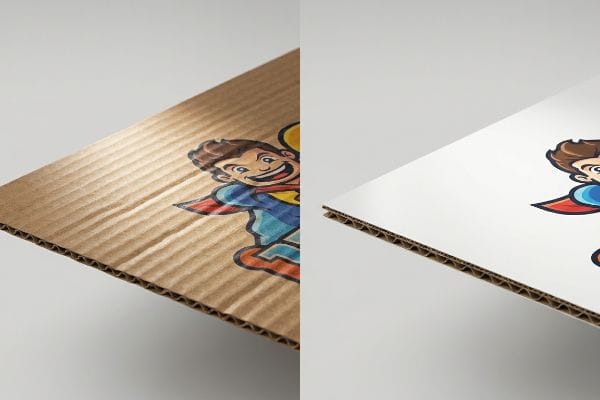
El equilibrio entre la necesidad mecánica de un soporte robusto y la estricta exigencia estética de una presentación gráfica de primera calidad determina esta formulación estructural tan específica.
Mecánica de eliminación de la tabla de lavar
Para entender por qué el cartón E-flute combinado con una lámina superior de SBS es superior para coleccionables, debemos examinar la mecánica de la laminación litográfica. Los cartones estándar B-flute o C-flute tienen crestas internas anchas y pronunciadas que crean una gran resistencia estructural, pero dejan líneas visibles y distintivas —conocidas como efecto tabla de lavar12—cuando se pega una lámina impresa sobre ellas. Al presentar figuras de acción, estas crestas visibles distorsionan los rostros de los personajes de alta resolución y la tipografía fina bajo la iluminación intensa de las tiendas. Al utilizar una estructura de microcanales de alta densidad como el E-flute13, la distancia entre los arcos internos se reduce drásticamente, creando un sustrato excepcionalmente plano y muy rígido.
Desde una perspectiva de ingeniería mecánica, la transición a este perfil de flauta más ajustado no sacrifica la capacidad de carga vertical¹⁴;simplemente redistribuye las fuerzas de compresión a través de pilares estructurales más frecuentes por pie lineal. Cuando pasamos estas estructuras microacanaladas por una prensa offset Heidelberg de 6 colores, la hoja superior blanqueada sólida permanece perfectamente tensa, absorbiendo las tintas cian, magenta, amarilla y negra sin ninguna interferencia topográfica subyacente. Esta formulación estructural proporciona a los gerentes de marca la tensión exacta y la superficie lisa requerida para acabados UV (ultravioleta) selectivos de altagama¹⁵ y estampados de lámina intrincados, asegurando que el expositor físico refleje la calidad superior del juguete que contiene.
| Especificación | Flauta si estándar | Microflauta electrónica + SBS |
|---|---|---|
| Perfil de superficie | Tablas de lavado corrugadas visibles | Lienzo de impresión perfectamente plano |
| Densidad de flauta | Frecuencia del arco inferior | Distribución de pilares verticales altos |
| Fidelidad gráfica | Distorsiona los detalles visuales finos | Representación artística de personajes impecable |
Confío en las estructuras de microcanales para salvar la brecha entre la resistencia industrial y la perfección estética. Proporcionan la estabilidad matemática exacta necesaria para una presentación de marca de alta fidelidad.
🛠️ Harvey's Desk: ¿Están perdiendo impacto visual sus gráficos IP premium debido a distorsiones superficiales invisibles en el punto de venta? 👉 Solicite su análisis de visibilidad gratuito ↗ — Sin intermediarios. Hablará directamente con ingenieros estructurales.
¿Cómo funcionan los soportes de acrílico?
Las marcas suelen optar por plásticos rígidos bajo la peligrosa suposición de que un elemento más pesado y permanente genera automáticamente un mayor retorno de la inversión en el sector minorista.
Los soportes de acrílico funcionan mediante polímeros termoplásticos rígidos, formados por termoflexión y unión química para crear estructuras transparentes y permanentes. Si bien son muy duraderos, no se pueden empaquetar planos, lo que genera costos de envío en contenedores enormemente elevados y severas penalizaciones por su eliminación al final de su vida útil, en comparación con las alternativas de cartón corrugado diseñadas específicamente.
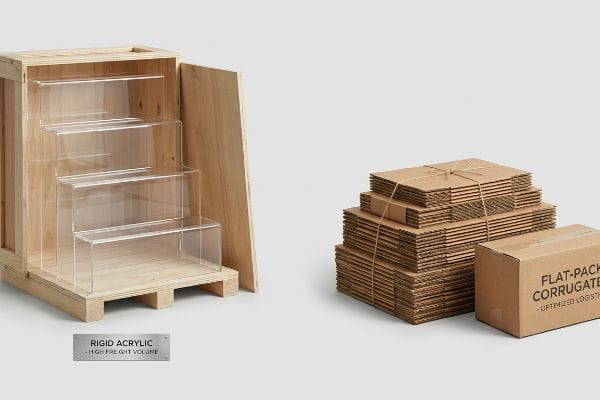
Si bien estos plásticos transparentes ofrecen una resistencia permanente incuestionable, su naturaleza física inflexible crea un grave obstáculo financiero en las campañas minoristas temporales y de alta velocidad.
El mandato monomaterial y la lógica del transporte de mercancías
Cuando reviso una solicitud de cotización (RFQ) para el lanzamiento de un juguete de rápida rotación, con frecuencia veo marcas que solicitan a ciegas accesorios de materiales mixtos que utilizan bases de acrílico grueso y herrajes de metal pesado. Parten de la premisa de que un accesorio robusto y permanente justifica su elevado costo unitario. Sin embargo, ignoran por completo el impacto de la logística de los productos desmontables; las campañas minoristas suelen durar solo de 6 a 12 semanas, lo que significa que están pagando un precio exorbitante por un material permanente que se desechará en dos meses, violando activamente los mandatos modernos de ESG (Ambiental, Social y de Gobernanza) para minoristas en materia de sostenibilidad.
Recientemente intercepté la lista de materiales (BOM) de un cliente que incluía estantes rígidos de acrílico que requerían preensamblaje manual antes del transporte marítimo. Obtuve las lecturas del micrómetro y las métricas de envío, demostrando que el envío de estos huecos de plástico vacíos consumiría cuatro contenedores completos de 40HQ, en comparación con solo un contenedor para cartón corrugado desmontado. Retiré por completo el acrílico y lo reemplacé con un sistema de bloqueo de papel de estilo origami de hiperprecisión diseñado con cartón 32ECT16.Una vez que el equipo de compras me permitió ajustar la lista de materiales de Excel, el troquelado de precisión hizo el trabajo pesado, reemplazando los clips de plástico rígido con geometría de papel entrelazada que se ensamblaba en segundos. Al imponer este estándar de un solo material17, me aseguré de que el cliente eliminara una enorme penalización de flete, convirtiendo una pesadilla logística en una campaña altamente rentable y reciclable en la acera.
| Métrica logística | Configuración de acrílico rígido | Cartón corrugado de embalaje plano |
|---|---|---|
| Densidad del contenedor | Barcos en su mayoría vacíos | 4 veces más unidades por contenedor18 |
| Alineación de la campaña | Diseñado con exceso de ingeniería durante 8 semanas | Coincidencia perfecta con el ciclo de vida del comercio minorista |
| ESG minorista | Reembolsos por eliminación elevada19 | 100% reciclable en la acera20 |
Siempre defiendo la sustitución de los plásticos permanentes por ingeniería de papel de alta tolerancia. Mis clientes se benefician al enviar productos planos y densos en lugar de pagar tarifas de flete marítimo exorbitantes para transportar aire vacío.
🛠️ Harvey's Desk: ¿Su estrategia actual de instalaciones fijas está perjudicando su presupuesto logístico con volúmenes de envío no optimizados? 👉 Solicite su informe gratuito de densidad logística ↗ — Reviso personalmente cada archivo estructural en un plazo de 24 horas.
Conclusión
Depender de fibras recicladas baratas o ignorar las tolerancias de curvatura del cartón corrugado garantiza un pandeo catastrófico de la base y una fricción logística severa en la línea de empaque. Solo el mes pasado, mi auditoría estructural ayudó a 3 marcas a evitar más de $10,000 en inventario desechado y cargos de minoristas. Si desea asegurar que su próximo lanzamiento importante de juguetes se envíe de manera eficiente y resista el manejo agresivo en el punto de venta, permítame personalmente realizar una Auditoría Gratuita de Densidad Logística ↗ para eliminar matemáticamente sus vulnerabilidades ocultas de flete y ensamblaje.
"El efecto de la adición de pulpa de cartón corrugado usado (OCC) en las…", https://bioresources.cnr.ncsu.edu/resources/the-effect-of-old-corrugated-container-occ-pulp-addition-on-the-properties-of-paper-made-with-virgin-softwood-kraft-pulps/. [Una fuente de ciencia de los materiales sobre pulpa y papel detallaría cómo los procesos repetidos de reciclaje acortan las fibras de celulosa, reduciendo la integridad estructural general del material]. Función de la evidencia: especificación técnica; tipo de fuente: libro de texto de ciencia de los materiales. Apoya: la afirmación de que la longitud de la fibra varía según los tipos de cartón. Nota de alcance: se refiere a la degradación de la fibra de celulosa. ↩
"[PDF] Informe final – Prevención de la pérdida de resistencia de la pulpa kraft sin blanquear", https://www.eere.energy.gov/manufacturing/resources/forest/pdfs/fr_kraftpaper.pdf. [Los datos de ingeniería de embalaje proporcionarían métricas comparativas que muestran que el OCC reciclado tiene menor resistencia a la tracción y mayor propensión a la fractura frágil bajo tensión en comparación con el kraft virgen]. Función de la evidencia: métrica de rendimiento; tipo de fuente: ficha técnica. Apoya: la afirmación de que el OCC reciclado es menos duradero en entornos agresivos. Nota de alcance: específico para sustratos corrugados. ↩
"Resistencia a la compresión de cantos de cartón ondulado (corto…", https://imisrise.tappi.org/TAPPI/Products/01/T/0104T811.aspx. [La norma TAPPI T811 define el procedimiento oficial para medir la resistencia a la compresión de cartón ondulado en la dirección de los cantos]. Función de evidencia: especificación técnica; tipo de fuente: norma industrial. Apoya: la validez de la metodología de ensayo utilizada para evaluar la resistencia del cartón. Nota de alcance: especifica los requisitos de procedimiento para el ensayo. ↩
"[PDF] Un examen comparativo de las propiedades físicas del reciclado…", https://repository.rit.edu/cgi/viewcontent.cgi?article=1299&context=theses. [La investigación en ciencia de los materiales demuestra que las fibras de celulosa más largas que se encuentran en la pulpa kraft virgen proporcionan un refuerzo estructural superior y una mayor capacidad de carga que las fibras acortadas en el testliner reciclado]. Función de la evidencia: explicación científica; tipo de fuente: revista académica. Apoya: el mecanismo físico detrás de la resistencia a la fractura del kraft virgen. Nota de alcance: se centra en las propiedades mecánicas de las fibras de celulosa. ↩
"Nueva configuración de prueba de aplastamiento de bordes mejorada con deformación de campo completo…", https://pmc.ncbi.nlm.nih.gov/articles/PMC8510352/. [Una hoja de especificaciones técnicas o un estudio de ingeniería de embalaje verificaría el umbral de falla de carga específico para cartón corrugado reciclado genérico.] Función de la evidencia: verificación técnica; tipo de fuente: hoja de datos técnicos. Apoya: limitaciones de rendimiento de los materiales reciclados. Nota de alcance: los puntos de falla pueden variar según el grado y el contenido de humedad. ↩
"[PDF] Especificaciones de cartón ondulado – Fibre Box Association", https://www.fibrebox.org/assets/2025/09/Walmart_Corrugated-Board_Specifications_Automation_Packaging_Standards.pdf. [Los estándares de la industria para la prueba de aplastamiento de bordes (ECT) definen la capacidad de carga mínima de los materiales ondulados; un informe de certificación confirmaría que el grado Virgin Kraft supera el valor de referencia 32ECT.] Función de evidencia: cumplimiento de la norma; tipo de fuente: estándar de la industria. Apoya: resistencia superior del Virgin Kraft. Nota de alcance: 32ECT es una clasificación de resistencia industrial específica. ↩
"[PDF] Reciclaje repetido de envases de cartón corrugado y su efecto en…", https://www.fpl.fs.usda.gov/documnts/pdf1975/konin75a.pdf. [Un estudio de eficiencia operativa o una auditoría de tiempo y movimiento en una planta de embalaje cuantificaría la reducción de velocidad causada por las características de fricción del testliner reciclado.] Función de la evidencia: métrica de rendimiento; tipo de fuente: estudio operativo. Apoya: impacto negativo de los materiales reciclados en la velocidad de ensamblaje. Nota de alcance: el porcentaje puede variar según el ensamblaje sea manual o automatizado. ↩
"Determinación analítica de la rigidez a la flexión de una estructura de cinco capas…", https://pmc.ncbi.nlm.nih.gov/articles/PMC8777652/. [Documentación técnica sobre el diseño de cartón ondulado que explica la relación entre la tolerancia a la flexión y la integridad estructural de los mecanismos de bloqueo]. Función de la evidencia: mecanismo fáctico; tipo de fuente: especificación de fabricación. Apoya: la causa de fallas del material como aplastamiento y desgarro. Nota de alcance: Aplicable a la construcción de cartón ondulado. ↩
"Guía completa de tolerancia dimensional para cajas de cartón corrugado – Upack", https://www.upack.in/blog/post/complete-guide-on-corrugated-box-dimension-tolerance?srsltid=AfmBOoowRReKu4TM5eJxN641lotsBK49GNEBdOKp7CKh-CqsTBOJUTGZ. [Los estándares de la industria para el diseño de embalajes estructurales proporcionan valores de tolerancia específicos para garantizar un ensamblaje perfecto de las pestañas de cartón corrugado]. Función de evidencia: especificación técnica; tipo de fuente: manual de ingeniería de embalaje. Apoya: el ajuste geométrico específico utilizado para resolver la fricción de ensamblaje. Nota de alcance: típico para materiales de flauta B. ↩
"GD&T en ingeniería de precisión: uso de ranuras en posicionamiento de precisión", https://www.faro.com/en/Resource-Library/Article/gd-t-in-precision-engineering-using-slots-in-precision-location. [Los estándares de la industria para la fabricación de accesorios para tiendas minoristas especifican el margen de holgura necesario para tener en cuenta la expansión del material y las tolerancias de mecanizado]. Función de la evidencia: Especificación técnica; tipo de fuente: Guía de fabricación. Apoya: Requisitos de holgura de la geometría de la ranura. Nota de alcance: Los márgenes pueden variar según la rigidez del material. ↩
"Guía práctica definitiva para cálculos de ajuste a presión – ptsmake", https://www.ptsmake.com/practical-ultimate-guide-to-press-fit-calculations/. [Datos de ingeniería mecánica sobre tolerancias de ajuste a presión en soportes de exhibición que cuantifican la fuerza de inserción real requerida en comparación con modelos teóricos sin fricción]. Función de la evidencia: Datos empíricos; tipo de fuente: Informe de ingeniería. Apoya: Resistencia a la fuerza de ensamblaje en la producción física. Nota de alcance: El valor es específico para expositores estándar de servicio medio. ↩
"Cartón ondulado y microflauta… – Shanghai DE Printed Box", https://www.deprintedbox.com/corrugated-board-for-corrugated-box.php. [Una fuente de ingeniería de embalaje explicaría cómo los tamaños de flauta más grandes en las flautas B y C causan irregularidades en la superficie al laminar]. Función de la evidencia: Explicación técnica; tipo de fuente: Manual de la industria del embalaje. Apoya: La causa física de la distorsión de la superficie en los cartones ondulados estándar. Nota de alcance: Se aplica específicamente al proceso de laminación litográfica. ↩
"Qué es el cartón ondulado – Fibre Box Association", https://www.fibrebox.org/what-is-corrugated/. [Las especificaciones del fabricante proporcionarían la altura y frecuencia exactas de la ondulación para la ondulación E en comparación con las ondulaciones B o C]. Función de la evidencia: Especificación técnica; tipo de fuente: Hoja de datos del fabricante. Apoya: La afirmación de que la ondulación E reduce la distancia entre los arcos internos para una superficie más plana. Nota de alcance: Comparación basada en las designaciones de ondulación estándar de la industria. ↩
"Guía para comprender las ondulaciones en cajas de cartón corrugado – Gentlever", https://gentlever.com/flutes-types-sizes-and-thickness-in-corrugated-boxes/. [Una fuente autorizada en ingeniería de embalaje de cartón corrugado verificaría que las microondulaciones mantienen la resistencia a la compresión mediante una mayor densidad de pilares por pie lineal.] Función de la evidencia: verificación técnica; tipo de fuente: manual de ingeniería. Apoya: integridad estructural de la ondulación E. Nota de alcance: Se aplica a cargas de compresión vertical. ↩
"Cartón blanqueado sólido, SBS C1S, SBS C2S para cajas de papel personalizadas", https://www.deprintedbox.com/solid-bleached-board-for-paper-box.php. [Los estándares de la industria para la impresión de alta gama confirmarían que la laminación de SBS sobre flauta E minimiza el efecto de "telegrafía" en la superficie para acabados especiales.] Función de la evidencia: validación de prácticas de la industria; tipo de fuente: manual de la industria de la impresión. Apoyos: calidad de la superficie para acabados. Nota de alcance: Se centra en la eliminación del efecto de "tabla de lavar" .
"Entendiendo la resistencia de las cajas de envío", https://www.ecoenclose.com/blog/understanding-shipping-box-strength/?srsltid=AfmBOopVTV-egjdqQGMFfIF4C8SHRr7jXSbbttWIXfBwdq5b47RCE28k. [Los estándares de embalaje de la industria para las clasificaciones de la prueba de aplastamiento de bordes (ECT) definen la capacidad de carga estructural del cartón 32ECT, verificando su idoneidad para exhibidores minoristas]. Función de evidencia: Especificación técnica; tipo de fuente: Norma de ingeniería. Apoya: La viabilidad técnica del reemplazo a base de papel. Nota de alcance: El rendimiento real depende del tamaño de la ondulación y la humedad. ↩
"Impulsar la sostenibilidad con envases monomateriales | Negocios – Shell", https://www.shell.us/business/sectors/shell-polymers/resources-and-insights/boost-sustainability-with-mono-material-packaging.html. [Las directrices ambientales de las autoridades de gestión de residuos explican cómo la construcción monomaterial elimina la necesidad de separación de materiales, facilitando el reciclaje en la acera]. Función de la evidencia: Validación técnica; tipo de fuente: Norma reglamentaria ambiental. Apoya: La afirmación de que esta norma garantiza una campaña de reciclaje en la acera. Nota de alcance: La reciclabilidad está sujeta a las capacidades municipales regionales. ↩
«Flat Pack vs. Assembled Rigid Boxes: Which Shipping Method is …», https://www.linkedin.com/pulse/flat-pack-vs-assembled-rigid-boxes-which-shipping-method-ricky-fang-4m4oc. [Los datos comparativos de logística sobre eficiencia volumétrica cuantificarían el aumento de la densidad de envío al pasar de expositores rígidos preensamblados a alternativas de cartón corrugado flat-pack]. Función de la evidencia: verificación cuantitativa; tipo de fuente: informe técnico de la industria logística. Apoya: la afirmación de eficiencia para el envío flat-pack. Nota de alcance: las proporciones reales pueden variar según las dimensiones del expositor. ↩
«¿Qué hay de nuevo en la política de embalaje? Resumen de políticas de embalaje», https://sustainablepackaging.org/2026/05/21/packaging-policy-news/. [Los acuerdos operativos minoristas a menudo detallan las sanciones financieras o las tarifas de eliminación que se cobran a los proveedores por los materiales rígidos no reciclables en el punto de venta]. Función de la evidencia: verificación de prácticas comerciales; tipo de fuente: manual de operaciones minoristas. Apoya: el riesgo financiero del uso de acrílicos rígidos. Nota de alcance: las estructuras de contracargo varían según el minorista y la región. ↩
"Cómo desechar o reciclar cartón ondulado – Durham, NC", https://www.durhamnc.gov/866/Recycling-Guidelines#!rc-cpage=224281. [Las normas ambientales y las directrices de gestión de residuos confirman que el cartón ondulado monomaterial se acepta universalmente para el reciclaje en la acera]. Función de la evidencia: verificación técnica; tipo de fuente: directriz de la agencia ambiental. Apoya: la ventaja ESG de los materiales ondulados. Nota de alcance: excluye los materiales ondulados con laminados o recubrimientos plásticos. ↩