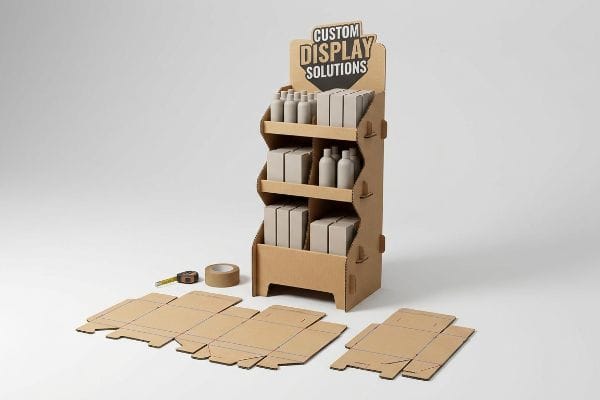
Buscar un fabricante confiable para producir sus exhibidores comerciales puede ser como caminar por un campo minado. Si elige al socio equivocado, su campaña fracasará antes de llegar a la tienda.
Para encontrar expositores para el punto de venta, es necesario evaluar a fabricantes de embalajes especializados, socios de la cadena de suministro global o empresas de ingeniería estructural. Los proveedores de alta calidad se centran en materiales de cartón corrugado, troquelado de precisión y el estricto cumplimiento de las normas minoristas internacionales para garantizar que sus expositores resistan el transporte y funcionen de forma segura.
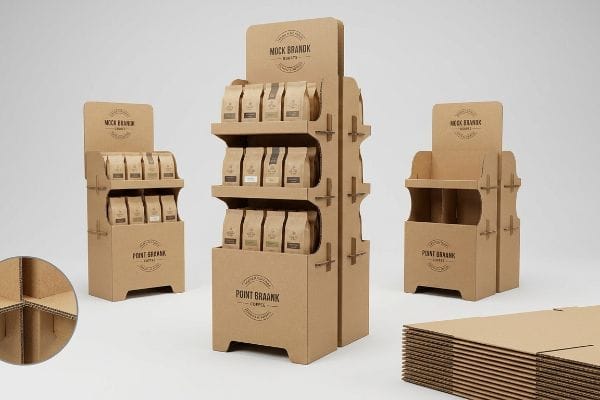
Pero encontrar un proveedor no se trata solo de conseguir el presupuesto más barato; se trata de evitar los fallos estructurales catastróficos que se producen cuando la teoría se enfrenta a la realidad en la línea de producción física.
¿Dónde se ubican los displays en los puntos de venta?
La ubicación determina por completo el diseño estructural. Si no se sabe con exactitud dónde se ubicará la unidad, no se puede diseñar matemáticamente para que resista las condiciones ambientales.
Los expositores de punto de venta se ubican estrictamente cerca de las cajas registradoras, mostradores o cabeceras de góndola de alto tránsito. Estas zonas comerciales específicas requieren estructuras más pequeñas y estables en comparación con las enormes paletas de pasillo, lo que garantiza que se aprovechen las compras impulsivas de último minuto sin obstaculizar el paso de los clientes ni infringir las limitaciones de alcance.
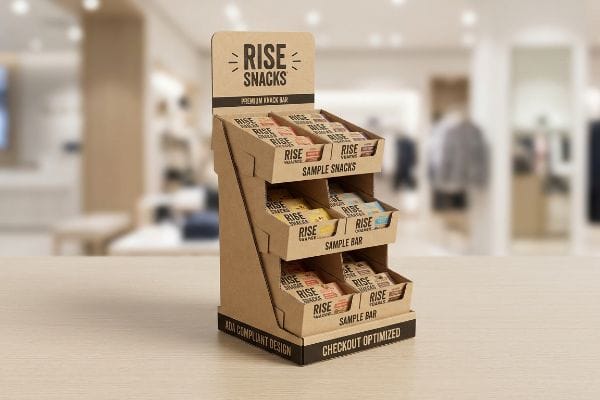
Muchos equipos de marca dan por sentado que pueden simplemente reducir el tamaño de un expositor de suelo grande para que quepa cerca de la caja registradora, pero la física se niega a cooperar.
Por qué falla la reducción de unidades de piso en el mostrador
Las empresas comerciales suelen presentar un diseño "escalable" en el que un gran expositor de suelo puede reducirse a la mitad para funcionar como caja registradora. Esto presupone que la escala proporcional funciona para el cartón en bruto. Ignora las estrictas normas legales y logísticas que rigen la separación de estas dos zonas en los entornos minoristas norteamericanos .
Incluso los equipos de compras más experimentados suelen pasar por alto este punto ciego. Constantemente veo marcas que intentan imponer un diseño de palé voluminoso en el mostrador de caja, solo para ver cómo los gerentes de tienda lo rechazan de plano. En mi centro, mantengo permanentemente separados los procesos de ingeniería para estas dos ubicaciones.
Las unidades de piso se anclan a los límites de paletas GMA (Grocery Manufacturers Association) de 48 × 40 pulgadas (1219 × 1016 mm) para soportar cargas pesadas. Las unidades de caja registradora deben cumplir estrictamente con la ventana de alcance frontal ADA (Americans with Disabilities Act) de 15 a 48 pulgadas (381 a 1219 mm) . Cuando un empleado de la tienda se esfuerza por colocar un expositor encogido y desequilibrado sobre una repisa estrecha, la rigidez del cartón kraft virgen provoca que la base se doble bajo su propio peso, lo que genera el rechazo inmediato por parte del minorista. Al separar los modelos matemáticos, evito estos cargos adicionales y garantizo que sus unidades se mantengan perfectamente estables.
| Error común de principiante | La solución profesional | Beneficio para el punto de venta |
|---|---|---|
| Reducción de unidades de piso | Dielines separados que cumplen con la ADA4 | Elimina el rechazo de la caja registradora |
| Ignorar los límites del registro | Reglas de alcance hacia adelante de 15 a 48 pulgadas5 | Garantiza la accesibilidad para los compradores |
| Sobrecarga de bases pequeñas | Rediseño de las relaciones de peso base6 | Evita riesgos de vuelco |
Jamás permito que un cliente utilice una estrategia de "adaptación al espacio". Diseñar específicamente para la geometría física del mostrador de caja elimina por completo el riesgo de que los gerentes de la tienda desechen tu costosa campaña.
🛠️ Oficina de Harvey: ¿No está seguro de si el diseño de su piso reducido infringe las leyes de alcance en caja? 👉 Obtenga una auditoría de cumplimiento de alcance ↗ — Acceso directo a mi oficina. Sin spam de ventas automatizado, lo prometo.
¿Cuál es un ejemplo de un expositor en un punto de compra?
Saber cómo lucen estas unidades en la práctica ayuda a elegir el formato adecuado. Las grandes superficies tienen preferencias estrictas sobre cómo distribuyen el espacio de sus pasillos principales.
Un ejemplo de expositor en el punto de venta es un expositor independiente para palets fraccionados. Estas unidades estructurales de cartón almacenan grandes cantidades de inventario directamente en el suelo de la tienda, y suelen diseñarse en tamaños de media o cuarta parte para integrarse perfectamente en los pasillos de mayor tránsito sin ocupar un espacio valioso.

Identificar el formato correcto es fácil, pero optimizarlo para un entorno minorista hostil requiere cálculos matemáticos estructurales precisos.
La estrategia de geometría de paletas fraccionadas
Las marcas suelen presentar campañas publicitarias masivas a gran escala a los compradores de grandes superficies, partiendo de la base de que un tamaño mayor siempre se traduce en una mayor visibilidad. Diseñan estructuras impresionantes de 1219 × 1016 mm (48 × 40 pulgadas) que ocupan una base de madera completa. Sin embargo, el valioso espacio en los pasillos está estrictamente racionado por la gerencia de la tienda, lo que dificulta enormemente la aprobación de palés completos para lanzamientos de productos más pequeños.
Los compradores me preguntan con frecuencia por qué sus magníficos prototipos a tamaño real son rechazados por las tiendas mayoristas. La realidad es que a los compradores minoristas no les gusta desperdiciar espacio en el piso . Una vez vi a un cliente forcejear para arrastrar una estructura corrugada enorme y no aprobada al piso de una tienda, solo para escuchar el fuerte raspado de la paleta de madera contra un extremo de pasillo que era demasiado estrecho.
Para solucionar esto, diseño expositores a granel con precisión, adaptándolos a dimensiones fraccionarias estándar, como medios palets de 48 × 20 pulgadas (1219 × 508 mm) o cuartos de palé. Al fijar esta geometría en los archivos de troquelado iniciales, garantizo que múltiples campañas promocionales puedan compartir una misma base sin problemas. Esta subdivisión matemática permite a los compradores minoristas maximizar la densidad de su espacio de venta, aumentando drásticamente sus posibilidades de obtener una ubicación privilegiada y ahorrándoles importantes costes logísticos.
| Error común de principiante | La solución profesional | Beneficio para el punto de venta |
|---|---|---|
| Solo se aceptan palés completos | Utilizando geometría fraccionaria | Facilita la aprobación del comprador |
| Ignorar los límites de ancho de los pasillos | Tamaño de medio o cuarto de palé | Maximiza la densidad de pisos compartidos |
| Mala comunicación en la fábrica | Bloqueo de dimensiones antes del troquelado | Evita el rechazo en la tienda física |
Siempre animo a las marcas a adoptar formatos de tienda más pequeños cuando carecen del respaldo de un gigante minorista global. Esto resuelve de inmediato la barrera espacial, convirtiendo a un gerente de tienda reacio en un socio dispuesto.
🛠️ Harvey's Desk: ¿Las dimensiones actuales de su expositor limitan considerablemente su tasa de aprobación en el punto de venta? 👉 Solicite una revisión de geometría espacial ↗ — Descargue de forma segura. Mi bandeja de entrada está abierta si tiene alguna pregunta más adelante.
¿Sigue siendo eficaz el POSM?
Con el marketing digital dominando los presupuestos, muchos fundadores de marcas se preguntan si el cartón físico sigue teniendo el mismo impacto. Los datos demuestran que la innovación física continúa siendo clave en la última milla.
Sí. El material publicitario en el punto de venta (POSM) sigue siendo muy eficaz porque la presentación física de los productos interrumpe los hábitos de compra automáticos del consumidor directamente en el pasillo de la tienda. Las estructuras de cartón corrugado, táctiles y bien diseñadas, generan una distracción visual que impulsa las compras por impulso y produce un aumento de ventas cuantificable que la publicidad digital simplemente no puede replicar.
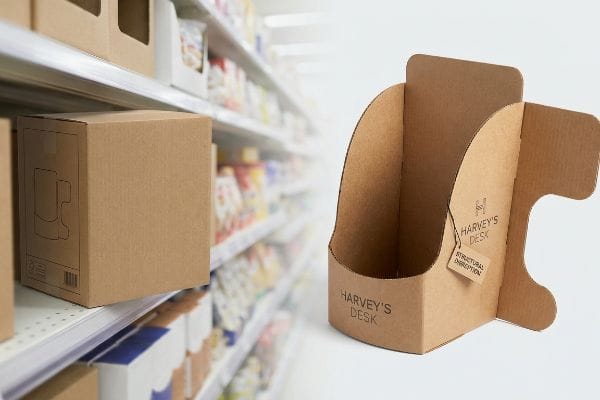
Pero la efectividad no se garantiza simplemente tirando una caja de cartón al suelo; requiere una interrupción visual diseñada cuidadosamente.
La física de la disrupción visual
Un enfoque habitual consiste en imprimir colores brillantes en una caja cuadrada básica y esperar que los compradores se detengan. Los diseñadores recurren en gran medida a gráficos planos, tratando el cartón corrugado como una simple hoja de papel de impresora. Esto ignora la realidad física de un pasillo abarrotado, donde las formas geométricas estándar se mimetizan perfectamente con el ruido de fondolos estantes de la tienda.
Piensa en un pasillo de una tienda como en una autopista; si todas las vallas publicitarias son exactamente iguales, los conductores dejan de fijarse en ellas por completo. Veo marcas que desperdician miles en impresión offset de alta calidad, solo para terminar doblando su material y convirtiéndolo en un cuadrado aburrido e invisible. Una regla general sencilla es que si tu diseño no rompe las líneas rectas del estante de la tienda , no logrará captar la atención.
Al inspeccionar muestras frescas, paso las manos por los bordes curvos, sintiendo el polvo fino del proceso de troquelado CNC (Control Numérico por Computadora). Al diseñar formas curvas y troqueladas a en lugar de ángulos rectos rígidos, obligo al ojo humano a detenerse. Esta interrupción estructural genera el "Efecto de 3 Segundos11", rompiendo el piloto automático del comprador y ralentizándolo físicamente12, lo que se traduce directamente en un aumento cualitativo de los ingresos locales para la marca.
| Error común de principiante | La solución profesional | Beneficio para el punto de venta |
|---|---|---|
| Utilizando cajas cuadradas básicas | Ingeniería de formas curvas troqueladas | Rompe el piloto automático visual del comprador13 |
| Basándose únicamente en gráficos 2D | Creación de disrupción estructural 3D14 | Requiere atención inmediata en el pasillo |
| Integrarse en los estantes de las tiendas | Ampliando los perfiles más allá de los estantes | Impulsa ventas por impulso medibles15 |
Siempre les digo a mis clientes que la forma estructural es tan importante como el diseño gráfico. Si no se introduce una disrupción física en la materia prima, la campaña pasa desapercibida para el consumidor.
🛠️ Harvey's Desk: ¿Tu expositor actual se pierde entre la multitud de pasillos de una tienda? 👉 Solicita tu Plan de Transformación Estructural ↗ — Sin formularios que generen interminables llamadas de ventas. Solo valor puro.
¿Qué es un expositor POS?
Definir esta unidad es sencillo, pero su fabricación genera una intensa fricción mecánica. Cuanto menor sea su tamaño, más estrictas deberán ser las tolerancias.
Un expositor de punto de venta (TPV) es una unidad de merchandising compacta que se coloca directamente en el mostrador de caja para captar compras impulsivas. Estas estructuras rígidas aprovechan el espacio limitado, exhibiendo artículos de alto margen como cosméticos o dulces, y dependen de un diseño preciso del centro de gravedad para mantenerse en pie.
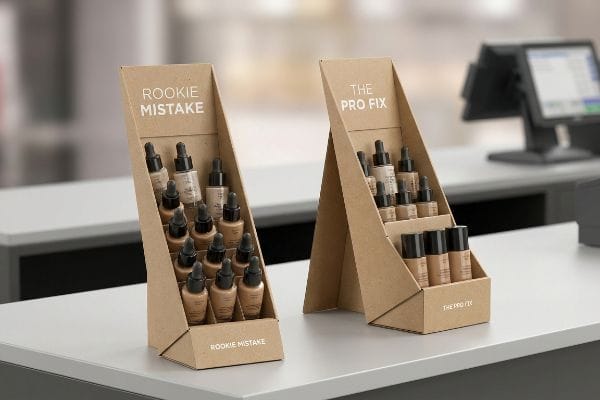
Pero conocer la teoría no es suficiente cuando las máquinas empiezan a funcionar y estas unidades tan pesadas en la parte superior chocan físicamente con el mostrador de la caja.
Por qué los expositores de mostrador estándar fallan en la planta de producción
Los diseñadores suelen crear expositores de caja con un panel trasero perfectamente plano de 90 grados, asumiendo que la unidad se equilibrará por sí sola. Cargan el modelo 3D teórico con productos de consumo densos, confiando en que la base de cartón crudo tenga suficiente superficie para mantenerse erguida¹⁶.Esta suposición, aparentemente razonable, ignora el entorno caótico y de alta fricción de una zona de transacciones comerciales concurrida.
Lograr que un expositor se mantenga en pie vacío en un laboratorio impecable es fácil, pero esta es la cruda realidad cuando se envían 500 de ellos llenos de cosméticos pesados. En mis instalaciones, pruebo rutinariamente estas unidades simulando impactos reales de los consumidores. Cuando los compradores chocan con una unidad pesada en la parte superior con una base poco profunda, el centro de gravedad estructural falla por completo17.
Mido esta inestabilidad en el área de pruebas, observando cómo las unidades se vuelcan con un ángulo de impacto de tan solo 12 grados¹⁸.La solución requiere física estructural, no un tablero más grueso. Tomo las lecturas del micrómetro e integro un respaldo extendido y un fondo falso en la línea de troquelado, desplazando el centro de masa hacia abajo. Al aplicar esta extensión de profundidad específica de 88,9 mm (3,5 pulgadas)¹⁹, elimino por completo el riesgo de vuelco, evitando un desastre frustrante en el punto de venta que ralentizaría las cajas y provocaría el rechazo inmediato por parte del minorista.
| Error común de principiante | La solución profesional | Beneficio para el punto de venta |
|---|---|---|
| Paneles traseros planos de 90 grados | Agregar un caballete extendido en la parte posterior | Evita que el vehículo se vuelque debido al desequilibrio en la parte superior20 |
| Huellas de base poco profunda | Diseñar un falso fondo | Asegura el centro de gravedad21 |
| Ignorar la fricción en el proceso de pago | Pruebas de ángulo de impacto en condiciones reales22 | Evita interrupciones en la fila de caja |
Me niego a aprobar cualquier mostrador que no supere mi prueba física de punto de inflexión. Resolver el centro de gravedad antes de la producción garantiza que su expositor siga siendo un vendedor silencioso en lugar de un obstáculo frustrante.
🛠️ Harvey's Desk: ¿Conoces el ángulo exacto de vuelco de tu expositor de mostrador con la parte superior pesada? 👉 Envíame tu archivo de troquelado ↗ — Haré una prueba de estrés antes de que malgastes tu presupuesto en la producción en masa.
Conclusión
Puedes elegir un proveedor más económico, pero si un mostrador inestable se vuelca en una caja concurrida, ralentizando las transacciones en un 20 % aproximadamente y provocando el rechazo inmediato del minorista, el margen de beneficio de tu campaña desaparece. Más de 500 gerentes de marca utilizan mi lista de verificación de preimpresión para evitar estos errores fatales iniciales. Deja de adivinar las tolerancias del centro de gravedad y permíteme revisar personalmente tus archivos estructurales con mi Auditoría Gratuita de Troqueles ↗ para detectar riesgos físicos antes de que comience la producción en masa.
"Estándares de accesibilidad de la ADA – Access-Board.gov", https://www.access-board.gov/ada/. [Las directrices reglamentarias, como los estándares de accesibilidad de la ADA y los códigos de seguridad contra incendios, exigen anchos de pasillo y espacios libres entre mostradores específicos, creando requisitos distintos para las zonas de punto de venta y las zonas de piso]. Función de la evidencia: verificación; tipo de fuente: directriz reglamentaria. Apoya: la existencia de restricciones legales distintas para diferentes ubicaciones minoristas. Nota de alcance: aplicable a entornos minoristas norteamericanos. ↩
"Palet de madera tratada térmicamente GMA – 48 x 40" H-1260 – ULINE", https://www.uline.com/Product/Detail/H-1260/Pallets/Heat-Treated-Wood-GMA-Pallet-48-x-40. [La documentación estándar de la industria de la Grocery Manufacturers Association confirma que el palet de 48 × 40 pulgadas es el estándar para la logística minorista en Norteamérica]. Función de evidencia: especificación técnica; tipo de fuente: estándar de la industria. Soportes: dimensiones estructurales de carga para unidades de piso. Nota de alcance: Se aplica principalmente a los mercados norteamericanos. ↩
"Estándares ADA de 2010 para el diseño accesible", https://www.ada.gov/law-and-regs/design-standards/2010-stds/. [Los Estándares de la Ley de Estadounidenses con Discapacidades (ADA) para el diseño accesible definen el rango específico para alcanzar objetos sin obstáculos hacia adelante para garantizar la accesibilidad]. Función de la evidencia: requisito reglamentario; tipo de fuente: reglamento gubernamental. Apoya: restricciones de cumplimiento para la ubicación de exhibidores minoristas. Nota de alcance: requisito legal federal de EE. UU .
"Estándares ADA para el diseño accesible", https://www.ada.gov/law-and-regs/design-standards/. [Los requisitos legales de accesibilidad exigen restricciones dimensionales específicas que requieren plantillas de diseño o troqueles distintos de las unidades estándar]. Función de la evidencia: especificación técnica; tipo de fuente: norma reglamentaria. Apoya: la necesidad de un diseño que cumpla con la ADA. Nota de alcance: Los requisitos pueden variar según la jurisdicción local. ↩
"Capítulo 3: Partes Operables – Access-Board.gov", https://www.access-board.gov/ada/guides/chapter-3-operable-parts/. [Las normas ADA para el diseño accesible especifican los rangos de alcance permitidos para garantizar que las personas en sillas de ruedas puedan acceder a los objetos]. Función de la evidencia: verificación de hechos; tipo de fuente: reglamento gubernamental. Apoya: límites de alcance de accesibilidad para compradores. Nota de alcance: Se aplica específicamente a las directrices ADA de EE. UU .
"Fórmula de dimensiones de la base – Woodworking Talk", https://www.woodworkingtalk.com/threads/base-dimensions-formula.220359/. [Los principios de ingeniería estructural dictan que el centro de gravedad debe mantenerse mediante relaciones específicas entre el peso de la base y la carga para evitar el vuelco]. Función de la evidencia: principio técnico; tipo de fuente: manual de ingeniería. Apoyos: prevención de riesgos de vuelco. Nota de alcance: Aplicable a unidades estructurales independientes. ↩
"Tipos de expositores de palets: completos, medios y cuartos – GreenDot Packaging", https://greendotpackaging.com/understanding-pallet-display-types-full-half-and-quarter-pallet-displays/. [Una fuente autorizada de estándares logísticos o minoristas confirma que 48×40 pulgadas es el tamaño estándar de la industria para un palet GMA utilizado en expositores minoristas]. Función de la evidencia: especificación técnica; tipo de fuente: estándar de la industria. Apoya: dimensionamiento estándar para expositores de piso de palets completos. Nota de alcance: se aplica principalmente a la logística minorista de América del Norte. ↩
"La psicología del comercio minorista: cómo la distribución de la tienda influye en las ventas – Forbes", https://www.forbes.com/councils/forbesbusinesscouncil/2025/01/03/the-psychology-of-retail-how-store-layout-impacts-sales/. [Los estándares de la industria sobre comercialización minorista y métricas de ventas por pie cuadrado explican por qué los compradores priorizan la densidad del piso y la optimización del espacio]. Función de la evidencia: hecho de apoyo; tipo de fuente: guía de la industria. Apoya: la afirmación de que la eficiencia del espacio impulsa la aprobación de la exhibición. Nota de alcance: Se aplica principalmente a entornos minoristas de alto volumen como las tiendas club. ↩
"Cómo la inteligencia visual habilitada por IA está transformando las experiencias en…", https://consumergoods.com/how-ai-enabled-visual-intelligence-transforming-experiences-shelf. [Un estudio sobre la atención visual del consumidor demostraría cómo los patrones geométricos estándar no logran activar la "respuesta de orientación" en comparación con las formas no estándar en entornos minoristas con alta estimulación]. Función de la evidencia: justificación psicológica; tipo de fuente: estudio de comportamiento del consumidor. Apoya: teoría de la disrupción visual. Nota de alcance: Se aplica específicamente a entornos de estanterías de alta densidad. ↩
"Mirar es comprar. Cómo la atención visual y la elección se ven afectadas por…", https://pubmed.ncbi.nlm.nih.gov/28433775/. [Investigaciones en ergonomía visual y estudios de seguimiento ocular confirman que romper patrones geométricos en entornos minoristas aumenta la prominencia visual e interrumpe la navegación automática]. Función de la evidencia: respaldo fáctico; tipo de fuente: estudio de psicología del marketing. Apoya: la necesidad de la disrupción estructural para la atención. Nota de alcance: La efectividad puede variar según la densidad de estímulos visuales competitivos. ↩
"La regla de los 3 segundos del POSM: La psicología del impacto visual en el comercio minorista", https://www.linkedin.com/pulse/3-second-rule-posm-psychology-visual-impact-retail-spectrum-unitec-oywxc. [Un estudio de análisis de comercio minorista o un informe de neuromarketing que proporciona evidencia de la correlación entre un tiempo de permanencia de tres segundos y mayores tasas de conversión]. Función de la evidencia: métrica empírica; tipo de fuente: informe de investigación de mercado. Apoya: la afirmación de que las breves interrupciones en el movimiento del comprador impulsan los ingresos. Nota de alcance: Aplicable a entornos de venta minorista físicos. ↩
"Comportamiento del consumidor a través de la perspectiva neurofisiológica… – PMC", https://pmc.ncbi.nlm.nih.gov/articles/PMC6766676/. [Investigación revisada por pares sobre sesgos cognitivos y patrones de compra habituales, que demuestra cómo las interrupciones visuales rompen los estados de "piloto automático" para aumentar el foco de atención]. Función de la evidencia: mecanismo psicológico; tipo de fuente: revista académica. Apoya: la afirmación de que la interrupción estructural capta la atención. Nota de alcance: Enfoque en los desencadenantes sensoriales en el comercio minorista. ↩
"Cómo la psicología del empaque moldea el comportamiento del consumidor", https://www.thundertech.com/blog-news/package-design-and-consumer-behavior. [Estudios sobre la interrupción de patrones en entornos minoristas demuestran cómo las formas orgánicas y no lineales alteran el procesamiento cognitivo automático para aumentar la visibilidad del producto]. Función de la evidencia: validación psicológica; tipo de fuente: revista académica. Apoya: efectividad de las formas curvas troqueladas. Nota de alcance: Se centra en el comportamiento de la mirada cognitiva. ↩
"[PDF] El efecto del diseño sostenible de tiendas 3D en el consumidor online…", https://scholarworks.uark.edu/cgi/viewcontent.cgi?article=1047&context=ampduht. [La investigación sobre la prominencia visual sugiere que las extensiones tridimensionales crean un mayor contraste con los fondos planos, aumentando el tiempo de fijación]. Función de la evidencia: validación técnica; tipo de fuente: estudio de neuromarketing. Apoyos: beneficios de la disrupción estructural. Nota de alcance: Aplicable a pasillos de tiendas minoristas de alta densidad. ↩
"Efecto del orden espacial en la compra impulsiva: moderado por la autopercepción", https://pmc.ncbi.nlm.nih.gov/articles/PMC10451481/. [Las métricas de rendimiento minorista indican que romper el plano del estante mediante extensiones de perfil se correlaciona con un aumento en el volumen de compras no planificadas]. Rol de la evidencia: evidencia empírica; tipo de fuente: informe técnico de la industria. Apoya: crecimiento de los ingresos a través de extensiones de estante. Nota de alcance: los resultados pueden variar según la categoría de producto. ↩
"Expositor de papel vs. expositor de cartón: comparación de resistencia", https://insights.fetchingpack.com/paper-display-stand-vs-cardboard-stand-strength-comparison. [Las normas de ingeniería de embalaje definen la relación mínima entre la base y la altura, así como los requisitos del centro de gravedad para evitar el vuelco en expositores de cartón ondulado]. Función de la evidencia: Validación técnica; tipo de fuente: Manual de ingeniería. Apoya: El riesgo de inestabilidad al cargar productos densos sobre bases de cartón. Nota de alcance: Se aplica específicamente a unidades de mostrador independientes. ↩
"Cálculo de la estabilidad de su equipo – Vention", https://vention.io/blogs/calculating-the-stability-of-your-equipment-89?srsltid=AfmBOor1lWbh1Z1EJajYuFHfypWDjG0scdNihentBBYHsTulE5NPo4ev. [Los principios de ingeniería mecánica relativos a la estabilidad estática demuestran que un centro de gravedad elevado en relación con una base estrecha aumenta la probabilidad de vuelco cuando se aplica una fuerza lateral externa]. Función de la evidencia: validación teórica; tipo de fuente: libro de texto de ingeniería. Apoya: la causa mecánica de la inestabilidad de la pantalla del TPV. Nota de alcance: se aplica a la dinámica de cuerpos rígidos. ↩
"[PDF] Entendiendo la prueba de estabilidad – Webflow", https://uploads-ssl.webflow.com/5964a1de0dff681f24a9308b/5a70c564a290250001f0449d_Weekly%20Whitepaper%20%2345%20-%20Understanding%20the%20Stability%20Test.pdf. [Una guía de ingeniería sobre la estabilidad de las exhibiciones minoristas validaría los ángulos de inclinación estándar utilizados en las pruebas de control de calidad]. Función de evidencia: punto de referencia técnico; tipo de fuente: manual de ingeniería. Apoya: la inestabilidad de las unidades POS compactas. Nota de alcance: los ángulos pueden variar según la altura de la unidad. ↩
"¿Cómo elegir la altura de su expositor comercial?", https://popdisplay.me/how-to-choose-your-retail-display-height/. [Las especificaciones técnicas para el hardware de punto de venta minorista proporcionarían las relaciones estándar de profundidad a altura necesarias para garantizar la estabilidad]. Función de la evidencia: especificación técnica; tipo de fuente: estándar de la industria. Apoya: la efectividad de la extensión de profundidad. Nota de alcance: aplicable a rangos de altura específicos. ↩
"3 maneras de lastrar fondos de caballete para mayor estabilidad – TikTok", https://www.tiktok.com/@poppopballoon/video/7623449812016303373. [Las directrices de ingeniería para expositores comerciales explican cómo extender el caballete hacia atrás desplaza el centro de masa hacia atrás para evitar que se vuelque hacia adelante]. Función de la evidencia: Validación técnica; tipo de fuente: Manual de diseño industrial. Apoya: Estabilidad mecánica de expositores de mostrador. Nota de alcance: Se centra en el centro de gravedad en la señalización vertical. ↩
"Estabilidad del centro de gravedad y del centro de sustentación – Aviation Stack Exchange", https://aviation.stackexchange.com/questions/87124/center-of-gravity-and-center-of-lift-stability. [Los principios físicos del equilibrio estático demuestran que añadir masa a la base mediante un falso fondo reduce el centro de gravedad, aumentando la estabilidad frente al vuelco]. Función de la evidencia: Principio científico; tipo de fuente: Referencia de ingeniería. Apoya: Integridad estructural de expositores de tamaño reducido. Nota de alcance: Se aplica a unidades minoristas de perfil bajo. ↩
"Mediciones del ángulo de contacto ASTM D5946 – Intertek", https://www.intertek.com/polymers-plastics/testlopedia/contact-angle-measurements-astm-d5946/. [Los manuales operativos de venta minorista describen las pruebas de ángulo de impacto para garantizar que las exhibiciones estén colocadas de manera que no obstruyan el flujo de clientes ni las operaciones de las cajas registradoras]. Función de la evidencia: Estándar de la industria; tipo de fuente: Guía de gestión minorista. Apoya: UX y eficiencia operativa en las cajas registradoras. Nota de alcance: Específico para entornos minoristas de alto tráfico. ↩