Quieres que tu lanzamiento en tienda domine el pasillo, pero la jerga técnica confusa lleva a elegir materiales incorrectos. La falta de comprensión de la terminología de exhibición provoca sobrecostos catastróficos en el transporte y devoluciones de cargo en la tienda.
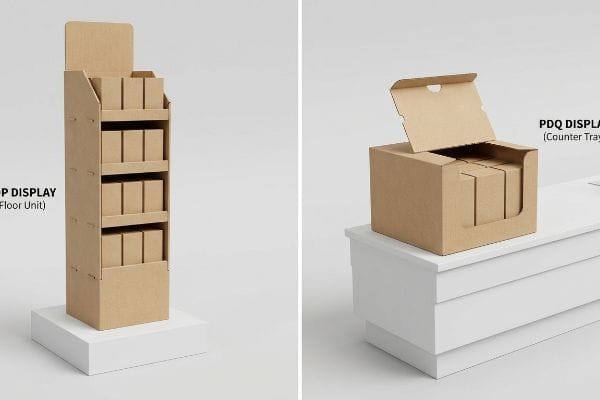
Comprender las diferencias entre POP (Punto de Venta) y PDQ (Exhibición Rápida de Producto) es fundamental para toda su estrategia de comercialización. POP se refiere a grandes unidades de exhibición independientes que atraen la atención de los compradores en pasillos amplios. Por otro lado, PDQ se refiere a bandejas de cartón corrugado ligeras y preempaquetadas, diseñadas para su colocación inmediata en estantes o mostradores de caja.
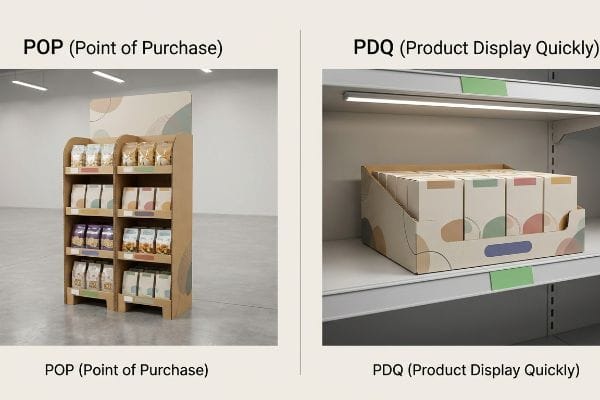
Confundir estas definiciones no es solo un pequeño error de marketing; altera fundamentalmente la forma en que su producto sobrevive al transporte marítimo y a la manipulación en tienda, que suele ser muy engorrosa.
¿Qué significa la pantalla PDQ?
Los compradores minoristas exigen rapidez, pero la falta de comprensión de los términos básicos de las pantallas de exhibición genera implementaciones caóticas. Saber exactamente qué es un PDQ evita la acumulación de inventario en el mostrador de caja.
PDQ (Product Display Quickly) es una bandeja de cartón corrugado prellenada, lista para su uso en tiendas, diseñada para una rápida colocación en los estantes. Estos expositores compactos evitan el montaje manual en tienda, protegiendo los productos durante el transporte y convirtiéndose instantáneamente en una caja registradora visible y lista para la compra.

La transición de una disposición plana a una bandeja completamente cargada requiere una atención meticulosa a la forma en que el personal interactuará realmente con el embalaje.
La estrategia minorista detrás del despliegue rápido
Las marcas suelen asumir que cualquier caja de cartón pequeña puede servir como expositor eficaz en el mostrador de caja. Consideran estos espacios reducidos como un mero detalle estético, priorizando los gráficos llamativos sobre la colocación estratégica del producto. Los equipos de marketing suelen crear diseños conceptuales preciosos que lucen increíbles en la pantalla del ordenador, pero ignoran por completo cómo funcionará la caja física en el espacio limitado de una caja registradora concurrida.
La realidad en el punto de venta es completamente diferente. Los cajeros desecharán inmediatamente cualquier bandeja que requiera un plegado complejo o que obstaculice su limitado espacio de escaneo. Un sistema de punto de venta adecuado debe funcionar como una unidad estructural integrada que equilibre a la perfección el impacto visual con una funcionalidad de fácil apertura. Si su empaque listo para la venta tarda más de tres segundos en prepararse¹,el personal de la tienda simplemente arrancará la parte superior manualmente, destruyendo su marca cuidadosamente diseñada y dejando sus productos con un aspecto de derrame accidental.
| Característica | Caja pequeña genérica | Bandeja PDQ auténtica |
|---|---|---|
| Montaje de la tienda | Plegamiento complejo | Acceso desmontable |
| Tiempo de configuración | Minutos | Menos de 3 segundos |
| Impacto visual | A menudo dañado | Impecable y listo |
Obligar al personal a crear empaques complicados garantiza la destrucción de la marca. Diseñar específicamente para una implementación rápida y sin errores asegura una ubicación privilegiada en las cajas registradoras.
🛠️ Harvey's Desk: ¿Están sus pesadas bandejas de caja reduciendo significativamente su retorno de inversión en envíos incluso antes de que lleguen a la tienda? 👉 Obtenga una auditoría gratuita de troquelado estructural ↗ — Reviso personalmente cada archivo estructural en un plazo de 24 horas.
¿Cuál es la diferencia entre un expositor de punto de venta (POS) y un expositor de punto de venta (POP)?
Las zonas de merchandising se rigen por estrictas normas espaciales. Difuminar la línea entre la promoción en pasillos amplios y la compra impulsiva en caja garantiza un rechazo inmediato por parte del minorista y un desperdicio del presupuesto promocional.
Las diferencias entre los expositores POS (Punto de Venta) y POP (Punto de Compra) dependen exclusivamente de su ubicación física en el establecimiento. Los expositores POS se sitúan justo en la caja registradora para impulsar microcompras inmediatas, mientras que las unidades POP ocupan pasillos más amplios de la tienda para exhibir el inventario de las campañas a granel.
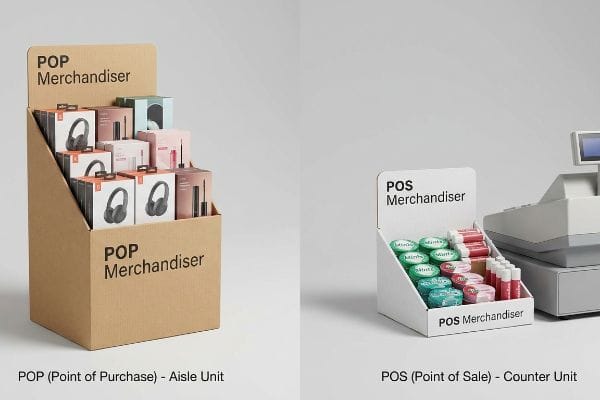
Comprender esta división geográfica es la base fundamental antes de comenzar a definir la presencia comercial.
Las matemáticas espaciales de las zonas comerciales
Al planificar una nueva campaña promocional, los equipos de marketing suelen tratar todo el entorno comercial como un lienzo único y uniforme. Dan por sentado que un diseño gráfico exitoso para pasillos amplios se puede reducir proporcionalmente para que quepa directamente en el mostrador de caja. Este enfoque, que prioriza la estética, ignora las diferencias fundamentales en la psicología del comprador²y las estrictas normas espaciales que separan las zonas de compra impulsiva³de los pasillos dedicados a la exploración de productos.
La distribución de las tiendas minoristas funciona como cuadrículas municipales altamente reguladas, con tolerancia cero ante las infracciones de zonificación. Un punto de venta (POP) de pasillo ancho actúa como una enorme valla publicitaria diseñada para atraer carritos y aumentar el volumen de ventas, mientras que un punto de venta a nivel de caja funciona como un quiosco peatonal altamente controlado, enfocado en microtransacciones inmediatas. Intentar implementar una estrategia de gran volumen en un espacio de caja restringido sin adaptarse a los parámetros de cumplimiento de alcance frontal4 garantiza que su campaña nunca pasará del muelle de carga del gerente de la tienda.
| Restricción | Merchandiser de punto de venta | Merchandiser de punto de venta |
|---|---|---|
| Ubicación minorista | Pasillos de la tienda principal | Caja registradora |
| Límite espacial | Palet de 48×40 pulgadas5 | 15-48 en alcance hacia adelante6 |
| Función principal | Interrupción del volumen | Conversión de impulsos |
Ignorar los límites geográficos de las tiendas invalida por completo tu campaña. Adaptar el formato de tu tienda para que se ajuste perfectamente a su zona de destino evita costosos rechazos por incumplimiento normativo.
🛠️ Harvey's Desk: ¿El diseño actual de su mostrador incumple la normativa de alcance frontal y corre el riesgo de que sea rechazado inmediatamente en caja? 👉 Solicite un análisis gratuito de visibilidad en puntos de venta ↗ — 100 % confidencial. Sus diseños de venta aún no publicados están a salvo conmigo.
¿Cuáles son los tres tipos de pantallas?
Los expositores de merchandising adoptan diversas formas, pero generalmente se clasifican en tres categorías físicas distintas. Elegir el formato incorrecto para el volumen de tu producto conlleva una mala ubicación en la tienda y la pérdida de ventas.
Tres tipos principales de expositores dominan los espacios comerciales modernos: unidades de suelo independientes, bandejas de mostrador que ahorran espacio y expositores de palés a granel. Los modelos de suelo captan el flujo de clientes, las versiones de mostrador impulsan las ventas por impulso en caja, y las enormes estructuras de palés almacenan grandes volúmenes de mercancía directamente en los pasillos principales de los clubes mayoristas.

Si bien los formatos varían enormemente en tamaño, todos exigen un enfoque estratégico sobre cómo los compradores examinarán realmente el catálogo.
Alinear el formato con el volumen de ventas minoristas
Los diseñadores inexpertos suelen seleccionar un estilo de exhibición basándose únicamente en restricciones presupuestarias arbitrarias, en lugar de analizar la velocidad de ventas del producto específico⁷.Asumen erróneamente que un soporte de suelo genérico e independiente puede sustituir universalmente a un palé a granel de alta resistencia, tratando los formatos estructurales como productos intercambiables. Esta estrategia de planificación superficial prioriza el ahorro inicial, pero ignora por completo cómo la unidad física se integrará finalmente con los patrones de tráfico de latienda⁸.
El entorno minorista real exige una alineación precisa entre el formato estructural y la estrategia de inventario. Un expositor de suelo delicado se derrumbará al instante si se carga con artículos pesados de grandes almacenes, mientras que una estructura de palés resulta totalmente inapropiada para cosméticos pequeños de alto margen. Debe seleccionar su categoría de comercialización basándose exclusivamente en cómo los compradores interactúan naturalmente con su producto específico, asegurándose de que los productos de gran volumen ocupen los espacios del almacén9 mientras que los artículos compactos de compra impulsiva dominen las cajas de pago, donde hay mayor fricción10.
| Categoría de visualización | Entorno minorista | Interacción del comprador |
|---|---|---|
| Bandeja de encimera | Caja registradora | Agarre rápido por impulso |
| Piso independiente | Pasillo principal de la tienda | Intercepción del tráfico peatonal |
| Unidad de palé a granel | Club de almacenes | Carga de alto volumen |
Elegir una distribución basada en la estética en lugar de en la rotación del producto garantiza un fracaso comercial catastrófico. Alinear el formato con la psicología del comprador asegura un dominio absoluto del mercado.
🛠️ Harvey's Desk: ¿Las microfracturas ocultas en sus soportes de piso están afectando silenciosamente sus métricas BCT antes de la paletización? 👉 Solicite su auditoría gratuita de cartón ondulado ↗ — Sin intermediarios. Habla directamente con ingenieros estructurales.
¿Cuál es la vida útil típica de un expositor de pop-up?
Diseñar un expositor temporal como si fuera un mueble permanente es una trampa financiera enorme. Alinear la durabilidad del material con los ciclos reales de la tienda optimiza matemáticamente su presupuesto estacional crucial.
La vida útil típica de las estructuras de punto de venta oscila entre cuatro y doce semanas, coincidiendo con los ciclos estacionales de venta minorista. Las unidades temporales de cartón corrugado son ideales para estas promociones de corta duración, mientras que las estructuras permanentes, fabricadas con plásticos rígidos y metales, están diseñadas para resistir hasta cincuenta y dos semanas de interacción constante con los compradores.
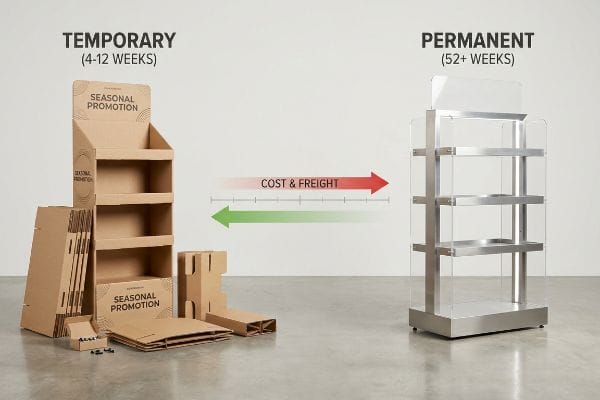
Adaptar las especificaciones técnicas a este ciclo de vida temporal evita un sobrediseño excesivo y garantiza que la unidad nunca falle prematuramente.
Cronograma de ingeniería del ciclo de vida activo
Una idea errónea común es que la durabilidad extrema proporciona inherentemente un mejor valor, lo que lleva a las marcas a especificar materiales mixtos permanentes para una simple campaña navideña de seis semanas. Los equipos de diseño a menudo exigen acrílicos gruesos y plásticos extruidos pesados, tratando un expositor temporal como si fuera una estructura arquitectónica permanente. Asumen que sobredimensionar el sustrato base se traducirá de alguna manera en un mayor prestigio de la marca, ignorando por completo las devastadoras penalizaciones por peso de transporte y los rígidos protocolos de montaje que estos materiales pesados imponen a la fuerza en una cadena de suministro estacional acelerada.
Como ingeniero estructural, rechazo categóricamente la práctica de utilizar plásticos rígidos para ciclos de campaña temporales. Un expositor temporal actúa como un organismo biológico con una fecha de caducidad estrictamente programada, lo que implica que debemos calibrar científicamente el grado del cartón corrugado para que resista un período exacto de ocho semanas de fatiga acumulada por la humedad y la fricción física de los clientes. Mediante un diseño matemático, el uso de cartón de ingeniería nos permite reducir con precisión nuestro multiplicador de "Factor de Seguridad 3.511" justo donde termina la campaña. Esta degradación estructural calculada con precisión permite el embalaje plano completo, reemplazando cuatro enormes contenedores marítimos12 de accesorios rígidos preensamblados con un solo contenedor plano, eliminando por completo el aumento del Costo Total de Propiedad (TCO) y evitando por completo las severas penalizaciones por eliminación en vertederos al final de su vida útil (EOL).
| Métrica del ciclo de vida | Rígido permanente | Corrugado temporal |
|---|---|---|
| Duración prevista | Más de 52 semanas | 4 a 12 semanas13 |
| Densidad del contenedor | 1 unidad (preensamblada) | 4 unidades (embaladas planas)14 |
| Penalización por fin de vida útil | Alto riesgo de vertido en vertederos | Reciclable en la acera15 |
Construir exhibidores en exceso para un período promocional corto destruye sistemáticamente sus márgenes de ganancia en flete. Diseñar el cartón para que cumpla con las fechas de vencimiento exactas garantiza matemáticamente su retorno de inversión logística.
🛠️ Harvey's Desk: ¿Su equipo de compras está pagando un sobreprecio del 300 % por materiales permanentes en una campaña estacional de seis semanas? 👉 Obtenga una auditoría gratuita de densidad de flete del ciclo de vida ↗ — Reviso personalmente cada archivo estructural en 24 horas.
Conclusión
Dominar la diferencia entre el volumen en el punto de venta y la física de compresión de las bandejas de pago evita que sus estructuras pesadas en la parte superior se deformen ante las duras realidades de la cadena de suministro. Esta misma revisión de ingeniería detectó recientemente un error de tolerancia fatal de 2 mm en un importante lanzamiento nacional antes de la producción. Antes de finalizar su próximo envío de contenedores, permítame personalmente realizar una Auditoría Gratuita de Densidad de Carga de Cajas Maestras ↗ para eliminar matemáticamente el voladizo de los palets y asegurar sus márgenes de venta.
"Guía de embalaje listo para la venta (SRP) – Software de cumplimiento para el sector minorista", https://www.retailerhub.ai/guides/retail-ready-packaging. [Los estándares de la industria para el embalaje listo para la venta (RRP) establecen umbrales máximos de tiempo de configuración para garantizar el cumplimiento por parte del personal de la tienda y evitar la destrucción manual de los expositores de marca]. Función de la evidencia: estándar técnico; tipo de fuente: documento técnico del sector minorista. Apoya: la necesidad operativa de una implementación rápida en el diseño de PDQ. Nota de alcance: Los plazos pueden variar ligeramente según las directrices laborales específicas del minorista.] ↩
"Factores que afectan el comportamiento de compra impulsiva de los consumidores – PMC – NIH", https://pmc.ncbi.nlm.nih.gov/articles/PMC8206473/. [Una fuente autorizada sobre psicología del comercio minorista debería explicar cómo difieren la carga cognitiva y la toma de decisiones entre las áreas de exploración y las zonas de pago]. Función de la evidencia: validación técnica; tipo de fuente: revista académica o informe técnico de la industria minorista. Apoya: base psicológica para estrategias POP/POS distintas. Nota de alcance: Se aplica a entornos minoristas físicos. ↩
"Reorganización estratégica de la distribución del espacio en los estantes de las tiendas: Uso de datos…", https://www.sciencedirect.com/science/article/abs/pii/S0957417422024617. [Los estándares de la industria o las directrices reglamentarias, como la ADA o los códigos de incendios, rigen la ubicación y las dimensiones de las exhibiciones en los pasillos en comparación con las cajas registradoras]. Función de la evidencia: verificación de hechos; tipo de fuente: organismo regulador o manual de diseño minorista. Apoya: restricciones en el tamaño y la ubicación de las exhibiciones. Nota de alcance: Las regulaciones pueden variar según la jurisdicción. ↩
"Normas ADA para el diseño accesible, Título III, Reglamento 28 CFR…", https://www.ada.gov/law-and-regs/design-standards/1991-design-standards/. [Una fuente autorizada de la industria sobre regulaciones de seguridad o comercialización minorista especificaría la protrusión máxima permitida de las exhibiciones en los pasillos para garantizar el flujo peatonal y el cumplimiento de la ADA]. Función de la evidencia: Especificación técnica; tipo de fuente: Guía regulatoria de la industria. Apoya: La necesidad de cumplir con las restricciones espaciales en las zonas de pago. Nota de alcance: Las medidas específicas varían según la jurisdicción y la política del minorista. ↩
"Tipos de exhibición de palets: completos, medios y cuartos", https://greendotpackaging.com/understanding-pallet-display-types-full-half-and-quarter-pallet-displays/. [Los estándares de la industria para logística y comercialización minorista confirman que el palet de 48 × 40 pulgadas es la base para exhibidores en el punto de venta en entornos de pasillos anchos]. Función de evidencia: especificación técnica; tipo de fuente: estándar de la industria. Admite: límites espaciales de POP. Nota de alcance: se aplica principalmente a los estándares minoristas de América del Norte. ↩
"Cómo las pantallas de punto de venta (TPV) pueden aumentar las compras impulsivas", https://www.iprint360.com/resources/blog/how-point-of-sale-pos-displays-can-increase-impulse-purchases.html. [Las directrices de ergonomía y diseño de tiendas minoristas especifican que la distancia de alcance óptima en las cajas registradoras para conversiones impulsivas debe estar dentro de un rango de 15 a 48 pulgadas]. Función de la evidencia: validación de métricas; tipo de fuente: directriz de diseño minorista. Apoya: límites espaciales del TPV. Nota de alcance: las medidas reales pueden variar según la altura del mostrador y las leyes de accesibilidad para el cliente. ↩
"Por qué necesita realizar un seguimiento de la velocidad de ventas y cómo hacerlo | Fintech®", https://fintech.com/blog/why-you-need-to-track-sales-velocity-and-how-to-do-it. [Los estándares de la industria para la comercialización minorista especifican que la rotación de inventario y la velocidad de ventas son las métricas principales utilizadas para determinar la escala y el tipo adecuados de unidad de exhibición]. Función de evidencia: validación técnica; tipo de fuente: manual de la industria; Apoya: la necesidad de una planificación basada en la velocidad para la selección de exhibidores. Nota de alcance: se aplica a bienes de consumo de alta rotación (FMCG). ↩
"Cómo el diseño y la construcción de la tienda impactan el flujo de clientes y las ventas", https://www.rsvc.com/blog-posts/how-store-layout-and-construction-impact-customer-flow-and-sales. [Investigaciones en psicología ambiental del comercio minorista demuestran cómo el tamaño, la ubicación y el formato estructural de las unidades de comercialización influyen directamente en el flujo de clientes y el tiempo de permanencia]. Función de la evidencia: validación técnica; tipo de fuente: estudio académico; respalda: la afirmación de que las unidades de exhibición impactan la integración del flujo de clientes en la tienda. Nota de alcance: los resultados pueden variar según la arquitectura de la tienda. ↩
"¿Qué buscan los clubes mayoristas en un paquete?", https://mauserpackaging.com/mauser_news/what-do-warehouse-clubs-look-for-in-a-package/. [Las guías de operaciones minoristas para clubes mayoristas confirman que se requieren exhibidores de piso a gran escala para gestionar la carga física y el reabastecimiento logístico de inventario de alto volumen]. Función de evidencia: verificación; tipo de fuente: manual de operaciones minoristas. Apoya: colocación de productos a granel. Nota de alcance: se aplica específicamente a formatos de almacén/grandes superficies. ↩
¿Quieres dominar las ventas de artículos de compra impulsiva en la caja? Aquí tienes la clave…, https://incontextsolutions.com/blog/impulse-sales-at-checkout/. [La investigación sobre el comportamiento del consumidor indica que las zonas de caja con alta fricción son las áreas más efectivas para impulsar las compras impulsivas de artículos pequeños y de alto margen]. Función de la evidencia: verificación; tipo de fuente: estudio de marketing. Apoya: la ubicación estratégica de artículos de compra impulsiva. Nota de alcance: se centra en la psicología del consumidor en el punto de venta. ↩
"DISEÑO ESTRUCTURAL DE EXHIBICIONES PARA COMERCIO MINORISTA INTERACTIVO…", https://www.bcipkg.com/display-structural-design-for-interactive-retail-displays/. [Las normas de ingeniería para embalajes de cartón ondulado especifican factores de seguridad para tener en cuenta la degradación del material y la variabilidad de la carga durante el ciclo de vida del producto]. Función de la evidencia: especificación técnica; tipo de fuente: manual de ingeniería. Apoya: la calibración de la degradación estructural. Nota de alcance: Los factores de seguridad exactos varían según la aplicación y el grado del cartón. ↩
"Flat-Pack vs. Fully Assembled: ¿Cuál es más rentable?", https://www.samtop.com/flat-pack-vs-fully-assembled-display/. [Estudios comparativos de logística sobre la distribución de mobiliario comercial cuantifican la reducción volumétrica lograda al pasar de unidades rígidas preensambladas a expositores de cartón corrugado embalados en plano]. Función de la evidencia: métrica cuantitativa; tipo de fuente: informe logístico. Apoya: reducción de costos de envío y TCO. Nota de alcance: La relación 4:1 es un ejemplo de ganancias típicas de eficiencia volumétrica. ↩
"Exhibidores minoristas temporales, semipermanentes y permanentes", https://www.tphinc.com/custom-point-of-purchase-pop-pos-retail-store-displays-packaging-blog/temporary-semi-permanent-permanent-pallet-displays/. [Los estándares de la industria para materiales de marketing en el punto de venta establecen el ciclo de vida estándar para exhibidores de cartón corrugado en función de los ciclos de rotación minorista]. Función de evidencia: verificación de hechos; tipo de fuente: informe técnico de la industria. Apoya: vida útil de los exhibidores temporales. Nota de alcance: Puede variar según el tráfico de la tienda y el grado del material. ↩
"Planificación de embalaje y logística para expositores minoristas – Frank Mayer", https://www.frankmayer.com/blog/packaging-and-logistics-planning-for-retail-displays/. [Datos de logística y transporte que comparan la eficiencia del volumen cúbico entre estructuras rígidas preensambladas y unidades de cartón corrugado plegables]. Función de la evidencia: verificación cuantitativa; tipo de fuente: estudio logístico. Apoya: afirmaciones sobre la densidad de contenedores. Nota de alcance: La relación es un promedio basado en dimensiones comunes de expositores. ↩
"Los beneficios ambientales del uso de expositores de cartón ondulado", https://packagingrevolution.net/environmental-benefits-corrugated-cardboard-displays/. [Las normas de gestión de residuos confirman que el cartón ondulado utilizado en la comercialización temporal es generalmente compatible con los programas municipales de reciclaje en la acera]. Función de la evidencia: verificación técnica; tipo de fuente: regulación ambiental. Apoya: sostenibilidad al final de su vida útil. Nota de alcance: Sujeto a las normas municipales locales y a la toxicidad de la tinta. ↩