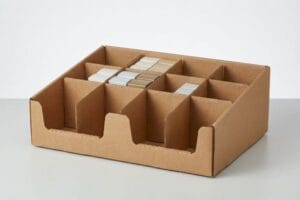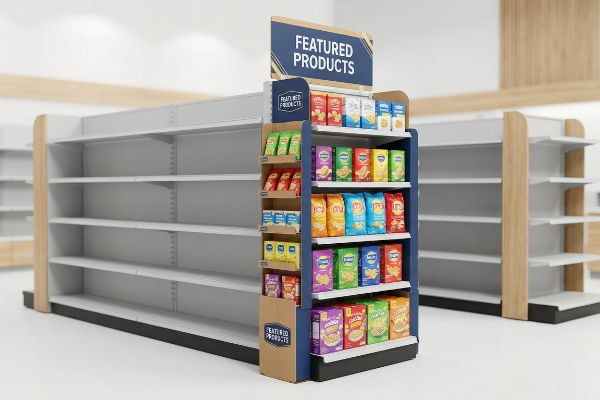
Brands pour massive budgets into retail marketing, yet perfectly good products still get ignored in the aisle. If you want to stop bleeding cash, you need to command the perimeter.
An endcap display drives business by dominating high-traffic store perimeters, forcing visual disruption, and capturing impulse purchases before shoppers enter standard aisles. Placed strategically at the end of gondola shelving, these specialized retail fixtures maximize SKU (Stock Keeping Unit) visibility and significantly increase overall sales velocity for established brands.
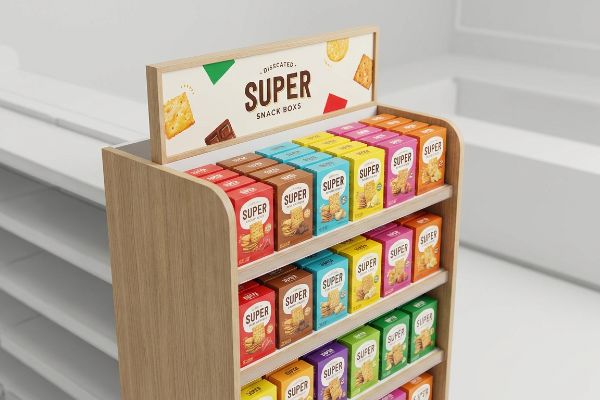
Knowing what these units do is only half the battle. Surviving the strict structural standards of major North American retailers requires flawless manufacturing execution.
What is the purpose of an endcap display in retail?
Understanding the actual function of these prime retail locations dictates exactly how you must build them.
The purpose of an endcap display is to aggressively capture shopper attention entirely outside standard store aisles. By dominating high-traffic intersections, these highly visible merchandisers break visual monotony, highlight promotional campaigns, and consistently drive impulse conversions before consumers navigate heavily congested central retail locations.
But understanding the theoretical purpose means nothing if the unit vanishes into the background on the actual retail floor.
The 3-3-3 Rule for Retail Endcaps
Junior marketing teams often design these displays strictly for up-close viewing on backlit office monitors. They assume that if a graphic looks clean on a 2D PDF (Portable Document Format), it will automatically pull foot traffic in a massive big-box store. This ignores the physical reality of how human beings navigate large retail spaces1.
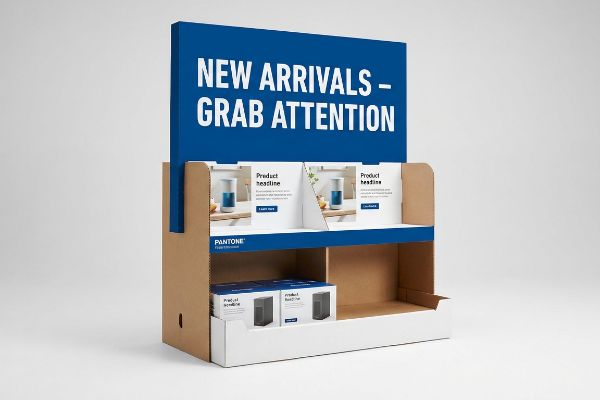
The actual purpose of this structure is governed by the 3-3-3 Rule of retail engagement2. It must create visual disruption from thirty feet away, engage the specific interest at three feet, and drive the tactile conversion at three inches (76.2 mm). I see rookie designers completely ignore this spatial continuum, cramming tiny text all over the header. When I walk the testing floor and look at their printed prototype from a distance, the messaging turns into a muddy, illegible blur under the harsh warehouse lighting. To fix this, I strip away the secondary copy and force a massive Pantone spot color flood for the 30-foot hook. This adjustment alone stops shoppers in their tracks, preventing the display from blending into the white noise of the store and immediately accelerating product sell-through.
| Common Rookie Mistake | The Pro Fix | Retail-Floor Benefit |
|---|---|---|
| Tiny header text | Bold Pantone flood | Grabs 30-foot attention3 |
| Flat side panels | Die-cut structural shapes | Breaks aisle monotony |
| High retaining lips | Cut lip to 85% visibility4 | Frictionless tactile conversion |
I refuse to let brands print cognitive overload on a physical structure. If your graphics cannot command attention from thirty feet away, you are simply paying for expensive wallpaper that no shopper will ever read.
🛠️ Harvey's Desk: Not sure if your graphics are legible from thirty feet away? 👉 Get a Free Art Audit ↗ — Direct access to my desk. Zero automated sales spam, I promise.
Are end of aisle displays worth it?
Retail buyers often question the premium manufacturing costs associated with commanding the perimeter of the store.
Yes. End of aisle displays are worth the investment because they generate a measurable sales lift by capitalizing on prime, high-traffic real estate. When engineered correctly to meet strict retail guidelines, these specialized fixtures drastically reduce restocking friction and maximize product turnover rates for both brands and retailers.
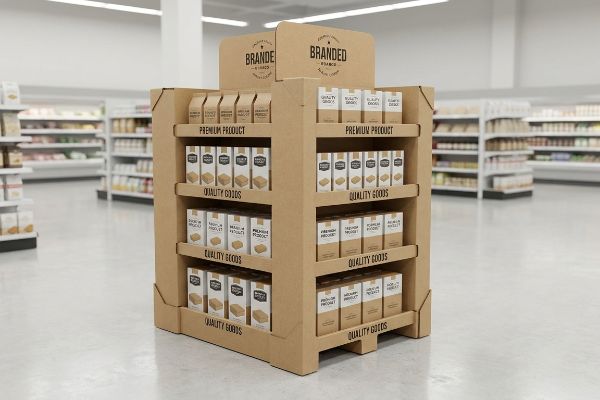
However, that premium ROI only materializes if the physical structure survives the demanding supply chain journey.
Calculating the Sales Lift ROI
Brands often hesitate to allocate budget toward premium structural materials, viewing the fixture as a disposable expense rather than an active sales engine. They attempt to bootstrap their campaigns by specifying cheap, low-grade board to save a few pennies per unit, assuming any structure will suffice for a temporary promotion.
The true worth of these units relies heavily on the "3-Second Lift" formula5, which proves ROI by measuring how quickly a shopper transitions from noticing the unit to physically holding the product. I frequently watch experienced procurement teams sabotage this metric by ordering cheap, flimsy base trays that warp. Last week, I tested a client's budget tray and felt the stiff physical resistance of the products jamming against each other because the weak flutes had bowed inward. When clerks struggle to restock an unstable fixture, they simply leave the merchandise in the backroom, completely killing your sales lift. I engineered a hidden metal support bar beneath the front lip, restoring complete rigidity. This micro-adjustment eliminated the restocking friction, ensuring the fixture remained fully loaded and driving revenue without slowing down the retail clerks.
| Common Rookie Mistake | The Pro Fix | Retail-Floor Benefit |
|---|---|---|
| Cheap, flimsy trays | Hidden metal support bar6 | Eliminates restocking jams |
| Generic sizing | Retailer-specific dimensions7 | Avoids compliance rejection |
| Weak base structures | Double-wall corrugated spines8 | Prevents mid-campaign collapse |
I strictly engineer for maximum velocity, not just minimum cost. If your unit collapses or frustrates the store staff, your theoretical ROI instantly evaporates into expensive manual rework fees.
🛠️ Harvey's Desk: Are your current base trays strong enough to handle heavy restocking without bowing? 👉 Download My Structural Checklist ↗ — Download safely. My inbox is open if you have questions later.
What is the psychology behind end cap placement?
Shopper behavior is dictated by visual tension, and how you arrange products on the shelf completely alters that dynamic.
The psychology behind end cap placement leverages visual tension to aggressively interrupt a shopper's natural walking rhythm. By strategically utilizing asymmetrical product groupings and bold structural shapes, these massive displays force the human eye to pause, process the physical merchandise, and trigger an immediate, high-value impulse purchasing decision.
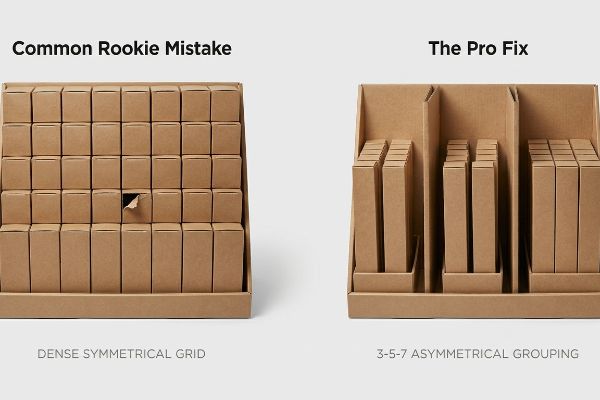
But exploiting shopper psychology requires precise physical execution on the actual manufacturing floor.
The 3-5-7 Asymmetry Rule
Junior designers frequently attempt to flat-pack a dense, perfectly symmetrical grid of products onto a single shelf, assuming maximum density yields higher sales9. They believe that cramming as much merchandise as possible onto the corrugated tray will naturally increase the perceived value of the promotion10.
This symmetrical overcrowding completely fails the psychological reality of visual merchandising, because perfect, unbroken grids cause rushing shoppers to glance past them11 entirely. Even veteran brands fall into this trap. When I test these dense layouts on the factory floor, I hear the distinct tearing sound of raw paperboard as my hands struggle to force tight items out of the overflowing tray. To solve this, I mandate the 3-5-7 Rule, engineering modular internal dividers that separate the merchandise into asymmetrical, odd-numbered clusters. This built-in structural spacing creates the psychological tension needed to stop the eye, while simultaneously providing a crucial 0.25 inches (6.35 mm) of physical clearance12. By doing this, we completely eliminate paperboard tearing during aggressive in-store restocking, protecting the brand's premium image.
| Common Rookie Mistake | The Pro Fix | Retail-Floor Benefit |
|---|---|---|
| Dense symmetrical grids | 3-5-7 odd-numbered grouping | Forces visual engagement |
| Zero shelf clearance | 0.25-inch structural spacing | Prevents raw paperboard tears |
| Glued-in permanent walls | Modular floating dividers | Allows flexible SKU loading |
I always prioritize psychological disruption over sheer volume. If a shopper's eye slides right past your perfectly symmetrical grid, every single unit on that shelf becomes invisible dead weight.
🛠️ Harvey's Desk: Struggling to calculate the perfect clearance for your modular dividers? 👉 Claim Your Free Structural Template ↗ — No forms that trigger endless sales calls. Just pure value.
What are the four basic types of displays?
While the retail environment offers numerous merchandising options, mastering the fundamental categories is essential for a successful rollout.
The four basic types of retail displays are floor models, countertop units, pallet merchandisers, and sidekick fixtures. Each distinct category serves a highly specific logistical purpose, ranging from massive warehouse club bulk presentations to compact, impulse-driven register placements strategically designed to aggressively maximize every inch of available space.
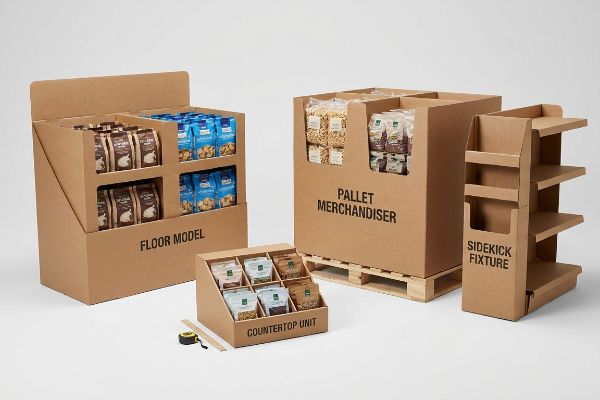
Knowing the difference between a floor unit and a counter unit is easy in theory, but treating them interchangeably on the manufacturing floor is a fatal mistake.
The ADA vs. GMA Retail Constraint
Trading companies frequently pitch a scalable design strategy where a large floor fixture can simply be scaled down by 50% to serve as a countertop unit. They assume the structural math is universally fluid13 and that resizing a dieline is a harmless software adjustment14.
In my facility, I routinely see clients attempt this dangerous shrink-to-fit crossover, completely ignoring the rigid legal and logistical rules dictating North American retail zones. This isn't just theory—I see this happen on the testing floor when a client tries to force a reduced floor dieline onto a countertop. The proportions fail instantly. Floor units must anchor strictly to a 48×40 inches (1219.2×1016 mm) GMA (Grocery Manufacturers Association) pallet limit15 for massive BCT (Box Compression Test) dynamic loads. Conversely, counter units are strictly bound to the ADA (Americans with Disabilities Act) 15-48 inches (381-1219.2 mm) forward reach16 compliance window. When I pull the CAD (Computer-Aided Design) micrometer readings on these shrunken files, the center of gravity is dangerously off-balance. I immediately separate the engineering pipelines, mathematically rebuilding the base width to maintain a strict 2:3 depth-to-height stability ratio. By enforcing this absolute spatial boundary, I prevent the units from tipping over, saving clients from massive chargebacks and outright rejections by store managers who refuse non-compliant register units.
| Common Rookie Mistake | The Pro Fix | Retail-Floor Benefit |
|---|---|---|
| Shrinking floor dielines | Separate POS and POP pipelines | Prevents unit tipping |
| Ignoring reach limits | 15-48 inch ADA compliance17 | Avoids retailer rejection |
| Weak countertop bases | 2:3 depth-to-height ratio18 | Ensures structural stability |
I never allow scaled-down floor math to dictate countertop architecture. You must engineer specific structural tolerances for each unique retail zone, or your entire shipment becomes an expensive liability.
🛠️ Harvey's Desk: Does your countertop dieline mathematically comply with strict forward reach limits? 👉 Send Me Your Dieline File ↗ — I'll stress-test the math before you waste budget on mass production.
Conclusion
You can choose a vendor who simply shrinks a floor dieline to fit a counter, but when that top-heavy unit tips over, it triggers an immediate retailer rejection and completely wipes out your campaign's profit margin. Over 500 brand managers use my prepress checklist to avoid these exact fatal early-stage mistakes. Stop guessing on retail compliance math and let me personally run your files through my Free Dieline Audit ↗ to catch these structural blind spots before production begins.
"Navigation bar design effects on consumer visual processing", https://digitalcommons.kennesaw.edu/cgi/viewcontent.cgi?article=1773&context=ama_proceedings. [Academic research in environmental psychology and retail science details how shoppers process visual stimuli and move through big-box store layouts]. Evidence role: foundational principle; source type: academic journal. Supports: the claim that digital design assumptions fail to account for physical spatial navigation. Scope note: focused on large-scale retail footprints. ↩
"How to Market Seasonal Merchandise – PopDisplay", https://popdisplay.me/how-to-market-seasonal-merchandise/. [An industry-standard guide on retail merchandising or environmental graphic design would validate the distance-based engagement framework for visual displays]. Evidence role: technical definition; source type: retail industry manual. Supports: the spatial requirements for capturing shopper attention. Scope note: Specifically applicable to high-traffic retail endcaps. ↩
"Sign Letter Visibility: Houston Sign's Distance Guide", https://houstonsign.com/letter-size-signs-at-distance-letter-visibility-chart/. [Research on consumer psychology and environmental design provides benchmarks for the distance at which high-contrast visual cues capture shopper attention]. Evidence role: factual verification; source type: retail design study. Supports: effectiveness of bold Pantone colors for distance visibility. Scope note: effectiveness may vary based on ambient lighting. ↩
"End Cap Display Dimensions: Maximizing Checkout Aisle Impact", https://wzrack.com/end-cap-display-dimensions-maximizing-checkout-aisle-impact/. [Merchandising guidelines specify the ideal percentage of product visibility above the shelf lip to maximize tactile engagement and ease of product removal]. Evidence role: technical specification; source type: merchandising manual. Supports: the correlation between product visibility and conversion. Scope note: specific to retaining lips on retail fixtures. ↩
"POP Displays Help Shoppers Decide – Custom Cardboard …", https://popdisplay.me/pop-displays-help-shoppers-decide/. [An authoritative source on retail shopper psychology or point-of-purchase marketing would define this specific metric and its validity in calculating sales ROI]. Evidence role: technical definition; source type: industry standard. Supports: the measurement of ROI via shopper interaction speed. Scope note: May refer to a specific framework used in retail conversion analytics. ↩
"DISPLAY STRUCTURAL DESIGN FOR INTERACTIVE RETAIL …", https://www.bcipkg.com/display-structural-design-for-interactive-retail-displays/. [Engineering benchmarks for point-of-purchase displays show that metal reinforcements reduce tray sagging and product jams during replenishment]. Evidence role: technical fix; source type: packaging engineering study. Supports: reduction in restocking inefficiency. Scope note: specifically applicable to heavy product loads. ↩
"1616.62 Policy regarding retail display requirements for items.", https://www.law.cornell.edu/cfr/text/16/1616.62. [Retailer compliance manuals detail the strict dimensional requirements for end-cap displays to ensure safety and uniformity across store layouts]. Evidence role: industry standard; source type: retail compliance manual. Supports: avoidance of shipment rejection. Scope note: standards vary by retailer. ↩
"Custom Corrugated Display Boxes | Free Shipping & Design", https://theboxology.us/product/corrugated-display-boxes/. [Technical specifications on corrugated cardboard grades explain how double-wall constructions increase vertical load-bearing capacity to prevent structural failure under product weight]. Evidence role: technical specification; source type: manufacturing guide. Supports: structural integrity of end-of-aisle displays. Scope note: efficacy depends on the fluting size used. ↩
"The Effect of Product Variety and Inventory Levels on Retail Sales", https://www.hbs.edu/faculty/Pages/item.aspx?num=37388. [A retail psychology study would provide empirical data on whether increasing the number of units per shelf directly correlates with an increase in sales volume]. Evidence role: verification; source type: academic study. Supports: the assumption that density drives sales. Scope note: results may differ by product category. ↩
"[PDF] Higher Quality or Lower Price? How Value-Increasing Promotions …", https://digitalcommons.bryant.edu/cgi/viewcontent.cgi?article=1033&context=mark_jou. [Marketing research on 'perceived abundance'explains how the visual quantity of merchandise on a display influences a shopper's estimation of a deal's value]. Evidence role: verification; source type: consumer psychology journal. Supports: the link between abundance and perceived value. Scope note: specific to impulse purchase displays. ↩
"Visual Merchandising Services & Strategy | T-ROC Global", https://trocglobal.com/visual-merchandising/. [Studies in retail psychology and visual attention demonstrate that high symmetry can lead to 'pattern blindness,'where the brain filters out repetitive grids as background noise]. Evidence role: psychological basis; source type: consumer behavior study. Supports: the failure of symmetrical layouts. Scope note: Effects vary based on shopper speed and cognitive load. ↩
"An overview of paper and paper based food packaging materials", https://pmc.ncbi.nlm.nih.gov/articles/PMC6801293/. [Packaging engineering standards specify minimum tolerance gaps between product and container walls to reduce friction and prevent structural failure during manual extraction]. Evidence role: technical specification; source type: packaging industry manual. Supports: the elimination of paperboard tearing. Scope note: Specific clearance requirements depend on the GSM of the paperboard used. ↩
"Structural Design in Temporary Corrugated Retail Displays – UD Direct", https://www.ud-direct.com/blog/the-importance-of-structural-design-in-temporary-corrugated-retail-displays. [Structural engineering principles for packaging indicate that weight distribution and material stress change non-linearly during scaling]. Evidence role: technical correction; source type: engineering textbook. Supports: the invalidity of fluid structural math in resizing. Scope note: Applies to physical retail fixtures. ↩
"Dieline in Packaging | Learn Here How to Save Costs & Avoid Errors", https://boxlark.com/what-is-dieline-packaging-cost-saving-guide/. [Technical packaging standards specify that scaling a dieline requires recalculating fold allowances and material caliper to maintain integrity]. Evidence role: technical correction; source type: packaging design manual. Supports: the technical complexity of dieline resizing. Scope note: Specific to corrugated cardboard construction. ↩
"Standard Pallet Sizes | With Chart – Kamps Pallets", https://www.kampspallets.com/standard-pallet-sizes-with-chart/. [Logistics standards for North American retail confirm the standard pallet size is 48×40 inches]. Evidence role: factual verification; source type: industry standard. Supports: Floor display dimensions. Scope note: Standard for GMA pallet systems. ↩
"Chapter 3: Operable Parts – Access-Board.gov", https://www.access-board.gov/ada/guides/chapter-3-operable-parts/. [The ADA accessibility standards specify forward reach ranges to ensure users in wheelchairs can access surfaces]. Evidence role: legal verification; source type: regulatory document. Supports: Countertop unit height compliance. Scope note: Applicable to US ADA guidelines. ↩
"ADA Standards for Accessible Design Title III Regulation 28 CFR …", https://www.ada.gov/law-and-regs/design-standards/1991-design-standards/. [Official ADA guidelines for accessible design specify the maximum and minimum reach ranges for operable parts and retail fixtures]. Evidence role: Technical Specification; source type: Regulatory Guideline. Supports: Reach limit requirements for retailer acceptance. Scope note: Applicable to US federal accessibility laws. ↩
"Chapter 2: Choosing a Display Height for Your Customers", https://www.creativedisplaysnow.com/guides/understanding-the-retail-customer/chapter-2-how-to-choose-the-right-display-height-for-your-customers/. [Industrial design and physics standards for freestanding furniture define specific depth-to-height ratios to ensure a center of gravity that prevents tipping]. Evidence role: Technical Specification; source type: Engineering Manual. Supports: Structural stability of countertop bases. Scope note: General rule of thumb for freestanding displays. ↩