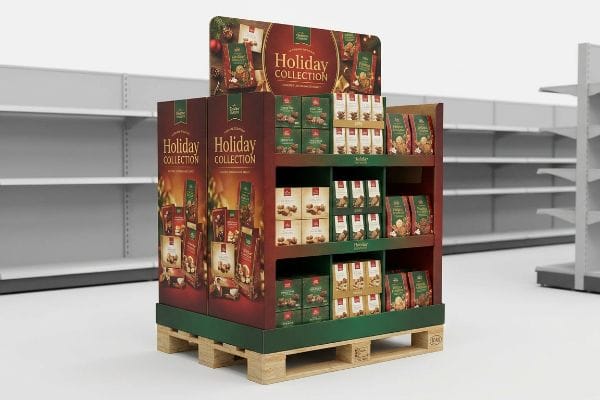
Retail aisles are brutal during holiday rushes. Brands spend thousands on promotions, only to see their seasonal products ignored or crushed. Pallet merchandisers offer a heavy-duty, high-visibility solution.
Embracing seasonality with pallet displays requires strategically leveraging temporary structural merchandisers, specifically anchored to a standard 48×40 inch (1219×1016 mm) wooden base, to handle massive holiday inventory volumes, maximize big-box retail floor space, and drive immediate impulse conversions during short-term high-traffic shopping periods.
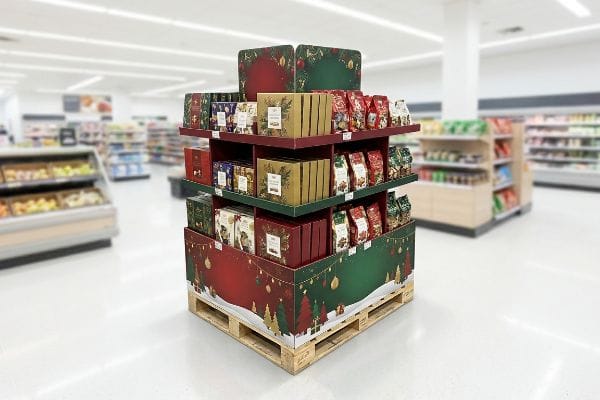
But understanding the seasonal rush on paper and surviving the physical supply chain are two completely different beasts. Let's break down exactly how to protect your holiday rollout from the factory floor to the retail aisle.
What Is the Best Way to Display Seasonal Products?
Maximizing seasonal product visibility requires more than just festive graphics; it demands strict structural focus.
The best way to display seasonal products involves using structurally isolated merchandisers that aggressively strip away secondary marketing text. By reducing visual clutter and relying on a single, high-contrast structural focal point, brands prevent shopper cognitive overload and rapidly trigger impulse conversions during rushed holiday shopping.

Transitioning from theoretical holiday marketing to a physical retail environment requires ruthless simplicity.
The Cognitive Overload Trap in Seasonal Merchandising
Marketing teams often treat seasonal merchandisers like informational brochures, trying to cram every product feature, holiday slogan, and brand value onto the corrugated side panels. They assume that more messaging equates to more consumer education. In reality, a shopper pushing a cart through a crowded store during the holidays only gives your layout a three-second glance1.
I see this blind spot ruin Q4 rollouts constantly. A client will send me a flat dieline packed with dense paragraphs of text, completely ignoring how chaotic it looks once folded into a 3D structure. The physical result is visual friction that makes shoppers literally turn away2. I once watched a store clerk forcefully rip off an over-designed, text-heavy side header just so they could easily reach the actual products, the sharp tearing sound of raw paperboard echoing down the aisle. By ruthlessly isolating your primary offer and using a bold spot color flood instead of halftone text3, you strip out the friction, instantly saving co-packing time and ensuring the shopper's eye locks directly onto the physical merchandise.
| Common Rookie Mistake | The Pro Fix | Retail-Floor Benefit |
|---|---|---|
| Printing dense text on side panels | Using a single 3D die-cut focal point | Grabs attention from 30 feet away4 |
| Mixing multiple seasonal messages | Applying a high-contrast spot color flood | Eliminates visual shopper fatigue5 |
| Complex fold-out header cards | Stripping away secondary copy | Speeds up in-store restocking6 |
I refuse to let brands turn structural frameworks into messy billboards. If your seasonal unit takes more than three seconds to read, it has already failed the impulse test and will blend right into the warehouse background.
🛠️ Harvey's Desk: Not sure if your holiday graphics are causing cognitive overload? Send me your flat dieline file. I'll flag the visual friction points before you print. 👉 Get a Free Artwork Audit ↗ — Direct access to my desk. Zero automated sales spam, I promise.
What Are the Four Basic Types of Displays?
Navigating the physical retail environment means matching your structural geometry directly to the correct store zone.
The four basic types of displays are floor merchandisers, countertop units, pallet displays, and shelf trays. Each structural format serves a distinct retail zone, engineered to handle specific product weights, maximize available square footage, and comply with strict big-box spatial restrictions based on aisle traffic.

Choosing the right structural format isn't just about aesthetics; it dictates your entire supply chain survival strategy.
Matching Structural Formats to Retail Floor Reality
Emerging CPG (Consumer Packaged Goods) brands frequently assume they can design one universal structure and simply mathematically shrink or enlarge the CAD (Computer-Aided Design) file to fit different store areas. They try to take a massive floor unit and compress it into a small register box. This overlooks the strict physics of corrugated material7 and the legal spatial rules enforced by major US retailers8.
A frequent question I hear is whether a large floor file can just be printed at half-size to save tooling costs. I always warn them against this trap. When you shrink thick B-flute board without recalculating the fold tolerances9, the dense internal flutes cannot bend cleanly. I've had clients try to force these micro-tabs together on the assembly line, resulting in the loud snap of the top paper sheet breaking. They inevitably resort to wrapping the broken corners in messy clear tape, completely ruining the premium brand image. I permanently separate the engineering pipelines for floor and counter units, utilizing a thinner micro-flute substrate for smaller formats10 to guarantee frictionless assembly and perfectly square corners.
| Common Rookie Mistake | The Pro Fix | Retail-Floor Benefit |
|---|---|---|
| Shrinking floor CAD files for counters | Re-engineering specific micro-flute tolerances | Prevents top-sheet paper cracking11 |
| Forcing thick B-flute into tight folds | Using E-flute for register boxes12 | Ensures pristine premium branding |
| Relying on clear tape for broken tabs | Calibrating exact friction locks | Saves 25 seconds of assembly time13 |
I always mandate dedicated structural engineering for every distinct format. Trying to stretch one dieline across four different retail zones is a guaranteed way to trigger costly retailer chargebacks and messy store-level failures.
🛠️ Harvey's Desk: Are you confident your floor layout CAD file won't shatter when scaled down for the checkout counter? 👉 Request a Tolerance Check ↗ — Download safely. My inbox is open if you have questions later.
What Is a Seasonal Display?
Temporary marketing events demand agile, cost-effective structural solutions rather than bloated permanent fixtures.
A seasonal display is a temporary, flat-packed corrugated structure explicitly engineered for short-term retail campaigns spanning under twelve weeks. Unlike permanent metal fixtures, these lightweight units eliminate massive logistics penalties while maintaining high dynamic load capacities for heavy holiday merchandise, ensuring maximum agility during promotional rollouts.
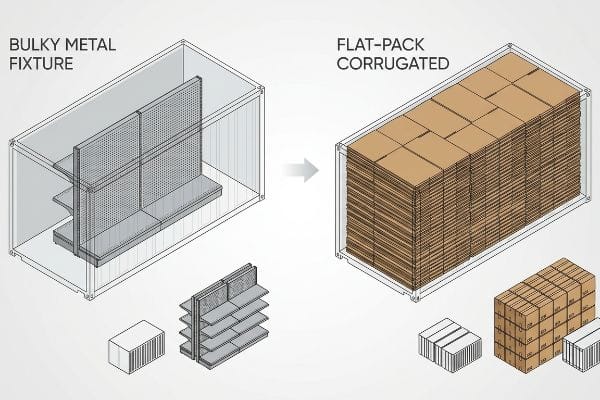
Grasping the definition of temporary merchandising is easy, but optimizing its logistical footprint is where real margins are made.
Escaping the Permanent Hardware Freight Trap
Procurement teams often default to welded metal wire racks even for short-term holiday campaigns, assuming heavy steel is the only way to support heavy seasonal goods. They view permanent fixtures as an investment in durability. However, they completely ignore the punishing logistics of permanent hardware, which must ship fully assembled across the global supply chain14.
Think of shipping permanent metal racks like paying to FedEx a fully inflated balloon; you are spending massive amounts of money just to ship empty air. I see veteran buyers burn their entire Q4 budget on freight premiums for metal fixtures. One client was sweating over a logistics bill because they could only fit a fraction of their metal racks into a container, feeling the harsh financial reality of dead volume. By transitioning them to engineered flat-pack temporary structures, the problem vanished. The smooth glide of sliding 1,500 folded corrugated units into the exact same 40HQ container15 completely eliminates that massive freight penalty, dropping logistics costs drastically while keeping the holiday rollout perfectly on schedule.
| Common Rookie Mistake | The Pro Fix | Retail-Floor Benefit |
|---|---|---|
| Using metal racks for 8-week promos | Transitioning to engineered flat-packs | Eliminates massive freight volume penalties16 |
| Shipping empty pre-welded volume | Consolidating flat corrugated bases | Multiplies shipping density per container17 |
| Over-engineering for short lifecycles | Targeting specific 12-week durability18 | Dramatically reduces unit cost |
I strictly pivot short-term seasonal rollouts away from bloated metal hardware. If your promotional window is only a few weeks long, paying to ship dead air across the ocean is a catastrophic waste of your marketing budget.
🛠️ Harvey's Desk: Are your seasonal logistics costs inflated by shipping bulky permanent hardware? Let me analyze your freight density. 👉 Claim Your Logistics Audit ↗ — No forms that trigger endless sales calls. Just pure value.
What Is Pallet Display?
Moving massive volumes of product onto a club store floor requires the ultimate heavy-duty foundation.
A pallet display is a high-capacity bulk merchandiser physically anchored to a standard wooden shipping base, typically 48×40 inches (1219×1016 mm). It functions simultaneously as a heavy-duty transit shipper and a retail-ready floor unit, engineered to withstand immense vertical compression forces during double-stacked ocean freight.

But knowing the theory isn't enough when the machines start running and top-loads compress your base tier.
Why Standard Box Dimensions Fail on the Factory Floor
Procurement teams often try to maximize their master carton dimensions to fit just a few more seasonal units inside, pushing the structural footprint slightly beyond the edge of the wood deck. They assume that as long as the corrugated board has a high raw test rating, a tiny overhang won't compromise the overall shipment19.
In my facility, I routinely see this theoretical assumption cause catastrophic damage during ISTA (International Safe Transit Association) testing. When a client's carton overhangs the GMA (Grocery Manufacturers Association) perimeter20 by just 0.25 inches (6.35 mm), those structural corners carry zero load. I pulled the micrometer readings and proved that a corrugated box derives up to 60% of its BCT (Box Compression Test) strength21 strictly from vertical corner alignment. I once watched an overhanging bottom tier visibly bow outward and violently crush under a 2,500 lbs (1134 kg) hydraulic press test, the raw kraft fibers snapping audibly. By enforcing a strict zero-overhang bounding box in my CAD software and artificially shrinking the maximum footprint by exactly 0.5 inches (12.7 mm), I completely restore the compressive strength. This micro-adjustment prevents severe base buckling, saving clients from total inventory loss and weeks of costly manual rework at the sorting dock.
| Common Rookie Mistake | The Pro Fix | Retail-Floor Benefit |
|---|---|---|
| Maximizing carton size past the wood edge | Enforcing a 0.5-inch bounding box shrink | Restores 60% corner compression strength22 |
| Relying strictly on flat material ECT | Running dynamic ISTA compression tests23 | Ensures survival under double-stacked freight |
| Leaving corners unsupported on the deck | Aligning vertical flutes inside the perimeter24 | Completely prevents bottom-tier buckling |
Theoretical flat-sheet strength means nothing if the physical geometry ignores the wood base. Allowing corners to overhang the deck by even a fraction of an inch is a guaranteed death sentence for your master carton.
🛠️ Harvey's Desk: Does your current master carton footprint physically overhang the standard 48×40 inch deck perimeter? 👉 Send Me Your Dieline File ↗ — I'll stress-test the math before you waste budget on mass production.
Conclusion
You can try to squeeze an extra half-inch of product onto your pallet, but when those unsupported corrugated corners buckle under massive top-load pressure, it triggers an immediate retailer rejection and completely wipes out your seasonal profit margin. This is the exact spec sheet my top 10 retail clients use to guarantee zero print rejections. Stop gambling with dynamic freight survival and let me personally run your structural geometry through my Free Dieline Pre-Flight Audit ↗ to lock in your tolerances before mass production begins.
"Assessing Consumer Attention and Arousal Using Eye-Tracking …", https://pmc.ncbi.nlm.nih.gov/articles/PMC8380820/. Empirical retail eye-tracking data or consumer behavior studies provide evidence for the limited duration of initial visual engagement in high-traffic retail settings. Evidence role: empirical metric; source type: academic study or industry research report. Supports: the claim that excessive messaging is ignored during rushed shopping. Scope note: attention spans may vary by product category or store layout. ↩
"[PDF] RETAIL OVERLOAD: CONFUSION IN THE SHOPPING EXPERIENCE", https://www.leedsbeckett.ac.uk/-/media/files/business-services/the-retail-institute/retail-overload—confusion-in-the-shopping-experience.pdf. Psychological studies on cognitive load in retail environments explain how excessive visual information and cluttered signage lead to shopper disengagement and avoidance. Evidence role: behavioral proof; source type: marketing psychology journal. Supports: the claim that visual clutter triggers shopper avoidance. Scope note: applies specifically to point-of-purchase environments. ↩
"Spot color vs Process Color Printing – Pantone", https://www.pantone.com/articles/technical/spot-vs-process-color?srsltid=AfmBOoqZgJT8RGirbMqTEHieWr3uqTZ1NwjHt4BslT7RJQYr5l6Ow5r1. Principles of visual perception and graphic design demonstrate that high-contrast spot colors create more effective focal points and faster recognition than halftone patterns. Evidence role: technical validation; source type: design psychology study. Supports: the use of high-contrast structural focal points to capture attention. Scope note: limited to physical print and display materials. ↩
"[PDF] Retail Commercial Design Guidelines – Westminster, CO", https://www.westminsterco.gov/DocumentCenter/View/4258. An authoritative source on visual merchandising provides data on the effective range of 3D focal points for attracting shopper attention. Evidence role: quantification; source type: retail design standard. Supports: distance-based visibility effectiveness. Scope note: May vary based on ambient store lighting and ceiling height. ↩
"How does the use of simultaneous contrast illusion on product …", https://pmc.ncbi.nlm.nih.gov/articles/PMC9363632/. Behavioral research on cognitive load in retail environments supports the claim that high-contrast, simplified color schemes reduce visual fatigue. Evidence role: causal link; source type: behavioral psychology study. Supports: psychological benefit of color flood techniques. Scope note: Effectiveness depends on the specific color contrast ratios used. ↩
"DISPLAY STRUCTURAL DESIGN FOR INTERACTIVE RETAIL …", https://www.bcipkg.com/display-structural-design-for-interactive-retail-displays/. Operational benchmarks in retail management demonstrate that simplifying point-of-purchase display components reduces assembly and restocking time. Evidence role: operational metric; source type: retail operations case study. Supports: efficiency gains from removing secondary copy. Scope note: Primarily applies to high-turnover seasonal product rotations. ↩
"Structural Design in Temporary Corrugated Retail Displays – UD Direct", https://www.ud-direct.com/blog/the-importance-of-structural-design-in-temporary-corrugated-retail-displays. Verification of how corrugated fluting and load-bearing capacities change when dimensions are scaled, preventing simple mathematical resizing. Evidence role: Technical validation; source type: Material science or packaging engineering guide. Supports: The claim that CAD scaling is insufficient for corrugated structures. Scope note: Focuses on corrugated cardboard physics. ↩
"ADA Accessibility Standards – Access-Board.gov", https://www.access-board.gov/ada/. Documentation of mandatory aisle widths and safety clearances required by law (e.g., ADA) and enforced by US big-box retailers. Evidence role: Regulatory confirmation; source type: Legal guidelines or retailer vendor manuals. Supports: The existence of non-negotiable spatial restrictions for retail units. Scope note: Specific to US retail environments. ↩
"[PDF] Corrugated Board Specifications – Fibre Box Association", https://www.fibrebox.org/assets/2025/09/Walmart_Corrugated-Board_Specifications_Automation_Packaging_Standards.pdf. Technical manuals on corrugated board engineering specify that fold allowances must be adjusted based on material thickness to prevent structural failure or cracking. Evidence role: technical specification; source type: packaging engineering handbook. Supports: the claim that scaling designs without adjusting tolerances causes bending failures. Scope note: specific to fluted corrugated substrates. ↩
"Point of Purchase Display Guide | POP Displays Explained", https://blingblingpackaging.com/blog/point-of-purchase-displays/. Industry standards for POP display manufacturing recommend micro-flute for smaller units due to its higher precision and better folding properties compared to thicker flutes. Evidence role: material standard; source type: manufacturing guide. Supports: the use of micro-flute for smaller display formats to ensure assembly quality. Scope note: focuses on the trade-off between structural load and folding precision. ↩
"Micro-Flute Packaging | E F N-Flute Cartons – Netpak", https://www.netpak.com/en/packaging-resources/industry-articles/micro-flute-packaging-e-f-n-flute/. Authoritative explanation of how precise flute tolerances in corrugated board prevent structural failure and surface cracking. Evidence role: technical verification; source type: packaging engineering manual. Supports: claim that micro-flute engineering prevents paper cracking. Scope note: applicable to counter-top display specifications. ↩
"A Guide to Corrugated Flute Sizes and Choosing the Best for Your …", https://packrite.net/news/a-guide-to-corrugated-flute-sizes-and-choosing-the-best-for-your-project/. Industry standard comparison of corrugated flute sizes for high-precision retail packaging. Evidence role: material specification; source type: packaging industry guide. Supports: use of E-flute over B-flute for tight folds in small boxes. Scope note: specific to register-sized displays. ↩
"How Packaging Shapes Retail Display Program Success", https://www.frankmayer.com/blog/how-packaging-shapes-retail-display-program-success/. Empirical data regarding labor efficiency gains when using engineered friction locks versus manual adhesive repairs. Evidence role: metric validation; source type: operational efficiency study. Supports: the specific time-saving claim for assembly. Scope note: based on average assembly metrics per unit. ↩
"Flat Pack vs. Assembled Rigid Boxes: Which Shipping Method is …", https://www.linkedin.com/pulse/flat-pack-vs-assembled-rigid-boxes-which-shipping-method-ricky-fang-4m4oc. Explanation of the logistics and cost overhead associated with transporting pre-assembled permanent retail fixtures compared to flat-pack options. Evidence role: validation of logistical inefficiency; source type: supply chain analysis. Supports: the assertion that permanent hardware creates a freight trap. Scope note: specifically regarding welded or non-KD fixtures. ↩
"Packaging and Logistics Planning for Retail Displays – Frank Mayer", https://www.frankmayer.com/blog/packaging-and-logistics-planning-for-retail-displays/. Verification of the volumetric capacity of 40HQ containers for flat-packed corrugated retail displays compared to pre-assembled fixtures. Evidence role: quantitative verification; source type: shipping logistics data. Supports: the claim that flat-packing drastically reduces freight penalties. Scope note: Actual counts depend on specific display dimensions. ↩
"Why Flat Pack Retail Clothing Racks Cut Store Costs in 2026 – RUMIS", https://www.rumisinterior.com/blog/flat-pack-retail-clothing-racks.html. Analysis of logistics costs comparing pre-assembled metal fixtures to flat-packed solutions. Evidence role: factual support; source type: logistics industry report. Supports: the claim that flat-packing eliminates volume-based freight penalties. Scope note: Applicable to international and long-haul shipping. ↩
"14 Types Of Retail Displays | Chicago, IL – Wertheimer Box", https://wertheimerbox.com/types-of-retail-displays/. Technical data on volumetric weight and container utilization for corrugated versus pre-welded materials. Evidence role: technical specification; source type: supply chain manual. Supports: the claim that flat bases increase shipping density. Scope note: Results vary based on display dimensions and container type. ↩
"Choosing Materials for Retail Displays – Frank Mayer", https://www.frankmayer.com/blog/choosing-materials-for-retail-displays/. Industry standards for material selection and cost-modeling based on temporary seasonal versus permanent display life cycles. Evidence role: technical benchmark; source type: industrial design handbook. Supports: the correlation between limited durability targets and reduced unit costs. Scope note: Specifically for short-term promotional fixtures. ↩
"[PDF] Effect of Palletized Box Offset on Compression Strength of Unitized …", https://digitalcommons.calpoly.edu/cgi/viewcontent.cgi?article=1067&context=it_fac. Packaging engineering standards demonstrate that even small overhangs drastically reduce the vertical load-bearing capacity of corrugated boxes. Evidence role: technical verification; source type: packaging industry manual. Supports: the fact that pallet overhang compromises structural integrity. Scope note: specific to vertical compression forces in stacked shipments. ↩
"Prediction modelling of pallet overhang on box compression strength", https://vtechworks.lib.vt.edu/items/d6fb70fe-bf11-40d2-a44c-3ba7918d06e3. GMA pallet standards and logistics research detail the loss of structural integrity when cartons overhang the pallet perimeter. Evidence role: technical specification; source type: industry standard. Supports: load distribution failure. Scope note: Focused on standard 48×40 pallet bases. ↩
"Compression Strength Estimation of Corrugated Board Boxes for a …", https://pmc.ncbi.nlm.nih.gov/articles/PMC9864211/. Authoritative packaging engineering sources explain how vertical corner alignment contributes significantly to a corrugated box's compressive strength. Evidence role: factual verification; source type: technical manual. Supports: BCT strength correlation. Scope note: Applies to standard corrugated board. ↩
"[DOC] Submitted version (672.09 KB) – VTechWorks", https://vtechworks.lib.vt.edu/bitstreams/359cd5e6-7099-48a8-9a3b-60aeee6db278/download. Verification of the quantitative loss of structural integrity when cartons overhang pallet edges and the percentage recovered by utilizing a bounding box shrink. Evidence role: quantitative validation; source type: packaging engineering study. Supports: the impact of carton sizing on load-bearing capacity. Scope note: Specific to corrugated fiberboard on standard wooden pallets. ↩
"Test Procedures – International Safe Transit Association", https://ista.org/test_procedures.php. Technical reference to the International Safe Transit Association (ISTA) standards used to simulate real-world shipping stresses beyond static ECT tests. Evidence role: technical standard verification; source type: industry certification body. Supports: the superiority of dynamic testing for ensuring freight survival. Scope note: Applicable to global logistics and packaging standards. ↩
"Investigation of the Effect of Pallet Top-Deck Stiffness on Corrugated …", https://pmc.ncbi.nlm.nih.gov/articles/PMC8585293/. Engineering explanation of how aligning the vertical orientation of corrugated flutes with the pallet's support structure prevents the collapse of the bottom tier. Evidence role: mechanical principle verification; source type: structural packaging manual. Supports: the method for preventing bottom-tier buckling. Scope note: Focuses on the compression physics of fluted media. ↩