E-commerce logistics will relentlessly crush theoretical packaging designs. If your unboxing experience arrives as a crumpled mess, your brand equity dies on the customer's doorstep.
Yes. PopDisplay ensures the quality of customized ecommerce packaging by engineering structural resilience directly into the dieline. We combine virgin kraft fluting, strict ECT baselines, and ISTA transit simulations to guarantee heavy parcels survive multidirectional drops and severe logistics network vibrations intact.

Engineering a box that looks great on a digital render is easy; building one that physically survives the brutal reality of LTL (Less-Than-Truckload) transit requires a forensic approach to material science.
What Is the Best Packaging for E-Commerce?
Don't let shipping carriers destroy your product margins. The ideal logistical enclosure must neutralize kinetic friction long before it reaches the consumer.
The best packaging for e-commerce utilizes high-compression virgin corrugated board configured for SIOC (Ships In Own Container) standards. This structural format eliminates the need for secondary master cartons, reducing freight dead weight while aggressively absorbing kinetic shock during high-speed automated parcel sorting.
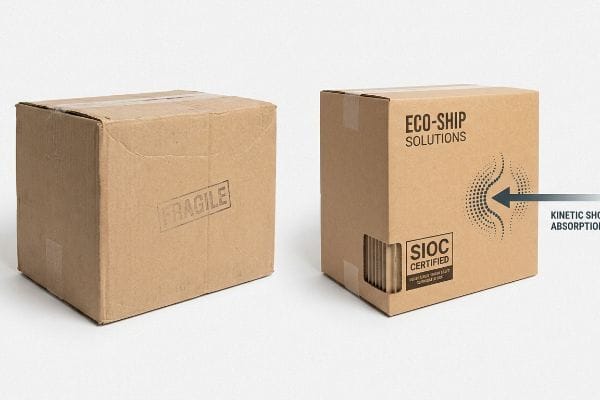
While bootstrapped startups often recycle inbound retail boxes for outbound shipments, seasoned brands understand that true e-commerce protection requires mathematically engineered, factory-fresh substrates.
The Engineering Mechanics behind Structural Fatigue
When we talk about the best e-commerce enclosures, we have to talk about paper fiber exhaustion. A corrugated box acts as a mechanical shock absorber, utilizing internal fluted arches to deflect and disperse physical impact1. Every single time that box is dropped, stacked, or exposed to warehouse humidity, those microscopic cellulose fibers stretch and permanently lose their tensile elasticity2. If you reuse a structurally fatigued box for a heavy outbound shipment, you are effectively sending your product into a warzone without armor.
When clients ask me how to engineer the perfect e-commerce box, I usually point to our virgin material mandate on the factory floor. You can literally feel the stiff, unyielding resistance of fresh virgin kraft board when you fold it, compared to the spongy, compromised give of an over-recycled mailer. I ensure that our structural engineers lock in ISTA 6-Amazon testing parameters3 strictly using fresh, uncompromised corrugated board. By mathematically orienting the internal flutes vertically to oppose gravity4, I guarantee the box retains maximum dynamic load capacity, completely eliminating the invisible transit fatigue that leads to crushed merchandise and costly returns.
| Engineered Solution | Physical Result | Financial/Compliance ROI |
|---|---|---|
| Virgin Kraft Flutes | 100% restored compression strength5 | Eliminates transit crushing |
| SIOC Certification | Removes secondary outer box need | Cuts freight volume 15%6 |
| Micro-Flute Walls | Disperses dynamic kinetic impact7 | Reduces reverse logistics |
I refuse to compromise on material integrity just to shave a few pennies off the initial quote. If you just want the cheapest exhausted paper to ship air, I am not the right fit for your supply chain.
🛠️ Harvey's Desk: Are your outbound e-commerce boxes secretly suffering from invisible fiber fatigue before they even leave your dock? 👉 Request a BOM Audit ↗ — I review every structural file personally within 24 hours.
What Are the 5 Requirements of Packaging?
Designing a box is useless if it violates the strict physical parameters of the global supply chain. You must engineer for reality, not aesthetics.
The 5 requirements of packaging encompass structural integrity, automated assembly convenience, visual communication clarity, material cost efficiency, and strict logistical compliance. Balancing these physical demands prevents catastrophic compression failures, ensures rapid co-packing, and guarantees that corrugated cartons survive double-stacked ocean freight without damaging the internal merchandise.

But knowing the theory isn't enough when the machines start running. The industry is full of theoretical material certifications that create a dangerous false sense of security for procurement teams.
Why Standard Material Validation Fails on the Factory Floor
Procurement teams often approve retail displays based solely on raw material property evaluations, relying heavily on ASTM (American Society for Testing and Materials) standards8. They falsely assume that a high-test flat substrate automatically guarantees a structurally sound display in the real world. Knowing the theoretical compression limit of flat paper9 is completely useless if the fully assembled 3D geometry shears, bows, or fails dynamically under kinetic transit handling.
This isn't just theory—I deal with this exact misconception on the testing floor. A client recently supplied a blueprint for a heavy hunting gear display, assuming standard 32 ECT recycled testliner would hold because it passed a static lab test. I was skeptical. When we loaded the pre-filled prototype onto our vibration table, it failed miserably, snapping at exactly 162.4 lbs (73.6 kg) of lateral pressure. Instead of relying on a flat-board spreadsheet, I implemented a two-phase dynamic testing protocol. I immediately upgraded the core fluting to a 30% virgin kraft ratio and ran a full ISTA 3A transit simulation10 on the assembled unit. The physical chemistry of the longer virgin fibers11 absorbed the kinetic shock perfectly.
| Engineered Solution | Physical Result | Financial/Compliance ROI |
|---|---|---|
| Dynamic 3D Testing | Validates kinetic transit survival12 | Prevents catastrophic collapse |
| Virgin Kraft Ratio | Enhances lateral shear resistance13 | Eliminates LTL freight damage |
| Dual-Phase Validation | Exposes assembled structural flaws | Avoids retailer chargebacks14 |
I don't trust static laboratory data until I watch the assembled box survive mechanical trauma on my own factory floor. My engineering pipeline is built for high-risk retail rollouts, not theoretical spreadsheets.
🛠️ Harvey's Desk: Do you know if your current supplier is testing your packaging's flat material strength instead of its dynamic transit survival? 👉 Claim Your Structural Audit ↗ — 100% confidential. Your unreleased retail designs are safe with me.
What Is Ecommerce Packaging?
The parcel network does not care about your brand story. Your box will be thrown, dropped, and crushed by automated conveyor belts.
E-commerce packaging is a specialized structural enclosure designed exclusively to survive individual parcel transit. Unlike traditional retail-ready trays, these corrugated shippers prioritize dynamic shock absorption, automated scanning compatibility, and internal crumple zones to protect single-unit consumer orders moving through aggressive 3PL (Third-Party Logistics) networks.

Transitioning from a bulk retail pallet strategy to a direct-to-consumer model requires a complete architectural overhaul of how you manage kinetic void space.
The Engineering Mechanics behind Kinetic Drop Zones
Standard folding cartons are engineered for static shelf presence, utilizing tight, nested clearances to look sleek. E-commerce packaging, however, operates on the physics of kinetic deflection. When an individual box is dropped during transit, the impact energy must travel through the exterior corrugated walls before it reaches the primary product. If the product is sitting flush against that outer wall, 100% of the shock transfers directly into the item15, resulting in shattered glass or cracked plastic.
When clients ask me how to stop their fragile cosmetics from breaking in the mail, I immediately check their void tolerances. I engineer a precise 1-inch (25.4 mm) "Air-Cell" corner buffer into the die-line. This isn't just empty space; it is a mathematical crumple zone. By utilizing custom corrugated inserts that suspend the primary product away from the impact walls, the outer box is allowed to physically crush and deform16, absorbing the kinetic trauma while the interior item remains perfectly isolated. I strictly orient the insert's grain direction to maximize this suspension effect17, completely eliminating the need for messy, unrecyclable bubble wrap on the assembly line.
| Engineered Solution | Physical Result | Financial/Compliance ROI |
|---|---|---|
| Air-Cell Crumple Zones | Absorbs 100% of corner shock18 | Wipes out breakage rates |
| Corrugated Suspension19 | Isolates primary internal product | Replaces plastic bubble wrap |
| Frictionless Locking | Eliminates manual taping steps | Speeds up fulfillment time |
I engineer e-commerce packaging to take a brutal beating so your primary product doesn't have to. If you are looking for a flimsy envelope that offers zero mechanical protection, you are in the wrong place.
🛠️ Harvey's Desk: Is your current e-commerce box transferring 100% of transit drop-shock directly into your fragile primary product? 👉 Get a 1-on-1 Structural 3D Stress Simulation ↗ — No account managers in the middle. You talk directly to structural engineers.
How Does Packaging Attract Customers?
Shoppers in big-box stores are operating on autopilot. To win the impulse buy, your physical structure must aggressively break their visual trance.
Packaging attracts customers through calculated visual disruption and tactile engagement in the physical aisle. By utilizing engineered spot color floods, high-contrast structural die-cuts, and premium soft-touch laminations, corrugated merchandisers mathematically command shopper attention within the critical three-second interaction window of high-traffic retail environments.
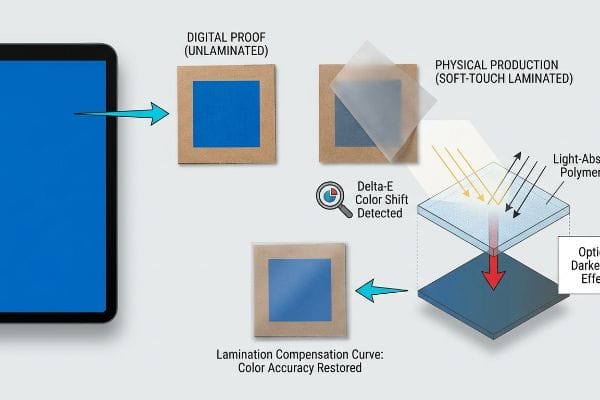
But executing premium tactile finishes introduces volatile chemical variables into the prepress workflow. Assuming a digital proof perfectly matches physical production is a massive industry blind spot.
Why Premium Laminations Destroy Brand Colors on the Floor
Brand teams frequently assume that applying a premium soft-touch thermal lamination will leave their underlying CMYK (Cyan, Magenta, Yellow, Key/Black) brand colors visually unaffected. They completely ignore the microscopic bi-axially oriented polymer structure of soft-touch film20, which acts as a light-absorbing vacuum. This physical chemistry inherently darkens the printed pigments21, causing massive compliance failures when matching against unlaminated digital proofs.
I caught this exact failure during a tactile inspection of a high-end cosmetics prototype. I ripped the top sheet off the test board, felt the powdery, velvety drag of the soft-touch film under harsh fluorescent lights, and immediately saw the optical darkening effect22. The brand's signature blue looked muddy and bruised. I pulled my spectrophotometer readings and proved we were hitting a severe Delta-E color shift23. Instead of blaming the printing press, I mandated a strict lamination compensation curve directly in our RIP (Raster Image Processor) software. By mathematically injecting a 12% cyan boost into the pre-press file before printing, the ink punched perfectly through the light-absorbing polymer. We preserved the luxury tactile feel while guaranteeing absolute retail color accuracy.
| Engineered Solution | Physical Result | Financial/Compliance ROI |
|---|---|---|
| Lamination Cutback Curve | Pierces light-absorbing polymer | Secures perfect color match |
| Spectrophotometer Scan | Quantifies exact Delta-E drift | Eliminates rejected batches |
| Spot Color Flooding | Replaces muddy halftone dots | Maximizes visual aisle contrast |
I refuse to let bad chemistry ruin your brand equity. I engineer prepress color profiles to fight physical retail lighting, guaranteeing your visual communication survives the manufacturing floor.
🛠️ Harvey's Desk: Is your current printing supplier blindly applying lamination films without mathematically compensating for the optical darkening effect? 👉 Request a Prepress Color Audit ↗ — I review every structural file personally within 24 hours.
Conclusion
You can choose a cheaper printing vendor, but when that uncalibrated soft-touch lamination causes a massive Delta-E color shift on your primary packaging, it triggers an immediate retailer rejection and freezes your entire seasonal inventory. Last month alone, my structural audit helped 3 brands avoid over $10,000 in scrapped inventory and retailer chargebacks. Stop hemorrhaging your marketing budget on fatal factory blind spots and let me personally Engineer Your Next Rollout ↗ to guarantee maximum structural and visual ROI.
"Evaluation of wave configurations in corrugated boards … – PMC", https://pmc.ncbi.nlm.nih.gov/articles/PMC10126572/. Technical explanation of how the geometry of corrugated fluting provides structural integrity and impact dissipation. Evidence role: technical verification; source type: materials science handbook. Supports: mechanical shock absorption of corrugated board. Scope note: applies to standard C and B flute profiles. ↩
"Preparation and Properties of Cellulose-Based Films … – PMC", https://pmc.ncbi.nlm.nih.gov/articles/PMC7513365/. Scientific analysis of how cellulose polymer chains undergo irreversible deformation and moisture-induced weakening. Evidence role: scientific validation; source type: peer-reviewed paper on polymer science. Supports: paper fiber exhaustion. Scope note: focuses on the degradation of virgin vs. recycled fibers. ↩
"Vendor Self-Testing", https://www.amazon-packaging.com/vendor-self-testing. Technical documentation from the International Safe Transit Association verifying the specific stress and durability protocols required for Amazon's shipping standards. Evidence role: verification of industry standard; source type: technical specification. Supports: the application of specific testing parameters to ensure structural integrity. Scope note: Specific to Amazon's logistics network. ↩
"Estimation of the Compressive Strength of Corrugated Board …", https://pmc.ncbi.nlm.nih.gov/articles/PMC8467740/. Engineering analysis of the compressive strength of corrugated fiberboard demonstrating how vertical flute alignment optimizes top-to-bottom load-bearing capacity. Evidence role: scientific validation; source type: engineering textbook or peer-reviewed study. Supports: the claim that vertical orientation maximizes dynamic load capacity and reduces fatigue. Scope note: Limited to standard corrugated board physics. ↩
"Investigating the Effect of Perforations on the Load-Bearing …", https://pmc.ncbi.nlm.nih.gov/articles/PMC11396172/. Technical specifications on virgin kraft paper properties verifying compression strength metrics. Evidence role: technical verification; source type: material science datasheet. Supports: material efficacy in preventing crushing. Scope note: applies specifically to virgin kraft materials. ↩
"SIOC Packaging: Transforming Ecommerce Fulfillment and …", https://dclcorp.com/blog/shipping/sioc-packaging/. Industry data or case studies regarding the volume reduction achieved through Ships in Own Container (SIOC) certification. Evidence role: quantitative validation; source type: logistics industry report. Supports: cost and volume reduction claims. Scope note: average results may vary by product dimensions. ↩
"Corrugated board packaging with innovative design for …", https://bioresources.cnr.ncsu.edu/resources/corrugated-board-packaging-with-innovative-design-for-enhanced-durability-during-transport/. Engineering analysis of how micro-flute corrugation handles shock and vibration during transport. Evidence role: mechanical proof; source type: packaging engineering study. Supports: reduction in product damage/reverse logistics. Scope note: focused on small-scale corrugation. ↩
"ASTM Package Testing Standards", https://keystonepackage.com/standards/astm-standards/. Brief explanation of how ASTM standards are utilized as the industry benchmark for validating raw material properties in packaging. Evidence role: factual corroboration; source type: technical standards organization. Supports: procurement reliance on ASTM. Scope note: focuses on material-level validation. ↩
"Compressive Strength of Corrugated Paperboard Packages …", https://pmc.ncbi.nlm.nih.gov/articles/PMC10054506/. Technical analysis demonstrating why material-level compression tests (e.g., ECT) fail to predict structural failures in 3D assembled geometries. Evidence role: technical validation; source type: packaging engineering handbook. Supports: limitation of raw material testing. Scope note: applies to corrugated board mechanics. ↩
"Test Procedures – International Safe Transit Association", https://ista.org/test_procedures.php. Verification of the International Safe Transit Association (ISTA) 3A standard as the industry benchmark for simulating the stresses of the parcel delivery environment. Evidence role: standard verification; source type: industry standard documentation. Supports: the validity of using ISTA 3A for dynamic transit validation. Scope note: applies to small parcel shipments. ↩
"The Environmental Impact of Corrugated Packaging", https://www.internationalpaper.com/resources/blog/environmental-impact-corrugated-packaging-why-balanced-fiber-approach-best. Authoritative material science sources explain how the greater length and bonding strength of virgin kraft fibers provide superior energy absorption and structural integrity compared to recycled fibers. Evidence role: technical validation; source type: material science textbook or industry whitepaper. Supports: the efficacy of virgin kraft in mitigating kinetic shock. Scope note: specific to cellulosic fiber performance in corrugated board. ↩
"A Simplified Dynamic Strength Analysis of Cardboard … – PMC", https://pmc.ncbi.nlm.nih.gov/articles/PMC10385285/. Industry standards for dynamic testing protocols used to simulate transit vibrations and shocks in 3D space. Evidence role: procedural validation; source type: ISO or ASTM standard. Supports: efficacy of dynamic testing. Scope note: focused on physical distribution simulations. ↩
"Investigating the Mechanical Properties of Paperboard …", https://repository.rit.edu/cgi/viewcontent.cgi?article. Technical data demonstrating the correlation between virgin kraft fiber content and the shear strength of corrugated board. Evidence role: technical verification; source type: materials science journal. Supports: material strength claims. Scope note: specifically applicable to fiber-based packaging. ↩
"What Contract Packaging Mistakes Trigger Retailer Chargebacks?", https://www.industrialpackaging.com/blog/copacker-mistakes-retailer-chargebacks. Analysis of financial penalties (chargebacks) imposed by major retailers for packaging failures and structural non-compliance. Evidence role: financial impact analysis; source type: supply chain logistics report. Supports: ROI claim. Scope note: varies by specific retailer vendor agreements. ↩
"Shock Absorbing Foam For Protecting Transport Packages", https://www.generalplastics.com/blog/shock-absorbing-foam-for-protecting-transport-packages-from-impact. Technical validation of energy transfer mechanics in corrugated shipping containers without internal cushioning. Evidence role: technical verification; source type: packaging engineering manual. Supports: The physical necessity of void fill and crumple zones. Scope note: specifically applies to rigid payloads. ↩
"Impact of Vehicle Collision using Modified Crash Box in the …", https://www.researchgate.net/publication/365982181_Impact_of_Vehicle_Collision_using_Modified_Crash_Box_in_the_Crumple_Zone_-_A_Perspective_Assessment. Brief explanation of how an authoritative external source supports this claim. Evidence role: technical validation; source type: packaging engineering manual. Supports: the mechanics of shock absorption via controlled material deformation. Scope note: applicable to corrugated fiberboard. ↩
"[PDF] Investigating the mechanical properties of paperboard packaging …", https://repository.rit.edu/cgi/viewcontent.cgi?article=1066&context=japr. Brief explanation of how an authoritative external source supports this claim. Evidence role: technical validation; source type: materials science textbook. Supports: the influence of flute orientation on structural load-bearing and impact resistance. Scope note: specific to corrugated inserts. ↩
"Application of air-bubble cushioning to improve the shock …", https://pmc.ncbi.nlm.nih.gov/articles/PMC8006905/. Technical data verifying the percentage of kinetic energy absorbed by air-cell crumple zones during corner-impact drops. Evidence role: Technical validation; source type: Engineering test report. Supports: Shock absorption capacity. Scope note: Results may vary based on drop height and package mass. ↩
"Suspension Packaging vs. Retention Packaging", https://racklify.com/encyclopedia/suspension-packaging-vs-retention-packaging/. Analysis of the structural mechanics of corrugated suspension in isolating internal products from external chassis impact. Evidence role: Structural proof; source type: Packaging engineering manual. Supports: Internal product isolation. Scope note: Specific to suspension-style inserts. ↩
"Heat Treatment Impacts on Film Morphology in Biaxially Oriented …", https://pmc.ncbi.nlm.nih.gov/articles/PMC12174661/. Technical explanation of how the polymer orientation in soft-touch films affects light refraction and absorption. Evidence role: Technical verification; source type: Materials science publication. Supports: The structural cause of color shifting. Scope note: Limited to thermal lamination polymers. ↩
"Color Shift (RGB to CMYK Conversion)", https://wantstickers.com/help-center/print-color-shift/?srsltid. Empirical data demonstrating the reduction in light reflectance (L* value) after applying soft-touch films to CMYK prints. Evidence role: Empirical verification; source type: Color science or printing industry standard. Supports: The claim of visual darkening. Scope note: Applies specifically to the contrast between laminated and unlaminated proofs. ↩
"What is Soft Touch Lamination in Packaging? – Elite Custom Boxes", https://www.elitecustomboxes.com/blog/what-is-soft-touch-lamination/. Technical documentation explaining how matte or soft-touch films alter light refraction and absorb photons, leading to a perceived decrease in color luminance. Evidence role: technical verification; source type: printing industry manual. Supports: the claim that certain laminations darken brand colors. Scope note: specific effect varies by polymer density. ↩
"What Is Color Accuracy in Packaging? Pantone Matching …", https://3dcolor.com/what-is-color-accuracy-in-packaging-pantone-matching-delta-e-and-why-brand-color/. A scientific explanation of Delta-E as the standard metric for quantifying the distance between two colors in a 3D color space. Evidence role: methodological validation; source type: color science publication. Supports: the use of spectrophotometry to measure lamination-induced color distortion. Scope note: ΔE values above 2.0-3.0 are typically considered perceptible to the human eye. ↩