Retail environments are fiercely competitive. Upgrading your in-store strategy is a baseline requirement, but forcing unnecessary technology into the aisle can backfire if you ignore physical retail fundamentals.
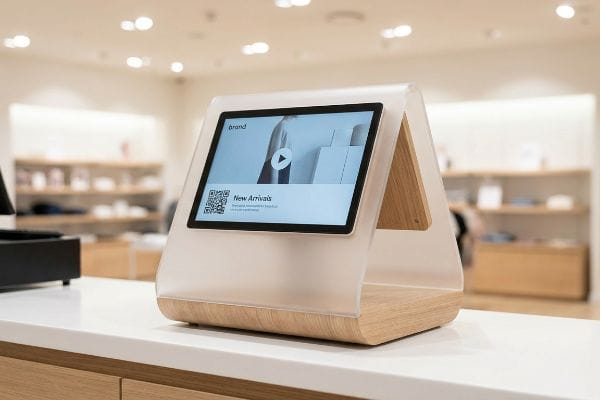
Yes. Digital POS displays make shopping significantly better by merging interactive media with physical merchandising. A digital POS display (Point of Sale) engages consumers through dynamic messaging, targeted video content, or QR codes, actively reducing perceived wait times while driving impulse conversions directly at the retail checkout counter.
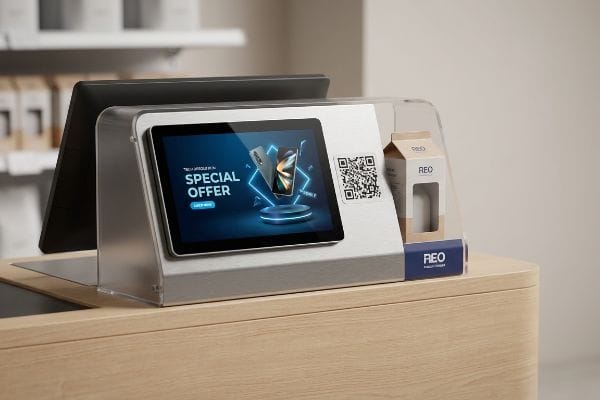
Bridging the gap between a flashy screen and a functional retail fixture requires precise engineering, ensuring the technology actually survives the store environment.
What Are the Main Benefits of Digital Display Panels?
High-speed retail demands agility. Relying on outdated prepress methods for your promotional panels completely destroys your speed-to-market advantage.
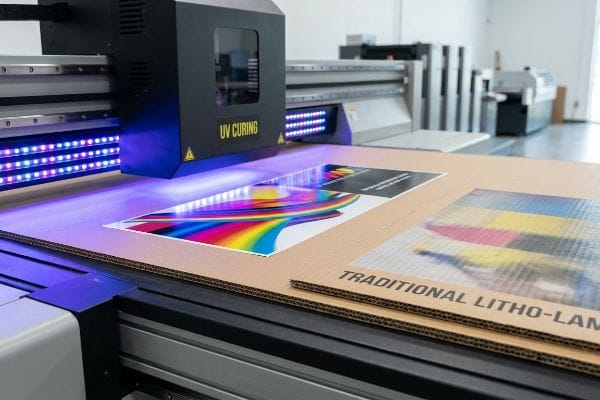
The main benefits of digital display panels include rapid prototyping, zero tooling costs, and immediate production agility. Utilizing UV flatbed digital printing instantly polymerizes liquid ink onto corrugated substrates, bypassing traditional litho-lamination delays and delivering ultra-crisp, moisture-resistant graphics that survive harsh retail environments.
But simply knowing digital printing exists doesn't help if your prepress files are an unorganized mess.
Why Traditional Prepress Ruins Digital Display Panels
Many marketing teams assume they can just send standard CMYK (Cyan, Magenta, Yellow, Key/Black) digital files to a factory and expect perfect results. They rely heavily on traditional litho-lamination timelines, assuming a multi-week prepress cycle is unavoidable for premium retail panels1. This outdated approach wastes both time and money when executing agile short-run campaigns.
I constantly see brand teams suffer from the "muddy panel" trap when trying to port standard artwork over to unsealed corrugated testliner. Even veteran designers often overlook this blind spot, assuming the ink will sit beautifully on top of the paper. In reality, standard liquid inks absorb deeply into the porous paper fibers2. The physical result? A washed-out, grainy graphic that looks terrible under harsh fluorescent lights. In my facility, I fix this by bypassing litho-lamination entirely and using direct-to-board UV digital printing. You can actually smell the sharp ozone scent of the UV light arrays instantly curing the ink into a solid polymer film3 the millisecond it hits the board. This completely eliminates fiber bleed, cutting our production timeline down by weeks and saving clients the headache of expensive metal printing plates.
| Common Rookie Mistake | The Pro Fix | Retail-Floor Benefit |
|---|---|---|
| Printing standard ink on raw testliner | Direct-to-board UV digital printing4 | Prevents washed-out graphics |
| Paying for expensive metal plates | Plate-free digital polymer curing5 | Saves weeks of setup time |
| Ignoring ink absorption rates | Instant UV light array curing6 | Ensures crisp barcode scanning |
I refuse to let my clients waste budget on unnecessary metal tooling for short-run digital panels. Bypassing litho-lamination for UV flatbed printing protects your margins and guarantees your brand colors pop accurately from twenty feet away.
🛠️ Harvey's Desk: Not sure if your artwork files are optimized for UV flatbed digital printing? 👉 Request a Free Artwork Pre-Flight ↗ — Direct access to my desk. Zero automated sales spam, I promise.
What Are the 5 P's of Retail?
You can engineer the most visually stunning merchandiser in the world, but it will fail if it ignores basic commercial frameworks.
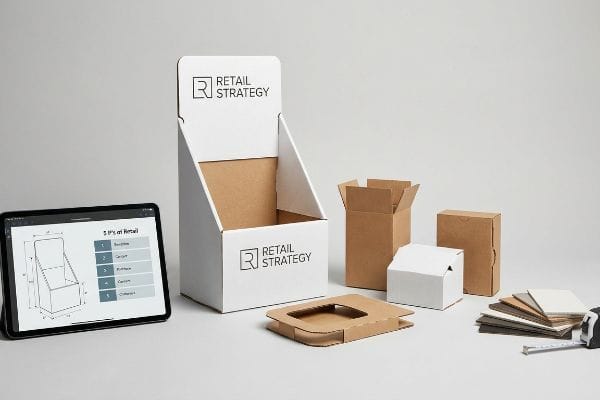
The 5 P's of retail are Product, Price, Place, Promotion, and People. This strategic framework dictates how physical merchandise is positioned within a specific store ecosystem, ensuring structural packaging aligns seamlessly with store operations, logistical restrictions, and targeted consumer demographics to maximize point-of-purchase profitability.
Understanding this matrix is easy in a boardroom, but executing it on the physical store floor is where most campaigns collapse.
How Misaligned Retail Strategies Destroy Floor Executions
Emerging brands frequently attempt to launch products without mastering the foundational mechanics of retail strategy. They assume a great item with an eye-catching graphic will naturally sell itself, ignoring the strict operational models of different big-box retailers7. This lack of alignment means their physical displays often end up economically and logistically incompatible with the targeted store.
I see this happen all the time when a brand tries to force a massive warehouse club display into a local convenience store layout. The buyer gets excited about the "Promotion" but completely ignores the "Place." When the unit arrives, the store clerks physically cannot fit the 48-inch (1219.2 mm) wide base down the narrow aisles. You hear the loud, abrasive scraping of the corrugated base tearing against steel shelving as clerks try to shove it into a corner, eventually just throwing the mangled display in the trash. I engineer around this by mandating a strict framework alignment matrix before we cut a single piece of board. By dynamically mapping your display dimensions to the specific retailer's operational model, we eliminate these physical friction points, preventing devastating store-level rejections and saving thousands in wasted logistics8.
| Common Rookie Mistake | The Pro Fix | Retail-Floor Benefit |
|---|---|---|
| Ignoring specific store aisle limits | Retail-specific framework mapping | Prevents display trash rejections9 |
| Using one-size-fits-all dimensions | Custom fractional pallet geometries10 | Ensures seamless aisle placement |
| Disconnecting promotion from placement | Pre-engineering the 5 P's matrix11 | Secures premium store locations |
I always map the structural design directly to the targeted retailer's specific floor strategy. Securing an order means nothing if your merchandiser physically conflicts with the store's operational footprint and gets tossed in the dumpster.
🛠️ Harvey's Desk: Are you blindly sending the exact same floor display size to both Target and local pharmacy chains? 👉 Download My Retail Dimension Cheat Sheet ↗ — Download safely. My inbox is open if you have questions later.
What Are the Advantages of Point of Sale Displays?
Capturing the shopper's attention at the checkout register is the ultimate retail victory, but that space is highly regulated and incredibly cramped.
The advantages of point of sale displays include capturing high-intent impulse purchases, increasing average order value, and utilizing premium checkout counter space. By positioning merchandise directly in the final transaction zone, POS displays leverage immediate consumer proximity to drive rapid conversions before the shopper exits the store.
However, treating these premium checkout units just like smaller floor displays is a massive logistical trap.
Why Shrinking Floor Displays for the Checkout Counter Fails
Junior designers often try to save money by designing a scalable floor unit that they simply shrink by 50% to use as a countertop POS display. They assume the structural math naturally translates to a smaller footprint. They completely ignore the strict legal and logistical rules dictating these two very separate zones12 in North American retail.
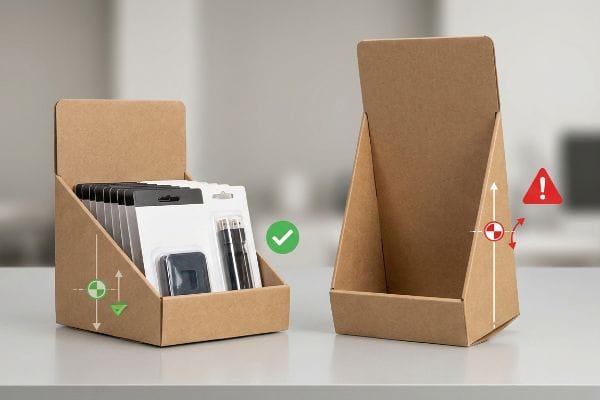
It's a common trap that catches even experienced procurement teams. Think of it like trying to fit a truck engine into a compact car; the proportions are entirely wrong. When you simply shrink a floor model, the center of gravity gets dangerously high. I've watched these unbalanced "shrink-to-fit" displays violently tip forward during stability tests, with the heavy thud of the products spilling all over the floor. To fix this, I permanently separate the engineering pipelines. I strictly anchor POS files to the ADA (Americans with Disabilities Act) 15-48 inch (381-1219 mm) forward reach13 compliance window, adjusting the depth-to-height ratio to ensure absolute stability. This structural pivot prevents massive chargebacks from store managers who immediately reject wobbly, non-compliant register units.
| Common Rookie Mistake | The Pro Fix | Retail-Floor Benefit |
|---|---|---|
| Shrinking floor units for counters | Separating POS and POP engineering | Prevents top-heavy tipping14 |
| Ignoring legal reach limits | Designing to strict ADA parameters15 | Eliminates compliance rejections |
| Unbalanced depth-to-height ratio | Lowering the center of gravity16 | Keeps checkout lanes safe |
I never allow my factory to just scale down a floor merchandiser for a register counter. Engineering strictly to ADA reach limits guarantees your display sits perfectly stable and actively drives impulse sales without violating store policies.
🛠️ Harvey's Desk: Is your current countertop display violating strict checkout reach compliances? Let me run the math. 👉 Get a Free POS Stability Check ↗ — No forms that trigger endless sales calls. Just pure value.
What Should Effective Point of Purchase Displays Do?
A successful retail unit must actively intercept foot traffic and force an interaction. Passive structures simply become invisible background noise.
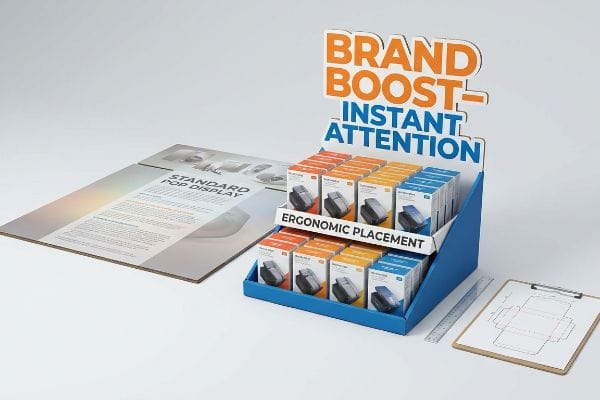
Effective point of purchase displays should instantly capture visual attention, organize merchandise intuitively, and drive physical product interaction. A highly engineered POP display (Point of Purchase) interrupts consumer traffic patterns, clearly communicates brand value, and facilitates frictionless restocking to ensure the unit remains profitable throughout its lifecycle.
But knowing the theory isn't enough when the machines start running and the pallets hit the actual store aisles.
Why Standard POP Displays Fail on the Factory Floor
Marketing teams frequently design point-of-purchase displays strictly for up-close viewing on their backlit computer monitors. They assume that tiny, intricate text and subtle gradient graphics will perfectly translate to a bustling retail environment. This creates a dangerous blind spot regarding how human shoppers actually navigate large, distracting store aisles17.
In my facility, I routinely see beautifully designed dielines completely fail the 3-3-3 spatial engagement rule18 once we print the physical samples. Brands cram massive paragraphs onto the header, which causes massive cognitive overload for a shopper walking by at three feet per second. When I measure the visual contrast under our simulated retail lighting, the subtle digital gradients turn into a muddy blur, causing foot traffic to ignore the unit entirely. I fix this by ruthlessly stripping away secondary copy and engineering aggressive, 3D die-cut headers with dense Pantone spot color floods. By calculating the exact 50-inch (1270 mm) strike zone from the floor19 for primary product placement, I ensure the unit pulls attention from thirty feet away. This exact spatial engineering prevents the unit from blending into the background, dramatically lifting impulse conversions and justifying the floor space investment.
| Common Rookie Mistake | The Pro Fix | Retail-Floor Benefit |
|---|---|---|
| Designing only for up-close viewing | Implementing the 3-3-3 engagement rule20 | Captures attention from 30 feet |
| Using tiny text on headers | High-contrast 3D die-cut elements | Stops shopper scrolling blindness |
| Placing items out of easy reach | Ergonomic 50-inch (1270 mm) strike zones21 | Frictionless product grabbing |
I build point-of-purchase units to act as physical speedbumps in the aisle. If your structural geometry and visual contrast don't successfully interrupt a shopper's walking pattern, you are just paying to ship empty cardboard.
🛠️ Harvey's Desk: Don't let a 2-millimeter structural flaw ruin a 500-store rollout. 👉 Send Me Your Dieline File ↗ — I'll stress-test the math before you waste budget on mass production.
Conclusion
You can settle for a basic uncalibrated display, but when that top-heavy unit violently tips over during a cart collision, the resulting damage creates massive liability friction, completely wiping out your profit margin and triggering an immediate retailer rejection. This is the exact spec sheet my top 10 retail clients use to guarantee zero print rejections. Stop gambling with unstable structural math and let me personally audit your geometry through my Free Dieline Audit ↗ to ensure your next campaign stands perfectly secure.
"Litho Lam Lead Times Got You Down? Opt for Digital Printing Instead!", https://blog.fantastapack.com/litho-lead-times-got-you-down. Brief explanation of how traditional litho-lamination requires plate production and curing periods resulting in multi-week lead times. Evidence role: factual verification; source type: printing industry standard. Supports: the inefficiency of traditional prepress cycles. Scope note: Lead times vary by manufacturer. ↩
"The effect of colorants on the content of heavy metals in recycled …", https://bioresources.cnr.ncsu.edu/resources/the-effect-of-colorants-on-the-content-of-heavy-metals-in-recycled-corrugated-board-papers/. Brief explanation of how liquid inks penetrate unsealed corrugated testliner, resulting in reduced color saturation and blurred edges. Evidence role: technical mechanism; source type: printing industry guide. Supports: the 'muddy panel'effect on unsealed substrates. Scope note: specific to non-coated paper fibers. ↩
"A Review of Vat Photopolymerization Technology: Materials … – PMC", https://pmc.ncbi.nlm.nih.gov/articles/PMC7922356/. Brief explanation of the photopolymerization process where UV light converts liquid ink into a solid film on the substrate surface. Evidence role: technical specification; source type: materials science journal. Supports: the elimination of fiber bleed through surface-level curing. Scope note: applies to UV-curable ink systems. ↩
"UV Printing 101: Why We Got a UV Printer & What You Need to Know!", https://www.youtube.com/watch?v=InpNtJl45Rs&vl=en-US. Technical explanation of how UV-curable inks bond to porous substrates like testliner without soaking in, preventing color loss. Evidence role: technical verification; source type: industrial printing manual. Supports: prevention of washed-out graphics. Scope note: applies to porous board materials. ↩
"Glass Cure Plates for Fabricating Flat Composite Panels – Tech Briefs", https://www.techbriefs.com/component/content/article/6966-gsc-14040. Comparative analysis of digital plate-less workflows versus traditional offset plate production and registration timelines. Evidence role: process efficiency analysis; source type: print production case study. Supports: reduction in setup time. Scope note: specific to large-format display panels. ↩
"Invisible UV Barcode Technology", https://angtech.com/invisible-uv-barcode-technology-5-tips/. Technical detail on how instant UV curing locks ink on the substrate surface to prevent bleeding and maintain edge contrast for barcodes. Evidence role: technical specification; source type: printing standards guide. Supports: barcode scanning reliability. Scope note: focuses on high-speed retail printing. ↩
"Complying With Big-box Retailer Requirements – Inbound Logistics", https://www.inboundlogistics.com/articles/complying-with-big-box-retailer-requirements/. Industry analysis of retail vendor compliance reveals the rigid operational frameworks, such as planogram adherence and logistical constraints, required by large-scale retailers. Evidence role: supporting fact; source type: industry report. Supports: the existence of strict operational constraints for brands. Scope note: applicable to major big-box retail chains. ↩
"Merchandising Best Practices: Compliance – Vanguard Companies", https://www.vanguardpkg.com/merchandising-best-practices-compliance/. Industry reports on retail execution and compliance confirm that incorrectly sized point-of-purchase displays lead to high rejection rates and wasted shipping and production costs. Evidence role: factual validation; source type: industry analysis. Supports: the financial impact of display misalignment. Scope note: monetary loss varies based on the scale of the retail rollout. ↩
"AG 1091A: Retail Merchandise Displays in the Frontage Zone", https://www.seattle.gov/transportation/permits-and-services/permits/applicant-guides/ag-1091a. Documentation of retail store policies where oversized displays are discarded or rejected as waste due to aisle obstruction. Evidence role: operational fact; source type: store operations manual. Supports: importance of aisle limit mapping. Scope note: specific to big-box retail. ↩
"Club Store Displays: endcaps, pallets & more for bulk merchandise", https://www.qpack.com/retail-displays/pallet/club-store. Explanation of how non-standard pallet sizing ensures compliance with store footprint requirements to avoid rejection. Evidence role: technical specification; source type: retail logistics guide. Supports: use of custom geometries for placement. Scope note: depends on specific store layout. ↩
"The 5 P's of Retail: Why Retailers Shouldn't Ignore Process | One Door", https://onedoor.com/resource/5-ps-of-retail-strategy-framework/. Analysis of how aligning Product, Price, Place, Promotion, and People/Packaging reduces friction and increases likelihood of premium placement. Evidence role: strategic framework; source type: marketing research. Supports: link between 5 P's and location. Scope note: conceptual strategy. ↩
"Using Counter Displays To Drive Retail Sales – Bling Packaging", https://blingblingpackaging.com/blog/using-counter-displays-drive-retail-sales/. Explanation of retail safety, fire codes, and accessibility regulations (such as ADA) that differentiate floor-standing displays from counter-top POS installations. Evidence role: verification; source type: industry regulatory standards. Supports: The claim that separate rules govern these retail zones. Scope note: Applies to North American retail environments. ↩
"Chapter 3: Operable Parts – Access-Board.gov", https://www.access-board.gov/ada/guides/chapter-3-operable-parts/. Verification of the official ADA guidelines regarding the unobstructed forward reach range for accessibility. Evidence role: technical validation; source type: government regulation. Supports: the specific height constraints for POS display compliance. Scope note: applies to unobstructed reach ranges. ↩
"8 Best Practices for Retail Display Success | TPH Global Solutions", https://www.tphinc.com/custom-point-of-purchase-pop-pos-retail-store-displays-packaging-blog/8-retail-display-design-logistics-best-practices/. An engineering or safety guide on retail fixtures would validate the risk of instability when downsizing large floor units for counter use. Evidence role: validation; source type: engineering handbook; Supports: physics of display stability. Scope note: Applies to structural retail design. ↩
"ADA Update: A Primer for Small Business", https://www.ada.gov/resources/title-iii-primer/. Official ADA guidelines specify reach ranges and clearance for accessible retail environments to ensure equity of access. Evidence role: legal requirement; source type: government regulation; Supports: compliance requirements for POS displays. Scope note: Specifically applies to US federal law. ↩
"14 Types Of Retail Displays | Chicago, IL – Wertheimer Box", https://wertheimerbox.com/types-of-retail-displays/. Physics principles of static equilibrium explain how a lower center of gravity prevents tipping in high-traffic retail areas. Evidence role: technical explanation; source type: structural engineering manual; Supports: safety of checkout lane fixtures. Scope note: General mechanical principles. ↩
"Assessing Consumer Attention and Arousal Using Eye-Tracking …", https://pmc.ncbi.nlm.nih.gov/articles/PMC8380820/. Authoritative research in environmental psychology or retail anthropology explains the cognitive load and visual search patterns of shoppers in high-stimulus settings. Evidence role: empirical validation; source type: peer-reviewed journal. Supports: the claim that screen-based design fails to account for physical navigation realities. Scope note: behavior may vary based on store layout and shopper intent. ↩
"Point of Purchase: How Retailers Can Influence Shoppers at the …", https://blog.intouch.com/posts/points-of-purchase-displays. Verification of the 3-3-3 rule as an industry standard for retail display engagement and visual hierarchy. Evidence role: technical standard; source type: retail design manual. Supports: The use of specific spatial rules to prevent cognitive overload. Scope note: Rule definitions may vary slightly across different retail sectors. ↩
"Retail premises design for effective displays and customer flow", https://www.business.qld.gov.au/industries/manufacturing-retail/retail-wholesale/retail-displays. Validation of the 50-inch height as the ergonomic 'strike zone'for maximum adult shopper visibility and interaction. Evidence role: ergonomic specification; source type: human factors study or retail merchandising guide. Supports: Engineering product placement to lift impulse conversions. Scope note: Focused on average adult eye-level and reach. ↩
"3-3-3 Rule in Marketing: What You Need to Know – Display Wizard", https://www.displaywizard.co.uk/3-3-3-rule-in-marketing/. Verification of the specific metrics and timing associated with the 3-3-3 rule in visual merchandising. Evidence role: Technical standard; source type: Industry guide. Supports: The claim that specific distance-based engagement triggers capture attention. Scope note: Effectiveness may vary by retail environment. ↩
"[PDF] Guidelines for Retail Grocery Stores – Ergonomics for the … – OSHA", https://www.osha.gov/sites/default/files/publications/OSHA3192.pdf. Confirmation of the industry-standard height for optimal product reach and accessibility in retail shelving. Evidence role: Technical specification; source type: Ergonomic study. Supports: The efficiency of a 50-inch height for frictionless grabbing. Scope note: Based on average human anthropometrics. ↩