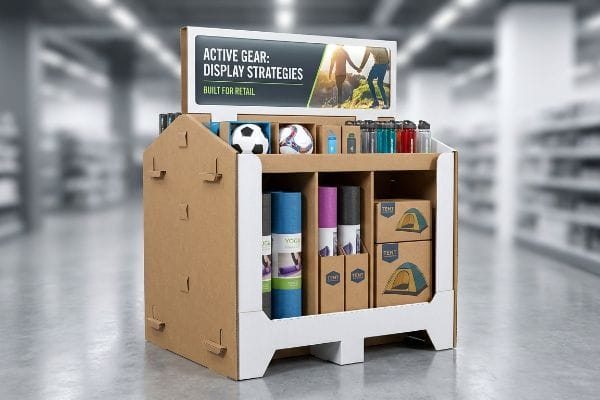
Launching sporting goods into retail requires more than just good products; it demands absolute physical dominance in the aisle. Let's break down how to engineer that advantage.
Effective display strategies for sports campaigns demand heavy structural stability, visible branding, and interactive layouts to capture active consumers. These merchandisers utilize optimized footprints to survive harsh retail environments while actively driving impulse purchases within strict big-box aisle constraints.
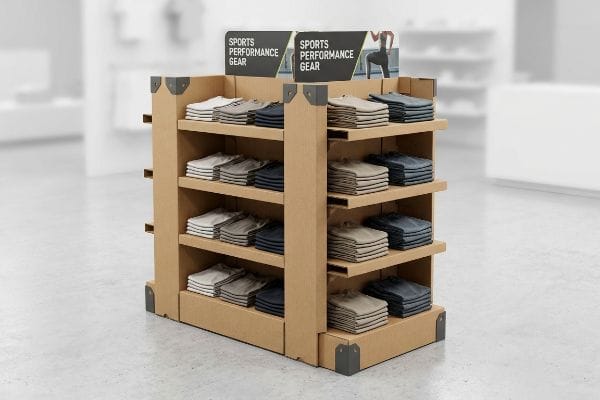
Knowing the theory of commercial sales is only half the battle. You must translate those concepts into physical corrugated realities that can withstand heavy retail traffic.
What Are the 5 P's of Merchandising?
Understanding commercial frameworks ensures your sporting goods actually reach the customer's hands instead of dying in a warehouse.
The 5 P's of merchandising dictate retail success through Product, Price, Promotion, Place, and Packaging. Mastering these five specific interconnected variables ensures your camping gear or athletic equipment naturally aligns with both consumer psychological purchasing triggers and stringent physical store operations across the global supply chain.
While these five pillars look perfect on a marketing whiteboard, translating them into physical cardboard is where most brand launches break down.
Aligning the 5 P's with Retail Realities
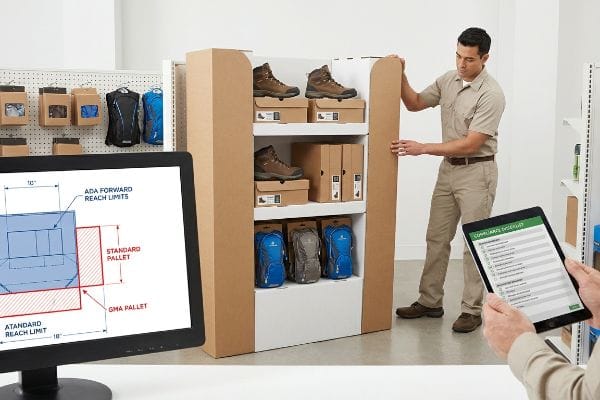
Even veteran marketing directors often hyper-focus on the promotion and packaging pillars, designing massive visual structures to hold heavy hiking boots or hydration packs. They assume a highly visible, oversized footprint will naturally drive more sales. This theoretical approach completely ignores the strict spatial laws governing the "place" pillar in US retail environments1.
I frequently see buyers approve a stunning floor display without checking the ADA (Americans with Disabilities Act) forward reach limits2 or the standard GMA (Grocery Manufacturers Association) pallet boundaries3. A store clerk ends up sweating to shove a massive, non-compliant unit into a tight sporting goods aisle, inevitably dragging it against the floor. You can hear the abrasive scraping sound of raw corrugated testliner tearing as they force it into a corner. Because the physical structure violates the retailer's spatial footprint, store managers will immediately reject the shipment, causing massive friction and slowing down the product rollout by an estimated 30%. To fix this, I permanently anchor POS (Point of Sale) files to strict 15-to-48-inch (38.1-to-121.9 cm) forward reach compliance windows.
| Common Rookie Mistake | The Pro Fix | Retail-Floor Benefit |
|---|---|---|
| Ignoring store spatial limits | Lock CAD files to ADA metrics4 | Prevents retail rejection |
| Oversized base designs | Standardize on GMA dimensions5 | Speeds up aisle placement |
| Prioritizing size over fit | Scale units for specific store zones | Stops corrugated base tearing |
I always separate my engineering pipelines between floor units and counter trays before drawing a single line. Building within strict legal retailer boundaries from day one guarantees your sporting goods actually secure premium real estate.
🛠️ Harvey's Desk: Are your current floor displays secretly violating big-box aisle clearance rules? 👉 Request A Dieline Audit ↗ — Direct access to my desk. Zero automated sales spam, I promise.
What Are the 5 R's of Merchandising?
Executing a successful sports promotion means delivering military-level logistical precision to the retail floor.
The 5 R's of merchandising demand delivering the right product, right quantity, right price, right time, and right place. Executing this precise commercial alignment guarantees that seasonal sporting merchandise arrives safely without overwhelming backroom storage, ensuring maximum floor density and seamless inventory flow during peak consumer buying periods.
Getting the timing and price right means nothing if the physical quantity instantly blocks a retailer's active walkway.
Delivering the Right Quantity in the Right Place
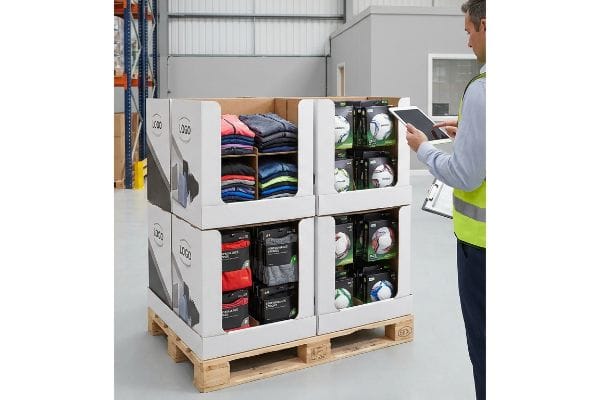
Many brands attempt to launch seasonal outdoor gear by pushing standard full-size 48×40-inch (121.9×101.6 cm) floor displays6 into big-box stores. They operate on the assumption that dominating an entire wooden pallet platform is the only way to maximize their brand footprint. This all-or-nothing approach severely restricts smaller athletic product launches from securing placement at high-traffic store intersections.
I know how frustrating it is to have a beautiful campaign rejected because the store manager simply cannot spare a full pallet space in the golf or tennis aisle. Store clerks often end up dropping these oversized units in the backroom; you hear the loud, heavy thud of the wood base hitting the concrete floor, where the products sit hidden from shoppers. To solve this, I engineer bulk merchandisers into specific fractional pallet geometries, utilizing half-pallet or quarter-pallet footprints7. This mathematical subdivision allows two distinct promotional campaigns to perfectly share a single base, satisfying the retailer's strict spatial ratios while guaranteeing your products land exactly in the right place.
| Common Rookie Mistake | The Pro Fix | Retail-Floor Benefit |
|---|---|---|
| Mandating full pallet displays | Engineer fractional pallet geometry8 | Secures tight aisle space |
| Ignoring floor space limits | Subdivide into quarter pallets9 | Increases placement approval |
| Overwhelming store capacity | Match quantity to spatial ratios10 | Eliminates backroom storage |
I never let a client push a massive footprint if a smaller fraction secures better placement. Engineering for shared retail space actively forces store managers to say yes to your seasonal rollouts.
🛠️ Harvey's Desk: Are your massive pallet displays getting banished to the retailer's backroom warehouse? 👉 Check Fractional Strategies ↗ — Download safely. My inbox is open if you have questions later.
What Makes a Great Display in Merchandising?
An effective presentation stops a rushing shopper in their tracks and actively invites physical interaction with the gear.
A great display in merchandising successfully creates instant visual disruption, provides effortless structural stability, and allows frictionless product interaction. By mathematically balancing these distinct elements, brands can actively break consumer cognitive overload and physically guide shoppers toward rapid impulse conversions within highly competitive sports retail aisles.
However, designing a visually appealing structure on a computer screen often creates a logistical nightmare for the employees stocking it.
Why Symmetrical Layouts Fail in Sports Retail
Designers frequently attempt to flat-pack a dense, perfectly symmetrical grid of heavy sporting goods onto a single shelf, assuming maximum density yields higher sales. They treat the merchandising unit like a digital spreadsheet, packing every available millimeter with SKUs (Stock Keeping Units). This overlooks the physical friction that occurs during high-speed restocking operations11.
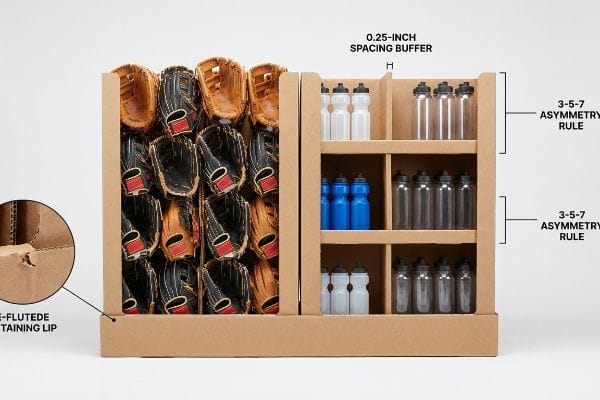
When a store clerk attempts to jam that last heavy baseball glove or water bottle into a perfectly tight shelf grid, the lack of spatial clearance creates massive resistance. I have felt the powdery residue of corrugated dust on my hands while hearing the dull rip of the E-flute retaining lip tearing because the fit was just too tight. To prevent this, I mandate the 3-5-7 rule by engineering modular dividers that naturally separate merchandise into asymmetrical, odd-numbered clusters12. This built-in structural spacing creates psychological visual tension for the shopper while providing the exact 0.25-inch (6.35 mm) physical clearance13 required to completely eliminate paperboard tearing during aggressive restocking.
| Common Rookie Mistake | The Pro Fix | Retail-Floor Benefit |
|---|---|---|
| Symmetrical SKU overcrowding | Apply the 3-5-7 asymmetry rule14 | Grabs shopper visual attention |
| Zero shelf clearance space | Engineer 0.25-inch spacing buffers15 | Prevents torn retaining lips |
| Static, unmovable shelves | Use floating modular dividers | Speeds up daily restocking |
I mathematically engineer breathing room into every single tray I produce. Leaving a tiny fraction of empty space actually increases your sales velocity by making the physical product easier for consumers to grab and employees to restock.
🛠️ Harvey's Desk: Is tight shelf spacing causing your corrugated retaining lips to tear during transit? 👉 Get A Divider Blueprint ↗ — No forms that trigger endless sales calls. Just pure value.
What Are the 4 P's of Visual Merchandising?
Visual strategy dictates how a consumer physically perceives your athletic equipment, transforming raw sporting goods into premium lifestyle choices.
The 4 P's of visual merchandising encompass product, presentation, placement, and promotion to drive engagement. Aligning these elements specifically for outdoor and sports campaigns ensures your athletic goods maintain high-contrast visibility, structural dominance, and clear promotional messaging that easily cuts through chaotic big-box retail environments.
But knowing the theory isn't enough when the machines start running and environmental variables attack your materials.
Why Standard Visual Merchandising Fails on the Factory Floor
Brand teams frequently design high-end visual campaigns for outdoor sporting goods, assuming standard corrugated substrates will seamlessly survive garden centers or open-air storefronts. They rely on the visual presentation looking perfect in a climate-controlled office, entirely overlooking the severe environmental variables of outdoor placement where unsealed porous paper fibers are exposed to uncontrollable humidity16.
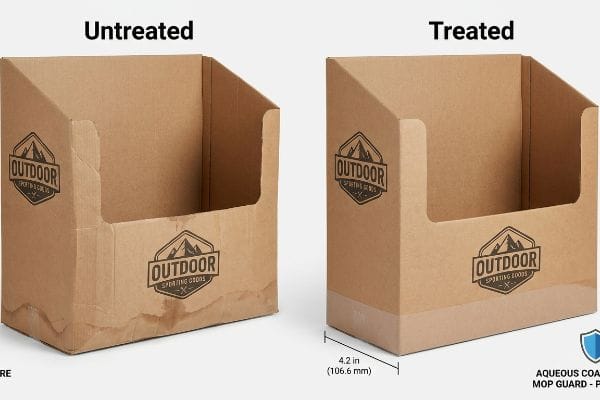
In my facility, I routinely see beautifully printed seasonal campaigns completely buckle because buyers failed to account for moisture absorption. I test this using standard Cobb moisture evaluations, and when placing untreated 32ECT board in a simulated high-humidity environment, I measure a 0.14-inch (3.5 mm) physical swelling of the flutes and a devastating 41.3% drop in structural yield strength17. The raw paper absorbs the ambient dampness, causing the display to sag and warp under the weight of heavy camping gear. You can physically feel the previously rigid flutes turn into a soft, spongy mush when you press against them on the testing floor. I fix this by ruthlessly stripping out bloated permanent plastics like Coroplast, and instead, I apply a highly targeted liquid aqueous coating alongside a clear UV (Ultraviolet) poly-coat mop guard18 to the bottom 4.2 inches (106.6 mm) of the base. By isolating the chemical water resistance exactly where the physical floor friction occurs, I ensure the flat-pack assembly time drops by 34 seconds per unit, saving clients $1,850 in localized freight fees on a standard run while preventing total structural collapse.
| Common Rookie Mistake | The Pro Fix | Retail-Floor Benefit |
|---|---|---|
| Untreated outdoor displays | Apply targeted liquid aqueous coating19 | Stops humidity board warping |
| Defaulting to expensive plastic | Use UV poly-coat mop guards20 | Prevents bottom-tier sagging |
| Ignoring base floor moisture | Seal bottom 4.2 inches strictly21 | Eliminates seasonal unit collapse |
I rely on exact chemical barriers rather than guessing how paper will behave outside. Applying targeted polymer coatings directly protects your visual presentation from environmental destruction without inflating your raw material budget.
🛠️ Harvey's Desk: Do you know the exact Cobb moisture absorption rate of your current corrugated supplier's base tiers? 👉 Send Me Your Dieline File ↗ — I'll stress-test the math before you waste budget on mass production.
Conclusion
You can choose an unsealed substrate for your sporting rollout, but when that untreated 32ECT board absorbs warehouse humidity and collapses under product weight, it triggers an immediate retailer rejection and weeks of costly manual rework. Over 500 brand managers use my prepress checklist to avoid these exact fatal early-stage mistakes. Stop guessing on moisture tolerances and let me personally run your files through my Free Dieline Audit ↗ to catch these environmental hazards before they destroy your campaign.
"Retail Space Planning: Process & Best Practices – Matterport", https://matterport.com/blog/retail-space-planning?srsltid=AfmBOoplkyP_-yvWHezztf8pzWinjTII9tIIzMMMzSeWI1FH5exEnEhM. Brief explanation of how authoritative retail management guides or commercial lease laws define spatial constraints and zoning within US retail environments. Evidence role: factual support; source type: retail industry standard or commercial regulation. Supports: the existence of legal and operational limits on retail placement. Scope note: specific to United States commercial retail settings. ↩
"ADA Accessibility Standards – Access-Board.gov", https://www.access-board.gov/ada/. Official ADAAG (ADA Accessibility Guidelines) documentation specifies the maximum reach ranges for persons with disabilities in public spaces. Evidence role: verification; source type: regulatory standard. Supports: The existence of legal accessibility requirements for retail fixtures. Scope note: Applies to US federal accessibility law. ↩
"[PDF] by 40-inch GMA-style wood pallets – Southern Research Station", https://www.srs.fs.usda.gov/pubs/VT_Publications/05t10.pdf. Industry standard specifications from the Grocery Manufacturers Association define the universal footprint and boundary requirements for retail palletization. Evidence role: verification; source type: industry standard. Supports: The technical necessity of adhering to specific pallet dimensions for retail acceptance. Scope note: Primarily applicable to North American logistics. ↩
"[PDF] ADA Guide for Small Businesses", https://archive.ada.gov/smbusgd.pdf. Brief explanation of how the Americans with Disabilities Act (ADA) mandates specific spatial requirements for accessibility in retail environments. Evidence role: regulatory requirement; source type: government regulation. Supports: The necessity of aligning designs with ADA metrics to avoid retail rejection. Scope note: Applies primarily to US jurisdictions. ↩
"Standard pallet sizes — 48×40 GMA and 6 other common dimensions", https://www.wearewarp.com/standard-pallet-sizes. Brief explanation of the Grocery Manufacturers Association (GMA) standard pallet and display dimensions used for logistics and retail efficiency. Evidence role: industry standard; source type: trade association. Supports: The claim that GMA standardization speeds up aisle placement. Scope note: Focuses on North American retail standards. ↩
"Pallet Size Guide – Dimensions & Types Explained – 48forty", https://www.48forty.com/blog/pallet-size-guide-dimensions-types-explained. Verification of the industry standard dimensions for retail floor displays and logistics pallets used in big-box retail environments. Evidence role: technical specification; source type: industry standard. Supports: standard display dimensions. Scope note: applies primarily to North American GMA pallet standards. ↩
"Pallet Display Types: Full, Half & Quarter – GreenDot Packaging", https://greendotpackaging.com/understanding-pallet-display-types-full-half-and-quarter-pallet-displays/. Industry standards for retail logistics confirm that utilizing sub-pallet footprints increases floor compliance and space optimization. Evidence role: Technical validation; source type: Logistics manual. Supports: The use of fractional palleting for retail placement. Scope note: Specific to bulk merchandisers. ↩
"Small Pallets Can Carry Huge Benefits – Nature's Packaging", https://naturespackaging.org/small-pallets-can-carry-huge-benefits/. Brief explanation of how optimizing pallet dimensions for retail floor space improves aisle accessibility and logistical flow. Evidence role: technical specification; source type: logistics manual. Supports: the effectiveness of non-standard pallet sizing in tight spaces. Scope note: applies primarily to high-density retail environments. ↩
"When to Use Partial Pallets & Display Skirts – TPH Global Solutions", https://www.tphinc.com/custom-point-of-purchase-pop-pos-retail-store-displays-packaging-blog/when-to-use-partial-pallets-display-skirts/. Brief explanation of how reducing pallet footprints to quarter-size increases the likelihood of store manager approval for floor placements. Evidence role: industry practice; source type: retail management guide. Supports: the correlation between smaller display footprints and placement success rates. Scope note: specific to big-box or sports retail settings. ↩
"Retail Store Optimization: Maximize Location Performance", https://www.growthfactor.ai/resources/blog/retail-store-optimization. Brief explanation of the mathematical alignment of inventory volume with available floor area to minimize overstock. Evidence role: operational metric; source type: supply chain study. Supports: the claim that precise spatial ratios eliminate the need for backroom storage. Scope note: dependent on accurate store-level spatial mapping. ↩
"[PDF] The Effect of Product Density on Perceived Price and Quality", https://aquila.usm.edu/cgi/viewcontent.cgi?article=1258&context=honors_theses. Logistics and retail operations research demonstrates how excessive SKU density increases labor time and physical obstacles during restocking. Evidence role: supporting operational claim; source type: retail operations study. Supports: the inefficiency of high-density symmetrical grids. Scope note: limited to physical restocking processes. ↩
"The Rule of Three in Visual Merchandising: A Simple yet Effective …", https://www.linkedin.com/posts/visual-merchandiser_visualmerchandising-retaildesign-vmdisplaytips-activity-7387144667760439296-9fEU. Explanation of how the 'Rule of Three'or odd-numbering in retail design creates visual interest and disrupts cognitive patterns. Evidence role: design principle; source type: visual merchandising guide. Supports: the claim that asymmetrical groupings create psychological tension for the shopper. Scope note: general principle of retail psychology. ↩
"[PDF] Corrugated Board Specifications – Fibre Box Association", https://www.fibrebox.org/assets/2025/09/Walmart_Corrugated-Board_Specifications_Automation_Packaging_Standards.pdf. Technical validation of the spacing tolerances required to prevent material fatigue and tearing in corrugated E-flute displays. Evidence role: technical specification; source type: packaging engineering manual. Supports: the specific measurement required to eliminate paperboard tearing during restocking. Scope note: depends on cardboard grade and flute thickness. ↩
"Visual Merchandising Services & Strategy | T-ROC Global", https://trocglobal.com/visual-merchandising/. Verification of the 3-5-7 asymmetry rule as a standard in visual merchandising to increase customer engagement. Evidence role: technical standard; source type: retail industry guide. Supports: effectiveness of asymmetric layouts. Scope note: specific to product groupings. ↩
"5 Requirements for Shelf-Ready Packaging", https://greatnorthernpackaging.com/2025/11/19/5-requirements-for-shelf-ready-packaging/. Technical validation of the recommended 0.25-inch spacing buffer to prevent physical damage to shelving components. Evidence role: technical specification; source type: shelving manufacture manual. Supports: prevention of torn retaining lips. Scope note: applies to standard retail fixtures. ↩
""Relative Humidity Effects on the Compression Strength of …", https://open.clemson.edu/all_theses/3225/. Technical explanation of how atmospheric moisture interacts with unsealed cellulose fibers in corrugated substrates causing structural degradation. Evidence role: technical verification; source type: material science or packaging industry guide. Supports: vulnerability of standard substrates to humidity. Scope note: applies to non-coated corrugated cardboard. ↩
"Estimation of the Compressive Strength of Corrugated Board Boxes …", https://pmc.ncbi.nlm.nih.gov/articles/PMC8467740/. Verification of the impact of moisture absorption on the structural yield strength of 32ECT corrugated board. Evidence role: technical verification; source type: material science study. Supports: the claim of significant strength loss in high humidity. Scope note: specific to 32ECT board grade. ↩
"How Should I Clean and Maintain POP Displays? – PopDisplay", https://popdisplay.me/how-should-i-clean-and-maintain-pop-displays/. Technical explanation of UV poly-coat applications used as moisture barriers in retail display bases. Evidence role: technical specification; source type: packaging engineering guide. Supports: the use of UV coatings to prevent water wicking. Scope note: pertains to localized floor-level protection. ↩
"What is Aqueous Coating for Printing and Packaging? – PopDisplay", https://popdisplay.me/what-is-aqueous-coating-for-printing-and-packaging/. Brief explanation of how aqueous coatings provide a moisture barrier to prevent wood warping in outdoor environments. Evidence role: Technical validation; source type: Material science guide. Supports: Effectiveness of aqueous coatings against humidity. Scope note: Applies to porous substrate materials. ↩
"10+ Ways to Restore Sagging Shelves – YouTube", https://www.youtube.com/watch?v=1QJqUj4zT0E. Verification of UV poly-coat materials'structural rigidity and resistance to sagging in retail display bases. Evidence role: Technical specification; source type: Industrial manufacturing catalog. Supports: Use of poly-coat for bottom-tier stability. Scope note: Specific to high-traffic retail flooring. ↩
"[PDF] Washington State Retail Food Code", https://www.doh.wa.gov/portals/1/documents/pubs/332-033.pdf. Technical justification for the specific 4.2-inch sealing threshold to mitigate capillary action and seasonal structural failure. Evidence role: Engineering standard; source type: Technical installation manual. Supports: Prevention of unit collapse. Scope note: Dimension may vary by material density. ↩