
Marken investieren Unsummen in aufwendig gestaltete Verpackungen, die im Regal scheitern. Wenn Ihr Display zusammenbricht oder Kunden einfach daran vorbeigehen, ist Ihr Marketingbudget verloren. Das ändern wir.
Die Aufgabe von Einzelhandelsverpackungen besteht darin, Waren zu schützen, Markenwerte zu kommunizieren und Spontankäufe anzuregen. Über die reine Aufbewahrung hinaus fungiert die Verpackung als stiller Verkäufer: Sie ist so konzipiert, dass sie Kunden anzieht, die Einhaltung logistischer Vorgaben gewährleistet und Waren sicher von den globalen Produktionsstätten in die lokalen Verkaufsregale transportiert.

Die Theorie zu kennen ist einfach, aber in der harten Realität der Regale großer Einzelhandelsketten zu bestehen, erfordert ein ganz anderes Maß an Ingenieurskunst.
Welchen Zweck hat die Einzelhandelsverpackung?
Eine schöne Verpackung nützt nichts, wenn sie den Absatz nicht ankurbelt. Der eigentliche Zweck von Verpackungen besteht darin, in einer überfüllten und von Ablenkungen geprägten Umgebung einen Kaufimpuls zu setzen.
Die Aufgabe von Einzelhandelsverpackungen besteht darin, Produkte physisch zu schützen und gleichzeitig die 3-3-3-Regel der räumlichen Interaktion umzusetzen. Sie muss die Aufmerksamkeit des Käufers aus neun Metern Entfernung wecken, den Wert aus einem Meter Entfernung vermitteln und die haptische Interaktion aus nächster Nähe fördern.
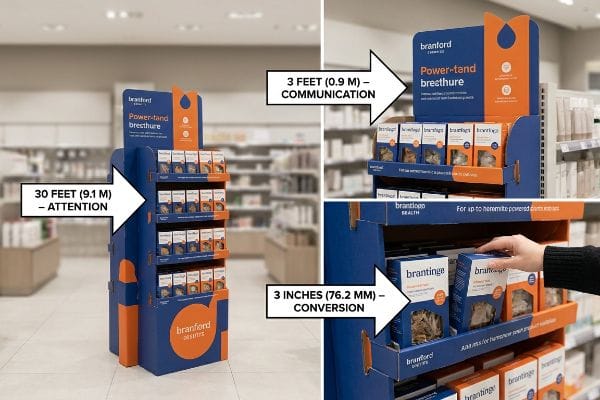
Das Designen für einen Computerbildschirm ist eine häufige Falle, aber Einzelhandelsumgebungen erfordern kinetische, physische Störungen.
Die 3-3-3-Regel für Einzelhandelsverpackungen: So meistern
Nachwuchsdesigner gestalten Verkaufsdisplays oft speziell für die Nahansicht auf flachen, hintergrundbeleuchteten Digitalmonitoren. Sie konzentrieren sich obsessiv auf winzige Typografie und nuancierte Farbverläufe. Dabei setzen sie voraus, dass der Kunde bereits stillsteht und seine volle Aufmerksamkeit dem Display widmet.
Draußen im Verkaufsraum fühlen sich die Kunden von der Informationsflut überwältigt. Ich habe einmal erlebt, wie eine Marke eine mit Text überladene Wellpappverpackung auf den Markt brachte, die unter grellem Neonlicht völlig unterging. Verkäufer rissen beim Einlegen der Waren sogar die hohe Haltekante ein und zerstörten so die Frontgrafik durch ein lautes Reißen des Kartons. Um dem entgegenzuwirken, setze ich auf auffällige Stanzformen und großflächige PMS-Farben (Pantone Matching System)¹ für eine Reichweite von 9,1 m (30 Fuß) und schneide die Vorderkante so ab, dass 85 % der Produkte sichtbar bleiben²– für die optimale Wirkung auf die letzten 76,2 mm (3 Zoll).
| Häufiger Anfängerfehler | Die Profi-Lösung | Vorteil für die Verkaufsfläche |
|---|---|---|
| Fettdruck in der Kopfzeile | Hochkontrastige Stanzformen | Unterbricht den Fußgängerverkehr in einer Entfernung von 30 Fuß3 |
| Hohe vordere Haltelippe | Lippe für 85% Sichtbarkeit4 | Erhöht die Impulsgreifkraft bei 7,6 cm (3 Zoll) |
| CMYK-Prozess auf Kraftpapier | Vollflächige PMS-Sonderfarben5 | Verhindert das Ausbleichen von Grafiken |
Ich erlaube Marken niemals, ein Bodendisplay wie eine Broschüre zu behandeln. Wenn es nicht innerhalb von drei Sekunden ins Auge fällt, wird es zur unsichtbaren Fläche, was letztendlich den Lagerumschlag verlangsamt und den ROI Ihrer Werbeaktion zunichtemacht.
🛠️ Harveys Schreibtisch: Wirken Ihre Markenfarben auf unbeschichtetem Testliner trüb? 👉 Kostenlose Artwork-Analyse anfordern ↗ — Direkter Kontakt zu meinem Schreibtisch. Garantiert kein automatisierter Werbe-Spam.
Was sind die fünf Hauptzwecke von Verpackungen?
Die Aufteilung von Verpackungen in ihre grundlegenden Funktionen hilft, die fatale Falle zu vermeiden, einen Aspekt übermäßig zu entwickeln und die anderen völlig zu vernachlässigen. Ausgewogenheit ist entscheidend.
Die fünf Hauptzwecke von Verpackungen sind Aufbewahrung, Schutz, Information, Nutzen und Werbung. Diese Kernfunktionen wirken zusammen, um sicherzustellen, dass das Produkt den Transport unbeschadet übersteht, den Vorschriften des Einzelhandels entspricht, dem Verbraucher beim Auspacken Komfort bietet und die Markenbotschaft am Verkaufsort wirkungsvoll kommuniziert.

Das Verständnis dieser fünf Säulen ist grundlegend, aber die eigentliche Ingenieurskunst beginnt erst, wenn man sie anwendet, ohne die Gewinnmargen zu zerstören.
Überwindung des Ungleichgewichts der 4 Cs im Verpackungsdesign
Einkaufsteams nutzen häufig das Standard-Verpackungsmodell – Kosten, Konzept, Komfort und Kommunikation–um ihre Markteinführungen im Einzelhandel zu steuern. Dabei konzentrieren sie sich jedoch fast immer ausschließlich auf die primäre Kostenkennzahl und sparen an der Materialqualität, um kurzfristig Kosten zu senken.
Man kann es sich vorstellen wie den Kauf billiger Reifen für einen Hochleistungssportwagen: Man spart zwar heute Geld, riskiert aber morgen einen Unfall. Ich habe schon erlebt, wie Hersteller von einer 32-ECT-Platte (Edge Crush Test) auf eine wackelige 26-ECT-7-– nur um dann festzustellen, dass die Konstruktion unter dem Gewicht einer Palette zusammengebrochen ist und dabei ein deutliches, langsames Knirschen von sich gegeben hat. Ich stelle mathematisch einen direkten Zusammenhang zwischen den reinen Strukturkosten und der Effizienz der nachgelagerten Lieferkette her und sorge so für eine reibungslose Montage, die katastrophale Transportschäden und massive Rückbelastungen durch den Einzelhandel verhindert.
| Häufiger Anfängerfehler | Die Profi-Lösung | Vorteil für die Verkaufsfläche |
|---|---|---|
| Herabstufung der ECT-Noten | Durchsetzung von 32 ECT-Mindestwerten8 | Verhindert das Zerdrücken von BCT |
| Montagereibung wird vernachlässigt | Mathematische Stanzlinienabstände9 | Verkürzt die Zeit für das Mitverpacken |
| Kosten isoliert betrachten | Verknüpfung von Kosten und Überlebensraten | Eliminiert Rückbelastungen im Transitbereich10 |
Ich verbiete es strikt, die reinen Stückkosten als isolierte Kennzahl zu betrachten. Indem ich die fünf Kernziele mit der strukturellen Integrität in Einklang bringe, stelle ich sicher, dass Ihr Verpackungssystem einen positiven Ertrag erwirtschaftet, anstatt teure manuelle Nacharbeiten auszulösen.
🛠️ Harveys Schreibtisch: Verzichten Sie auf praktischen Nutzen, nur um ein Beschaffungsziel zu erreichen? 👉 Fordern Sie eine Margenprüfung an ↗ — Sicher herunterladen. Bei Fragen können Sie mich gerne kontaktieren.
Was bedeutet die Angabe „Nicht-Einzelhandelsverpackung“ bei Amazon?
Die Abwicklung im E-Commerce operiert auf einem völlig anderen logistischen Planeten als die Regale großer Einzelhandelsketten, und die Vermischung der beiden Verpackungsstrategien ist ein sicheres Rezept für Misserfolg.
Wenn Amazon von „Nicht-Einzelhandelsverpackung“ spricht, bedeutet das, dass das Produkt in einem minimalistischen, braunen Wellpappkarton versendet wird, der speziell für den E-Commerce-Transport entwickelt wurde. Dieses Format, auch bekannt als SIOC (Ships In Own Container), verzichtet auf glänzendes, kosmetisches Branding, transparente Kunststofffenster und diebstahlsichere Klappverpackungen, um die maximale Stabilität für den Transport zu gewährleisten.

Während ein einfacher brauner Versandkarton für die Paketzustellung äußerst effizient ist, ist der Versuch, ihn für die B2B-Logistik (Business-to-Business) im Einzelhandel umzufunktionieren, ein fataler Fehler.
Die versteckte Gefahr der Ermüdung von Wellblech
Startups versuchen häufig, ihre Logistik zu optimieren, indem sie eingehende B2C-E-Commerce-Kartons (Business-to-Consumer ) für den Versand an den Einzelhandel wiederverwenden. Sie gehen davon aus, dass ein Umkarton, der äußerlich unbeschädigt aussieht, seine ursprüngliche Stabilität für den Palettenversand beibehält .
Wellpappe wirkt wie ein Stoßdämpfer im Auto. Während des Transports absorbiert sie Mikrostöße und Feuchtigkeit, die die Papierfasern dauerhaft ermüden und sie weich und matschig machen. Die Wiederverwendung dieser strukturell erschöpften Kartons führt zu einem massiven, unsichtbaren Verlust der Druckfestigkeit<sup>12</sup>, was zum Einsturz der Basisschicht unter schwerer Last führen kann. Meine Faustregel ist einfach: Strikte Verwendung von Neuware und frische, ISTA 6-Amazon SIOC-geprüfte Versandkartons13</sup> für alle ausgehenden Sendungen, um sicherzustellen, dass die Ecken ihre volle dynamische Tragfähigkeit behalten.
| Häufiger Anfängerfehler | Die Profi-Lösung | Vorteil für die Verkaufsfläche |
|---|---|---|
| Wiederverwendung eingehender B2C-Boxen | Verpflichtung von Spediteuren mit neuem Kraftpapier14 | Verhindert den Zusammenbruch der Basisebene |
| Stärke visuell beurteilen | ISTA 6-Amazon SIOC-Test15 | Überlebt Paketnetzwerke |
| Faserermüdung außer Acht lassen | Verwendung frischer Wellpappe | Hält dynamische Lastgrenzen ein16 |
Ich lehne es ab, dass Marken strukturell beschädigte Kartons für den Einzelhandel wiederverwenden. Die Garantie unbeschädigter Wellpappecken schließt Transportschäden vollständig aus und schützt Ihr Produkt vor den gravierenden Mikrorissen der Lieferkette.
🛠️ Harveys Schreibtisch: Verlieren Ihre Umkartons heimlich an Kompressionsfestigkeit, bevor sie überhaupt den LKW erreichen? 👉 Fordern Sie Ihre ISTA-Konformitätscheckliste an ↗ — Keine Formulare, die endlose Verkaufsgespräche auslösen. Einfach nur echter Mehrwert.
Was ist Einzelhandelsverpackung?
Die Verpackung im Einzelhandel ist nicht einfach nur ein Behälter; sie ist eine präzise konstruierte, dreidimensionale physische Struktur, die anspruchsvollen Lieferketten standhalten und gleichzeitig die Aufmerksamkeit der Verbraucher auf sich ziehen muss.
Die Verkaufsverpackung ist die endgültige, dem Verbraucher zugewandte Verpackung – ob Karton, Schachtel oder Display –, die speziell für den Einsatz im Ladenregal entwickelt wurde. Im Gegensatz zu einfachen Versandkartons zeichnet sich die Verkaufsverpackung durch hochauflösende Grafiken, individuell gestaltete Stanzformen und spezifische Abmessungen gemäß den Vorgaben des Einzelhandels aus, um die Markenpräsenz zu maximieren und die Ware optimal zu schützen.
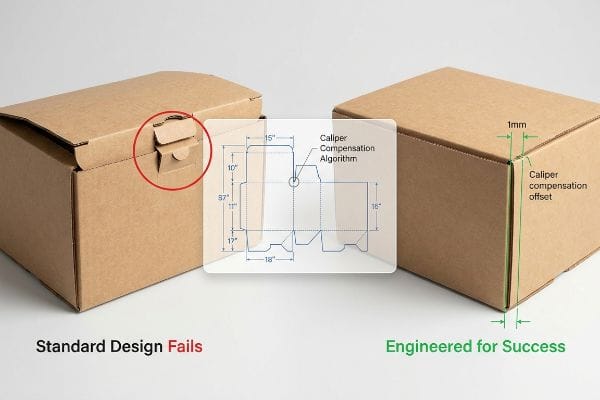
Es ist einfach, eine einzelne Verkaufsverpackung so aussehen zu lassen, dass sie auf dem Bildschirm eines Designers perfekt wirkt, aber die harte Realität sieht anders aus, wenn man Tausende davon an eine Lohnverpackungsanlage liefert.
Warum Standard-Einzelhandelsverpackungen in der Fabrikhalle versagen
Grafikdesigner erstellen häufig in Vektorprogrammen ineinandergreifende Laschen und Klappschlitze mit exakt der gleichen Breite wie das Gegenstück17.Sie gehen davon aus, dass, wenn eine Lasche auf dem Bildschirm 2 Zoll (50,8 mm) breit ist, der entsprechende Schlitz ebenfalls exakt 2 Zoll (50,8 mm) breit sein sollte, um eine passgenaue, perfekte Verbindung zu gewährleisten.
In meinem Betrieb erlebe ich regelmäßig, wie diese theoretische Berechnung absolutes Chaos am Fließband verursacht. Wenn eine 2,8 mm dicke B-Welle (Wellpappe18 um 90 Grad gefaltet wird, verbraucht sie Material und erzeugt einen starren Außenradius(19). Wird der Aufnahmeschlitz an der Stanzform nicht entsprechend verbreitert, verformt sich die Verpackung stark. Bei einem kürzlich aufgetretenen Problem habe ich die Mikrometerwerte überprüft und festgestellt, dass wir lediglich einen Algorithmus zur Toleranzkorrektur von 1 mm (0,04 Zoll) für den Schlitz benötigen. Durch die mathematische Einhaltung dieser Mikrotoleranz konnte ich die Montagezeit für die Lohnverpackung um 22 Sekunden pro Einheit reduzieren. Dadurch entfällt das lästige Klebeband, und der Kunde spart schätzungsweise 15 % der manuellen Arbeitskosten bei einer Standardproduktion.
| Häufiger Anfängerfehler | Die Profi-Lösung | Vorteil für die Verkaufsfläche |
|---|---|---|
| 1:1-Verhältnis von Steckplätzen zu Registerkarten | Hinzufügen einer Bremssattelkompensation20 | Verhindert das Durchbiegen der Bodenplatte |
| Plattendicke außer Acht gelassen | Parametrische CAD-Biegezugaben21 | Erübrigt manuelle Klebebandreparaturen |
| auf flache 2D-Grafik setzen | 3D-Mikrotoleranzprüfung | Verkürzt die Montagezeit um 22 Sekunden22 |
Ich verlasse mich niemals auf eine einfache digitale Zeichnung, ohne die Belastbarkeit der physischen Faltlehre zu testen. Durch die Entwicklung exakter geometrischer Versätze stelle ich sicher, dass sich Ihre Verkaufsverpackung reibungslos montieren lässt und somit sowohl die strukturelle Integrität als auch Ihre knappen Liefermargen geschützt sind.
🛠️ Harveys Schreibtisch: Lassen Sie sich nicht von einem 2 Millimeter kleinen Konstruktionsfehler die Einführung in 500 Filialen vermasseln. 👉 Senden Sie mir Ihre Stanzdatei ↗ – ich prüfe die Berechnungen, bevor Sie Ihr Budget für die Massenproduktion verschwenden.
Abschluss
Sie können zwar die günstigsten Grafikgehäuse beziehen, aber wenn die einfache 2D-Berechnung die Biegetoleranzen von Wellblech ignoriert und die Displaybasis dadurch verformt wird, entsteht massive Reibung, die die Produktionslinie um schätzungsweise 30 % verlangsamt. Genau dieses Datenblatt verwenden meine zehn wichtigsten Einzelhandelskunden, um Druckfehler zu vermeiden. Setzen Sie nicht länger auf theoretische Toleranzen, sondern lassen Sie mich Ihre Strukturgeometrie persönlich durch meinen kostenlosen Stanzform-Pre-Flight-Audit führen, um diese kritischen Reibungspunkte vor Produktionsbeginn zu erkennen.
„CMYK vs. Sonderfarben im Verpackungsdruck: Was Konsumgütermarken wissen müssen …“, https://meyers.com/meyers-blog/cmyk-vs-spot-colors-in-packaging-printing-what-cpg-brands-need-to-know/. Branchenübliche Designstandards empfehlen die Verwendung von Pantone-Sonderfarben, um maximale Farbsättigung und gute Sichtbarkeit aus der Ferne zu gewährleisten. Nachweisfunktion: Technische Validierung; Quellentyp: Designhandbuch. Unterstützung: Farbwahl für Aufmerksamkeitseffekte. Hinweis: Die Wirksamkeit ist abhängig von den Lichtverhältnissen im Geschäft. ↩
„Verpackungsdesign als Branding-Instrument in der Kosmetikindustrie“, https://pmc.ncbi.nlm.nih.gov/articles/PMC9123395/. Marktforschung oder Studien im Bereich Verpackungstechnik würden die empirische Grundlage für einen spezifischen Sichtbarkeitsprozentsatz liefern, der für die taktile Konversion erforderlich ist. Nachweisfunktion: Metrikverifizierung; Quellentyp: Branchenforschung. Unterstützt: Sichtbarkeitsverhältnis des Produkts. Anmerkung zum Anwendungsbereich: Die Anwendbarkeit kann je nach Produktkategorie variieren. ↩
„Was sind die 5 Rs des Merchandising? – PopDisplay“, https://popdisplay.me/what-are-the-5-rs-of-merchandising/. Überprüfung der Entfernung, in der kontrastreiche visuelle Elemente in Einzelhandelsverpackungen die Aufmerksamkeit der Verbraucher effektiv auf sich ziehen. Nachweisfunktion: Überprüfung; Quellentyp: Studie zum Einzelhandelsdesign. Belege: Wirksamkeit von Stanzformen hinsichtlich der Blickfangwirkung. Anmerkung: Die Entfernung kann je nach Ladenbeleuchtung und Gangbreite variieren. ↩
„Wie PDQ-Verpackungen den Einzelhandelsumsatz und die Markenbekanntheit steigern“, https://innorhino.com/blog/about-business/pdq-packaging-retail-sales?srsltid=AfmBOoqFOviEtTDYSKLmtjiFKcm9rcvDbVkW2RfKZqDYv7DY7rrY7xOO. Technische Spezifikation zur Verbesserung der Produktsichtbarkeit durch Anpassung der Höhe der Haltelippe. Nachweisfunktion: Technische Spezifikation; Quellentyp: Handbuch für Verpackungstechnik. Unterstützt: Kennzahlen zur Sichtbarkeit für Impulskäufe. Anmerkung: Der Prozentsatz ist abhängig von der Gesamthöhe des Produkts. ↩
„PMS vs. CMYK für Verpackungen: Was ist besser? – PAX Solutions“, https://pax.solutions/corrugated-packaging/pms-vs-cmyk-for-packaging/. Technische Erklärung, warum Pantone (PMS)-Sonderfarben auf saugfähigen Kraftpapiersubstraten im Vergleich zu CMYK-Prozessen ihre Leuchtkraft und Deckkraft besser bewahren. Nachweisfunktion: Technische Verifizierung; Quellentyp: Leitfaden für die Druckindustrie. Anwendungsbereich: Vermeidung des Ausbleichens von Grafiken auf braunem Papier. Hinweis: Gilt speziell für poröse, unbeschichtete Materialien. ↩
„Mai: Wie intelligentere Verpackungsbeschaffung Kosten senkt …“, https://allstarpurchasing.com/may-how-smarter-packaging-procurement-reduces-costs-and-strengthens-your-supply-chain/. Bestätigung, dass das 4-C-Framework ein anerkannter Branchenstandard ist, der von Beschaffungsteams für die Einführung im Einzelhandel verwendet wird. Nachweisfunktion: technische Validierung; Quellentyp: Branchenhandbuch oder Lehrbuch für Lieferkettenmanagement. Unterstützt: die Existenz und die Komponenten des referenzierten Verpackungs-Frameworks. Anwendungsbereich: Fokus auf Beschaffung und Einzelhandelsanwendung. ↩
„ECT-Klassifizierungen erklärt: Was sie für Ihre Wellpappenverpackungen bedeuten“, https://epackagesupply.com/blogs/packaging-guide/ect-ratings-explained-what-they-mean-for-your-corrugated-packaging?srsltid=AfmBOooNbWsivSDUCMt6YakMMRkJSfjlaHTtBJvDhxAikEDQlBIPWfp8. Kurze Erläuterung, wie eine maßgebliche externe Quelle diese Aussage stützt. Nachweisfunktion: technische Validierung; Quellentyp: Normen für Verpackungstechnik. Beleg: der Unterschied in der Strukturfestigkeit zwischen den ECT-Klassifizierungen. Anmerkung zum Anwendungsbereich: Fokus auf die Druckfestigkeit von Wellpappe. ↩
„BCT- und ECT-Tests: Bewertung der Festigkeit von Wellpappkartons“, https://www.metropack.eu/definition/materials/corrugated-cardboard/ect-edge-crush-test-and-bct-box-compression-test-corrugated-box. Die technischen Normen für den Kantenstauchtest (ECT) und den Kartonkompressionstest (BCT) korrelieren spezifische ECT-Werte mit der Tragfähigkeit und Stapelfestigkeit. Nachweisfunktion: Technische Spezifikation; Quellentyp: Industriestandard (ASTM/TAPPI). Unterstützt: Anforderungen an die strukturelle Integrität. Anwendungsbereich: Die Aussagekraft hängt von den Kartonabmessungen und der Wellenstruktur ab. ↩
„Bedeutung von Stanzfugen bei der Angebotserstellung für Co-Packing-Projekte – Econo-Pak“, https://www.econo-pak.com/articles/importance-of-dielines-in-quoting-co-packing-projects/. Richtlinien für Verpackungstechnik erläutern, wie präzise Stanzfugenabstände Materialreibung und Montagefehler in Hochgeschwindigkeits-Co-Packing-Umgebungen minimieren. Nachweisfunktion: Bewährte Verfahrenspraxis; Quellentyp: Technisches Handbuch. Unterstützt: Betriebliche Effizienz. Anwendungsbereich: Gilt für automatisierte Montagelinien. ↩
„Prüfung von Einzelhandelsverpackungen für die Einhaltung von Vorschriften im Großflächenhandel – Intertek“, https://www.intertek.com/performance-testing/packaging/retail-compliance/. Die Compliance-Handbücher für Einzelhändler definieren Rückbelastungen für beschädigte Waren und wie Überlebensratenprüfungen (z. B. nach ISTA-Standards) diese Strafen reduzieren. Nachweisfunktion: Kennzahl für die finanzielle Compliance; Quellentyp: Leitfaden zur Einhaltung von Vorschriften im Einzelhandel. Unterstützt: Kosten-Nutzen-Analyse der Verpackungsqualität. Anwendungsbereich: Speziell für die von Einzelhändlern durchgesetzten Versandstandards. ↩
„[PDF] Einfluss des Versatzes palettierter Kartons auf die Druckfestigkeit von unitisierten …“, https://digitalcommons.calpoly.edu/cgi/viewcontent.cgi?article=1067&context=it_fac. Technische Daten zur Verschlechterung der Stapelfestigkeit und der strukturellen Integrität von Wellpappe nach dem ersten Transport. Nachweisfunktion: Technische Validierung; Quellentyp: Studie im Bereich Verpackungstechnik. Beleg: Die Tatsache, dass wiederverwendete Kartons unabhängig von ihrem optischen Erscheinungsbild an ursprünglicher struktureller Festigkeit einbüßen. Anwendungsbereich: Gilt für Standard-Wellpappensorten. ↩
„Druckfestigkeit von Wellpappenverpackungen mit geringer …“, https://pmc.ncbi.nlm.nih.gov/articles/PMC10054506/. Eine technische Studie zur mechanischen Degradation von Wellpappe bei der Wiederverwendung würde den Verlust der vertikalen Druckfestigkeit bestätigen. Nachweisfunktion: Verifizierung; Quellentyp: Fachzeitschrift für Verpackungstechnik. Begründung: das strukturelle Risiko der Wiederverwendung von Versandkartons. Anmerkung zum Untersuchungsbereich: Fokus auf Faserermüdung. ↩
„So bestehen Sie die Verpackungstests von Amazon: Ihre ISTA 6 …“, https://www.pacificbox.com/box-resources/how-to-pass-amazon-ista-6-packaging-tests. Die offizielle ISTA-6-Standarddokumentation legt die Testprotokolle für die von Amazon verwendeten SIOC-Verpackungen (Ships In Own Container) fest. Nachweisfunktion: Verifizierung; Quellentyp: Branchenstandard. Unterstützt: die Verwendung einer spezifischen Prüfzertifizierung für die Haltbarkeit im E-Commerce. Anwendungsbereich: beschränkt auf die ISTA-6-Reihe. ↩
„Eine vergleichende Untersuchung der physikalischen Eigenschaften von …“, https://repository.rit.edu/cgi/viewcontent.cgi?article=1299&context=theses. Vergleichende Studie zur Berst- und Druckfestigkeit von Primärkraftfasern im Vergleich zu Recyclingfasern in Umgebungen mit hoher Stapelbelastung. Nachweisfunktion: Vergleichsdaten; Quellentyp: Bericht der Verpackungsindustrie. Unterstützt: die Verwendung von Primärkraftmaterialien zur Verhinderung des Zusammenbrechens der unteren Verpackungsebene. Anmerkung zum Untersuchungsbereich: Fokus auf Druckfestigkeit in der Logistik. ↩
„ISTA 6 Amazon Package Testing | Tektronix“, https://www.tek.com/en/services/testing-services/ista-6-amazon-package-testing. Technische Dokumentation mit detaillierten, standardisierten Testprotokollen für die Anforderungen von „Ship in Own Container“ (SIOC) auf der Amazon-Plattform. Nachweisfunktion: Spezifikation; Quelltyp: Industriestandard. Begründung: Die Notwendigkeit standardisierter Tests gegenüber Sichtprüfungen für den reibungslosen Ablauf im Paketnetzwerk. Anwendungsbereich: Speziell für die Fulfillment-Anforderungen von Amazon. ↩
„Verpackungen aus Wellpappe mit innovativem Design für …“, https://bioresources.cnr.ncsu.edu/wp-content/uploads/2026/01/BioRes_21_1_2229_Tworzydlo_PSMPGG_Corrugated_Packaging_Design_Durability_Transport_25399.pdf. Materialwissenschaftliche Forschung, die erklärt, wie Faserermüdung und Wellenverschleiß die Tragfähigkeit von recycelter oder wiederverwendeter Wellpappe verringern. Nachweisfunktion: technisches Prinzip; Quellentyp: Fachzeitschrift für Ingenieurwissenschaften. Unterstützt: die Behauptung, dass neue Wellen erforderlich sind, um dynamischen Belastungen standzuhalten. Anmerkung zum Umfang: Fokus auf die strukturelle Integrität von Verpackungen auf Zellulosebasis. ↩
„Leitfaden für die Strukturierung von Papierverpackungen“, https://greendotpackaging.com/paper-packaging-structural-design-guide/. Branchenstandards für die Strukturierung von Verpackungen erläutern, warum zusammenpassende Teile Toleranzabweichungen anstelle identischer Abmessungen benötigen, um Materialfaltung und -dicke zu berücksichtigen. Nachweisfunktion: Technische Korrektur; Quellentyp: Fachleitfaden für Ingenieure. Unterstützt: Die Notwendigkeit von Freiräumen bei der Stanzformherstellung. Anwendungsbereich: Fokus auf die strukturelle Integrität. ↩
„Wellpappe und Materialqualitäten | 30.06.2021“, https://www.packagingstrategies.com/articles/96269-corrugated-board-and-material-grades. Bestätigung der branchenüblichen Dicke für B-Welle. Nachweisfunktion: Faktenprüfung; Quellentyp: Technische Spezifikation. Grundlage: Basismessung für Materialberechnungen. Hinweis: Die Dicke kann je nach Hersteller geringfügig variieren. ↩
„Analytische Bestimmung der Biegesteifigkeit eines Fünf-…“, https://pmc.ncbi.nlm.nih.gov/articles/PMC8777652/. Technische Erläuterung der Biegezugabe bei Wellpappe und der physikalischen Ausdehnung des Außenradius beim Falten. Nachweisfunktion: technisches Prinzip; Quellentyp: Handbuch für Verpackungstechnik. Begründung: die Notwendigkeit des Nutenausgleichs zur Vermeidung von Durchbiegungen. Anwendungsbereich: gilt für starre Wellpappenrohlinge. ↩
„Optimales Design von doppelwandigen Wellpappenverpackungen – PMC“, https://pmc.ncbi.nlm.nih.gov/articles/PMC8950760/. Kurze Erläuterung, wie die Berücksichtigung der Materialstärke bei der Schlitzkonstruktion strukturelle Verformungen verhindert. Nachweisfunktion: Technische Validierung; Quellentyp: Handbuch für Verpackungstechnik. Unterstützt: den Zusammenhang zwischen Dickenkompensation und Plattenstabilität. Anwendungsbereich: Speziell für Wellpappe oder schwere Kartonmaterialien. ↩
„Erstellen von Kartonverpackungen und Flachschnitten in …“, https://productdesignonline.com/fusion-360-tutorials/create-cardboard-box-packaging-and-flat-patterns-in-fusion-360/. Technische Details zur Berechnung der Biegezugaben durch parametrische Software anhand der Kartonstärke für präzise Faltungen. Nachweisfunktion: Technische Spezifikation; Quelltyp: CAD-Konstruktionsdokumentation. Vorteile: Wegfall manueller Montageanpassungen. Anwendungsbereich: Anwendbar auf Präzisionsstanzverfahren. ↩
„Der 3D-Drucker für engste Toleranzen“, https://www.azom.com/article.aspx?ArticleID. Empirische Daten belegen die Zeitersparnis bei der manuellen Montage durch 3D-Toleranztests im Vergleich zu 2D-Modellen. Nachweisfunktion: Leistungskennzahl; Quellentyp: Fallstudie aus dem Bereich Wirtschaftsingenieurwesen. Unterstützt: Quantitativer Nutzen von 3D-Prototyping. Anmerkung: Die Zeitersparnis kann je nach Komplexität des Bauteils variieren. ↩