Wenn Marken Kampagnen im Einzelhandel starten, fragen sie sich oft, was Wellpappe eigentlich leistet. Die Wahrheit ist: Es ist nicht einfach nur ein Karton; es ist ein ausgeklügeltes, strukturelles Ökosystem, das auf Überleben ausgelegt ist.
Wellpappe dient der Gewährleistung dynamischer Stabilität, Stoßfestigkeit und attraktiver Markenpräsentation im Einzelhandel. Durch die Verwendung von speziell entwickelten, gewellten Papierbögen, die zwischen flachen Deckschichten eingebettet sind, bildet sie die Grundlage für robuste Versandkartons, komplexe Verkaufsdisplays und schützende Logistiksysteme weltweit.

Doch die Kenntnis der grundlegenden Definition schützt nicht vor einer zusammengebrochenen Palette auf dem Lagerboden. Betrachten wir daher die mechanischen Gegebenheiten des Materials.
Was ist Wellpappe?
Bevor Sie eine erfolgreiche Markteinführung im Einzelhandel planen können, müssen Sie das Rohmaterial verstehen. Es ist mehr als nur dickes Papier; es ist eine durchdachte architektonische Struktur.
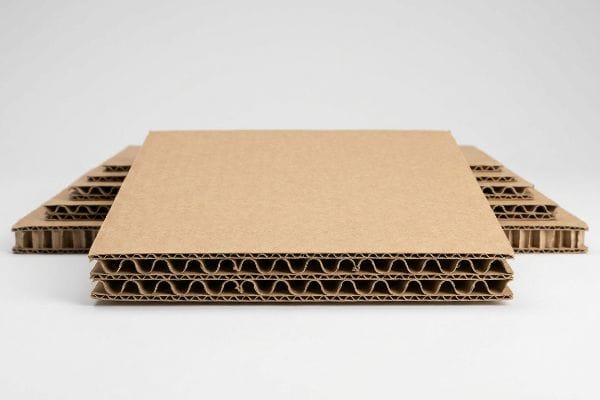
Wellpappe ist ein robustes Verpackungsmaterial, das aus einer gewellten Innenschicht besteht, die zwischen zwei flachen Außenschichten aus Karton eingebettet ist. Diese spezielle Wölbung verleiht der Wellpappe ihre dynamische Druckfestigkeit und unterscheidet sie grundlegend von herkömmlichem, flachem Papier, das in einfachen Faltschachteln verwendet wird.
Lassen wir die Definition aus dem Lehrbuch einmal beiseite und schauen wir uns an, wie sich dieses Material tatsächlich verhält, wenn man es schneidet und faltet.
Die verborgene Physik der Wellpappen
Nachwuchsdesigner behandeln dieses Trägermaterial oft genauso wie die flache digitale Leinwand ihres Computerbildschirms. Sie konzentrieren sich ausschließlich auf die Platzierung von Grafiken und die Pantone-Farbabstimmung und ignorieren dabei völlig die physische Ausrichtung der inneren Wellenbögen, die der Platte ihre eigentliche Stabilität verleihen¹.Sie gehen davon aus, dass die physische Form erhalten bleibt, solange sie eine hochwertige Platte verwenden.
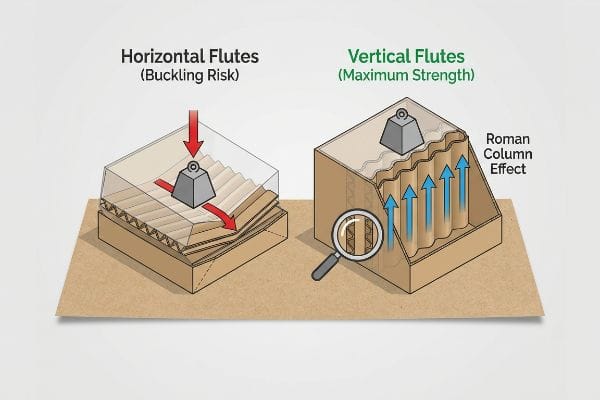
Ich weiß, Sie starren ratlos auf diese Pappkonstruktion , denn 80 % meiner Kunden machen genau diesen Fehler bei ihrer ersten Stanzform. Sie entwerfen zwar ein ansprechendes Display, richten die Wellen aber horizontal über die tragenden Wände aus. Ich habe schon oft beobachtet, wie Verkäufer versucht haben, diese horizontal geriffelten Tabletts wieder aufzufüllen; man kann das Reißen und Knirschen des rohen Kartons förmlich hören, wenn die inneren Bögen unter nur 9 kg Konserven einknicken. Um das zu vermeiden, achte ich bei allen CAD-Dateien (Computer-Aided Design) für die Konstruktion stets auf eine strikt vertikale Faserrichtung. Indem ich die Pappe um 90 Grad drehe, sodass die Wellen wie römische Säulen stehen, erreiche ich sofort den maximalen Wert des Box Compression Test (BCT)², was meinen Kunden katastrophale Rückbuchungen durch den Händler und stundenlanges, frustrierendes manuelles Nachkleben erspart.
| Häufiger Anfängerfehler | Die Profi-Lösung | Vorteil für die Verkaufsfläche |
|---|---|---|
| Nuten horizontal ausrichten | Durchsetzung einer strikten vertikalen Maserung3 | Verhindert das Zusammenbrechen der tragenden Elemente |
| Plattendicke außer Acht gelassen | Hinzufügen von Bremssattelbiegungszugaben | Spart 25 Sekunden Montagezeit4 |
| Es wie flaches Papier behandeln | Konstruktion von 3D-Strukturverbindungen | Vermeidet lästiges, durchsichtiges Klebeband |
Ich lasse einen Kunden niemals die Druckvorlage freigeben, bevor ich nicht mathematisch die Faserrichtung auf dem Schneidetisch überprüft habe. Ein wunderschöner Druck ist wertlos, wenn die Kernstruktur unter ihrem eigenen Gewicht zusammenbricht, bevor sie das Werk verlässt.
🛠️ Harveys Schreibtisch: Sind Sie sich nicht sicher, ob die Riffelung Ihres Displays für eine hohe Produktlast geeignet ist? 👉 Senden Sie mir Ihre Stanzform ↗ – Direkter Kontakt zu mir. Garantiert kein automatisierter Werbe-Spam.
Worin besteht der Unterschied zwischen Karton und Wellpappe?
Käufer verwenden diese beiden Begriffe häufig synonym, aber sie als ein und dasselbe zu behandeln, wird Ihre Lieferkettenlogistik und die Einhaltung der Vorschriften im Einzelhandel.
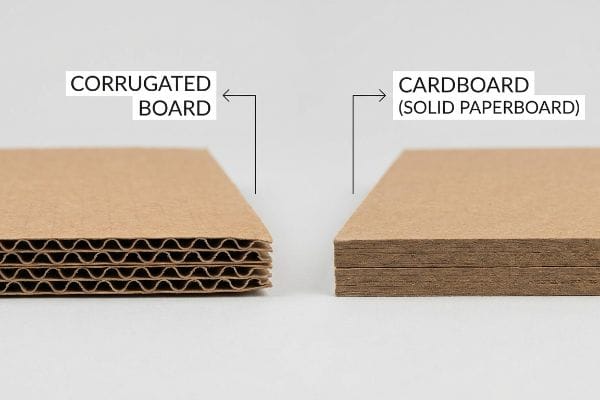
Der Unterschied zwischen Karton und Wellpappe liegt in ihrer inneren Struktur. Karton ist flacher, nicht gewellter Vollkarton, der beispielsweise für leichte Müslischachteln verwendet wird, während Wellpappe eine gewellte Innenschicht aufweist, die Stöße absorbiert und das hohe Gewicht beim Transport schwerer Güter trägt.
Das Verwechseln dieser Materialien ist nicht nur ein sprachlicher Fehler; es ist ein kritischer Konstruktionsfehler, der nur darauf wartet, zu passieren.
Die ungeriffelte Substratfalle
Einkaufsteams versuchen häufig, leichte, massive Kartonverpackungen für den Einzelhandel zu skalieren, um so Materialkosten zu sparen. Sie gehen fälschlicherweise davon aus, dass eine Erhöhung der Rohdicke oder -dichte eines massiven Kartons automatisch die dynamische Belastbarkeit eines echten Wellpappensubstrats erreicht . Der Prototyp wird anhand seines Aussehens im leeren Zustand freigegeben.
Das ist eine häufige Falle, in die selbst erfahrene Einkaufsteams tappen, wenn sie versuchen, die Stückkosten um wenige Cent zu senken. Ich habe schon erlebt, wie Marken dichte, schwere, ungewellte Kartondisplays direkt an große Kaufhäuser lieferten, nur um dann festzustellen, dass sich die gesamte unterste Ebene sichtbar nach außen wölbte und verbogen hatte, sobald ein Gabelstapler die Palette bewegte. Da ungewelltes Material keine inneren Wölbungen aufweist,besitzt es keinerlei Mechanismus zur Dämpfung von Stößen, und man kann deutlich sehen, wie sich die beanspruchten Fasern unter dem Licht verziehen. Wenn ich eingreife, um solche gescheiterten Kampagnen zu retten, ordne ich einen sofortigen Wechsel zu leichter E-Welle-Wellpappean. Durch die Nutzung der inneren geometrischen Wölbungen anstelle der Rohmaterialdichte absorbieren wir Transportschwingungen sicher und erhalten perfekt rechtwinklige Trays, reduzieren das Materialgewicht und vermeiden Transportschäden vollständig.
| Häufiger Anfängerfehler | Die Profi-Lösung | Vorteil für die Verkaufsfläche |
|---|---|---|
| Vergrößerung von Vollspanplatten | Aufrüstung auf E-Welle8 | Übersteht starke kinetische Schocks |
| Abhängigkeit von der Rohmaterialdichte | Verwendung geometrischer kannelierter Bögen9 | Hält Verkaufstabletts perfekt quadratisch |
| Materialfestigkeit abschätzen | Prüfung der dynamischen Belastbarkeit10 | Verhindert das Ausknicken der unteren Ebene |
Ich weise meine Kunden stets darauf hin, dass die statische Dicke nicht gleich der strukturellen Festigkeit ist. Ich verwende grundsätzlich keine massiven, nicht geriffelten Platten für Konstruktionen, die eine physische Last tragen, da deren Geometrie den Vibrationen im Lagerhaus nicht standhält.
🛠️ Harveys Schreibtisch: Befürchten Sie, dass Ihre aktuelle Materialspezifikation in Wirklichkeit ein nicht geriffeltes Trägermaterial ist, das als Schwerlastplatte getarnt ist? 👉 Materialprüfung anfordern ↗ — Sicher herunterladen. Bei Fragen können Sie mich gerne kontaktieren.
Wozu werden Wellpappenverpackungen verwendet?
Über die üblichen braunen Versandkartons hinaus ist dieses speziell entwickelte Substrat die Geheimwaffe für die gleichzeitige Durchführung agiler, wirkungsvoller Marketingkampagnen an Tausenden von Einzelhandelsstandorten.
Wellpappenverpackungen werden für wirkungsvolle Verkaufsdisplays, verkaufsfertige Warenträger und robuste Versandkartons für den internationalen Markt eingesetzt. Sie dienen als leichte, flach verpackbare Lösung, die teure, fest installierte Metallkonstruktionen ersetzt und es Marken ermöglicht, umfangreiche saisonale Werbeaktionen mit minimalem Logistikaufwand und maximaler visueller Wirkung durchzuführen.
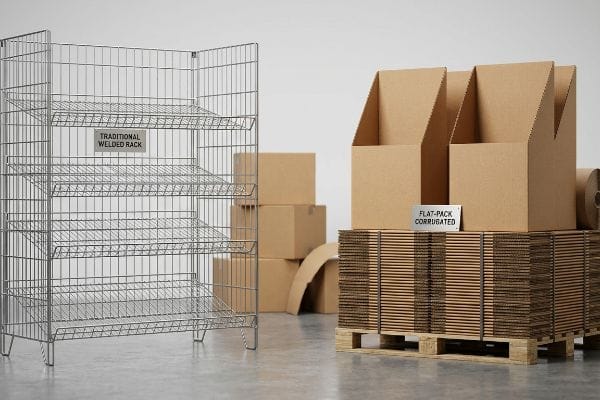
Für den effektiven Einsatz dieser Strukturen ist jedoch ein tiefes Verständnis der Logistik erforderlich, nicht nur gutes Grafikdesign.
Umgehung der permanenten Hardware-Frachtstrafe
Markenteams greifen bei temporären Kampagnen im Einzelhandel häufig auf fest installierte, verschweißte Metallgestelle zurück, in der Annahme, dass robuster Stahl automatisch eine höhere Rendite garantiert. Bei der Planung dieser Aktionen konzentrieren sie sich ausschließlich auf die Lebensdauer der Gestelle und ignorieren dabei völlig den hohen logistischen Aufwand für die permanente Installation. Da Metallgestelle nicht faltbar sind, müssen Marken enorme Mengen an leerer Luft über den Ozeantransportieren.
Stellen Sie sich vor, Sie zahlen Miete für eine leere Wohnung; Sie geben Tausende für Frachtkosten aus, nur um ungenutzten Platz zu transportieren. Ich sehe Marketingleiter in Panik geraten, wenn ihre Buchhaltung eine horrende Logistikrechnung meldet, weil in einen Standardcontainer nur etwa 250 vollständig verschweißte Drahtgestelle passen. Um dieses Problem zu lösen, stelle ich ihre kurzfristigen Kampagnen auf hochleistungsfähige, flach verpackte Wellpappkonstruktionen um. Sobald sie den festen, angenehmen Widerstand spüren, wenn ein fachgerecht konstruierter 32ECT-Kraftkarton12 einrastet, erkennen sie, dass sie keinen Stahl benötigen. Durch den Wechsel zu Wellpappe kann ich bis zu 1.500 flach verpackte Einheiten in denselben Container13und so die enormen Frachtkosten eliminieren, während die Standard-Nutzlastgewichte beibehalten werden.
| Häufiger Anfängerfehler | Die Profi-Lösung | Vorteil für die Verkaufsfläche |
|---|---|---|
| Versand von geschweißten Metallgestellen | Gestaltung von flach verpackten Wellpappen | Erhöht die Behälterdichte um 600 %14 |
| Überdimensionierung für 12 Wochen | Material auf den Lebenszyklus abstimmen | Eliminiert den Aufwand für die Rücklogistik15 |
| Für den Transport von leerem Raum bezahlen | Zusammenklappbare Komponenten flach | Senkt die Frachtkosten pro Einheit |
Bevor ich physische Strukturen entwerfe, prüfe ich die Werbezeitpläne meiner Kunden rigoros. Bei Kampagnen unter zwölf Wochen bestehe ich strikt auf Wellpappkartons, um deren Betriebskapital vor unnötigen Logistikkosten zu schützen.
🛠️ Harveys Schreibtisch: Verschwenden Sie Ihr Marketingbudget versehentlich durch den Versand von fertig montierten, starren Displays? 👉 Holen Sie sich einen Frachtdichteplan ↗ – Keine Formulare, die endlose Verkaufsgespräche auslösen. Nur echter Mehrwert.
Wird Wellpappe als Schutzverpackung verwendet?
Ja, es ist der globale Standard für Schutzverpackungen, aber die Festigkeit des Rohmaterials ist völlig nutzlos, wenn die physikalische Strukturgeometrie beim Beladen der Paletten beeinträchtigt wird.
Ja. Wellpappe dient als Schutzverpackung, um empfindliche Waren vor Beschädigungen in der Lieferkette zu schützen. Ihre Innenrillen wirken als mechanischer Stoßdämpfer gegen kinetische Vibrationen, während ihre stabile Eckgeometrie eine hohe vertikale Druckfestigkeit gewährleistet, um den Belastungen durch doppelt gestapelte Seefracht und Gabelstapler standzuhalten.
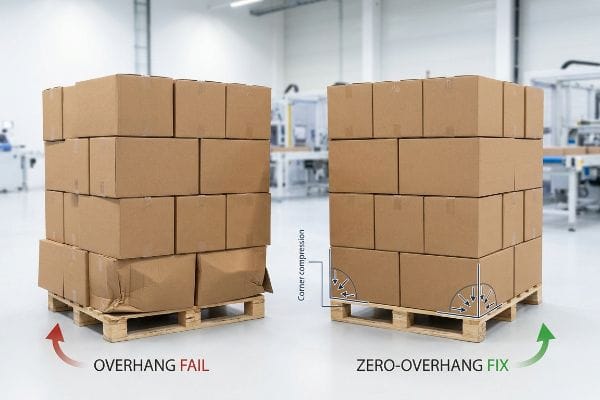
Doch die Theorie allein genügt nicht, wenn die Maschinen anlaufen und schwere Paletten durch das Lager bewegt werden.
Warum Standard-Schutzboxen in der Fabrikhalle versagen
Einkaufsteams vergrößern häufig die Abmessungen ihrer Umkartons, um die Versanddichte zu maximieren. Sie gehen dabei davon aus, dass die Kompressionswerte eines hochbelastbaren Kartons (16) die Ware im Inneren automatisch schützen. Die Kartons werden in einer sterilen Softwareumgebung entworfen, völlig losgelöst von den physischen Abmessungen gängiger Logistikplattformen. Dabei vertrauen die Teams den theoretischen Materialdaten, ohne die realen Stapelbedingungen zu berücksichtigen.
Ein einzelnes Display im Labor aufzustellen ist einfach, doch die Realität sieht anders aus, wenn man 500 Stück über den Pazifik verschickt. In meinem Betrieb sehe ich regelmäßig Kunden, die Sonderkartons einreichen, die eine Standard-Holzpalette von 1219 × 1016 mm (48 × 40 Zoll) nur um 12,7 mm (0,5 Zoll) überragen. Da ein Wellpappkarton bis zu 60 % seiner Druckfestigkeit<sup>17</sup> allein durch die vertikale Ausrichtung seiner vier Ecken erhält, bedeutet dieser minimale Überstand, dass die Ecken keinerlei Last tragen. Ich habe die Messwerte der Hydraulikpresse in unserer Testhalle ausgewertet und nachgewiesen, dass dieser unsichtbare Überstand das gesamte kinetische Gewicht auf die ungestützten Mittelwände verlagert und so ein katastrophales Einknicken verursacht. Um dies zu beheben, setze ich ein striktes Protokoll für Kartons ohne Überstand durch und verkleinere die zulässige Grundfläche, um die vollständige Abstützung der Ecken zu gewährleisten. Dies verhindert ein Einknicken des Kartons und erspart meinen Kunden Tausende von Euro an Gebühren für die Ablehnung durch den Einzelhandel.
| Häufiger Anfängerfehler | Die Profi-Lösung | Vorteil für die Verkaufsfläche |
|---|---|---|
| Über die Holzpalette hinausragend | Erzwingen eines Begrenzungsrahmens ohne Überhang | Stellt 60 % der Eckkompression wieder her18 |
| Vertrauen in flache Materialdaten | Testen der zusammengesetzten 3D-Geometrie | Übersteht Doppelstocktransport19 |
| Eckausrichtung ignorieren | Abmessungen von Bruchteilen einer Palette | Eliminiert zerdrückte unterste Ebenen20 |
Ich verlasse mich nie allein auf ein Materialdatenblatt. Ich garantiere mathematisch, dass jede von mir konstruierte Ecke perfekt bündig mit dem Holzdeck abschließt, denn Schwerkraft und Vibrationen decken während des Transports immer Geometriefehler auf.
🛠️ Harveys Schreibtisch: Lassen Sie sich nicht von einem 2 Millimeter kleinen Konstruktionsfehler die Einführung in 500 Filialen vermasseln. 👉 Senden Sie mir Ihre Stanzdatei ↗ – ich prüfe die Berechnungen, bevor Sie Ihr Budget für die Massenproduktion verschwenden.
Abschluss
Sie können zwar einen günstigeren Lieferanten wählen, doch wenn der unsichtbare Überstand der Paletten in einem feuchten Lager zum Verziehen Ihrer Umkartons führt, kommt es sofort zur Ablehnung durch den Händler und zu wochenlangen, kostspieligen Nacharbeiten. Über 500 Markenmanager nutzen meine Checkliste für die Druckvorstufe, um genau diese fatalen Fehler in der Anfangsphase zu vermeiden. Hören Sie auf, über die Statik zu raten, und lassen Sie mich Ihre Dateien persönlich durch meinen kostenlosen Stanzlinien-Audit ↗ , um diese versteckten Schwachstellen vor dem Druck zu erkennen.
„[PDF] Kantendruckfestigkeit von Wellpappe“, https://repository.gatech.edu/server/api/core/bitstreams/17648daf-ab05-4e86-af1f-1eb669a9c20c/content. Normen für Verpackungstechnik beschreiben detailliert, wie die Wellenstruktur durch vertikale Kompression für strukturelle Steifigkeit sorgt. Nachweisfunktion: Technische Verifizierung; Quellentyp: Branchenhandbuch. Unterstützt: den Zusammenhang zwischen Wellenstruktur und Plattenfestigkeit. Anwendungsbereich: Gilt speziell für Wellpappe. ↩
„Druckfestigkeitsabschätzung von Wellpappkartons für …“, https://pmc.ncbi.nlm.nih.gov/articles/PMC9864211/. Die technische Dokumentation zur Verpackungstechnik erläutert, wie die vertikale Wellenausrichtung die Tragfähigkeit und die BCT-Werte optimiert. Nachweisfunktion: Technische Verifizierung; Quellentyp: Technisches Handbuch oder Industriestandard. Unterstützt: Die Aussage, dass die vertikale Wellenausrichtung die Druckfestigkeit maximiert. Anwendungsbereich: Gilt für Standard-Wellpappkartons. ↩
„Abschätzung der Druckfestigkeit von Wellpappe …“, https://pmc.ncbi.nlm.nih.gov/articles/PMC8467740/. Technische Normen für Wellpappenmaterialien belegen, dass eine vertikale Faserrichtung die Säulenfestigkeit maximiert und so ein Versagen unter Druckbelastung verhindert. Nachweisfunktion: Technische Validierung; Quellentyp: Handbuch für Verpackungstechnik. Begründung: Notwendigkeit der vertikalen Faserrichtung für die Tragfähigkeit. Anwendungsbereich: Gilt speziell für axiale Druckbelastungen. ↩
„Analytische Bestimmung der Biegesteifigkeit eines fünflagigen …“, https://pmc.ncbi.nlm.nih.gov/articles/PMC8777652/. Daten zur betrieblichen Effizienz und Benchmarks aus dem Bereich Industrial Engineering quantifizieren die Reduzierung der manuellen Montagezeit, wenn die Biegezugaben für Bremssättel korrekt in die Konstruktion integriert werden. Nachweisfunktion: quantitative Verifizierung; Quellentyp: Studie aus dem Bereich Industrial Engineering. Belege: die konkrete Aussage zur Zeitersparnis. Anmerkung: Empirische Daten variieren je nach Darstellungsgröße und -komplexität. ↩
„[PDF] Untersuchung der mechanischen Eigenschaften von Kartonverpackungen …“, https://repository.rit.edu/cgi/viewcontent.cgi?article=1066&context=japr. Eine technische Quelle aus dem Bereich Verpackung oder Materialwissenschaften, die die Strukturphysik von Wellpappe hinsichtlich Tragfähigkeit und Druckfestigkeit erläutert. Nachweisfunktion: Technische Validierung; Quellentyp: Industriestandard oder Ingenieurhandbuch; Beleg: Die Behauptung, dass gewellte Substrate eine höhere dynamische Belastbarkeit als Vollkarton aufweisen; Anwendungsbereich: Fokus auf vertikale Druckbelastung und Stoßdämpfung. ↩
„Druckfestigkeit von Wellpappenverpackungen …“, https://pmc.ncbi.nlm.nih.gov/articles/PMC10054506/. Technische Erläuterung, wie das Fehlen von Wellen in Vollkarton dessen Fähigkeit zur Verteilung kinetischer Energie im Vergleich zu Wellenstrukturen einschränkt. Nachweisfunktion: Technische Validierung; Quellentyp: Materialwissenschaftliches Handbuch. Unterstützt: Anfälligkeit von ungewellten Substraten gegenüber Stößen. Anmerkung zum Umfang: Fokus auf die Strukturgeometrie. ↩
„Wellpappenverpackungen mit innovativem Design für …“, https://bioresources.cnr.ncsu.edu/wp-content/uploads/2026/01/BioRes_21_1_2229_Tworzydlo_PSMPGG_Corrugated_Packaging_Design_Durability_Transport_25399.pdf. Detaillierte Spezifikation der Wellenhöhe von E-Welle und ihrer Wirksamkeit hinsichtlich Druckfestigkeit und Vibrationsdämpfung für leichte Transportverpackungen. Nachweisfunktion: Produktspezifikation; Quellentyp: Verpackungsindustriestandard. Unterstützung: Verwendung von E-Welle zur Erhöhung der Transportstabilität. Anmerkung zum Anwendungsbereich: Fokus auf dem Verhältnis von Festigkeit zu Gewicht. ↩
„Untersuchung verschiedener Kartonmaterialien unter Stoßbelastung“, https://bioresources.cnr.ncsu.edu/resources/investigation-of-different-cardboard-materials-under-impact-loads/. Technische Spezifikationen zur Stoßdämpfung und Schlagfestigkeit von E-Welle-Wellpappe im Vergleich zu Vollpappe. Nachweisfunktion: Technische Verifizierung; Quellentyp: Materialwissenschaftliche Referenz. Beleg: Die Behauptung, dass E-Welle besser für die Beständigkeit gegenüber kinetischen Stößen geeignet ist. Anwendungsbereich: Speziell für Verpackungsmaterialien im Einzelhandel. ↩
„Was ist Wellpappe?“, https://www.fibrebox.org/what-is-corrugated/. Technische Erklärung, wie die Bogenstruktur der Wellenform für eine höhere vertikale Druckfestigkeit und Formbeständigkeit im Vergleich zur Rohmaterialdichte sorgt. Belegfunktion: Strukturanalyse; Quellentyp: Leitfaden für Verpackungstechnik. Unterstützt: Die Behauptung, dass Wellenbögen die Form von Trays stabilisieren. Anmerkung zum Umfang: Fokus auf die Physik von Wellpappensubstraten. ↩
„Die Rolle des Knickens bei der Abschätzung der Druckfestigkeit von … – PMC“, https://pmc.ncbi.nlm.nih.gov/articles/PMC7602429/. Validierung von Prüfprotokollen für dynamische Belastungen zur Erkennung und Vermeidung von Strukturversagen wie Knicken in gestapelten Displays. Nachweisfunktion: Verfahrensvalidierung; Quellentyp: Industrienorm (z. B. ASTM oder ISO). Unterstützt: Die Wirksamkeit dynamischer Prüfungen zur Vermeidung von Knicken der untersten Ebene. Anwendungsbereich: Gilt für vertikale, tragende Verkaufsdisplays. ↩
„Volumengewicht und Versand nach Europa: Was Sie wissen sollten | ILG“, https://www.international-logistics-group.com/us-en/insights/volumetric-weight-explained-161836/. Eine Quelle aus dem Bereich Logistik oder Supply Chain Management würde Daten zu den Volumengewichtsaufschlägen für nicht faltbare Fracht im Vergleich zu flach verpackten Sendungen liefern. Nachweisfunktion: technische Validierung; Quellentyp: Logistikhandbuch oder Bericht der Schifffahrtsbranche. Unterstützt: die Ineffizienz des Versands starrer Metallgestelle. Anmerkung zum Anwendungsbereich: bezieht sich speziell auf internationale Versandcontainer. ↩
„Understanding Shipping Box Strength – EcoEnclose“, https://www.ecoenclose.com/blog/understanding-shipping-box-strength/?srsltid=AfmBOoqDyap4c_VQwbrL714jbEhoobvWrCy7ZkzWpuyDre3i6Lz2TYLv. Technische Normen für den Edge Crush Test (ECT) bestätigen die strukturelle Integrität und Tragfähigkeit von 32 ECT-zertifizierten Kraftpapieren. Nachweisfunktion: Technische Validierung; Quellentyp: Handbuch für Verpackungstechnik. Belege: Behauptung der strukturellen Eignung als Stahlersatz. Anmerkung: Der ECT misst speziell die vertikale Druckfestigkeit. ↩
„Flatpack-Container vs. Versandcontainer“, https://www.prefabex.com/our_galleries/flat-pack-vs-traditional-shipping-containers. Logistikdaten belegen den Effizienzgewinn und die höhere Packungsdichte beim Übergang von vormontierten Drahtgestellen zu flach verpackten Wellpappdisplays. Nachweisfunktion: quantitative Verifizierung; Quelle: Analyse der Versandbranche. Beleg: Vermeidung von Frachtkostenzuschlägen. Anmerkung: abhängig von den Abmessungen der einzelnen Einheiten und der Containergröße. ↩
„Flatpack- vs. Stahllagercontainer: Wann welche Lösung Vorteile bietet“, https://www.sentinelcontainers.com/blog/flat-pack-vs-steel-storage-containers. Technischer Vergleich der volumetrischen Effizienz von Flatpack-Wellpappdisplays und vormontierten, geschweißten Metallregalen. Nachweisfunktion: quantitative Verifizierung; Quellentyp: Branchenbenchmark für Logistik. Unterstützt durch: die spezifische Kennzahl der Containerdichteerhöhung. Anmerkung: Die tatsächlichen Prozentsätze können je nach Produktabmessungen variieren. ↩
„Reduzierung der Kosten der Reverse-Logistik – Gegenwart und Zukunft“, https://www.retaildive.com/spons/reducing-the-cost-of-reverse-logistics-present-and-future/638146/. Analyse der ökologischen und finanziellen Kosten der Rückgabe von Hardware im Vergleich zum Recycling von Wellpappe vor Ort. Nachweisfunktion: Prozessvalidierung; Quellentyp: Studie zum Lieferkettenmanagement. Unterstützt die These, dass kurzlebige Materialien den Rückversand überflüssig machen. Anmerkung zum Anwendungsbereich: Abhängig von der Recyclinginfrastruktur des jeweiligen Einzelhandelsstandorts. ↩
„Untersuchung des Einflusses der Steifigkeit der Palettenoberseite auf Wellpappe …“, https://pmc.ncbi.nlm.nih.gov/articles/PMC8585293/. Kurze Erläuterung, wie Industriestandards wie der Edge Crush Test (ECT) die Materialfestigkeit messen, jedoch die Strukturgeometrie und den Palettenüberstand nicht berücksichtigen. Nachweisfunktion: Technische Validierung; Quellentyp: Verpackungstechnikstandard. Unterstützt die Aussage, dass Rohmesswerte für den Schutz in der Praxis unzureichend sind. Anwendungsbereich: Speziell für Wellpappe. ↩
„Eine vergleichende Studie zur Druckfestigkeit von Wellpappe …“, https://repository.rit.edu/theses/285/. Technische Normen für Verpackungstechnik quantifizieren den Beitrag der Eckspalten zum Gesamtwert des Box Compression Test (BCT). Nachweisfunktion: technische Validierung; Quellentyp: technisches Lehrbuch oder Industriestandard. Unterstützt: die Aussage, dass die Eckstabilität der Hauptfaktor für die vertikale Belastbarkeit ist. Anmerkung: Die genauen Prozentsätze können je nach Wellentyp und Kartonqualität variieren. ↩
„Auswirkungen des Palettenversatzes auf die Druckfestigkeit von …“, https://digitalcommons.calpoly.edu/cgi/viewcontent.cgi?article=1067&context=it_fac. Eine technische Analyse der Tragfähigkeit von Wellpappenverpackungen zeigt den prozentualen Festigkeitsverlust durch Palettenüberstand. Nachweisfunktion: Quantitative Verifizierung; Quellentyp: Studie im Bereich Verpackungstechnik. Unterstützt: Die Auswirkungen eines fehlenden Überstands auf die Eckfestigkeit. Anmerkung zum Anwendungsbereich: Bezieht sich auf Kennzahlen der vertikalen Druckfestigkeit. ↩
„Wellpappenverpackungen mit innovativem Design für verbesserte …“, https://bioresources.cnr.ncsu.edu/resources/corrugated-board-packaging-with-innovative-design-for-enhanced-durability-during-transport/. Branchenstandards für die Verpackungsprüfung bestätigen, dass die Prüfung der 3D-Geometrie von zusammengesetzten Verpackungen den Daten von flachem Material hinsichtlich der Vorhersage der Stapelbarkeit überlegen ist. Nachweisfunktion: Validierung der Methodik; Quellentyp: Verpackungsindustriestandard (ASTM/ISO). Begründung: Die Notwendigkeit von 3D-Prüfungen zur Sicherstellung der Transportstabilität. Anwendungsbereich: Gilt für vertikale Lastaufnahme. ↩
„Reduzierung des Risikos zusammenbrechender Palettenladungen: Teil II | Packaging World“, https://www.packworld.com/home/article/13372817/reducing-the-occurrence-of-collapsing-pallet-loads-part-ii. Technische Richtlinien zur Palettierung und Kartonausrichtung beschreiben detailliert, wie präzise Teilmaße strukturelle Schäden in den unteren Lagen verhindern. Nachweisfunktion: Technische Begründung; Quellentyp: Logistik- und Lagerhandbuch. Unterstützung: Die Rolle der Ausrichtung bei der Vermeidung des Zusammenbrechens der unteren Lagen. Anwendungsbereich: Spezifisch für die Geometrie der Palettenbeladung. ↩