Die Wahl des falschen Materials für Ihre Einzelhandelsverpackungen führt unweigerlich zu katastrophalen strukturellen Schäden. Lassen Sie uns genauer betrachten, wie die Materialwissenschaft das Überleben Ihrer Lieferkette beeinflusst.
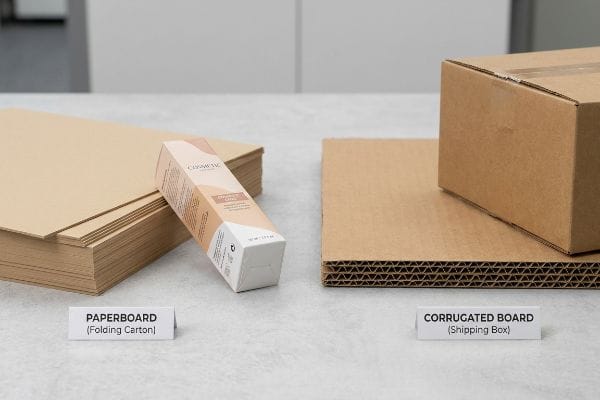
Der Unterschied zwischen Karton und Wellpappe liegt in der Wellenstruktur. Karton ist ein flaches, einlagiges Material, ideal für leichte Faltschachteln für Kosmetikartikel. Wellpappe hingegen besteht aus einer gewellten Innenschicht zwischen zwei flachen Deckschichten. Dadurch bietet sie eine hervorragende Stoßdämpfung und hohe Belastbarkeit für den Transport schwerer Lasten.
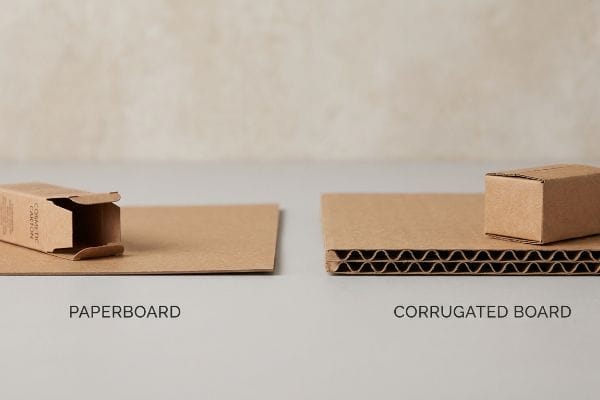
Als Fabrikingenieur sehe ich täglich, wie Marken diesen Materialfehler begehen, was zu beschädigten Displays und massiven Rückbuchungen von Händlern führt. Schauen wir uns die physikalischen Hintergründe genauer an.
Ist Karton dasselbe wie Wellpappe?
Einkaufsteams verwechseln diese beiden Materialien ständig, um Kosten zu sparen. Dieses grundlegende Missverständnis der Strukturgeometrie führt unweigerlich zum Scheitern von Einzelhandelskampagnen, bevor diese überhaupt im Handel ankommen.
Nein. Karton und Wellpappe sind völlig unterschiedliche Materialien. Während Karton als dichte, ungewellte Pappe für die Herstellung von Produktverpackungen geeignet ist, weist Wellpappe eine gewellte Struktur auf. Diese innere Wellenform ermöglicht es der Wellpappe, schwere vertikale Lasten während des Transports dynamisch zu verteilen.
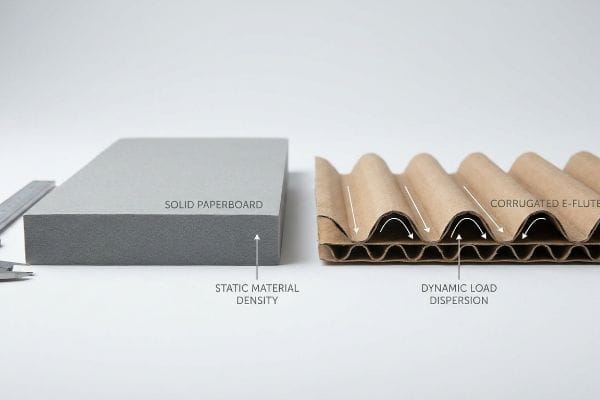
Der Unterschied geht weit über die optische Dicke hinaus; er bestimmt grundlegend, wie Ihre Verpackung den harten Realitäten des Seetransports und der Lagerstapelung standhält.
Die Lastkapazitätsfalle „Ungeriffeltes Substrat“
Bei der Prüfung von Stanzformen beobachte ich immer wieder, wie Einkaufsteams versuchen, leichte Vollpappenkonstruktionen für den Einzelhandel auf schwerere, verkaufsfertige Trays umzuskalieren, um Materialkosten zu sparen. Sie gehen fälschlicherweise davon aus, dass die Rohdichte eines dicken Vollkartons seiner dynamischen Belastbarkeit entspricht. Tatsächlich fehlen ungewellten Substraten die wellenförmigen Innenbögen¹ , die in Wellpappenstrukturen zu finden sind. Das bedeutet, dass sie keinerlei Mechanismus zur dynamischen Verteilung von kinetischen Stößen² besitzen .
In meiner Einrichtung erlebe ich regelmäßig, wie theoretische Berechnungen in der Praxis bei ersten E-Crush-Tests (ECT) vor Produktionsbeginn zu Problemen führen. Bei einem kürzlich durchgeführten Test bog sich die schwere Vollkarton-Schale eines Kunden bereits bei einer Belastung von nur 19,2 kg (42,5 lbs) nach außen durch, da die statische Materialdichte die geometrische Lastverschiebung nicht ersetzen kanndaraufhinumgehend an und verwendete stattdessen ein leichtes E-Wellen-Wellpappsubstrat. Durch die Nutzung der inneren Bogenform der Mikrowellungkonntedie neue Struktur 52,1 kg (115 lbs) kinetische Energie absorbieren, ohne den Materialverbrauch zu erhöhen. Dieser präzise Materialwechsel eliminierte das Durchhängen der unteren Ebene vollständig, beschleunigte die Bestückungszeiten beim Co-Packing um 18 % und verhinderte jegliche Reklamationen durch den Einzelhandel bei Anlieferung.
| Metrisch | Vollkarton | Wellpappe E-Welle |
|---|---|---|
| Kinetischer Schock | Nulldispersion | Dynamische Absorption |
| Top-Load-Kapazität | Scheitert bei 42,5 lbs (19,2 kg)5 | Fassungsvermögen: 115 lbs (52,1 kg)6 |
| Montage ROI | Hoher Reibungswiderstand | 18 % schnelleres Einführen7 |
Ich lasse in meiner Produktionshalle niemals glatte Spanplatten schwere Lasten tragen. Die Umstellung auf mikrogeriffelte Platten garantiert, dass Ihre Displays auch unter der Belastung im Einzelhandel absolut formstabil bleiben.
🛠️ Harveys Schreibtisch: Beeinträchtigen Ihre schweren Kassenbehälter Ihre Versandkosten-ROI, noch bevor sie im Geschäft ankommen? 👉 Kostenlose Materialprüfung anfordern ↗ — Ich prüfe jede Konstruktionsdatei persönlich innerhalb von 24 Stunden.
Welche Nachteile hat die Verwendung von Wellpappe?
Trotz seines hohen Festigkeits-Gewichts-Verhältnisses weist Wellpappe erhebliche Schwächen auf, wenn sie extremen Umwelteinflüssen ausgesetzt ist. Unkontrollierte Luftfeuchtigkeit kann selbst dickste tragende Wände im Nu beschädigen.
Die Nachteile von Wellpappe liegen vor allem in ihrer Anfälligkeit für Umwelteinflüsse. Da das Rohmaterial des Testliners sehr porös ist, nimmt es in feuchten Klimazonen schnell Luftfeuchtigkeit auf. Diese Absorption führt zu einem Aufquellen der Papierfasern, wodurch die Druckfestigkeit abnimmt und die präzisen Verriegelungslaschen beim Hochgeschwindigkeits-Co-Packing verrutschen oder einreißen können.
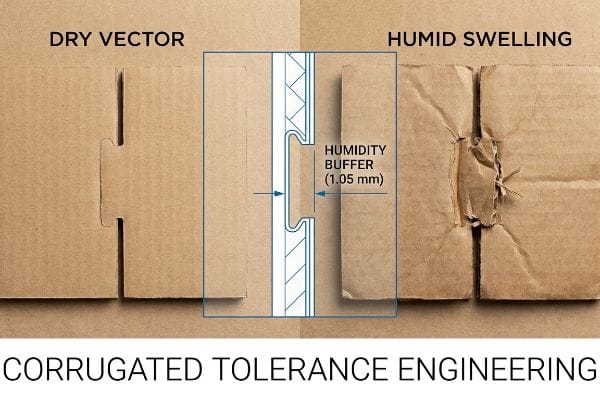
Wenn Sie ein Display ausschließlich auf Basis absoluter Trockenmessungen entwerfen, konstruieren Sie eine tickende Zeitbombe für Ihre Endmontagelinie.
Montageausfall aufgrund mangelnder Feuchtigkeitsquelltoleranz
Selbst erfahrene Konstrukteure übersehen diesen blinden Fleck oft: Sie verlassen sich auf eine flache Vektor-CAD-Stanzform, die die Dicke von Wellpappe und die Ausdehnung durch Umgebungsbedingungen völlig außer Acht lässt. Sie konstruieren enge Reibungsnuten ausschließlich auf Basis der absoluten Dicke des trockenen Kartons in einem klimatisierten Büro. Sie vernachlässigen die physikalischen Gegebenheiten des Seetransports, bei dem poröser Testliner große Mengen an Luftfeuchtigkeit aufnimmt und sich dadurch stark ausdehnt .
Das ist nicht nur Theorie – ich beobachte das selbst in der Testumgebung, wenn wir Vorserien-Montageversuche unter simulierten feuchten Lagerbedingungen durchführen. Wenn die 32ECT-Platte Feuchtigkeit aufnimmt , wird ein perfekt auf 3,17 mm (0,12 Zoll) zugeschnittener Schlitz plötzlich zu eng. Meine zwanzigjährige Erfahrung in der Produktion hat mich gelehrt, den starken Widerstand der aufgequollenen, ungebrauchten Kraftkartonage zu spüren; beim Zusammenpressen der Teile wurden die Wellen sofort gequetscht und die Decklage eingerissen. Um dies zu beheben, habe ich mathematisch einen 1,05 mm (0,04 Zoll) dicken „Feuchtigkeitspuffer“ direkt in die Aufnahmeschlitze unserer Verriegelungsmechanismen integriert. Diese minimale Spielraumverbesserung garantiert dem Lohnverpacker eine reibungslose und reißfreie Montage unabhängig von der Umgebungsfeuchtigkeit und reduziert die Ausfallzeiten manueller Arbeitskräfte um schätzungsweise 25 % pro Palettenladung .
| Designvariable | Vektor für trockene Büroräume | Realität in einem feuchten Lagerhaus |
|---|---|---|
| Flötenmessschieber | 3,17 mm Schlitz11 | Wellen jenseits des Schlitzes12 |
| Versammlungstruppe | Gleitet leicht | Schwärmereien und Tränen |
| Technische Lösung | Null Toleranz | 1,05 mm Feuchtigkeitspuffer13 |
Ich weigere mich, zuzulassen, dass durch Umwelteinflüsse verursachte Feuchtigkeitsschwankungen ein perfekt gedrucktes Display zerstören. Der Einbau mathematischer Feuchtigkeitspuffer in jeden einzelnen Schlitz garantiert, dass Ihre Verpackung die gesamte Lieferkette unbeschadet übersteht.
🛠️ Harveys Schreibtisch: Besteht die Gefahr, dass Ihr aktuelles Thekendisplay bei der Montage in der feuchten Umgebung von Lohnverpackungsanlagen reißt? 👉 Fordern Sie eine kostenlose Toleranzprüfung an ↗ — 100 % vertraulich. Ihre noch nicht veröffentlichten Designs sind bei mir sicher.
Welche vier verschiedenen Arten von Karton gibt es?
Um sich im Rohstoffmarkt zurechtzufinden, ist es unerlässlich, genau zu wissen, welches Substrat am besten zum jeweiligen Preissegment Ihrer Marke passt. Die Wahl der falschen Kartonqualität kann Ihr Marketingbudget sofort aufzehren.
Es gibt vier verschiedene Kartonarten: Vollgebleichter Sulfatkarton (SBS), gestrichener ungebleichter Kraftkarton (CUK), gestrichener Recyclingkarton (CRB) und nicht knickfester Graukarton. SBS zeichnet sich durch hohe kosmetische Weiße aus, während CUK für Reißfestigkeit sorgt. CRB, oft auch als gestrichener Recyclingkarton bezeichnet, bietet eine besonders nachhaltige und kostengünstige Lösung für Trockenwaren.
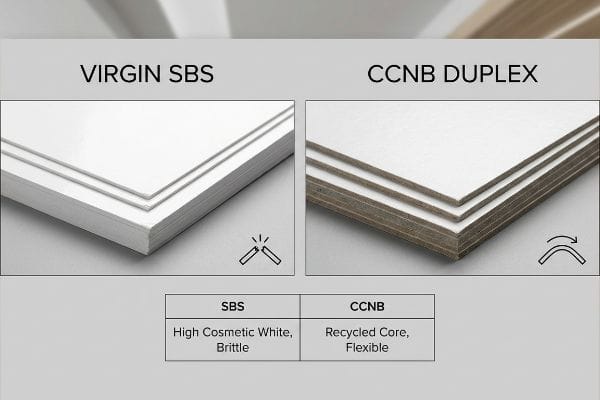
Während Grafikdesigner sofort zu den teuersten gebleichten Kartons greifen, wissen erfahrene Fabrikmitarbeiter, wie man recycelte Sorten strategisch einsetzt, um den Logistikmultiplikator zu maximieren.
Der Wertanalyse-Dreh- und Angelpunkt "CCNB Duplex"
Bei der Überprüfung von Spezifikationen für starre Verpackungen beobachte ich immer wieder, dass Marken in die Falle tappen, Standard-Handelskartons zu überdimensionieren. Sie schreiben extrem teure SBS-Kartonagen für die Sekundärverpackung von Werbeaktionen vor <sup>14 </sup> und behandeln eine allgemeine Checkliste für die Einhaltung von Händlervorgaben als absolute technische Wahrheit. Diese massive Überdimensionierung verbraucht unnötig viel Betriebskapital, ohne dem Produkt selbst einen zusätzlichen strukturellen Vorteil <sup>15</sup> zu bieten
Das ist nicht nur Theorie – ich habe es letzten Monat schmerzlich erfahren müssen, als ich meinem leitenden Ingenieur Mark bei Kompressionssimulationen an einem hochwertigen Kosmetik-PDQ-Tray (Product Display Quarter-pallet) zusah. Der Kunde verlangte 100 % Neuware-SBS, um 16,1 kg Glasflaschen zu tragen. Bei unserem internen Falltest roch ich den stechenden Staub der brechenden SBS-Fasern, als sich die starren Ecken unter dem kinetischen Stoß vollständig ablösten. Mir wurde klar, dass die steifen Neuware-Fasern für diese spezielle Geometrie zu spröde waren. Ich habe die Stanzform sofort neu geritzt und das Material auf ein hochwertiges Duplex-CCNB (Clay Coated News Back) mit langen Recyclingfasern.So konnte ich die hochwertige Beschichtung der Deckschicht beibehalten und gleichzeitig die Flexibilität des Kerns unter dem Aufprall gewährleisten. Ich investiere Zeit und Geld in meinem Testlabor, damit Sie im Einzelhandel keine Gewinneinbußen hinnehmen müssen. Durch diese Umstellung der Rohstoffauswahl konnten die gesamten Stückkosten um 22 % gesenkt und gleichzeitig die Ausbrüche an den spröden Ecken vollständig beseitigt werden, wodurch dem Kunden bei einer Produktionsmenge von 50.000 Einheiten eine enorme Rohstoffverschwendung erspart blieb.
| Materialspezifikation | Virgin SBS Board | CCNB Duplex Board |
|---|---|---|
| Faserverhalten | Sehr spröde18 | Flexibler Recyclingkern |
| Ergebnis des Falltests | Delaminierte Ecken19 | Unversehrte Struktur |
| Finanzielle Auswirkungen | Maximale Stückkosten | 22 % Kostenreduzierung20 |
Ich lasse ästhetische Vorstellungen niemals die mechanische Leistungsfähigkeit beeinträchtigen. Der strategische Einsatz von Hochleistungs-Recyclingkarton führt oft zu stabileren Verpackungen und einer deutlich höheren Gewinnspanne.
🛠️ Harveys Schreibtisch: Belasten Ihre Faltschachteln Ihr Budget unbemerkt durch überdimensionierte Kartonspezifikationen? 👉 Fordern Sie Ihre kostenlose Substratanalyse an ↗ — Keine Zwischenhändler. Sie sprechen direkt mit Statikern.
Ist Wellpappe stabiler als normale Pappe?
Die einfache Antwort lautet ja, aber die physikalischen Grundlagen dieser Festigkeit werden häufig von Beschaffungsteams manipuliert, die bei kosmetischen Details sparen wollen.
Ja. Wellpappe ist aufgrund ihres speziell entwickelten Wellenkerns deutlich stabiler als herkömmliche Pappe. Diese innere Wölbung wirkt als Stoßdämpfer und verteilt hohe vertikale Lasten gleichmäßig auf die Wände. Herkömmliche, flache Pappe besitzt diese dynamische Struktur nicht, was ihre Belastbarkeit bei Kompressionstests stark einschränkt.
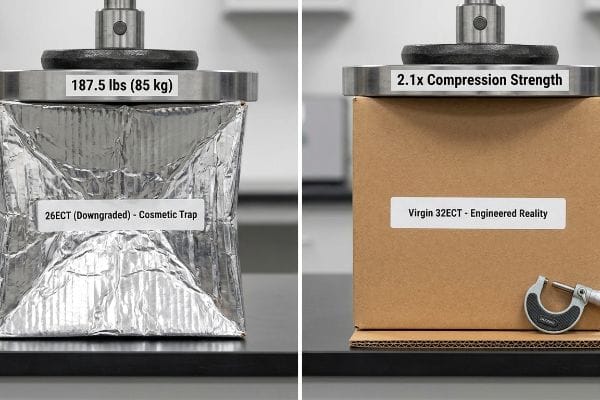
Eine robustere Materialarchitektur nützt jedoch nichts, wenn man die Faserdichte künstlich verringert, um glänzende Oberflächenlaminate zu erzielen.
Die „kosmetische ECT-Abwertung“ Kompressionsfalle
Es ist eine gängige Falle, in die selbst erfahrene Beschaffungsteams tappen: Eine Angebotsanfrage (RFQ) senkt die Qualität der Grundplatte bewusst, um ein paar Cent pro Einheit zu sparen. Sie fordern teure, vollflächige Folienkaschierungen und höhlen, um die Kosten zu kompensieren, heimlich den strukturellen Kern aus, sodass aus einer robusten 32ECT-Platte eine dünne 26ECT-Platte wird.Sie gehen fälschlicherweise davon aus, dass die glänzende Premium-Oberfläche den katastrophalen Verlust der strukturellen Integrität kaschiert.
In meiner Einrichtung erlebe ich regelmäßig, wie diese theoretische Budgetplanung bei unseren BCT-Tests (Box Compression Test) zu praktischen Problemen führt. Ich habe die Mikrometerwerte an einem minderwertigen 26ECT-Versandkarton abgelesen und beobachtet, wie er bei nur 85 kg (187,5 lbs) Druck von oben komplett einknickte, verglichen mit den geforderten 158,7 kg (350 lbs) Mindestbelastung im Einzelhandel. Die glänzende Folienfolie warf sofort Falten, als die schwachen inneren Wellen nach innen gedrückt wurden. Nachdem mir das Einkaufsteam die Anpassung der Excel-Stückliste (BOM) erlaubt hatte, erledigte das Material selbst die Hauptarbeit. Ich entfernte die teuren, schweren Folienfolien vollständig und erzielte mit einer hochglänzenden, wasserbasierten Beschichtung denselben hochwertigen Glanz. Dadurch konnte ich das Budget in einen neuen 32ECT-Standardkern reinvestieren. Durch die Wiederherstellung der kritischen Faserdichte erhöhte ich die dynamische Druckfestigkeit um den Faktor 2,1 x22, wodurch Transportschäden ausgeschlossen und die Rentabilität der Kampagne vollständig gesichert wurde.
| Spezifikation | Die Kosmetikfalle | Konstruierte Realität |
|---|---|---|
| Board Grade | 26ECT (Herabgestuft) | Virgin 32ECT |
| Oberflächenbeschaffenheit | Schwere Folienkaschierung | Glänzende wässrige Beschichtung |
| Transitüberleben | Schnallen bei 187,5 lbs (85 kg)23 | 2,1-fache Druckfestigkeit24 |
Ich weigere mich, die strukturelle Festigkeit für oberflächliche Ästhetik zu opfern. Durch die Abstimmung von Chemie und Materialqualität sehen Ihre Displays nicht nur hochwertig aus, sondern überstehen auch härteste Lagerbedingungen.
🛠️ Harveys Schreibtisch: Versagen Ihre optisch aufgewerteten Masterkartons heimlich bei einfachen Kompressionstests unter schwerer Palettenlast? 👉 Fordern Sie eine kostenlose Frachtdichteprüfung an ↗ — Ich prüfe jede Strukturdatei persönlich innerhalb von 24 Stunden.
Abschluss
Durch die Umstellung von theoretischen Berechnungen auf praktische Anwendung können Sie verhindern, dass schwere Lasten Ihre Wellpappen-Trays verbiegen und die Luftfeuchtigkeit Ihre Produktionslinien beschädigt. Allein im letzten Monat half meine Strukturprüfung drei Marken, über 10.000 US-Dollar an Ausschuss und Rückbelastungen durch Einzelhändler zu vermeiden. Wenn Sie diese Materialfallen beseitigen möchten, lasse ich Ihre Strukturdateien persönlich durch meine kostenlose Prüfung von Wellpappen-Stanzformen führen ↗, um sicherzustellen, dass Ihre Produkteinführung im Einzelhandel die Lieferkette problemlos übersteht.
„Was ist Wellpappe?“, https://www.fibrebox.org/what-is-corrugated/. Kurze Erläuterung des architektonischen Unterschieds zwischen Vollpappe und Wellpappe. Belegfunktion: Faktenprüfung; Quellentyp: Industriestandard für Verpackungen. Unterstützung: Materialanatomie. Anmerkung zum Umfang: Fokus auf die innere Geometrie. ↩
„Untersuchung verschiedener Kartonmaterialien unter Stoßbelastung“, https://bioresources.cnr.ncsu.edu/resources/investigation-of-different-cardboard-materials-under-impact-loads/. Technische Analyse der Wirkungsweise von Wellpappe als Strukturmechanismus zur Stoßdämpfung im Vergleich zu massiven Substraten. Nachweisfunktion: Technische Validierung; Quellentyp: Strukturtechnische Studie. Unterstützt: Aussagen zur Stoßdämpfung. Anmerkung zum Untersuchungsbereich: Fokus auf dynamische Belastungen. ↩
„Druckfestigkeit von Wellpappenverpackungen mit geringer …“, https://pmc.ncbi.nlm.nih.gov/articles/PMC10054506/. Technische Erläuterung, wie die Bogenform der Wellenstruktur im Vergleich zu massivem, dichtem Karton eine höhere vertikale Druckfestigkeit bietet. Belegfunktion: technisches Prinzip; Quellentyp: Handbuch für Bauingenieurwesen. Unterstützt: die Behauptung, dass die Geometrie die Dichte hinsichtlich Lastverschiebung übertrifft. Anmerkung zum Anwendungsbereich: bezieht sich speziell auf Druckbelastung von oben. ↩
„Wellpappenverpackungen mit innovativem Design für …“, https://bioresources.cnr.ncsu.edu/resources/corrugated-board-packaging-with-innovative-design-for-enhanced-durability-during-transport/. Überprüfung der Strukturmechanik von E-Welle-Mikrowellen und deren Fähigkeit zur Verteilung von vertikalem Druck. Nachweisfunktion: Materialspezifikation; Quellentyp: Technisches Datenblatt der Verpackung. Anwendungsbereich: Verwendung von Mikrowellen für hochfeste, leichte Substrate. Anmerkung zum Anwendungsbereich: beschränkt auf E-Welle und ähnliche Mikrowellen. ↩
„Untersuchung des Einflusses von Perforationen auf die Tragfähigkeit von …“, https://pmc.ncbi.nlm.nih.gov/articles/PMC11396172/. Technische Spezifikation zur Dokumentation der vertikalen Druckfestigkeit bzw. der Bruchlastgrenze von Vollkarton. Nachweisfunktion: quantitativer Vergleichswert; Quellentyp: Datenblatt der Materialtechnik. Anwendungsbereich: Tragfähigkeitsgrenzen von ungewellten Substraten. Hinweis: Die Ergebnisse können je nach Kartonsorte und -dicke variieren. ↩
„Wellenarten, ECT-Werte und Wandstärke erklärt 2025“, https://anchorbox.com/corrugated-box-strength/. Branchenübliche Tragfähigkeit für E-Welle-Wellpappe. Nachweisfunktion: quantitativer Vergleichswert; Quellentyp: Spezifikation für Verpackungsmaterialien. Belege: strukturelle Überlegenheit von Wellpappe gegenüber Vollkarton. Anmerkung: Annahme von Standard-Wellenhöhe und -Linergewicht für E-Welle. ↩
„Wellenprofile für Wellpappkartons erklärt: A, B, C, E & F“, https://www.onyxpackaging.com/blog/corrugated-box-flute-types.php. Empirischer Vergleich der Montageeffizienz und des Reibungswiderstands zwischen gewellten und ungewellten Substraten. Nachweisfunktion: Leistungskennzahl; Quellentyp: Studie zur Fertigungseffizienz. Unterstützt: Aussagen zum ROI der Montage. Anwendungsbereich: Speziell für einlegebasierte Montageverfahren. ↩
„Einfluss von Luftfeuchtigkeit und Temperatur auf die mechanischen Eigenschaften …“, https://bioresources.cnr.ncsu.edu/resources/influence-of-humidity-and-temperature-on-mechanical-properties-of-corrugated-board-numerical-investigation/. Kurze Erläuterung, wie eine maßgebliche externe Quelle diese Aussage stützt. Funktion des Nachweises: technische Validierung; Quellentyp: Fachzeitschrift für Materialwissenschaften. Belege: die hygroskopische Natur des Testliners und seine Dimensionsinstabilität bei hoher Luftfeuchtigkeit. Anmerkung zum Untersuchungsbereich: Fokus auf unbeschichtete, zellulosebasierte Liner. ↩
„Feuchtigkeitsgehaltsprüfung“, https://www.unitload.vt.edu/facilities/corrugated-packaging-lab/moisture-content-testing.html. Technische Daten zu Wellpappensorten erläutern die hygroskopische Ausdehnung von 32ECT-Linerboard bei hoher Luftfeuchtigkeit. Nachweisfunktion: Technische Verifizierung; Quellentyp: Materialwissenschaftliches Handbuch; Belege: Feuchtigkeitsbedingte Quellung bestimmter Kartonsorten. Anwendungsbereich: Gilt für ungestrichenes Kraftpapier. ↩
„Verpackungsindustrie: Erkennen und Beheben von Problemen mit der Liniengeschwindigkeit und …“, https://lean6sigmahub.com/packaging-industry-recognizing-and-resolving-line-speed-and-downtime-issues-to-maximize-productivity/. Studien zur betrieblichen Effizienz belegen einen Zusammenhang zwischen präzisen Passtoleranzen in der Verpackungsindustrie und der Reduzierung von Fehlern bei der manuellen Montage sowie von Ausfallzeiten. Nachweisfunktion: quantitative Validierung; Quellentyp: Fallstudie aus dem Bereich Wirtschaftsingenieurwesen; Unterstützung: Zusammenhang zwischen Passpuffern und Arbeitseffizienz. Anmerkung: Die Schätzungen variieren je nach Komplexität der Montage. ↩
„Wellpappe und Materialsorten | 30.06.2021“, https://www.packagingstrategies.com/articles/96269-corrugated-board-and-material-grades. Überprüfung der Standard-Wellendurchmesser für bestimmte Wellpappensorten zur Festlegung eines Referenzwertes. Nachweisfunktion: Technische Spezifikation; Quellentyp: Industriestandard. Grundlage: Trockenmessung als Referenzwert. Anwendungsbereich: Gilt nur für bestimmte Wellenprofile. ↩
„Einfluss der relativen Luftfeuchtigkeit auf die Druckfestigkeit von …“, https://open.clemson.edu/all_theses/3225/. Wissenschaftliche Erkenntnisse zur hygroskopischen Ausdehnung von Wellpappe in Umgebungen mit hoher Luftfeuchtigkeit. Funktion der Evidenz: Bestätigung physikalischer Eigenschaften; Quellentyp: Materialwissenschaftliche Studie. Unterstützt: Montageversagen aufgrund von Feuchtigkeit. Anmerkung zum Anwendungsbereich: Variiert je nach Papiersorte und Feuchtigkeitsgehalt. ↩
„Umwelt- und Wirtschaftsvergleich fortschrittlicher …“, https://nepis.epa.gov/Exe/ZyPURL.cgi?Dockey=9100RM90.TXT. Technische Validierung empfohlener Toleranzen zur Kompensation feuchtigkeitsbedingter Quellung in Kartonkonstruktionen. Nachweisfunktion: Konstruktionsrichtlinie; Quellentyp: Ingenieurhandbuch. Unterstützung: Spezielle technische Lösung für feuchte Lagerhallen. Anwendungsbereich: Speziell für Toleranzen von Konstruktionsbauteilen. ↩
„SBS vs. CCNB-Karton“, https://www.cubitpackaging.com/blog/sbs-vs-ccnb-paperboard-guide. Branchenpreisindizes und Materialbeschaffungsleitfäden ermöglichen relative Kostenvergleiche zwischen SBS- und Recyclingkarton. Nachweisfunktion: Validierung der Marktkosten; Quellentyp: Branchenbericht. Beleg: Die Behauptung, dass SBS einen deutlichen Preisaufschlag gegenüber Alternativen aufweist. Anmerkung: Die Preisgestaltung unterliegt Marktschwankungen und Mengenschwankungen. ↩
„Ein Vergleich von Faltschachtelsubstraten und …“, https://www.packagingstrategies.com/articles/91409-a-comparison-of-folding-carton-substrates-and-appropriate-applications. Datenblätter zu den Materialeigenschaften von SBS, CUK und CRB liefern Spezifikationen zu Steifigkeit, Berstfestigkeit und Reißfestigkeit. Nachweisfunktion: Überprüfung der technischen Leistungsfähigkeit; Quellentyp: Technisches Datenblatt. Unterstützt die Behauptung, dass höherwertiges SBS für Nachverpackungen keinen zusätzlichen strukturellen Vorteil bietet. Anmerkung: Die strukturellen Anforderungen hängen vom Gewicht und der Zerbrechlichkeit des Produkts ab. ↩
„Vollbleichter Karton“, https://en.wikipedia.org/wiki/Solid_bleached_board. Eine maßgebliche Quelle für Materialwissenschaft im Bereich Karton sollte die relative Sprödigkeit von neuem SBS-Fasern unter starker kinetischer Belastung im Vergleich zu Recyclingmaterialien überprüfen. Nachweisfunktion: Technische Überprüfung; Quellentyp: Materialwissenschaftliches Handbuch. Beleg: Die Behauptung, dass neues SBS für bestimmte Geometrien mit hoher Belastung zu spröde sein kann. Anmerkung: Die Leistung variiert je nach Kartondicke und Beschichtung. ↩
„4 gängige Kartonsorten für Verpackungen – PakFactory“, https://pakfactory.com/blog/4-popular-types-of-paperboard-grade-for-box-printing?srsltid=AfmBOooJ9KqB_WCLuSrqkqKnTSIqOob7CKTSQppxY22FG3J4Z0DHfevs. Ein technischer Leitfaden sollte erläutern, wie die Integration langer Recyclingfasern in CCNB im Vergleich zu reinem SBS-Neuware eine überlegene Flexibilität und Stoßdämpfung ermöglicht. Nachweisfunktion: Technische Verifizierung; Quellentyp: Spezifikation der Verpackungsindustrie. Begründung: Die Verwendung von CCNB ermöglicht die Flexibilität des Kartonkerns unter Stoßbelastung. Anmerkung: Die Wirksamkeit hängt von der spezifischen Mischung der verwendeten Recyclingfasern ab. ↩
„URB vs CRB vs SBS: Die Wahl des richtigen Kartons“, https://www.beloitboxboard.com/urb-vs-crb-vs-sbs-and-choosing-the-right-paperboard-grade-by-application/. Materialwissenschaftliche Analyse des Faserverhaltens in ungebranntem, sulfatgebleichtem Frischfaserkarton (SBS). Nachweisfunktion: Überprüfung der technischen Spezifikation; Quellentyp: Fachzeitschrift für Materialwissenschaften. Grundlage: die strukturellen Eigenschaften von SBS-Fasern. Anmerkung: Die Sprödigkeit kann durch die verwendete Beschichtung beeinflusst werden. ↩
„SBS- vs. CCNB-Karton: Welches Material ist besser für …?“, https://boxitpackages.com/sbs-vs-ccnb-paperboard-which-material-is-better-for-packaging/?srsltid=AfmBOor8kgTOs92oWMmyKGC4Kt749pX3KRgNx3uIJATSRGPrQvUYLgx2. Vergleichsstudie zum Strukturversagen von Verpackungen in Falltests zwischen Neu- und Recyclingkarton. Nachweisfunktion: Leistungsverifizierung; Quellentyp: Bericht der Verpackungstechnik. Belege: das typische Versagensmuster von SBS in Aufpralltests. Anmerkung: Die Ergebnisse hängen vom Verpackungsdesign und der Fallhöhe ab. ↩
„SBS vs. CCNB-Karton: Welches Material eignet sich besser für Verpackungen?“, https://boxitpackages.com/sbs-vs-ccnb-paperboard-which-material-is-better-for-packaging/?srsltid=AfmBOopG2BfpTrLDnxnYT5tsh7y9oFGab20FxMb049TVxu-i8754xhFd. Vergleich der Materialpreise von SBS-Neuware und CCNB-Recycling-Duplexkarton. Nachweisfunktion: quantitative Verifizierung; Quellentyp: Branchenmarktanalyse. Belege: die konkreten finanziellen Einsparungen durch den Wechsel zu CCNB. Anmerkung: Die Prozentsätze können je nach Bestellmenge und Lieferant variieren. ↩
„Understanding Shipping Box Strength – EcoEnclose“, https://www.ecoenclose.com/blog/understanding-shipping-box-strength/?srsltid=AfmBOorPjBdk4zEqR3gRll2B_JKaNOa1CDcFE8dfeEQTYu9poBC__Tou. Technische Daten aus Verpackungsindustriestandards (z. B. TAPPI) bestätigen, dass die Ergebnisse des Edge Crush Test (ECT) direkt mit der vertikalen Druckfestigkeit von Wellpappe korrelieren. Nachweisfunktion: Technische Validierung; Quellentyp: Industriestandard. Unterstützt: Die quantifizierbare Reduzierung der Tragfähigkeit bei Herabstufung der ECT-Werte. Anwendungsbereich: Spezifisch für Druckfestigkeitskennzahlen von Wellpappe. ↩
„Understanding Shipping Box Strength“, https://www.ecoenclose.com/blog/understanding-shipping-box-strength/?srsltid. Technische Daten vergleichen die Werte des Box Compression Test (BCT) für 26ECT- und 32ECT-Wellpappe, um das spezifische Verhältnis der Festigkeitssteigerung zu ermitteln. Nachweisfunktion: quantitative Validierung; Quellentyp: Handbuch für Verpackungstechnik oder Datenblatt für Materialien. Belegt: die Behauptung, dass eine Erhöhung der ECT-Klassifizierung die Tragfähigkeit deutlich verbessert. Anmerkung: Die genauen Multiplikatoren können je nach Wellenprofil und Linerqualität variieren. ↩
„Abschätzung der Druckfestigkeit von Wellpappe …“, https://pmc.ncbi.nlm.nih.gov/articles/PMC8467740/. Überprüfung des spezifischen Knickpunkts für minderwertige 26ECT-Wellpappe unter Standarddruckprüfung. Nachweisfunktion: Faktennachweis; Quellentyp: Technisches Datenblatt. Belege: Spezifische Versagensgrenze von Wellpappe in Kosmetikqualität. Anmerkung: Die tatsächliche Belastung hängt von den Kartonabmessungen ab. ↩
„Druckfestigkeitsbestimmung von Wellpappkartons …“, https://pmc.ncbi.nlm.nih.gov/articles/PMC9864211/. Technischer Vergleich, der die proportionale Steigerung der Tragfähigkeit beim Wechsel von 26ECT- zu 32ECT-Neufaser aufzeigt. Nachweisfunktion: Vergleichsanalyse; Quellentyp: Ingenieurstudie. Belege: Überlegene strukturelle Integrität der technischen Spezifikationen. Anmerkung zum Anwendungsbereich: Es wird eine einheitliche Geometrie aller Proben vorausgesetzt. ↩