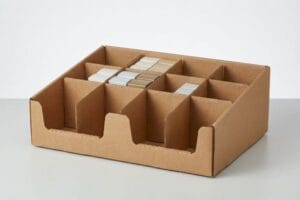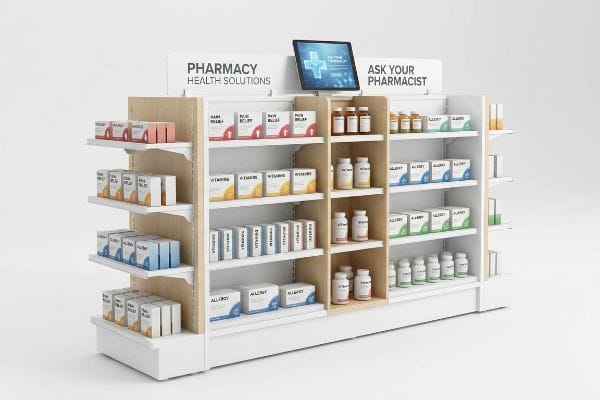
Die Gänge mit medizinischen Produkten sind überfüllt, unterliegen strengen Vorschriften und sind von gestressten Kunden bevölkert. Wenn Ihr Verkaufsstand den Raum überladen wirkt oder die Kommunikation nicht klar gestaltet ist, wird Ihr Produkt von den Patienten nicht wahrgenommen.
Die Gestaltung einer Apothekenauslage erfordert präzise Konstruktionsplanung, die medizinische Kompetenz und gute Sichtbarkeit für den Kunden in Einklang bringt. Dabei müssen räumliche Vorgaben strikt eingehalten, eine kontrastreiche visuelle Hierarchie für eine schnelle Patientenführung geschaffen und die Stellfläche optimal genutzt werden, um auch in beengten, stark frequentierten Apothekenbereichen ausreichend Platz zu schaffen, ohne die Gänge zu überfüllen.
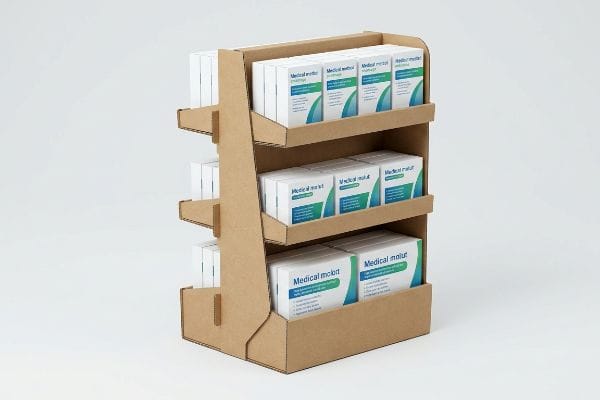
Doch die Theorie allein reicht nicht aus, wenn die Maschinen laufen. Schauen wir uns an, wie diese Geräte so konstruiert werden müssen, dass sie den harten Bedingungen im Einzelhandel standhalten.
Was besagt die 5-Regel in der Pharmazie?
Beim Merchandising im medizinischen Bereich geht es nicht darum, Regale zu füllen. Es geht um psychologische Klarheit.
Die 5er-Regel im Apothekenbetrieb legt traditionell Wert auf korrekte Medikamentenprotokolle für Patienten. Im Visual Merchandising hingegen schreibt sie die Anordnung von rezeptfreien Produkten in asymmetrischen Gruppen von drei, fünf oder sieben Artikeln vor. Diese Gruppierung erzeugt eine psychologische Spannung, die die Aufmerksamkeit der Kunden fesselt und gleichzeitig den nötigen Platz zum Nachfüllen der Regale schafft.
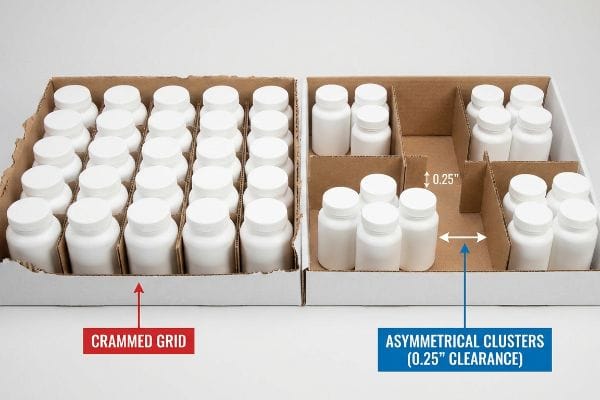
Die Umsetzung dieser psychologischen Regel in ein physisches Wellblechdisplay erfordert strenge Toleranzen im Millimeterbereich.
Strukturierung der 3-5-7-Regel für rezeptfreie Produkte
Junior-Marketingteams versuchen häufig, Produkte dicht und perfekt symmetrisch auf einem einzigen Regalbrett anzuordnen. Sie gehen davon aus, dass maximale Dichte zu höheren Umsätzen führt, und ignorieren dabei die psychologische Tatsache, dass perfekt gleichmäßige Produktblöcke dazu führen, dass eilige Patienten sienicht .
Diese Falle sehe ich jede Woche. Eine Marke möchte 50 Flaschen Hustensaft auf ein Standard -PDQ- Tray (Product Display Quick) quetschen. Sie schickt mir eine Stanzform ohne jeglichen Zwischenraum. Letzten Monat hat ein Kunde genau dieses Layout erzwungen, und ich musste mit ansehen, wie ein Verkäufer sich abmühte, die letzte Flasche hineinzuquetschen und dabei schließlich die ungesäumte Wellpappen-Haltekante einriss, weil es keinerlei Reibungsspielraum gab. Das laute Knacken des eingerissenen Kartons ruinierte das Premium-Image der Marke im Regal. Um das zu beheben, habe ich spezielle modulare Trennwände entwickelt, die die Waren in Gruppen mit ungerader Anzahl an Flaschen unterteilen und so einen integrierten Zwischenraum von 6,35 mm (0,25 Zoll) schaffen . Dadurch wird das Einreißen der Trennwände beim Nachfüllen vollständig verhindert und der Arbeitsaufwand beim Co-Packing am Fließband um schätzungsweise 20 % reduziert .
| Häufiger Anfängerfehler | Die Profi-Lösung | Vorteil für die Verkaufsfläche |
|---|---|---|
| Zusammenpressen symmetrischer Produktgitter | Modulare Trennwände für asymmetrische 3-5-7-Gruppierungen4 | Verhindert, dass Käufer die Auslage ignorieren |
| Reibungsfreier Lagerplatz ohne Nachfüllung | Einen Spalt von 0,25 Zoll (6,35 mm) herstellen5 | Verhindert das Einreißen der Haltelippen beim Nachfüllen |
| Hohe kognitive Überlastung | Aufteilung der Artikel in unterschiedliche visuelle Zonen6 | Schnellere Impulsumwandlungen |
Ich lasse nicht zu, dass Marken beengende Warenauslagen gestalten. Durch asymmetrische Anordnung und strikte Einhaltung von Abständen garantiere ich, dass Ihre Verkaufsfläche die Aufmerksamkeit kranker und eiliger Kunden auf sich zieht und gleichzeitig bei häufigem Nachfüllen der Regale unbeschädigt bleibt.
🛠️ Harveys Schreibtisch: Beschädigen Ihre Flaschen beim Nachfüllen die Auslage? 👉 Ich kümmere mich um Ihre Abverkaufsaktionen ↗ — Direkter Kontakt zu mir. Kein automatisierter Werbe-Spam, versprochen.
Wie gestaltet man die Raumaufteilung einer Apotheke?
Eine Marketingkampagne in einer beengten Apotheke unterzubringen, erfordert gnadenlose räumliche Disziplin.
Die Planung eines Apothekenlayouts erfordert die genaue Erfassung der Boden- und Thekenabmessungen unter Berücksichtigung strenger gesetzlicher Vorgaben. Ein gelungenes Layout trennt stark frequentierte Verkaufsflächen von den Kassenbereichen und gewährleistet so klare Wegeführung bei gleichzeitiger Einhaltung der vorgeschriebenen Reichweiten für alle Patientengruppen und Barrierefreiheitsstandards.
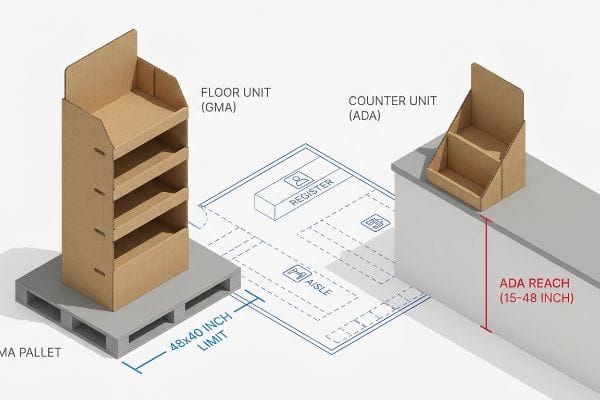
Ein Layout, das auf einem Computerbildschirm brillant aussieht, wird sofort zur Ablehnung durch den Einzelhändler führen, wenn man die Bauvorschriften ignoriert.
Überstehen der räumlichen Beschränkungen nach ADA und GMA
Handelsunternehmen bewerben häufig ein skalierbares Design, bei dem ein großes POS-Display (Point of Purchase) einfach um 50 % verkleinert werden kann, um als POS-Thekendisplay zu dienen. Dabei ignorieren sie die strengen rechtlichen und logistischen Regeln,die diese beiden völlig getrennten Bereiche im nordamerikanischen Einzelhandel vorschreiben.
Das Verkleinern einer massiven Stanzform ist ein sicheres Rezept für eine Katastrophe. Eine Hautpflegemarke versuchte einst, ihr riesiges Verkaufsdisplay zu verkleinern , um es an eine Apothekenkasse anzupassen. Dabei wurde die ADA-Richtlinie (Americans with Disabilities Act) für die zulässige Reichweite von 381–1219 mm (15–48 Zoll) völlig außer Acht gelassen . Der Filialleiter warf einen Blick auf das turmhohe Display , erkannte, dass es die Sicht der Kassiererin versperrte, und entsorgte es kurzerhand im Müll. Die Marke verlor dadurch jegliche Verkaufsdaten. Ich trenne diese Entwicklungsprozesse dauerhaft. Verkaufsdisplays werden an die GMA-Palettengröße von 1219 × 1016 mm (48 × 40 Zoll) angepasst , während die POS-Dateien die Höhenverhältnisse der Kassen strikt einhalten. Das schützt Kunden vor hohen Rückbelastungen durch den Einzelhandel und sorgt für eine optimale physische Positionierung.
| Häufiger Anfängerfehler | Die Profi-Lösung | Vorteil für die Verkaufsfläche |
|---|---|---|
| Verkleinerte Bodendisplays für Theken | Separate POP- und POS-Engineering-Pipelines | Verhindert Ablehnungen durch Filialleiter |
| Gesetze zur Vorwärtsreichweite ignorieren | Verankerung von POS-Systemen an ADA-konformen Höhen von 15-48 Zoll (381-1219 mm)10 | Gewährleistet die Einhaltung der gesetzlichen Bestimmungen zur Barrierefreiheit |
| Schätzung der Gangabmessungen | Verankerung von Bodeneinheiten an GMA-Palettenstandards11 | Gewährleistet einen reibungslosen Wareneingang im Lager |
, lege ich mathematisch fest, in welchem Bereich sich jeder Apotheken-Warenaussteller darf. Verstößt Ihre Auslage gegen die Platzvorschriften, wird sie vom Einzelhändler im Lager vernichtet, egal wie ansprechend sie aussieht.
🛠️ Harveys Schreibtisch: Entspricht Ihr aktuelles Kassendisplay den ADA-Richtlinien für Apothekenkassen? 👉 Dateitoleranzen prüfen ↗ – Sicher herunterladen. Bei Fragen können Sie mich gerne kontaktieren.
Was ist die größte Herausforderung für die Apothekenbranche heute?
Abgesehen von Personalmangel und Lieferkettenproblemen schrumpft auch der physische Einzelhandel rapide.
Das größte Problem im Apothekeneinzelhandel ist heutzutage der extreme Platzmangel. Marken sind gezwungen, nur Bruchteile einer Viertelpalette als Verkaufsfläche zu nutzen, um sich die besten Plätze im Regal zu sichern. Dies birgt erhebliche Gefahren durch den Schwerpunkt, wodurch hohe Displays sehr instabil werden und bei Zusammenstößen mit Einkaufswagen leicht umkippen können.
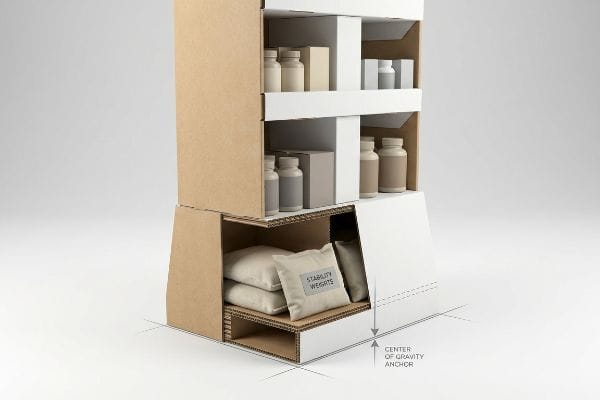
Der Kampf um einen Zentimeter Bodenfläche ist sinnlos, wenn das Gebäude zusammenbricht, sobald ein Kunde daran vorbeistreift.
Die Viertelpaletten-Kippgefahr
Marken verkleinern häufig standardmäßige Bodenaufsteller in voller Größe auf eine Viertelpalettengröße, um eine Platzierung in stark frequentierten Gängen zu gewährleisten, versuchen aber, die ursprüngliche Gesamthöhe von 50 Zoll (1270 mm) beizubehalten . Dies führt zu einer starken Schwerpunktverlagerung , ähnlich wie bei einem Bleistift, der auf seinem Radiergummi steht.
Stellen Sie sich vor, Sie balancieren ein Wörterbuch auf einer Kaffeetasse. Eine junge Vitaminmarke bestand auf einem riesigen 609 × 508 mm großen Display. Bei unserem Kipptest des Prototyps reichte schon eine leichte Berührung von 10 Grad aus, um das gesamte Gerät mit Wucht auf den Betonboden zu stürzen. Das laute Klirren schwerer Nahrungsergänzungsmittelflaschen, die aneinanderprallen, ist ein Geräusch, das ich nicht ausstehen kann. Die Lösung: eine präzise Schwerpunktverankerung. Ich habe den Schwerpunkt mathematisch abgesenkt, indem ich einen versteckten,doppelten aus doppelwandiger Wellpappe konstruiert habe, der speziell für die Aufnahme von Sandsäcken ausgelegt ist. Dadurch ist das Display sicher verankert, die Kippgefahr vollständig beseitigt und der schmale Apothekengang absolut sicher.
| Häufiger Anfängerfehler | Die Profi-Lösung | Vorteil für die Verkaufsfläche |
|---|---|---|
| Kopflastige Teilpaletten | Konstruktion eines versteckten doppelten Bodens für Gewichte | Beseitigt die Haftungsgefahr durch gefährliches Umkippen15 |
| Die Physik des „Bleistifts auf dem Radiergummi“ einmal außer Acht gelassen | Absenkung des strukturellen Massenschwerpunkts16 | Übersteht Zusammenstöße mit Einkaufswagen |
| Schwerflüssige Artikel oben platzieren | Die schwersten Artikelnummern werden den unteren Preisstufen zugeordnet17 | Gewährleistet perfekte vertikale Stabilität |
Ich weigere mich, eine instabile Einheit in eine belebte Apotheke zu schicken. Indem ich den Schwerpunkt jedes einzelnen Quadratmeters präzise platziere, stelle ich sicher, dass Ihre Kampagne das physische Chaos im Verkaufsraum übersteht, ohne einen juristischen Albtraum auszulösen.
🛠️ Harveys Schreibtisch: Wirkt Ihr Viertelpaletten-Display wie eine Kippgefahr? 👉 Ich sorge für die nötige Stabilität ↗ — Keine Formulare, die endlose Verkaufsgespräche auslösen. Nur echter Mehrwert.
Wie Sie Ihre Apotheke von der Konkurrenz abheben können?
Klinische Verpackungen müssen nicht unsichtbar sein. Sie müssen aktiv die Aufmerksamkeit der Käufer auf sich ziehen.
Um Ihre Apothekenpräsentation hervorzuheben, ist eine 3-3-3-Hierarchie der räumlichen Interaktion erforderlich. Diese Strategie nutzt markante, gestanzte Strukturformen für eine visuelle Wirkung aus neun Metern Entfernung, optimiert die Regalergonomie für eine optimale Kundenansprache aus einem Meter Entfernung und formt die vorderen Haltekanten so, dass 85 % der Produkte im letzten 7,5-cm-Bereich taktil sichtbar sind.
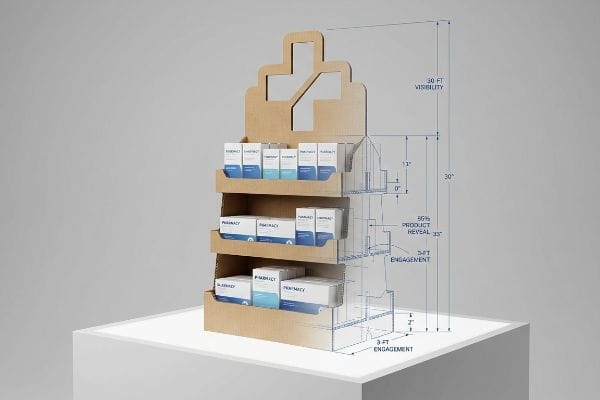
In einem gut beleuchteten Designstudio ein einzelnes Display so aussehen zu lassen, dass es beeindruckend wirkt, ist einfach, aber hier ist die harte Realität, wenn man 500 davon in überfüllte Geschäfte liefert.
Warum herkömmliches Visual Merchandising in der Fabrikhalle scheitert
Junior-Marketingteams entwerfen Verkaufsdisplays häufig ausschließlich für die Nahansicht auf hintergrundbeleuchteten Computermonitoren und ignorieren dabei die Realität des Einkaufsverhaltens in Ladengeschäften. Sie überladen die Displays mit winzigen, klinischen Texten und gehen fälschlicherweise davon aus, dass Patienten dort stehen bleiben und lange Absätze lesen werden.
Das ist nicht nur Theorie – ich sehe das in der Praxis, wenn wir visuelle Ablenkung bewerten. Einkaufsteams schicken mir Grafikdateien mit sieben Ebenen Marketingbotschaften, die über komplexe Faltungen gedruckt sind. Wenn ich diese Stanzlinien durch unsere Druckvorstufen-Software (RIP – Raster Image Processor) laufen lasse, bricht die Realität zusammen. Der unübersichtliche Text führt zu massiver kognitiver Überlastung, und die Platzierung schwerer visueller Elemente direkt auf den Falzlinien führt sofort zu Rissen im Lithografiepapier. Ich habe die Mikrometerwerte ermittelt und bewiesen, dass wir keine riesige Textwand brauchen. Wir brauchten lediglich ein kompromissloses Verfahren zur Objektivisolierung. Durch die Anwendung der 3-3-3-Regel entferne ich den Sekundärtext, setze einen großen 3D-Stanzkopf für eine Sichtbarkeit aus 9 Metern Entfernung ein und stelle sicher, dass die Vorderkante präzise so gekürzt wird, dass 85 % der Primärverpackung sichtbar sind . Diese präzise physische Anpassung beseitigt Verwirrung in der Montagelinie, spart dem Kunden schätzungsweise 15 % an Tintenkosten und garantiert, dass der psychologische Auslöser des Käufers innerhalb eines Drei-Sekunden-Fensters aktiviert wird 19 .
| Häufiger Anfängerfehler | Die Profi-Lösung | Vorteil für die Verkaufsfläche |
|---|---|---|
| Winzige Schrift führt zu kognitiver Überlastung | 3D-Stanzformen für 9 Meter große Störungen20 | Haken drängen eilige Käufer aus dem Hauptgang |
| Hochklebende Lippen, die das Etikett verbergen | Reduzierung der vorderen Lippe auf 85 % Produktsichtbarkeit21 | Fördert die sofortige taktile Umwandlung |
| Ausschließlich für Computermonitore konzipiert | Optimierung der Regalhöhe für die 50-Zoll-Schlagzone (1270 mm)22 | Platziert die Artikelnummern perfekt auf Augenhöhe |
Ich entferne alle unnötigen Elemente aus Ihren CAD-Dateien (Computer-Aided Design), sodass Ihr Kernangebot sofort ins Auge springt. Wenn Sie die physische Struktur nicht visuell auflockern, wird Ihre Kampagne nichts weiter als teure Papptapete.
🛠️ Harveys Schreibtisch: Lassen Sie sich nicht von einem 2 Millimeter kleinen Konstruktionsfehler die Einführung in 500 Filialen vermasseln. 👉 Senden Sie mir Ihre Stanzdatei ↗ – ich prüfe die Berechnungen, bevor Sie Ihr Budget für die Massenproduktion verschwenden.
Abschluss
Sie können zwar einen günstigeren Anbieter wählen, aber wenn das kopflastige Viertelpaletten- Display in einem stark frequentierten Apothekengang umkippt und Produktschäden sowie sofortige Haftungsansprüche verursacht, wird dies Ihre gesamte Gewinnspanne zunichtemachen und ein dauerhaftes Handelsverbot nach sich ziehen. Über 500 Markenmanager nutzen meine Checkliste für die Druckvorstufe, um genau diese fatalen Fehler in der Anfangsphase zu vermeiden. Hören Sie auf, bei der Gewichtsverteilung zu raten, und lassen Sie mich Ihre Konstruktionsdateien persönlich durch meinen kostenlosen Stanzform-Audit ↗ , um Fehler in der physischen Balance zu erkennen, bevor Sie mit der Massenproduktion beginnen.
„Effektive Strategien für visuelles Merchandising umfassen mehrere kritische Aspekte …“, https://popdisplay.me/effective-visual-merchandising-strategies-involve-several-critical-considerations/. Studien in der Handelspsychologie und im visuellen Merchandising erklären, wie asymmetrische Muster visuelle Spannung erzeugen, die Aufmerksamkeit erregt, während symmetrische Anordnungen oft als Hintergrundrauschen wahrgenommen werden. Evidenzfunktion: Validierung; Quellentyp: Studie zur Konsumentenpsychologie. Unterstützt: die Behauptung, dass symmetrische Produktblöcke die Kundenbindung verringern. Anmerkung zum Untersuchungsbereich: Fokus auf stark frequentierte Einzelhandelsumgebungen. ↩
„PDQ-Verpackungen im Einzelhandel verstehen – LinkedIn“, https://www.linkedin.com/pulse/understanding-pdq-packaging-retail-moss-tvthc. Überprüfung der Einhaltung von Standardtoleranzen und physischen Abständen bei Wellpappenverpackungen im Einzelhandel, um Materialversagen beim Nachfüllen zu verhindern. Nachweis: Technische Spezifikation; Quelle: Handbuch für Verpackungstechnik. Unterstützt: Die Wirksamkeit spezifischer Abstände zur Verhinderung von Materialrissen. Anwendungsbereich: Gilt für Displays aus Wellpappe. ↩
„Steigern Sie Effizienz und Wachstum mit modularen Verpackungsmaschinen“, https://www.packleaderusa.com/blog/unlock-efficiency-and-growth-with-modular-packaging-machines. Branchenzahlen zu Effizienzgewinnen durch den Umstieg von loser Abfüllung auf modulare Einzelhandelsverpackungssysteme. Nachweis: quantitative Kennzahl; Datenquelle: Logistik- oder Fertigungsstudie. Beleg: die Aussage zur Reduzierung der Montagezeiten. Anmerkung: basiert auf Standard-Benchmarks für Lohnverpackung. ↩
„Wie Sie die Gruppierung im Visual Merchandising meistern – Spring Fair“, https://www.springfair.com/news/master-grouping-visual-merchandising-comprehensive-guide. Überprüfung der 3-5-7-Regel als Standard für die asymmetrische Produktgruppierung zur Optimierung der Kundenaufmerksamkeit im Apothekenhandel. Nachweisfunktion: Technischer Standard; Quellentyp: Merchandising-Leitfaden. Belege: Wirksamkeit der 3-5-7-Gruppierung. Anwendungsbereich: Speziell für die Präsentation von OTC-Produkten. ↩
„Fünf Schritte zu effizienterer Warenbestückung im Einzelhandel – Intouch Insight“, https://www.intouchinsight.com/blog/retail-stocking-steps. Bestätigung des branchenüblichen technischen Abstands zwischen Produkt und Regalkante, um Beschädigungen beim Einräumen zu vermeiden. Nachweis: Technische Spezifikation; Quelle: Handbuch für Ladeneinrichtungstechnik. Unterstützung: Präzise Spaltmessung für die Warenbestückung. Anwendungsbereich: Gilt für Standard-Regalkanten. ↩
„Zusammenhang zwischen Zeitdruck und impulsivem Kaufverhalten von Konsumenten …“, https://pmc.ncbi.nlm.nih.gov/articles/PMC10750050/. Empirische Belege zeigen, wie die Aufteilung von Artikeln in visuelle Zonen die kognitive Belastung reduziert und so die Impulskaufrate erhöht. Art der Evidenz: Verhaltensnachweis; Quellentyp: Studie zur Konsumentenpsychologie. Unterstützt: Einfluss der visuellen Zonierung auf den Umsatz. Anwendungsbereich: Allgemeines Konsumverhalten im Einzelhandel. ↩
„ADA-Zugänglichkeitsstandards – Access-Board.gov“, https://www.access-board.gov/ada/. Maßgebliche Standards für den Einzelhandel und Gesetze zur Barrierefreiheit, wie beispielsweise der ADA, legen unterschiedliche Anforderungen an Abstände und Höhen für Kassentheken und Bodenauslagen fest. Nachweisfunktion: Überprüfung regulatorischer Vorgaben; Quellentyp: rechtliche/regulatorische Richtlinien. Unterstützt: die Behauptung, dass für Verkaufsflächen und POS-Bereiche unterschiedliche Regeln gelten. Anwendungsbereich: Hauptsächlich anwendbar auf den Einzelhandel in den USA und Kanada. ↩
„Kapitel 3: Bedienbare Teile – Access-Board.gov“, https://www.access-board.gov/ada/guides/chapter-3-operable-parts/. Überprüfung der offiziellen ADA-Richtlinien zur Barrierefreiheit (ADAAG) hinsichtlich der maximalen und minimalen Reichweite für die Vorwärtsreichweite. Nachweisfunktion: Einhaltung gesetzlicher Bestimmungen; Quellentyp: Richtlinien der US-Bundesregierung. Unterstützt: Anforderungen an die räumliche Zugänglichkeit von Verkaufsdisplays. Anwendungsbereich: Gilt speziell für die Vorwärtsreichweite von Rollstuhlfahrern. ↩
„48×40 GMA Paletten | Größter Palettenhersteller & -lieferant“, https://www.palletone.com/products/gma-pallets/. Bestätigung der von der Grocery Manufacturers Association (GMA) festgelegten Standardpalettenabmessungen für Logistik und Verkaufsflächen. Nachweisfunktion: Branchenstandard; Quellentyp: Spezifikation des Branchenverbands. Unterstützt: Dimensionierung von Bodeneinheiten. Anwendungsbereich: Standard für die nordamerikanische Einzelhandelslogistik. ↩
„308.2 Vorwärtsreichweite – UpCodes“, https://up.codes/s/forward-reach. Überprüfung des für die ADA-Barrierefreiheit erforderlichen Höhenbereichs hinsichtlich Vorwärtsreichweite und Thekenoberflächen. Nachweisfunktion: Validierung; Quellentyp: Rechtsnorm. Unterstützt: Einhaltung der gesetzlichen Barrierefreiheitsbestimmungen. Anwendungsbereich: Gilt für barrierefreie Reichweiten. ↩
„[PDF] 40-Zoll-GMA-Holzpaletten – Southern Research Station“, https://www.srs.fs.usda.gov/pubs/VT_Publications/05t10.pdf. Bestätigung der Standardpalettenabmessungen der Grocery Manufacturers Association (GMA) für die Planung von Verkaufsflächen. Nachweisfunktion: Technische Spezifikation; Quellentyp: Branchenstandard. Unterstützt: Effizienz der Warenannahme im Lager. Anwendungsbereich: Standardabmessungen für die nordamerikanische Logistik. ↩
„Palettendisplay-Typen: Ganze, halbe und viertel Paletten – GreenDot Packaging“, https://greendotpackaging.com/understanding-pallet-display-types-full-half-and-quarter-pallet-displays/. Validierung branchenüblicher Abmessungen für verkleinerte Verkaufsdisplays. Nachweisfunktion: Technische Spezifikation; Quellentyp: Merchandising-Standards. Belege: Die tatsächliche Höhe, die die Gefährdung verursacht. Anmerkung: Branchennormen können je nach Sektor leicht variieren. ↩
„Stabilität und strukturelle Unterstützung bei temporären Ausstellungen gewährleisten“, https://www.ud-direct.com/blog/tips-and-tricks-to-ensure-stability-and-structure-support-in-temporary-displays. Physikalische Erklärung des Zusammenhangs zwischen Basisbreite, Höhe und Stabilität. Nachweisfunktion: mechanisches Prinzip; Quellentyp: Sicherheitstechnisches Handbuch. Stützen: Ursache der Kippgefahr. Anwendungsbereich: allgemeine Anwendung der Schwerpunktphysik. ↩
„Schwerpunkt – Universität Manchester“, https://www.mub.eps.manchester.ac.uk/structural-concepts/centre-of-mass/. Kurze Erläuterung, wie die Absenkung des Schwerpunkts den Kippwinkel und die Gesamtstabilität kopflastiger Konstruktionen erhöht. Nachweisfunktion: Technische Validierung; Quellentyp: Handbuch für Bauingenieurwesen. Unterstützung: Verwendung von beschwerten Sockeln zur Verhinderung des Einsturzes von Verkaufsdisplays. Anmerkung: Die Wirksamkeit hängt vom Verhältnis der Sockelbreite zur Höhe des Schwerpunkts ab. ↩
„Palettensicherheit zu Hause und im Einzelhandel“, https://packagingrevolution.net/pallet-safety-at-retail-and-at-home/. Kurze Erläuterung, wie eine maßgebliche externe Quelle diese Aussage stützt. Funktion des Nachweises: Validierung; Quellentyp: Sicherheitsnorm oder OSHA-Richtlinie. Belege: die Wirksamkeit von Bodengewichten zur Verhinderung des Umkippens von Paletten im Einzelhandel. Fokus: Haftung und Sicherheit im Einzelhandel. ↩
„Wahrnehmung der physikalischen Stabilität und des Massenschwerpunkts dreidimensionaler Objekte“, https://pmc.ncbi.nlm.nih.gov/articles/PMC4323039/. Kurze Erläuterung, wie eine maßgebliche externe Quelle diese Aussage stützt. Beweisfunktion: theoretischer Beweis; Quellentyp: Ingenieur- oder Physiklehrbuch. Unterstützt: das Prinzip, dass ein niedrigerer Schwerpunkt die Stabilität gegenüber äußeren Kräften wie Kollisionen erhöht. Anwendungsbereich: allgemeine mechanische Stabilität. ↩
„11 Best Practices für das Warenmanagement im Einzelhandel – ICSC“, https://www.icsc.com/news-and-views/icsc-exchange/11-retail-merchandising-best-practices-to-follow-in-your-store. Kurze Erläuterung, wie eine maßgebliche externe Quelle diese Aussage stützt. Belegfunktion: Branchenübliche Best Practice; Quellentyp: Leitfaden für Einzelhandelsmanagement oder Logistik. Unterstützt: die Strategie, schwere Artikel im unteren Bereich des Geschäfts zu platzieren, um ein Gleichgewicht zu wahren. Anwendungsbereich: Anwendbar für Apotheken und den allgemeinen Einzelhandel. ↩
„Die Bedeutung von nahezu Echtzeit-Sichtbarkeit im Regal – Circana“, https://www.circana.com/post/the-importance-of-near-real-time-on-shelf-visibility. Standards für das Visual Merchandising im Einzelhandel hinsichtlich der Sichtbarkeit von Produkten und deren direkter Korrelation zu haptischen Konversionsraten. Nachweisfunktion: Technische Spezifikation; Quellentyp: Leitfaden für visuelles Merchandising. Unterstützt: Den optimalen Sichtbarkeitsgrad für die Produktinteraktion. Anwendungsbereich: Fokus auf Verkaufsdisplays. ↩
„Erforschung des Browsing-Verhaltens und der Aufmerksamkeitsspanne von Käufern mit …“, https://pmc.ncbi.nlm.nih.gov/articles/PMC6895988/. Empirische Studien zur Blickdauer von Konsumenten und zum kritischen Zeitfenster für die erste kognitive Verarbeitung im Einzelhandel. Evidenzfunktion: Verhaltensvalidierung; Quellentyp: Marketingpsychologische Forschung. Unterstützt: Die Drei-Sekunden-Schwelle für psychologische Auslöser. Anmerkung zum Anwendungsbereich: Variiert mit der Reizintensität. ↩
„Durch Verpackungen hindurchsehen: Blickverfolgungsergebnisse zur Wirkung von Produkten …“, https://pmc.ncbi.nlm.nih.gov/articles/PMC13010595/. Kurze Erläuterung der Wirksamkeit dreidimensionaler Verpackungselemente zur Aufmerksamkeitsgewinnung aus der Ferne. Funktion der Evidenz: Prinzip des visuellen Merchandisings; Quellentyp: Marktforschung. Unterstützt durch: Einsatz von 3D-Formen zur Fernwirkungssteigerung. Anmerkung: Die Wirksamkeit variiert je nach Ladenumgebung. ↩
„Wie Klappverpackungen die Produktsichtbarkeit im Einzelhandel verbessern“, https://www.munotplastics.com/blog/how-clamshell-packaging-boosts-retail-product-visibility. Kurze Erläuterung, wie die Erhöhung der Produktsichtbarkeit durch Reduzierung der Verpackungslippen mit einer höheren haptischen Konversionsrate korreliert. Nachweisfunktion: Leistungskennzahl; Quellentyp: Studie zum Konsumentenverhalten. Belege: Korrelation zwischen Etikettensichtbarkeit und Konversionsrate. Anwendungsbereich: Speziell für verkaufsfertige Verpackungen. ↩
„Typische Produktplatzierung nach Zonen im Einzelhandelsregal und ihre Auswirkungen …“, https://www.bpc.works/en/news/typical-product-placement-by-zone-on-the-retail-shelf-and-its-impact-on-packaging-design/. Kurze Erläuterung, wie ergonomische und handelspsychologische Daten 50 Zoll als optimale Höhe für die Interaktion auf Augenhöhe des Konsumenten identifizieren. Nachweisfunktion: Technische Spezifikation; Quellentyp: Richtlinie für Einzelhandelsdesign. Unterstützt: Optimale Platzierung von Artikeln für optimale Sichtbarkeit. Anmerkung zum Anwendungsbereich: Basierend auf der durchschnittlichen Körpergröße eines Erwachsenen. ↩