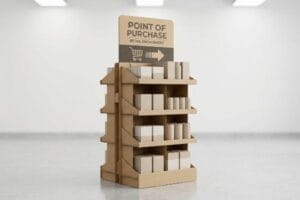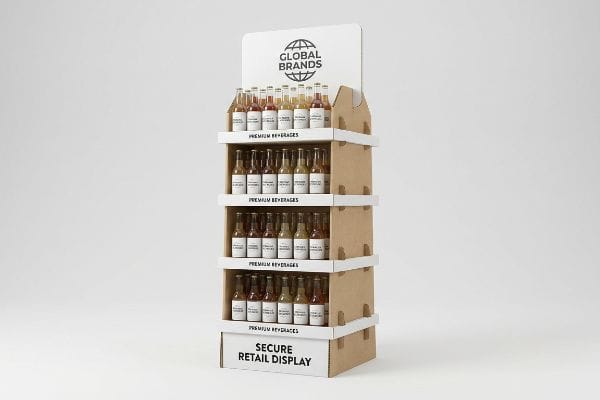
You secured the retail floor space, but if your physical presentation falls flat, shoppers walk right past. Retail success demands much more than just a pretty printed box.
A functional point of purchase display physically disrupts retail environments to drive immediate consumer engagement. These specialized merchandising structures blend precise structural engineering with targeted brand communication, effectively guiding store traffic while securely managing heavy product inventory across various competitive global supply chain ecosystems.
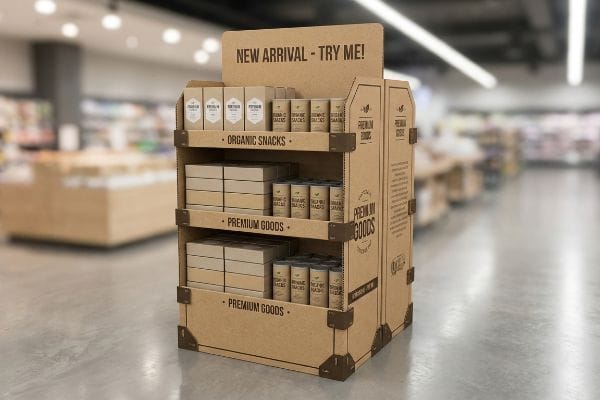
Understanding the physical mechanics of these units is the only way to protect your marketing investment and avoid disastrous logistics failures.
What Should Effective Point of Purchase Displays Do?
Your structure must do more than simply hold stock; it must actively command the aisle. If it fails to pull foot traffic, your retail placement becomes an expensive warehouse shelf.
Effective point of purchase displays actively capture consumer attention, organize merchandise, and drive impulse sales in retail environments. By leveraging strategic structural engineering and high-contrast branding, these fixtures break visual monotony in store aisles, directly guiding shoppers from initial product discovery to the final transactional decision.
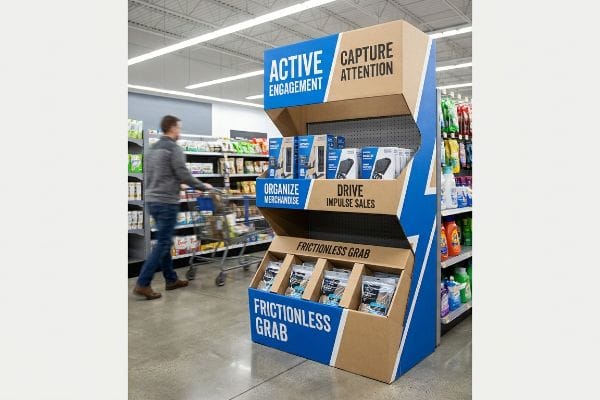
To achieve this level of engagement, the physical dimensions must cater to human behavior rather than just product volume.
Mastering the 3-3-3 Spatial Engagement Rule for Effective Displays
Many marketing teams assume that a graphic layout designed on a flat computer monitor will naturally translate to the physical store. They focus entirely on up-close details, ignoring how shoppers actually navigate long, cluttered commercial aisles.
I constantly see brands approve layouts that completely disappear under harsh fluorescent lights. When I walk the testing aisle, the lack of visual tension is glaring; I watch rushed shoppers push their carts right past the merchandise without a second glance. To fix this, I strictly enforce the 3-3-3 rule1, engineering aggressive CAD (Computer-Aided Design) die-cuts that grab attention from thirty feet (9.14 m), present clear branding at three feet (0.91 m), and offer a frictionless grab at three inches (76.2 mm). This spatial math actively pulls the customer in, preventing the unit from becoming invisible background noise and driving a measurable lift in physical interactions2.
| Common Rookie Mistake | The Pro Fix | Retail-Floor Benefit |
|---|---|---|
| Designing strictly for laptops | Applying the 3-3-3 spatial rule | Captures 30-foot aisle traffic3 |
| Using perfectly flat, symmetrical boxes | Engineering 3D structural die-cuts | Breaks visual shopper fatigue |
| Hiding text behind product barriers | Optimizing the 3-inch tactile zone4 | Increases impulse grab rates |
I refuse to let brands blend into the background. By organizing the physical structure around distinct viewing distances, I ensure your campaign consistently breaks visual monotony and actively triggers impulse engagement.
🛠️ Harvey's Desk: Not sure if your graphics will actually pop from down the aisle? 👉 Drop Your File Here ↗ — Direct access to my desk. Zero automated sales spam, I promise.
What Are the Key Features of a Good Display?
A stunning visual design means absolutely nothing if the physical mechanics frustrate the people handling it on the floor. Every structural millimeter must serve the presentation.
The key features of a highly effective display include robust structural stability, high product visibility, and frictionless assembly. Premium retail merchandisers integrate durable materials with smart load distribution mechanisms, ensuring the physical unit withstands heavy consumer traffic while maintaining perfect brand presentation throughout its entire lifecycle.

One of the most critical structural choices involves how the customer physically accesses the product from the shelf.
Enforcing the 85% Visibility Rule for Key Features
Even veteran designers often draft front retaining lips that wrap too high around the merchandise, prioritizing structural safety over visual marketing. They build deep cardboard trays specifically to prevent heavy items from falling out during transit operations5.
I frequently watch store clerks struggle to pull heavy shampoo bottles over front lips that are engineered far too high. The loud tearing sound of the raw corrugated paperboard instantly turns a premium brand presentation into a messy liability. I immediately cut the front profile down in the digital files to ensure a strict 85% product visibility threshold6. This precise engineering adjustment completely eliminates physical friction during restocking, drastically cutting down labor time and guaranteeing shoppers can instantly read the primary labels without obstruction.
| Common Rookie Mistake | The Pro Fix | Retail-Floor Benefit |
|---|---|---|
| Engineering overly tall retaining lips | Implementing the 85% visibility rule | Exposes primary brand labels |
| Forcing tight product nesting | Adding a 0.25 inches (6.35 mm) clearance | Eliminates paperboard tearing |
| Prioritizing transit over shopping | Lowering the frontal access barrier | Speeds up daily restocking |
I prioritize product access over bloated packaging structures. By lowering the retention barriers, I guarantee your merchandise remains the focal point, removing the daily restocking friction that causes store managers to discard the unit.
🛠️ Harvey's Desk: Are your retaining lips accidentally hiding your primary packaging claims? 👉 Get a Visibility Check ↗ — Download safely. My inbox is open if you have questions later.
What Are the 5 P's in Retail?
You cannot launch a successful physical campaign without mastering the fundamental business mechanics of the space. Every structure must answer to strict commercial logic.
The 5 P's in retail represent product, price, place, promotion, and people. This foundational commercial framework dictates how merchandise is physically positioned and marketed within global supply chains. Mastering these core principles ensures brand campaigns seamlessly integrate into store ecosystems, maximizing both floor logistics and point-of-purchase profitability.
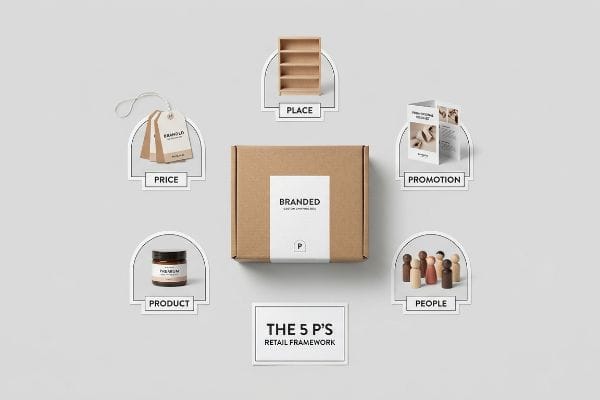
Applying this framework directly prevents you from shipping inappropriate physical structures to highly regulated store formats.
Aligning Your Merchandiser with the 5 P's Framework
Procurement teams sometimes try to force a one-size-fits-all structural campaign into wildly different retail environments. They bypass the foundational business matrix, expecting a big-box pallet design to seamlessly transition into a neighborhood pharmacy.
I see this misalignment constantly when a heavy end-cap unit is forced into an incompatible retail space. During a recent pilot run, a clerk tried to wedge a massive corrugated base into a narrow convenience store aisle, and I could hear the heavy cardboard aggressively scraping against the linoleum floor. I had to completely redesign the base architecture to map directly against the correct "place" and "quantity" constraints. By aligning the physical footprint to the retailer's specific operational model, I prevented the store manager from rejecting the shipment at the receiving dock, saving the client massive reverse logistics fees.
| Common Rookie Mistake | The Pro Fix | Retail-Floor Benefit |
|---|---|---|
| Using one universal CAD file | Mapping designs to specific store types | Stops receiving dock rejections |
| Ignoring spatial aisle limits | Adapting to local floor logistics | Prevents aisle blockage hazards |
| Overloading small format stores | Optimizing the physical quantity metric | Lowers reverse shipping fees |
I build structures that respect the retail ecosystem. By mapping your physical packaging directly to the operational demands of the destination, I eliminate logistical roadblocks before the first sheet of paper is ever printed.
🛠️ Harvey's Desk: Is your current footprint legally compliant with your target retailer's floor limits? 👉 Request a Spatial Audit ↗ — No forms that trigger endless sales calls. Just pure value.
What Is an Example of a Point of Purchase Display?
Theory works perfectly in a pristine digital environment. But physical reality on a high-speed assembly line rapidly exposes every hidden flaw in a structural design.
An example of a functional point of purchase display is a freestanding corrugated floor unit positioned near high-traffic aisle intersections. Other common formats include modular pallet configurations, interactive end-caps, and compact checkout trays, all specifically engineered to disrupt shopper navigation and securely hold heavy retail merchandise.
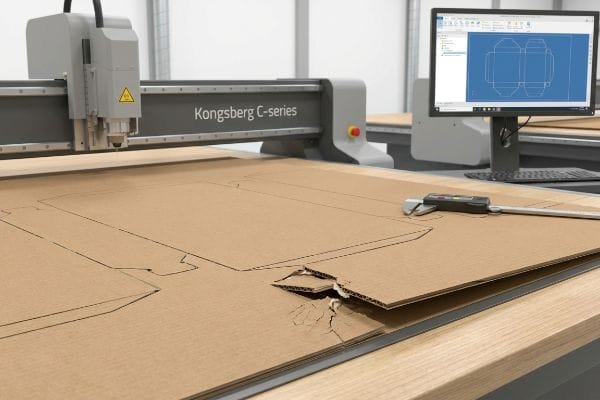
But knowing the basic formats is not enough when the heavy manufacturing machines actually start running your files.
Why Shrinking a Floor Unit Fails on the Factory Floor
It is a common trap that catches even experienced procurement teams: they take an approved, heavy-duty floor structure and mathematically scale the dieline down by 50%7 to use as a checkout unit. They assume the digital geometry is universally applicable regardless of the material.
In my facility, I routinely intercept these shrunken files just before they hit the Kongsberg C-series CNC (Computer Numerical Control) cutting table. When you force a 0.12 inches (3 mm) thick B-flute board into tight micro-tabs, the dense flutes cannot bend cleanly, and I hear the sharp snap of the top paper liner breaking under the physical stress. I strip out this bloated over-engineering and immediately pivot the material to a precise E-flute, completely rebuilding the lock clearances. By enforcing this 2.4 mm (0.09 inches) tolerance shift, I ensure the co-packing assembly time drops by 45 seconds per unit, preventing a massive labor cost penalty and stopping ugly clear tape from ruining the brand presentation.
| Common Rookie Mistake | The Pro Fix | Retail-Floor Benefit |
|---|---|---|
| Scaling down heavy B-flute files | Pivoting to lightweight E-flute | Stops the paper liner from snapping |
| Ignoring material thickness limits | Rebuilding fold clearances mathematically | Eliminates the need for messy tape |
| Using standard floor geometry | Redesigning specific micro-locks | Reduces co-packing time |
I trust empirical factory data, not theoretical digital scaling. Stripping out the inappropriate material grades and recalculating the physical fold allowances guarantees a frictionless rollout, protecting both your structural integrity and your financial margins.
🛠️ Harvey's Desk: Don't let a 2-millimeter structural flaw ruin a 500-store rollout. 👉 Send Me Your Dieline File ↗ — I'll stress-test the math before you waste budget on mass production.
Conclusion
You can try to cheat physics by mathematically shrinking a heavy floor unit to fit a checkout counter, but when those thick flutes inevitably snap and slow down the co-packing assembly line by an estimated 30%, your campaign margins evaporate. Over 500 brand managers use my prepress checklist to avoid these exact fatal early-stage mistakes. Stop guessing on strict structural tolerances and let me personally test your structural math through my Free Dieline Audit ↗ before you waste thousands on ruined mass production.
"Point of Purchase: How Retailers Can Influence Shoppers at the …", https://blog.intouch.com/posts/points-of-purchase-displays. An authoritative source on retail design or visual merchandising should verify the existence and definition of the 3-3-3 spatial rule for consumer engagement. Evidence role: technical definition; source type: industry standard/textbook. Supports: the methodology of spatial engineering for POP displays. Scope note: may be a proprietary or industry-specific heuristic. ↩
"THE IMPACT OF RETAIL POP DISPLAYS ON CONSUMER …", https://www.bcipkg.com/point-of-purchase-insights-the-impact-of-retail-pop-displays-on-consumer-behavior/. Empirical retail studies or marketing white papers should demonstrate the correlation between strategic structural engineering (like the 3-3-3 rule) and increased physical interaction rates. Evidence role: quantitative validation; source type: academic study/market research. Supports: the claim that spatial math leads to measurable lift. Scope note: results may vary by product category. ↩
"Retail premises design for effective displays and customer flow", https://www.business.qld.gov.au/industries/manufacturing-retail/retail-wholesale/retail-displays. Authoritative retail design data confirms the distance at which large-scale visual cues attract shoppers from the aisle. Evidence role: validation of metric; source type: industry study. Supports: the effectiveness of long-range attraction. Scope note: specific to open-floor retail environments. ↩
"Relationship between time pressure and consumers … – PMC", https://pmc.ncbi.nlm.nih.gov/articles/PMC10750050/. Consumer psychology research on the physical reach and 'touch'distance that triggers impulse buying behavior. Evidence role: technical specification; source type: behavioral study. Supports: the correlation between tactile accessibility and grab rates. Scope note: applies to point-of-purchase interaction. ↩
"Retail Packaging Testing for Big-Box Compliance – Intertek", https://www.intertek.com/performance-testing/packaging/retail-compliance/. Technical guidelines on packaging engineering and transit safety ensure that structural barriers prevent product displacement during shipping. Evidence role: technical validation; source type: industry standard. Supports: the purpose of deep trays in retail logistics. Scope note: focuses on logistics and safety metrics. ↩
"AG 1091A: Retail Merchandise Displays in the Frontage Zone", https://www.seattle.gov/transportation/permits-and-services/permits/applicant-guides/ag-1091a. Explanation of industry standards for product visibility thresholds in retail merchandising to optimize consumer accessibility and restocking efficiency. Evidence role: technical specification; source type: retail design manual. Supports: The efficacy of the 85% visibility metric. Scope note: May vary by product category. ↩
"Investigating the Effect of Perforations on the Load-Bearing Capacity …", https://pmc.ncbi.nlm.nih.gov/articles/PMC11396172/. Technical explanation of why proportional scaling of structural dielines fails due to changes in material thickness and load-bearing physics. Evidence role: technical validation; source type: packaging engineering guide. Supports: the failure of mathematical scaling in physical prototypes. Scope note: specific to corrugated materials. ↩