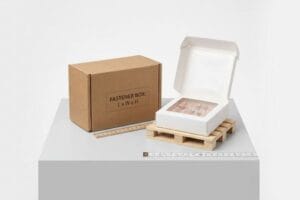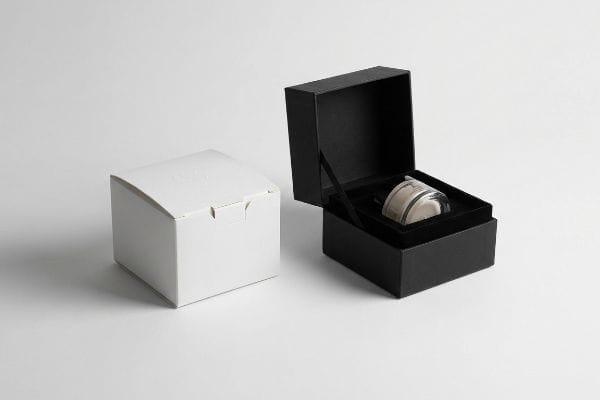
Launching a premium cosmetics line means navigating a maze of packaging terminology. Before you finalize your retail strategy, you need to know exactly what structural formats buyers expect.
A cosmetic box is called a folding carton or rigid setup box depending on its construction. These primary and secondary retail structures protect fragile beauty items while providing high-contrast printable surfaces. Industry standards demand specific tolerances to survive transit while maintaining luxury aesthetics under harsh store lighting.

Understanding the basic definitions is easy, but translating those concepts into physical retail displays that survive supply chain friction is where the real work begins.
What Is a Cosmetic Case Called?
A cosmetic case usually implies a more durable, multi-item container, often serving as a promotional VIP kit or a rigid point-of-purchase shelf tray.
A cosmetic case is called a rigid merchandising tray, PR (Public Relations) mailer, or promotional kit box. These heavy-duty structures are engineered to hold multiple heavy SKUs (Stock Keeping Units) like glass foundation bottles securely in place while presenting a premium tactile experience for high-end retail environments.
Achieving that high-end look on a physical shelf involves more than just picking a nice color on your screen.
The Color Shift Trap on Premium Cosmetic Cases
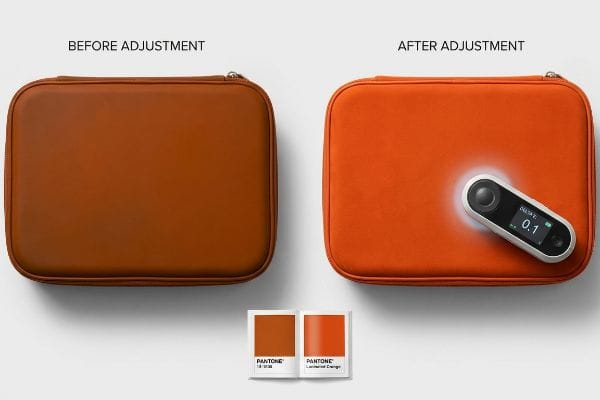
Even experienced marketing teams often assume that applying a premium soft-touch thermal lamination1 to a cosmetic case will leave their brand colors visually untouched. They approve the digital artwork on backlit monitors2 and push the files straight to the factory, expecting the physical output to perfectly match their Pantone swatch books.
I see this rookie mistake ruin product launches constantly. The microscopic polymer structure of soft-touch film acts like a vacuum, absorbing ambient retail light and darkening your printed pigments by up to 5%3. If you don't adjust the prepress RIP software before printing, your vibrant brand orange physically darkens to a muddy brown the second it hits the fluorescent store lighting. I run a physical spectrophotometer scan of an actual laminated draw-down to mathematically boost the ink density underneath, ensuring that rich, velvety feel doesn't trigger a massive retailer rejection due to brand inconsistency.
| Common Rookie Mistake | The Pro Fix | Retail-Floor Benefit |
|---|---|---|
| Ignoring film darkening | Prepress ink density boost4 | Guarantees exact brand color |
| Trusting screen proofs | Spectrophotometer physical scans5 | Prevents retailer rejection |
| Standard CMYK builds | Lamination compensation curves6 | Keeps premium feel intact |
I refuse to let bad prepress math destroy your brand equity. A quick digital file adjustment up front prevents a total aesthetic failure when your cases finally hit the physical aisles.
🛠️ Harvey's Desk: Are your cosmetic case files properly adjusted for lamination darkening? 👉 Request a Free Dieline Audit ↗ — Direct access to my desk. Zero automated sales spam, I promise.
What Are Makeup Containers Called?
Primary makeup containers require secondary merchandising trays that can handle dense, concentrated payloads without collapsing on the checkout counter.
Makeup containers are called primary packaging components, including jars, compacts, tubes, and palettes. When these items transition to the retail floor, they are housed in secondary corrugated PDQ (Product Display Quick) trays engineered to securely anchor their high-density weight profiles and prevent theft.
Securing heavy glass containers in a cardboard display introduces a severe conflict between premium aesthetics and structural physics.
Balancing Tactile Branding with Heavy Makeup Containers
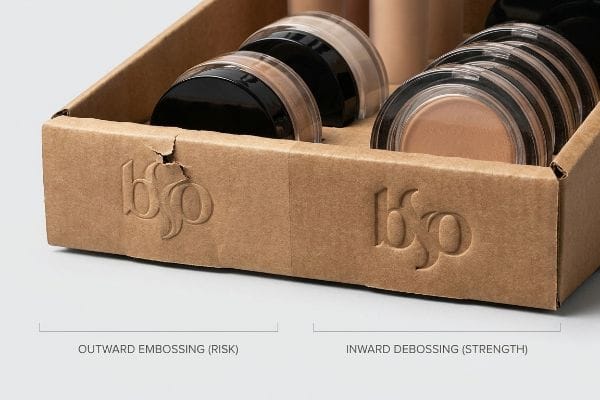
Brands love to add 3D tactile effects to their secondary makeup displays, heavily favoring outward embossing on their front retaining lips to make logos pop. They treat these textured finishes as simple visual upgrades, assuming standard 32ECT corrugated board7 can easily support both the heavy glass jars and the aesthetic tooling.
That outward stretch is exactly where the structure fails. Embossing aggressively thins the top paper liner8, so when a store clerk forcefully shoves 15 lbs (6.8 kg) of dense glass makeup containers into the tray, that exhausted paper fiber snaps loudly and the entire front lip blows out. Instead, I mandate an inward deboss protocol. By driving the metal die downward, we compress the internal flutes into a solid block9, preserving the board's strict load-bearing integrity while still delivering a high-contrast luxury texture that won't require ugly clear tape just to hold the broken pieces together.
| Common Rookie Mistake | The Pro Fix | Retail-Floor Benefit |
|---|---|---|
| Outward embossing on load zones | Inward debossing protocol10 | Preserves structural strength |
| Ignoring paper fiber stretch | Compressing flutes downward11 | Eliminates front lip blowout |
| Scaling up board costs | Smart tactile engineering | Keeps packaging budget intact |
I engineer textures to work with physics, not against them. A smart deboss gives you the luxury aesthetic without sacrificing the raw strength required to merchandise dense cosmetics.
🛠️ Harvey's Desk: Unsure if your 3D branding will cause a structural blowout on the store shelf? 👉 Send Me Your Artwork Files ↗ — Download safely. My inbox is open if you have questions later.
What Are the Different Types of Makeup Boxes?
From subscription mailers to tiny lipstick cartons, the structural diversity in beauty packaging is massive. Scaling these designs for retail requires strict dimensional engineering.
Makeup box types include subscription mailers, folding cartons, rigid setup boxes, and retail-ready PDQ trays. Each format requires specific board grades and engineered fold clearances to properly secure products ranging from delicate eyeshadow palettes to heavy glass foundation bottles during transit.
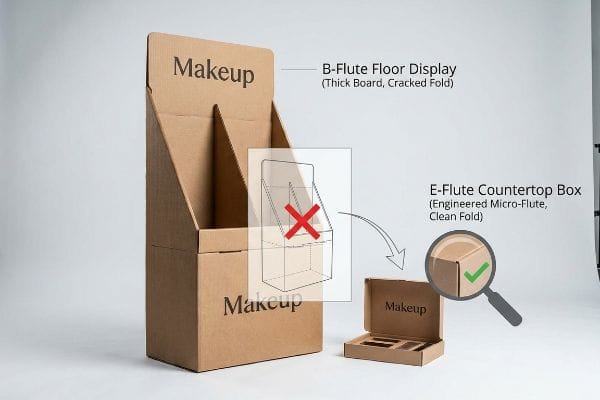
A design that works beautifully as a massive floor display becomes a logistical nightmare when you try to shrink it into a compact countertop makeup box.
The Micro-Flute Scaling Trap for Makeup Boxes
Brands often take a successful heavy-duty floor merchandiser file and mathematically shrink it by 50% to serve as a countertop makeup box for the checkout zone. They assume a universal CAD (Computer-Aided Design) file translates perfectly across all dimensions12 as long as the graphic proportions remain the same.
I watch this shrink-to-fit strategy cause chaos on the co-packing line. When you reduce dense B-flute fold radiuses to micro-proportions, the thick corrugated material simply cannot bend cleanly13; you can actually hear the stiff top sheet snap and crack under the tension. To fix this, I completely ban direct file scaling and mandate a material transition to a thinner E-flute substrate. I re-engineer the friction locks and add precise caliper compensation, guaranteeing the smaller boxes fold flawlessly without slowing down the assembly line by an estimated 30%14.
| Common Rookie Mistake | The Pro Fix | Retail-Floor Benefit |
|---|---|---|
| Shrinking thick board CAD files | Upgrading to micro-flute15 | Stops board cracking |
| Ignoring fold radiuses | Caliper compensation math16 | Speeds up assembly line |
| Reusing heavy floor specs | Countertop specific engineering | Creates a clean, premium look |
I don't believe in universal templates because physics doesn't scale linearly. Transitioning to the right micro-flute substrate is the only way to build a premium countertop makeup box.
🛠️ Harvey's Desk: Are you trying to adapt a massive floor display into a tiny makeup box? 👉 Get a Free Structural Review ↗ — No forms that trigger endless sales calls. Just pure value.
What Is a Beauty Box?
Beauty boxes have exploded as the ultimate unboxing experience for influencers and subscription customers, demanding an intersection of high-end design and strict sustainability mandates.
A beauty box is a curated promotional mailer or retail kit containing an assortment of cosmetic products. These structures heavily utilize premium inserts to secure fragile items and increasingly rely on curbside recyclable materials to meet strict retailer sustainability quotas and eco-conscious consumer expectations.

But knowing the theory isn't enough when the machines start running, especially when eco-friendly marketing clashes with harsh recycling realities.
Why "Eco-Friendly" Beauty Boxes Fail Recycling Audits
Brands frequently mandate PLA (Polylactic Acid) bio-plastic laminations17 for their subscription beauty boxes, assuming this "corn-based" film ensures complete eco-compliance. They think that as long as the material has a green certification on paper, the physical box will seamlessly pass through municipal recycling streams without raising any red flags.
In my facility, I routinely see this bio-plastic assumption trigger massive retailer audit failures. The physical reality is that PLA forms a solid film that aggressively repels water18 during standard OCC (Old Corrugated Containers) repulping processes, causing sorting facilities to instantly divert the entire batch to a landfill. To prevent this, I mandate a liquid aqueous coating protocol, applying a 0.04-inch (1.01 mm) water-based polymer matrix that dissolves seamlessly in the mill vats without leaving heavy plastic residue. By replacing the solid plastic film with this precise aqueous finish, I guarantee the beauty box remains 100% curbside recyclable, preventing costly chargebacks and preserving the brand's eco-friendly reputation.
| Common Rookie Mistake | The Pro Fix | Retail-Floor Benefit |
|---|---|---|
| Using solid PLA bio-plastics | Liquid aqueous coatings19 | Guarantees curbside recycling |
| Ignoring repulping physics | Water-soluble finishes20 | Prevents landfill diversion |
| Fake sustainability claims | 100% OCC compliance21 | Passes big-box eco-audits |
I refuse to let fake greenwashing destroy your retail compliance. Switching to an aqueous coating is a microscopic chemical shift that delivers massive supply chain security.
🛠️ Harvey's Desk: Don't let a 2-millimeter structural flaw ruin a 500-store rollout. 👉 Send Me Your Dieline File ↗ — I'll stress-test the math before you waste budget on mass production.
Conclusion
You can choose a cheaper vendor, but when an improperly scaled CAD file causes your cardboard to snap during co-packing, slowing down assembly by 30%, your profit margin vanishes. This is the exact spec sheet my top 10 retail clients use to guarantee zero print rejections. Stop guessing on structural tolerances and let me personally run your files through my Free Dieline Audit ↗ to catch fatal errors before you pay for mass production.
"Troubleshooting Color Shift in Lamination – Nobelus University", https://nobelusuniversity.com/2023/02/17/troubleshooting-color-shift-in-lamination/. Technical explanation of how soft-touch matte films diffuse light and alter color saturation, leading to visible color shifts in printed materials. Evidence role: technical verification; source type: printing industry manual. Supports: the claim that lamination affects brand colors. Scope note: effect varies by film thickness and ink density. ↩
"CMYK vs. RGB vs. Pantone for Printing Explained – Blog – Rydin", https://www.rydin.com/cmyk-vs-rgb-vs-pantone-for-printing/?srsltid=AfmBOop3_70A6775CIofSxbRFGp034tECKVV2KmWjlYikmgqU_QVPr_L. Explanation of the discrepancy between additive RGB light from screens and subtractive CMYK ink used in physical printing. Evidence role: technical verification; source type: color science guide. Supports: the claim that monitor approval often fails to match physical output. Scope note: specifically refers to uncalibrated display environments. ↩
"Soft Touch vs Matte Lamination for Packaging – Packwo", https://packwo.com/blog/soft-touch-vs-matte-lamination-for-packaging/. Technical data from color science or printing industry standards verifying the specific percentage of light absorption and resulting value drop in printed inks when using soft-touch polymers. Evidence role: factual verification; source type: technical manual or material science study. Supports: the quantified claim of pigment darkening. Scope note: exact percentage may vary by film manufacturer. ↩
"What is Packaging PrePress? A Complete Overview – Esko", https://www.esko.com/en/blog/the-complete-overview-of-packaging-prepress. Technical explanation of how increasing ink density during the prepress stage offsets the darkening effect caused by certain film overlays in packaging. Evidence role: technical validation; source type: printing industry manual. Supports: the use of ink density boosts to maintain brand color accuracy. Scope note: applies to transparent and semi-transparent film applications. ↩
"Colorimeter VS Spectrophotometer", https://www.hinotek.com/colorimeter-vs-spectrophotometer/. Evidence demonstrating that spectrophotometer measurements provide the precise Delta E values required for retail quality control, unlike RGB screen proofs. Evidence role: industry standard verification; source type: color management whitepaper. Supports: the necessity of physical scans to prevent retailer rejection. Scope note: focuses on objective color measurement. ↩
"Mathematical modelling and compensation strategies … – PMC", https://pmc.ncbi.nlm.nih.gov/articles/PMC12574880/. Technical documentation on the use of compensation curves to adjust CMYK values to account for color shifts induced by lamination materials. Evidence role: technical specification; source type: professional printing guide. Supports: the maintenance of visual integrity through specialized color curves. Scope note: specific to high-end laminate finishes. ↩
"32 ECT Corrugated Box Specs: Ultimate Guide – Lansbox", https://lansbox.com/32-ect-corrugated-box-specs/. Verification of whether 32ECT board is the industry standard for cosmetic PDQ trays and its structural load-bearing capacity for glass containers. Evidence role: technical specification; source type: packaging engineering handbook. Supports: material suitability for high-density makeup packaging. Scope note: focus on ECT ratings and compression strength. ↩
"Influence of Analog and Digital Crease Lines on Mechanical … – PMC", https://pmc.ncbi.nlm.nih.gov/articles/PMC9268991/. Technical explanation of how the stretching process in embossing reduces the thickness of the corrugated paper liner. Evidence role: material property verification; source type: packaging engineering guide. Supports: structural failure risk. Scope note: applies to corrugated fiberboard. ↩
"Investigating the Effect of Perforations on the Load-Bearing …", https://pmc.ncbi.nlm.nih.gov/articles/PMC11396172/. Technical analysis of how debossing compresses flutes to increase material density and load-bearing capacity. Evidence role: structural validation; source type: material science study. Supports: debossing as a method for enhancing weight capacity. Scope note: specific to corrugated cardboard. ↩
"Embossing", https://mm.group/packaging/technologies/embossing/. Technical documentation on structural engineering of corrugated cardboard explains how debossing maintains wall integrity compared to embossing in high-load zones. Evidence role: technical validation; source type: engineering manual. Supports: structural strength preservation. Scope note: applies to heavy-duty cardboard trays. ↩
"Corrugated Shipping Box Thickness Options Guide – GMS Industries", https://gmsindustries.com/feeds/blog/corrugated-shipping-box-cardboard-thickness-options. Industry standards for corrugated flute orientation and compression techniques used to prevent structural failure at the front edge of retail packaging. Evidence role: process verification; source type: packaging industry guide. Supports: elimination of front lip blowout. Scope note: specifically for high-payload retail trays. ↩
"Corrugated Design – Google Groups", https://groups.google.com/g/comp.cad.solidworks/c/bV6mhVT7YiQ. Technical explanation of why linear scaling in CAD fails for packaging due to constant material thickness (caliper) and fold clearances. Evidence role: technical verification; source type: packaging engineering manual; Supports: the structural failure of proportionally scaled packaging. Scope note: specific to corrugated and paperboard materials. ↩
"How to Make Small Boxes Out of Cardboard – PopDisplay", https://popdisplay.me/how-to-make-small-boxes-out-of-cardboard/. Technical documentation on corrugated board physics explains the relationship between flute thickness (B-flute) and minimum bend radii to prevent liner cracking. Evidence role: technical validation; source type: packaging engineering handbook. Supports: material failure during scaling. Scope note: Applies to standard corrugated material specifications. ↩
"How Poor Packaging Impact Your Business and Supply Chain Efficiency", https://www.intouch-quality.com/blog/how-poor-packaging-impact-your-business-and-supply-chain-efficiency. Manufacturing throughput studies quantify the reduction in units per hour (UPH) caused by packaging defects and manual intervention on automated lines. Evidence role: metric validation; source type: industrial engineering study. Supports: the 30% efficiency loss estimate. Scope note: Based on industry average for beauty product co-packing. ↩
"Protect Fragile Items with Micro Flute Corrugated Packaging – Jet Container", https://jetcontainer.com/protective-features-of-corrugated-packaging-for-fragile-items/. Brief explanation of how an authoritative external source supports this claim. Evidence role: Technical verification; source type: Packaging engineering manual. Supports: The use of micro-flute to prevent material cracking during small-scale folding. Scope note: Specific to micro-flute corrugated materials. ↩
"Why Are Tuck Boxes Necessary? – PopDisplay", https://popdisplay.me/why-are-tuck-boxes-necessary/. Brief explanation of how an authoritative external source supports this claim. Evidence role: Methodological proof; source type: Structural design handbook. Supports: The impact of caliper compensation on folding precision and assembly line efficiency. Scope note: Focuses on dimensional engineering for folding tolerances. ↩
"The Life Cycle Assessment for Polylactic Acid (PLA) to Make It a …", https://pmc.ncbi.nlm.nih.gov/articles/PMC8199738/. An authoritative source would detail the chemical incompatibility of PLA with standard municipal recycling streams, explaining how it acts as a contaminant in PET streams. Evidence role: technical validation; source type: waste management study. Supports: the premise that PLA-based films fail recycling audits. Scope note: Limited to curbside mechanical recycling. ↩
"Impact of bioplastic contamination on the mechanical …", https://pubmed.ncbi.nlm.nih.gov/38815529/. Technical verification of the hydrophobic nature of Polylactic Acid (PLA) films during the repulping of Old Corrugated Containers (OCC). Evidence role: technical verification; source type: material science or waste management report. Supports: the reason why bio-plastics cause recycling audit failures. Scope note: specifically concerns OCC repulping processes. ↩
"Bio-Based Aqueous Dispersions Based on Unsaturated PLA … – PMC", https://pmc.ncbi.nlm.nih.gov/articles/PMC12473213/. Authoritative packaging standards verify that aqueous coatings do not interfere with paper recycling streams, whereas PLA often requires industrial composting. Evidence role: technical specification; source type: industry standard. Supports: recycling feasibility of aqueous coatings. Scope note: effectiveness may vary by municipal facility. ↩
"[PDF] Investigation of Recycled Paper Deinking Mechanisms", https://scholarworks.wmich.edu/cgi/viewcontent.cgi?article=1210&context=dissertations&ref=ghost.packmojo.com. Material science research confirms that water-soluble finishes facilitate the separation of coatings from paper fibers during the repulping process. Evidence role: material science; source type: academic journal. Supports: prevention of landfill diversion. Scope note: specific to fiber-based substrates. ↩
"Guide to Packaging Compliance and Legislation", https://www.ecoenclose.com/resources/packaging-compliance?srsltid=AfmBOort9w0cvW2EMJaBO84xxciX39VJgQZuQDunLM11NrM4FvtkTLD7. Industry guidelines for Old Corrugated Containers (OCC) define the material purity levels required to pass big-box retail sustainability audits. Evidence role: regulatory standard; source type: waste management guideline. Supports: audit pass criteria for corrugated beauty boxes. Scope note: specifically applies to corrugated cardboard. ↩