
Marken investieren oft enorme Budgets in Marketing, nur um dann mitansehen zu müssen, wie ihre physischen Produkte in überfüllten Regalen untergehen, weil sie die falsche Vertriebsstrategie gewählt haben. Das ändern wir jetzt.
Zu den zwölf effektivsten Arten von Verkaufsdisplays zählen Bodenaufsteller, Stirnseitendisplays, Thekendisplays, Palettenaufsteller, Seitendisplays, Wühltische, Regalstopper, Clipstreifen, Schwerkraftdisplays, interaktive Kioske, modulare Regalsysteme und digitale Endregale. Jedes dieser Formate zielt strategisch auf spezifische Kundenströme ab, um Impulskäufe zu maximieren.
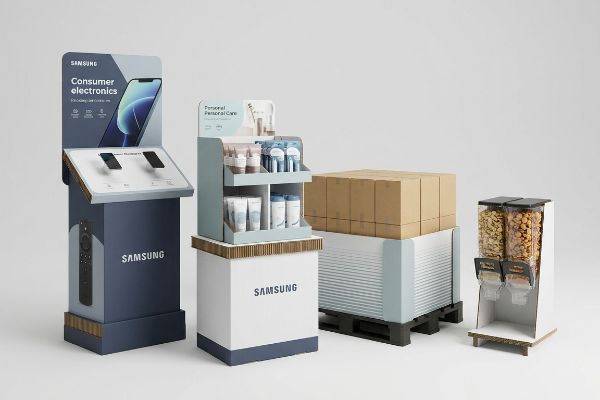
Die Kenntnis der Kategorien ist nur der Anfang. Die eigentliche Herausforderung besteht darin, zu verstehen, wie diese physischen Strukturen mit der Käuferpsychologie und der strengen Logistik des Einzelhandels interagieren, sobald sie das Werk verlassen.
Welche verschiedenen Arten von Verkaufsdisplays gibt es?
Die Wahl der richtigen Struktur entscheidet über das Überleben Ihrer Lieferkette. Sie benötigen ein Format, das eine effektive Warenpräsentation ermöglicht und gleichzeitig den harten physischen Anforderungen der Logistik großer Handelsketten standhält.
Die verschiedenen Arten von Verkaufsdisplays lassen sich in zwei klar abgegrenzte räumliche Zonen einteilen. POP-Systeme (Point-of-Purchase) umfassen robuste Palettenregale und freistehende Bodenaufsteller. POS-Systeme (Point-of-Sale) nutzen kompakte Strukturen wie Schwerkraftaufsteller, Clipstreifen und Kassenablagen, die strategisch positioniert sind, um Spontankäufe zu fördern.
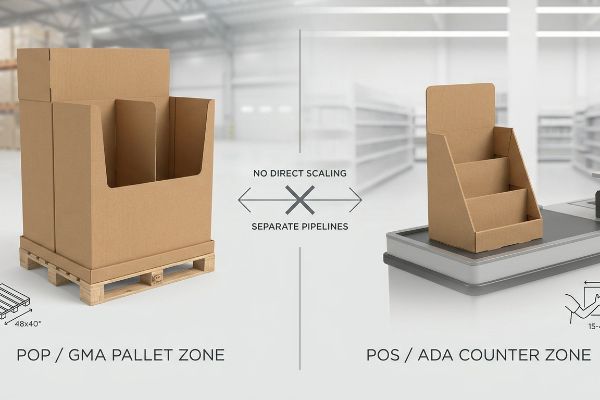
Die Kategorisierung dieser Einheiten ist in einer digitalen Präsentation einfach, doch bei der Umsetzung in die reale Ladenumgebung offenbart sich eine massive strukturelle Kluft.
Die ADA- vs. GMA-Richtlinien zu physischen Beschränkungen bei Verkaufsdisplays
Handelsunternehmen präsentieren häufig ein skalierbares Designkonzept, bei dem ein großes Bodendisplay einfach um 50 % verkleinert werden kann, um als kompakte Thekeneinheit. Dies erscheint als clevere Möglichkeit, Kosten für Konstruktion und Werkzeuge zu sparen. Selbst erfahrene Einkäufer gehen davon aus, dass die proportionale Größenanpassung die strukturelle Integrität erhält¹und gleichzeitig mehrere Verkaufsflächen nahtlos abdeckt.
Ich sehe diese Strategie des „Verkleinerns nach Bedarf“ immer wieder scheitern, weil sie die strengen rechtlichen und logistischen Vorgaben für Verkaufsflächen ignoriert. Ein Verkäufer müht sich ab, ein instabiles, verkleinertes Bodendisplay sicher auf einer engen Kassentheke zu platzieren, nur um dann mitzuerleben, wie das kopflastige Gerät laut und dumpf umkippt. Deshalb trenne ich die Produktionsprozesse für diese Geräte dauerhaft: Bodendisplays sind strikt an die GMA - Palettengröße von 1219 × 1016 mm (48 × 40 Zoll) für die Lagerlogistik angepasst, während Kassendisplays die ADA-Vorgaben (Americans with Disabilities Act) für die zulässige Reichweite von 381–1219 mm (15–48 Zoll ) erfüllen. Durch die strikte Einhaltung dieser getrennten Bereiche spare ich enorm viel manuelle Arbeit und vermeide massive Rückbuchungen von Filialleitern, die wackelige, nicht konforme Kassendisplays sofort ablehnen.
| Häufiger Anfängerfehler | Die Profi-Lösung | Vorteil für die Verkaufsfläche |
|---|---|---|
| Skalierung von Bodendesigns direkt auf Thekengrößen. | Trennung von CAD-Pipelines zur strikten Einhaltung der Zonenvorschriften. | Verhindert Ablehnung durch den Filialleiter. |
| Die ADA-Reichweitenbeschränkungen für Thekeneinheiten werden ignoriert. | Engineering innerhalb des Fensters 15-48 Zoll (381-1219 mm)4. | Gewährleistet die rechtliche Zugänglichkeit für Käufer. |
| Schwimmende Dimensionen ohne logistische Anker. | Verankerung der Bodenplatten an der 48×40 Zoll (1219×1016 mm) großen GMA-Palette5. | Verhindert das Zerdrücken von überhängenden Paletten. |
Ich lasse niemals zu, dass eine Marke bei der Markteinführung auf eine unflexible Standardlösung setzt. Der Aufbau individueller Strukturen für verschiedene Verkaufsbereiche beseitigt jegliche Probleme bei der Einhaltung von Vorschriften und stellt sicher, dass Ihre Kampagne den Weg ins Regal erfolgreich beschreitet.
🛠️ Harveys Schreibtisch: Befürchten Sie, dass Ihr aktuelles Bodendisplay nicht den Palettenvorgaben des Einzelhandels entspricht? 👉 Senden Sie mir Ihre Stanzdatei ↗ – Direkter Kontakt zu mir. Kein automatisierter Werbe-Spam, versprochen.
Welche 7 Arten von Einzelhändlern gibt es?
Man kann ein standardisiertes Merchandising-Konzept nicht in grundlegend unterschiedliche Einkaufsumgebungen zwingen. Eine Kampagne, die für einen riesigen Großhandelsclub konzipiert wurde, wird in einem kleinen Nachbarschaftsladen zwangsläufig scheitern.
Die sieben Einzelhandelsarten umfassen Convenience-Stores, Fachgeschäfte, Supermärkte, Discounter, Kaufhäuser, Großhandelsclubs und Supercenter. Jede dieser Kategorien zeichnet sich durch spezifische Gangabmessungen, Palettenbeschränkungen und unterschiedliche Verweildauern der Kunden aus, was hochgradig individualisierte Strategien für die Warenpräsentation erfordert, um eine erfolgreiche Produktplatzierung zu gewährleisten.
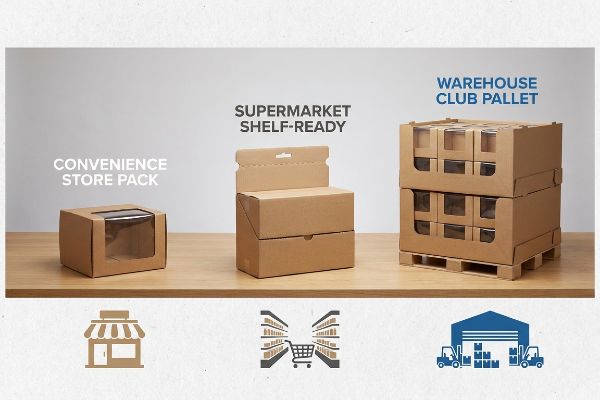
Die Identifizierung des Vertriebskanals ist nur der erste Schritt. Die eigentlichen Schwierigkeiten beginnen, wenn generische Verpackungsstrukturen auf diese hochspezifischen Geschäftsmodelle treffen.
Die Ausrichtungsmatrix für den Einzelhandelsrahmen
Aufstrebende Marken versuchen häufig, Produkte auf den Markt zu bringen, ohne die grundlegenden Mechanismen des Einzelhandels zu beherrschen. Sie gehen fälschlicherweise davon aus, dass sich ein gutes Produkt von selbst verkauft. Oft entwerfen sie eine einzige, ansprechende Verpackung und erwarten, dass diese sich nahtlos vom Regal einer Boutique in die Verkaufsfläche eines großen Kaufhauses . Dabei werden die spezifischen Geschäftsmechanismen und logistischen Regeln jedes einzelnen EinzelhandelsökosystemsAcht.
Wenn Käufer diese standardisierten Designs fordern, beobachte ich, wie Lieferketten bereits an der Warenannahme zusammenbrechen. Ich habe einmal miterlebt, wie ein Mitarbeiter eines Logistikdienstleisters die Laschen eines übergroßen Umkartons gewaltsam abriss, nur um ihn in ein enges Regal eines Supermarktes zu zwängen. Dabei wurden die Markengrafiken durch ein lautes Reißgeräusch zerstört. Um dies zu verhindern, schreibe ich vor, dass vor der Entwicklung jeglicher Verpackung eine strenge Einzelhandelsrahmenmatrix erstellt wird. Indem ich die Abmessungen Ihrer Einheit systematisch direkt mit den spezifischen Regalvorgaben des jeweiligen Einzelhändlers abgleiche, garantiere ich eine reibungslose Integration in die Warenpräsentation. Dadurch reduziert sich der Zeitaufwand für das Umpacken um schätzungsweise 25 %⁷ und die Gewinnspanne Ihres Projekts wird geschützt.
| Häufiger Anfängerfehler | Die Profi-Lösung | Vorteil für die Verkaufsfläche |
|---|---|---|
| Verwendung einer einheitlichen Displaygröße für alle Vertriebskanäle. | Entwicklung spezifischer Maßnahmen für jedes Ökosystem. | Optimiert die Platzierung an stark frequentierten Kreuzungen. |
| Die dynamischen Laderegeln des Club-Shops werden ignoriert. | Umrüstung auf doppelwandige Unterkonstruktionen für Lagerhallen8. | Verhindert das Zerdrücken der unteren Ebene unter Gewicht. |
| Versand von sperrigen Einheiten an Convenience-Stores. | Nutzung von Verkaufsflächen mit Bruchteil einer Viertelpalette9. | Gewährleistet die einfache Integration in engen Gängen. |
Ich weigere mich, eine Verpackung isoliert zu entwickeln. Nur wenn die strukturelle Geometrie perfekt auf die physikalischen Gegebenheiten des jeweiligen Vertriebskanals abgestimmt ist, lässt sich eine reibungslose und profitable Markteinführung gewährleisten.
🛠️ Harveys Schreibtisch: Stimmt die aktuelle Anordnung Ihrer Warenauslage mit den Regalvorgaben Ihres Zielhändlers überein? 👉 Laden Sie den Leitfaden zur Regalausrichtung herunter ↗ – Sicher herunterladen. Bei Fragen können Sie mich gerne kontaktieren.
Was sind die 5 Rs des Einzelhandels?
Erfolg im Einzelhandel bedeutet mehr als nur Präsenz; er ist eine exakte Wissenschaft von Timing, Platzierung und Absatzmenge. Wer diese Formel beherrscht, entscheidet über Erfolg oder Misserfolg seines Produkts.
Die fünf Rs des Einzelhandels sind das richtige Produkt, die richtige Menge, der richtige Preis, die richtige Zeit und der richtige Ort. Dieses strategische Rahmenkonzept stellt sicher, dass die Verkaufsförderungsmaßnahmen im stationären Handel optimal auf die Kundennachfrage abgestimmt sind, den Lagerumschlag maximieren und kostspielige Fehlbestände während wichtiger saisonaler Aktionszeiträume vermeiden.
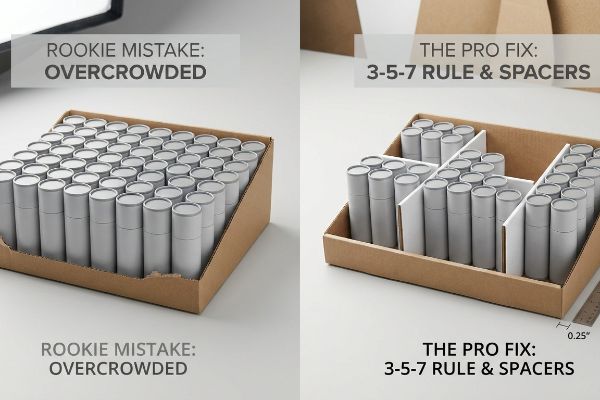
Während das Rahmenkonzept eine ausgezeichnete strategische Orientierung bietet, erfordert die physische Umsetzung der "richtigen Menge" auf einem Kartonregal exakte strukturelle Disziplin.
Die „richtige Menge“ mithilfe der 3-5-7-Asymmetrieregel umsetzen
Junior-Marketingteams versuchen häufig, Produkte dicht und perfekt symmetrisch auf einem einzigen Verkaufstablett anzuordnen , in der Annahme, dass eine maximale Produktdichte zu höheren Umsätzen führt. Sie behandeln die Verkaufsfläche wie ein einfaches geometrisches Raster auf ihren Bildschirmen. Dieser Ansatz mit perfekt gleichmäßigen Blöcken erzeugt jedoch keinerlei visuelle Spannung¹⁰ , sodass eilige Kunden die monolithische Präsentation einfach ignorieren.
Stellen Sie sich das wie einen überfüllten Aufzug vor: Wenn die Menschen dicht an dicht gedrängt stehen und sich kaum bewegen können, ist Bewegung unmöglich. Ich sehe immer wieder, wie Verkäufer Waren mit Gewalt in diese überfüllten Tabletts quetschen, und der starke Widerstand der dicken Wellpappe führt unweigerlich dazu, dass die vordere Haltekante einreißt. Um die Einhaltung der „richtigen Menge“ sicher zu gewährleisten, setze ich die 3-5-7-Regel ein und entwickle dafür spezielle modulare Trennwände, die die Waren in Gruppen mit ungerader Anzahl an Einheiten aufteilen. Dieser integrierte Abstand sorgt für einen präzisen physischen Freiraum von 6,35 mm (0,25 Zoll) ¹¹ und erzeugt so sofort eine optische Trennung, während gleichzeitig das Einreißen der Pappe¹² beim Auffüllen der Regale im Geschäft vollständig verhindert wird
| Häufiger Anfängerfehler | Die Profi-Lösung | Vorteil für die Verkaufsfläche |
|---|---|---|
| Die Produkte werden dicht an dicht in den Regalen gestapelt. | Einhaltung eines physischen Abstands von 0,25 Zoll (6,35 mm)13. | Verhindert das Einreißen der Haltelippen von Rohkarton. |
| Erstellung perfekt symmetrischer Inventarraster. | Anwendung der 3-5-7-Regel für asymmetrisches Clustering14. | Durchbricht die visuelle Monotonie, um die Aufmerksamkeit der Käufer zu erregen. |
| Schwere Produkte dürfen sich frei bewegen können. | Konstruktion modularer, schwebender Trennwände im Inneren des Tabletts15. | Sorgt dafür, dass der Lagerbestand beim Nachfüllen perfekt ausgerichtet ist. |
Ich sage meinen Kunden immer, dass Leerraum ein Gestaltungsmittel und kein verschwendetes Volumen ist. Die richtige geometrische Anordnung schützt die Unversehrtheit Ihrer Verpackung und lenkt den Blick des Käufers direkt auf Ihr Produkt.
🛠️ Harveys Schreibtisch: Sind Ihre Produkte so eng verpackt, dass die Verkäufer die Verkaufstabletts beschädigen? 👉 Fordern Sie eine Platzanalyse an ↗ – Keine Formulare, die endlose Verkaufsgespräche auslösen. Einfach nur echter Mehrwert.
Was sind die 4 Ps des visuellen Merchandisings?
Visuelle Strategien sind letztlich an die Gesetze der physikalischen Chemie gebunden. Man kann zwar ein brillantes Werbelayout am Bildschirm entwerfen, aber die Druckmaschine in der Fabrik bestimmt die Realität.
Die vier Ps des visuellen Merchandisings bestimmen die physische Präsentation von Produkt, Preis, Platzierung und Promotion. Diese konzeptionelle Matrix dient Marketingfachleuten als Leitfaden, um POS-Grafiken, strategische Beleuchtung und Raumaufteilung so zu gestalten, dass sie gängige Einkaufsmuster durchbrechen und die Kernmarkenbotschaft im Regal erfolgreich kommunizieren.
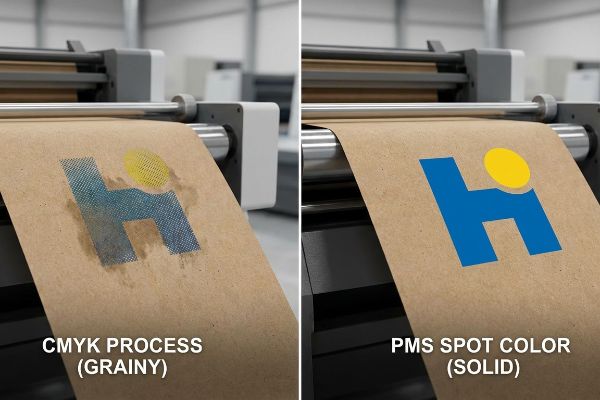
Doch die Theorie allein reicht nicht aus, wenn die Maschinen in Betrieb gehen, denn die visuelle "Werbung" kollidiert oft heftig mit der Realität der Chemie von Wellpappensubstraten.
Warum die Standard-CMYK-Promotion in der Fabrikhalle scheitert
Marketingteams konvertieren häufig Firmenlogos in Standard-CMYK-Farben (Cyan, Magenta, Gelb, Schwarz), in der Annahme, dass die Druckvorstufe die Farben nahtlos auf ihren hellen Bildschirmen wiedergibt<sup>16</sup>. Sie entwickeln ganze Werbekampagnen auf Basis dieser Standard-Vierfarben, im Glauben, die komplexe optische Farbmischung lasse sich perfekt auf jede Oberfläche übertragen<sup>17</sup>. Dies ist eine scheinbar vernünftige, aber im Umgang mit Rohverpackungen für den Einzelhandel äußerst riskante Annahme.
Eine einzelne Anzeige in einem digitalen PDF perfekt darzustellen, ist einfach. Doch die Realität sieht anders aus, wenn ich 5.000 Exemplare auf unversiegeltem Karton drucke. In meiner Druckerei beobachte ich regelmäßig, wie Standard-CMYK-Halbtonpunkte ungleichmäßig vom porösen 32ECT-Testliner18. Bei der Mikrometermessung und der Inspektion des Bogens unter grellem D50-Licht19zeigt sich, dass die optische Farbmischung mechanisch versagt und ein leuchtendes Markenlogo zu einem körnigen, verwaschenen und trüben Ergebnis wird. Um diese Mikroreibung im großen Maßstab zu beheben, deaktiviere ich die optische Farbmischung vollständig und setze stattdessen auf ein Spot-Color-Flood-Protokoll. Dabei ersetze ich das CMYK-Farbmuster durch eine einzige, perfekt gemischte PMS-Farbe (Pantone Matching System). Durch diese strikte Vorabkorrektur eliminiere ich die Halbtonkörnigkeit und garantiere, dass Ihre Grafiken aus sechs Metern Entfernung eine starke visuelle Wirkung erzielen, während gleichzeitig katastrophale Ablehnungen durch den Handel und der vollständige Verlust Ihrer Produktionsmarge vermieden werden.
| Häufiger Anfängerfehler | Die Profi-Lösung | Vorteil für die Verkaufsfläche |
|---|---|---|
| Drucken von primären Logos mit Standard-CMYK-Punkten. | Vorschreiben einer dedizierten PMS-Sonderfarben-Flutung20. | Beseitigt körniges, verwaschenes visuelles Branding. |
| Abgesehen davon, wie unbehandelter Testliner nasse, flüssige Tinte aufnimmt. | Anpassung der Vorpressprofile an die Porosität unversiegelter Substrate21. | Gewährleistet klare, kontrastreiche Werbebotschaften. |
| Vertrauen in unkalibrierte digitale Bildschirmfarbproofs. | Abtasten physikalischer, laminierter Abzüge mit einem Spektralphotometer22. | Verhindert massive Verstöße gegen die Delta-E-Markenrichtlinien. |
Ich setze auf präzise Druckvorstufenchemie, nicht auf digitale Vermutungen, um die visuelle Identität Ihrer Marke zu schützen. Die Kontrolle des Farbverhaltens auf mikroskopischer Ebene garantiert, dass Ihre Werbebotschaft auch unter grellem Neonlicht im Einzelhandel optimal zur Geltung kommt.
🛠️ Harveys Schreibtisch: Wissen Sie, ob Ihr Grafikdesigner für Ihr Logo sichere Sonderfarben oder riskante CMYK-Halbtöne verwendet hat? 👉 Schicken Sie mir Ihre Stanzdatei ↗ – ich prüfe die Berechnungen, bevor Sie Ihr Budget für die Massenproduktion verschwenden.
Abschluss
Sie können zwar einen günstigeren Druckdienstleister wählen, aber wenn CMYK-Halbtonpunkte in poröses Testpapier auslaufen, führt das zu unscharfen Grafiken, die Ihre Markenbekanntheit mindern und sofort zu Ablehnungen durch den Handel führen. Genau dieses Datenblatt verwenden meine zehn wichtigsten Einzelhandelskunden, um Druckfehler zu vermeiden. Hören Sie auf, bei der Substratchemie zu raten, und lassen Sie mich Ihre Druckvorlage persönlich mit meiner kostenlosen Druckvorstufen-Diagnose prüfen, um schwerwiegende Farbfehler vor der Massenproduktion zu erkennen.
„Strukturelle Gestaltung von Displays für den interaktiven Einzelhandel …“, https://www.bcipkg.com/display-structural-design-for-interactive-retail-displays/. Technische Analyse der Auswirkungen der Dimensionsskalierung auf die Tragfähigkeit und Stabilität von Wellpappe. Nachweisfunktion: Verifizierung; Quellentyp: Leitfaden für Verpackungstechnik. Unterstützt: die Aussage zur strukturellen Integrität bei der Größenänderung. Anwendungsbereich: Gilt für die Strukturphysik von Karton. ↩
„Standardpalettengrößen – 48×40 GMA und 6 weitere gängige Abmessungen“, https://www.wearewarp.com/standard-pallet-sizes. Eine maßgebliche Branchendokumentation bestätigt die Standardabmessungen von GMA-Paletten für die nordamerikanische Logistik. Nachweisfunktion: Technische Spezifikation; Quellentyp: Branchenstandard. Unterstützt: Standard-Logistikpalettenbeschränkungen. Anwendungsbereich: Primärer Standard für den Versand in Lebensmittel- und Einzelhandelslagern. ↩
„Kapitel 3: Bedienbare Teile – Access-Board.gov“, https://www.access-board.gov/ada/guides/chapter-3-operable-parts/. Die US-amerikanischen Barrierefreiheitsstandards der Regierung definieren den zulässigen Reichweitenbereich für Elemente, die von Menschen mit Behinderungen genutzt werden. Nachweisfunktion: Rechtsvorschrift; Quellentyp: Regierungsverordnung. Unterstützt: Gewährleistung der Barrierefreiheit und der Einhaltung der Reichweitenvorgaben. Anmerkung zum Geltungsbereich: Basierend auf den ADAAG-Richtlinien für Reichweitenbereiche. ↩
„Kapitel 9: Integrierte Elemente – Access-Board.gov“, https://www.access-board.gov/ada/chapter/ch09/. Überprüfung der ADA-Richtlinien (Americans with Disabilities Act) hinsichtlich der barrierefreien Reichweite für ungehindertes Greifen nach vorn oder zur Seite. Nachweisfunktion: Technische Spezifikation; Quellentyp: Regierungsverordnung. Unterstützt: Rechtliche Anforderungen an die Barrierefreiheit für Kunden. Geltungsbereich: Spezifisch für die US-amerikanischen ADA-Standards. ↩
„40-Zoll-GMA-Holzpaletten – Southern Research Station“, https://www.srs.fs.usda.gov/pubs/VT_Publications/05t10.pdf. Bestätigung der Standardpalettengröße der Grocery Manufacturers Association (GMA) für die nordamerikanische Einzelhandelslogistik. Nachweisfunktion: Branchenstandard; Quellentyp: Logistikspezifikation. Unterstützung: Anforderungen an die Basisabmessungen zur Vermeidung von Palettenüberstand. Anwendungsbereich: Standard für den nordamerikanischen Versand. ↩
„Verpackungs- und Logistikplanung für Verkaufsdisplays – Frank Mayer“, https://www.frankmayer.com/blog/packaging-and-logistics-planning-for-retail-displays/. Ein maßgeblicher Leitfaden für den Einzelhandel würde die spezifischen Verpackungs-, Palettierungs- und Compliance-Standards detailliert beschreiben, die je nach Ladenformat variieren. Belegfunktion: grundlegende Unterstützung; Quellentyp: Branchenhandbuch. Belegt: die These, dass Einzelhandelsökosysteme einzigartige Logistikregeln haben. Anmerkung zum Umfang: Fokus auf Standards des kommerziellen Einzelhandels. ↩
„Verpackungsoptimierung – Messung & Dimensionierung – Cognex“, https://www.cognex.com/en/applications/measurement-and-dimensioning/packaging-inspection. Branchenweite Logistik-Benchmarks oder Fallstudien aus der Lieferkette liefern quantitative Daten darüber, wie die Angleichung der Verpackungsabmessungen an die Vorgaben des Einzelhandels die Bearbeitungszeit verkürzt. Nachweisfunktion: quantitative Verifizierung; Quellentyp: Branchenbericht. Unterstützt: die Effizienzaussagen der Retail Framework Matrix. Hinweis: Die tatsächlichen Prozentsätze variieren je nach Komplexität der Artikel und Unternehmensgröße. ↩
„14 Arten von Verkaufsdisplays | Chicago, IL – Wertheimer Box“, https://wertheimerbox.com/types-of-retail-displays/. Detaillierte Branchenrichtlinien zur strukturellen Verstärkung von Palettendisplays in Großmärkten. Nachweisfunktion: Technische Spezifikation; Quellentyp: Handbuch für die Ladengestaltung. Unterstützung: Verwendung von doppelwandigen Untergründen, um ein Zusammendrücken der unteren Ebene zu verhindern. Anwendungsbereich: Speziell für Umgebungen mit hoher Belastung. ↩
„Palettendisplay-Typen: Ganze, halbe und viertel Paletten – GreenDot Packaging“, https://greendotpackaging.com/understanding-pallet-display-types-full-half-and-quarter-pallet-displays/. Technische Standards für kleinformatige Verkaufsdisplays, die speziell auf die räumlichen Gegebenheiten von Convenience-Stores zugeschnitten sind. Nachweisfunktion: Maßnorm; Quellentyp: Leitfaden für die Einzelhandelslogistik. Unterstützt: Integration von Teilflächen in beengten Räumen. Anwendungsbereich: Gilt für die Planung von Convenience-Store-Lagen. ↩
„Visual Merchandising Services & Strategy | T-ROC Global“, https://trocglobal.com/visual-merchandising/. Kurze Erläuterung, wie Prinzipien der visuellen Wahrnehmung und Konsumentenpsychologie erklären, warum asymmetrische Layouts Interesse wecken und Aufmerksamkeit effektiver auf sich ziehen als symmetrische Raster. Belegfunktion: Unterstützung eines theoretischen Prinzips; Quellentyp: Einzelhandelspsychologische Forschung oder Merchandising-Leitfaden. Unterstützt: die Behauptung, dass monolithische Displays von Käufern ignoriert werden. Anwendungsbereich: Gilt speziell für physische Verkaufsdisplays. ↩
„[PDF] Lagerung und Handhabung von Wellpappenverpackungsmaterialien“, https://www.fibrebox.org/assets/2025/07/B155_TR2-3_Storage_and_Handling_2018_Edition.pdf. Technische Richtlinien zur Festlegung optimaler Abstandsmaße zur Vermeidung von strukturellen Spannungen in Wellpappe. Nachweisfunktion: Technische Spezifikation; Quellentyp: Handbuch für Verpackungstechnik. Belege: Das spezifische Abstandsmaß. Anwendungsbereich: Variiert je nach Plattendichte. ↩
„Entdecken Sie die Vorteile von Trennwänden für Wellpappkartons für Ihr Unternehmen“, https://www.estic-maillot.com/en/corrugated-box-dividers/. Empirische Daten belegen die Reduzierung von Materialfehlern durch den Einsatz von Trennwänden in Verkaufsdisplays. Nachweisfunktion: Leistungsvalidierung; Quellentyp: Bericht der Verpackungsindustrie. Unterstützt: den kausalen Zusammenhang zwischen Trennwänden und der Vermeidung von Einrissen. Anwendungsbereich: Gilt für Wellpappenmaterialien. ↩
„5 Anforderungen an verkaufsfertige Verpackungen“, https://greatnorthernpackaging.com/2025/11/19/5-requirements-for-shelf-ready-packaging/. Technische Überprüfung der erforderlichen Spaltmaße, um Beschädigungen der Kartonhaltelippen beim Einlagern in Regale zu vermeiden. Nachweisfunktion: Technische Spezifikation; Quellentyp: Handbuch für Verpackungstechnik. Unterstützt: Die präzise Messung zur Einhaltung der Spaltmaße. Anwendungsbereich: Gilt speziell für kartonbasierte Einzelhandelsverpackungen. ↩
„Visuelles Merchandising optimal nutzen: 3 Tipps für mehr Kundenbindung …“, https://spc-retail.com/3-tips-to-connect-and-capture-shoppers-attention/. Bestätigung der 3-5-7-Regel als anerkannte Technik im visuellen Merchandising zur Steigerung der Kundenbindung. Nachweis: Branchenstandard; Quelle: Leitfaden für das Einzelhandels-Merchandising. Beleg: Die Wirksamkeit asymmetrischer Anordnungen zur Auflockerung visueller Monotonie. Anwendungsbereich: Speziell für Strategien der visuellen Warenpräsentation. ↩
„Regalteiler für den Einzelhandel – Kunststoff, Draht & Magnetisch | siffron“, https://siffron.com/product-categories/shelf-management/dividers/. Technische Analyse modularer, beweglicher Trennsysteme für Verkaufsschalen zur Sicherstellung der Warenausrichtung. Nachweisfunktion: Gerätespezifikation; Quellentyp: Whitepaper zu Logistik oder Lagertechnik. Beleg: Die Behauptung, dass bewegliche Trennwände das Verrutschen von Produkten verhindern. Anmerkung zum Anwendungsbereich: Bezieht sich auf die Innenausstattung von Verkaufsschalen. ↩
„RGB vs. CMYK: Der Leitfaden für perfekte Druckfarben 2026“, https://www.jukeboxprint.com/blog/rgb-vs-cmyk-for-print?srsltid=AfmBOoqeulbI-Hi7TIuunmFWVbL46VU11I4qt0mPG3z2f3B_OfTT5lVb. Technische Erklärung der additiven (RGB) und subtraktiven (CMYK) Farbräume und der Unfähigkeit des Drucks, alle Bildschirmfarben wiederzugeben. Belegfunktion: Technische Überprüfung; Quellentyp: Lehrbuch der Farbwissenschaft. Unterstützt: Die Behauptung, dass die Umwandlung von Digital- in Druckbilder mit einem systembedingten Farbverlust einhergeht. Anwendungsbereich: Allgemeine Druckstandards. ↩
„CMYK-Farbmodell für den Kartondruck – Gentlever“, https://gentlever.com/cmyk-for-printing-boxes/. Maßgebliche Anleitung, wie Tintenaufnahme und Oberflächenstruktur die CMYK-Farbgenauigkeit auf Rohmaterialien für den Einzelhandel beeinflussen. Nachweisfunktion: Technische Verifizierung; Quellentyp: Handbuch für den industriellen Druck. Beleg: Die Aussage, dass die CMYK-Ausgabe auf verschiedenen Oberflächen inkonsistent ist. Anwendungsbereich: Gilt speziell für ungestrichene oder Rohmaterialien. ↩
„Mathematische Modellierung und Kompensationsstrategien für Druckpunktabweichungen …“, https://pmc.ncbi.nlm.nih.gov/articles/PMC12574880/. Technische Erklärung, wie poröse, unversiegelte Substrate zu Farbverlauf und Punktzunahme beim Halbtondruck führen. Nachweisfunktion: Technische Verifizierung; Quellentyp: Technisches Handbuch der Druckindustrie. Belegt: Die Behauptung, dass CMYK auf bestimmten porösen Kartonagen versagt. Anwendungsbereich: Gilt für unversiegelte Wellpappenmaterialien. ↩
„Was ist D50 für Grafik und Druck? – Waveform Lighting“, https://www.waveformlighting.com/color-matching/what-is-d50-for-graphic-arts-printing. Bestätigung, dass D50 (5000 K) die internationale Standardlichtart für die Farbabstimmung in der Grafik ist. Nachweisfunktion: Bestätigung des Industriestandards; Quellentyp: ISO/ANSI-Standard. Unterstützt: die Gültigkeit der verwendeten Prüfmethodik. Anwendungsbereich: Speziell für die professionelle Farbbewertung. ↩
„Sonderfarben vs. CMYK-Farben: Wesentliche Unterschiede erklärt“, https://unicopacking.com/en/new/spot-color-vs-process-color.html. Technische Druckrichtlinien erläutern, wie Pantone Matching System (PMS)-Sonderfarben die Körnigkeit und Farbverschiebungen verhindern, die bei CMYK-Halbtonpunkten auftreten. Nachweis: Technische Spezifikation; Quellentyp: Branchenhandbuch. Argumentation: Überlegenheit von Sonderfarben für die Markenintegrität. Anwendungsbereich: Fokus auf Offset- und Flexodruckverfahren. ↩
„Eignung papierbasierter Substrate für gedruckte Elektronik – PMC“, https://pmc.ncbi.nlm.nih.gov/articles/PMC8839088/. Die materialwissenschaftliche Dokumentation beschreibt, wie die Porosität unversiegelter Substrate wie Testliner die Tintenpenetration und Farbsättigung beeinflusst. Belegfunktion: Technischer Fakt; Quellentyp: Fachzeitschrift für Materialwissenschaften. Unterstützt: Notwendigkeit der Anpassung der Druckvorstufenprofile an die Absorption. Anwendungsbereich: Speziell für Rohpapier und Wellpappe. ↩
„Was ist Delta E? Und warum ist es wichtig für die Farbgenauigkeit?“, https://www.viewsonic.com/library/creative-work/what-is-delta-e-and-why-is-it-important-for-color-accuracy/. Farbmanagementstandards definieren die Verwendung von Spektralphotometern zur Quantifizierung von Delta E (Farbdifferenz), um die Einhaltung der Markenrichtlinien über digitale Proofs hinaus sicherzustellen. Nachweisfunktion: Qualitätskontrollmetrik; Quellentyp: ISO-Norm. Unterstützt: Die Methode zur Vermeidung von Verstößen gegen die Markenrichtlinien. Anmerkung zum Anwendungsbereich: Bezieht sich auf die quantitative Farbmessung. ↩