Marken erleiden enorme Kapitalverluste, wenn Verkaufsflächen mitten im Gang zusammenbrechen. Die Wahl des richtigen Tragwerks verhindert katastrophale Lieferkettenausfälle und teure Rückbelastungen für Einzelhändler.
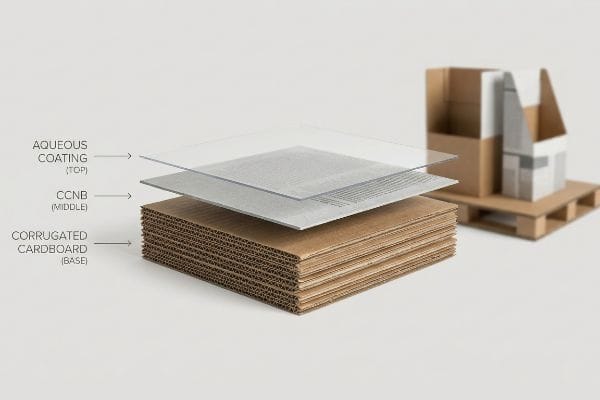
Für Palettendisplays wird hauptsächlich Wellpappe als stabiles Grundmaterial verwendet. Weitere Komponenten sind mit Clay-Coating News Back (CCNB) beschichtetes Papier für hochwertige Bedruckung sowie umweltfreundliche Wasserbeschichtungen und Feuchtigkeitssperren, die Langlebigkeit und die Einhaltung strenger globaler Handelsrichtlinien gewährleisten.

Doch die Kenntnis der theoretischen Schichten in einem Datenblatt schützt Ihre Marke nicht, wenn die physische Produktion in Gang kommt.
Aus welchen Materialien besteht die Präsentation von Schautafeln?
Sie benötigen ein präzises Gleichgewicht zwischen Druckfestigkeit und Bildqualität. Die Wahl der falschen Papierkombination führt entweder zu einem zerdrückten Untergrund oder zu stark verwaschenen Grafiken im Verkaufsraum.
Displaykarton besteht aus einem geriffelten Kern, typischerweise B- oder C-Welle, der zwischen zwei Deckblättern eingebettet ist. Für hochwertige Druckprodukte im Einzelhandel wird eine Deckschicht aus doppelseitigem, tonbeschichtetem Zeitungspapier lithografisch auf den geriffelten Kern laminiert. Dies sorgt für eine glatte Oberfläche für brillante Farben und gewährleistet gleichzeitig die Stabilität.
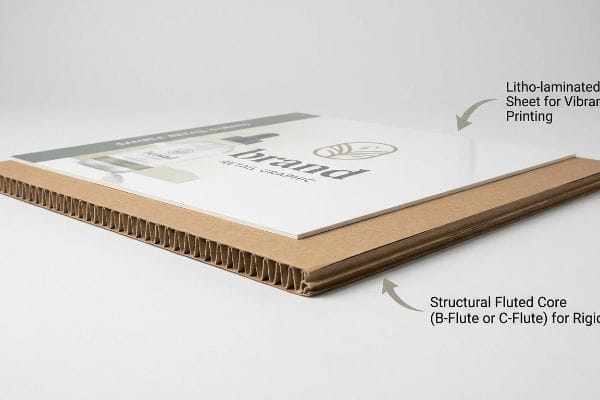
Die Angabe dieser Schichten in einer Konstruktionsdatei ist unkompliziert, aber wie sie sich chemisch unter physikalischer Belastung verhalten, ist eine ganz andere Geschichte.
Die versteckte Gefahr in Standard-Präsentationstafelmaterialien
Designer fordern häufig hochwertiges, gebleichtes Sulfatpapier (SBS) für die äußere Druckschicht1 und Standard-Recyclingpapier für den Strukturkern2.Sie gehen davon aus, dass diese hochwertige Papierkombination ein perfektes, luxuriöses Finish garantiert und gleichzeitig die Materialkosten niedrig hält.
Selbst erfahrene Einkaufsteams übersehen oft die physikalischen Grenzen von Recycling-Trägermaterialien bei hoher Luftfeuchtigkeit. Ich erinnere mich, wie ich am Boden stand und den steifen Widerstand von neuem Kraftkarton hörte, der in die Litho-Laminiermaschine eingeführt wurde, und ihn direkt mit einer Charge Recycling-Testträgermaterialien verglich. Die Recyclingfasern hatten die Luftfeuchtigkeit im Lager schnell aufgenommen und den Karton so weit aufgequollen, dass sich die gesamte Platte beim Trocknen wie ein Kartoffelchip nach innen wölbte, nachdem der nasse, wasserbasierte Klebstoff und die starre SBS-Deckschicht aufgetragen worden waren. Durch den Wechsel der Außenschicht zu einem poröseren Standard-CCNB und die Verwendung von neuem Kraftkarton für die inneren Wellen konnte ich die Feuchtigkeitsspannung stabilisieren. Dieser einfache Materialwechsel gewährleistet, dass die Display-Paneele perfekt plan aushärten und spart Kunden erhebliches Materialaufblähen. Gleichzeitig wird das Risiko wackeliger Verkaufsdisplays , die gefährlich in die Gänge kippen könnten, eliminiert.
| Häufiger Anfängerfehler | Die Profi-Lösung | Vorteil für die Verkaufsfläche |
|---|---|---|
| Spezifizierung von starren SBS-Platten über feuchten Recycling-Wellen | Wechseln Sie zu CCNB in Standardqualität mit Kern aus reinem Kraftpapier3 | Verhindert das Einwölben der Paneele nach innen |
| Die Aufnahme von Umgebungsfeuchtigkeit wird vernachlässigt | Gleichen Sie die Porosität des Linerboards aus4 | Beseitigt wackelige Standfüße |
| übermäßige Ausgaben für reine Kosmetikschichten | Die Platte für die strukturelle Flachhärtung konzipieren5 | Reduziert den Rohstoffverbrauch |
Ich lasse die Ästhetik niemals die Strukturchemie außer Acht. Die exakte Bestimmung des Mischungsverhältnisses der Papierqualitäten stellt sicher, dass Ihre Marketinginvestition auch unter dem grellen Neonlicht eines Großmarktes gerade steht und nicht gefährlich zu den Kunden geneigt wirkt.
🛠️ Harveys Schreibtisch: Sind Sie sich unsicher, ob sich Ihre Leiterplatte bei hoher Luftfeuchtigkeit verzieht? 👉 Fordern Sie eine Materialprüfung an ↗ – Direkter Kontakt zu mir. Garantiert kein automatisierter Werbe-Spam.
Was sind Ausstellungsmaterialien?
Abgesehen vom Rohkarton bestimmen die funktionalen Beschichtungen und Oberflächenlaminierungen maßgeblich, wie gut Ihr Produkt den Transport und die Interaktion mit dem Kunden übersteht.
Displaymaterialien bezeichnen die gesamte Mischung aus Trägermaterialien, Druckfarben und Schutzbeschichtungen, die in Ladeneinrichtungen verwendet werden. Dazu gehören Wellpappe aus Neuware für die Tragfähigkeit, Sojafarben für brillante Grafiken und spezielle wasserbasierte Beschichtungen, die die Grafiken vor Abrieb schützen und gleichzeitig die vollständige Recyclingfähigkeit gewährleisten.
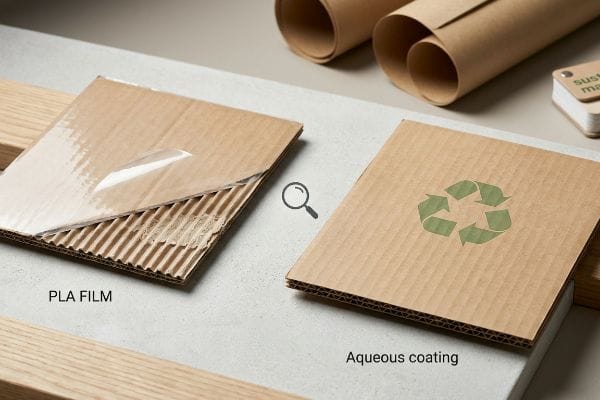
Auch wenn die Auswahl dieser spezifischen Oberflächen wie ein einfaches Abhaken einer Vorlage erscheint, ist die chemische Realität nachhaltiger Verpackungen hochkomplex.
Warum umweltfreundliche Displaymaterialien beim Recycling oft scheitern
Marken schreiben häufig PLA -Biokunststofflaminate (Polymilchsäure) in ihren Konstruktionsunterlagen vor, da sie davon ausgehen, dass diese auf Maisbasis hergestellte Folie die vollständige Einhaltung der Umweltstandards für ihre Werbeaktionen im Einzelhandel gewährleistet. Sie gehen davon aus, dass jede organisch klingende Schicht automatisch und problemlos die globalen Recyclingstandards erfüllt.
Es ist eine häufige Falle, in die selbst die wohlmeinendsten Markenmanager tappen. Ich überprüfte eine zurückgesendete Charge Verpackungen, bei der sich die klare, glänzende PLA-Folie während eines Aufschlusstests vollständig vom Karton gelöst hatte und einen klebrigen, gummiartigen Rückstand an meinen Händen hinterließ. PLA bildet eine feste, wasserabweisende Barriere(7) beim Standard-Recycling von Altpapier (OCC – Old Corrugated Containers). Das bedeutet, dass kommunale Recyclinghöfe die gesamte Verpackung oft ablehnen und direkt auf die Deponie bringen. Um dies zu beheben, entferne ich die festen Biokunststoffe und beschichte die bedruckten Grafiken mit einer flüssigen, wässrigen Beschichtung. Diese wasserbasierte Polymermatrix löst sich nahtlos in Standard-Papierbottichen(8), sodass die gesamte Struktur aus einem einzigen Material besteht und Ihre Kampagne zu 100 % über die Altpapiersammlung recycelbar ist.
| Häufiger Anfängerfehler | Die Profi-Lösung | Vorteil für die Verkaufsfläche |
|---|---|---|
| Verwendung von massiver PLA-Folie für glänzende Oberflächen | Eine flüssige, wässrige Beschichtung auftragen | Gewährleistet 100%ige Recyclingfähigkeit am Straßenrand |
| Angenommen, Biokunststoffe zersetzen sich irgendwo | Beschichtungen an Standard-OCC-Aufbereitung anpassen | Vermeidet die Ablehnung von kommunalem Recyclingmaterial |
| Schaffung von Mischmaterialstrukturen | Das Bauteil muss unbedingt aus einem einzigen Material bestehen | Beseitigung von Strafen für Verstöße gegen die Einhaltung der Vorschriften durch Einzelhändler |
Ich weigere mich, zuzulassen, dass Marken versehentlich einen Nachhaltigkeitsaufschlag zahlen, nur um dann ihre Produkte vernichten zu lassen. Die Abstimmung Ihrer Oberflächenbehandlungen auf reale Recyclingverfahren garantiert, dass Sie Ihre ökologischen Unternehmensziele erreichen, ohne die Haltbarkeit Ihrer Kampagne zu beeinträchtigen.
🛠️ Harveys Schreibtisch: Sind Ihre glänzenden Oberflächen versehentlich so, dass Ihre Wellpappendisplays nicht mehr recycelbar sind? 👉 Lassen Sie Ihre Beschichtung überprüfen ↗ – Sicher herunterladen. Bei Fragen können Sie mich gerne kontaktieren.
Was ist eine verkaufsfertige Palette?
Ein reibungsloser Übergang vom Lieferwagen in den Verkaufsraum ist unerlässlich. Dies erfordert eine präzise Planung des Gesamtkonzepts, das exakt den strengen Logistikparametern entspricht.
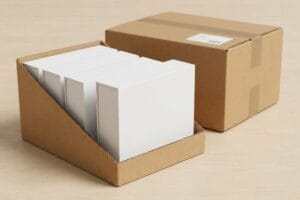
Eine verkaufsfertige Palette ist eine vormontierte Verkaufseinheit, die direkt vom LKW in den Verkaufsraum gestellt werden kann, ohne ausgepackt werden zu müssen. Diese Paletten sind mathematisch präzise konstruiert und passen nahtlos auf Standard-Holzgestelle. Dadurch haben Kunden sofortigen Zugriff auf die Waren, und der Arbeitsaufwand für die Verkäufer wird drastisch reduziert.
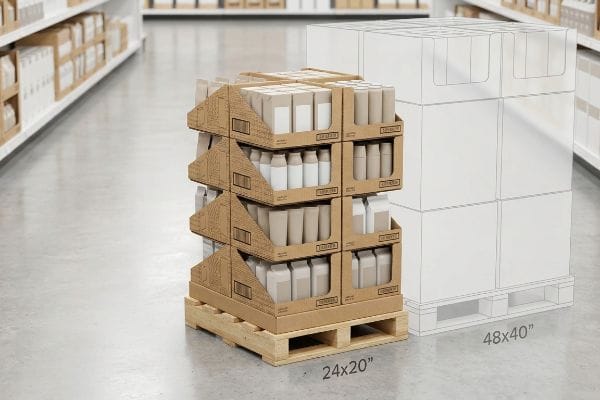
Eine riesige, voll bestückte Einheit in den Verkaufsraum zu bringen, ist logistisch ein enormer Erfolg, kollidiert aber häufig mit den räumlichen Gegebenheiten moderner Einzelhandelsregale.
Die räumliche Mathematik hinter verkaufsfertigen Paletten
Marketingteams präsentieren großen Einzelhändlern häufig großformatige , 1219 × 1016 mm große Bodenaufsteller , da sie davon ausgehen, dass ihre Kampagne eine massive, monopolisierte Präsenz erfordert. Sie entwerfen prachtvolle, hoch aufragende Konstruktionen, die in 3D-Rendering-Software fantastisch aussehen, ignorieren aber völlig die strikten Vorgaben zur Flächennutzung im Geschäft.
Es bremst den Schwung einer Produkteinführung, wenn ein Händler ein ansprechend gestaltetes Display kategorisch ablehnt, weil es den Durchgang von Einkaufswagen behindert. Ich erinnere mich noch gut an das schwere, kratzende Geräusch, als ein großes Display mit Gewalt zurück ins Lager gezerrt wurde, weil die Gangkreuzung einfach zu eng war. Um dieses Szenario zu vermeiden, sollten Sie Verkaufsflächen wie hochpreisige Immobilien betrachten: Sie brauchen nicht immer das Penthouse. Ich empfehle meinen Kunden daher, die Stellfläche zu verkleinern und die Einheiten an Standard- Viertelpaletten mit 609 × 508 mm (24 × 20 Zoll) anzupassen. So können zwei oder vier verschiedene Aktionsmarken perfekt auf einem einzigen GMA-Holzsockel (Grocery Manufacturers Association) platziert werden . Durch diese mathematische Unterteilung der Stellfläche ermöglichen Sie Filialleitern, die Flächennutzung optimal auszunutzen und garantieren so praktisch die Genehmigung Ihres verkleinerten Displays für einen Premium-Platz.
| Häufiger Anfängerfehler | Die Profi-Lösung | Vorteil für die Verkaufsfläche |
|---|---|---|
| Überdimensionierte Stellfläche 48×40 Zoll (1219×1016 mm),11 Fußabdrücke | Ingenieur für 24×20 Zoll (609×508 mm) Viertelpaletten12 | Sichert sich eine erstklassige Platzierung an einer stark frequentierten Stelle |
| Missachtung der Räumungsregeln im Einzelhandel | Unterteilen Sie die Hauptholzbasis | Verhindert Ausschuss im Lager |
| Erzwingen einer einzigen massiven Markenpräsenz | Teilen Sie die Geometrie mit komplementären Einheiten | Erhöht die Zustimmungsraten der Einzelhändler |
Entwerfen Sie für die starren räumlichen Vorgaben des Filialleiters, nicht für die des Marketingleiters. Die Verkleinerung der Geometrie bis in kleinste Schritte ist der entscheidende Faktor, um Ihre Produkte in die umsatzstärksten Regalgänge zu bringen.
🛠️ Harveys Schreibtisch: Sind Ihre aktuellen Ladenflächen zu groß, um die Vorgaben für große Einzelhandelsketten zu erfüllen? 👉 Fordern Sie Ihre Flächenanalyse an ↗ – Keine Formulare, die endlose Verkaufsgespräche auslösen. Nur echter Mehrwert.
Was sind Palettendisplays?
Das sind robuste, leistungsstarke Transportbehälter für Schüttgut. Sie tragen ein immenses dynamisches Gewicht und erfordern daher eine einwandfreie physische Ausrichtung zwischen der internen Produktladung und dem äußeren Wellblechrahmen.
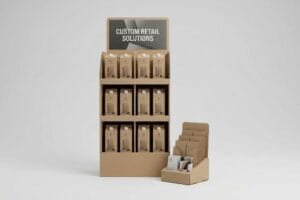
Palettendisplays sind großflächige, fest auf einem Holzsockel verankerte Warenträger aus Wellpappe für die Präsentation großer Warenmengen im Einzelhandel. Gefertigt aus doppel- oder dreilagigem Karton, tragen sie hohe, dynamische Lasten und kombinieren gut sichtbare grafische Aufsteller mit robusten Stützpfeilern, um den anspruchsvollen Bedingungen in Großmärkten und der sorgsamen Handhabung in der Lieferkette standzuhalten.
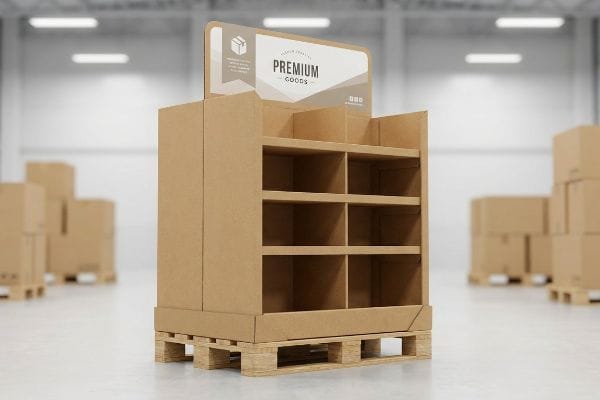
Doch die Theorie allein reicht nicht aus, wenn die Maschinen in Betrieb genommen werden und Containerladungen aus Übersee bis zur Decke gestapelt werden.
Warum Standard-Palettendisplays in der Fabrikhalle scheitern
Einkaufsteams versuchen routinemäßig, die Abmessungen von Umkartons zu maximieren, um möglichst viele Verbrauchereinheiten auf einem einzigen Holzsockel unterzubringen. Sie vertrauen dabei den Rohdaten des Kantenstauchtests (ECT) ihres Wellpappenlieferanten und gehen davon aus, dass die dicke, stabile Pappe die Ware automatisch schützt, unabhängig davon, wie sie physisch auf dem Holz aufliegt.
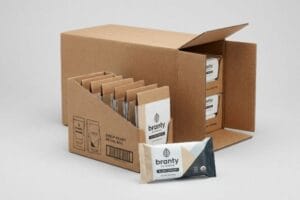
In meinem Betrieb sehe ich regelmäßig die verheerenden Folgen, die sich durch die Vernachlässigung der vertikalen Lastverteilung bei Transporttests vor der Serienproduktion ergeben. Wenn ich eingehende Testmuster messe, verliert ein Umkarton, der nur 11,4 mm (0,45 Zoll) über eine Standard-GMA-Palette hinausragt, fast seine gesamte Druckfestigkeit. Ein Wellpappkarton bezieht bis zu 60 % seiner Festigkeit im Box Compression Test (BCT) direkt aus der vertikalen Ausrichtung seiner vier Eckverstärkungen. Wenn diese Ecken über die Holzplatte hinausragen, tragen sie keine Last, wodurch sich das gesamte Gewicht auf die ungestützten Mittelplatten verlagert. Die Folge ist ein starkes Ausbeulen des Bodens , das eine sofortige Ablehnung durch den Händler und wochenlange, kostspielige manuelle Nachbearbeitung nach sich zieht. Ich behebe dieses Problem, indem ich in unserer CAD-Software (Computer-Aided Design) einen strikten Null-Überstand des Rahmens erzwinge und die maximal zulässige Kartonfläche künstlich um genau 12,7 mm (0,5 Zoll) verkleinere, um sicherzustellen, dass die Eckverstärkungen niemals die Holzplatte verlassen. Durch die Einhaltung dieser millimetergenauen Toleranz gewährleiste ich, dass Ihre Einheiten den Transport in doppelter Stapelung unbeschadet überstehen, wodurch Transportschäden durch Quetschungen vollständig ausgeschlossen und Ihre Kampagnenmarge geschützt wird.
| Häufiger Anfängerfehler | Die Profi-Lösung | Vorteil für die Verkaufsfläche |
|---|---|---|
| Dimensionen jenseits der Holzgrenze erweitern | Verkleinern Sie den CAD-Footprint um 0,5 Zoll (12,7 mm)16 | Beseitigt Quetschschäden der unteren Stufen |
| ausschließlich auf Basis der Rohdaten des ECT-Boards | Richten Sie die vier Eckpunkte der Struktur exakt senkrecht aus | Stellt 60 % der BCT-Tragfähigkeit wieder her17 |
| Überhang der GMA-Palette um Bruchteile | Erzwinge einen strikten Begrenzungsrahmen ohne Überhang | Verhindert kostspielige Rückbuchungen von Einzelhändlern |
Ich verlasse mich auf exakte Geometrie, nicht auf Hoffnung. Die perfekte Verankerung der vertikalen Last im Holz gewährleistet, dass Ihre Schwerlastkonstruktionen den harten Realitäten der Lagerlogistik standhalten, ohne unter ihrem eigenen Gewicht einzuknicken.
🛠️ Harveys Schreibtisch: Wissen Sie, ob Ihre aktuellen Master-Shipping-Dateien heimlich über den Rand des Holzes hinausragen? 👉 Schicken Sie mir Ihre Stanzdatei ↗ — Ich überprüfe die Berechnungen, bevor Sie Ihr Budget für die Massenproduktion verschwenden.
Abschluss
Sie können zwar einen günstigeren Anbieter wählen, aber wenn Ihre 32ECT-Platten aufgrund einer zu großen Grundfläche über das Holz hinausragen, führt dies zum Zusammenbrechen des Behälters, was sofortige Reklamationen seitens der Händler und somit einen Totalverlust Ihrer Gewinnspanne zur Folge hat. Genau dieses Datenblatt verwenden meine zehn wichtigsten Einzelhandelskunden, um Reklamationen beim Druck zu vermeiden. Hören Sie auf, bei den vertikalen Toleranzen zu raten, und lassen Sie mich Ihre Konstruktionsdateien persönlich durch meinen kostenlosen Stanzlinien-Audit führen, um schwerwiegende Maßfehler vor der Produktion aufzudecken.
„Vollbleichter Karton – Wikipedia“, https://en.wikipedia.org/wiki/Solid_bleached_board. [Industriestandards für hochwertige Verpackungen bestätigen, dass gebleichter Karton als Premium-Substrat für überlegene Helligkeit und Tintenaufnahme in Luxus-Verkaufsdisplays verwendet wird]. Nachweisfunktion: Technische Spezifikation; Quellentyp: Materialwissenschaftliches Handbuch. Unterstützung: Verwendung von gebleichtem Karton für Außenschichten. Anwendungsbereich: Speziell für Luxusanwendungen. ↩
„Kraftpapier vs. Testliner: Ein strategischer Leitfaden zu Kosten und Leistung“, https://packagemanufacturer.com/kraft-paper-vs-testliner/. [Technische Spezifikationen für Linerboards beschreiben die Verwendung von recyceltem Testliner als standardmäßiges, kostengünstiges Medium zur strukturellen Unterstützung von Wellpappenmaterialien]. Nachweisfunktion: Technische Spezifikation; Quellentyp: Handbuch für Verpackungstechnik. Begründung: Verwendung von recyceltem Testliner zur Erhöhung der Kernfestigkeit. Anmerkung: Bezieht sich auf Standard-Recyclingpapiersorten. ↩
„Marktprognose für Kraftliner-Karton zeigt steigendes Wachstum bis 2035 …“, https://www.indexbox.io/blog/kraft-liner-board-paper-market-demand-to-accelerate-through-2035-driven-by-e-commerce-and-sustainability/. [Eine materialwissenschaftliche Quelle zu Wellpappenverpackungen würde bestätigen, dass die Kombination aus Corrugated Containers News Back (CCNB) und Frischfaser-Kraftpapier eine überlegene Druckfestigkeit bietet und so ein Durchbiegen verhindert]. Nachweisfunktion: Technische Spezifikation; Quellentyp: Branchennorm. Begründung: Verwendung von CCNB und Frischfaser-Kraftpapier zur Stabilisierung. Anwendungsbereich: Speziell für stark beanspruchte Verkaufsdisplays. ↩
„[PDF] Vorrichtung zur Bewertung der Stabilität von Wellpappe unter Last …“, https://www.fpl.fs.usda.gov/documnts/pdf1994/gunde94a.pdf. [Eine ingenieurwissenschaftliche Studie zu Papiereigenschaften erklärt den Zusammenhang zwischen der Porosität der Deckschicht und der Beständigkeit der Pappe gegen hygroskopische Ausdehnung bzw. Durchhängen]. Nachweisfunktion: Kausalzusammenhang; Quellentyp: Fachzeitschrift. Belege: Zusammenhang zwischen Porosität und Stabilität des Untergrunds. Anmerkung zum Untersuchungsbereich: Beschränkt auf die Auswirkungen der Umgebungsfeuchtigkeit. ↩
„Die Formel für Wellpappenverpackungen, die den CO₂-Fußabdruck um … reduziert“, https://www.theboxery.com/blog/the-corrugated-packaging-formula-that-cuts-carbon-footprint-by-40/?srsltid=AfmBOopfVkqCCs8n0cTAd_FsGg-i15Nd9BZj-LEev-gSiHWYeuRQtgH-. [Fertigungsrichtlinien für die Wellpappenherstellung beschreiben detailliert, wie kontrollierte Aushärtungsprozesse Planheit gewährleisten und Materialverschnitt minimieren]. Nachweisfunktion: Prozessvalidierung; Quellentyp: Fertigungshandbuch. Unterstützt: Abfallreduzierung durch Planhärtung. Anwendungsbereich: Gilt für die Produktionsphase der Kartonherstellung. ↩
„Biokunststoffe für Lebensmittelverpackungen: Umweltauswirkungen, Trends und …“, https://pmc.ncbi.nlm.nih.gov/articles/PMC9563026/. [Eine maßgebliche Quelle würde die chemische Zusammensetzung von PLA detailliert beschreiben und erklären, warum diese Biokunststoffe häufig herkömmliche PET-Recyclingströme verunreinigen]. Nachweisfunktion: Technische Verifizierung; Quellentyp: Fachzeitschrift für Materialwissenschaften oder Abfallwirtschaftsnorm. Unterstützt: Die Behauptung, dass Biokunststoffe das Recycling erschweren. Anmerkung: Unterscheidet zwischen industrieller Kompostierung und Wertstoffsammlung. ↩
„Vereinigte Wertstoffe – International Paper“, https://www.internationalpaper.com/recycling/recycling-materials. [Technische Studien zu Polymilchsäure (PLA) in Papierströmen erklären, wie deren hydrophobe Eigenschaften die Fasertrennung beim Hydropulping behindern]. Nachweisfunktion: Technische Verifizierung; Quellentyp: Abfallwirtschaftsstudie. Unterstützt: Das Scheitern von PLA beim Altpapierrecycling. Anmerkung zum Umfang: Fokus auf kommunale Recyclingkapazitäten. ↩
„[PDF] Wiederaufbereitbarkeit von beschichtetem Wellkarton – TAPPI.org“, https://imisrise.tappi.org/download.aspx?key=91OCT079. [Richtlinien für nachhaltige Verpackungen legen fest, dass wasserbasierte Beschichtungen so konzipiert sein müssen, dass sie sich in Wasser dispergieren und dadurch eine hohe Wiederaufbereitbarkeit gewährleisten]. Nachweisfunktion: Technische Verifizierung; Quellentyp: Verpackungsindustriestandard. Unterstützt: Eignung von wässrigen Beschichtungen für das Recycling. Anmerkung zum Anwendungsbereich: Es wird von Standardbedingungen für die industrielle Zellstoffaufbereitung ausgegangen. ↩
„48×40 GMA-Paletten | Größter Palettenhersteller & -lieferant“, https://www.palletone.com/products/gma-pallets/. [Ein Branchenstandard in der Logistik bestätigt, dass 48×40 Zoll die Standardabmessungen für GMA-Paletten im nordamerikanischen Einzelhandel sind]. Nachweisfunktion: Technische Spezifikation; Quellentyp: Logistikstandard. Unterstützt: Standardpalettengröße. Anwendungsbereich: Gilt speziell für den nordamerikanischen Markt. ↩
„[PDF] 40-Zoll-GMA-Holzpaletten – Southern Research Station“, https://www.srs.fs.usda.gov/pubs/VT_Publications/05t10.pdf. [Branchenstandards der Grocery Manufacturers Association definieren die Abmessungen und Tragfähigkeiten der Standard-GMA-Palettenbasis]. Nachweisfunktion: Faktenprüfung; Quellentyp: Organisationsstandard. Unterstützung: Standardisierte Palettenabmessungen. Anwendungsbereich: Speziell für die nordamerikanische Lebensmittelbranche. ↩
„Wärmebehandelte Holzpalette GMA – 48 x 40 Zoll H-1260 – ULINE“, https://www.uline.com/Product/Detail/H-1260/Pallets/Heat-Treated-Wood-GMA-Pallet-48-x-40. [Die Logistikstandards der Grocery Manufacturers Association (GMA) definieren 48 × 40 Zoll als Standardpalettengröße in Nordamerika]. Nachweisfunktion: Technische Spezifikation; Quellentyp: Branchenstandard. Unterstützung: Identifizierung der Standardpalettengröße. Anwendungsbereich: Hauptsächlich anwendbar auf die nordamerikanische Logistik. ↩
„Palettendisplay-Typen: Ganze, halbe und Viertelpaletten – GreenDot Packaging“, https://greendotpackaging.com/understanding-pallet-display-types-full-half-and-quarter-pallet-displays/. [Richtlinien für Einzelhandelsverpackungen legen 24 × 20 Zoll als Standardabmessung für Viertelpaletten fest, um die Flächennutzung zu optimieren]. Nachweisfunktion: Technische Spezifikation; Quellentyp: Logistikhandbuch. Unterstützt: Optimale Abmessungen für den Einzelhandel. Anwendungsbereich: Speziell für verkaufsfertige Verpackungen (DRP). ↩
„Kantenstauchprüfung: Warum sie für Wellpappenverpackungen wichtig ist“, https://www.ernestpackaging.com/buzz/packaging-technology/importance-of-edge-crush-test-for-corrugated-packaging/. [Technische Normen von Organisationen wie TAPPI oder ASTM definieren die Kantenstauchprüfung als primäres Maß für die Druckfestigkeit von Wellpappe]. Nachweisfunktion: Technische Spezifikation; Quellentyp: Industriestandard. Unterstützt: Die Verwendung der Kantenstauchprüfung als quantitative Messgröße für die Tragfähigkeit von Verpackungen. Anwendungsbereich: Misst die Festigkeit senkrecht zu den Wellenrichtungen. ↩
„Vorhersagemodellierung des Einflusses von Palettenüberstand auf die Druckfestigkeit von Kartons“, https://vtechworks.lib.vt.edu/items/d6fb70fe-bf11-40d2-a44c-3ba7918d06e3. [Forschungen im Bereich der Verpackungswissenschaft belegen den drastischen Abfall der Tragfähigkeit, wenn die Kartonecken nicht von der Palettenfläche gestützt werden]. Belegfunktion: Tatsachenbehauptung; Quellentyp: Studie zur Verpackungsforschung. Belege: Der Zusammenhang zwischen Palettenüberstand und Druckversagen. Anmerkung: Der genaue Festigkeitsverlust variiert je nach Kartongeometrie. ↩
„Abschätzung der Druckfestigkeit von Wellpappkartons …“, https://pmc.ncbi.nlm.nih.gov/articles/PMC8467740/. [Verpackungstechnische Normen quantifizieren den prozentualen Anteil der Druckfestigkeit eines Kartons, der sich aus der vertikalen Ausrichtung seiner Ecken ergibt]. Nachweisfunktion: Technische Spezifikation; Quellentyp: Industrienorm/Ingenieurhandbuch. Begründung: Die entscheidende Bedeutung der Eckverstärkung für die Tragfähigkeit. Anmerkung: Abweichungen können je nach Wellenprofil und Kartonqualität auftreten. ↩
„Palettenregalabstände – Interlake Mecalux“, https://www.interlakemecalux.com/warehouse-manual/warehouse-design/pallet-racking-clearances. [Branchennormen für die Schüttgutlagerung empfehlen bestimmte Maßabweichungen, um die Materialstärke der Paletten zu berücksichtigen und Kantenquetschungen zu vermeiden]. Nachweisfunktion: Technische Spezifikation; Quellentyp: Industriedesignrichtlinie. Unterstützt: Die Verwendung eines 12,7 mm (0,5 Zoll) dicken Puffers, um Beschädigungen der unteren Regalebenen zu verhindern. Anwendungsbereich: Gilt speziell für Standard-GMA-Palettenabstände. ↩
„[PDF] Einfluss der Steifigkeit von Palettendeckbrettern und der Einheitslastfaktoren auf …“, https://www.unitload.vt.edu/content/dam/unitload_vt_edu/graduate-research-and-subpages-pictures-and-docs/thesis-and-dissertations-/Baker%20-%20ETD%20-%20Effect%20of%20pallet%20deckboard%20stiffness%20and%20unit%20load%20factors%20on%20corrugated%20box%20compression%20strength.pdf. [Technische Quellen der Verpackungstechnik quantifizieren den Verlust der Festigkeit im Box Compression Test (BCT) bei nicht ausgerichteten Ecken]. Nachweisfunktion: Technische Validierung; Quellentyp: Handbuch für Verpackungstechnik. Unterstützt: Die Behauptung, dass eine vertikale Ausrichtung die Tragfähigkeit signifikant wiederherstellt. Anmerkung: Die BCT-Wiederherstellungsprozentsätze können je nach ECT-Klasse variieren. ↩