
Holiday retail shelves are a battlefield of competing visuals. If your holiday package design relies on outdated structural engineering, you risk losing shopper attention and suffering massive seasonal chargebacks.
The latest holiday package design trend is the strategic shift toward mono-material structures, interactive digital elements, and eco-friendly soy inks. Current industry standards prioritize fully recyclable corrugated board, replacing mixed plastics with smart paper engineering to consistently meet strict global retail requirements while maximizing festive visual shelf impact.

Let's explore exactly how these seasonal shifts translate into physical retail execution on the factory floor.
Which is the most recent new trend in packaging and labeling?
Merging sleek labels with structural packaging often creates friction. The newest movement focuses on elastic surface treatments that survive the physical stress of fast-paced fulfillment centers.
The most recent new trend in packaging and labeling is the integration of elastic anti-crack film laminations. This flexible polymer layer moves harmoniously with the corrugated substrate rather than resisting it, preventing structural micro-fractures during high-speed automated assembly and keeping the product barrier entirely intact.
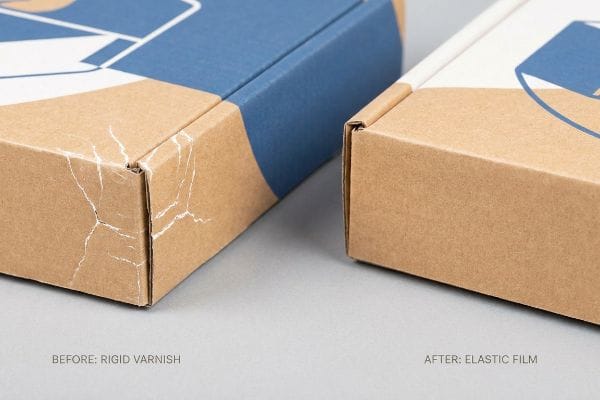
Understanding the chemistry behind this surface treatment changes how you approach folding cartons.
Preventing Micro-Fractures in Modern Packaging and Labeling
Many design teams assume that standard rigid litho-varnishes can simply be ported over to new, flexible holiday packaging structures. They apply heavy gloss coatings to thick substrates, expecting a premium finish under harsh fluorescent store lighting. This theory completely ignores the physical reality of automated folding machinery, which demands extreme surface elasticity to survive tight mechanical bends1.
I see this blind spot constantly when buyers transition to hybrid packaging. You hear a sickening 'snap'on the folding line as the dried ink and rigid varnish literally fracture along the score lines. Even experienced procurement teams get caught off guard when these micro-fractures expose raw paperboard, slowing down the assembly line by an estimated 30%2. The fix is switching to an elastic polymer film that stretches with the 180-degree header folds3, completely eliminating transit damages and keeping your brand image flawless.
| Common Rookie Mistake | The Pro Fix | Retail-Floor Benefit |
|---|---|---|
| Using standard rigid varnish on folds | Apply elastic anti-crack film4 | Prevents ugly white edge fractures |
| Ignoring automated assembly stress | Specify 180-degree bend tolerances5 | Stops co-packing line jams |
| Exposing raw material on score lines | Use polymer barrier lamination6 | Maintains moisture protection |
I always replace standard varnishes with high-elasticity films for complex holiday structures. This single material pivot completely eliminates surface cracking during automated folding, keeping your brand presentation pristine and drastically reducing expensive waste on the factory floor.
🛠️ Harvey's Desk: Are your printed labels snapping and cracking when folded around sharp corners? 👉 Get A Free Label Stress Test ↗ — Direct access to my desk. Zero automated sales spam, I promise.
What is the trend in packaging in 2026?
Future packaging regulations are forcing brands to rethink structural joints. By 2026, relying on mixed materials will trigger severe penalties from major retailers and eco-conscious shoppers alike.
A major trend in packaging in 2026 is the strict transition toward mono-material mandates. Brands are completely eliminating plastic clips and metal fasteners, relying entirely on advanced origami-style paper locks to secure heavy structures, ensuring total curbside recyclability without compromising dynamic load capacities or shelf stability.
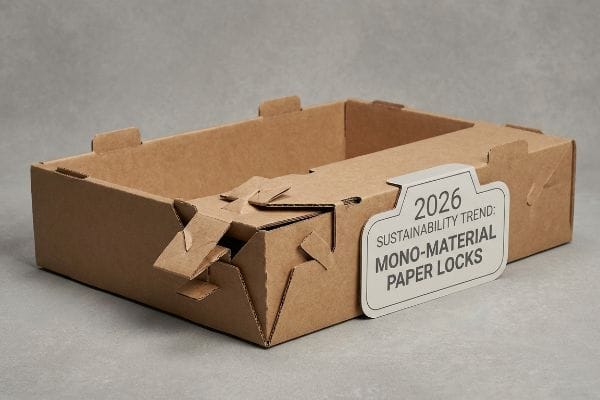
This shift away from plastics requires a totally different approach to structural math.
Why Origami-Style Locks Dominate the Trend in Packaging in 2026
Standard retail merchandisers historically relied on generic plastic clips to hold heavy display trays together. Design agencies often specify these fasteners because they require very little structural engineering to implement on a basic dieline. However, as sustainability taxes and strict recycling mandates increase globally7, these mixed-material components are becoming massive liabilities for fast-moving consumer goods.
Clients frequently ask me if paper joints can actually hold 50 lbs (22.6 kg)8 of holiday merchandise. The truth is, relying on plastic clips is a shortcut that causes headaches when store clerks slice their fingers trying to dismantle them. I've watched floor workers struggle to yank out sharp plastic tabs, eventually ripping the entire corrugated cardboard base and ruining the presentation. By engineering interlocking origami-style tabs, we eliminate the plastic completely, creating a seamless assembly experience that instantly complies with zero-waste retail initiatives9.
| Common Rookie Mistake | The Pro Fix | Retail-Floor Benefit |
|---|---|---|
| Using plastic binding clips | Engineer origami-style paper locks | 100% curbside recyclable10 |
| Ignoring mixed-material penalties | Adopt a mono-material mandate | Avoids retailer rejection11 |
| Designing difficult teardowns | Use friction-fit folding tabs12 | Speeds up end-of-life disposal |
I refuse to use plastic fasteners on modern corrugated structures. Designing intelligent paper locks not only future-proofs your compliance strategy, but it completely removes the headache of mixed-material sorting, saving your retail partners hours of manual labor.
🛠️ Harvey's Desk: Wondering if your current floor display will violate upcoming retail sustainability rules? 👉 Request A Structural Compliance Check ↗ — Download safely. My inbox is open if you have questions later.
What is the trend color packaging in 2026?
Festive colors drive impulse purchases, but replicating digital screen colors onto raw cardboard is notoriously difficult. The future of visual impact relies on aggressive ink saturation techniques.
The primary trend color packaging in 2026 is the abandonment of optical CMYK blending in favor of exact spot color flooding. This technique replaces overlapping halftone dots with precisely mixed solid pigments, guaranteeing high-contrast, muddy-free brand logos that pop under harsh fluorescent retail lighting environments.
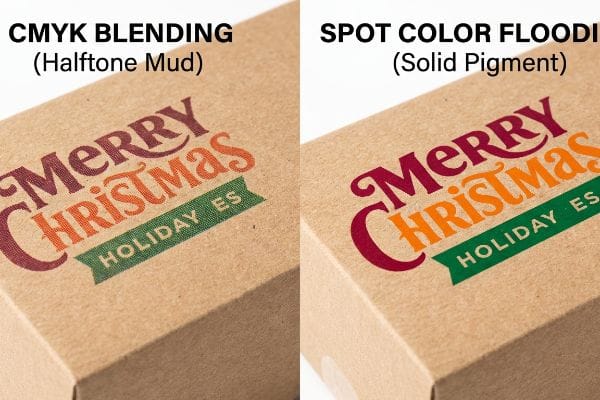
Let me explain why relying on your office printer to judge seasonal color accuracy is a dangerous game.
Preventing Halftone Mud in Trend Color Packaging in 2026
Graphic teams frequently convert solid corporate logos into standard CMYK (Cyan, Magenta, Yellow, Key/Black) process formats, assuming the printing press will seamlessly match their digital screens. They build intricate holiday patterns in their software and approve digital proofs without considering the raw substrate. This optical blending works perfectly on coated magazine paper but fails miserably on unsealed, porous structures13.
Think of printing four-color process dots on raw testliner like trying to paint a detailed watercolor on a paper towel. The liquid ink bleeds uncontrollably into the thirsty paper fibers14, turning a crisp holiday red into a washed-out, muddy mess. A good rule of thumb is to always use a solid PMS (Pantone Matching System) flood for your primary logo15 instead of relying on tiny, overlapping dots. This simple pivot ensures your seasonal graphics deliver a dense, vibrant punch that grabs shopper attention from 20 feet away.
| Common Rookie Mistake | The Pro Fix | Retail-Floor Benefit |
|---|---|---|
| Relying on CMYK for solid logos | Use a dedicated PMS spot color16 | Guarantees exact brand color match |
| Ignoring substrate absorbency | Flood pigment on porous boards17 | Stops logo from looking washed out |
| Judging color on a backlit screen | Approve physical spectrophotometer swatches18 | Prevents lighting visual shifts |
I always force a spot color flood protocol for primary brand elements on raw board. Replacing unpredictable dot patterns with a single mixed pigment completely eliminates visual mud, protecting your brand equity and boosting impulse visibility on crowded shelves.
🛠️ Harvey's Desk: Are your signature brand colors looking dull or pixelated on your current shipping boxes? 👉 Claim Your Prepress Color Audit ↗ — No forms that trigger endless sales calls. Just pure value.
What is new in packaging?
Beyond automated machinery and sustainable materials, the biggest shift is happening in prepress math. Tightening up digital file tolerances is now mandatory for large-scale production.
What is new in packaging is the mandatory implementation of extreme litho-shift bleed margins. Facilities now require a minimum 0.5-inch extension past the cut line, acting as an engineered safety net against physical lamination shift to completely eliminate exposed raw edges on finished holiday displays.
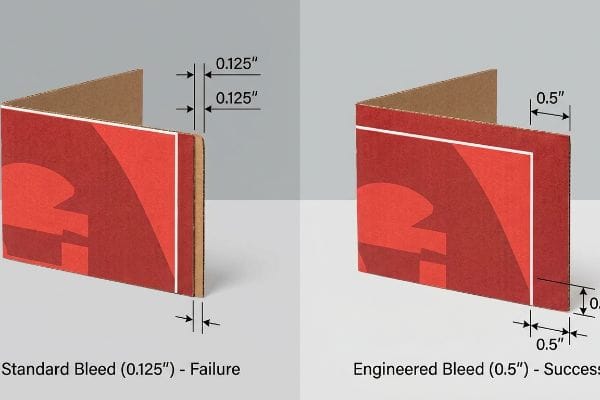
But knowing the theory isn't enough when the machines start running large holiday batches.
Why Standard Bleeds Fail on the Factory Floor
Independent designers frequently apply standard commercial print bleeds of exactly 0.125 inches (3.17 mm)19 to their corrugated display files. They treat a massive floor stand like a standard business card, assuming automated cutting tables possess infinite microscopic precision. This mathematically flawless assumption completely ignores the violent, high-speed physical realities of gluing thick, heavy paper components together.
This isn't just theory—I see this happen on the testing floor when we run litho-lamination on heavy B-flute boards. The wet, sticky PVA glue causes a natural, microscopic material shift of about 0.11 inches (2.8 mm)20 during the automated mounting process. When a file only has a tiny commercial bleed, that natural shift exposes ugly, raw brown cardboard flashing right along the primary folded edge, ruining the premium holiday vibe. By enforcing a ruthless 0.5-inch (12.7 mm) bleed margin in prepress21, I mathematically swallow that mechanical tolerance, preventing a massive aesthetic failure that could trigger a full retailer rejection and wipe out your entire Q4 profit margin.
| Common Rookie Mistake | The Pro Fix | Retail-Floor Benefit |
|---|---|---|
| Using 3mm commercial print bleed | Mandate 12.7mm litho-lam bleed | Eliminates ugly raw cardboard edges |
| Assuming perfect machine alignment | Engineer a mechanical safety net | Stops full-batch rejection risks |
| Treating B-flute like flat paper | Calculate physical board shift | Ensures premium holiday aesthetics |
I strictly reject incoming artwork files that fail this bleed threshold before printing plates are even made. Forcing designers to stretch their backgrounds is a minor adjustment that completely neutralizes the risk of exposed edges during mass assembly.
🛠️ Harvey's Desk: Do you know the exact mechanical shift tolerance of your current corrugated supplier's lamination machine? 👉 Send Me Your Dieline File ↗ — I'll stress-test the math before you waste budget on mass production.
Conclusion
You can specify the most festive graphics imaginable, but when standard rigid varnishes fracture on the folding line, exposing raw paperboard and slowing down the assembly line by an estimated 30%, your seasonal profit margin disappears. Over 500 brand managers use my prepress checklist to avoid these exact fatal early-stage mistakes. Stop guessing on mechanical tolerances and let me personally audit your artwork through my Free Dieline Pre-Flight Audit ↗ to catch these invisible friction points before you print.
"Effects of coating composition and folding direction on … – HERO – EPA", https://hero.epa.gov/reference/4671762/. [Industrial engineering documentation on packaging materials would verify the mechanical stress placed on coatings during automated folding and the resulting need for elasticity to prevent failure]. Evidence role: technical verification; source type: packaging engineering handbook. Supports: the requirement for flexible surface treatments in automated assembly. Scope note: focused on high-speed mechanical folding processes. ↩
"Efficiency and Automation: The Technological Basis of Modern …", https://www.lantech.com/efficiency-and-automation-the-technological-basis-of-modern-packaging-lines/. [An industry operational report or white paper quantifying the productivity loss caused by packaging material failure and manual intervention on automated lines]. Evidence role: quantitative metric; source type: industry report. Supports: the economic impact of packaging micro-fractures. Scope note: results may vary based on the level of automation. ↩
"Stretch Film – Intertape Polymer Group", https://www.itape.com/products/packaging-films/packaging-films-stretch-film/. [Technical documentation or material science research detailing the elongation properties of elastic polymers used to prevent cracking during high-angle substrate folding]. Evidence role: technical specification; source type: material science paper. Supports: the mechanical efficacy of elastic films in hybrid packaging. Scope note: applies specifically to flexible polymer laminations. ↩
"Combined Crack Initiation and Crack Growth Model for Multi-Layer …", https://pmc.ncbi.nlm.nih.gov/articles/PMC9100980/. [An authoritative source on packaging materials would verify that elastic films prevent the structural failure and whitening that occurs when rigid varnishes are folded]. Evidence role: Technical validation; source type: Material science journal. Supports: Use of elastic films to prevent edge fractures. Scope note: Effectiveness depends on the substrate and film thickness. ↩
"5 Ways to Stop Your Autobag® Machine from Jamming", https://www.adsure-autopacking.com/post/5-ways-to-stop-your-autobag-machine-from-jamming-the-operator-s-guide-to-roll-handling. [Engineering standards for automated packaging would demonstrate that precise bend tolerances reduce structural misalignment during high-speed assembly]. Evidence role: Process optimization proof; source type: Packaging engineering handbook. Supports: Reduction of co-packing line jams via bend tolerances. Scope note: Applicable specifically to automated assembly systems. ↩
"Thin Laminate Films for Barrier Packaging Application – HERO – EPA", https://hero.epa.gov/reference/1772530/. [Technical specifications for barrier coatings would confirm that polymer lamination prevents moisture ingress at vulnerabilities created by score lines]. Evidence role: Material performance validation; source type: Technical data sheet. Supports: Use of polymer barriers for moisture protection. Scope note: Specific to moisture-sensitive packaging materials. ↩
"What's New in Packaging Policy? Packaging Policy Roundup", https://sustainablepackaging.org/2026/04/29/packaging-policy-news/. [An authoritative report on global environmental legislation would document the rise of plastic taxes and extended producer responsibility (EPR) mandates targeting non-recyclable mixed materials]. Evidence role: corroboration; source type: regulatory report; Supports: the claim that mixed-material fasteners are becoming financial and legal liabilities. Scope note: Primary focus on EU and North American regulatory frameworks]. ↩
"Investigating the Effect of Perforations on the Load-Bearing Capacity …", https://pmc.ncbi.nlm.nih.gov/articles/PMC11396172/. [Technical specifications from packaging engineering standards would verify the maximum weight capacity of reinforced paper-based interlocking joints]. Evidence role: Technical verification; source type: Engineering manual or materials science study. Supports: The structural viability of mono-material joints for heavy loads. Scope note: Load capacity varies by paper grade and fold geometry. ↩
"Georgia's 2026 Plastic Ban: What B2B Buyers Need to Know About …", https://www.bioleaderpack.com/georgias-2026-plastic-ban-what-b2b-buyers-need-to-know-about-sustainable-packaging-solutions/. [Sustainability reports from major retailers or global packaging alliances would outline the specific criteria for zero-waste compliance regarding mixed-material elimination]. Evidence role: Regulatory alignment; source type: Corporate sustainability report. Supports: The strategic necessity of eliminating plastic fasteners. Scope note: Compliance criteria may vary by region and retailer. ↩
"Considerations for the Removal of Fasteners from Archival Documents", https://www.nps.gov/articles/000/conserve-o-gram-19-5-considerations-for-the-removal-of-fasteners-from-archival-documents.htm. [An authoritative source on waste management standards would confirm that mono-material paper structures are fully curbside recyclable whereas plastic clips create contamination]. Evidence role: technical verification; source type: industry recycling guidelines. Supports: the benefit of origami-style locks. Scope note: Recyclability depends on local municipal facility capabilities. ↩
"Plastic packaging laws harm small shops – New York Daily News", https://www.nydailynews.com/2026/04/29/plastic-packaging-laws-harm-small-shops/. [Industry reports on sustainable packaging regulations would document specific retailer policies that penalize or reject mixed-material packaging to meet 2026 sustainability goals]. Evidence role: market trend verification; source type: retail policy analysis. Supports: the necessity of a mono-material mandate. Scope note: Specifics vary by retailer and geographic region. ↩
"The Truth About Compostable Packaging: Why It's Not … – EcoEnclose", https://www.ecoenclose.com/blog/the-truth-about-compostable-packaging?srsltid=AfmBOoo2lK-Aeo5wBA8lEeNTZgKQ4rc5dXcDKBUVgRTNhPTlGrMKObhI. [Engineering studies on sustainable packaging design would demonstrate how friction-fit mechanisms reduce disassembly time for end-of-life disposal compared to adhesive or plastic fasteners]. Evidence role: design efficiency verification; source type: technical engineering study. Supports: the benefit of friction-fit tabs. Scope note: Focuses on manual consumer teardown speed. ↩
"CMYK Printing Guide: Achieve Vibrant and Accurate Colors", https://www.epackprinting.com/support/understanding-cmyk/. [Technical documentation on ink-substrate interaction demonstrates that unsealed, porous materials lead to significant dot gain and pigment absorption, compromising color purity]. Evidence role: technical verification; source type: printing industry standard. Supports: the failure of CMYK blending on porous surfaces. Scope note: specifically relates to non-coated cardboard substrates]. ↩
"[PDF] 1. Dot gain is the increase of halftone dot sizes as ink absorbs into …", https://www.coloradomesa.edu/art/documents/student-resources/study-guide-2019.pdf. [Technical documentation on ink absorption and dot gain would confirm how porous substrates like raw testliner cause ink to spread and blur. Evidence role: technical validation; source type: printing manual. Supports: the cause of 'muddy'colors on raw cardboard. Scope note: applicable to uncoated paper.] ↩
"Spot Color vs CMYK for Packaging Design – Which One's Better?", https://stampaprints.com/blog/spot-color-vs-cmyk-for-packaging/?srsltid=AfmBOooE4vRrdoMq-JPWrl7tRmFf6SKuA-winpoDSB-9tfLXePYDDhHU. [Printing standards specify that solid spot colors provide superior opacity and color saturation on absorbent materials compared to halftone process dots. Evidence role: industry standard; source type: color management guide. Supports: the recommendation for PMS flooding over CMYK. Scope note: focusing on logo visibility and brand consistency.] ↩
"CMYK vs. Spot Colors in Packaging Printing", https://meyers.com/meyers-blog/cmyk-vs-spot-colors-in-packaging-printing-what-cpg-brands-need-to-know/. [Industry printing standards explain how Pantone Matching System (PMS) spot colors ensure exact color reproduction across different substrates compared to CMYK process printing]. Evidence role: technical validation; source type: industry standard manual. Supports: guarantee of exact brand color match. Scope note: Applies to offset and flexographic printing processes. ↩
"Coatings for Corrugated Packaging – Industrial Print Magazine", https://industrialprintmagazine.com/coatings-for-corrugated-packaging-improving-adhesion-and-print-quality/. [Technical documentation on ink saturation describes how increasing ink density or using flood coats prevents the substrate from absorbing ink and dulling the color]. Evidence role: process verification; source type: technical printing manual. Supports: prevention of washed-out logos on porous cardboard. Scope note: Specific to uncoated or recycled paperboard. ↩
"Spectrodensitometers for Packaging Color Accuracy and Consistency", https://sensing.konicaminolta.us/us/blog/spectrodensitometers-for-packaging-color-accuracy-and-consistency/. [Colorimetry research demonstrates that spectrophotometers measure light reflection to provide objective numerical color data, eliminating the variance inherent in RGB backlit screens]. Evidence role: technical validation; source type: scientific study. Supports: prevention of lighting-induced visual shifts. Scope note: Relates to Delta E color difference measurement. ↩
"Understanding Printer Bleed for Perfect Prints – Printing Partners", https://www.printingpartners.net/printing-knowledge-library/what-is-printer-bleed/. [A technical printing manual or industry standard guide will verify that 0.125 inches is the conventional baseline requirement for commercial print bleeds]. Evidence role: factual verification; source type: technical standard. Supports: industry standard for bleeds. Scope note: generally applies to small to medium format print. ↩
"LithoFlute Litho-Laminated Heavyweight Cartons", https://www.graphicpkg.com/products/lithoflute-litho-laminated-heavyweight-cartons/. [Technical manuals for litho-lamination quantify the mechanical shift caused by PVA adhesive application on corrugated boards]. Evidence role: technical specification; source type: engineering handbook. Supports: a specific measurement of material movement. Scope note: values may vary by machine precision. ↩
"Bleed & Margins – LithoTech", http://www.aulithotech.org/?page_id=9. [Industry standards for large-scale retail display production specify extended bleed tolerances to compensate for lamination shift]. Evidence role: industry standard; source type: prepress specification. Supports: the necessity of extreme bleed margins. Scope note: applicable to litho-lamination processes. ↩