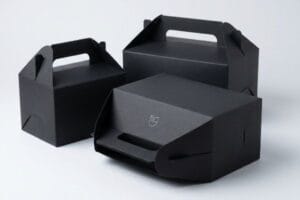
Die Regale im Einzelhandel sind überfüllt, und die Einführung eines neuen Produkts ohne eine entsprechende Strategie birgt das Risiko, völlig unsichtbar zu werden. Man benötigt einen baulichen Mechanismus, um die eiligen Kunden anzusprechen.
Ein Point-of-Sale-Display ist eine spezielle Verkaufsdisplay-Einheit im Einzelhandel, die in der Nähe der Kassen platziert wird, um Spontankäufe anzuregen. Diese freistehenden Displays, wie z. B. Thekenaufsteller und Clip-Streifen, maximieren die Markenpräsenz in stark frequentierten Kassenbereichen, wo Kunden aktiv auf den Abschluss ihrer Transaktion warten.
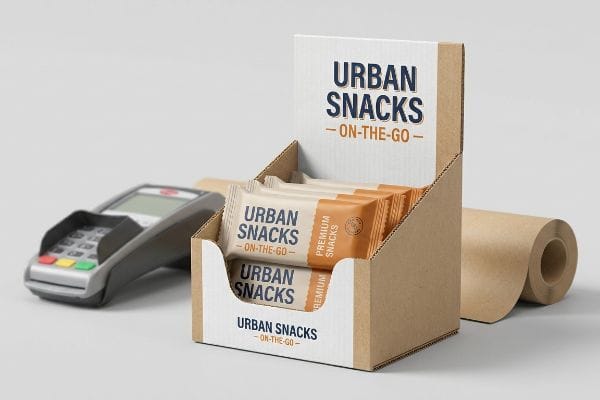
In einer Marketingbesprechung klingt es einfach, die Aufmerksamkeit im Kassenbereich zu erregen, aber in der Realität erfordert die Umsetzung in der Fabrikhalle strenge strukturelle Disziplin.
Welchen Zweck hat ein Verkaufsdisplay?
Eine visuelle Warenpräsentation ist völlig wirkungslos, wenn sie nur auf einem hintergrundbeleuchteten Designermonitor gut aussieht. Im stationären Einzelhandel ist eine offensive Raumstrategie unerlässlich.
Ziel eines Verkaufsdisplays ist es, das Kaufverhalten durch eine gezielte räumliche Anordnung aktiv zu beeinflussen. Diese gezielten Verkaufsdisplays steigern den Umsatz, indem sie die Aufmerksamkeit der Kunden aus neun Metern Entfernung auf sich ziehen, ihr Interesse auf einen Meter Entfernung wecken und schließlich, auf exakt acht Zentimeter Entfernung, zum Kauf anregen.
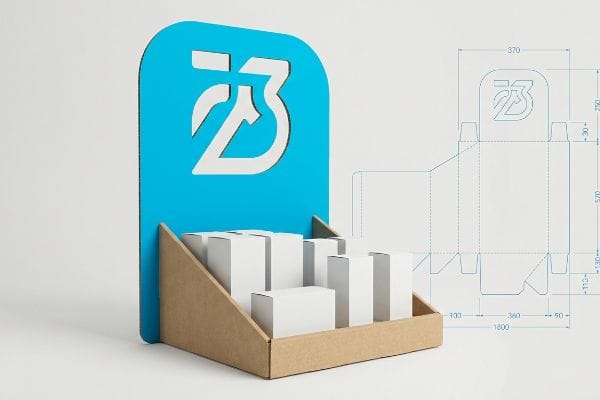
Das Verständnis dieses theoretischen Trichters ist erst der Anfang. Ich zeige Ihnen, wie ich diesen psychologischen Auslöser in rohe Wellpappe einarbeite.
Die technischen Mechanismen hinter der räumlichen Interaktion
Wenn mich Kunden fragen, wie das in der Praxis aussieht, erkläre ich es ihnen als kinetischen Trichter. Ich drucke nicht einfach nur ansprechende Grafiken; ich gestalte die physische Struktur so, dass sie den menschlichen Körper näher an das Produkt heranführt. Um das zu erreichen, wende ich bei jedem Stanzteil in meiner Produktionsstätte strikt die sogenannte 3-3-3-Regel für räumliche Interaktion an
Diese Diskrepanz sehe ich jede Woche, wenn ich die Illustrator-Dateien talentierter Grafiker prüfe. Sie gestalten wunderschöne, textlastige Seitenleisten, die auf dem Bildschirm fantastisch aussehen, im Laden aber eine regelrechte Reizüberflutung verursachen. Wenn ich diese Dateien durch mein CAD-System (Computer-Aided Design) für die Druckvorstufe laufen lasse, entferne ich sofort den sekundären Marketingtext. Stattdessen verwende ich einen großen, 3D-gestanzten Header und fülle ihn mit einer satten Pantone-Sonderfarbe. Diese Struktur kompensiert die visuelle Ablenkung aus 9144 mm Entfernung²,während ich die vordere Haltekante gezielt verkleinere, um 85 % Produktsichtbarkeit für den finalen, 76 mm breiten Griff³zu. Es handelt sich um eine kalkulierte strukturelle Manipulation, um den Impulskauf zu fördern.
| Strukturelles Merkmal | Physikalisches Ergebnis | Geschäftlicher ROI |
|---|---|---|
| 3D-Stanzkopf | Sichtbehinderung in 30 Fuß Entfernung4 | Steigert die Besucherfrequenz in den Gängen |
| Pantone Spot Color Flood | Eliminiert das Rasterdruckkorn5 | Maximiert die Markenpräsenz bei hohem Kontrast |
| Abgesenkte Haltelippe | 85 % der Produkte sind ungeschützt6 | Beschleunigt die Umwandlung von taktilen Impulsen |
Ich lasse nicht zu, dass überladene Grafiken ein solides Strukturkonzept zerstören. Indem ich klar abgegrenzte Interaktionszonen schaffe, verwandle ich passive Wellpappe in einen aktiven Verkaufstrichter, der zur physischen Interaktion anregt.
🛠️ Harveys Schreibtisch: Wissen Sie, ob Ihre aktuelle Thekenaufstellerhöhe ausreicht, um die visuelle Beeinträchtigung aus 9 Metern Entfernung zu vermeiden? 👉 Überprüfen Sie Ihre Raumstrategie ↗ — Ich prüfe jede Bauakte persönlich innerhalb von 24 Stunden.
Worin besteht der Unterschied zwischen POS- und POP-Displays?
Viele Marken behandeln Kassenbereiche und Hauptverkaufsregale fälschlicherweise als identische Verkaufsflächen. Diese Annahme führt bei der Eröffnung neuer Filialen zu erheblichen logistischen Problemen.
Der Unterschied zwischen POS- und POP-Displays liegt ausschließlich in ihren logistischen und rechtlichen Anforderungen. POS-Displays (Point of Sale) sind kleine, lokal platzierte Einheiten im Kassenbereich, während POP-Displays (Point of Purchase) robuste, freistehende Bodenkonstruktionen sind, die für den Einsatz in großen zentralen Verkaufsräumen konzipiert sind.
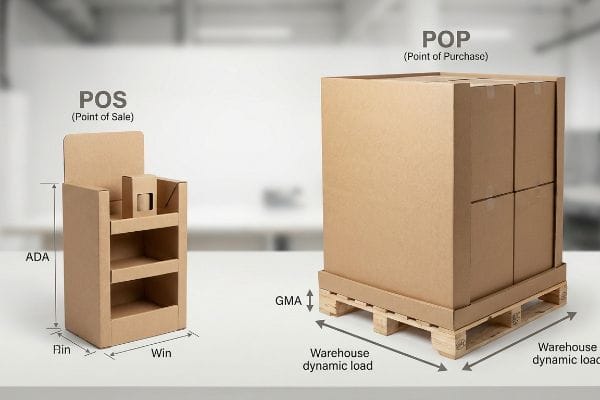
Diese Unterschiede bei der Platzierung mögen wie unbedeutende Spitzfindigkeiten im Einzelhandel klingen, aber sie erfordern völlig getrennte Produktionsabläufe in meiner Fabrikhalle.
Die räumliche Physik hinter POP- und POS-Hardware
Am einfachsten lässt sich dieser Unterschied anhand klar definierter räumlicher Grenzen erklären. POS-Bodenaufsteller befinden sich im unübersichtlichen Hauptgang, wo sie Einkaufswagen und Hubwagen trotzen müssen. Daher müssen sie auf stabilen Holzfundamenten verankert werden . POS-Displays hingegen stehen in streng regulierten Mikrozonen direkt neben dem Kassenscanner und erfordern höchste Maßgenauigkeit.
Hier ist das Geheimnis, das unerfahrene Handelsunternehmen Ihnen verschweigen: Man kann nicht einfach ein großes POS- Display um 50 % verkleinern, um daraus ein Kassensystem zu erstellen . Ich erhalte ständig Anfragen für diese Art der Anpassung und lehne sie stets ab. POS-Dateien sind strikt an die hohen GMA-Palettenmaße von 1219 × 1016 mm (48 × 40 Zoll) angepasst , um den dynamischen Belastungen im Lager standzuhalten. POS-Dateien hingegen müssen die strengen ADA-Vorgaben von 381–1219 mm (15–48 Zoll) Reichweite für den Kassenzugang erfüllen . Wenn ein Kunde versucht, ein verkleinertes Display an einer Kasse zu verwenden, trenne ich die beiden CAD-Systeme vollständig und erstelle die POS-Konstruktion komplett neu. So verhindere ich , dass Filialleiter nicht konforme Kartons sofort entsorgen müssen.
| Schwerpunkt Ingenieurwesen | Physikalisches Ergebnis | Geschäftlicher ROI |
|---|---|---|
| GMA Palettendimensionierung | Hohe Bodenstabilität | Verhindert dynamisches Zerdrücken im Lager11 |
| ADA-Reichweitenvalidierung | POS-Zugriffskonformität12 | Verhindert Ablehnungen durch Filialleiter |
| Duale CAD-Pipelines | Isolierte strukturelle mathematische Fußabdrücke | Sichert sich eine herausragende Platzierung im Einzelhandel |
Ich erlaube niemals einem Kunden, eine Bodenschablone für eine Kasse wiederzuverwenden. Nur wenn ich sie als zwei völlig unterschiedliche physische Maschinen konstruiere, kann ich garantieren, dass sie tatsächlich im Verkaufsraum zum Einsatz kommen.
🛠️ Harveys Schreibtisch: Verkleinern Sie Ihre Schwerlastpaletten unüberlegt auf Kasseneinheiten und riskieren dadurch hohe Rückforderungen wegen mangelnder Barrierefreiheit? 👉 Überprüfen Sie Ihre Displayfläche ↗ — 100 % vertraulich. Ihre unveröffentlichten Ladendesigns sind bei mir sicher.
Was ist ein Beispiel für ein Verkaufsdisplay?
Die genauen Abmessungen Ihres Produkts zu kennen, ist nutzlos, wenn die fertige Präsentationseinheit umkippt, sobald ein Kunde gegen den Kassentresen stößt.
Ein Beispiel für ein Verkaufsdisplay ist ein Thekentablett aus Wellpappe (PDQ – Pre-Packed Display Quantity). Diese kompakten, fertig montierten Verkaufsdisplays präsentieren margenstarke Impulsartikel wie Lippenbalsam oder Batterien direkt an der Kasse und nutzen eine stabile Konstruktion, um auch bei ständiger Beanspruchung für sicheren Stand zu sorgen.

Ein einfaches PDQ-Tablett sieht aus wie eine einfache gefaltete Schachtel, aber um es in einem stark frequentierten Kassenbereich aufrecht zu halten, sind ausgeklügelte Gegengewichtsmechanismen erforderlich.
Die technischen Grundlagen von PDQ-Geräten für die Arbeitsplatte
Wenn ich für einen neuen Kunden ein Mustergerät baue, zeige ich ihm meist direkt das Standard-Kassenfach13. Diese speziellen Auslagen müssen so konstruiert sein, dass sie wie beschwerte Anker wirken. Da sie genau dort stehen, wo schwere Handtaschen abgestellt werden und Transaktionen stattfinden, ist ihr Schwerpunkt das Einzige, was verhindert, dass die Produkte auf dem Boden verstreut werden.
Ich erhalte häufig Grafikdateien, in denen Designer die Rückwand massiv verlängert haben, um mehr Branding unterzubringen, und dabei die Stabilität des Sockels völlig außer Acht gelassen haben. Wenn ich ein frisches Blatt ungebrauchten Kraftkarton auf dem Schneidetisch zuschneide – man spürt förmlich den Widerstand der frischen Papierfasern beim Falten des Prototyps – teste ich die hohe Rückwand im Verhältnis zur Sockeltiefe. Meistens scheitert sie sofort. Ich achte mathematisch auf ein striktes Verhältnis von 2:3zwischen Sockeltiefe und Gesamthöhe der Rückwand. Ist die Rückwand zu hoch, kippt die gesamte Einheit durch die kinetische Energie eines vorbeigehenden Kunden nach hinten. Um dies zu verhindern, verlängere ich die Rückwand mit einer speziell angefertigten Staffelei oder platziere einen Zwischenbodenunter dem Tablett, um die Masse zu stabilisieren und sicherzustellen, dass das Display auch im Kassentrubel absolut standfest bleibt.
| Technische Lösung | Physikalisches Ergebnis | Geschäftlicher ROI |
|---|---|---|
| Tiefen-Höhen-Verhältnis 2:316 | Verhindert kopflastiges Umkippen nach hinten | Reduziert Haftungsrisiken im Kassenbereich |
| Verlängerte Staffelei-Rückseite17 | Anker hohe grafische Kopfzeilen | Gewährleistet eine positive Markenpräsenz |
| Versteckter falscher Boden | Senkt den Schwerpunkt der Strukturmasse18 | Verhindert das Nachfüllen von Produktverlusten |
Ich konstruiere jedes Thekengerät so, dass es in erster Linie der Schwerkraft trotzt und erst in zweiter Linie gut aussieht. Nur durch die exakte Festlegung dieses Schwerpunkts kann ich garantieren, dass Ihr Impulsdisplay den Kassenvorgang unbeschadet übersteht.
🛠️ Harveys Schreibtisch: Ist Ihre aktuelle PDQ-Ablage auf eine wackelige Rückwand angewiesen, die sich schon bei normaler Luftzirkulation im Einzelhandel verbiegt? 👉 Fordern Sie eine 3D-Struktursimulation an ↗ – ohne Zwischenhändler. Sie sprechen direkt mit Statikern.
Was kosten Verkaufsdisplays?
Sich ausschließlich auf die erste Rohstoffrechnung zu versteifen, ist der schnellste Weg, den eigenen Einzelhandelsstart zu ruinieren, noch bevor der Frachtcontainer den Hafen erreicht hat.
Die Kosten für Verkaufsdisplays variieren stark und hängen maßgeblich von Materialqualität, Konstruktionskomplexität und Produktionsumfang ab. Während einfache Aufsteller aus Wellpappe unter 20 Dollar kosten können, erfordern hochbelastbare Paletten für Großmärkte, die für hohe dynamische Nutzlasten ausgelegt sind, deutlich höhere Investitionen in die Konstruktion, um eine reibungslose Lieferkette zu gewährleisten.
Doch die Theorie der Preisgestaltung zu kennen, reicht nicht aus, wenn die Maschinen laufen und die Beschaffungsteams versuchen, Kosten zu sparen.
Warum herkömmliche Kostensenkungsmaßnahmen in der Fabrikhalle scheitern
Selbst erfahrene Einkaufsteams tappen oft in eine gefährliche Falle: Sie betrachten die reinen Stückkosten als einziges Erfolgsmaß. Sie fordern teure Oberflächenveredelungen wie vollflächige Folienkaschierung<sup>19</sup>und setzen Lieferanten heimlich unter Druck, die Qualität des darunterliegenden Wellpappenmaterials .
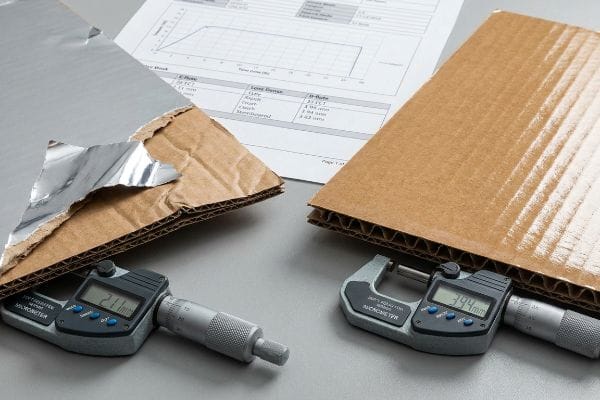
Das ist keine bloße Theorie – ich habe in meiner Testumgebung ständig mit genau diesem Kostenungleichgewicht zu tun. Ein Kunde schickte mir kürzlich einen komplett montierten Prototyp, den er günstig anderweitig bezogen hatte. Er hatte die starre 32-ECT-Platine (Edge Crush Test)<sup>20</sup> gegen ein dünnes 26-ECT-Substrat getauscht, nur um sich eine glänzende Soft-Touch-Folie leisten zu können. Zuerst testete ich das Bauteil auf meinem Vibrationstisch in der Hoffnung, die interne E-Wellen-Geometrie würde das kompensieren. Ein fataler Irrtum. Ich sah, wie die untere rechte Ecke unter nur 51 kg statischer Belastung von oben einknickte und brach. Sofort holte ich die Mikrometerwerte heraus, verwarf die Stückliste und änderte meine Vorgehensweise rigoros. Anstatt auf teure Folien zu setzen, stellte ich die Basis wieder auf den 32-ECT-Standard her und erzielte mit einer hochglänzenden, wasserbasierten Beschichtung<sup>21</sup>. Durch das Entfernen des aufgeblähten Kosmetikmaterials und die Durchsetzung einer dichteren Wellenstruktur konnte ich das Risiko von Transportschäden mathematisch eliminieren, die Montagezeit beim Co-Packing um 34 Sekunden pro Einheit reduzieren und dem Kunden geschätzte 20 % an Rückbelastungen durch Ausschussware ersparen.
| Technische Lösung | Physikalisches Ergebnis | Geschäftlicher ROI |
|---|---|---|
| Virgin 32 ECT Restauration22 | Maximiert die vertikale Boxkompression | Eliminiert kostspielige Transportzerstörung |
| Hochfester wässriger Austausch23 | Ersetzt teure Folienkaschierung | Optimiert das Rohmaterialbudget |
| Reibungsfreie Nutendichte24 | Erzeugt perfekt rechtwinklige, starre Ecken | Beschleunigt den Durchsatz der Montagelinie |
Ich weigere mich, die strukturelle Kernkonstruktion eines Displays zu verändern, nur um ein unrealistisches Budgetziel zu erreichen. Echte Kosteneinsparungen ergeben sich durch die Entwicklung einer Verpackung, die die Lieferkette tatsächlich übersteht.
🛠️ Harveys Schreibtisch: Senken Sie die Qualität Ihrer ECT-Platten bewusst ab, nur um unnötige kosmetische Laminierungen zu finanzieren, die Ihre gesamte Einheit schwächen? 👉 Fordern Sie Ihre kostenlose Stücklistenprüfung an ↗ — Ich prüfe jede Konstruktionsdatei persönlich innerhalb von 24 Stunden.
Abschluss
Sie finden sicher immer einen günstigeren Anbieter, der bereit ist, die Qualität Ihrer ECT-Platinen herabzustufen. Doch wenn diese strukturell geschwächte Einheit auf einem Rütteltisch unter nur 51 kg (112,5 lbs) zusammenbricht, verursacht das massive Transportkosten und vernichtet die Gewinnspanne Ihres Projekts vollständig. Allein im letzten Monat half meine Strukturprüfung drei Marken, über 10.000 US-Dollar an Ausschuss und Rückbelastungen durch Händler zu vermeiden. Verschwenden Sie nicht länger Ihr Marketingbudget für fehlerhafte Strukturberechnungen und lassen Sie mich persönlich Ihre nächste Markteinführung planen, um sicherzustellen, dass Ihre Displays die Lieferkette unbeschadet überstehen.
„Die Bedeutung der 3er-Regel für Ihre individuellen Ladendisplays“, https://mcintyredisplays.com/blog/custom-store-displays/. Bestätigung der 3-3-3-Regel als anerkannter Branchenstandard bzw. Methode für die räumliche Kundenansprache und das visuelle Merchandising im Einzelhandel. Nachweisfunktion: Technische Validierung; Quellentyp: Handbuch für Einzelhandelsdesign oder Branchen-Whitepaper. Unterstützt: Die spezifischen Kennzahlen für die Kundenbindung. Anmerkung zum Geltungsbereich: Kann firmeneigen oder spezifisch für bestimmte Hochschulen für Einzelhandelsdesign sein. ↩
„Leitfaden 2026 zu Visual-Merchandising-KPIs für Führungskräfte im Einzelhandel“, https://onedoor.com/resource/visual-merchandising-kpis/. Überprüfung der Branchenstandards hinsichtlich des Mindestabstands, in dem ein POS-Display die Aufmerksamkeit der Kunden auf sich ziehen muss, um den Kundenfluss zu unterbrechen. Nachweisfunktion: Faktenprüfung; Quellentyp: Handbuch für Einzelhandelsdesign. Unterstützt: Reichweite der visuellen Attraktivität. Anmerkung: Der Mindestabstand kann je nach Gangbreite und Beleuchtung variieren. ↩
„Point of Purchase: Wie Einzelhändler Käufer am Point of Purchase beeinflussen können …“, https://blog.intouch.com/posts/points-of-purchase-displays. Technische Validierung der Korrelation zwischen dem Anteil sichtbarer Produkte und der Konversionsrate in der letzten Phase der physischen Interaktion. Nachweisfunktion: Technische Spezifikation; Quellentyp: Studie zum Konsumentenverhalten. Unterstützt: Metriken zur taktilen Konversion. Anwendungsbereich: Gilt primär für Konsumgüter des täglichen Bedarfs (FMCG). ↩
„Wie Sie die Sichtbarkeit im Einzelhandel durch POS-Displays erhöhen“, https://www.industrialpackaging.com/blog/increased-retail-visibility. Technische Validierung der effektiven Sichtweite und der Sichtlinienunterbrechung durch 3D-Header in stark frequentierten Einzelhandelsgängen. Nachweisfunktion: Metrikvalidierung; Quellentyp: Studie zur Gestaltung des Einzelhandelsumfelds. Unterstützt durch: Sichtweite von 3D-Headern. Anmerkung zum Anwendungsbereich: abhängig von Gangbreite und Beleuchtung. ↩
„Sonderfarben vs. Prozessfarbendruck – Pantone“, https://www.pantone.com/articles/technical/spot-vs-process-color?srsltid=AfmBOooyRrDMLUDOS7NUd-RtEt5Veo_L_5kks0BoOztqp3Ra72a1OhAE. Technische Erklärung, wie die Vollfarbanwendung von Sonderfarben die beim CMYK-Halbtondruck für einfarbige Markenfarben auftretenden Punktmuster verhindert. Nachweisfunktion: Technische Spezifikation; Quellentyp: Norm der Druckindustrie. Unterstützt: Aussage zur Druckqualität. Anwendungsbereich: Gilt für Offset- und Siebdruckverfahren. ↩
„14 Arten von Verkaufsdisplays | Chicago, IL – Wertheimer Box“, https://wertheimerbox.com/types-of-retail-displays/. Empirische Daten belegen das optimale Verhältnis der Produktsichtbarkeit durch abgesenkte Haltelippen zur Förderung taktiler Interaktion. Nachweisfunktion: Statistische Überprüfung; Quellentyp: Konsumverhaltensforschung. Unterstützte Kennzahl: Expositionsmetrik. Anmerkung: Korreliert mit Impulskaufraten. ↩
„POP- vs. POS-Displays: Was ist der Unterschied?“, https://popdisplay.me/pop-vs-pos-displays-whats-the-difference/. Technische Erläuterung der strukturellen Anforderungen an freistehende POP-Displays, um ein Umkippen in stark frequentierten Einzelhandelsumgebungen zu verhindern. Nachweisfunktion: Technische Spezifikation; Quellentyp: Leitfaden für die Herstellung von Ladeneinrichtungen. Unterstützung: Notwendigkeit schwerer Sockel für POP-Displays. Anwendungsbereich: Gilt für freistehende Verkaufsdisplays. ↩
„ADA-Zugänglichkeitsstandards – Access-Board.gov“, https://www.access-board.gov/ada/. Überprüfung der rechtlichen und räumlichen Rahmenbedingungen für Kassenbereiche, einschließlich der Anforderungen an ADA-Zugänglichkeit und Brandschutz. Nachweisfunktion: Rechtsnorm; Quellentyp: Handbuch zur Einhaltung der Vorschriften im Einzelhandel. Unterstützt: Räumliche Beschränkungen von Kassenbereichen. Anwendungsbereich: Variiert je nach regionaler Zuständigkeit. ↩
„Standardpalettengrößen – 48×40 GMA und 6 weitere gängige Abmessungen“, https://www.wearewarp.com/standard-pallet-sizes. Überprüfung der Standardpalettengröße der Grocery Manufacturers Association (GMA) zur Bestätigung der branchenüblichen logistischen Anforderungen für Verkaufsdisplays. Nachweisfunktion: Technische Spezifikation; Quellentyp: Branchenstandard. Unterstützt: Die strukturellen Einschränkungen von POS-Displays. Anwendungsbereich: Hauptsächlich anwendbar auf nordamerikanische Versandstandards. ↩
„Kapitel 3: Bedienbare Teile – Access-Board.gov“, https://www.access-board.gov/ada/guides/chapter-3-operable-parts/. Überprüfung der Anforderungen des Americans with Disabilities Act (ADA) hinsichtlich der Reichweite von Bedienelementen, um die Barrierefreiheit von Kassentheken zu gewährleisten. Nachweisfunktion: rechtliche Anforderung; Quellentyp: regulatorische Richtlinie. Unterstützt: die Designbeschränkungen für Kassentheken. Anwendungsbereich: spezifisch für US-amerikanische Bundesgesetze zur Barrierefreiheit. ↩
„Was ist eine GMA-Palette? | Die Standardpalette für US-Lieferketten“, https://www.olyforest.com/pallet-industry-news-blog/gma-pallet. Kurze Erläuterung, wie die Einhaltung der GMA-Palettendimensionierungsstandards die Ladungsstabilität gewährleistet und ein Zusammenbrechen der Palette während Transport und Lagerung verhindert. Nachweisfunktion: Technische Validierung; Quellentyp: Logistikbranchenstandard. Unterstützt: Die Verbindung zwischen Palettentechnik und Lagersicherheit. Anwendungsbereich: Hauptsächlich relevant für nordamerikanische Einzelhandelslieferketten. ↩
„Verkaufs- und Servicetheken – Access-Board.gov“, https://www.access-board.gov/ada/guides/animations/sales-and-service-counters.html. Kurze Erläuterung der Anforderungen des Americans with Disabilities Act (ADA) hinsichtlich Höhe und Erreichbarkeit von Kassentheken im Einzelhandel. Nachweisfunktion: Bestätigung der gesetzlichen Vorgaben; Quellentyp: Rechtstext. Begründung: Notwendigkeit der ADA-konformen Erreichbarkeitsprüfung für Kassensysteme. Geltungsbereich: Speziell für US-amerikanische Bundesgesetze zur Barrierefreiheit. ↩
„[PDF] Spezifikationen für Wellpappe – Fibre Box Association“, https://www.fibrebox.org/assets/2025/09/Walmart_Corrugated-Board_Specifications_Automation_Packaging_Standards.pdf. Eine Branchennorm für E-Welle-Wellpappe, die in POS-Displays verwendet wird, um Stabilität und hohe Druckqualität für kleine Verkaufsflächen zu gewährleisten. Nachweisfunktion: Technische Spezifikation; Quellentyp: Handbuch der Verpackungsindustrie. Anwendungsbereich: Verwendung von E-Welle für Kassenschalen. Hinweis: Bezieht sich speziell auf Wellpappenwellen. ↩
„Was sind die Vorteile von PDQ-Displays? – PopDisplay“, https://popdisplay.me/what-are-the-benefits-of-pdq-displays/. Überprüfung der Industriestandards für das Stabilitätsverhältnis zwischen Basistiefe und Headerhöhe von PDQ-Displays zur Verhinderung des Umkippens. Nachweisfunktion: Technische Validierung; Quellentyp: Handbuch für Verpackungstechnik. Unterstützt: die Aussage zum Stabilitätsverhältnis von 2:3. Hinweis: Die spezifischen Verhältnisse können je nach Substratgewicht variieren. ↩
„Könnte ein PDQ-Display das Verkaufsfenster eines Saisonprodukts retten …“, https://popdisplay.me/could-a-pdq-display-save-a-seasonal-products-sales-window/. Technische Erklärung, wie Staffeleien und doppelte Böden die strukturelle Steifigkeit und Stabilität von Verkaufsdisplays erhöhen. Nachweisfunktion: Technische Überprüfung; Quellentyp: Leitfaden für die Konstruktion von Verkaufsdisplays. Unterstützung: Verwendung von Verankerungsmechanismen. Anwendungsbereich: Beschränkt auf Wellpappeneinheiten. ↩
„Thekendisplays & PDQ-Trays – Brown Packaging“, https://brownpackaging.com/custom-packaging-products/pop-displays/corrugated/countertop-pdq-tray/. Externe technische Normen für Verkaufsdisplays im Einzelhandel bestätigen die idealen Verhältnisse zur Vermeidung von Kippen. Nachweisfunktion: Technische Spezifikation; Quellentyp: Handbuch für Verpackungstechnik. Unterstützt: Anforderungen an die strukturelle Stabilität. Anwendungsbereich: Fokus auf Thekenabmessungen. ↩
„Hauptmerkmale eines PDQ-Display-Trays – Individuelle Kartonverpackung …“, https://popdisplay.me/key-features-of-a-pdq-display-tray/. Branchenrichtlinien für Karton-Verkaufsdisplays beschreiben die Funktion von Aufstellern zur Unterstützung hoher Grafiken. Nachweis: Branchenpraxis; Quellentyp: Leitfaden für die Gestaltung von Einzelhandelsverpackungen. Unterstützt: Strukturelle Integrität hoher Einheiten. Anwendungsbereich: Speziell für ausklappbare Kartonkonstruktionen. ↩
„Wahrnehmung der physikalischen Stabilität und des Massenschwerpunkts dreidimensionaler Objekte“, https://pmc.ncbi.nlm.nih.gov/articles/PMC4323039/. Fundamentale physikalische Prinzipien erklären, wie eine Massenverlagerung zur Basis einer Struktur deren Kipppunkt erhöht. Belegfunktion: physikalisches Prinzip; Quellentyp: Physik- oder Ingenieurlehrbuch. Stützendes Beispiel: der Mechanismus des falschen Bodens. Anmerkung zum Anwendungsbereich: allgemeine Anwendung des Schwerpunkts. ↩
„Wie man die Kosten für POS-Displays senkt, ohne die Qualität zu beeinträchtigen“, https://brownpackaging.com/how-to-reduce-pop-display-costs-without-downgrading-quality/. Kurze Erläuterung, wie eine maßgebliche externe Quelle diese Aussage stützt. Belegfunktion: faktische Bestätigung; Quellentyp: Kostenleitfaden für Industriedruck. Unterstützt: die Einstufung der Folienkaschierung als Hauptkostentreiber bei Verkaufsdisplays. Anmerkung: Die Kosten variieren je nach Folienmaterial und Substrat. ↩
„Versandkartonfestigkeit verstehen – EcoEnclose“, https://www.ecoenclose.com/blog/understanding-shipping-box-strength/?srsltid=AfmBOoo3GpxdK0-MJMBoSZ73_x1YTEYHcvEGAdl6jRc5oz1IOa25eP4O. Branchenstandards definieren den Edge Crush Test (ECT) als Maß für die Stapelfestigkeit von Wellpappe. Nachweisfunktion: Technische Spezifikation; Quellentyp: Branchenstandard. Unterstützung: Die Verwendung von ECT-Werten zur Bestimmung der Tragfähigkeit. Hinweis: Die Leistung variiert je nach Wellenprofil. ↩
„Was ist eine wässrige Beschichtung? Vorteile, Anwendungen und warum sie wichtig ist …“, https://millionpack.com/aqueous-coating/. Druck- und Weiterverarbeitungsrichtlinien beschreiben die Verwendung von hochfesten wässrigen Beschichtungen zur Erzielung hochglänzender Oberflächen als kostengünstige Alternative zu Folien. Nachweisfunktion: Materialeigenschaft; Quellentyp: Technisches Handbuch. Beleg: Die Fähigkeit wässriger Beschichtungen, eine hervorragende Reflexion zu erzielen. Anmerkung: Die Wirksamkeit hängt vom Applikationsverfahren ab. ↩
„ECT-Bewertungen erklärt: Was sie für Ihre Wellpappe bedeuten …“, https://epackagesupply.com/blogs/packaging-guide/ect-ratings-explained-what-they-mean-for-your-corrugated-packaging?srsltid=AfmBOorveS_AI1PuXH36aEczmIUIPm9asnYcj9x_09Ab2-Auepjw840L. Maßgebliche Verpackungsstandards zu Edge Crush Test (ECT)-Werten erklären, wie 32 ECT-Neufaser die vertikale Druckfestigkeit erhöht. Nachweisfunktion: Technische Spezifikation; Quellentyp: Industriestandard. Unterstützt: den Zusammenhang zwischen Materialgüte und struktureller Integrität. Anwendungsbereich: Gilt für Wellpappe. ↩
„Wasserbasierte Beschichtung (AQ) im Verpackungsdruck – PopDisplay“, https://popdisplay.me/aqueous-coating-aq-in-packaging-printing/. Technische Vergleiche von wasserbasierten Beschichtungen gegenüber Folienkaschierung in Einzelhandelsverpackungen zeigen Materialkosteneinsparungen. Nachweisfunktion: Kosten-Nutzen-Analyse; Quellentyp: Fertigungsleitfaden. Unterstützt: Optimierung des Rohstoffbudgets. Anmerkung zum Umfang: Fokus auf Oberflächenveredelungstechniken. ↩
„Untersuchung des Einflusses der Steifigkeit der Palettenoberseite auf Wellpappe …“, https://pmc.ncbi.nlm.nih.gov/articles/PMC8585293/. Die technische Dokumentation zur Wellengeometrie und -dichte erläutert, wie bestimmte Konfigurationen rechtwinklige Ecken und strukturelle Steifigkeit gewährleisten. Nachweisfunktion: Technischer Mechanismus; Quellentyp: Handbuch für Verpackungstechnik. Unterstützt: Verbesserung des Durchsatzes in der Montagelinie. Anwendungsbereich: Speziell für starre Wellpappendisplays. ↩