
Sie investieren Tausende in Verkaufsdisplays, aber wenn Sie deren physischen und finanziellen Erfolg nicht messen, tappen Sie im Dunkeln. Nicht messbare Kampagnen schmälern Ihre Gewinnspanne sofort.
Die Messung des Erfolgs von Marketingkampagnen im stationären Handel bestimmt Ihren physischen ROI (Return on Investment). Sie quantifiziert die Kundenbindung, bestätigt die Stabilität der Verkaufsflächen und beugt logistischen Problemen vor. Ohne die Erfassung von Daten über alle Vertriebskanäle hinweg riskieren Marken katastrophale Rückbelastungen aufgrund von Compliance-Verstößen, Ladenhüter und massive Fehlinvestitionen in ineffektive Kartonaufsteller.

Doch das konzeptionelle Verständnis der Daten nützt nichts, wenn die physische Verpackung im Laden versagt.
Was besagt die 3-3-3-Regel im Marketing?
Um die Aufmerksamkeit der Käufer zu gewinnen, bedarf es räumlicher Präzision, nicht nur auffälliger Grafiken.
Die 3-3-3-Regel besagt, dass ein Marketingdisplay die Aufmerksamkeit aus 9,1 Metern Entfernung auf sich ziehen, das spezifische Interesse des Käufers in 0,9 Metern Entfernung wecken und den Kaufabschluss in 76,2 mm Entfernung bewirken muss. Dieses räumliche Konzept garantiert den Erfolg von Impulskäufen.
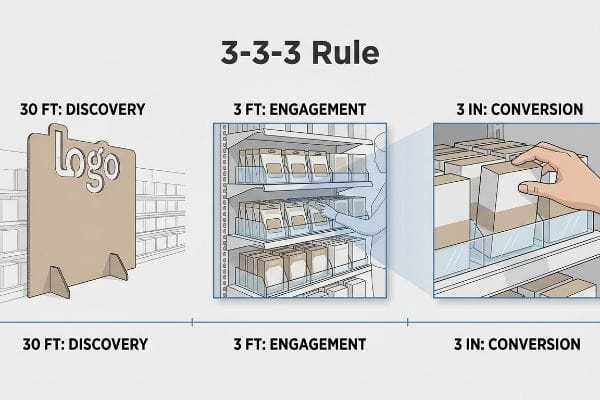
Die korrekte Angabe dieser drei Entfernungen klingt in einer PDF-Datei einfach, ist aber unter dem grellen Neonlicht eines Ladens eine ganz andere Herausforderung.
Technische Displays für das 3-3-3-Raumkontinuum
Junior-Marketingteams entwerfen Warenpräsentationen häufig ausschließlich für die Nahansicht auf hintergrundbeleuchteten Computermonitoren. Sie gehen davon aus, dass ein Logo, das auf ihrem Schreibtisch gestochen scharf aussieht, automatisch Kunden in einem riesigen Supermarktregal anzieht. Dabei wird völlig außer Acht gelassen, wie sich ein abgelenkter Mensch in einem vollen Geschäft bewegt.
Ich sehe diesen Fehler ständig, wenn mir Kunden flache Druckvorlagen schicken, die versuchen, einen ganzen Roman auf eine Headerkarte zu quetschen. Erst letzten Monat beobachtete ich eine Verkäuferin, die verzweifelt versuchte, ein überfülltes Regal wieder aufzufüllen, weil die Marke die 76,2 mm (3 Zoll) breite Werbefläche mit komplizierten, winzigen Laschen überladen hatte, die ständig einrissen und ein frustrierendes Geräusch verursachten. Um das zu vermeiden, sollten Sie Ihr Kernprodukt immer klar hervorheben. Verwenden Sie eine große Stanzform für die 9,1 Meter (30 Fuß) breite Werbefläche, optimieren Sie die Regalhöhe auf die 127 cm (50 Zoll) breite Werbefläche¹ für eine 0,9 Meter (3 Fuß) breite Werbefläche und kürzen Sie die vordere Haltekante, um eine Produktsichtbarkeit von 85 % ² für die maximale Reichweite zu gewährleisten.
| Häufiger Anfängerfehler | Die Profi-Lösung | Vorteil für die Verkaufsfläche |
|---|---|---|
| Text im Header unterbringen | Verwendung einer einzigen massiven Stanzform | Erregt schon aus 9,1 Metern Entfernung Aufmerksamkeit3 |
| Produkte hinter hohen Lippen verstecken | Frontlippe auf 85 % Sichtweite kürzen4 | Gewährleistet die physische Umwandlung auf 3 Zoll (76,2 mm) |
| Design ausschließlich für digitale Bildschirme | Optimierung für die 50-Zoll-Treffzone (127 cm)5 | Beseitigt die kognitive Überlastung für Käufer |
Ich lasse meine Kunden niemals Lehrbücher auf Karton drucken. Indem ich auf überflüssige Zusatzinformationen verzichte und mich ausschließlich auf die räumliche Wirkung konzentriere, sorge ich dafür, dass Ihre Präsentation Impulskäufe auslöst, anstatt eilige Kunden zu verwirren.
🛠️ Harveys Schreibtisch: Sind Sie sich nicht sicher, ob Ihre Grafik aus zehn Metern Entfernung lesbar ist? 👉 Schicken Sie mir Ihre Stanzform ↗ – Direkter Kontakt zu mir. Garantiert kein automatisierter Werbe-Spam.
Warum ist Marketingmessung wichtig?
Wer die Leistung nicht misst, tappt beim Logistikbudget im Dunkeln.
Die Erfolgsmessung im Marketing ist wichtig, da sie sowohl die physische Stabilität als auch den finanziellen Erfolg erfasst. Eine präzise Auswertung verhindert, dass Einkaufsteams heimlich die Qualität von Wellpappe herabstufen, um Kosten zu sparen. Dies führt letztendlich zu katastrophalen Transportschäden und beeinträchtigt die Kommunikation im Einzelhandel sowie die Montagefreundlichkeit erheblich.

Alle wollen den Umsatzanstieg messen, aber niemand misst die versteckten logistischen Reibungsverluste, die zuerst die Gewinnspanne auffressen.
Der versteckte logistische ROI von Verkaufsdisplays
Markenteams konzentrieren sich häufig obsessiv auf die Erfassung digitaler Coupons oder theoretischer Umsatzsteigerungen und vernachlässigen dabei die tatsächlichen Kennzahlen ihrer Display-Einführung. Einkaufsabteilungen isolieren oft die Kennzahl der Stückkosten und drängen Fabriken dazu, die Qualität von Strukturkarton von einem robusten 32ECT (Kantenbruchfestigkeitstest) auf ein schwächeres 26ECT6 , nur um eine vorgegebene Zielvorgabe zu erreichen.
Hier ist der Realitätscheck, den ich jedem neuen Einkäufer mitgebe, der beim Rohmaterial sparen will. Ich stand einmal an einer Warenannahme und sah zu, wie eine ganze Viertelpaletten-Kampagne zusammenbrach, weil die Hohlkammern das Gewicht der gestapelten Shampooflaschen nicht tragen konnten; der muffige, erdige Geruch von zerdrücktem Testliner lag in der Luft, als die unterste Ebene einbrach. Marketingmessung und Konstruktion lassen sich nicht trennen. Indem Sie Ihre Strukturkosten mathematisch direkt mit der Bequemlichkeit der nachgelagerten Lieferkette und dem garantierten schadenfreien Transport verknüpfen , schützen Sie tatsächlich den Werbeeffekt, den Sie messen wollen.
| Häufiger Anfängerfehler | Die Profi-Lösung | Vorteil für die Verkaufsfläche |
|---|---|---|
| Herabstufung der ECT-Prüfungsnoten | 32 ECT für schwere Displays vorschreiben9 | Verhindert katastrophale Frachtzerquetschungen |
| Die Stückkosten als einziges Messkriterium isolieren | Verknüpfung der Strukturkosten mit der Montagegeschwindigkeit10 | Senkt die Lohnkosten beim Co-Packing |
| Die Raten für physischen Schaden werden ignoriert | Verfolgung der Überlebensraten beim Transit | Verhindert teure Rückbuchungen durch Einzelhändler11 |
Ich weigere mich, ein Display zu entwickeln, das zwar in der Bilanz gut aussieht, aber im Gang zusammenbricht. Die wahren Kosten zu ermitteln bedeutet, die physische Stabilität mit einzubeziehen und sicherzustellen, dass Ihre Kampagne unversehrt im Kassenbereich ankommt.
🛠️ Harveys Schreibtisch: Messen Sie die tatsächlichen logistischen Herausforderungen Ihres aktuellen Display-Rollouts oder hoffen Sie einfach, dass es den Transport unbeschadet übersteht? 👉 Berechnen Sie Ihre tatsächliche Marge ↗ — Sicher herunterladen. Bei Fragen können Sie mich später gerne kontaktieren.
Was sind die 5 Ps des Einzelhandelsmarketings?
Ohne einen klar definierten kommerziellen Rahmen lässt sich kein erfolgreiches physisches Produkt auf den Markt bringen.
Die fünf Ps des Einzelhandelsmarketings umfassen Produkt, Preis, Platzierung, Promotion und Personal. Dieses strategische Rahmenwerk legt fest, wie Marken ihre stationären Verkaufsflächen gestalten und sicherstellt, dass Lieferkettenlogistik und Werbegrafiken optimal auf das jeweilige Geschäftsmodell und das Zielverhalten der Konsumenten abgestimmt sind.

Diese Konzepte auf einem Whiteboard festzuhalten, ist ein guter Anfang, aber sie auf gefalteten Karton zu übertragen, erfordert strenge Disziplin.
Integration der 5 Ps in das strukturelle Merchandising
Aufstrebende Marken versuchen häufig, neue Produkte mit standardisierten, unpersönlichen Displays einzuführen, in der Annahme, ein gutes Produkt verkaufe sich von selbst. Dabei ignorieren sie die strengen Mechanismen des kommerziellen Marktes und versäumen es, ihre physische Präsenz an die spezifischen logistischen Gegebenheiten unterschiedlicher Einzelhandelsumgebungen–von Convenience-Stores bis hin zu riesigen Großhandelsmärkten.
Stellen Sie sich vor, Sie versuchen, einen riesigen SUV in einer kleinen Garage zu parken: Passen die Abmessungen nicht zum Platzangebot, streikt das ganze System. Ich sehe immer wieder, wie Kunden versuchen, ein hochwertiges, teures Produkt in eine billige, wackelige, offene Verpackung – und damit ihrer Markenbekanntheit schaden. Ich erinnere mich an das schrille Geräusch eines überdimensionierten Displays, das über den Betonboden schleifte, weil die Marke die räumlichen Gegebenheiten eines Großmarktes nicht berücksichtigt hatte. Um das zu vermeiden, sollten Sie Ihre Werbestrategie immer direkt an den spezifischen Gegebenheiten des jeweiligen Einzelhändlers ausrichten, bevor Sie auch nur ein einziges Stück Karton zuschneiden.
| Häufiger Anfängerfehler | Die Profi-Lösung | Vorteil für die Verkaufsfläche |
|---|---|---|
| Verwendung eines einheitlichen Displays für alle Filialen | Anpassung der Markenpräsenz an spezifische Einzelhändler13 | Verhindert die Ablehnung von Gangflächen |
| Fehlende Abstimmung der Preisklasse mit der Displayqualität | Hochwertige Produkte mit robusten Materialien kombinieren14 | Bewahrt einen hohen Markenwert |
| Ignorieren der Personalengpässe bei den Ladenangestellten | Konstruktion einer schnellen Reibungsverriegelung15 | Stellt sicher, dass die Displays tatsächlich auf dem Boden aufkommen |
Bevor wir auch nur eine einzige Stanzform entwickeln, lasse ich jeden Kunden eine Matrix zur Ausrichtung des Rahmens durchlaufen. Wenn Ihre physische Verpackung die logistischen Vorgaben des Geschäfts erfüllt, dominiert Ihr Produkt ganz natürlich den Point of Sale.
🛠️ Harveys Schreibtisch: Werden Ihre aktuellen Warenauslagen von Filialleitern abgelehnt, weil sie nicht den Regalrichtlinien entsprechen? 👉 Ich prüfe Ihre Spezifikationen ↗ – Keine Formulare, die endlose Verkaufsgespräche auslösen. Einfach nur echter Mehrwert.
Was sind die 4 Ps des Merchandising?
Die Theorie des Warenmanagements ist völlig wertlos, wenn das Display nicht physisch auf der Co-Packing-Linie aufgebaut werden kann.
Die vier Säulen des Merchandisings – Produkt, Preis, Platzierung und Promotion – bestimmen, wie Waren visuell präsentiert werden, um den Umsatz zu maximieren. Die praktische Umsetzung dieser Strategie erfordert jedoch präzise Konstruktionstechnik, um abstrakte Marketingkonzepte in robuste, verkaufsfertige Wellpappenkonstruktionen zu übersetzen, die auch starker Beanspruchung in der Lieferkette standhalten.
Doch das konzeptionelle Verständnis der vier Säulen wird Sie nicht retten, wenn die automatisierten Fertigungsmaschinen in Betrieb gehen.
Warum generisches Merchandising in der Fabrikhalle scheitert
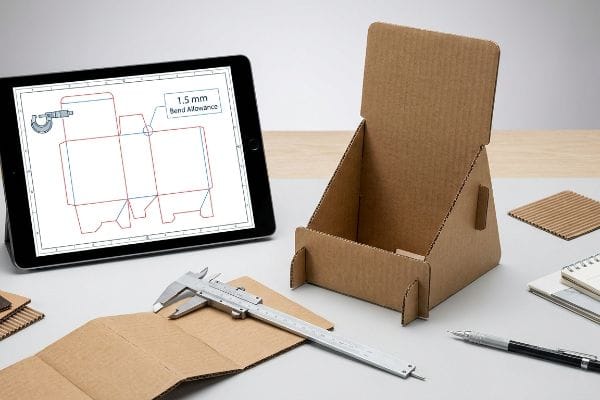
Einkaufsteams und Designer behandeln physische Verkaufsdisplays oft als einfache 2D-Leinwände für ihre Werbegrafiken. Sie gehen davon aus, dass das Zeichnen von standardmäßigen , ineinandergreifenden Laschen und Klappschlitzen in einem einfachen Softwareprogramm sich nahtlos in ein stabiles, tragfähiges Verkaufsdisplay umsetzen lässt .
Ein einzelnes Display im Labor aufzustellen ist einfach, doch die Realität sieht anders aus, wenn man 500 Stück versendet. In meiner Produktionsstätte sehe ich regelmäßig flache Vektordateien, die die Dicke von gefaltetem E-Wellen-Karton völlig ignorieren. Wenn eine 1,5 mm dicke Platteum 90 Grad gefaltet wird, verbraucht sie Material. Wird die Aufnahmenut an der Stanzform nicht entsprechend verbreitert, verbiegt sich das Display stark oder lässt sich gar nicht montieren. Anhand der Mikrometermessungen eines kürzlich fehlgeschlagenen Kundenauftrags konnte ich nachweisen, dass wir keine teuren Kunststoff-Stützclips benötigten; eine strikte Biegetoleranz von 1,5 mm,die wir in unserer CAD-Software (Computer-Aided Design) implementierten, genügte. Durch die Einhaltung dieser präzisen Toleranz konnte ich die Montagezeit beim Co-Packing um schätzungsweise 35 Sekunden pro Einheit reduzieren, die Kosten für manuelle Arbeit drastisch senken und eingerissenen Karton vermeiden.
| Häufiger Anfängerfehler | Die Profi-Lösung | Vorteil für die Verkaufsfläche |
|---|---|---|
| Zeichenschlitze im Verhältnis 1:1 | Anwendung der mathematischen Messschieberkompensation19 | Sorgt dafür, dass die Laschen reibungslos einrasten, ohne zu reißen |
| Die Plattenstärke bei Faltungen wird vernachlässigt | Hinzufügen spezifischer Biegetoleranzen20 | Sorgt dafür, dass die endgültige Struktur perfekt quadratisch bleibt |
| Verwendung teurer Kunststoffclips zur Korrektur von Durchbiegungen | Entwicklung präziser gewellter Reibungskupplungen21 | Spart Materialkosten und beschleunigt die Montage |
Ich lasse nicht zu, dass fehlerhafte Mathematik gute Verkaufsstrategien beeinträchtigt. Indem ich Wellpappe als dreidimensionales Architekturmaterial und nicht als flaches Papier behandle, eliminiere ich Reibungsverluste in der Montage und sorge für eine reibungslose Lieferkette.
🛠️ Harveys Schreibtisch: Lassen Sie sich nicht von einem 2 Millimeter kleinen Konstruktionsfehler die Einführung in 500 Filialen vermasseln. 👉 Senden Sie mir Ihre Stanzdatei ↗ – ich prüfe die Berechnungen, bevor Sie Ihr Budget für die Massenproduktion verschwenden.
Abschluss
Sie können einen Lieferanten ausschließlich nach dem niedrigsten Stückpreis auswählen. Doch wenn die ausgehöhlte 26ECT-Platine in einem feuchten Lagerhaus unweigerlich zusammenbricht, werden die Transportschäden Ihre gesamte Gewinnspanne zunichtemachen. Genau dieses Datenblatt verwenden meine zehn wichtigsten Einzelhandelskunden, um Druckfehler zu vermeiden. Setzen Sie nicht länger auf theoretische Toleranzen und lassen Sie mich Ihre Strukturdateien persönlich durch meinen kostenlosen Stanzform-Audit führen, um schwerwiegende Fehler bei der Biegezugabe zu erkennen, bevor Sie in die Massenproduktion investieren.
„Wie hoch ist die durchschnittliche Regalhöhe im Einzelhandel? – PopDisplay“, https://popdisplay.me/what-is-the-average-retail-shelf-height/. Überprüfung der Branchenstandards für die optimale Regalhöhe im Bereich der „Aufmerksamkeitszone“, um die Kundenbindung zu maximieren. Nachweisfunktion: Technische Spezifikation; Quellentyp: Handbuch für Einzelhandelsdesign. Unterstützt: Die Effizienz der Drei-Fuß-Regel für die Kundenbindung. Anmerkung zum Anwendungsbereich: Kann je nach Körpergröße der Zielgruppe variieren. ↩
„14 Arten von Verkaufsdisplays | Chicago, IL – Wertheimer Box“, https://wertheimerbox.com/types-of-retail-displays/. Empirische Daten, die die Höhe der vorderen Haltekante mit einem bestimmten Schwellenwert der Produktsichtbarkeit verknüpfen, der für die physische Konversion erforderlich ist. Nachweisfunktion: Validierung von Kennzahlen; Quellentyp: Studie zum visuellen Merchandising. Unterstützt: die Gestaltung der 7,6 cm (3 Zoll) großen Konversionszone. Hinweis: Die Ergebnisse können je nach Verpackungsgröße variieren. ↩
„Gestaltung von Verkaufsflächen für effektive Warenpräsentation und Kundenführung“, https://www.business.qld.gov.au/industries/manufacturing-retail/retail-wholesale/retail-displays. Überprüfung des Standardabstands, in dem großflächige Werbeschilder im Einzelhandel die Aufmerksamkeit der Kunden auf sich ziehen. Nachweisfunktion: Validierung der Kennzahl; Quellentyp: Handbuch für die Gestaltung von Verkaufsflächen. Unterstützt: Räumliche Präzision für die Aufmerksamkeitslenkung. Anmerkung zum Anwendungsbereich: Kann je nach Geschäftsgröße variieren. ↩
„AG 1091A: Warenpräsentation im Eingangsbereich von Geschäften“, https://www.seattle.gov/transportation/permits-and-services/permits/applicant-guides/ag-1091a. Branchenstandard für die Sichtbarkeit von Produkten in Verkaufsdisplays, um eine Verdeckung der Waren zu vermeiden. Nachweisfunktion: Technische Spezifikation; Quellentyp: Leitfaden für die Warenpräsentation. Unterstützt: Optimierung des Produktzugangs. Anwendungsbereich: Speziell für verkaufsfertige Verpackungen. ↩
„[PDF] Leitlinien für Lebensmittelgeschäfte – Ergonomie für … – OSHA“, https://www.osha.gov/sites/default/files/publications/OSHA3192.pdf. Bestätigung des optimalen Abstands zwischen Kunde und Warenauslage für eine fokussierte Produktinteraktion. Evidenzfunktion: Validierung räumlicher Messwerte; Quellentyp: umweltpsychologische Studie. Nutzen: Reduzierung kognitiver Überlastung. Anwendungsbereich: Gilt für stehende Kunden. ↩
„[PDF] Spezifikationen für Wellpappe – Fibre Box Association“, https://www.fibrebox.org/assets/2025/09/Walmart_Corrugated-Board_Specifications_Automation_Packaging_Standards.pdf. Technische Spezifikationen, die die Unterschiede in der Tragfähigkeit zwischen Wellpappensorten mit 32 ECT und 26 ECT bestätigen. Nachweisfunktion: Technische Überprüfung; Quellentyp: Normen der Verpackungsindustrie. Belegt: Die Behauptung, dass eine Herabstufung der ECT die strukturelle Integrität verringert. Anwendungsbereich: Speziell für Wellpappenmaterialien. ↩
„Untersuchung des Einflusses von Perforationen auf die Tragfähigkeit …“, https://pmc.ncbi.nlm.nih.gov/articles/PMC11396172/. Normen der Verpackungstechnik (z. B. ECT) quantifizieren, wie die Integrität und Geometrie der Wellen die vertikale Tragfähigkeit und Stapelfestigkeit beeinflussen. Nachweisfunktion: Technische Spezifikation; Quellentyp: Industrienorm. Belegt: Die Behauptung, dass Wellenversagen zum strukturellen Einsturz führt. Anwendungsbereich: Gilt für Wellpappe. ↩
„Strategien zur Senkung der Verpackungsmaterialkosten – Oxmaint“, https://oxmaint.com/industries/delivery-operations-management/packaging-materials-cost-reduction-strategies. Studien im Bereich Logistik und Verpackung zeigen, dass die Optimierung von Materialspezifikationen die Kosten von Transportschäden reduziert und die Effizienz der gesamten Lieferkette verbessert. Nachweisfunktion: Technische Validierung; Quellentyp: Branchen-Whitepaper. Unterstützt die Aussage, dass strukturelle Investitionen den ROI von Werbemaßnahmen sichern. Anwendungsbereich: Speziell für Wellpappendisplays im Einzelhandel. ↩
„Versandkartonfestigkeit verstehen – EcoEnclose“, https://www.ecoenclose.com/blog/understanding-shipping-box-strength/?srsltid=AfmBOop2tAY3bZEJL21zxoE6BR8nccldbVE7BzyWcazrPIhAz7On7_6Z. Autoritative Verpackungsstandards definieren die erforderlichen Werte für den Kantenstauchtest (ECT), um ein Versagen unter Frachtlasten zu verhindern. Nachweisfunktion: Technische Validierung; Quellentyp: Branchenstandard. Belege: Wirksamkeit von 32 ECT zur Verhinderung von Quetschungen. Anwendungsbereich: Gilt für Wellpappe. ↩
„Wie Verpackungen den Erfolg von Verkaufsdisplayprogrammen beeinflussen“, https://www.frankmayer.com/blog/how-packaging-shapes-retail-display-program-success/. Betriebsstudien zur Effizienz von Co-Packing zeigen, dass die Komplexität der Displaymontage direkt mit dem Arbeitsaufwand korreliert. Nachweisfunktion: Beleg für betriebliche Effizienz; Quellentyp: Logistik-Whitepaper. Unterstützt: Reduzierung der Arbeitskosten durch optimierte Strukturgestaltung. Fokus: Die Montagephase der Logistik. ↩
„Was tun, wenn Ihnen Artikel in Rechnung gestellt werden, die Sie nie erhalten haben, oder wenn Sie … erhalten?“, https://consumer.ftc.gov/articles/what-do-if-youre-billed-things-you-never-got-or-you-get-unordered-products. Daten der Logistikbranche zu Strafgebühren für beschädigte Ware bestätigen die finanziellen Auswirkungen von Transportfehlern. Belegfunktion: finanzielle Rechtfertigung; Quellentyp: Bericht der Lieferkettenbranche. Unterstützt: Zusammenhang zwischen Sendungsverfolgung und Reduzierung von Rückbelastungen. Anmerkung: Die Rückbelastungsquoten variieren je nach Händlervertrag. ↩
„Best Practices im Merchandising: Compliance – Vanguard Companies“, https://www.vanguardpkg.com/merchandising-best-practices-compliance/. Ein maßgeblicher Branchenleitfaden für das Merchandising im Einzelhandel beschreibt detailliert die spezifischen Compliance-Standards und räumlichen Gegebenheiten verschiedener Ladenformate. Belegfunktion: Faktenprüfung; Quellentyp: Fachpublikation für den Einzelhandel. Unterstützt: die Aussage, dass unterschiedliche Umgebungen angepasste Ladenflächen erfordern. Fokus: Compliance-Standards im Einzelhandel. ↩
„7 Merkmale eines wirkungsvollen Verkaufsdisplays – Smurfit Westrock“, https://www.smurfitwestrock.com/blog/7-features-of-a-high-impact-retail-display. Professionelle Richtlinien für den Einzelhandel zu Stellflächenvorgaben und Ladenlayout-Konformität. Nachweisfunktion: Überprüfung der Einhaltung von Betriebsstandards; Quellentyp: Branchenhandbuch. Begründung: Notwendigkeit individueller Stellflächen, um Ablehnungen zu vermeiden. Anwendungsbereich: Variiert je nach Unternehmensgröße. ↩
„Herausstechen oder in Vergessenheit geraten: Der Einfluss von Storytelling-Typen im Luxussegment …“, https://www.emerald.com/jrim/article/20/4/473/1275812/Standing-out-or-fading-away-the-impact-of-luxury. Studien zum sensorischen Marketing und dem Zusammenhang zwischen physischen Berührungspunkten und wahrgenommenem Markenwert. Evidenzfunktion: theoretische Unterstützung; Quellentyp: wissenschaftliche Zeitschrift. Unterstützt: den Zusammenhang zwischen Materialqualität und Markenwert. Fokus: Premiumsegmente. ↩
„Was kostet die Montage von POS-Displays?“, https://www.industrialpackaging.com/blog/point-of-purchase-display-cost. Technische Spezifikationen für die Gestaltung von POS-Displays (Point-of-Purchase), die darauf abzielen, die Einrichtungszeit für das Verkaufspersonal zu minimieren. Nachweisfunktion: Technische Validierung; Quellentyp: Whitepaper der Fertigungsabteilung. Unterstützt: den Zusammenhang zwischen Montagegeschwindigkeit und Ausführungsraten. Anwendungsbereich: Gilt für temporäre Displays. ↩
„Bemessungsgrundsätze für tragende Konstruktionen von POS-Displays aus Wellpappe“, https://brownpackaging.com/load-bearing-design-principles-for-corrugated-pop-displays/. Technische Normen für Wellpappe beschreiben die strukturellen Anforderungen und Traglastberechnungen, die für Ladeneinrichtungen erforderlich sind, um deren Stabilität unter Gewicht zu gewährleisten. Nachweisfunktion: Technische Validierung; Quellentyp: Industrienorm. Begründung: Der Bedarf an Tragwerksplanung, die über die 2D-Konstruktion hinausgeht. Anwendungsbereich: Speziell für Wellpappe. ↩
„Wellentypen für Wellpappe erklärt: A, B, C, E & F“, https://www.onyxpackaging.com/blog/corrugated-box-flute-types.php. Die technischen Spezifikationen für Wellpappenmaterialien bestätigen die Standarddicke (Sättel) von E-Welle. Nachweisfunktion: Faktenprüfung; Quellentyp: Industriestandard. Beleg: Die spezifische Messung der Materialdicke im Stanzwerkzeug. Anmerkung: Der genaue Sättel kann je nach Hersteller leicht variieren. ↩
„Analytische Bestimmung der Biegesteifigkeit eines fünflagigen …“, https://pmc.ncbi.nlm.nih.gov/articles/PMC8777652/. Technische Richtlinien für Strukturverpackungen erläutern, wie die Biegezugabe Materialverformung und Durchbiegung bei gefalteter Wellpappe verhindert. Nachweisfunktion: Technische Validierung; Quellentyp: Technisches Handbuch. Unterstützt: Die Aussage, dass präzise Toleranzen in CAD-Software für eine erfolgreiche Montage erforderlich sind. Anmerkung: Die Berechnungen hängen von der Materialgüte und der Wellenart ab. ↩
„[PDF] Cal Poly BSAE Bremssattel“, https://digitalcommons.calpoly.edu/cgi/viewcontent.cgi?filename=1&article=1899&context=mesp&type=additional. Kurze Erläuterung, wie eine maßgebliche externe Quelle die Verwendung der Bremssattelkompensation zur Gewährleistung des präzisen Sitzes und der Funktion der Verriegelungslaschen unterstützt. Nachweisfunktion: Technische Verifizierung; Quellentyp: Technisches Handbuch. Unterstützt: Laschenverriegelung ohne Einreißen. Anwendungsbereich: Speziell für Materialstärkenschwankungen. ↩
„[PDF] Die Biegesteifigkeiten von Wellpappe“, https://www.fpl.fs.usda.gov/documnts/pdf1992/luo92a.pdf. Kurze Erläuterung, wie Industrienormen für die Biegezugabe Verformungen verhindern und die geometrische Rechtwinkligkeit gefalteter Strukturen gewährleisten. Nachweisfunktion: Technische Verifizierung; Quellentyp: Fertigungsnorm. Unterstützt: Rechtwinkligkeit der Endstruktur. Anwendungsbereich: Gilt für faltbare Substrate. ↩
„Lumiclip Box Clip Verbindungselemente – Lumina Packaging“, https://luminapackaging.com/box-clips. Kurze Erläuterung, wie integrierte Reibungsverriegelungen im Vergleich zu externen Befestigungselementen Materialaufwand und Montagezeit reduzieren. Nachweisfunktion: Kosten-Nutzen-Analyse; Quellentyp: Whitepaper für Industriedesign. Vorteile: Materialkosteneinsparungen und schnellere Montage. Anwendungsbereich: Fokus auf Wellpappenverpackungen. ↩