Kartonverpackungen tragen maßgeblich zum Erfolg im Einzelhandel bei, indem sie präzise Konstruktion mit kosteneffektivem Marketing verbinden. Wenn Sie maximale Markenpräsenz ohne Einbußen bei den Margen Ihrer Lieferkette erzielen möchten, ist Wellpappe die ideale Lösung.
Kartonverpackungen bieten große Vorteile, da sie ein hervorragendes Verhältnis von Festigkeit zu Gewicht aufweisen, über die Wertstoffsammlung recycelbar sind und kostengünstig individualisiert werden können. Die Verwendung von Wellpappe ermöglicht präzise Konstruktionen für Verkaufsdisplays, schützt Produkte während des Transports und dient gleichzeitig als wirkungsvolle, direkt bedruckbare Fläche für Impulskäufe.
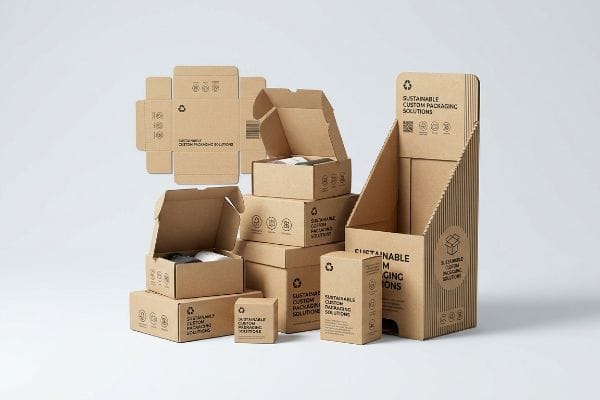
Das Verständnis der Vorteile von Karton ist jedoch nur der erste Schritt; um dies im Einzelhandel einwandfrei umzusetzen, müssen einige kritische Branchenfallen vermieden werden.
Ist Karton gut oder schlecht für die Umwelt?
Die Einhaltung von Umweltauflagen stellt eine große Hürde für die Expansion moderner Einzelhandelsketten dar. Großmärkte fordern nachhaltige Lösungen, doch gutmeinende Marketingteams zerstören oft unbeabsichtigt die Umweltfreundlichkeit von Karton.
Karton ist äußerst umweltfreundlich, da er vollständig erneuerbar und über die Wertstoffsammlung recycelbar ist. Wird er ohne giftige Klebstoffe oder unlösliche Kunststofffolien hergestellt, lässt sich Wellpappe problemlos in den Recyclingkreislauf für Altpapier (OCC) zurückführen. Dadurch wird der Abfall auf Deponien reduziert und der globale CO₂-Fußabdruck entlang der gesamten Lieferkette minimiert.
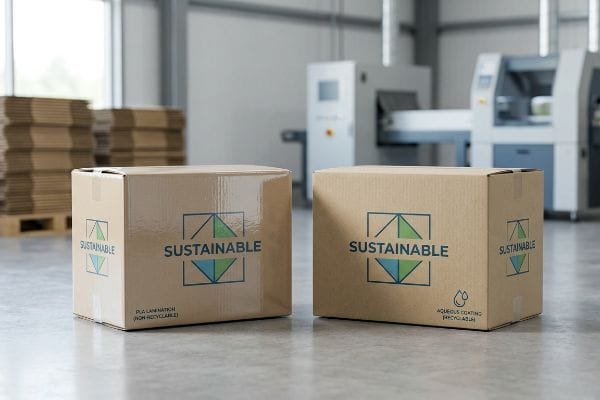
Während das Rohpapier an sich nachhaltig ist, bestimmt das, was man darauf gibt, seine tatsächlichen Umweltauswirkungen.
Die versteckte PLA-Kompostierungsfalle in nachhaltigen Verpackungen
Marken setzen häufig auf PLA-Laminierungen (Polymilchsäure)¹, da sie davon ausgehen, dass diese Folie auf Maisbasis die vollständige Einhaltung der Umweltstandards für ihre Verkaufsdisplays gewährleistet. Marketingteams schätzen die hochwertige Haptik und das „Bio“-Label, da sie davon ausgehen, dass sich die Folie zusammen mit den Papierfasern auf natürliche Weise zersetzt. Sie vertrauen darauf, dass die Verwendung dieser Folien die strengen Nachhaltigkeitsprüfungen der Einzelhändler automatisch besteht.
Dies führt zu einem erheblichen Problem, wenn das Display das Recyclingzentrum erreicht. PLA bildet einen festen, glatten Film²,der Wasser während herkömmlicher Aufbereitungsprozesse stark abweist. Wenn ein Verkäufer das Display in den Restmüll wirft, fängt die Recyclinganlage diesen starren Biokunststofffilm ab und leitet die gesamte Konstruktion direkt auf eine Deponie³.Um dies zu beheben, sollten die festen PLA-Filme durch eine flüssige, wässrige Beschichtung ersetzt werden. Diese wasserbasierte Beschichtung löst sich in den Papierbottichen der Papierfabrik vollständig auf, sodass die Konstruktion weiterhin über die Wertstoffsammlung recycelt werden kann und kostspielige Rückbelastungen für Einzelhändler vermieden werden.
| Häufiger Anfängerfehler | Die Profi-Lösung | Vorteil für die Verkaufsfläche |
|---|---|---|
| Spezifizierung von PLA-Biokunststofflaminaten | Aufbringen flüssiger wässriger Beschichtungen4 | Gewährleistet die Recyclingfähigkeit am Straßenrand |
| Mischen von nicht löslichen Klebstoffen | Verwendung von wasserbasiertem PVA-Klebstoff5 | Verhindert die Umleitung von Müll auf Deponien |
| Ignorieren der OCC-Wiederaufbereitungsgrenzen6 | Beschichtungen an Papiersorten anpassen | Besteht strenge Händlerprüfungen |
Die Umstellung auf wasserbasierte Beschichtungen schützt Ihre Umweltinitiativen und verhindert hohe Bußgelder von den Nachhaltigkeitsbehörden. Ich sorge dafür, dass Ihre Displays weiterhin über die Wertstoffsammlung recycelt werden können und somit nicht auf Mülldeponien landen.
🛠️ Harveys Schreibtisch: Sind Sie sich nicht sicher, ob Ihre aktuellen Displaybeschichtungen die Recyclingrichtlinien erfüllen? 👉 Fordern Sie eine kostenlose Stücklistenprüfung an ↗ — Direkter Kontakt zu mir. Garantiert kein automatisierter Werbe-Spam.
Wofür wird Karton hauptsächlich verwendet?
Neben herkömmlichen Versandkartons nutzen clevere Marken verstärkte Kartonagen, um die Regale im Einzelhandel zu dominieren. Sie ersetzen teure, permanente Verkaufsflächen und ermöglichen so kurzfristige Werbeaktionen.
Karton wird hauptsächlich für die Warenpräsentation im Einzelhandel und für Transportverpackungen in großen Mengen verwendet. Hochleistungsfähige Wellpappenrohlinge ersetzen teure, fest installierte Metallkonstruktionen bei kurzfristigen Werbeaktionen und bieten effiziente Flatpack-Logistik, erhebliche Einsparungen bei den Frachtkosten sowie hochauflösende, bedruckbare Oberflächen, die Impulskäufe im großflächigen Einzelhandel fördern.
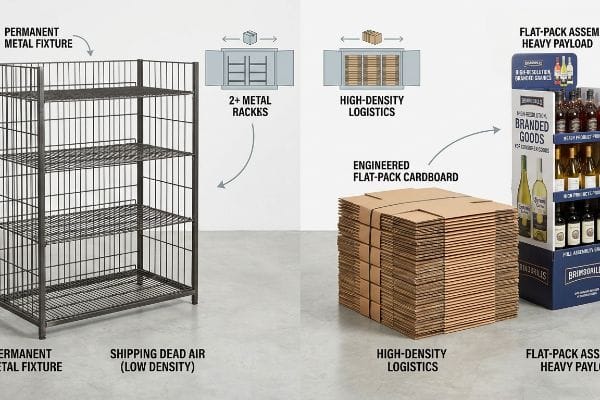
Vielen Beschaffungsteams ist nicht bewusst, wie viel Arbeit eine temporäre Papierstruktur tatsächlich leisten kann.
Frachtstrafe für fest installierte Metallbefestigungen
Einkaufsteams greifen bei kurzfristigen Verkaufskampagnen häufig auf fest installierte, geschweißte Metall-Verkaufsdisplays (FSDUs7 – Free Standing Display Units) zurück, da sie davon ausgehen, dass robuster Stahl automatisch eine höhere Rendite garantiert. Sie glauben, dass eine starre, permanente Konstruktion die einzige zuverlässige Möglichkeit ist, schwere Konsumgüter in stark frequentierten Gängen sicher zu präsentieren.
Diese Logik ignoriert jedoch völlig die aufwendige Logistik von fest installierten Regalsystemen, die komplett montiert transportiert werden müssen. Ich sehe immer wieder, wie Kunden enorme Frachtkostenaufschläge zahlen, nur um leere, ungenutzte Regale durch die globale Lieferkette zu transportieren, da ein einzelner Versandcontainer nur etwa 250 geschweißte Drahtgestelle fasst . Wenn ich diese Kunden auf hochleistungsfähige, temporäre, flach verpackte Wellpappregale umstelle, ist der Unterschied enorm. Ich kann bis zu 1.500 gefaltete Einheiten in ein und demselben Container unterbringen . Durch die mathematische Auslegung der Innenrippen, die hohe Lasten tragen können, eliminieren wir die hohen Frachtkosten für fest installierte Regalsysteme und bieten gleichzeitig den Verkäufern im Einzelhandel einen leichten, werkzeuglosen Montageprozess, der reibungslos verläuft und die Vinylböden im Geschäft nicht zerkratzt.
| Häufiger Anfängerfehler | Die Profi-Lösung | Vorteil für die Verkaufsfläche |
|---|---|---|
| Versand leerer Metallgestelle | Gestaltung von flach verpackten Wellpappen | Verdreifacht die Dichte der Schiffscontainer10 |
| Stahl für 8-wöchige Werbeaktionen verwenden | Umstellung auf hochbelastbaren Karton | Senkt die Stückkosten drastisch11 |
| Das Volumen der toten Luft wird vernachlässigt | Konstruktion modularer Ausklappvorrichtungen | Vereinfacht den Wareneingang auf Filialebene |
Ich rate meinen Kunden stets von Heavy-Metal-Artikeln für saisonale Werbeaktionen. Der Umstieg auf vorgefertigte, platzsparende Möbel reduziert die Kosten für den Seefrachttransport drastisch, sodass Sie das eingesparte Kapital direkt in eine bessere Konstruktion und Markengrafik investieren können.
🛠️ Harveys Schreibtisch: Zahlen Sie für unnötigen Versand vormontierter Metallgestelle? 👉 Holen Sie sich einen Plan für den Umbau auf Flatpack ↗ – Sicher herunterladen. Bei Fragen können Sie mich gerne kontaktieren.
Welche Gegenstände sollten niemals in Kartons aufbewahrt werden?
Karton ist im Innenbereich äußerst vielseitig einsetzbar, doch unkontrollierte Umwelteinflüsse verändern die physikalischen Eigenschaften des Materials grundlegend. Die Kenntnis seiner Grenzen verhindert katastrophale Lieferkettenausfälle.
Gegenstände, die der Witterung, unkontrollierter Luftfeuchtigkeit oder Kondensation ausgesetzt sind, dürfen niemals in herkömmlichen Kartons gelagert werden. Unversiegelte, poröse Papierfasern absorbieren schnell Feuchtigkeit, was zu schwerwiegenden strukturellen Schäden, einem massiven Verlust der Druckfestigkeit und sofortigem Reißen an kritischen Belastungspunkten unter hoher Last führt.
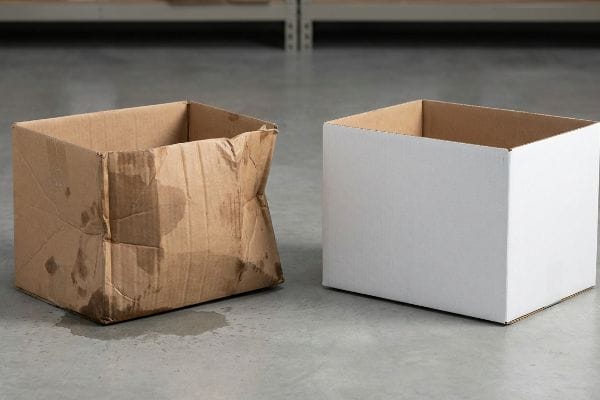
Wenn man die Grenzen des Papierverbrauchs über klimatisierte Zonen hinaus ausreizt, ist das ein sicheres Rezept für ein Desaster im Einzelhandel.
Die Feuchtigkeitsfalle für Outdoor-Merchandising
Marken versuchen mitunter, standardisierte Wellpapp-Displays vor Ladenlokalen, in Gartencentern oder bei Open-Air-Veranstaltungen aufzustellen, um Passanten anzulocken. Sie gehen davon aus, dass bei überwiegend gutem Wetter ein handelsüblicher bedruckter Versandkarton oder eine Verkaufsschale für eine Wochenendaktion völlig ausreicht.
Stellen Sie sich einen trockenen Schwamm auf einer feuchten Küchenarbeitsplatte vor; er saugt das Wasser sofort auf. Genau das passiert mit unversiegelten Papierfasern, wenn sie Morgentau oder hoher Luftfeuchtigkeit im Lager ausgesetzt sind. Die Feuchtigkeit schwächt die Testliner-Schicht 12 rasch , wodurch die Struktur ihre Druckfestigkeit verliert und die Ware zu Boden fällt. Um dies zu verhindern, sollte ein vollständiger Materialwechsel hin zu wetterfesten Trägermaterialien wie gewelltem Polypropylen 13 vorgeschrieben oder eine dicke, kantenversiegelte Polyethylenbeschichtung auf den Karton aufgebracht werden. Dadurch wird die Feuchtigkeit zuverlässig isoliert und die strukturelle Integrität erhalten.
| Häufiger Anfängerfehler | Die Profi-Lösung | Vorteil für die Verkaufsfläche |
|---|---|---|
| Rohpapier im Freien auslegen | Aufrüstung auf polybeschichtete Barrieren14 | Verhindert feuchtigkeitsbedingtes Zusammenbrechen |
| Die Umgebungsfeuchtigkeit wird vernachlässigt | Konstruktion wetterfester Fundamente15 | Verhindert das Herunterfallen des Produkts |
| Verwendung von handelsüblichen Haken im Außenbereich | Umstellung auf geriffelte Kunststoffplatten16 | Gewährleistet das langfristige Überleben der Kampagne |
Der Einsatz empfindlicher Papierstrukturen in den wechselnden Mikroklimata im Außenbereich führt im Einzelhandel unweigerlich zum Scheitern. Die Verwendung wetterfester Materialien isoliert die Feuchtigkeit und gewährleistet, dass Ihre Markenpräsentation auch völlig unvorhersehbaren Umwelteinflüssen standhält.
🛠️ Harveys Schreibtisch: Planen Sie in dieser Saison die Eröffnung eines Gartencenters oder eines Freiluftgeschäfts? 👉 Fordern Sie jetzt Ihre wetterfeste Beratung an ↗ – Keine Formulare, die endlose Verkaufsgespräche auslösen. Nur echter Mehrwert.
Ist Karton ein Abfallmaterial?
Nachhaltigkeitsquoten drängen Marken dazu, recycelte Materialien zu verwenden, doch die Betrachtung von Karton als unerschöpflichen Abfall ignoriert völlig die mechanischen Realitäten des Aufbereitungsprozesses.
Nein. Karton ist ein hochentwickeltes Trägermaterial und kein unerschöpflicher Abfallstoff. Obwohl er häufig recycelt wird, sind die Zellulosefasern nach fünf bis sieben Aufbereitungszyklen mikroskopisch erschöpft. Übermäßig recycelte Kartons verlieren ihre dynamische Druckfestigkeit und müssen daher mit neuem Kraftpapier versetzt werden, um den Belastungen des Transports im Einzelhandel standzuhalten.
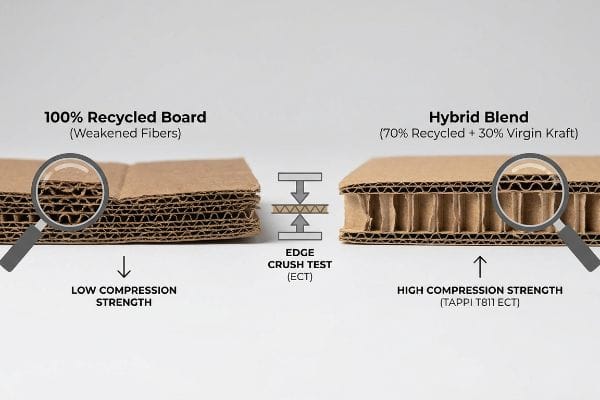
Nur weil ein Karton braun und recycelt ist, heißt das nicht, dass er die nötige Stabilität besitzt, um schwere Waren zu transportieren.
Die versteckte Fasererschöpfungsgrenze
Einkaufsteams, die nach maximaler Nachhaltigkeit streben, schreiben oft 100% recyceltes Testliner für stark beanspruchte Verkaufsdisplays17. Sie gehen selbstverständlich davon aus, dass stark recycelter Karton die gleiche physikalische Integrität wie neues Material besitzt und betrachten alles braune Papier als mechanisch gleichwertig.
Papierfasern sind jedoch kein unzerstörbarer Stahl; sie bestehen aus organischer Zellulose und zersetzen sich. Werden diese kurzen, übermäßig recycelten Fasern starker Belastung ausgesetzt, versagen sie sofort. Ich teste dies mit dem TAPPI T811 Edge Crush Test18, und die Ergebnisse sind verheerend. Die inneren Wellen sind nicht steif genug und werden einfach nach innen gedrückt, wodurch ein weicher, schwammiger Widerstand anstelle eines scharfen Bruchs entsteht. Dies verursacht massive Reibung und verlangsamt die Produktionslinie um schätzungsweise 30 %. Um dieses strukturelle Defizit zu beheben, injiziere ich präzise 30 % frisches Kraftpapier19 direkt in die tragenden Wellen. Diese gezielte Zugabe langer, frischer Papierfasern stellt sofort die dynamische Druckfestigkeit wieder her, die für den Transport im doppelt gestapelten Seefrachtraum erforderlich ist und gleichzeitig die Umweltauflagen des Einzelhändlers erfüllt.
| Häufiger Anfängerfehler | Die Profi-Lösung | Vorteil für die Verkaufsfläche |
|---|---|---|
| Vorschrift für 100% Recyclingkarton | Einspritzen von 30 % Neu-Kraftfasern20 | Verhindert das Einklemmen unter Paletten |
| Alle Papiere gleich behandeln | Überprüfung der TAPPI T811 ECT-Metriken21 | Übersteht Hochgeschwindigkeitstransporte |
| Die Grenzen der Aufbereitung außer Acht lassen | Nutzung von Hybridmaterialmischung | Ausgewogenheit zwischen Kraft und Umweltzielen |
Ich werde niemals die Markteinführung eines robusten Produkts gefährden, nur um ein perfektes Recycling-Siegel zu erhalten. Durch die Beimischung frischer Fasern in die Wellpappe garantiere ich, dass Ihre Verpackung den anspruchsvollen Transport unbeschadet übersteht.
🛠️ Harveys Schreibtisch: Versagen Ihre Kartons aus 100 % Recyclingmaterial heimlich unter dem Gewicht von Paletten? 👉 Fordern Sie eine Materialfestigkeitsprüfung an ↗ — Direkter Kontakt zu mir. Kein automatisierter Werbe-Spam, versprochen.
Was kann man aus Pappe machen?
Die Vielseitigkeit von Karton ermöglicht enorme strukturelle Kreativität, von hoch aufragenden Palettendisplays bis hin zu aufwendigen Thekenelementen. Die Skalierung dieser Designs erfordert jedoch tiefgreifende mathematische Ingenieursleistungen.
Mit Karton lassen sich vielfältige Konstruktionsarbeiten realisieren, darunter die Gestaltung von robusten Palettendisplays, interaktiven Endkappen und modularen Thekenaufstellern. Durch die Anpassung der Wellenstärke und der Kartonqualität kann dieses vielseitige Material präzise per CNC (Computer Numerical Control) zugeschnitten werden, um hohen dynamischen Belastungen und komplexen Geometrien standzuhalten.
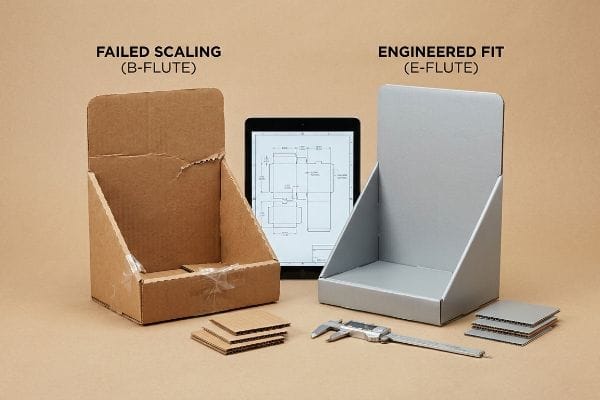
Doch die Theorie allein genügt nicht, wenn die Maschinen in Betrieb gehen; die Vergrößerung oder Verkleinerung von Strukturen offenbart verborgene Materialgrenzen.
Warum das „Schrumpfen-auf-Passung“-Skalierungskonzept in der Fabrikhalle scheitert
Marken verwenden häufig bewährte, robuste Bodenaufsteller-Stanzformen und verkleinern diese mathematisch um 50 %, um sie als Thekenaufsteller einzusetzen . Sie gehen davon aus, dass eine universelle CAD-Datei (Computer-Aided Design) für alle Dimensionen funktioniert und behandeln dicke Wellpappe wie eine skalierbare Vektorgrafik auf einem Bildschirm.
Ein einzelnes Display im Labor aufzustellen ist einfach, doch die Realität sieht anders aus, wenn man 500 Stück versendet. In meiner Einrichtung sehe ich regelmäßig, wie Kunden versuchen, dichte B-Wellen-Platinen in Mikro-Proportionen zu biegen. Da sie die Messschieberkompensation23, lassen sich die dicken Wellen nicht sauber biegen. Der Widerstand führt dazu, dass das obere Papierblatt hörbar reißt, und die Lohnverpacker müssen schließlich unsauberes, klebriges Klebeband verwenden, um die abgebrochene Lasche zusammenzuhalten. Um dies zu beheben, überarbeite ich die Datei komplett und schreibe eine strukturelle Reduzierung auf ein dünneres E-Wellen-Substrat mit einer Dicke von exakt 1,5 mm (0,06 Zoll)24vor. Durch die Neuberechnung der Reibungsverbindungen und Laschenabstände für die dünnere Platine stelle ich sicher, dass sich die Montagezeit beim Lohnverpacken um etwa 42 Sekunden pro Einheit reduziert, geklebte Kanten vermieden und die Markengrafiken makellos bleiben.
| Häufiger Anfängerfehler | Die Profi-Lösung | Vorteil für die Verkaufsfläche |
|---|---|---|
| Verkleinerung der B-Flöten-CAD-Dateien | Umstieg auf E-Wellen-Brettern25 | Verhindert unschöne Klebebandkanten |
| Die Dicke des Bremssattels wird vernachlässigt | Überarbeitung von Reibungssperren26 | Beschleunigt die Montagezeit der Angestellten |
| Dicke Laschen zum Umklappen zwingen | Mathematische Anpassung der Faltradien27 | Sorgt für makellosen Druck auf dem Deckblatt |
Gehen Sie nicht davon aus, dass ein ansprechendes Bodendisplay automatisch auch an einer Kasse funktioniert. Indem ich die Materialstärke der Platten berücksichtige und die Geometrie der Konstruktion anpasse, garantiere ich Ihnen eine einwandfreie Montage Ihrer Einheiten – jedes Mal.
🛠️ Harveys Schreibtisch: Lassen Sie sich nicht von einem 2 Millimeter kleinen Konstruktionsfehler die Einführung in 500 Filialen vermasseln. 👉 Senden Sie mir Ihre Stanzdatei ↗ – ich prüfe die Berechnungen, bevor Sie Ihr Budget für die Massenproduktion verschwenden.
Abschluss
Sie können zwar einen günstigeren Lieferanten wählen, doch wenn die unversiegelte Pappe in einem feuchten Gartencenter im Freien zusammenfällt, entsteht enorme Reibung, die den Wareneingangsprozess um schätzungsweise 30 % verlangsamt und die Gewinnspanne des Projekts vollständig zunichtemacht. Über 500 Markenmanager nutzen meine Checkliste für die Druckvorstufe, um genau diese fatalen Fehler in der Anfangsphase zu vermeiden. Hören Sie auf, über Materialbeschränkungen zu raten, und lassen Sie mich Ihre Strukturdateien persönlich durch meinen kostenlosen Stanzformen-Pre-Flight-Audit führen, um schwerwiegende Schwachstellen vor Produktionsbeginn aufzudecken.
„Biokunststoffe“, https://nebraskacorn.gov/cornstalk/ag-tech-and-innovation/bioplastics/. Technischer Nachweis, dass PLA ein Polymilchsäure-Biokunststoff ist, der typischerweise aus Maisstärke gewonnen wird. Nachweisfunktion: Faktennachweis; Quellentyp: Materialwissenschaftliche Referenz. Belege: Die chemische Identität und Herkunft der erwähnten Laminierung. Anmerkung: Obwohl PLA größtenteils auf Maisbasis hergestellt wird, können auch andere pflanzliche Stärken verwendet werden. ↩
„Umfassender Leitfaden für PLA-beschichtetes Papier“, https://naturepoly.com/comprehensive-guide-to-pla-coated-paper-sustainable-packaging/. Wissenschaftliche Daten zu den hydrophoben Eigenschaften von PLA, die eine Fasertrennung beim Hydropulping verhindern. Nachweisfunktion: Technische Verifizierung; Quellentyp: Fachzeitschrift für Materialwissenschaften. Belege: Versagen von PLA beim Standard-Repulping. Anmerkung zum Anwendungsbereich: Bezieht sich auf die Verarbeitung im industriellen Maßstab. ↩
„Recycling der blauen Tonne – LA Sanitation – Stadt Los Angeles“, https://sanitation.lacity.gov/san/faces/home/portal/s-lsh-wwd/s-lsh-wwd-s/s-lsh-wwd-sr/s-lsh-wwd-sr-rybb. Betriebsberichte von Sortieranlagen zur Sortierung und Aussortierung von mit Biokunststoffen kontaminierten Papierströmen. Evidenz: Empirische Daten; Quelle: Bericht der Abfallwirtschaftsbranche. Unterstützt: die Vermeidung der Deponierung von PLA-beschichteten Materialien. Hinweis: Die Ergebnisse können je nach den Kapazitäten der regionalen Anlagen variieren. ↩
„Recycelbare und biologisch abbaubare Papierbeschichtung mit … – PMC“, https://pmc.ncbi.nlm.nih.gov/articles/PMC11948148/. Nachweis, dass wässrige Beschichtungen im Gegensatz zu PLA-Biokunststofflaminaten mit Standard-Papierrecyclingströmen kompatibel sind. Nachweisfunktion: Technischer Nachweis; Quellentyp: Branchenstandard für Recycling. Unterstützt: Die Behauptung, dass wässrige Beschichtungen die Recyclingfähigkeit über die Wertstoffsammlung gewährleisten. Anmerkung: Die tatsächliche Recyclingfähigkeit hängt von den Kapazitäten der lokalen Anlagen ab. ↩
„Wie gut sind Wellpappenverpackungen recycelbar? – PopDisplay“, https://popdisplay.me/how-recyclable-is-corrugated-packaging/. Technischer Nachweis, der belegt, dass wasserbasierte PVA-Klebstoffe während des Aufbereitungsprozesses löslich sind und somit Verunreinigungen verhindern. Funktion des Nachweises: Technische Verifizierung; Quellentyp: Materialwissenschaftliche Dokumentation. Unterstützt: Die Behauptung, dass PVA-Klebstoff die Abfallmenge auf Deponien reduziert. Anwendungsbereich: Speziell für wasserlösliche PVA-Formulierungen. ↩
„Kreislaufwirtschaft in der Verpackungsindustrie und die Rolle der mechanischen Aufbereitung …“, https://www.internationalpaper.com/resources/recycling/white-paper/circularity-packaging-and-role-mechanical-recycling. Technische Spezifikationen bezüglich der maximal zulässigen Beschichtungsmengen für Altpapierverpackungen (OCC), um deren Wiederaufbereitungsfähigkeit zu gewährleisten. Nachweisfunktion: Technische Spezifikation; Quellentyp: Richtlinien der Abfallwirtschaft. Begründung: Die Aussage, dass die Abstimmung der Beschichtung auf die Papiersorte für die Wiederaufbereitung notwendig ist. Hinweis: Die Grenzwerte können je nach regionaler Recyclinganlage variieren. ↩
„Markt für freistehende Verkaufsdisplays | Marktanteil 2026–2033“, https://www.persistencemarketresearch.com/market-research/free-standing-display-units-market.asp. Branchenanalysen und Whitepapers zum Thema Beschaffung bestätigen die systematische Präferenz für Metalldisplays gegenüber temporären Alternativen im Einzelhandel. Evidenzfunktion: Verhaltensvalidierung; Quellentyp: Branchenbericht. Unterstützung: Die Verbreitung von permanenten Displays für kurzfristige Werbeaktionen. Fokus: Beschaffungsverhalten von großflächigen Einzelhandelsketten. ↩
„Intermodaler Container – Wikipedia“, https://en.wikipedia.org/wiki/Intermodal_container. Überprüfung der typischen Menge an vollständig montierten Metall-Ladeneinrichtungen, die in einen Standard-Seecontainer passen. Nachweisfunktion: quantitative Überprüfung; Datenquelle: Daten der Logistikbranche. Unterstützt die Behauptung, dass der Transport von fest installierten Hardwareartikeln ineffizient ist. Anmerkung: Die Schätzungen hängen von den Abmessungen der Regale ab. ↩
„14 Arten von Verkaufsdisplays | Chicago, IL“, https://wertheimerbox.com/types-of-retail-displays/. Überprüfung der Versanddichte von zusammengefalteten Wellpappdisplays im Vergleich zu vormontierten Metallständern. Nachweisfunktion: Vergleichsanalyse; Datenquelle: Kennzahlen der Lieferkette. Unterstützt: die logistische Effizienz von Hochleistungskarton. Anmerkung zum Untersuchungsbereich: basiert auf spezifischer Flatpack-Technik. ↩
„Flatpack-Container vs. Seefrachtcontainer“, https://www.prefabex.com/our_galleries/flat-pack-vs-traditional-shipping-containers. Kurze Erläuterung, wie eine maßgebliche externe Quelle diese Aussage stützt. Funktion des Nachweises: quantitative Verifizierung; Quellentyp: Bericht aus der Logistikbranche. Belege: Der volumetrische Effizienzgewinn von Flatpack-Wellpappenmaterialien gegenüber montierten Metallcontainern. Anmerkung: Die tatsächlichen Dichtemultiplikatoren können je nach den spezifischen Abmessungen der Vorrichtungen variieren. ↩
„Kartondisplays: Die kosteneffektive Lösung“, https://atlaspackaginginc.com/cardboard-displays-the-cost-effective-solution/. Kurze Erläuterung, wie eine maßgebliche externe Quelle diese Aussage stützt. Funktion des Nachweises: Wirtschaftlichkeitsbeurteilung; Quellentyp: Fertigungskostenanalyse. Belege: Die signifikante Reduzierung der Stückkosten bei Verwendung von Karton für kurzfristige Displays. Anmerkung zum Untersuchungsbereich: Der Vergleich konzentriert sich auf temporäre vs. permanente Materialien. ↩
„Einfluss der relativen Luftfeuchtigkeit auf die Druckfestigkeit von …“, https://open.clemson.edu/all_theses/3225/. Technische Daten zur Reduzierung der Druckfestigkeit von Testlinern bei Feuchtigkeitseinwirkung. Nachweisfunktion: Mechanismusverifizierung; Quellentyp: Fachzeitschrift für Materialwissenschaften. Anwendungsgebiet: Strukturelles Versagen von Karton in feuchter Umgebung. Anmerkung zum Anwendungsbereich: Speziell für Testliner aus Wellpappe. ↩
„Warum ist PP-Wellpappe ein ideales Material für die Herstellung von …?“, https://www.polyreflex.com/n1899709/Why-is-PP-Corrugated-Sheet-an-Ideal-Material-for-Making-Packaging-Boxes.htm. Technische Spezifikationen, die die hydrophoben Eigenschaften und die strukturelle Stabilität von gewelltem Polypropylen belegen. Nachweisfunktion: Materialvalidierung; Quellentyp: Handbuch für Verpackungstechnik. Unterstützt: Wirksamkeit synthetischer Substrate zum Feuchtigkeitsschutz. Anmerkung: Biologisch abbaubare Kunststoffalternativen sind ausgeschlossen. ↩
„Tipp zur Wasserdichtmachung von Karton?“, https://customboxesmarket.com/tip-on-how-to-make-cardboard-waterproof/?srsltid. Technische Daten zur Reduzierung der Wasserdampfdurchlässigkeit durch Polyethylenbeschichtungen und zur Verhinderung des Strukturversagens von Papiermaterialien. Nachweisfunktion: Technische Validierung; Quellentyp: Materialwissenschaftliche Spezifikation. Unterstützung: Verwendung von Beschichtungen zur Verhinderung feuchtigkeitsbedingten Versagens. Anwendungsbereich: Speziell für polybeschichteten Karton. ↩
„Maßgefertigte Karton-Displayständer | Eigene Fertigung in den USA“, https://www.creativedisplaysnow.com/displays/. Statische Berechnungsprinzipien für die Konstruktion feuchtigkeitsbeständiger Sockel zur Aufrechterhaltung der Tragfähigkeit im Außenverkauf. Nachweisfunktion: Validierung bewährter Verfahren; Quellentyp: Leitfaden für die Konstruktion von Verkaufsdisplays. Unterstützt: Verhinderung des Zusammenbrechens von Produkten durch Luftfeuchtigkeit. Anwendungsbereich: Gilt für beschwerte oder chemisch behandelte Sockel. ↩
„Coroplast-Schilder und individueller Hartplastikdruck: Ein umfassender Leitfaden“, https://albertbasse.com/coroplast-signs-and-custom-rigid-printing-the-complete-guide/. Vergleichende Analyse der Lebensdauer und strukturellen Integrität von Wellkunststoff (Coroplast) im Vergleich zu Standardkarton im Außenbereich. Nachweisfunktion: Leistungsnachweis; Quellentyp: Branchenbericht zur Haltbarkeit. Unterstützung: Verwendung von Wellkunststoff für den langfristigen Einsatz im Außenbereich. Anwendungsbereich: Fokus auf Beschilderung und Displays im Einzelhandel. ↩
„Umsatz und Gewinn im Einzelhandel durch nachhaltige Verpackungen steigern …“, https://www.internationalpaper.com/resources/recycling/article/drive-retail-sales-profit-through-sustainable-packaging-recycling. Branchenberichte oder Nachhaltigkeitsrichtlinien von Unternehmen bestätigen die Praxis, hohe Anteile an Recyclingmaterial in Einzelhandelsverpackungen vorzuschreiben. Belegfunktion: Bestätigung der Branchenpraxis; Quellentyp: Marktanalyse. Unterstützt: die Aussage, dass Einkaufsteams 100 % Recyclingmaterial für Displays priorisieren. Anmerkung zum Untersuchungsbereich: Fokus auf Trends im Unternehmenseinkauf. ↩
„Neue Konfiguration des Kantenstauchtests mit vollflächiger Messung …“, https://pmc.ncbi.nlm.nih.gov/articles/PMC8510352/. Verifizierung des TAPPI-Standards T811 zur Messung der Kantenstauchfestigkeit (ECT) von Wellpappe und dessen Anwendung zur Erkennung von Faserdegradation. Nachweisfunktion: Technische Validierung; Quellentyp: Industriestandard. Unterstützt: die Verwendung eines standardisierten Tests zur Messung des Steifigkeitsverlusts. Anwendungsbereich: Der Standard gilt speziell für Wellpappe. ↩
„Druckfestigkeit von Wellpappenverpackungen …“, https://pmc.ncbi.nlm.nih.gov/articles/PMC10054506/. Technische Daten zum Mindestanteil an Primärkraftfasern, der erforderlich ist, um die strukturelle Integrität und dynamische Druckfestigkeit von Recycling-Wellpappe zu gewährleisten. Nachweisfunktion: Technische Spezifikation; Quellentyp: Materialwissenschaftliche Forschung. Unterstützt: Das spezifische Additivverhältnis, das für die Tragfähigkeit erforderlich ist. Anmerkung: Die tatsächlichen Verhältnisse können je nach Wellenart und Nutzlast variieren. ↩
„Der ultimative Leitfaden für Wellpappkartons – Shorr Packaging“, https://www.shorr.com/resources/blog/ultimate-guide-corrugated-boxes/. Ein technisches Handbuch für Wellpappenverpackungen würde den spezifischen Anteil an Primärfasern bestätigen, der erforderlich ist, um die strukturelle Integrität zu gewährleisten und ein Zusammenbrechen unter Palettenlasten zu verhindern. Nachweisfunktion: technische Validierung; Quellentyp: Branchenhandbuch. Belegt: die Aussage, dass 30 % Primärfasern ein Zusammenbrechen verhindern. Anmerkung: Die Wirksamkeit variiert je nach Kartonqualität und -gewicht. ↩
„Kantenstauchprüfverfahren und Kartonkompression …“, https://www.tappi.org/publications-standards/tappi-journal/home/2022/aug/edge-crush-testing-methods-and-box-compression-modeling-tappi-journal-august-2022/. Die offizielle TAPPI-Normendokumentation definiert T811 als Standard für den Kantenstauchtest (Edge Crush Test, ECT) zur Messung der Druckfestigkeit von Wellpappe. Nachweisfunktion: Technische Spezifikation; Quellentyp: Industriestandard. Unterstützung: Die Anwendung des ECT zur Beurteilung der Haltbarkeit beim Hochgeschwindigkeitstransport. Anwendungsbereich: Speziell für Wellpappe. ↩
„Einfluss analoger und digitaler Falzlinien auf die Mechanik …“, https://pmc.ncbi.nlm.nih.gov/articles/PMC9268991/. Ressourcen zur Verpackungstechnik beschreiben detailliert, wie die Materialdicke im Gegensatz zu digitalen Vektoren konstant bleibt, was für unterschiedliche Maßstäbe individuelle Stanzlinien erfordert, um die Passgenauigkeit zu gewährleisten. Nachweisfunktion: Technische Validierung; Quellentyp: Ingenieurhandbuch. Unterstützt: Die technische Begründung, warum die universelle CAD-Skalierung bei dicken Kartonagen versagt. Anmerkung zum Umfang: Fokus auf die Diskrepanz zwischen digitaler Skalierung und physikalischen Materialkonstanten. ↩
„Wellpappenverpackungen mit innovativem Design für …“, https://bioresources.cnr.ncsu.edu/resources/corrugated-board-packaging-with-innovative-design-for-enhanced-durability-during-transport/. Statische Berechnungsrichtlinien für Wellpappenverpackungen erläutern die Bedeutung des Dickenausgleichs zur Vermeidung von Materialspannungen und -versagen beim Falten. Belegfunktion: Technisches Prinzip; Quellentyp: Ingenieurhandbuch. Beleg: Die Behauptung, dass fehlender Ausgleich zu Materialversagen in dichten Wellen führt. Anwendungsbereich: Besonders relevant für enge Biegeradien. ↩
„Leitfaden zur Kartonstärke – AOPACK“, https://www.aopackmachine.com/cardboard-thickness-guide/?srsltid=AfmBOopBaRFxagtpIUZpZBjGFNYayBylUv004CYW2yoHgsa_jGRU5w6w. Eine technische Verpackungsnorm oder Herstellerspezifikation bestätigt die Standardstärke von E-Welle-Wellpappe. Nachweisfunktion: Technische Spezifikation; Quellentyp: Industriestandard. Unterstützung: Die spezifische Stärke wird als Lösung für Mikroproportionen verwendet. Hinweis: Geringfügige Abweichungen zwischen Herstellern sind möglich. ↩
„Wellenarten für Wellpappkartons erklärt: A, B, C, E & F“, https://www.onyxpackaging.com/blog/corrugated-box-flute-types.php. Technische Spezifikationen zur Wellenstärke und deren Einfluss auf die Präzisionsskalierung und Kantenqualität im Verpackungsdesign. Nachweisfunktion: Technische Validierung; Quellentyp: Handbuch für Verpackungstechnik. Belegt: Die Behauptung, dass E-Welle eine praktikable Alternative zu verkleinerter B-Welle darstellt, um Passungsprobleme zu vermeiden. Anwendungsbereich: Gilt speziell für Wellpappe. ↩
„[PDF] Untersuchung der mechanischen Eigenschaften von Kartonverpackungen …“, https://repository.rit.edu/cgi/viewcontent.cgi?article=1066&context=japr. Analyse des Einflusses von Materialdickenmessungen auf die Toleranzen und die Montagefreundlichkeit von Reibpassungsmechanismen. Belegfunktion: Kausalzusammenhang; Quellentyp: Studie zum Industriedesign. Unterstützt die Behauptung, dass die Berücksichtigung der Materialdicke die Montagegeschwindigkeit optimiert. Fokus: Montage von Verkaufsdisplays. ↩
„Kartonkonstruktionen: Berechnung der Biegezugabe 1“, https://www.youtube.com/watch?v=j1n5ojAbAic. Technische Normen zur Berechnung der Biegezugabe und des Faltradius, um Materialspannungen oder Druckrisse beim Falten zu vermeiden. Nachweisfunktion: Prozessverifizierung; Quellentyp: Leitfaden für die Tragwerksplanung. Belegt: die Behauptung, dass die mathematische Anpassung die Druckintegrität des Deckblatts erhält. Anwendungsbereich: beschränkt auf Kartonmaterialien mit hoher Dicke. ↩