
Der Start einer Einzelhandelskampagne ist schon stressig genug, ohne dass die Displays im Distributionszentrum abgelehnt werden. Wer die strengen Richtlinien großer Handelsketten ignoriert, riskiert Rückbuchungen, strukturelle Mängel und verschwendetes Budget.
Die Einhaltung der Walmart-Standards gewährleistet, dass Ihre Wellpapp-Displays die globalen Lieferketten unbeschadet überstehen und die strengen Anforderungen des Einzelhandels erfüllen. Diese strengen Vorgaben regeln alles von den Palettenabmessungen bis zur Tragfähigkeit und garantieren so, dass Produktpräsentationen an Tausenden von Standorten sicher, gut sichtbar und hochprofitabel sind.

Die Regeln auf dem Papier zu kennen, ist das eine, aber zu verstehen, wie sie sich in der praktischen Verpackungstechnik umsetzen, ist das, was Ihre Gewinnmargen tatsächlich schützt.
Muss Walmart die OSHA-Standards einhalten?
Man könnte sich fragen, ob die bundesstaatlichen Sicherheitsvorschriften auch für einen einfachen Pappaufsteller im Gang gelten.
Ja. Walmart muss in allen seinen Einrichtungen die OSHA-Standards (Arbeitsschutzbehörde) einhalten. Diese bundesweite Vorgabe schreibt strenge Sicherheitsanforderungen für den stationären Einzelhandel vor. So müssen beispielsweise Verkaufsdisplays stabil stehen, dürfen keine Gehwege blockieren und müssen vor Umkippgefahren geschützt sein, um sowohl Mitarbeiter als auch Kunden zu schützen.

Man könnte meinen, Sicherheit sei eine Frage des Betriebsablaufs, aber tatsächlich beginnt sie bereits in der Phase der strukturellen Gestaltung Ihrer Verpackung.
Vermeidung von Kippgefahren durch ordnungsgemäße Fundamentverankerung
Selbst erfahrene Designer versuchen oft, Standard-Bodenaufsteller in voller Größe auf die Größe einer Viertelpalette zu verkleinern, um sie in stark frequentierten Kassenbereichen unterzubringen. Sie verringern einfach die Basisbreite, behalten aber die ursprüngliche Gesamthöhe von 1270 mm (50 Zoll) bei, um die Grafikfläche zu maximieren. Dies führt zu einer starken Schwerpunktverlagerung¹undmacht aus einem stabilen Display ein kopflastiges Problem.
Diese physikalische Falle begegne ich häufig bei der Überprüfung von Stanzformen für Flachverpackungen neuer Kunden. Die Datei sieht auf einem flachen Computerbildschirm einwandfrei aus. Sobald jedoch ein Verkäufer schwere Konservendosen auf das schmale oberste Regal schiebt, verhält sich die gesamte Konstruktion wie ein Bleistift, der auf seinem Radiergummi balanciert. Ich erinnere mich an einen Test eines solchen Prototyps; schon die leichte Berührung mit der Hüfte verursachte ein lautes Kratzen auf dem Boden, da das gesamte beladene Display heftig zur Seite kippte. Anstatt darauf zu hoffen, dass die Verkäufer die Waren perfekt ausbalancieren, setze ich ein striktes Schwerpunkt-Verankerungsprotokoll durch. Durch einen versteckten Zwischenboden in der E-Welle (Mikro-Welle)-Basis, in dem Sandsäcke als Gewichte Platz finden, bleibt das Display sicher am Boden verankert.
| Häufiger Anfängerfehler | Die Profi-Lösung | Vorteil für die Verkaufsfläche |
|---|---|---|
| Verkleinerung der Basisbreite ohne Anpassung der Höhe | Konstruktion eines versteckten, beschwerten Doppelbodens | Eliminiert die Haftung für Trinkgelder vollständig |
| Schwere Artikel gleichmäßig auf allen Ebenen stapeln | Die schwersten Produkte ins unterste Regal zwingen | Verhindert das Schwanken der Struktur aufgrund ihrer Kopflastigkeit2 |
| Rotationsgang-Schwebewege werden ignoriert | Beschränkung der Basis auf exakte Bruchteildimensionen | Verhindert Kollisionsschäden an Einkaufswagen |
Die Sicherheit in den Regalgängen überlasse ich niemals dem Zufall. Durch die mathematische Absenkung des Schwerpunkts in der Konstruktionsdatei stelle ich sicher, dass das fertige Regal beim Einräumen absolut formstabil bleibt. So vermeide ich teure Rückbelastungen durch den Einzelhandel und schütze den Ruf Ihrer Marke.
🛠️ Harveys Schreibtisch: Sind Ihre hohen Viertelpaletten-Konstruktionen eine versteckte Kippgefahr? 👉 Lassen Sie mich Ihre Stanzform prüfen ↗ — Direkter Zugang zu meinem Schreibtisch. Kein automatisierter Werbe-Spam, versprochen.
Was sind die vier Säulen von Walmart?
Die Abstimmung Ihres Produktlaunches mit einem großen Einzelhändler erfordert ein grundlegendes Verständnis dafür, wie dieser sein Geschäftsmodell organisiert.
Die vier Säulen von Walmart basieren auf ihrem zentralen Einzelhandelskonzept, das dauerhaft niedrige Preise ermöglicht. Dieses strategische Geschäftsmodell konzentriert sich stark auf die Optimierung der Lieferkettenlogistik, die Maximierung der betrieblichen Effizienz, die Steigerung des Warenvolumens und die Gewährleistung eines reibungslosen Einkaufserlebnisses für die Kunden in ihren zahlreichen stationären und Online-Shops.

Das Verständnis dieser übergeordneten Unternehmensziele ist hilfreich, aber man muss diese Säulen aktiv in physische Merchandising-Strategien umsetzen.
Umsetzung der Einzelhandelsstrategie in die physische Warenpräsentation
Es ist eine häufige Falle, in die selbst erfahrene Einkaufsteams tappen: Sie entwerfen ein ansprechendes und solides Display und gehen davon aus, dass der Einzelhändler schon herausfinden wird, wie er es verkauft. Sie trennen die physische Verpackung von den strengen Geschäftsmechanismen des Einzelhandelsmodells und ignorieren völlig die spezifischen Werbe- und Platzierungsstrategien, die für Großhandelsclubs im Vergleich zu Nachbarschaftsmärkten erforderlichsind.
Ein Kunde lieferte einmal Hunderte von wunderschön bedruckten Einheiten, die die strengen Lagerhaltungsvorschriften des Einzelhändlers völlig ignorierten. Ich ging in die Montagehalle und beobachtete, wie das Co-Packing-Team sich abmühte, einen etwas zu großen Umkarton auf eine Standardpalette der GMA (Grocery Manufacturers Association)quetschen. Das raue Kratzen des rohen Testliners auf dem rauen Holz war laut und deutlich zu hören. Da die Abmessungen nicht mit den logistischen Effizienzvorgaben des Einzelhändlers kollidierten, wies das Distributionszentrum die Ladung zurück, was zu erheblichen Verzögerungen führte und die Lieferkette um schätzungsweise 30 % verlangsamte.Bevor ich auch nur eine einzige CAD-Linie (Computer-Aided Design) zeichne, lasse ich daher sofort eine Matrix des Einzelhandelsrahmens erstellen. Indem ich Ihre Einheit direkt auf das jeweilige System des Geschäfts abstimme, stelle ich sicher, dass die Verpackung tatsächlich zu dessen betrieblichen Gegebenheiten passt.
| Häufiger Anfängerfehler | Die Profi-Lösung | Vorteil für die Verkaufsfläche |
|---|---|---|
| Entwurf vor Bestätigung der Ladenflächenpläne | Zuordnung von Dimensionen zu spezifischen Ladenformaten | Garantiert die sofortige Genehmigung des Layouts |
| Die Reibung bei der Hochgeschwindigkeits-Nachfüllung wird vernachlässigt | Hinzufügen modularer SKU-Trennwände für einfaches Beladen | Spart 25 Sekunden pro Nachfüllung6 |
| Unter der Annahme universeller Logistikanforderungen | Ausrichtung der Fußabdrücke an exakten Teilpaletten7 | Optimiert den Wareneingangsprozess im Lager |
Ich integriere die Geschäftslogik immer direkt in die Kartonverpackung. Wenn Ihre physische Verpackung die Anforderungen des Einzelhändlers an logistische Geschwindigkeit und Volumen nahtlos unterstützt, wird Ihre Kampagne nicht länger zum Hindernis, sondern zu einem äußerst profitablen Vorteil.
🛠️ Harveys Schreibtisch: Entspricht Ihre aktuelle Displayfläche tatsächlich den Abläufen Ihres Zielhändlers? 👉 Strategische Flächenanalyse anfordern ↗ – Sicher herunterladen. Bei Fragen können Sie mich gerne kontaktieren.
Was ist Walmarts größtes Problem?
Die Genehmigung Ihres Produkts durch das Einkaufsteam zu erhalten, ist ein großer Erfolg, aber der Weg bis zum Verkaufsstart ist für die meisten Kampagnen der schwierigste.
Walmarts größte Herausforderung im Bereich der physischen Warenpräsentation besteht darin, die massive Lieferkettenlogistik ohne Transportschäden zu bewältigen. Da ihr Vertriebsnetz mit hoher Geschwindigkeit und schweren Palettengütern arbeitet, können selbst geringfügige strukturelle Mängel an Verkaufsdisplays oder Verpackungen zu katastrophalen Lagerschäden, verzögerten Markteinführungen und erheblichen finanziellen Rückbelastungen führen.
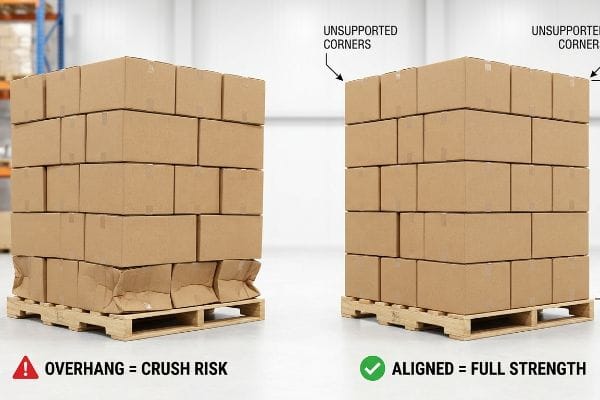
Da die Logistik das Hauptschlachtfeld ist, müssen Sie genau prüfen, wie Ihre Verpackung mit der physischen Lagerumgebung zusammenwirkt.
Die versteckte Gefahr geringfügiger Palettenüberstände
Einkaufsteams versuchen häufig, die Abmessungen ihrer Umkartons maximal auszunutzen, um einige zusätzliche Einheiten in eine Sendung zu quetschen. Sie gehen davon aus, dass ein hochbelastbarer Karton der Stärke 32ECT (Edge Crush Test)8 ausreichend stabil ist, um die Ware zu schützen, und ignorieren dabei völlig die physikalischen Gesetze der Palettenstapelung.
Stellen Sie sich einen Karton wie vier tragende Säulen vor, die ein Dach stützen. Ein Wellpappkarton bezieht bis zu 60 % seiner vertikalen Druckfestigkeit direkt aus der präzisen Ausrichtung seiner vier Ecken. Wenn ein Umkarton eine Standardpalette von 1219 × 1016 mm (48 × 40 Zoll) nur um 12,7 mm (ein halbes Zoll) überragt, hängen diese Ecken frei in der Luft und tragen keinerlei Last. Ich habe die Folgen dieses Fehlers schon oft an der Warenannahme gesehen. Man kann förmlich das langsame, qualvolle Knirschen der Papierfasern hören, wenn das Gewicht der kopflastigen Lagerware auf die ungestützten Mittelplatten drückt und die untere Lage nach außen wölbt und zerdrückt. Meine Faustregel ist einfach: Ich schreibe ein striktes Null-Überstand-Protokoll für Umkartons vor. Ich verkleinere die maximal zulässige Kartonfläche in unserer Statiksoftware künstlich um exakt 12,7 mm (ein halbes Zoll), um sicherzustellen, dass die Ecken vollständig gestützt bleiben.
| Häufiger Anfängerfehler | Die Profi-Lösung | Vorteil für die Verkaufsfläche |
|---|---|---|
| Maximale Vergrößerung der Box bis zum äußersten Rand | Verkleinerung der Stellfläche um 0,5 Zoll (12,7 mm) | Hält die tragenden Ecken vollständig gestützt |
| Ausschließlich auf Basis der Rohdaten der ECT-Board-Bewertungen | Die Ecken perfekt an den Palettenkanten ausrichten | Behält 60 % der vertikalen Kastenfestigkeit |
| Geringfügige manuelle Ladefehler werden ignoriert | Konstruktion eines automatischen internen Spielpuffers | Übersteht den Transport in einem doppelt gestapelten Container |
Ich weigere mich, durch fehlerhafte Maßberechnung einwandfreie Materialien zu zerstören. Indem ich den Umfang um nur einen Bruchteil eines Zolls (12,7 mm) nach innen verringere, stelle ich die entscheidende Druckfestigkeit wieder her und vermeide so Transportschäden bei der Sortierung im Lager vollständig.
🛠️ Harveys Schreibtisch: Verlieren Ihre Umkartons durch überstehende Paletten heimlich die Hälfte ihrer Stabilität? 👉 Fordern Sie eine statische Dimensionsprüfung an ↗ – Keine Formulare, die endlose Verkaufsgespräche auslösen. Nur echter Mehrwert.
Was besagt die 10-Fuß-Regel bei Walmart?
Kundenservice-Richtlinien sind dafür bekannt, dass sie die Interaktion mit Käufern diktieren, aber dieselben Prinzipien der Kundenbindung gelten auch direkt für unbelebte Marketingeinrichtungen.
Die „3-Meter-Regel“ bei Walmart verpflichtet die Mitarbeiter, jeden Kunden im Umkreis von drei Metern anzusprechen und zu unterstützen. Diese Philosophie gilt auch für die Warenpräsentation: Verkaufsdisplays müssen kontrastreiche Designs und auffällige Grafiken verwenden, um die Aufmerksamkeit der Kunden zu gewinnen und den Produktwert aus nächster Nähe klar zu vermitteln.
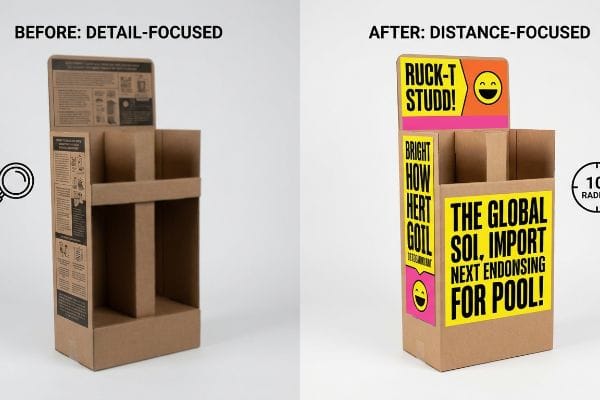
Doch die Theorie allein genügt nicht, wenn die Maschinen anlaufen und Ihr Kunstwerk tatsächlich auf physischen Karton gepresst wird.
Warum die standardmäßige Skalierung von Grafiken in der Fabrikhalle versagt
Grafikdesigner entwerfen Verkaufsdisplays ausschließlich für die Nahansicht auf ihren hintergrundbeleuchteten, hochauflösenden Computermonitoren. Sie gehen davon aus, dass eine komplexe Werbebotschaft, die aus einer Leseentfernung von 304 mm (12 Zoll)gut, automatisch auch in einem unübersichtlichen Regalgang eines Großmarktes als dreidimensionale Struktur wirkt.
In meiner Einrichtung erlebe ich regelmäßig, wie theoretische Büroarbeit die praktische Umsetzung beeinträchtigt. Designer drucken riesige Textwände und ignorieren dabei völlig die kognitive Überlastung im Einzelhandel. Das ist nicht nur Theorie – ich sehe es in der Testumgebung, wenn wir fertig montierte, litholaminierte Prototypen prüfen. Die physikalischen Eigenschaften von Soft-Touch-Folien oder dicken Lacken können die gedruckten Pigmente um bis zu 5 % verdunkeln, sodass die winzigen Schriftarten unter grellem Neonlicht zu einem unleserlichen Durcheinander verschwimmen. Wenn ich die visuelle Klarheit aus zehn Metern Entfernung messe, geht die Hauptbotschaft völlig verloren, was bedeutet, dass das Display den zentralen Test zur räumlichen Wahrnehmung nicht besteht. Ich ziehe die Mikrometer-Messwerte heran und setze eine strikte 40-40-20-Regel für die Gestaltung durch. Ich entferne rigoros alle sekundären Texte und ersetze sie durch große, gestanzte Blickfänge und großflächige Farbflächen in Pantone Matching System (PMS). Indem ich sicherstelle, dass die Botschaft auch aus der Ferne lesbar ist und den physischen Druckprozess übersteht, erhöhe ich die Impulskonversionsrate der Einheit massiv und steigere so direkt die Rentabilität Ihrer Kampagne.
| Häufiger Anfängerfehler | Die Profi-Lösung | Vorteil für die Verkaufsfläche |
|---|---|---|
| Die Darstellung wie eine detaillierte Broschüre behandeln | Text entfernen, um einen massiven 3D-Stanzschnitt als Blickfang zu schaffen | Zieht schon aus 9 Metern Entfernung die Blicke auf sich10 |
| Verwendung dünner, eleganter Schriftarten im Roh-Testliner | Verwendung von fetten PMS-Sonderfarben für Text | Gewährleistet Lesbarkeit auch unter grellem Einzelhandelslicht |
| Den Verdunkelungseffekt der Laminierung außer Acht lassen | Einspritzen eines 10-12%igen Cyan-Boosts während der Druckvorstufe11 | Sorgt dafür, dass die Markenfarben gut sichtbar und präzise dargestellt werden |
Ich konzentriere mich stark darauf, wie physische Tinte unter realen Lichtverhältnissen mit strukturellen Substraten reagiert. Wenn ich die Druckchemie an die tatsächliche Bewegung von Menschen in einem Verkaufsregal anpasse, verwandelt sich Ihr Display von einem unscharfen Kasten in ein hochwirksames Werbemittel.
🛠️ Harveys Schreibtisch: Lassen Sie sich nicht von einem 2 Millimeter kleinen Konstruktionsfehler die Einführung in 500 Filialen vermasseln. 👉 Senden Sie mir Ihre Stanzdatei ↗ – ich prüfe die Berechnungen, bevor Sie Ihr Budget für die Massenproduktion verschwenden.
Abschluss
Die physikalischen Aspekte der Logistik lassen sich zwar ignorieren, doch wenn ein geringfügiger Palettenüberstand dazu führt, dass Ihre Umkartons unter der schweren Lagerlast nachgeben, führt dies zu sofortiger Ablehnung durch den Händler und vernichtet Ihre gesamte Gewinnspanne. Über 500 Markenmanager nutzen meine Checkliste für die Druckvorstufe, um genau diese fatalen Fehler in der Anfangsphase zu vermeiden. Hören Sie auf, Kompressionsgrenzen zu erraten, und lassen Sie mich Ihre Strukturdateien persönlich durch meinen kostenlosen Stanzlinien-Audit führen, um diese unsichtbaren Schwachstellen aufzudecken, bevor sie Ihre Produktion ruinieren.
„Wie beeinflusst der Schwerpunkt die Stabilität eines Objekts? – YouTube“, https://www.youtube.com/watch?v=vN8cZPABbpc. Wissenschaftliche Erklärung, wie eine Verringerung der Grundflächenbreite bei gleichbleibender Höhe den Schwerpunkt verlagert und die Instabilität erhöht. Belegfunktion: Technisches Prinzip; Quellentyp: Physiklehrbuch oder Ingenieurhandbuch. Unterstützt die Behauptung, dass eine Verkleinerung der Grundfläche zu einer erhöhten Kopflastigkeit führt. Anwendungsbereich: Allgemeine Prinzipien des statischen Gleichgewichts. ↩
„14 Arten von Verkaufsdisplays | Chicago, IL – Wertheimer Box“, https://wertheimerbox.com/types-of-retail-displays/. Ingenieurtechnische Prinzipien aus der Physik oder dem Industriedesign erklären, wie das Platzieren schwerer Gegenstände auf den unteren Regalböden den Schwerpunkt senkt und so ein Schwanken verhindert. Nachweisfunktion: Technische Validierung; Quellentyp: Ingenieurhandbuch. Grundlage: Physik der strukturellen Stabilität. Anwendungsbereich: Gilt für freistehende Kartondisplays. ↩
„Brand Experience Brief: Walmart Neighborhood Market“, https://deniseleeyohn.com/brand-experience-brief-walmart-neighborhood-market/. Überprüfung der unterschiedlichen betrieblichen und verkaufstechnischen Anforderungen der verschiedenen Walmart-Filialformate. Belegfunktion: faktische Validierung; Quellentyp: Analyse der Einzelhandelsbranche. Unterstützt die These, dass unterschiedliche Filialmodelle spezifische Platzierungsstrategien erfordern. Fokus: Untersuchung der spezifischen betrieblichen Unterschiede bei Walmart. ↩
„[PDF] 40-Zoll-GMA-Holzpaletten – Southern Research Station“, https://www.srs.fs.usda.gov/pubs/VT_Publications/05t10.pdf. Überprüfung der offiziellen Spezifikationen der Grocery Manufacturers Association (GMA) für Standardpalettenabmessungen zur Festlegung der technischen Grundlage für die Versandkompatibilität. Nachweisfunktion: Technische Spezifikation; Quellentyp: Branchenstandard. Unterstützt: Die Definition einer Standard-Versandfläche. Anwendungsbereich: Gilt für die nordamerikanische Einzelhandelslogistik. ↩
„Optimierung der Effizienz und Kosten von Logistiklagern in Unternehmen“, https://www.sciencedirect.com/science/article/pii/S2949753125000931. Analyse von Logistikdaten hinsichtlich der durch abgelehnte Sendungen in Einzelhandelsverteilzentren verursachten Betriebsverzögerungen und Effizienzverluste. Nachweisfunktion: quantitative Kennzahl; Quellentyp: Branchen-Whitepaper oder Logistikstudie. Beleg: die Aussage zum Produktivitätsverlust. Anmerkung zum Umfang: Schätzung basierend auf allgemeinen Modellen für Reibungsverluste in der Lieferkette. ↩
„Warum Logistikteams in modulare Verpackungssysteme investieren“, https://www.packproinc.com/why-operations-teams-are-investing-in-modular-packaging-systems/. Empirische Daten oder Fallstudien aus der Branche belegen die konkreten Zeiteinsparungen durch modulare Trennwände bei der Warenauffüllung. Nachweisfunktion: quantitative Verifizierung; Quellentyp: Logistikstudie. Belege: Effizienzsteigerung durch modulare Trennwände. Hinweis: Kann je nach Produktkategorie variieren. ↩
„Standards für die Lieferkette von Sekundärverpackungen“, https://p2pi.com/file/PtPI16509cf4c7b5d4070798853/Walmart%2520Supply%2520Chain%2520Packaging%2520Guide%2520August%25202023.pdf. Technische Dokumentation zu den Anforderungen an die Palettenfläche in großen Einzelhandelsverteilzentren zur Sicherstellung einer effizienten Warenannahme. Nachweisfunktion: Technische Spezifikation; Quellentyp: Handbuch für die Lieferkette. Unterstützt: Anforderungen an die Logistikausrichtung. Anwendungsbereich: Speziell für Standards im großflächigen Einzelhandel. ↩
„[PDF] Spezifikationen für Wellpappe – Fibre Box Association“, https://www.fibrebox.org/assets/2025/09/Walmart_Corrugated-Board_Specifications_Automation_Packaging_Standards.pdf. Die technischen Spezifikationen für Wellpappe im 32-Kantenstauchtest bestätigen ihre Belastbarkeit und gängige industrielle Anwendungsfälle. Nachweisfunktion: Technische Verifizierung; Quellentyp: Materialwissenschaft/Verpackungsnorm. Beleg: Die Angabe zur Rohfestigkeit der Platte. Anmerkung: Die tatsächliche Festigkeit variiert je nach Luftfeuchtigkeit und Stapelkonfiguration. ↩
„Arbeitsplatzkomponenten – Monitore“, http://www.osha.gov/etools/computer-workstations/components/monitors. Eine maßgebliche Quelle für Ergonomie und UX-Design bestätigt den Standardabstand zwischen Benutzer und Monitor bei detaillierten Designarbeiten. Belegfunktion: faktische Kalibrierung; Quellentyp: Industriestandard/Ergonomiestudie. Unterstützt: Die Aussage zum typischen Betrachtungsabstand von Monitoren. Anwendungsbereich: Gilt speziell für digitale Designkontexte. ↩
„[PDF] Messung des Wertes von Point-of-Purchase-Marketing mit … – INSEAD“, https://sites.insead.edu/facultyresearch/research/doc.cfm?did=2691. Maßgebliche Gestaltungsrichtlinien zu visueller Hierarchie und Sichtlinien bestätigen die Entfernung, in der kontrastreiche 3D-Elemente die Aufmerksamkeit der Käufer auf sich ziehen. Nachweisfunktion: Verifizierung; Quellentyp: Branchenstandard. Unterstützt: Wirksamkeit von Blickfängen. Anmerkung zum Anwendungsbereich: Variiert je nach Ladenbeleuchtung. ↩
„Prepress Part 1 – RGB, Color Calibration, and CMY – YouTube“, https://www.youtube.com/watch?v=D7CBcFlR3Ms. Technische Handbücher zur Druckproduktion erläutern Farbverschiebungen beim Laminieren und die spezifischen prozentualen Anpassungen, die erforderlich sind, um die Markentreue zu gewährleisten. Nachweisfunktion: Technische Spezifikation; Quellentyp: Druckhandbuch. Unterstützt: Farbkorrekturverfahren. Anwendungsbereich: Spezifisch für bestimmte Laminierarten. ↩