Sie investieren Monate in die Perfektionierung eines Produkts, doch wenn die Warenpräsentation im Handel scheitert, kauft es niemand. Lassen Sie uns Ihre Merchandising-Strategie optimieren, bevor Sie Ihr Budget für unsichtbare, wirkungslose Kartonverpackungen verschwenden.
Zu den Vorteilen von POS-Displays zählen gesteigerte Einzelhandelsumsätze, höhere Impulskaufraten und eine deutlich verbesserte Markenpräsenz. Diese platzsparenden Verkaufsdisplays lenken den Kundenfluss in vollen Ladengängen gezielt und sorgen so dafür, dass Ihr Hauptproduktangebot optimal zur Geltung kommt. Gleichzeitig maximieren sie die Flächennutzung und überstehen problemlos den rauen Bedingungen beim Transport im Lager.
Das Verständnis dieser Vorteile ist nur der Anfang; ihre Umsetzung im tatsächlichen Einzelhandel erfordert die strikte Einhaltung physikalischer und psychologischer Regeln.
Was besagt die 3-3-3-Regel im Marketing?
Wer für einen Computerbildschirm designt, scheitert in einem großen Kaufhaus garantiert. Kunden bewegen sich schnell, und man hat nur Sekundenbruchteile Zeit, sie zum Anhalten zu bewegen.
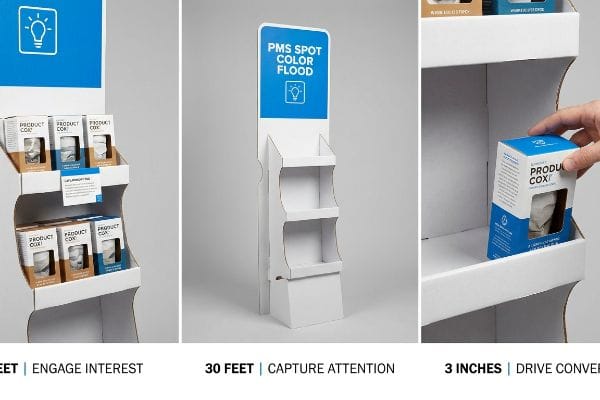
Die 3-3-3-Regel im Marketing besagt, dass eine Verkaufsfläche aus einer Entfernung von 9,14 m (30 Fuß) Aufmerksamkeit erregen, das Interesse der Käufer in einer Entfernung von 0,91 m (3 Fuß) wecken und den Kauf des physischen Produkts innerhalb eines Nahbereichs von genau 76,2 mm (3 Zoll) fördern muss.
Diese Distanzschwellenwerte zu kennen ist einfach, aber sie auf Wellpappe zu übertragen, ist der Punkt, an dem die meisten Markenteams scheitern.
Engineering für die räumliche Interaktionsdistanz im 3-3-3-Format
Die meisten Marketingteams entwerfen Verkaufsdisplays ausschließlich für die Nahansicht auf hintergrundbeleuchteten Computermonitoren und ignorieren dabei die Realität des Kundenverhaltens in den riesigen Regalgängen. Sie genehmigen dichte, symmetrische Textblöcke, die zwar aus der Entfernung eines Schreibtisches gut aussehen, aber keinerlei visuelle Spannung erzeugen. Ohne speziell für unterschiedliche Betrachtungsdistanzen entwickelte Struktur- und Grafikelemente geht der Warenträger im visuellen Rauschen des Verkaufsraums unter.
Bei der Analyse gescheiterter Kampagnen liegt die Ursache fast immer in der kognitiven Überlastung aus der Ferne. Selbst erfahrene Designer übersehen diesen blinden Fleck oft und gehen fälschlicherweise davon aus, dass kleine Schrift die Kundenfrequenz erhöht. In meiner Druckerei sehe ich regelmäßig, wie Kunden versuchen, ganze Textabschnitte auf den unteren Rand des Regals zu drucken. Ich rate ihnen dringend davon ab. Die Lösung besteht darin, das Hauptangebot konsequent hervorzuheben. Wir setzen auf auffällige Stanzformen und großflächige, leuchtende Pantone-Farben (PMS), um maximale Aufmerksamkeit zu erzielen, optimieren die Regalergonomie für die 1270 mm breite Auffangzone und kürzen die vordere Haltekante, um eine Sichtbarkeit von 85 % für die finale Kaufentscheidung zu gewährleisten . Wenn ich mit der Hand über die glatte, glänzende Fläche der Sonderfarbe streiche, weiß ich, dass sie den nötigen Kontrast besitzt, um selbst durch grelles Leuchtstoffröhrenlicht im Laden zu wirken.
| Häufiger Anfängerfehler | Die Profi-Lösung | Vorteil für die Verkaufsfläche |
|---|---|---|
| Absätze auf der Basis drucken | Hochkontrastige Stanzformen | Erregt die Aufmerksamkeit eines 9 Meter entfernten Menschen4 |
| Flache, symmetrische Regale | Abgewinkelte Ergonomie bei 50 Zoll5 | Weckt Interesse in einem Meter Entfernung |
| Hohe Lippen, die Gegenstände verbergen | Mindestens 85 % Produktsichtbarkeit6 | Antriebe 3-Zoll-Umrüstung |
Ich erlaube meinen Kunden nie, ein Ladenlokal wie eine Firmenbroschüre zu behandeln. Durch die Anwendung von Kennzahlen zur räumlichen Interaktion lenken wir die Aufmerksamkeit des Betrachters auf die Raumaufteilung und sorgen so dafür, dass Ihr Ladenlokal aktiv Besucher anzieht und nicht wie eine teure Tapete wirkt.
🛠️ Harveys Schreibtisch: Sie sind sich nicht sicher, ob Ihr Grafiklayout aus zehn Metern Entfernung wirklich den Gang stört? 👉 Schicken Sie mir Ihre Grafikdatei ↗ – Direkter Zugang zu meinem Schreibtisch. Garantiert kein automatisierter Werbe-Spam.
Was sollten effektive POS-Displays leisten?
Ein hübscher Karton bezahlt nicht Ihre Lieferantenrechnungen. Ihre Ladeneinrichtung hat genau eine Aufgabe: Kundenfrequenz in Umsatz umzuwandeln, bevor der Kunde den Laden verlässt.
Effektive Verkaufsdisplays sollten Ihr Hauptproduktangebot sofort kommunizieren, die visuelle Monotonie im Regal aufbrechen und Impulskäufe anregen. Darüber hinaus müssen diese stabilen Verkaufsdisplays den rauen Bedingungen der Lagerlogistik standhalten und schwere Produktlasten sicher tragen können, ohne unter den üblichen Umgebungsbedingungen im Einzelhandel zu reißen oder sich zu verformen.

Das Erreichen dieser Ziele klingt einfach, bis man tatsächlich versucht, die Markenrichtlinien auf eine physische 3D-Struktur abzubilden.
Die 40-40-20-Falle der kognitiven Überlastung überwinden
Markenteams behandeln Wellpappdisplays im Einzelhandel häufig wie leere Informationsflächen und ignorieren dabei die grundlegende 40-40-20-Regel der Direktwerbung⁷ . Sie gehen davon aus, dass sie, wenn ihnen die Fläche zur Verfügung steht, jeden Quadratzentimeter mit Markengeschichten, Zutatenlisten und QR-Codes füllen müssen. Dies widerspricht jedoch völlig der Realität des schnelllebigen Einzelhandels, wo ein eiliger Kunde einem Verkäufer nur ein Zeitfenster von drei Sekunden für die Interaktion einräumt⁸ .
Eine häufige Falle, in die selbst erfahrene Einkaufsteams tappen, ist die Umwandlung der Struktur in eine chaotische Werbetafel. Ich sehe das ständig in der Produktionshalle, wenn ich die Rohdrucke prüfe. Der Designer hat sieben verschiedene Botschaften auf die Kopfzeile geklatscht und geht davon aus, dass die Kunden sie wie eine Zeitschrift lesen. Wenn wir den Testliner falten und ich das knackige Einrasten der Verschlusslaschen höre, sehe ich mir das physische Modell an und stelle fest, dass das Kernproduktangebot völlig untergeht. Wir schreiben daher während der CAD-Phase (Computer-Aided Design) einen strengen Strukturfilter vor und begrenzen die visuelle Komplexität konsequent. Indem wir sekundäre Botschaften rigoros entfernen und großflächige 3D-Stanzteile verwenden, isolieren wir das Hauptangebot klar. Diese präzise visuelle Trennung reduziert die kognitive Hürde und schützt direkt die Impulskaufraten .
| Häufiger Anfängerfehler | Die Profi-Lösung | Vorteil für die Verkaufsfläche |
|---|---|---|
| Textreiche Kopfzeilen | 3D-gestanzte Einzelnachricht | Verhindert Kunden-Burnout10 |
| Unübersichtliche Seitenwände | einfarbige Flutzonen | Highlights des Hauptangebots11 |
| Drucken winziger Zutaten | QR-Code auf den Rückseiten | Hält die Vorderseite sauber |
Ich weigere mich, visuelle Unordnung zu drucken, die Ihr Produkt aktiv verdeckt. Die Beschränkung Ihrer kreativen Umsetzung auf einen einzigen, wirkungsvollen psychologischen Auslöser ist der einzige mathematisch fundierte Weg, um sicherzustellen, dass Ihre Struktur in einem wettbewerbsintensiven Einzelhandelsumfeld Besucher zu Kunden macht.
🛠️ Harveys Schreibtisch: Sind Ihre Seitenleisten mit Text überladen, den kein Kunde im Vorbeigehen je lesen wird? 👉 Layout-Check anfordern ↗ — Sicher herunterladen. Bei Fragen können Sie mich gerne kontaktieren.
Was ist ein Point-of-Purchase-Display (POS-Display)?
Alle verwenden die Begriffe synonym, aber wenn Sie diese Definition auf einem Händler-Konformitätsformular falsch angeben, wird Ihre gesamte Palette an der Warenannahmestelle zurückgewiesen.
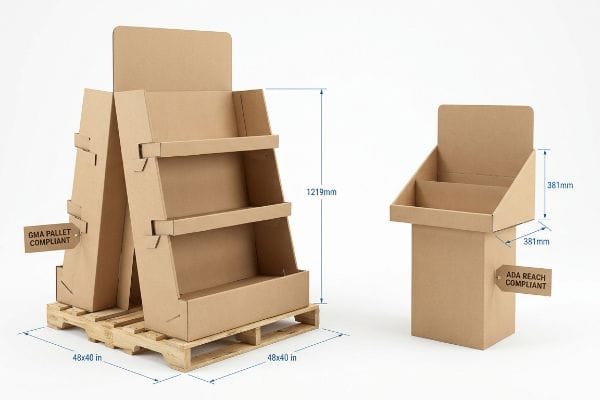
Ein POS-Display ist ein freistehendes, strukturell aufgebautes Verkaufsdisplay, das strategisch im Verkaufsraum, abseits des Kassenbereichs, platziert wird. Diese Displays dienen der Präsentation von Sekundärwaren, beeinflussen den Kundenverkehr im Gang und unterliegen strengen Logistikvorgaben, die in der Regel so ausgelegt sind, dass sie problemlos auf Standard-Holzpaletten passen.
Die Definition ist einfach, aber die räumliche Mathematik, die erforderlich ist, um diese Einheiten konform zu halten, ist bekanntermaßen äußerst fehleranfällig.
Die räumliche Einzelhandelsbeschränkung nach ADA vs. GMA
Handelsunternehmen präsentieren häufig ein skalierbares Design, bei dem ein großes Verkaufsdisplay einfach um 50 % verkleinert und als Thekendisplay genutzt werden kann .Sie versuchen, für beide Bereiche die gleichen Konstruktionsberechnungen anzuwenden, um Werkzeugkosten zu sparen. Diese riskante Abkürzung ignoriert jedoch die strengen rechtlichen und logistischen Vorgaben für diese beiden getrennten Zonenim nordamerikanischen Einzelhandel.
Es ist, als würde man versuchen, einen Sattelschlepper in eine enge Parklücke zu zwängen. Für Bodenbeläge und Kassentheken gelten völlig unterschiedliche rechtliche Vorgaben. In meiner Einrichtung schicken mir Kunden oft verkleinerte Bodenplatten-Schablonen und bitten mich, diese für eine Thekenplatte zuzuschneiden. Das lehne ich ab. Wenn man dickes B-Wellen-Karton verkleinert, kann ich die starren Papierfasern förmlich spüre, wie sie knicken und reißen, weil die Mikroproportionen zu eng sind. Wir trennen die technischen Prozesse daher dauerhaft. Bodenelemente sind strikt an die GMA-Palettenbegrenzung (1219 × 1016 mm) von13 für Lagerlogistik und dynamische Belastungen angepasst. Kassentheken hingegen sind strikt an die ADA-Vorgaben (Americans with Disabilities Act) für die maximale Reichweite von 15–48 Zoll (381–1219 mm) von14 , wodurch Rückbelastungen durch Filialleiter ausgeschlossen werden.
| Häufiger Anfängerfehler | Die Profi-Lösung | Vorteil für die Verkaufsfläche |
|---|---|---|
| Verkleinerung der Etageneinheiten | Getrennte technische Rohrleitungen | Verhindert Faserrisse |
| Palettenüberstand ignorieren | Strenger GMA-Begrenzungsrahmen15 | Übersteht den Transport im Lager |
| Beliebige Zählerhöhe | ADA-Vorwärtsreichweite Mathematik16 | Verhindert Ablehnung durch Einzelhändler |
Ich lege die räumliche Geometrie vollständig fest, bevor auch nur ein Tropfen Tinte auf die Tafel gelangt. Die Einhaltung dieser klar definierten Bereiche stellt sicher, dass Ihr Merchandiser tatsächlich zum Betriebsmodell des Einzelhändlers passt und nicht im Recycling landet.
🛠️ Harveys Schreibtisch: Befürchten Sie, dass Ihre aktuelle Bodeneinrichtung die strengen Abstandsregeln für Gänge überschreitet und dadurch Bußgelder wegen Nichteinhaltung der Vorschriften drohen? 👉 Lassen Sie eine Überprüfung der räumlichen Konformität durchführen ↗ – Keine Formulare, die endlose Verkaufsgespräche nach sich ziehen. Einfach nur echter Mehrwert.
Was sind die 4 Ps des Merchandising?
Man kann die beste Preis- und Werbestrategie der Welt haben, aber wenn die physische Präsentation den Bedingungen vor Ort nicht standhält, scheitert die Kampagne.
Die vier Ps des Merchandisings sind Produkt, Preis, Platzierung und Promotion. Im Einzelhandel stellt dieses grundlegende Rahmenwerk sicher, dass Sie das richtige Produkt zu einem wettbewerbsfähigen Preis anbieten, optisch optimal für die Platzierung im Verkaufsregal präsentiert und gleichzeitig durch gezieltes Marketing den Wert aktiv kommunizieren und so den Umsatz steigern.
Doch die Kenntnis des theoretischen Rahmens reicht nicht aus, wenn die automatisierten Schneidetische in Betrieb genommen werden und Ihre Einheiten tatsächlich im Gütertransport eingesetzt werden.
Warum theoretische „Ortsstrategien“ in der Fabrikhalle scheitern
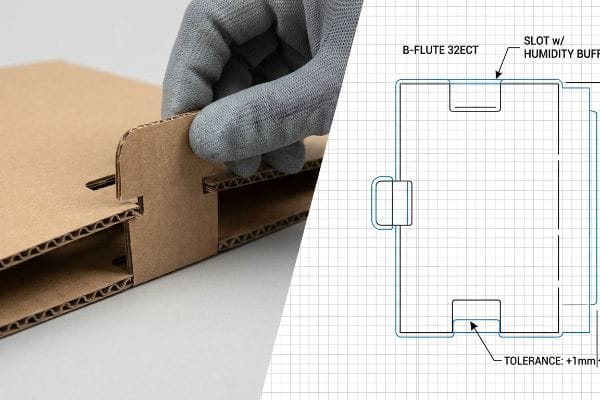
Neue Marken planen ihre vier Kernpunkte häufig in klimatisierten Konferenzräumen, in der Annahme, ihre logistische Platzierungsstrategie sei perfekt durchdacht. Sie finalisieren ein ansprechendes, ineinandergreifendes Bodendisplay , das optimal auf die Werbebotschaft und den Preis abgestimmt ist. Allerdings bewerten sie die Stanztoleranzen ausschließlich anhand der absoluten Trockenstärke(17 mm) des Kartons und gehen davon aus, dass die physische Struktur vom Werk bis zum Verkaufsregal unverändert bleibt.
In meiner Einrichtung erlebe ich regelmäßig, wie eine theoretische Platzierungsstrategie an den physikalischen Gesetzen der Atmosphäre scheitert. Das ist nicht nur Theorie – ich sehe es in der Testumgebung, wenn ein Kunde einen exakten 3,17 mm (0,125 Zoll) breiten Aufnahmeschlitz für eine B-Wellen-Registerkarteunddabei völlig vergisst, dass diese Flatpacks per Seefracht versendet oder in Regionen mit hoher Luftfeuchtigkeit gelagert werden. Wenn ich diese engen Dokumente in einer Klimakammer teste, sehe ich, wie das poröse 32ECT-Testliner aktiv die Umgebungsfeuchtigkeit aufnimmt und aufquillt.Ein Schlitz, der in der Software perfekt passte, ist plötzlich 1,01 mm (0,04 Zoll) zu eng, und das Montageteam quetscht unweigerlich die Wellen, um die Teile zusammenzupressen. Indem ich automatisch einen mathematisch berechneten Feuchtigkeitspuffer in jeden Schlitz einbaue, stelle ich sicher, dass die Montage völlig reibungslos verläuft. Diese Toleranzanpassung von 1 Millimeter verhindert massives Papierreißen, verlangsamt die Montagelinie um schätzungsweise 30 % und vernichtet die Gewinnspanne des Projekts vollständig.
| Häufiger Anfängerfehler | Die Profi-Lösung | Vorteil für die Verkaufsfläche |
|---|---|---|
| enge, trockene Schlitze | Hinzufügen eines Feuchtigkeitspuffers | Null-Reiß-Laschenmontage |
| Umgebungsfeuchtigkeit außer Acht lassen | Klimakammertests20 | Übersteht den Seetransport |
| Aufgedunsene Flöten | 0,04-Zoll-Steckplatzerweiterung21 | Reduzierung der Lohnkosten |
Ich lasse nicht zu, dass ein Fehler in der Atmosphärenphysik Ihre sorgfältig geplante Einzelhandelsstrategie zunichtemacht. Die Berücksichtigung der Umweltausdehnung vor dem Schneiden verhindert Engpässe in den Produktionslinien und garantiert, dass Ihr Werbemittel unversehrt ankommt.
🛠️ Harveys Schreibtisch: Kennen Sie die genaue Feuchtigkeitsausdehnung der B-Welle Ihres aktuellen Wellpappenlieferanten vor der Montage? 👉 Senden Sie mir Ihre Stanzdatei ↗ – ich überprüfe die Berechnungen, bevor Sie unnötig Geld für die Massenproduktion ausgeben.
Abschluss
Sie können die perfekte Marketingstrategie haben, aber wenn unkompensiert 32ECT-Platinen während des Seetransports quellen, verursachen die gequetschten Wellen massive Reibung in der Montage. Dies verlangsamt die Co-Packing-Linie um schätzungsweise 30 % und schmälert Ihre Gewinnmargen. Genau dieses Datenblatt verwenden meine zehn wichtigsten Einzelhandelskunden, um Druckfehler zu vermeiden. Hören Sie auf, atmosphärische Toleranzen zu schätzen, und lassen Sie mich Ihre Geometrie persönlich durch meinen kostenlosen Stanzform-Pre-Flight-Audit führen, um schwerwiegende Strukturfehler vor der Massenproduktion zu erkennen.
„Sichtbarkeit/Sichtweite – NACTO“, https://nacto.org/publication/urban-street-design-guide/intersection-design-elements/visibility-sight-distance/. Professionelle Standards für die Gestaltung von Einzelhandelsflächen schreiben die Verwendung gestaffelter visueller Hierarchien vor, die auf der Betrachtungsdistanz basieren, um zu verhindern, dass Beschilderungen mit Umgebungsgeräuschen verschmelzen. Nachweisfunktion: Technische Validierung; Quellentyp: Designhandbuch. Unterstützt: Die Notwendigkeit einer distanzbasierten Gestaltung von Verkaufsflächen. Anwendungsbereich: Gilt speziell für physische Einzelhandelsumgebungen. ↩
„Gestaltung von Verkaufsflächen für effektive Warenpräsentation und Kundenführung“, https://www.business.qld.gov.au/industries/manufacturing-retail/retail-wholesale/retail-displays. Kurze Erläuterung, wie Standards für die Gestaltung von Verkaufsflächen oder ergonomische Studien die Höhe von 50 Zoll als optimale Augenhöhe für erwachsene Käufer bestätigen. Nachweis: Technische Spezifikation; Quelle: Handbuch für die Gestaltung von Verkaufsflächen. Unterstützung: Optimale Platzierung zur Förderung der Kundenbindung. Anmerkung: Die Wirksamkeit der Höhe kann je nach Zielgruppe variieren. ↩
„Verkaufsfördernde Verkaufsdisplays: Strategien zur Umsatzsteigerung“, https://orangepkg.com/blog/retail-displays-that-convert-strategies-for-boosting-sales/. Kurze Erläuterung, wie empirische Daten zu visuellen Hindernissen in Verkaufsdisplays einen bestimmten Sichtbarkeitsprozentsatz mit Konversionsraten korrelieren. Funktion des Nachweises: Leistungskennzahl; Quellentyp: Marktforschungsstudie. Belege: die Auswirkungen physischer Displaybarrieren auf die Produktsichtbarkeit. Anmerkung zum Untersuchungsbereich: basiert auf durchschnittlichen Annäherungswinkeln von Käufern. ↩
„Visuelle Strategien zur Umsatzsteigerung im großflächigen Einzelhandel“, https://thelookcompany.com/blog/visual-engagement-tactics-that-drive-sales-for-big-box-retail/. Erläuterung, wie kontrastreiche visuelle Reize die Aufmerksamkeitsdistanz von Kunden im großflächigen Einzelhandel beeinflussen. Nachweisfunktion: Validierung; Quellentyp: Richtlinien für die Gestaltung von Einzelhandelsflächen. Unterstützt: die Kennzahl „Kundenbindung aus 9 Metern Entfernung“. Anwendungsbereich: Allgemeine Anwendung in Geschäften mit breiten Gängen. ↩
„[PDF] Richtlinien für Lebensmitteleinzelhandel – Ergonomie für … – OSHA“, https://www.osha.gov/sites/default/files/publications/OSHA3192.pdf. Technische Daten zu ergonomischen Augenhöhen und Reichweitenbereichen für Verkaufsdisplays zur Maximierung der Kundenbindung. Nachweisfunktion: Spezifikation; Quellentyp: Industriedesignnorm. Unterstützt: die empfohlene Reichweite von 90 cm. Anmerkung zum Anwendungsbereich: Basierend auf der durchschnittlichen Augenhöhe eines Erwachsenen. ↩
„Wie Sie die Konversionsrate im Einzelhandel steigern – MRI Software“, https://www.mrisoftware.com/blog/how-to-increase-conversions-in-retail/. Statistische Analyse der minimalen Produktsichtbarkeit, die für Konversionen am Point of Sale erforderlich ist. Nachweisfunktion: Überprüfung der Kennzahl; Quellentyp: Marktforschungsstudie. Unterstützt die These der 3-Zoll-Konversionsrate. Anmerkung zum Untersuchungsbereich: Speziell für die physische Sichtbarkeit am Regalrand. ↩
„Die 40/40/20-Regel des Direktmarketings | Metadata.io“, https://metadata.io/resources/blog/the-40-40-20-rule-of-direct-marketing/. Erläuterung des Marketingprinzips, wonach die Responseraten zu 40 % von der Liste/Zielgruppe, zu 40 % vom Angebot und zu 20 % von der Gestaltung/dem Text abhängen. Belegfunktion: Theoretischer Rahmen; Quellentyp: Branchenstandard. Unterstützt die Aussage, dass die Gestaltung nur einen kleinen Teil des Konversionserfolgs ausmacht. Anmerkung zum Anwendungsbereich: Ursprünglich für Direktmailings formuliert. ↩
„Erforschung des Browsing-Verhaltens und der Aufmerksamkeitsspanne von Konsumenten mit …“, https://pmc.ncbi.nlm.nih.gov/articles/PMC6895988/. Empirische Daten zum begrenzten Zeitfenster, das Konsumenten in stark frequentierten Einzelhandelsumgebungen für die Bewertung visueller Reize aufwenden. Evidenzfunktion: Verhaltensmetrik; Quellentyp: Konsumentenpsychologische Studie. Belege: Die Notwendigkeit unmittelbarer visueller Kommunikation auf POS-Displays. Anmerkung zum Anwendungsbereich: Kann je nach Produktkategorie variieren. ↩
„Eine Studie zur kognitiven Belastung von Konsumenten auf E-Commerce-Websites …“, https://arxiv.org/html/2605.02899v1. Autoritative Studien aus der Kognitionspsychologie und dem Neuromarketing erklären, wie die Reduzierung der kognitiven Belastung die Konversionsraten durch geringeren Verarbeitungsaufwand erhöht. Evidenzrolle: Kausalmechanismus; Quellentyp: wissenschaftliche Zeitschrift/Marktforschung. Unterstützt: den Zusammenhang zwischen visueller Einfachheit und Impulskäufen. Anmerkung zum Untersuchungsbereich: speziell im Hinblick auf die Umgebungsfaktoren am Point of Sale. ↩
„Verbraucherpräferenzen für Lebensmittel-Bundles unter kognitiver Belastung – PMC“, https://pmc.ncbi.nlm.nih.gov/articles/PMC8997493/. Kurze Erläuterung, wie vereinfachte Botschaften und 3D-Visualisierungen die kognitive Belastung reduzieren und Kaufentscheidungsmüdigkeit vorbeugen. Evidenz: Kausalzusammenhang; Quellentyp: Studie aus der Verhaltenspsychologie oder dem Einzelhandelsmarketing. Unterstützt: Die Wirksamkeit von Überschriften mit einer einzigen Botschaft. Anmerkung zum Untersuchungsbereich: Fokus auf kognitive Prozesse in stark frequentierten Einzelhandelsumgebungen. ↩
„[PDF] Wie man eine Hochwasserkarte liest – FEMA“, https://www.fema.gov/sites/default/files/documents/how-to-read-flood-insurance-rate-map-tutorial.pdf. Beleg dafür, wie die Verwendung von einfarbigen Flächen visuelle Kontraste erzeugt, um die Aufmerksamkeit der Verbraucher auf einen bestimmten Fokuspunkt zu lenken. Belegfunktion: Gestaltungsprinzip; Quellentyp: Leitfaden für visuelles Merchandising oder Blickverfolgungsstudie. Unterstützt: Die Verwendung von Hochwasserzonen zur visuellen Hervorhebung. Anwendungsbereich: Gilt speziell für physische Verkaufsdisplays. ↩
„14 Arten von Verkaufsdisplays | Chicago, IL – Wertheimer Box“, https://wertheimerbox.com/types-of-retail-displays/. Externe Quellen wie die ADA-Richtlinien zur Barrierefreiheit und die GMA-Palettenstandards bestätigen die unterschiedlichen rechtlichen und logistischen Anforderungen für Boden- und Thekendisplays. Belegfunktion: Überprüfung regulatorischer Vorgaben; Quellentyp: Regierungs- und Branchenstandards. Unterstützt: die Aussage, dass für POS- und POP-Bereiche unterschiedliche Rechtsvorschriften gelten. Anwendungsbereich: Gilt speziell für den nordamerikanischen Einzelhandel. ↩
„48×40 GMA-Paletten | Größter Palettenhersteller & -lieferant“, https://www.palletone.com/products/gma-pallets/. Autoritative Quelle, die die branchenüblichen Standardabmessungen für Paletten der Grocery Manufacturers Association (GMA) bestätigt. Nachweisfunktion: Technische Spezifikation; Quellentyp: Branchenstandard. Unterstützt: Die Logistik für bodenstehende POS-Displays. Anwendungsbereich: Nordamerikanische Versandstandards. ↩
„Kapitel 3: Bedienbare Teile – Access-Board.gov“, https://www.access-board.gov/ada/guides/chapter-3-operable-parts/. Offizielle ADA-Richtlinien, die den zulässigen Höhenbereich für die Vorwärtsreichweite detailliert beschreiben, um die Zugänglichkeit für Menschen mit Behinderungen zu gewährleisten. Nachweisfunktion: rechtliche Anforderung; Quellentyp: Regierungsverordnung. Unterstützt: die räumlichen Beschränkungen für Thekenauslagen. Anwendungsbereich: Fokus auf Rollstuhlzugänglichkeit. ↩
„[PDF] 40-Zoll-GMA-Holzpaletten – Southern Research Station“, https://www.srs.fs.usda.gov/pubs/VT_Publications/05t10.pdf. Die Branchenstandards der Grocery Manufacturers Association (GMA) legen die spezifischen Abmessungen und Belastungsgrenzen für palettierte Sendungen fest, um ein Überhängen zu verhindern. Nachweisfunktion: Technische Spezifikation; Quellentyp: Branchenstandard. Begründung: Die Einhaltung der GMA-Vorgaben ist für den sicheren Transport im Lager unerlässlich. Anwendungsbereich: Gilt hauptsächlich für nordamerikanische Palettenstandards der Größe 48 × 40 Zoll. ↩
„ADA-Standards für barrierefreies Design, Titel III, Verordnung 28 CFR …“, https://www.ada.gov/law-and-regs/design-standards/1991-design-standards/. Der Americans with Disabilities Act (ADA) definiert spezifische Reichweitenmessungen für Vorwärtsgriffe, um die Barrierefreiheit für Menschen mit Behinderungen zu gewährleisten. Nachweisfunktion: gesetzliche Anforderung; Quellentyp: Regierungsverordnung. Unterstützt: Die Behauptung, dass die Berechnung der ADA-Vorwärtsgriffweite die Ablehnung von Verkaufsdisplays durch Einzelhändler verhindert. Anwendungsbereich: Bezieht sich auf die ADA-Standards für barrierefreies Design von 2010, Abschnitt 308. ↩
„Einfluss analoger und digitaler Rilllinien auf die mechanische Präzision … – PMC“, https://pmc.ncbi.nlm.nih.gov/articles/PMC9268991/. Die technische Dokumentation zur Wellpappenverpackungstechnik zeigt, wie sich hygroskopische Ausdehnung und Durchmesseränderungen aufgrund von Luftfeuchtigkeit auf die Stanzgenauigkeit auswirken. Nachweisfunktion: Technische Validierung; Quellentyp: Industriestandard für Verpackungen. Beleg: Die Ungenauigkeit von Messungen mit einem trockenen Messschieber im realen Einzelhandel. Anwendungsbereich: Gilt für Strukturmaterialien auf Zellulosebasis. ↩
„[PDF] Spezifikationen für Wellpappe – Fibre Box Association“, https://www.fibrebox.org/assets/2025/09/Walmart_Corrugated-Board_Specifications_Automation_Packaging_Standards.pdf. Überprüfung der branchenüblichen Konstruktionstoleranzen für Laschenaufnahmen in B-Welle-Wellpappe. Nachweisfunktion: Standardüberprüfung; Quellentyp: Handbuch für Verpackungstechnik. Belege: Spezifische Maßangabe. Hinweis: Die Toleranzen können je nach Hersteller leicht variieren. ↩
„[PDF] Auswirkungen des Feuchtigkeitsgehalts auf die Druckfestigkeit von Kartons: FBA BCT …“, https://renewablebioproducts.gatech.edu/sites/default/files/2025-12/4effects-of-moisture-content-on-box-compression-strength.pdf. Technischer Nachweis der hygroskopischen Eigenschaften von 32ECT-Linerboard und dessen Ausdehnungsneigung bei hoher Luftfeuchtigkeit. Nachweisfunktion: Technische Validierung; Quellentyp: Materialwissenschaftliche Spezifikation. Belege: Aussage zur Materialquellung. Anwendungsbereich: Speziell für Wellpappenmaterialien. ↩
„Umweltbedingungenprüfung“, https://unitload.vt.edu/facilities/distribution-packaging-lab/environmental-conditioning-testing.html. Branchenstandards für Verpackungslogistik beschreiben die Verwendung von Klimakammern zur Simulation der Feuchtigkeitsverhältnisse beim Seetransport. Nachweisfunktion: Validierung der Methodik; Quellentyp: Technischer Standard. Beleg: Die Wirksamkeit von Klimakammertests für die Haltbarkeit von Frachtgut. Anwendungsbereich: Variiert je nach Materialart. ↩
„Einfluss der relativen Luftfeuchtigkeit auf die Druckfestigkeit von …“, https://open.clemson.edu/all_theses/3225/. Die technische Dokumentation zu Normen für Wellpappenverpackungen bestätigt die erforderliche Toleranz zur Vermeidung von Materialverformungen bei Feuchtigkeitsschwankungen. Nachweisfunktion: Technische Spezifikation; Quellentyp: Branchenhandbuch. Beleg: Der spezifische Wert für die Schlitzaufweitung. Anwendungsbereich: Gilt für Standard-Wellengrößen. ↩