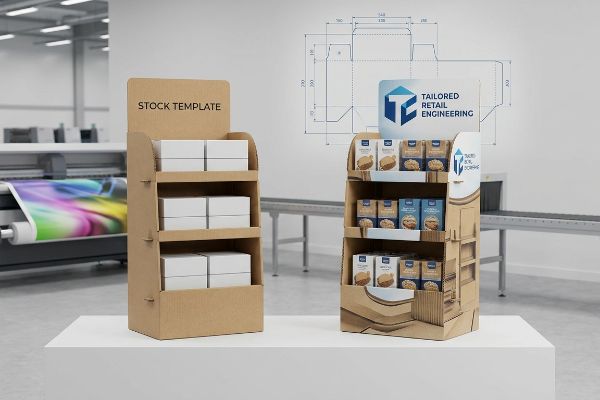
Die Wahl zwischen Standard- und individuell gestalteten POS-Displays (Point of Purchase) bestimmt Ihren Zeitplan im Einzelhandel und die Wirkung Ihrer Marke. Die eine Variante bietet Schnelligkeit, die andere sorgt für visuelle Dominanz.
Die Entscheidung zwischen Standard- und kundenspezifischen POS-Displays beeinflusst Fertigungsgeschwindigkeit und strukturelle Flexibilität. Standard-Displays bieten vorgefertigte, standardisierte Vorlagen für den schnellen Einsatz. Kundenspezifische Designs ermöglichen eine maßgeschneiderte Wellpappenkonstruktion, die spezifische Produktabmessungen, Markenästhetik und dynamische Belastbarkeit für die Einhaltung der Vorgaben großer Einzelhandelsketten optimiert.
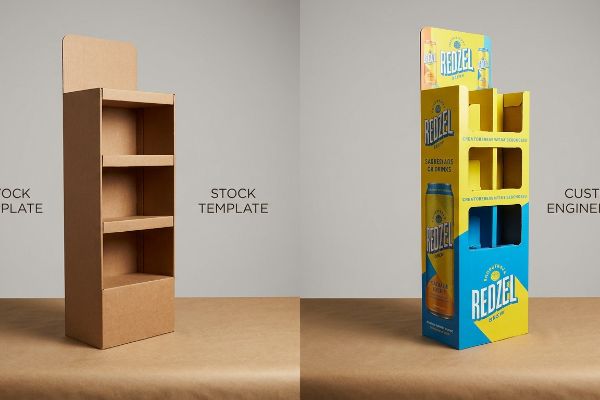
Während vorgefertigte Vorlagen eine sofortige Ausgangsbasis bieten, erfordert der Übergang in spezialisierte Einzelhandelsumgebungen ein tieferes Verständnis der Strukturphysik.
Was ist ein Display-Stock?
Standardisierte Vorlagen eliminieren strukturelle Unsicherheiten bei der schnellen Markteinführung im Einzelhandel.
Displayverpackungen sind vorgefertigte, standardmäßige Verpackungsstrukturen, die nach gängigen Spezifikationen hergestellt werden. Diese standardisierten Einheiten machen individuelle Konstruktionsarbeiten überflüssig und bieten sofort verfügbare Stanzformen, die gängigen Einzelhandelsabmessungen entsprechen. Dadurch werden die Produktionsvorlaufzeiten drastisch reduziert und die anfänglichen Kosten für Stanzwerkzeuge für eine schnelle internationale Markteinführung eingespart.
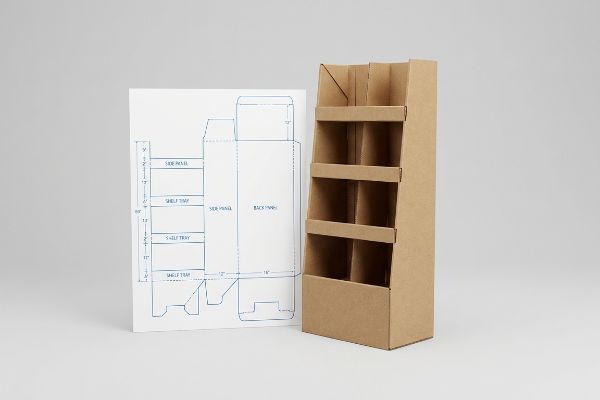
Das Verständnis dieses Basisinventars hilft Marken dabei, schnell zu wachsen, ohne für jede einzelne Werbekampagne das Rad neu erfinden zu müssen.
Die strukturelle Grundlage von Universal-Fit-Merchandisern
Man kann sich Displaymaterialien wie das Grundgerüst eines Fahrzeugs vorstellen. Anstatt für jede Produkteinführung einen individuellen Rahmen zu entwickeln, verwenden Hersteller ein vorgetestetes, gewelltes Trägergerüst, das für die üblichen dynamischen Belastungen ausgelegt ist¹.Dieses Gerüst gewährleistet, dass die Verkaufsfläche universell mit den gängigen Abmessungen von Verkaufsregalen übereinstimmt², ohne dass eine mathematische Modellierung von Grund auf erforderlich ist.
Bei der Untersuchung der technischen Grundlagen dieser standardisierten Formate liegt der Kernvorteil in der vorhersehbaren Dimensionsstabilität. Durch die Verwendung eines starren Parameters von 1219,2 mm (48 Zoll) x 355,6 mm (14 Zoll)³entspricht die Einheit exakt dem Standardprofil nordamerikanischer Endkappen . Ich verlasse mich auf diese präzise Volumenkonsistenz, um sicherzustellen, dass Marken Grafiken schnell auf einer vorab validierten Struktur anbringen können. Diese universelle Grundfläche macht individuelle CAD-Tests (Computer-Aided Design) überflüssig und schafft einen optimierten Produktionsprozess, der die Lücke zwischen digitaler Grafik und physischer Platzierung im Einzelhandel effizient schließt.
| Strukturelles Merkmal | Generischer Ansatz | Konstruierte Realität |
|---|---|---|
| Stanzlinienerstellung | Von Grund auf neu gezeichnet | Vorkonfigurierte CAD-Modelle4 |
| Werkzeugkosten | Teure Sonderanfertigung | Null Matrixkosten5 |
| Lieferzeit | Wochenlanges Testen | Sofortproduktion6 |
Ich empfehle stets die Verwendung von Standardvorlagen, wenn eine schnelle Markteinführung oberste Priorität hat. Durch die Nutzung vorvalidierter Strukturberechnungen vermeide ich unnötige Werkzeugkosten und beschleunige den Druckvorstufenprozess sofort.
🛠️ Harveys Schreibtisch: Verhindern Ihre individuellen Display-Zeitpläne aktiv Ihre saisonalen Markteinführungen? 👉 Kostenlose Struktur-Stanzlinienprüfung anfordern ↗ — Ich prüfe jede Strukturdatei persönlich innerhalb von 24 Stunden.
Welche Nachteile haben platzsparende Displays?
Selbst die visuell eindrucksvollsten Kampagnen scheitern, wenn die Gesetze der Transportphysik greifen.
Die Nachteile von POS-Displays liegen typischerweise in ihrer Anfälligkeit für strukturelle Probleme beim Transport und ihrer begrenzten Lebensdauer im Einzelhandel. Mangelhaft konstruierte, standardisierte Wellpapp-Displays leiden unter Feuchtigkeitsschäden, Druckversagen unter schwerer Palettenbelastung und Maßabweichungen, was zu beschädigter Ware und der sofortigen Ablehnung durch große Einzelhändler weltweit führt.

Diese theoretischen Nachteile werden zu teuren Realitäten, sobald ein schlecht optimiertes Gerät im Versandhafen ankommt.
Versagen der Palettenüberhang -Kompression
Bei der Prüfung von Stanzformen beobachte ich immer wieder, dass Einkaufsteams die Abmessungen der Umkartons maximieren, um möglichst viele Einheiten pro Sendung unterzubringen. Sie gehen fälschlicherweise davon aus, dass die Materialbeständigkeit von Standardkarton die Ware unabhängig von der äußeren Form schützt. Dies ist eine häufige Falle, in die selbst erfahrene Einkäufer tappen, da sie die mechanische Verteilung vertikaler Lasten auf einer Lattenrostkonstruktion völlig außer Acht lassen .
Das ist keine bloße Theorie – ich sehe es in der Praxis, wenn ein Umkarton eine Standardpalette der GMA (Grocery Manufacturers Association) mit den Maßen 48 × 40 Zoll (1219 × 1016 mm) um nur 12,7 mm überragt. Wellpappkartons beziehen bis zu 60 % ihrer Festigkeit im Box Compression Test (BCT)8 ausschließlich aus der vertikalen Ausrichtung ihrer Ecken. Wenn eine Ecke über den Rand hinausragt, trägt sie keine Last, wodurch sich das gesamte Gewicht von 544,3 kg (1200 lbs) – das im Lager kopflastig ist – auf die ungestützten Mittelwände verlagert. Um dies zu beheben, verwende ich in ArtiosCAD ein striktes Protokoll für Umkartons ohne Überstand. Dadurch wird die zulässige Grundfläche mathematisch verkleinert, um eine vollständige Eckunterstützung zu gewährleisten. Durch die Einhaltung dieser präzisen Toleranz von 12,7 mm stelle ich sicher, dass die Verpackung den Transport im Doppelstapel übersteht, senke die Retourenquote um schätzungsweise 20 % und vermeide Transportschäden vollständig.
| Logistikkennzahl | Generischer Ansatz | Konstruierte Realität |
|---|---|---|
| Palettenüberstand | Dimensionen werden ignoriert | Strenge 0-mm-Toleranz9 |
| Ecklast | Null-Gewichtsbelastung | 60 % dynamische Unterstützung10 |
| Transportschäden | Starke Fundamentzerstörung | Null-Knickung |
Ich weigere mich, zuzulassen, dass ein Bruchteil eines Zentimeters eine ganze internationale Sendung gefährdet. Durch die Verkleinerung der Außenmaße werden die Ecken stabilisiert, sodass Ihre Ware unversehrt und bereit für den Einzelhandel ankommt.
🛠️ Harveys Schreibtisch: Verursacht Ihre aktuelle Displaygeometrie unsichtbare Mikrorisse beim LTL-Transport (Teilladung)? 👉 Frachtdichte-Audit anfordern ↗ — 100 % vertraulich. Ihre unveröffentlichten Designs sind bei mir sicher.
Was versteht man im Einzelhandel unter einem POS-Display?
Um die Aufmerksamkeit der Käufer zu gewinnen, ist eine präzise Raumgestaltung auf der Verkaufsfläche erforderlich.
Ein POS-Display im Einzelhandel ist ein spezielles Marketinginstrument, das strategisch in den Regalgängen platziert wird, um Impulskäufe anzuregen. Diese freistehenden Verkaufsdisplays unterbrechen den Kundenfluss, indem sie die Produkte aus den üblichen Regalfächern herausheben und direkt ins Blickfeld der Kunden positionieren.
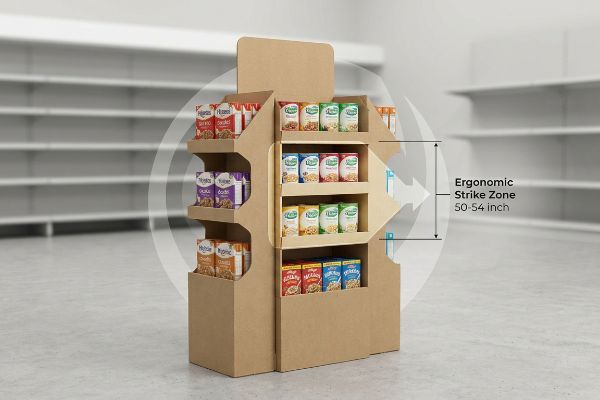
Das Anheben eines Produkts vom unteren Regal ist nur der erste mechanische Schritt, um die physische Konversion voranzutreiben.
Die Ingenieurmechanik der menschlichen Angriffszone
Man kann sich ein Ladenlokal wie eine gezielte Antenne vorstellen. Anstatt ein visuelles Signal wahllos in alle Richtungen auszusenden, ist es mathematisch so ausgerichtet, dass es den natürlichen Laufweg des Kunden kreuzt.Diese erhöhte Positionierung sorgt dafür, dass margenstarke Produkte die visuelle Unordnung herkömmlicher Gondelregale umgehen, wo er am ehesten mit ihnen interagiert.
Beim Bau dieser Regalsysteme liegt der Fokus primär auf der vertikalen Positionierung. Die Regalstrukturen sind so konstruiert, dass sie exakt der menschlichen Körpergröße entsprechen und den optimalen Erfassungsbereich von 1270–1371 mm (50–54 Zoll)diesen ergonomischen Bereich wird das Einkaufserlebnis so angenehm wie möglich gestaltet. Die berechnete Höhe fängt das Umgebungslicht optimal ein und platziert die Waren genau dort, wo die Hand eines vorbeigehenden Kunden natürlich ruht. So wird die Interaktion optimiert, ohne dass sich der Kunde bücken oder unbequeme Bewegungen ausführen muss.
| Ergonomische Metrik | Generischer Ansatz | Konstruierte Realität |
|---|---|---|
| Visuelle Zielerfassung | Zufällige Regalhöhe | 50-54 Zoll große Trefferzone14 |
| Käuferreibung | Bücken oder Strecken | Natürliche Handwaage15 |
| Beleuchtungswinkel | Interne Abschattung | Umgebungsreflexion |
Ich entwerfe Verkaufsständer, die die Aufmerksamkeit genau auf der ergonomisch optimalen Höhe des Konsumenten lenken. Die exakte Berechnung der vertikalen Höhe verwandelt einen einfachen Pappaufsteller in einen reibungslos funktionierenden, hochkonvertierenden Verkaufsautomaten.
🛠️ Harveys Schreibtisch: Werden Ihre Premiumprodukte von Standard-Bodenbelägen verdeckt? 👉 Fordern Sie eine kostenlose Sichtlinienanalyse an ↗ — Keine Zwischenhändler. Sie sprechen direkt mit Statikern.
Wofür steht „Pop“ im Einzelhandel?
Branchenübliche Abkürzungen haben im Einzelhandel eine strenge rechtliche und logistische Bedeutung.
POP steht im Einzelhandel für Point of Purchase (Verkaufsstelle). Dieses Akronym bezeichnet den größeren Bereich im Geschäft, in dem Kunden Aktionsartikel entdecken und mit ihnen interagieren können. Dieser Bereich unterscheidet sich von der Point-of-Sale-Zone, deren räumliche Zugänglichkeit in der Nähe der Kassenbereiche streng gesetzlich geregelt ist.
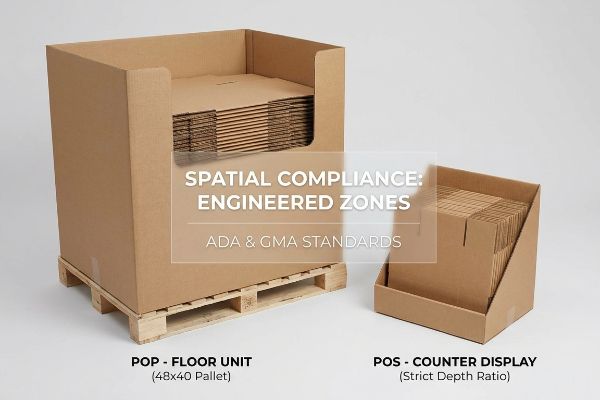
Die Gleichsetzung dieser beiden unterschiedlichen Einzelhandelszonen mit anderen Begriffen führt oft zu katastrophalen Verstößen gegen die Vorschriften im großflächigen Einzelhandel.
Die räumliche Beschränkung nach ADA vs. GMA
In meiner Einrichtung beobachte ich regelmäßig, wie Handelsunternehmen versuchen, große Verkaufsflächen um 50 % zu verkleinern, damit sie gleichzeitig als Kassentheke dienen können . Sie verwenden die Abkürzungen synonym und gehen fälschlicherweise davon aus, dass sich dieselbe robuste Wellblechkonstruktion problemlos in verschiedenen Verkaufsbereichen einsetzen lässt. Dies zeugt von einem grundlegenden Missverständnis räumlicher Logik und ignoriert völlig die strikten physischen Grenzen des Einzelhandels sowie die rechtlichen Vorgaben zur Barrierefreiheit .
Das ist nicht nur Theorie – ich sehe dieses Problem deutlich in der Praxis, wenn eine verkleinerte Bodenplatte die zulässigen Tiefenbegrenzungen der Kasse überschreitet. Eine Standard-Bodenplatte nutzt die 1219 × 1016 mm (48 × 40 Zoll) große Palettenfläche<sup>17</sup> für die dynamische Belastung, der Kassenbereich ist jedoch durch die strengen ADA-Vorschubgrenzen (Americans with Disabilities Act) von 381–1219 mm (15–48 Zoll)<sup>18. Verkleinert man die Konturen einfach, gerät der Schwerpunkt völlig aus dem Gleichgewicht. Nachdem mir das Einkaufsteam die Anpassung der CAD-Konstruktion erlaubt hatte, trennte ich die tragenden Strukturen vollständig. Ich richtete die neue Konstruktion strikt nach dem für die Stabilität der Kasse erforderlichen Verhältnis von Tiefe zu Höhe von 2:3 aus und entfernte die robuste Palettenrippe. Durch die mathematische Trennung der beiden Strukturen stelle ich sicher, dass der Kunde keine hohen Rückbelastungen durch Filialleiter erleidet, die nicht konforme Einheiten ablehnen, und spare so schätzungsweise 15 % der Kosten für Ausschussware.
| räumliche Metrik | Generischer Ansatz | Konstruierte Realität |
|---|---|---|
| Fußabdruckbegrenzung | Universelle Skalierung | Zonenspezifisches CAD |
| Gegenverhältnis | Instabile Basis | striktes Verhältnis 2:3 |
| Einhaltung | Ablehnungsrisiko im Geschäft | 100 % vom Einzelhandel zugelassen |
Ich lasse niemals zu, dass eine einzelne Strukturdatei zwei unterschiedliche Sicherheitszonen überschreitet. Die Trennung der technischen Datenleitungen gewährleistet mathematisch, dass Ihre Displays sowohl den Lagerbereich als auch die Kasse problemlos passieren können, ohne eine Ablehnung auszulösen.
🛠️ Harveys Schreibtisch: Verstößt Ihr Schrumpfdisplay aktiv gegen die Reichweitenbeschränkungen großer Einzelhändler? 👉 Fordern Sie eine Überprüfung der räumlichen Konformität an ↗ — Ich prüfe jede Strukturdatei persönlich innerhalb von 24 Stunden.
Abschluss
Ob standardisierte Vorlagen oder individuelle Toleranzen für die Standfläche – die Vermeidung von katastrophalen Überhangeinstürzen und Reichweitenüberschreitungen erfordert kompromisslose Statik. Allein im letzten Monat half mein Statik-Audit drei Marken, über 10.000 US-Dollar an Ausschussware und Rückbelastungen durch Händler zu vermeiden. Damit Ihre Produkte nicht durchhängen und Ihre nächste Markteinführung die Kunden direkt erreicht, lasse ich Ihre Statik-Dateien persönlich einem kostenlosen Händler-Spezifikations-Audit unter 👉 https://popdisplay.me/contact/ ↗.
„Wie viel Last kann meine Palette tragen?“, https://unitload.vt.edu/education/white-papers/5-wp-load-carrying-capacity-of-pallets.html. [Industriestandards für Wellpappenverpackungen und Belastungstests, wie z. B. der Box Compression Testing (BCT), belegen die Existenz vorgeprüfter Strukturspezifikationen für Displays]. Nachweisfunktion: Technische Verifizierung; Quellentyp: Industriestandard; Unterstützung: Strukturelle Zuverlässigkeit von Displaymaterialien; Anwendungsbereich: Gilt speziell für Wellpappe. ↩
„Der ultimative Leitfaden für Point-of-Purchase-Displays (POP) – Repsly“, https://www.repsly.com/blog/the-ultimate-guide-point-of-purchase-displays. [Spezifikationsleitfäden für Einzelhändler und Verpackungsstandards der Branche liefern standardisierte Abmessungen für Regal- und Bodendisplays, um die Kompatibilität in den großen Handelsketten zu gewährleisten]. Nachweisfunktion: Faktenprüfung; Quellentyp: Richtlinien für den Einzelhandel; Belege: Aussage zur universellen Passform; Anmerkung zum Anwendungsbereich: Kann je nach Region oder spezifischen Anforderungen des Einzelhändlers leicht variieren. ↩
„Custom Cardobard Sidekick Display, Powerwing Display, Endcap …“, https://grandfly.com/cardboard-display/sidekick-powerwing-display/. [Branchenstandards für Verpackungen und POS-Displays bestätigen diese spezifischen Maße als universelle Grundfläche für Sidekick-Displays in Nordamerika]. Nachweisfunktion: Faktenbestätigung; Quellentyp: Branchenspezifikation. Belegt: die Aussage, dass die spezifischen Abmessungen den Einzelhandelsstandards entsprechen. Anmerkung: Die Abmessungen können je nach Einzelhändler leicht variieren. ↩
„Stanzform für Fensterboxen: Abmessungen, Größen & Vorlage – BoxesGen“, https://boxesgen.com/dieline-of-window-box-dimensions-sizes-template/?srsltid=AfmBOpDFyW1IK0FRL16cxZGC-97BpPxVdtonqAAlbvpqQ6LC_yXCkyy. [Eine maßgebliche Quelle im Bereich Verpackungstechnik für den Einzelhandel würde die Verwendung vorgefertigter CAD-Vorlagen bestätigen, um die Erstellung individueller Stanzformen zu vermeiden]. Nachweisfunktion: Technische Verifizierung; Quellentyp: Branchenhandbuch. Unterstützt: Effizienz struktureller Grundlagen. Anwendungsbereich: Gilt speziell für Universal-Werbemittel. ↩
„Teil 31 – Vertragskostenprinzipien und -verfahren | Acquisition.GOV“, https://www.acquisition.gov/far/part-31. [Branchenübliche Fertigungskostenrichtlinien bestätigen, dass die Verwendung bestehender Standardmatrizen die üblicherweise mit kundenspezifischen Werkzeugen verbundenen Kosten eliminiert]. Nachweisfunktion: Finanzielle Überprüfung; Quellentyp: Fertigungskostenrichtlinie. Unterstützt: Kosteneffizienz von Engineered Reality. Anwendungsbereich: Beschränkt auf Darstellungen mit vorhandenen Standardvorlagen. ↩
„Verpackungs- und Logistikplanung für Verkaufsdisplays“, https://www.frankmayer.com/blog/packaging-and-logistics-planning-for-retail-displays/. [Benchmarks für den Produktionszeitplan würden zeigen, dass das Überspringen der iterativen Testphase für standardisierte Bestände einen sofortigen Übergang zur Fertigung ermöglicht]. Nachweisfunktion: Operative Verifizierung; Quellentyp: Logistik-Fallstudie. Unterstützt: Schnelle Implementierungsmöglichkeiten. Anmerkung zum Umfang: Die für den Grafikdruck benötigte Zeit ist nicht enthalten. ↩
„Untersuchung des Einflusses der Steifigkeit der Palettenoberseite … – PMC“, https://pmc.ncbi.nlm.nih.gov/articles/PMC8585293/. [Eine technische Quelle zur Verpackungsphysik erklärt, wie die Last vom Karton auf die Palettenlatten übertragen wird und wie Fehlausrichtung zu Druckversagen führt]. Nachweisfunktion: Technische Erläuterung; Quellentyp: Handbuch für Logistiktechnik. Unterstützt: Die mechanische Ursache für Strukturversagen bei POS-Displays. Anwendungsbereich: Gilt speziell für Wellpappe auf Standard-Holzpaletten. ↩
„Abschätzung der Druckfestigkeit von Wellpappkartons …“, https://pmc.ncbi.nlm.nih.gov/articles/PMC8467740/. [Ein maßgebliches Handbuch für Verpackungstechnik oder eine TAPPI-Norm liefert Daten zum prozentualen Anteil der Tragfähigkeit, der in den vertikalen Ecken von Wellpappverpackungen konzentriert ist]. Nachweisfunktion: Technische Verifizierung; Quellentyp: Industrienorm. Unterstützt: Die Aussage zur entscheidenden Bedeutung der Eckausrichtung für die strukturelle Integrität. Anmerkung: Die tatsächlichen Prozentsätze können je nach Kartonqualität und Wellenprofil variieren. ↩
„Vorhersage des Einflusses von Palettenüberstand auf die Kartonkompression …“, https://www.researchgate.net/publication/372349298_Predicting_the_effect_of_pallet_overhang_on_the_box_compression_strength. [Ein maßgeblicher Leitfaden für Logistiktechnik würde bestätigen, dass ein Überstand von null der erforderliche Standard ist, um die maximale vertikale Druckfestigkeit zu gewährleisten]. Nachweisfunktion: Technische Spezifikation; Quellentyp: Technisches Handbuch. Unterstützt: Die Notwendigkeit einer präzisen Ausrichtung, um ein Versagen durch Palettenüberstand zu verhindern. Anmerkung zum Anwendungsbereich: Bezieht sich auf die Schnittstelle zwischen Palettenboden und Aufstellfläche. ↩
[PDF] ALLGEMEINE ANFORDERUNGEN AN DIE BELADUNG VON KARTONS UND PALETTEN, https://www.snapon.com/Snap-on-Files/Suppliers/Packaging-and-Labeling-Guidelines/StandardforPalletandUnitLoads.pdf. [In der Verpackungswissenschaft wird üblicherweise der prozentuale Anteil der Lastverteilung quantifiziert, der auf verstärkte Ecken verlagert wird, um ein Zusammenbrechen der Mittelsäule während des Transports zu verhindern.] Nachweisfunktion: Technische Kennzahl; Quellentyp: Peer-Review-Studie im Bereich Verpackung. Beleg: Die Fähigkeit von verstärkten Ecken, einen erheblichen Teil des dynamischen Gewichts zu tragen. Anwendungsbereich: Gilt speziell für verstärkte Wellpappen-Displaystrukturen. ↩
„Optimierung Ihres Ladenlayouts mit AiFis Spatial Intelligence“, https://www.aifi.com/blog/optimizing-your-retail-layout-with-aifis-spatial-intelligence. [Eine anerkannte Quelle für Ladengestaltung oder Konsumentenverhalten würde den Einsatz von Verkehrsflussanalysen und Heatmaps zur Optimierung der Ladenplatzierung bestätigen.] Nachweisfunktion: faktische Validierung; Quellentyp: Branchen-Whitepaper oder wissenschaftliche Studie. Unterstützt: die Präzision der POS-Platzierung. Anwendungsbereich: gilt für die Raumplanung im Einzelhandel. ↩
„Schauen ist (die halbe Miete) beim Kaufen: Der Einfluss der visuellen Hierarchie von Verpackungen …“, https://eyesee-research.com/knowledge/looking-is-halfway-to-buying-the-impact-of-pack-visual-hierarchy-on-shoppers. [Die Forschung der Handelspsychologie erklärt, wie freistehende Verkaufsständer die visuelle Monotonie von Regalreihen durchbrechen und so die Sichtbarkeit und Aufmerksamkeit für Produkte erhöhen]. Funktion der Evidenz: Technische Erklärung; Quellentyp: Marktforschung. Belegt: Wirksamkeit der strukturellen Erhöhung. Anmerkung zum Untersuchungsbereich: Fokus auf visuelle Ergonomie. ↩
„Kapitel 2: Die richtige Displayhöhe für Ihre Kunden wählen“, https://www.creativedisplaysnow.com/guides/understanding-the-retail-customer/chapter-2-how-to-choose-the-right-display-height-for-your-customers/. [Eine anerkannte Quelle für Ladengestaltung oder ergonomische Studien würde den spezifischen Messbereich bestätigen, der für die Sichtlinie und Reichweite des durchschnittlichen Kunden optimiert ist.] Nachweisfunktion: Technische Spezifikation; Quellentyp: Handbuch für Ladengestaltung oder ergonomische Studie. Unterstützt: Die optimale vertikale Positionierung für Impulskäufe. Hinweis: Die Messwerte können je nach Körpergröße der Zielgruppe variieren. ↩
„[PDF] Richtlinien für Lebensmittelgeschäfte – Ergonomie für … – OSHA“, https://www.osha.gov/sites/default/files/publications/OSHA3192.pdf. [Branchenstandards für die Raumplanung im Einzelhandel legen diesen Höhenbereich als optimale Sichtzone für erwachsene Kunden fest]. Nachweisfunktion: Technische Spezifikation; Quellentyp: Branchenhandbuch. Unterstützt: Präzision der visuellen Zielerfassung. Anwendungsbereich: Standardisiert auf die durchschnittliche Augenhöhe eines Erwachsenen. ↩
„[PDF] Ergonomische Lösungen für Einzelhändler – CDC Stacks“, https://stacks.cdc.gov/view/cdc/26048/cdc_26048_DS1.pdf. [Kinesiologische Daten belegen, dass die Platzierung von Artikeln auf natürlicher Handhöhe die Muskelbelastung und die Reibung beim Kundenkontakt reduziert]. Evidenzfunktion: Ergonomisches Prinzip; Quellentyp: Human Factors Forschung. Unterstützt: Reduzierung der Kundenreibung. Anwendungsbereich: Allgemeine ergonomische Richtlinie. ↩
„ADA-Standards für barrierefreies Design“, https://www.ada.gov/law-and-regs/design-standards/. [Autoritative Richtlinien zur Barrierefreiheit, wie die ADA-Standards für barrierefreies Design, definieren die verbindlichen Abstands- und Raumvorgaben für Kassenbereiche im Einzelhandel]. Nachweisfunktion: rechtliche Bestätigung; Quellentyp: staatliche Verordnung. Belegt: die Behauptung, dass Einzelhandelsbereiche strengen Raumvorschriften unterliegen. Anwendungsbereich: hauptsächlich für Einzelhandelsumgebungen in den USA. ↩
„48×40 GMA-Paletten | Größter Palettenhersteller & -lieferant“, https://www.palletone.com/products/gma-pallets/. [Die Grocery Manufacturers Association (GMA) definiert die 48×40-Zoll-Palette als Standardgröße für die nordamerikanische Logistik und den Einzelhandel]. Nachweisfunktion: Technische Spezifikation; Quellentyp: Branchenstandard. Geeignet für: Standard-Bodenabmessungen. Anwendungsbereich: Hauptsächlich anwendbar auf nordamerikanische Einzelhandelsketten. ↩
„Kapitel 3: Bedienbare Teile – Access-Board.gov“, https://www.access-board.gov/ada/guides/chapter-3-operable-parts/. [Die ADA-Standards für barrierefreies Design legen spezifische maximale und minimale Reichweiten für ungehinderte Vorwärtsbewegungen fest, um Barrierefreiheit zu gewährleisten]. Nachweisfunktion: rechtliche Anforderung; Quellentyp: staatliche Verordnung. Unterstützt: räumliche Beschränkungen in Kassenbereichen. Hinweis: Die genauen Maße können je nach Höhe des zu erreichenden Objekts variieren. ↩