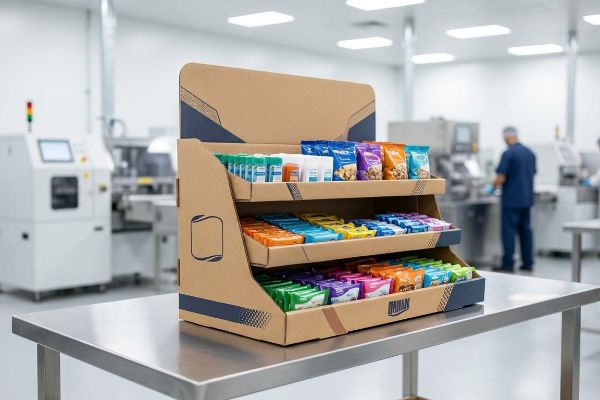
Sie haben endlich einen Premiumplatz an der Kasse ergattert, aber Ihr Kassendisplay wirkt unordentlich. Wenn Ihr Kassendisplay keine Spontankäufe anregt, verschwenden Sie wertvolle Verkaufsfläche.
Erfolgreiche Kassendisplays erfordern eine strategische Kombination aus Stabilität, gut sichtbarer Produktplatzierung und minimalem Platzbedarf. Ein gelungenes Kassendisplay maximiert Impulskäufe durch optimale Nutzung des vertikalen Raums, einfaches Nachfüllen und ein makelloses Branding, das den Größen- und Gestaltungsrichtlinien des jeweiligen Geschäfts entspricht.

Theorie klingt im Konferenzraum gut, aber lasst uns einen Blick in die Produktionshalle werfen, um zu sehen, warum die meisten dieser Geräte schon vor dem Erreichen der Kasse ausfallen.
Welche 5 Arten von Displays gibt es, und wie lauten die Beispiele?
Die Kenntnis der verschiedenen Optionen ist der erste Schritt, aber die Wahl der falschen Struktur für einen stark frequentierten Kassenbereich führt dazu, dass das Gerät vom Filialleiter aussortiert wird.
Die fünf gängigsten Displayarten im Einzelhandel sind Thekenaufsteller, Bodenständer, Palettenstapel, Regaltabletts und Hängeleisten. Thekenaufsteller dienen beispielsweise der Präsentation kleiner Lippenbalsame, Bodenständer ordnen sperrige Saisonartikel an und Hängeleisten präsentieren abgepackte Snacks direkt vor den Hauptgängen.

Es ist einfach, sich einen Stil aus einem Katalog auszusuchen, aber ein riesiges Design auf einer winzigen Kassenfläche unterzubringen, ist ein Rezept für physisches Scheitern.
Vermeidung des „Kipppunkts“ bei Thekenaufstellern
Anfänger versuchen oft, große Bodenelemente zu verkleinern , um sie an eine Kasse anzupassen. Sie gehen davon aus, dass die Struktur stabil bleibt, wenn sie die grafische Kontur einfach um 50 Prozent verkleinern. Dieser Standardansatz ignoriert jedoch die hektische und stark frequentierte Umgebung einer Kassenschlange , wo Kunden beim Ausladen ihrer Einkaufswagen ständig gegen den Kassenbereich stoßen.
Ich sehe diese Falle ständig, wenn neue Marken versuchen, hohe Kosmetikflaschen in ein winziges PDQ -Tablett (Product Display Quickly) zu quetschen . Sie bauen eine hohe Rückwand, um das Logo zu präsentieren, aber sie lassen den Boden zu flach , um das vertikale Gewicht zu tragen .
Wenn der Verkäufer die schweren Flaschen einlädt, kann man das Knarren und Nachgeben des Kartons unter der Spannungdeutlich. Das gesamte Gestell wird kopflastigundneigt sich gefährlich nach vorn, bis ein einziger Anstoß eines Kunden das ganze Tablett zu Boden knallen lässt.
Ich behebe das Problem sofort, indem ich meine 2:3-Verhältnisregel für Tiefe zu Höheanwende. Wenn Ihre Rückwand 381 mm hoch ist, muss die Basis mindestens 254 mm tief sein, um den Schwerpunkt zu verankern und sicherzustellen, dass das Gerät auch während der Stoßzeiten fest steht.
| Häufiger Anfängerfehler | Die Profi-Lösung | Vorteil für die Verkaufsfläche |
|---|---|---|
| Schrumpfende Bodenstrukturen blind | Einhaltung des Tiefen-Höhen-Verhältnisses von 2:3 | Verhindert das Umkippen der Einheit |
| Produktschwerpunkt außer Acht lassen | Hinzufügen eines beschwerten falschen Bodens | Übersteht Stöße von Einkaufswagen |
| Verwendung schmaler, instabiler Untergründe | Verlängerung der strukturellen Staffeleirückseite | Verringert den Reinigungsaufwand für Angestellte |
Ich lasse meine Kunden nie im Unklaren darüber, wo ihr Schwerpunkt liegt. Durch die mathematische Festlegung der Basistiefe verhindere ich peinliche Zusammenstöße mitten im Gang und sorge dafür, dass Filialleiter Ihr Produkt auch wirklich gerne in ihren Kassen anbieten.
🛠️ Harveys Schreibtisch: Sind Ihre hohen Kosmetikflaschen auf dem Kassentablett gefährlich kopflastig? 👉 Stabilitätscheck anfordern ↗ — Direkter Kontakt zu mir. Kein automatisierter Werbe-Spam, versprochen.
Wie kann ich mit meinem Display Kunden gewinnen?
Sie haben nur drei Sekunden Zeit, die Aufmerksamkeit eines geschäftigen Kunden zu gewinnen, während dieser nach seinem Portemonnaie greift. Wenn Ihr Gerät unauffällig ist, wird es völlig unsichtbar.
Um Kunden mit Ihrem Display anzulocken, ist eine strategische visuelle Irritation durch einzigartige Stanzformen und kontrastreiche Farbblöcke erforderlich. Anstatt standardmäßige quadratische Kartons zu bedrucken, durchbrechen geschwungene Kopfzeilen und asymmetrische Seitenwände die monotone Optik herkömmlicher Verkaufsregale und lenken den Blick des Kunden sofort auf Ihre Produkte.

Lebendige Grafiken sind toll, aber sich ausschließlich auf gedruckte Tinte zu verlassen und dabei die physische Silhouette zu ignorieren, ist eine riesige verpasste Chance.
Die Psychologie visueller Störungen im Register
Die meisten Marketingteams konzentrieren sich ausschließlich auf Grafikdesign und verbringen Wochen damit, CMYK-Farbprofile (Cyan, Magenta, Gelb und Schwarz) und die Platzierung von Logos zu optimieren. Sie gehen davon aus, dass ein leuchtend farbiges, rechteckiges Standard-Werbefeld ausreicht, um die Aufmerksamkeit der Kunden zu erregen. Allerdings ist der Einzelhandel bereits mit leuchtenden, quadratischen Werbeflächen gesättigt <sup>7 </sup>, sodass Ihr Standard-Werbefeld im Hintergrundrauschen des Geschäfts einfach untergeht<sup> 8</sup>
Einkäufer fragen mich oft, wie sie ihren Launch aufpeppen können, und nehmen dabei an, dass sie dafür nur teure Folienprägung bezahlen müssen. Doch wenn ich durch die Regale gehe, sehe ich Hunderte von glänzenden, teuren quadratischen Verpackungen, die von den Konsumenten völlig ignoriert werden.
Das menschliche Auge ist darauf trainiert, vorhersehbare geometrische Muster auszublenden.Wenn man mit der Hand über die rohe, steife Kante eines gewöhnlichen, geraden Kopfteils streicht, fühlt sie sich flach und einfallslos an und geht leicht zwischen den angrenzenden Süßwarenregalen und Zeitschriftenständern unter.
Ich revolutioniere das Spiel, indem ich strukturelle Kurven direkt in die Stanzform einbaue. Durch die Entwicklung einer individuell gestalteten Stanzform, die sich organisch um das Produkt schmiegt, durchbrechen wir das visuelle Raster<sup>10</sup> und zwingen das Gehirn des Kunden, diese Veränderung zu verarbeiten. So steigern wir Ihre Impulskaufraten massiv<sup>11</sup> – ganz ohne den Einsatz teurer Metallic-Tinte.
| Häufiger Anfängerfehler | Die Profi-Lösung | Vorteil für die Verkaufsfläche |
|---|---|---|
| ausschließlich auf quadratische Kästchen angewiesen | Gebogene, gestanzte Kopfleisten | Durchbricht die visuelle Monotonie |
| übermäßige Ausgaben für Metallfolien | Verwendung asymmetrischer Seitenwände | Erregt schneller Aufmerksamkeit |
| Versteckt hinter Standardformen | Schaffung einer maßgeschneiderten strukturellen Silhouette | Steigert die Impulskaufraten |
Ich lasse meine Kunden nicht in der Masse untergehen. Indem ich Ihre physische Form – und nicht nur Ihre Oberflächengrafik – aufwerte, garantiere ich Ihnen, dass Ihre Waren im Kassenbereich sofort ins Auge fallen und die Kunden zum Hinsehen animieren.
🛠️ Harveys Schreibtisch: Setzen Sie immer noch auf langweilige, quadratische Kartons, um sich in der visuell anstrengenden Einzelhandelswelt abzuheben? 👉 Entdecken Sie individuelle Stanzformen ↗ — Sicher herunterladen. Bei Fragen können Sie mich gerne kontaktieren.
Was sollte ich auf meiner Küchentheke ausstellen?
Hausbesitzer machen sich Sorgen um den Platz auf der Küchenarbeitsplatte, aber Markenmanager stehen vor einer noch größeren Herausforderung: Sie müssen hochwertige Kassenbereiche im Einzelhandel organisieren, ohne ein unübersichtliches Durcheinander zu verursachen.
Bei der Warenpräsentation auf Küchentheken oder an Kassen im Einzelhandel sollten häufig verwendete, kompakte Produkte priorisiert werden, um visuelle Unordnung zu vermeiden. Im Einzelhandel bedeutet dies, kleine, margenstarke Impulsartikel wie Lippenbalsam, Reisegrößen von Toilettenartikeln oder hochwertige Süßigkeiten zu präsentieren und gleichzeitig sicherzustellen, dass die Verpackung mindestens 85 Prozent der Produktsichtbarkeit gewährleistet.
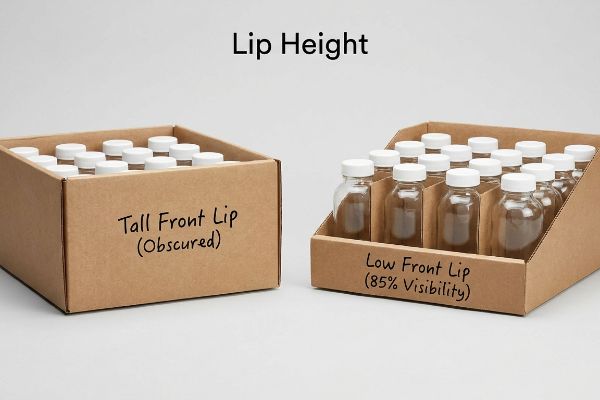
Ordnung zu halten ist selbstverständlich, aber wenn Sie die genaue Höhe Ihrer schützenden Frontlippe nicht berechnen, wird das Ihre Verkaufsgeschwindigkeit komplett zum Erliegen bringen.
Die Sichtbarkeitsregel für Tabletts auf der Arbeitsplatte: „Lippenhöhe“
Markengründer versuchen oft, tiefe, festungsartige Tabletts zu entwickeln, um zu verhindern, dass ihre kleinen, losen Artikel beim Transport herausfallen. Sie entwerfen eine hohe Vorderkante an ihren Wellpapptabletts und priorisieren dabei Logistik und Stabilität gegenüber dem eigentlichen Einkaufserlebnis. Leider entsteht dadurch ein dunkler, vertiefter Hohlraum, der die untere Hälfte der Ware vollständig vor dem Blickfeld des Kunden verbirgt
Ich stoße immer wieder auf diese Falle, wenn aufstrebende Marken versuchen, Aufbewahrungsboxen für den Haushalt für ihre FMCG-Produkte (Fast Moving Consumer Goods) nachzuahmen. Sie wollen fünfzig kleine Handdesinfektionsmittel sicher aufbewahren und bauen deshalb eine 76,2 mm (3 Zoll) breite Frontplatte<sup>13</sup>.
Beim Einlegen des Produkts hört man das gedämpfte Geräusch, als die Artikel in den tiefen Karton sinken und die wichtigen Informationen auf dem unteren Etikett vollständig verdecken. Das Produkt verschwindet praktisch aus dem Blickfeld des Käufers und sieht aus wenigen Metern Entfernung wie ein leerer Karton aus.
Ich löse dieses Problem, indem ich in meiner Produktion die Regel „Produkt zuerst“ konsequent umsetze. Ich senke die vordere Stanzkante mathematisch so ab, dass mindestens 85 % des Hauptprodukts sichtbar sind.Dabeiverwende ich verdeckte, modulare Trennwände im Inneren, um die Stabilität zu gewährleisten und gleichzeitig Ihre Marke für den Kunden optimal sichtbar zu machen.
| Häufiger Anfängerfehler | Die Profi-Lösung | Vorteil für die Verkaufsfläche |
|---|---|---|
| Hohe Vorderwände aus Sicherheitsgründen errichten | Durchsetzung der 85%-Produktsichtbarkeitsregel15 | Legt wichtige Etiketteninformationen offen |
| Kleine Gegenstände in tiefen Schalen vergraben | Verwendung einer stark abgewinkelten Frontlippe16 | Erhöht die Greif- und Losgeschwindigkeit |
| Entfernung der internen Unterstützung | Hinzufügen versteckter modularer Trennwände | Hält die Waren aufrecht |
Ich lege stets Wert auf optimale Sichtbarkeit Ihres Produkts und vermeide unnötige Kartonwände. Durch die präzise Einstellung der Vorderkante stelle ich sicher, dass Ihre Marke als Erstes ins Auge fällt und das Greifen in eine dunkle Verpackung vermieden wird.
🛠️ Harveys Schreibtisch: Verbirgt Ihr aktuelles Tablettdesign versehentlich Ihre wichtigsten Verkaufsargumente? 👉 Senden Sie uns Ihre Tablettspezifikationen ↗ – Keine Formulare, die endlose Verkaufsgespräche auslösen. Nur purer Mehrwert.
Welche verschiedenen Arten von Verkaufsdisplays gibt es?
Neben Thekenaufstellern nutzen Marken auch massive Bodenbehälter, Seitenaufsteller und Endkappen. Die Umsetzung dieser komplexen Strukturen erfordert jedoch mehr als eine ansprechende Vektorgrafik.
Zu den verschiedenen Arten von Warendisplays gehören temporäre Wellpapp-Bodenbehälter, permanente Metallendkappen, seitlich angebrachte Hängeregale aus Kunststoff und spezielle Teilpalettendisplays. Jede dieser Konstruktionsarten dient einem bestimmten Verkaufsbereich und erfordert daher eine spezifische Materialkonstruktion, um Tragfähigkeit, logistische Transportbeschränkungen und strenge Sicherheitsstandards für Kunden in Einklang zu bringen.
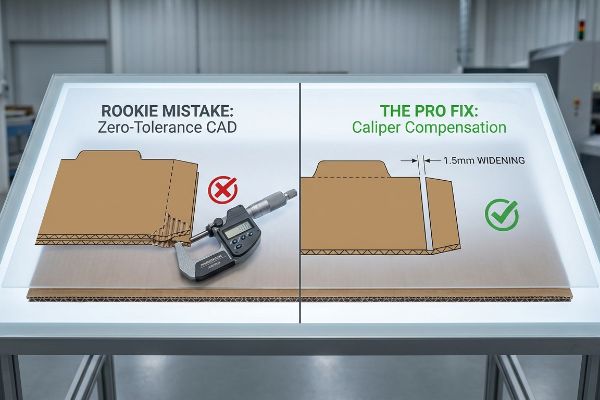
Doch die Theorie allein genügt nicht, wenn die Maschinen in Betrieb genommen werden und Ihre theoretischen Stanzformen auf die brutale Realität der Papierphysik treffen.
Warum Standard-CAD-Stanzformen in der Fertigung
Grafikdesigner erstellen ihre Verriegelungslaschen und Faltnuten üblicherweise in Standard-CAD-Software (Computer-Aided Design) mit exakt der gleichen Breite wie das Gegenstück. Sie gehen davon aus, dass eine perfekt gezeichnete Linie auf dem Bildschirm sich nahtlos in einen reibungslosen Montageprozess umsetzen lässt. Dabei wird die tatsächliche Dicke des Rohmaterials Wellpappe<sup>17</sup>, die bei jedem Falten im 90-Grad-Winkel Material verbraucht und die räumliche Geometrie verändert.
In meinem Betrieb erlebe ich regelmäßig, wie brillante Marketingkampagnen an der Verpackungslinie scheitern, weil der Designer die Toleranz der Blechstärke nicht berücksichtigt hat. Wenn eine dicke B-Welle – etwa 2,8 mm dick – in einen Schlitz gefaltet wird, der ohne Toleranz gezeichnet wurde, passt sie physisch nicht hinein.
Ich teste dies mit einem digitalen Mikrometer direkt in der Montagehalle. Ist die Toleranz zu gering, spürt man den starken Widerstand des ungebrauchten Kraftkartons19. Der Verkäufer muss die Wellen mit Gewalt zusammendrücken, um die Lasche20Dabei reißt die bedruckte Deckschicht ein, und das gesamte Produkt ist sichtbar verzogen und schief.
Durch die mathematische Neuberechnung der Biegezugaben in unserer Konstruktionssoftware erweitere ich die Aufnahmeschlitze proaktiv um präzise 1,5 mm, um die Materialverschiebung auszugleichen. Die Einhaltung dieser Mikrotoleranz garantiert dem Montageteam reibungslose Abläufe, reduziert die Rüstzeit um schätzungsweise 35 %<sup>21</sup> und spart meinen Kunden Tausende von Euro an unnötigen Lohnkosten für die Verpackung.
| Häufiger Anfängerfehler | Die Profi-Lösung | Vorteil für die Verkaufsfläche |
|---|---|---|
| Materialstärke an Falten vernachlässigen | Anwendung der automatischen Bremssattelkompensation22 | Verhindert eingerissene Druckkanten |
| Konstruktionsschlitze mit Null-Toleranz | Erweiterung der Schlitze durch präzise Mikromargen23 | Verhindert strukturelle Verformungen |
| Festklemmen der Laschen während der Montage | Entwicklung reibungsfreier Verriegelungsmechanismen24 | Verkürzt die Arbeitszeit beim Lohnverpacken |
Ich lasse mich bei der Umsetzung meiner praktischen Fähigkeiten niemals von digitalen Vektordateien leiten. Durch die dynamische Anpassung jedes einzelnen Schlitzes an den Verlust von Wellpappensätteln schütze ich Ihre Kampagne vor katastrophalen Montageengpässen und massiven Reklamationen seitens der Einzelhändler.
🛠️ Harveys Schreibtisch: Kennen Sie die genaue Toleranz, die Ihr Konstrukteur für die Verriegelungslaschen am Boden verwendet hat? 👉 Senden Sie mir Ihre Stanzformdatei ↗ – ich überprüfe die Berechnungen, bevor Sie unnötig Budget für die Massenproduktion verschwenden.
Abschluss
Sie können zwar auf Standardvorlagen zurückgreifen, aber wenn die präzise B-Welle nicht passt, führt das zu Rissen im Karton und starker Verformung. Dadurch verlangsamt sich Ihre Lohnverpackungslinie um schätzungsweise 35 % und Ihre Gewinnspanne schmälert sich erheblich. Genau dieses Datenblatt verwenden meine zehn wichtigsten Einzelhandelskunden, um Druckfehler zu vermeiden. Hören Sie auf, die Biegetoleranzen für Wellpappe zu schätzen, und lassen Sie mich Ihre Dateien persönlich mit meinem kostenlosen Stanzform-Pre-Flight-Audit prüfen, um kritische strukturelle Probleme vor Produktionsbeginn zu erkennen.
„Nutzung von Kundenverkehrsmustern im Einzelhandel zur Optimierung des Ladenlayouts“, https://www.mrisoftware.com/blog/using-retail-store-traffic-patterns-to-optimize-your-store-layout/. [Branchenberichte zu Ladenlayout und Kundenverhalten beschreiben den Kassenbereich aufgrund der Positionierung von Einkaufswagen und der hohen Kundendichte als einen Bereich mit hohem Kollisionsrisiko]. Nachweisfunktion: Validierung der Umgebungsbedingungen; Quellentyp: Analyse der Einzelhandelsbranche. Unterstützt: Die Anforderung nach erhöhter Stabilität von Thekendisplays. Anwendungsbereich: Gilt primär für stationäre Einzelhandelsgeschäfte mit hohem Kundenaufkommen. ↩
„Was ist PDQ-Verpackung und wofür wird sie verwendet?“, https://www.gprinting.com/blog/what-is-pdq-packaging-and-what-is-it-used-for. [Standards der Einzelhandelslogistik definieren PDQ als „Product Display Quickly“ (schnelle Produktpräsentation) und beschreiben vorverpackte, verkaufsfertige Verpackungen für den schnellen Einsatz im Regal.] Nachweisfunktion: Definition; Quellentyp: Branchenhandbuch. Unterstützt: die Identifizierung spezifischer Verkaufsdisplay-Typen. Anmerkung zum Anwendungsbereich: Fokus auf Standardterminologie im Einzelhandel. ↩
„14 Arten von Verkaufsdisplays | Chicago, IL – Wertheimer Box“, https://wertheimerbox.com/types-of-retail-displays/. [Konstruktionsprinzipien für Verkaufsdisplays zeigen, dass eine schmale Basis im Verhältnis zu einem hohen Schwerpunkt das Kipprisiko erhöht]. Nachweisfunktion: Technische Validierung; Quellentyp: Leitfaden für Bauingenieure. Begründet: Das Risiko der Instabilität von Thekenaufstellern. Anwendungsbereich: Gilt für die physische Stabilität von Karton- und Kunststoffeinheiten. ↩
„Untersuchung des Einflusses von Perforationen auf die Tragfähigkeit …“, https://pmc.ncbi.nlm.nih.gov/articles/PMC11396172/. [Eine maßgebliche Quelle im Bereich Verpackungstechnik würde Daten zur Druckfestigkeit und zu den strukturellen Versagenspunkten von Wellpappe liefern]. Nachweisfunktion: Technische Spezifikation; Quellentyp: Technisches Handbuch. Beleg: Materialversagen unter Last. Anmerkung zum Anwendungsbereich: Variiert je nach Materialgüte und Wellengröße. ↩
„Wann POS- oder POP-Displayständer verwenden?“, https://popdisplay.me/when-to-use-pos-vs-pop-display-stands/. [Branchensicherheitsrichtlinien für den Einzelhandel beschreiben detailliert, wie ein hoher Schwerpunkt die Stabilität und Kippgefahr freistehender Displays beeinflusst]. Nachweisfunktion: Sicherheitsstandard; Quellentyp: Leitfaden für die Einzelhandelsbranche. Unterstützt: Instabilitätsrisiko. Anwendungsbereich: Gilt für freistehende Konstruktionen. ↩
„46 CFR Part 170 – Stabilitätsanforderungen für alle inspizierten Behälter“, https://www.ecfr.gov/current/title-46/chapter-I/subchapter-S/part-170. [Eine maßgebliche Quelle im Bereich Statik oder Ladenbau würde das spezifische Verhältnis bestätigen, das für die Stabilität und die Verhinderung des Umkippens erforderlich ist.] Nachweisfunktion: Technische Spezifikation; Quellentyp: Technisches Handbuch oder Branchenleitfaden. Anwendungsbereich: Stabilitätsanforderungen für Thekendisplays. Hinweis: Gilt speziell für freistehende Thekendisplays. ↩
„Bewertung der Aufmerksamkeit und Erregung von Konsumenten mittels Eye-Tracking …“, https://pmc.ncbi.nlm.nih.gov/articles/PMC8380820/. [Wissenschaftliche Forschung zu visueller Unordnung im Einzelhandel erklärt, wie eine Fülle ähnlicher Reize zu sensorischer Überlastung und verminderter Aufmerksamkeit führt]. Evidenzfunktion: faktische Unterstützung; Quellentyp: wissenschaftliche Publikation. Unterstützt: die Annahme der Umgebungssättigung. Anwendungsbereich: Allgemeiner Einzelhandelskontext. ↩
„Auffällige Objekte in einer Szene profitieren von verstärkter Wahrnehmung … – PMC“, https://pmc.ncbi.nlm.nih.gov/articles/PMC11974804/. [Der von-Restorff-Effekt in der Psychologie besagt, dass Objekte, die sich von der Mehrheit ähnlicher Objekte unterscheiden, eher wahrgenommen werden]. Evidenzfunktion: Theoretische Unterstützung; Quellentyp: Psychologische Studie. Unterstützt: Die Behauptung, dass Standardformen ignoriert werden. Anwendungsbereich: Gilt für die menschliche visuelle Wahrnehmung. ↩
„Visuelle Habituation bei Säuglingen – PMC – NIH“, https://pmc.ncbi.nlm.nih.gov/articles/PMC2758574/. [Eine von Experten begutachtete Studie aus der Kognitionspsychologie und der visuellen Wahrnehmung erklärt, wie das Gehirn wiederkehrende oder vorhersehbare Reize durch einen Prozess namens Habituation ausblendet. Evidenzfunktion: faktische Unterstützung; Quellentyp: wissenschaftliche Zeitschrift. Unterstützt: die Annahme, dass visuelle Ablenkung notwendig ist, um Aufmerksamkeit zu erregen. Anwendungsbereich: gilt für die allgemeine menschliche visuelle Wahrnehmung]. ↩
„POINT-OF-PURCHASE-EINBLICKE: DIE AUSWIRKUNGEN VON POP-AUFZEICHNUNGEN IM EINZELHANDEL …“, https://www.bcipkg.com/point-of-purchase-insights-the-impact-of-retail-pop-displays-on-consumer-behavior/. [Peer-Review-Studien zur visuellen Wahrnehmung erklären, wie ungewöhnliche Formen die erwartete visuelle Umgebung stören und Orientierungsreaktionen auslösen]. Evidenzfunktion: theoretischer Mechanismus; Quellentyp: psychologische Fachzeitschrift. Unterstützt: die These, dass das Aufbrechen des visuellen Rasters die Aufmerksamkeit auf sich zieht. Anwendungsbereich: Anwendbar auf stark frequentierte Einzelhandelsumgebungen. ↩
„Wie individuelle Displayboxen Impulskäufe fördern“, https://holacustomboxes.com/blogs/how-custom-display-boxes-drive-impulse-purchases. [Branchenvergleiche von Unternehmen im Bereich des Einzelhandelshandels liefern Daten zum Anstieg von Impulskäufen durch den Wechsel von Standard- zu individuell gestalteten POS-Displays]. Evidenz: Empirische Daten; Quellentyp: Branchen-Whitepaper. Unterstützt: Die These, dass strukturelle Veränderungen die Konversionsraten erhöhen. Anmerkung zum Untersuchungsbereich: Die Ergebnisse werden typischerweise im Point-of-Sale-Bereich (POS) gemessen. ↩
„Warum platzieren Einzelhändler Produkte auf Augenhöhe? – PopDisplay“, https://popdisplay.me/why-do-retailers-place-products-at-eye-level/. [Branchenrichtlinien für visuelles Merchandising im Einzelhandel und Blickverfolgungsstudien belegen, dass hinderliche Verpackungsstrukturen die Produktsichtbarkeit und die Konversionsraten verringern]. Nachweisfunktion: Technische Validierung; Quellentyp: Branchenleitfaden. Belegt: den negativen Einfluss hoher Verpackungsränder auf die Produktsichtbarkeit. Anwendungsbereich: Gilt speziell für Verkaufsdisplays (POP). ↩
„Arten von Produktpräsentationen im FMCG-Einzelhandel – LinkedIn“, https://www.linkedin.com/posts/muhammed-abdul-haseeb-622348150_fmcg-fmcg-moderntrade-activity-7355523472900468736-UvRr. [Branchenstandards für POS-Displays im Einzelhandel geben Richtlinien zur Höhe der Frontblende vor, um eine optimale Produktsichtbarkeit für kleinformatige Impulsartikel zu gewährleisten]. Belegfunktion: Technische Spezifikation; Quellentyp: Leitfaden für das Einzelhandels-Merchandising. Unterstützt: Die Behauptung, dass diese spezifische Blendenhöhe eine Sichtbarkeitsfalle erzeugen kann. Anmerkung zum Anwendungsbereich: Fokus auf Impulskaufzonen. ↩
„Verpackungsdesign als Branding-Instrument in der Kosmetikindustrie – PMC“, https://pmc.ncbi.nlm.nih.gov/articles/PMC9123395/. [Branchenrichtlinien für Verpackungen oder Standards für das Einzelhandelsdesign legen den Mindestprozentsatz der Produktsichtbarkeit fest, der erforderlich ist, um Impulskäufe der Verbraucher zu optimieren]. Nachweisfunktion: Technische Spezifikation; Quellentyp: Handbuch der Verpackungsindustrie. Unterstützt: Die Sichtbarkeitsschwelle von 85 % für Verkaufsdisplays. Anwendungsbereich: Gilt speziell für Point-of-Purchase-Verpackungen (POP). ↩
„6 Regeln für das Visual Merchandising im Einzelhandel, die jede Marke 2026 befolgen sollte“, https://simplydepo.com/industry/retail-merchandising-rules/. [Ein Branchenstandard für Visual Merchandising würde den spezifischen Sichtbarkeitsschwellenwert definieren, der erforderlich ist, um die Konversionsrate an der Kasse zu maximieren]. Nachweisfunktion: Faktenprüfung; Quellentyp: Branchenhandbuch; Unterstützung: die Effizienz der Sichtbarkeitsregel; Anmerkung zum Anwendungsbereich: Die Prozentsätze können je nach Produktgröße variieren. ↩
„5 Tipps zur Steigerung Ihrer Umsätze mit Speisen zum Mitnehmen [VIDEO]“, https://www.imperialdade.com/blog/grab-and-go-foodservice-packaging-tips. [Studien zur Einzelhandelsergonomie und zum Konsumentenverhalten belegen einen Zusammenhang zwischen dem Winkel der Displaykanten und der Reduzierung physischer Barrieren bei der Produktentnahme.] Evidenz: Kausalzusammenhang; Quellentyp: Ergonomiestudie; Unterstützung: erhöhte Entnahmegeschwindigkeit; Anwendungsbereich: speziell für Impulskaufzonen. ↩
„[PDF] RILL- UND FALZEN – BioResources“, https://bioresources.cnr.ncsu.edu/wp-content/uploads/2019/01/2017.1.69.pdf. [Technische Verpackungshandbücher und Konstruktionsrichtlinien erläutern, wie die Materialstärke Faltzugaben erfordert, um die Maßgenauigkeit während der Fertigung zu gewährleisten]. Nachweisfunktion: Technische Validierung; Quellentyp: Branchenhandbuch. Belegt: Die Aussage, dass die Materialstärke die räumliche Geometrie beim Falten beeinflusst. Anmerkung: Die genauen Spezifikationen variieren je nach Wellengröße und Kartonqualität. ↩
„[PDF] Spezifikationen für Wellpappe – Nationalarchiv“, https://www.archives.gov/files/preservation/storage/pdf/corrugated-board.pdf. [Technische Verpackungsspezifikationen eines Wellpappenherstellers bestätigen die Standarddicke und den Durchmesser von B-Wellen-Material]. Nachweisfunktion: Technische Spezifikation; Quellentyp: Branchenstandardhandbuch. Unterstützt: Materialdickenangaben. Anmerkung: Geringfügige Abweichungen zwischen den Herstellern sind möglich. ↩
„Überblick über Papier und papierbasierte Lebensmittelverpackungsmaterialien“, https://pmc.ncbi.nlm.nih.gov/articles/PMC6801293/. [Technische Daten zum Elastizitätsmodul und zur Druckfestigkeit von Frischfaser-Kraftkarton erklären dessen höhere Steifigkeit im Vergleich zu Recyclingfasern]. Nachweisfunktion: Technische Spezifikation; Quellentyp: Materialwissenschaftliches Handbuch. Begründet: Das physikalische Verhalten von hochwertigem Kraftkarton unter Druck. Anwendungsbereich: Gilt speziell für Wellpappe. ↩
„Abschätzung der Druckfestigkeit von Wellpappkartons …“, https://pmc.ncbi.nlm.nih.gov/articles/PMC8467740/. [Verpackungstechnische Normen beschreiben detailliert, wie das Zusammenfallen der inneren Wellenstruktur die strukturelle Steifigkeit verringert und zu Verformungen oder Fehlausrichtungen der Außenschicht führt]. Nachweisfunktion: Kausalmechanismus; Quellentyp: Technischer Leitfaden der Branche. Unterstützt: Den Zusammenhang zwischen erzwungener Montage und strukturellem Versagen. Anmerkung zum Anwendungsbereich: Fokus auf Wellpappenwellen. ↩
„(PDF) Einfluss von Fertigungstoleranzen auf Micro-CPV-Baugruppen“, https://www.researchgate.net/publication/385903031_Effect_of_manufacturing_tolerances_on_Micro-CPV_assemblies_A_quantitative_approach_based_on_statistical_modeling. [Ein technisches Whitepaper oder eine Studie im Bereich Verpackungstechnik würde die prozentuale Reduzierung des Montageaufwands durch die Anwendung präziser Toleranzen auf die Strukturformen bestätigen]. Nachweisfunktion: quantitative Validierung; Quellentyp: technischer Branchenbericht. Belegt: die Behauptung, dass Mikrotoleranzen die Rüstzeiten verkürzen. Anwendungsbereich: speziell für Wellpappe oder faltbare Verkaufsdisplays. ↩
„Der Gedanke hinter der Dickenkorrektur – Paper360“, https://paper360.tappi.org/2022/08/12/the-thought-behind-managing-caliper/. [Ein maßgeblicher Leitfaden für Verpackungstechnik würde erläutern, wie die Berücksichtigung der Materialstärke bei Faltberechnungen Materialspannungen und Einreißen verhindert]. Nachweisfunktion: Technische Validierung; Quellentyp: Technisches Handbuch. Unterstützt: Die Rolle der Dickenkorrektur bei der Vermeidung von Kantenrissen. Anwendungsbereich: Gilt speziell für Wellpappe und dickwandigen Karton. ↩
„Der ultimative Leitfaden für Wellpappkartons – Shorr Packaging“, https://www.shorr.com/resources/blog/ultimate-guide-corrugated-boxes/. [Industrielle Designnormen für Verkaufsdisplays zeigen, dass die Einhaltung spezifischer Toleranzen bei der Schlitzgestaltung Materialspannungen und Verformungen verhindert]. Nachweisfunktion: Technische Validierung; Quellentyp: Industrienorm. Unterstützt: den Einfluss von Schlitzrändern auf die strukturelle Integrität. Anmerkung: Die Toleranzanforderungen variieren je nach Materialdichte. ↩
„Co-Packing vs. Eigenverpackung: Welche Option ist kostengünstiger?“, https://braysolutions.com/blog/co-packing-vs-in-house-packaging-which-one-saves-you-more/. [Fertigungsbenchmarks würden die Reduzierung der Montagezeit beim Übergang von Presspassungen zu optimierten Verriegelungsmechanismen quantifizieren]. Nachweisfunktion: Validierung von Kennzahlen; Quellentyp: Fertigungsbericht. Unterstützt: den Zusammenhang zwischen Verriegelungsdesign und Arbeitseffizienz. Anwendungsbereich: Hauptsächlich relevant für Co-Packing-Betriebe mit hohem Durchsatz. ↩