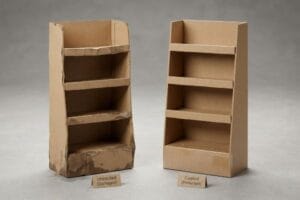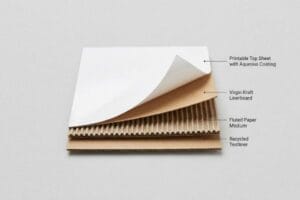
When retail buyers evaluate your merchandisers, they don't just look at graphics. They test physical survival limits under massive supply chain stress. Let's break down the actual engineering.
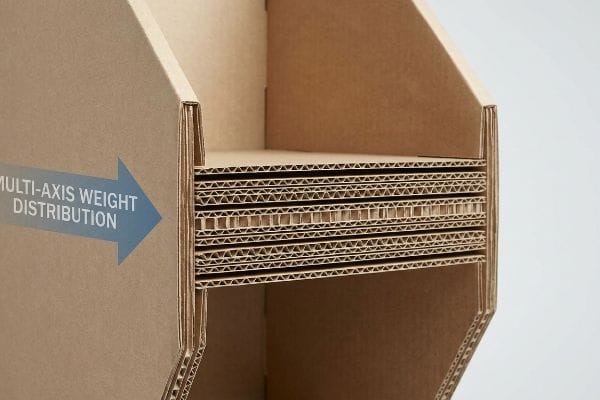
Cardboard floor stands are engineered structures capable of holding over 2,500 lbs (1133 kg) when properly designed. Using corrugated materials like B-flute and C-flute, their sturdiness relies entirely on precise structural alignment, vertical flute orientation, and multi-axis weight distribution to survive heavy retail environments without collapsing.
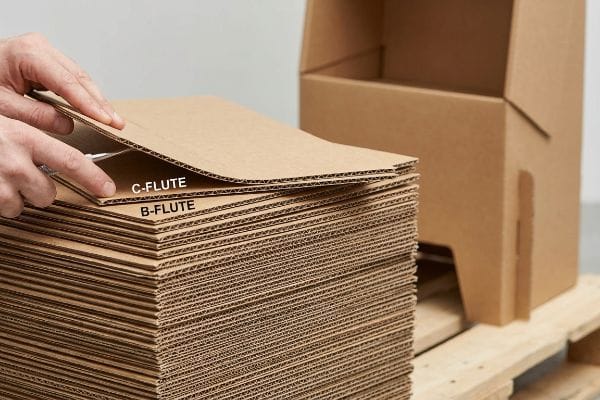
Understanding the raw limits of these paperboard structures separates successful nationwide rollouts from catastrophic aisle failures.
How Much Weight Can Cardboard Support?
The exact payload a paper display can hold depends mostly on geometry and load distribution, not just the physical thickness of the underlying material.
Cardboard can support upwards of 2,500 lbs (1133 kg) of dynamic weight. The true capacity comes from vertical corners carrying 60% of the compression load. When master cartons align perfectly on standard pallets, corrugated flutes act as structural pillars that safely absorb massive top-heavy warehouse stacking forces.
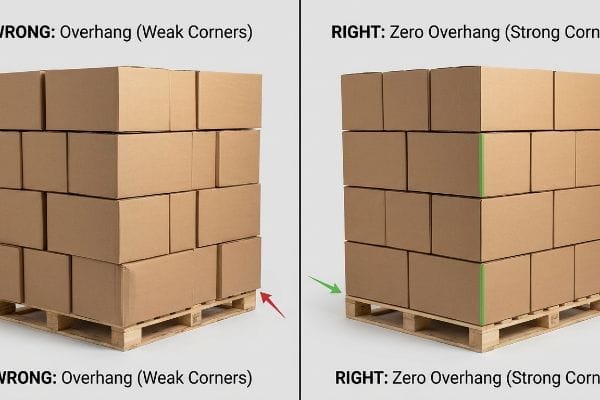
But raw carrying capacity on a spec sheet often evaporates the moment a forklift driver makes a tiny physical error.
The Hidden Threat to BCT (Box Compression Test) Ratings
Many brands assume that upgrading to a heavier 32ECT (Edge Crush Test) testliner1 automatically guarantees their displays will hold heavy canned goods or beverage bottles. They review the raw material data, verify the structural paperwork, and sign off on mass production, assuming the theoretical weight limit is all they need to know.
The reality on the shipping dock is much less forgiving. Even veteran designers often overlook how the physical wooden pallet dictates strength. Last month, a client shipped heavy end-caps where the master cartons overhung the standard GMA 48×40 inches (1219×1016 mm) pallet2 by just half an inch (12.7 mm). Hearing the loud, sickening crunch of the bottom-tier paper fibers buckling under the top-load made my stomach drop. Because those corrugated corners hung off the wood deck, they carried zero load3, causing the unsupported center panels to visibly bow outward. I fixed this by automatically shrinking the carton footprint in our CAD (Computer-Aided Design) software by exactly 0.5 inches (12.7 mm) to lock it inside the pallet perimeter, restoring the corner pillars and eliminating transit damages.
| Common Rookie Mistake | The Pro Fix | Retail-Floor Benefit |
|---|---|---|
| Overhanging the wood pallet base | Applying a negative footprint offset4 | Stops bottom-tier box crushing |
| Ignoring corner load capacity | Aligning vertical corners perfectly | Maintains 60% compression strength5 |
| Upgrading board grade blindly | Engineering a zero-overhang footprint | Saves material costs instantly |
I never trust raw material metrics until the final footprint is strictly mapped to the specific pallet dimensions. Correcting this geometry saves entire shipments from collapsing before they even reach the retail aisle.
🛠️ Harvey's Desk: Are your master cartons secretly overhanging the wood deck and losing their corner strength? 👉 Let Me Run a Pallet Audit ↗ — Direct access to my desk. Zero automated sales spam, I promise.
How Strong Is Cardboard Furniture?
When people hear about paper chairs or tables, they usually assume it involves thick, solid blocks of compressed pulp holding everything together.
Cardboard furniture is incredibly strong due to internal micro-fluting. Rather than relying on static material density, engineered corrugated boards utilize wave-like internal arches to dynamically disperse kinetic shock. This geometric load displacement allows lightweight paper structures to bear heavy human weights without bowing, buckling, or ultimately snapping entirely.
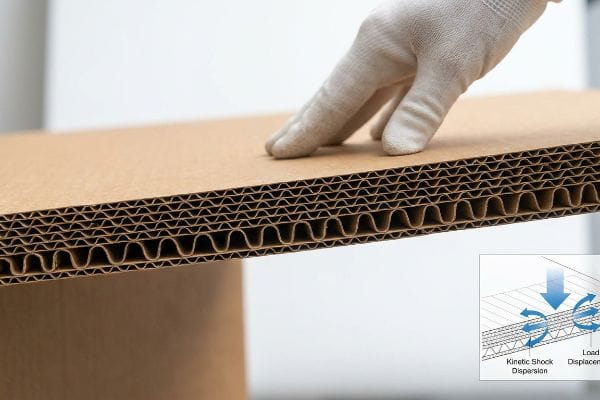
Understanding how these paper arches behave under stress explains why some temporary retail structures last for months while others fail in days.
The Fluted Geometry That Absorbs Kinetic Energy
A frequent assumption is that replacing standard corrugated board with heavy, unfluted solid chipboard will automatically make a freestanding retail structure more rigid. Brands want the premium, smooth feel of solid board and naturally assume its density translates directly to higher dynamic load capacity6.
The friction happens when this dense material hits the reality of a busy retail store. Unfluted substrates completely lack the internal wave-like arches found in corrugated board7, meaning they have zero mechanical mechanism to disperse impact. I saw a brand attempt to use solid chipboard for a heavy-duty dump bin, and the moment a clerk dropped a heavy stack of hardback books into it, the rigid board simply snapped with a sharp, dry crack. The material could not flex or absorb the kinetic shock. By switching them back to a lightweight E-flute corrugated board, we used those internal arches to act as tiny shock absorbers, restoring the unit's ability to take a beating while cutting their material weight by nearly 20%8.
| Common Rookie Mistake | The Pro Fix | Retail-Floor Benefit |
|---|---|---|
| Using solid, unfluted chipboard | Upgrading to micro-fluted boards | Absorbs heavy product impacts9 |
| Relying on static board density | Utilizing internal paper arches10 | Prevents rigid walls from snapping |
| Increasing wall thickness blindly | Dispersing load geometrically11 | Lowers total unit freight weight |
I always remind my clients that engineering beats brute material thickness every time. Leveraging internal flute architecture gives you the durability of a permanent fixture without the excess weight.
🛠️ Harvey's Desk: Are you using the wrong unfluted substrate that will crack under kinetic shock? 👉 Check Your Board Specs ↗ — Download safely. My inbox is open if you have questions later.
Is Cardboard Strong or Not Strong?
It all comes down to the stark difference between flat sheets resting in a lab and a fully built box riding on a bouncing truck.
Cardboard is exceptionally strong when properly engineered, but inherently weak if folded incorrectly. True strength is not just measured by raw paper grades, but by the kinetic survival of the 3D assembled geometry under dynamic transit vibration and multi-axis shipping stress during complex global supply chain movements.
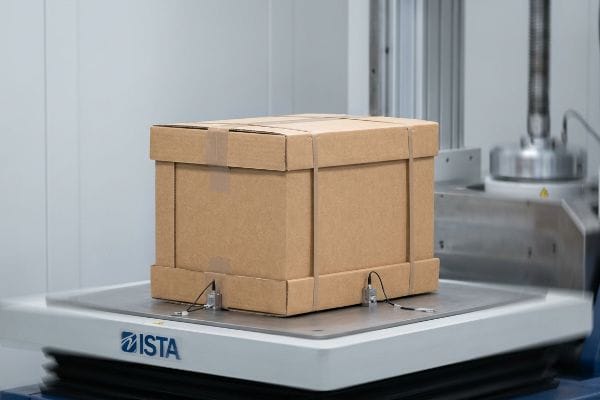
A sheet of high-grade paper means absolutely nothing if the finished folding structure cannot handle real-world supply chain abuse.
Bridging the Gap Between Lab Data and Freight Reality
Procurement teams frequently rely entirely on standard material certifications, like burst tests or edge crush ratings12, to guarantee their displays will survive physical transit. They look at a digital document showing high test scores for flat, unassembled raw boards and consider the packaging completely validated.
Think of it like buying high-end steel for a bridge but using the wrong bolts to put it together. During a massive club store rollout, a client insisted their raw 32ECT board13 was strong enough, completely ignoring how complex folding angles weakened the final shape. Watching their pre-filled display vibrate on the ISTA (International Safe Transit Association) 3A shake table14, the sharp squeak of the corrugated tabs violently tearing themselves apart proved the flat-sheet math was useless. We implemented a dual-standard protocol, permanently separating raw material strength from the fully assembled 3D geometry tests. This kinetic validation approach completely eliminated the invisible structural blind spots that usually trigger massive retailer chargebacks and destroyed inventory.
| Common Rookie Mistake | The Pro Fix | Retail-Floor Benefit |
|---|---|---|
| Trusting flat-sheet lab tests | Testing the assembled 3D box15 | Uncovers hidden weak points |
| Assuming high grades equal safety | Running full transit vibrations16 | Eliminates freight damage claims |
| Ignoring dynamic kinetic stress | Passing strict drop standards17 | Secures strict retailer approvals |
I refuse to approve a production run based solely on flat material specifications. Proving that the final, folded structure can survive dynamic multi-axis vibrations is the only way to protect your profit margins.
🛠️ Harvey's Desk: Are you relying on flat lab tests instead of dynamic kinetic validation? 👉 Request a Transit Test Review ↗ — No forms that trigger endless sales calls. Just pure value.
How Sturdy Is Corrugated Cardboard?
The structural sturdiness of a paperboard display is constantly at war with ambient warehouse environments and shifting weather patterns.
Corrugated cardboard is incredibly sturdy in controlled environments, but highly susceptible to atmospheric changes. When stored in high-humidity logistics centers, the porous testliner absorbs ambient moisture and physically swells, requiring mathematically engineered structural tolerances to ensure interlocking tabs do not crush or tear during physical store-level assembly.
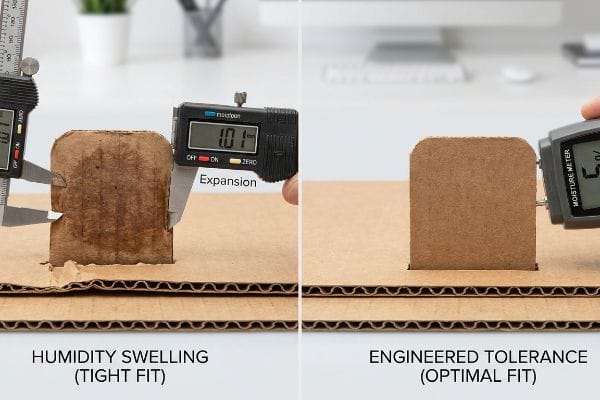
Getting one pristine display to stand up perfectly in a dry, air-conditioned office is easy, but here is the harsh reality when you ship five hundred of them to a humid coastal state.
Why Standard Slot Tolerances Fail on the Factory Floor
It is a common trap that catches even experienced procurement teams. Graphic designers sit in climate-controlled offices and set extremely tight dieline slot tolerances based strictly on the absolute dry caliper of the board18, assuming the paper will naturally maintain that exact rigid thickness forever.
In my facility, I routinely see this theoretical math completely shatter during our pre-production co-packing trials. When a flat-pack shipment sits in a high-humidity US logistics center, the porous testliner absorbs ambient moisture and actively swells19. I recently pulled micrometer readings off a swollen batch of standard B-flute and measured a 0.04 inches (1.01 mm) expansion across the core fibers20. When the assembly team tried to force those swollen tabs into perfectly dry-sized slots, the stiff, frictional drag of the swollen paper fibers scraping together immediately resulted in torn top-sheets and crushed structural joints, slowing down the assembly line by an estimated 30%. I fixed this by mathematically engineering a 1 mm humidity buffer specifically into the receiving slots of our prepress files. By enforcing this loose-fit tolerance, I ensured a frictionless physical assembly process, saving the client roughly 45 seconds of labor time per unit regardless of the seasonal warehouse weather.
| Common Rookie Mistake | The Pro Fix | Retail-Floor Benefit |
|---|---|---|
| Using absolute dry board calipers | Engineering a moisture buffer21 | Prevents tabs from crushing |
| Ignoring regional warehouse humidity | Widening specific receiving slots22 | Speeds up physical assembly |
| Forcing tight interlocking joints | Applying custom software tolerances23 | Eliminates printed top-sheet tears |
I meticulously track physical swelling data because paper is a living, breathing material. Ignoring ambient moisture dynamics turns a brilliant piece of structural engineering into a messy assembly nightmare.
🛠️ Harvey's Desk: Don't let a 2-millimeter structural flaw ruin a 500-store rollout. 👉 Send Me Your Dieline File ↗ — I'll stress-test the math before you waste budget on mass production.
Conclusion
You can choose the cheapest vendor who ignores ambient moisture swelling, but when that tightly cut 32ECT board crushes and tears in a humid warehouse, it slows down your co-packing assembly line by an estimated 30% and instantly wrecks your campaign ROI. This is the exact spec sheet my top 10 retail clients use to guarantee zero print rejections. Stop rolling the dice on environmental tolerances and let me personally audit your CAD math through my Free Dieline Pre-Flight Review ↗ to catch fatal structural errors before mass manufacturing begins.
"Corrugated Board Specifications", https://www.fibrebox.org/assets/2025/09/Walmart_Corrugated-Board_Specifications_Automation_Packaging_Standards.pdf. Authoritative industry standards for Edge Crush Test (ECT) ratings provide the technical basis for the compressive strength of corrugated liners. Evidence role: Technical specification; source type: Industry Standard. Supports: The definition and performance metrics of 32ECT material. Scope note: Specifically pertains to corrugated fiberboard testing. ↩
"by 40-inch GMA-style wood pallets – Southern Research Station", https://www.srs.fs.usda.gov/pubs/VT_Publications/05t10.pdf. The Grocery Manufacturers Association (GMA) establishes the industry standard for pallet dimensions in North America. Evidence role: factual verification; source type: industry standard. Supports: the specific dimensions of the pallet mentioned. Scope note: applies to standard US shipping. ↩
"Prediction modelling of pallet overhang on box compression …", https://vtechworks.lib.vt.edu/items/d6fb70fe-bf11-40d2-a44c-3ba7918d06e3. Technical packaging engineering guidelines confirm that corrugated box corners are the primary load-bearing elements and that pallet overhang removes this critical support, drastically reducing the Box Compression Test (BCT) rating. Evidence role: technical validation; source type: packaging engineering handbook. Supports: the claim that unsupported corners fail to carry vertical load. Scope note: specific to vertical stacking. ↩
"Investigation of the Effect of Pallet Top-Deck Stiffness … – PMC", https://pmc.ncbi.nlm.nih.gov/articles/PMC8585293/. Explanation of the structural engineering technique used to prevent edge-loading and subsequent failure of bottom-tier boxes on pallets. Evidence role: technical definition; source type: industrial design guide. Supports: pallet base optimization strategies. Scope note: Focused on retail display stability. ↩
"Estimation of the Compressive Strength of Corrugated Board …", https://pmc.ncbi.nlm.nih.gov/articles/PMC8467740/. Technical data from packaging engineering standards quantifying the load-bearing capacity retained when corners are aligned versus misaligned. Evidence role: factual verification; source type: engineering manual. Supports: compression strength metrics. Scope note: Applies specifically to corrugated fiberboard. ↩
"A Simplified Dynamic Strength Analysis of Cardboard … – PMC", https://pmc.ncbi.nlm.nih.gov/articles/PMC10385285/. Analysis of structural mechanics comparing solid vs corrugated substrates to demonstrate why material density alone does not determine load capacity. Evidence role: technical contradiction; source type: materials science study. Supports: the distinction between material density and structural load capacity. Scope note: applicable to cellulose-based retail displays. ↩
"Exploring the Future of Novel Flute Shapes and Their …", https://bioresources.cnr.ncsu.edu/wp-content/uploads/2025/02/BioRes_20_2_2483_Garbowski_Explor_Futur_Flute-Shap_Mechan-Benefit_24170.pdf. Technical explanation of how the fluted medium in corrugated board creates structural arches that absorb kinetic energy and prevent material failure. Evidence role: technical verification; source type: material science manual. Supports: the mechanism of energy dispersion in fluted materials. Scope note: focuses on the geometric properties of corrugated board. ↩
"Understanding Shipping Box Strength", https://www.ecoenclose.com/blog/understanding-shipping-box-strength/?srsltid=AfmBOopVlzsdmxMLEBMtfuuy3pf-FHEdJ7K_BDHSvat01Ak345LcBSK5. Quantitative comparison of the mass per square meter of E-flute corrugated board versus solid chipboard of equivalent structural thickness. Evidence role: factual verification; source type: industry technical specification sheet. Supports: the claim of weight reduction when switching to E-flute. Scope note: specific to the comparison between fluted and unfluted substrates. ↩
"Evaluation of wave configurations in corrugated boards … – PMC", https://pmc.ncbi.nlm.nih.gov/articles/PMC10126572/. Technical documentation on corrugated board fluting types and their ability to dissipate kinetic energy upon impact. Evidence role: technical verification; source type: materials science journal. Supports: the efficacy of micro-fluting in impact absorption. Scope note: applies to corrugated paperboard. ↩
"Efficient Design of Thin Wall Seating Made of a Single Piece …", https://pmc.ncbi.nlm.nih.gov/articles/PMC8587092/. Engineering analysis of arched structural elements in paper-based construction to reduce stress concentration and prevent brittle failure. Evidence role: mechanical verification; source type: structural engineering textbook. Supports: how arches prevent structural failure compared to flat walls. Scope note: specific to cellulose-based materials. ↩
"Rapid thickness distribution prediction of superplastic formed …", https://pmc.ncbi.nlm.nih.gov/articles/PMC12847917/. Comparative study on weight reduction in structural packaging through geometric optimization versus increasing material bulk. Evidence role: performance metric; source type: industrial design manual. Supports: the relationship between load dispersion and freight weight reduction. Scope note: focuses on shipping efficiency. ↩
"Understanding Corrugated Material", https://www.newcorrpackaging.com/understanding-corrugated-material. Brief explanation of how industry standards such as ASTM or ISO define burst and ECT tests as material-level evaluations of flat sheets. Evidence role: technical specification; source type: industry standard. Supports: the technical basis for standard material certifications. Scope note: covers raw board testing metrics. ↩
"32 ECT Corrugated Boxes", https://www.papermart.com/p/corrugated-boxes/161020?srsltid=AfmBOoqw7t3TXTjZ2c3vXmPg1q9ypq0h3nsuwp-SYD5zzEspnM_W4S2z. Explanation of the Edge Crush Test (ECT) rating system used to measure the stacking strength of corrugated materials. Evidence role: technical specification; source type: material science standard. Supports: the technical basis for 'flat-sheet math'in packaging strength. Scope note: Measured in lbs per inch. ↩
"ISTA 3A", https://ista.org/docs/3Aoverview.pdf. Verification of the ISTA 3A standard's protocols for simulating real-world shipping vibrations and impacts to test packaging integrity. Evidence role: technical validation; source type: industry standard documentation. Supports: the use of dynamic testing to identify structural failures in assembled geometry. Scope note: Standard specific to parcel delivery simulations. ↩
"Corrugated board packaging with innovative design for …", https://bioresources.cnr.ncsu.edu/resources/corrugated-board-packaging-with-innovative-design-for-enhanced-durability-during-transport/. Authoritative packaging engineering sources explain why assembled box testing reveals structural failures and stress points not visible in flat-sheet tests. Evidence role: technical validation; source type: engineering manual. Supports: the claim that 3D testing uncovers hidden weak points. Scope note: specifically for corrugated fiberboard. ↩
"Transit Noise and Vibration Impact Assessment Manual", https://www.transit.dot.gov/sites/fta.dot.gov/files/docs/research-innovation/118131/transit-noise-and-vibration-impact-assessment-manual-fta-report-no-0123_0.pdf. Logistics and supply chain studies demonstrate that simulating transit vibrations during the design phase reduces actual freight damage claims. Evidence role: factual correlation; source type: industry report. Supports: the claim that vibration testing eliminates damage claims. Scope note: effectiveness varies by product density. ↩
"Retail Packaging Testing for Big-Box Compliance", https://www.intertek.com/performance-testing/packaging/retail-compliance/. Retailer compliance manuals and ISTA standards specify drop test thresholds as mandatory requirements for vendor approvals. Evidence role: regulatory proof; source type: compliance guide. Supports: the claim that drop standards secure retailer approvals. Scope note: applies primarily to major big-box retailers. ↩
""Relative Humidity Effects on the Compression Strength of …", https://open.clemson.edu/all_theses/3225/. Brief explanation of how material science sources confirm that paperboard thickness (caliper) fluctuates with moisture, making dry-caliper-based tolerances unreliable in humid environments. Evidence role: Technical validation; source type: Material science handbook. Supports: The risk of using absolute dry caliper for slot tolerances. Scope note: Focused on hygroscopic properties of cellulosic fibers. ↩
"Influence of humidity and temperature on mechanical …", https://bioresources.cnr.ncsu.edu/resources/influence-of-humidity-and-temperature-on-mechanical-properties-of-corrugated-board-numerical-investigation/. Technical explanation of the hygroscopic nature of cellulose fibers in testliner paper and their reaction to atmospheric moisture. Evidence role: factual verification; source type: material science journal. Supports: the physical mechanism of cardboard swelling. Scope note: applies generally to porous paper-based liners. ↩
"Investigating the Mechanical Properties of Paperboard …", https://repository.rit.edu/cgi/viewcontent.cgi?article=1066&context=japr. Verification of typical dimensional variance and expansion rates for B-flute corrugated board under high-humidity conditions. Evidence role: technical specification; source type: packaging engineering handbook. Supports: the quantitative claim of material swelling. Scope note: specific to B-flute material standards. ↩
"Effects of Moisture content on Box Compression Strength", https://renewablebioproducts.gatech.edu/sites/default/files/2025-12/4effects-of-moisture-content-on-box-compression-strength.pdf. Technical guidelines on corrugated materials explain how moisture buffers prevent structural failure and deformation during material expansion. Evidence role: technical validation; source type: industry standard; Supports: prevention of tab crushing; Scope note: specific to high-humidity environments. ↩
"Storage and Handling of Corrugated Packaging Materials", https://www.fibrebox.org/assets/2025/07/B155_TR2-3_Storage_and_Handling_2018_Edition.pdf. Logistics and packaging standards demonstrate that adjusting slot tolerances for hygroscopic expansion reduces assembly friction. Evidence role: operational validation; source type: technical manual; Supports: increased assembly speed via slot widening; Scope note: limited to regional humidity variations. ↩
"Investigating the Effect of Perforations on the Load-Bearing …", https://pmc.ncbi.nlm.nih.gov/articles/PMC11396172/. Structural engineering benchmarks for cardboard displays show that precision software tolerances mitigate mechanical tension on printed laminates. Evidence role: technical validation; source type: engineering whitepaper; Supports: elimination of top-sheet tears; Scope note: specifically for interlocking joints. ↩